The mathematics of Septoku
Septoku is a Sudoku variant invented by Bruce Oberg, played on a hexagonal grid of 37 cells. We show that up to rotations, reflections, and symbol permutations, there are only six valid Septoku boards. In order to have a unique solution, we show that…
Authors: George I. Bell
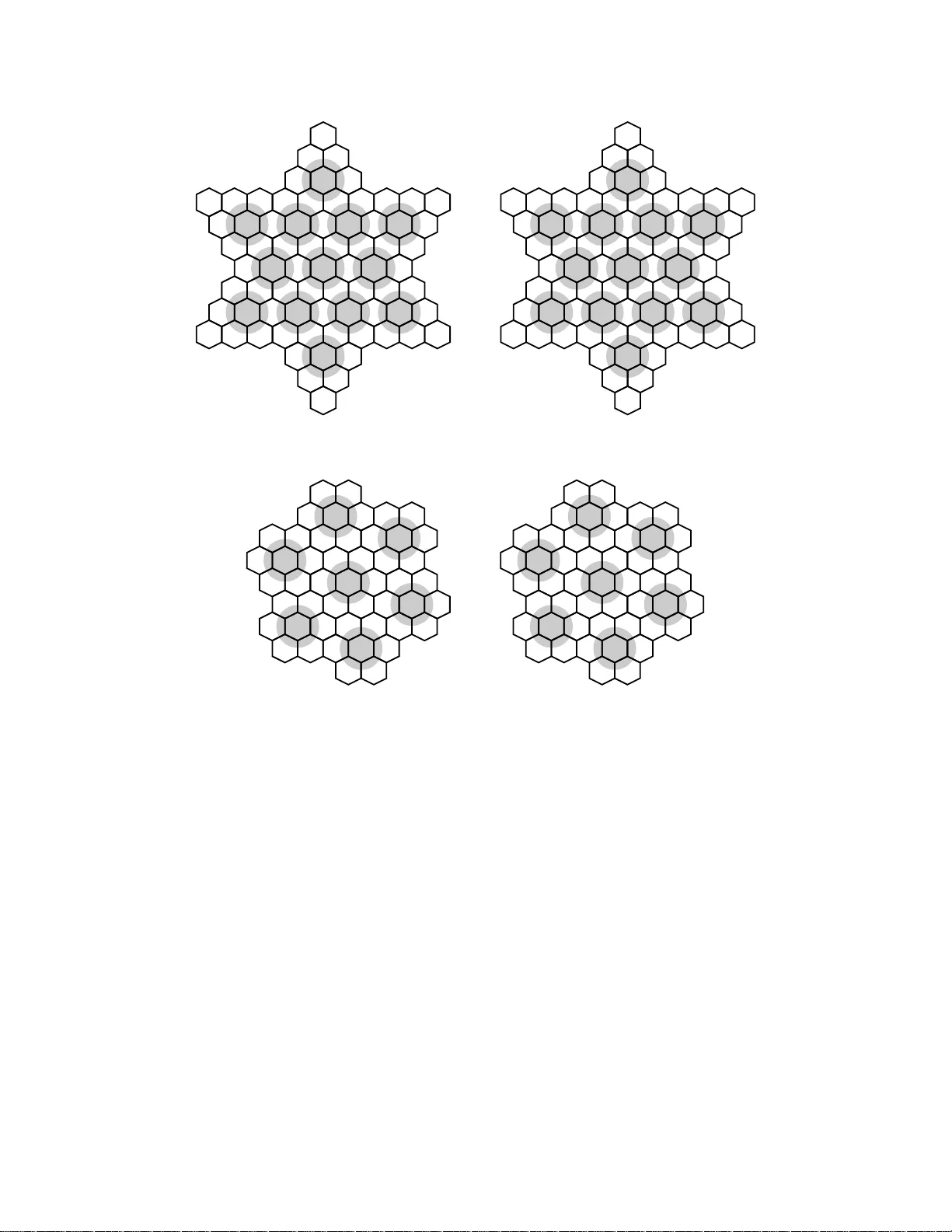
The mathematics of Septoku George I. Bell gibell@c omcast.n et , http://w ww.gibel l.net/ Mathematics Sub ject Classifications: 00A08, 97A20 Abstract Septoku is a Su doku v arian t inv en ted by Bru ce Ob erg, pla ye d on a hexagonal grid of 37 cells. W e sho w that up to rotations, refl ections, and sym b ol p ermutati ons, th er e are only six v alid Septoku b oards. In order to ha ve a unique solution, we sho w that the minim um n u m b er o f giv en v alues is six. W e generalize the p uzzle to other b o ard shap es, and devise a pu zzle on a star-shap ed b oard with 73 cells with six give ns whic h h as a unique solution. W e sho w ho w this puzzle r elates to the unsolved Hadwiger-Nelson problem in combinato rial geometry . Sudoku is o ne of the most popular p encil and pap er puzzles , and has sprouted a seemingly endless series of v a riations. Witness the man y r ecent b o oks c ho c k-full of exciting new v ar ia n ts on the Sudoku t heme [3, 6, 7]. One v ariation is to consider the puzzle on a hexagonal rather than square grid. Bruce Ob erg in v en ted suc h a v ariation in 2006 and named it “Septoku” [4]. The name deriv es from the fa ct that sev en is a significan t num b er for this puzzle. Septoku fit nicely in to the sev en theme at the 2006 conference “Gathering 4 Gardner 7”, whe r e it w as Bruce Ob erg’s exc hange gift [4 ]. 1 2 3 7 4 6 5 2 7 5 6 3 4 1 2 3 4 5 6 7 8 9 10 11 12 13 14 15 16 17 18 19 20 21 22 23 24 25 26 27 28 29 30 31 32 33 34 35 36 37 Figure 1 : A Septoku puzzle [4] and the Septoku b oa rd with cells n umbered. Figure 1a sho ws a sample Septoku puzzle, and Figure 1b the num b ering of the 37 hexag- onal cells . W e will refer to a ro w of the b oard to include not o nly the horizon tal ro ws, 1 but also the “diagonal rows” par allel to the other sides of the b oard. F or example the cells n umbered { 1,2 ,3 ,4 } form one row, as do the cells { 1,5,10,16 } and { 3,8,14,21,28 } . W e will abbreviate these as “row 1 → 4 ”, “ro w 1 → 16” and “row 3 → 2 8”. In general, an y subset of the b oard t ha t m ust contain distinct sym b ols will b e called a region . The puzzle is to fill the 37 cells with sev en sym b ols (the n umbers 1 to 7) suc h that 1. Eac h row con tains d i ff er ent sy m b o ls. There are sev en rows in eac h of three directions, so 21 ro ws in all. Note tha t most ro ws contain less than 7 cells. 2. The sev en circ ular regions (hexagons of side t wo) must each contain a ll sev en sym- b ols. F or example t he cells { 1 , 2,5,6,7,11,1 2 } must con ta in all of the n umbers 1 to 7. These circular regio ns are denoted by gray circles as a visual aid to the solve r 1 . Note that the circles ov erlap. Henceforth, w e will refer to a circular region a s a circle ; a particular circle is iden tified by its cen ter, i.e. “circle 19” refers to cells { 12,13 ,18,19,20,2 5 ,26 } . A puzzle is defined b y a blank b oard with some cells filled in, called giv ens (Figure 1a). The puzzle is to fill out the remaining cells so that t he ab ov e rules are satisfied, suc h a completed puzzle will b e called a v alid b oard. A w ell-crafted puzzle has only one solution. Before reading further, the reader should try the Septoku puzzle in F ig ure 1, and the tw o harder puzzles in F igure 2. T o get started with the Figure 1 puzzle, one should b e able to deduce the v a lue in cells 13, 24, and 28, a nd then con tinue with cells 12, 11, 16, 25, . . . F or a collection of 2 8 Septoku puzzles that can b e downloaded and prin ted, see [4]. 3 2 1 4 5 6 7 6 4 2 1 6 3 2 1 4 5 6 7 6 4 2 1 6 6 4 1 7 6 5 4 3 6 4 1 7 6 5 4 3 Figure 2: “Medium” and “hard” Septoku puzzles. Sev en Se p toku Theore ms On the face of it, solving Septoku seem s similar to Sudoku. But first impressions can b e deceiving. In f act, Septoku differs significan tly b ecause it is m uch more tig htly constrained. As w e will see, Septoku is also muc h easier to analyze. 1 This helpful suggestion is due to Nick Bax ter. 2 In Sudoku, eac h cell (usually called a square in this case) is in exactly three regions, a (normal) row, column, and 3 × 3 blo ck . There a re nine ro ws, nine columns, and nine 3 × 3 blo c ks, so 27 regions in all. In Septoku there are 28 regions (sev en ro ws in eac h of three directions, plus sev en circles), but the b oard is les s than half the size of a Sudoku b o ard. Eac h cell is in at least four regions and t welv e cells a re in fiv e regions. When Bruce Ob erg created the first Sudoku puzzles, he no t iced that all t he v alid bo ards he generated satisfied additional constrain ts that w ere not required b y the puzzle rules. Here w e see that these extra constraints on v alid b oards a re easy to pro ve . Theorem 1. In a valid Septoku b o ar d, e ach c i r cle c e n ter m ust ha v e a unique symb o l . In other wor ds, R 1 = { 6 , 8 , 17 , 19 , 2 1 , 30 , 32 } must b e a r e gion (c ontain e ach symb ol 1–7). Pr o of. Supp ose otherwise. Then there m ust b e some sym b ol that o ccurs twic e among the circle cen ters. The cen ter sym b ol is clearly unique b y the rules of the puzzle, so without loss of generalit y , assume a 1 app ears in cells 6 and 21. There mus t b e a 1 in the center circle 19, and this can only b e in cell 13 or 25. But if it is in 25, then circle 8 can contain no 1 at all. Th us there m ust b e a 1 in cell 13. There m ust b e a 1 in circle 17, and this can now only b e in cell 24, and a 1 in circle 32, which can only b e in cell 31. But now circle 3 0 con ta ins t wo 1’s, so this is not a v alid Septoku b oa rd. Theorem 2. In a valid Septoku b o ar d, e ach c orner and the c enter c el l 19 must have a unique symb ol. In other wor ds, R 2 = { 1 , 4 , 16 , 19 , 22 , 34 , 3 7 } must b e a r e gion (c ontain e ach symb ol 1–7). Pr o of. Supp ose otherwise. Then there m ust b e some sym b ol that o ccurs twic e among the corners (the cen t er sym b ol is clearly unique b y the r ules of the puzzle). Without loss of generalit y , assume a 1 app ears in cells 1 a nd 22. By Theorem 1 there must b e a 1 in some circle cente r, and this can only b e in cell 8 or 30. In either case, t here can no longer b e a 1 in the cen ter circle 19, so this is not a v alid Septoku b oard. Theorem 3. In a valid Septoku b o ar d , e ach symb ol m ust app e ar at le ast five times . Pr o of. Supp ose the sym b ol 1 app ears four or few er times. By Theorems 1 and 2 each sym b ol m ust app ear in a circle cen ter, and in a corner (or once in the cen ter, 19). If 1 o ccurs in a corner and one circle cen ter, then this co v ers only t w o of the circles out of sev en. There is no w ay the last t w o 1’s can cov er the remaining five circles, since one cell is in common with at most tw o circles. If 1 is in the cen ter, then to co v er the remaining 6 circles w e must ha ve a 1 in cells 7, 24 and 27 (or rotational equiv alen t s), but no w w e ha v e tw o 1’s in ro w 3 → 29. If each sym b ol o ccurs 5 times this co vers only 35 of the 37 cells, so at least one sym b ol m ust o ccur more than 5 times. In fa ct there are only t wo p ossibilities: 1. Fiv e of the sym b ols app ear 5 times, t wo sym b ols app ear 6 times. 2. Six of the sym b ols app ear 5 times, one sym b ol app ears 7 times. 3 W e shall see that b oth of these p ossibilities can o ccur. Theorem 4. Not c ounting r efle ctions, r otations, and p ermutations, ther e ar e on ly six valid Septoku b o ar ds. Counting r efle ctions, r otations, and p ermutations as s e p ar ate b o ar ds, ther e ar e 120 , 960 = 2 4 × 7! v alid Septoku b o ar ds. The cen tral cell is the k ey to this b oa rd, b ecause whateve r n um b er is placed in cell 19, there are only t wo patterns for this n umber o ver the rest of the b oard (up to rotations and reflections). These tw o patterns ar e show n in F ig ure 3, where the dark-shaded cells iden tify all cells con taining the same n um b er. T o deriv e the t wo central patterns, start with the cen tral cell 1 9 , and supp ose the pattern includes at least one cell from the inte rior cells I = { 7,1 1,14,24,27,3 1 } . W ithout loss of generality , w e can assume this cell is 7 . W e m ust co v er circles 17 and 21, so the patt ern mu st include cells 10 and 28 , or 15 and 23, and then the only w ay to co v er circles 30 and 32 is b y including cell 31. This giv es the pattern C5. If w e assume the pat t ern includes no cell in I w e get C7. The tw o patterns C 5 and C7 hav e 180 ◦ and 60 ◦ rotational symmetry , resp ectiv ely . This is significan t because (as w e will see) this symmetry is car r ied into the full solution. S5, ‘scalene’ C5, ‘center’ C7, ‘center’ U6, ‘unique’ E5, ‘equilateral’ I5, ‘isosceles’ Figure 3 : P atterns for a num b er on a Septoku b oard: the t w o patterns including the cen ter, C5 and C7; the unique 6-cell pattern U6; the 5-cell patterns E5, I5 and S5. Surprisingly , t here is only one w a y to place six of the same n umbers on the b oard (up to sy mmetry), and there are exactly three w a ys to place fiv e of the same n umbers on the b oard (not including the cen ter pattern C5). These patterns are show n in Figure 3. The simplest w a y to deriv e t hese patterns is fro m the center outw ard: without lo ss of generalit y assume the pattern includes cell 2 0. W e then need to hav e a n um b er o n circle 17 , and this can only b e at cell 10 or 11 (or equiv alen tly b y reflec t ion, cell 23 or 24). Cell 10 leads to the unique 6-cell pattern (U6) , and cell 11 leads to the three 5-cell patterns: E5, I5, and S5. A p oten tia l fourth pattern is obtained fro m I5 b y moving a shaded cell f rom 8 to 4, but this pattern violates Theorem 2, so is eliminated. These patterns ma y b e easily iden t ified b y the shap es formed b y their inte rior cells: “unique” U6 (tw o in terior cells), “equilateral” 4 E5, “isosceles” I5, and “scalene” S5. These shap es are useful for identifying these patterns in Septoku solutions. Just as p olyominoes a re obtained b y joining squares, a po lyhex is obtained b y j o ining hexagons. By loo king at the patterns formed b y all o ccurrences of a num b er, w e can view a Septoku pro blem as a p o lyhex pac king problem! Our p olyhex pieces a re the pa tterns sho wn in F igure 3—these are unus ual polyhex piec es in that they are total l y disc onne cte d . Nonetheless, finding a v a lid Septoku b oar d is equiv alent to pack ing sev en of these p olyhexes in to the b oard. W e can ro tate or flip any of the polyhexes, but w e are not allow ed to translate them. Consider the case where t w o n umbers app ear six times, and all other n um b ers fiv e times. W e take tw o copies of the p olyhex U6, the cen tra l p olyhex C5, and up to fo ur copies of an y of E5, I5 or S5. Supp ose w e take U6 together with a reflection a nd r o tation of U6—it is either not p o ssible to place the second U6, or not p ossible t o place C5. The only p ossibilit y is a cop y of U6 together with a rotatio n of U6 b y 180 ◦ . The pattern C5 can then b e fit in an y of three orientations, and each leads to a unique solution, giv en in the first row of Figure 4. C7 + 6(S5) 2 6 4 3 7 3 5 1 6 3 4 1 2 7 5 1 5 6 7 3 2 4 2 7 5 4 1 6 3 4 2 6 7 6 1 3 5 C5 + 2(U6) + 4(I5) 5 6 4 3 2 3 7 1 6 3 4 1 2 5 7 1 5 6 7 3 2 4 7 2 5 4 1 6 3 4 7 6 5 6 1 3 2 C5 + 2(U6+I5+S5) 5 6 7 3 2 3 4 1 6 3 7 1 2 5 4 4 5 6 7 3 2 1 1 2 5 4 7 6 3 4 1 6 5 6 7 3 2 C5 + 2(U6) + 4(S5) 6 7 3 1 2 5 4 6 7 7 3 1 2 5 4 5 4 6 7 3 1 2 1 2 5 4 6 7 7 3 1 2 5 4 6 7 3 C7 + 6(E5) 2 7 4 3 3 6 5 1 7 7 4 1 2 6 5 1 5 6 7 3 2 4 2 3 5 4 1 7 7 4 2 3 6 6 1 7 5 C7 + 6(I5) 5 7 3 6 2 6 4 1 7 7 3 1 2 5 4 4 5 6 7 3 2 1 1 2 5 4 6 7 7 4 1 3 5 3 6 7 2 Figure 4: The six solution b oards, with the sev en p olyhex patterns eac h is comp osed of giv en b elo w. The other case is to use the p olyhex C7 together with six of E5, I5 and/or S5. It is not hard to see that these can only w ork o ut using C7 plus six copies of the same p olyhex, leading to another three unique solutions giv en in the second row of Figure 4. The six Septoku solutions in Figure 4 satisfy some inte resting sy mmetry relations. W e define ( R ot ) as the transformation whic h rot ates the b oard clo ckw ise 60 ◦ . W e use standard notation to represen t a p ermutation as a pro duct of cycles. The cycle (14) describ es the p erm utat io n whic h sends 1 7→ 4, 4 7→ 1 , and lea v es all other n um b ers alone. W e can easily v erify that all solution b oards B in Figur e 4 satisfy B ( Rot ) 3 (14)(25)(3 6 ) = B . (1) 5 The b oards in the second row of Figure 4 satisfy an eve n stricter relation B ( Rot )(12 3456) = B . (2) The low er- left b oard in Figure 4 has an additional symmetry: all sev en num b ers are presen t in every p ossib le cir cle on the b o a r d ! This includes the sev en Septoku circles plus t we lv e additional circles cen tered at all remaining in terior cells. As w e shall see, this “all equilateral” pattern can b e extended p erio dically to infinity . If w e take the six Septoku b oards, and apply an y of 12 sy mmetry tr a nsformations follo w ed b y an y of 7 ! perm utations, w e will generate 6 ( 1 2)(7!) v alid Septoku boards. Ho w ev er, not all o f these b o a rds are distinct, due to the symmetry Equations (1 ) a nd (2). F o r a n y b oard in the top r ow of Figure 4, the t o tal n umber of b o a rds is reduced by a factor of 2, and in t he b otto m row b y a fa cto r of 6 . This reduces the total n um b er of distinct b oards to 3(12 / 2 + 12 / 6)(7!) = 24 × 7!. Theorem 5. F or a Septoku puzzle with a unique solution, the mi nimum numb er of givens is six. Pr o of. Clearly the answ er cannot b e less than six. If it w as, there mus t b e tw o of the sev en n umbers not eve n among the giv ens. If there is one solution, a differen t one can b e obtained b y sw apping these t w o num b ers. T o show the answ er is six, we need only find a puzzle with six givens and a unique solution. W e wrote a program tha t c hec ks puzzles for a unique solution by matc hing against all p ossible symmetry transformations and p erm utations of the six p ossible b oards. W e found hundreds of six giv en puzzles with unique solutions, tw o are sho wn in Figure 5 . 5 1 4 2 6 3 3 1 2 4 5 6 1 1 1 Figure 5: Tw o puzzles with 6 giv ens and unique solutions, and a puzzle with 3 giv ens and a unique solution up to a p ermutation. T o narrow the solution do wn to o ne of the six types sho wn in F ig ure 4, only 3 g iv ens are required. F or example, note that the ‘equilateral’ pa t tern E5 app ears in only one solution. Th us, if w e use the 3 giv ens on t he right b oard in F igure 5 , the solution can only b e the “all equilateral” b oard on the low er left of Figure 4 , or an y p ermutation of it whic h fixes 1. The symmetry relatio ns in Equation (1) generate a useful algorithm for solving Septoku b oards. 6 Theorem 6. I n a valid Septoku b o ar d, the s e ven symb ols c an b e p artitione d into thr e e p airs and one unp air e d symb ol which is the va lue of the c entr al c el l 19. L et x and y b e any two c el ls that m a p to e ach other under 180 ◦ r o tation of the b o ar d. T h en either 1. x and y have differ ent values taken fr om one of the thr e e p airs, or 2. x an d y b oth have the va l ue of the c entr al c el l (cle arly this is only p ossible if x a nd y ar e not in the same r ow). Pr o of. F or the six solutions in Figure 4, Theorem 6 is just a restatemen t of Equ ation (1). Since an y solutio n is a symmetry transformation plus p erm utation of o ne of these, all solu- tions satisfy Theorem 6 . Once we determine the pairings, Theorem 6 is v ery useful in solving Septoku puzzles— b ecause it says that o nce w e de termine a num b er in a certain ce ll, w e can immediately fill out the cell dia metrically o pp osite (ma pp ed by 180 ◦ rotation). With these additional insigh ts, the reader ma y wish to revisit the puzzles in Figure 2. F o r example, in the “ hard” puzzle, one Theorem 6 pair is { 3 , 4 } , and this implies that cell 12 m ust contain a 3. The reader should find that completing this puzzle is not difficult using Theorem 6. One puzzle t hat remains difficult is that in Figure 5b. In this puzzle no pairing s can b e determined from the starting giv ens. The last theorem show s that the requiremen ts on the cen tral circle 1 9 can b e remo v ed, and the puzzle is unc ha ng ed. Theorem 7. Con sider Septoku, but dr op the r e quir eme n t that the symb ols in the c enter cir cle 19 b e distinct. Ther e ar e no solutions to the puzzle wher e the c e l ls in the c enter cir cle ar e not distinct. Pr o of. Supp ose a solution exists with t wo sym b o ls t he same in circle 19. Because the rows m ust b e distinct, the central num b er cannot b e the duplicate, so without lo ss of generalit y assume that the sym b o l 1 app ears in cells 13 and 26. But circles 17 and 21 m ust b oth contain 1’s, and these can only b e on row 16 → 22. There cannot b e t wo 1’s along this ro w, so no solution is p ossible. Larger Bo ards When analyzing Septoku, I noticed that some Septoku solutions hav e the prop ert y tha t the solution can b e extended off the b oard, while ho lding to a na t ural extension of the rules. W e can extend t wo opp osite edges of t he b oard to create a 49-cell r hom bus Septoku b o a rd in Figure 6. 7 1 2 3 4 5 6 7 3 4 5 6 7 1 2 5 6 7 1 2 3 4 7 1 2 3 4 5 6 2 3 4 5 6 7 1 4 5 6 7 1 2 3 6 7 1 2 3 4 5 ‘all equilateral’, C7+6(E5) 5 7 3 6 2 1 4 2 6 4 1 7 5 3 7 3 1 2 5 4 6 4 5 6 7 3 2 1 3 1 2 5 4 6 7 6 2 7 4 1 3 5 1 4 5 3 6 7 2 C7+6(S5) Figure 6: The t w o v alid rhombus Septoku b oards. The rhom bus (or diamond) b oard has t w o sets of ro ws which all ha ve 7 cells, and another set of ro ws whic h hav e 2 to 7 cells. On this b oard, ev ery sym b ol m ust app ear exactly sev en times. All the Figure 3 patterns can b e extended to this b oard exc ept for U 6 and I 5, and of the six solutions in Fig ure 4 only tw o do not in volv e U 6 or I 5, therefore there are only tw o v alid rhombus Septoku b o ards (F ig ure 6). The “all equilateral” solution in Figur e 6 has additio nal symmetries in that every cir cle con tains all sev en n um b ers. Extended p erio dically , this solution sho ws that any Septoku b oard, no matter ho w larg e or how the circles are a rranged, ha s at least one v a lid b o ard. If w e interpret each num b er as a color, the “all equilateral” solution giv es a 7-coloring of the plane whic h is w ell-kno wn to graph theorists. If the diameter of eac h hexagon is just under one, this coloring has the remark able prop erty that a n y tw o p oints in the plane a distance exactly one apart ha ve different colors. This coloring pro vides a n upp er b ound f o r the so-called Ha dwiger-Nelson problem, whic h asks for the minim um num b er of colors for whic h suc h a coloring of the plane is p ossible. As sho wn in 19 61, the minim um n um b er of colors required lies b etw een 4 and 7 (inclusiv e) [2, 5]. In 2018, the low er b ound was increased to 5 [8, 9], but the Hadwiger-Nelson problem remains a significan t unsolv ed pro blem in com binatorial geometry [1]. Another v ariation whic h is p ossible is the 73- cell star Septoku b oard (Figure 7). On this b oard, some of the rows hav e mor e than sev en cells. W e therefore mo dify the rules to sp ecify that the sym b ols in an y connected sub set of a row with sev en or few er cells m ust con tain distinct sym b ols. There are only t wo v alid star Septoku b oards. Not surprisingly , it is easy to create man y puzzles in rhombus or star Septoku with 6 giv ens that ha v e unique solutions. An example of one suc h puzzle is sho wn in Figure 7. In all the b oard t yp es discussed so far, the circular regions ov erlap. It is p ossible to create a b oard on a hexagonal grid where t he circular regions do not o verlap, more reminiscen t of ordinary Sudoku. Figure 8 sho ws a flo w er Septoku b oard, whic h has 49 cells and 34 regions. Since the circular regio ns no lo nger ov erlap, one migh t guess that flow er Septoku is quite differen t fro m normal Septoku. Ho we v er, a similar analysis rev eals that there are o nly three differen t flo w er Septoku b oards ( up to a symmetry tra nsformation and p erm utatio n) . These 8 3 6 2 1 4 5 2 1 4 5 7 3 6 2 1 4 5 3 2 6 4 1 7 5 3 6 7 3 1 2 5 4 6 4 5 6 7 3 2 1 3 1 2 5 4 6 7 3 6 2 7 4 1 3 5 6 2 1 4 5 3 6 7 2 1 4 5 2 1 4 5 3 6 1 2 3 4 5 6 Figure 7: A v alid star Septoku b oard, a puzzle with 6 giv ens and a unique solution. 1 6 3 5 7 4 2 5 7 2 4 3 6 1 6 4 3 1 2 5 7 2 1 6 7 3 4 5 7 2 5 4 6 1 3 4 3 6 1 5 7 2 5 1 7 2 6 3 4 1 2 3 6 4 5 Figure 8: A v alid flow er Septoku b oa rd, a puzzle with 6 givens and a unique solution. three solutions also satisfy Theorem 6—so despite the c hange in geometry , solutions to flow er Septoku hav e the same symmetry prop erties as in regular Septoku. Conclus ions Although Septoku app ears similar to Sudoku, w e ha ve found that it has only six fundamen- tally differen t solution b oards. W e ha ve show n that a Septoku puzzle m ust ha ve at least six giv ens to hav e a unique solution, and ha v e devised puzzles with six give ns that can b e quite difficult to solv e by hand. Theorems 1, 2, and esp ecially 6 are us eful for solving Septoku puzzles. The main difference b etw een Sudoku and Septoku are t he extra constrain ts impo sed b y a n additional set of parallel ro ws in a hexagonal gr id. In any v ariation of Septoku w e ha ve considered, these a dditional constrain ts ha v e resulted in a relativ ely small n um b er o f 9 solutions. Ho w might we mo dify the rules of Septoku so that there are more than six solutio n b oards? One w ay is to reduce the num b er of regions, but w e ha ve sho wn that remo ving the cen tral region do es not c hang e the puzzle. Another o ption is to allow 8 sym b ols and k eep all the regions the same. If w e do this, all our theorems are no longer v a lid, and man y mor e solution b oards are p ossible. How ev er, it is no w quite difficult to sp ecify a unique solution to a puzzle using a reasonable n umber of giv ens. F or example, it is not hard to find a n 8 sym b ol Septoku puzzle with 36 giv ens and only o ne op en cell whic h do es not ha ve a unique solution! Ac kno w ledgmen ts I thank Bruce Ob erg for in v enting this fascinating puzzle, and Ed Pe g g for p ointing out the connection to the Hadwiger-Nelson problem. Thanks to W ei-Hwa Huang for sharing his analysis of Septoku, and his idea that the t wo cen tral patterns we re the key to the analysis. Solutio n s Figure 5b 4 7 1 2 2 6 5 3 7 7 1 3 4 6 5 3 4 6 5 2 7 1 5 2 7 1 3 4 4 1 5 2 6 6 3 4 7 Figure 1a 5 7 4 6 6 3 2 1 7 7 4 1 5 3 2 2 5 3 4 6 7 1 1 6 7 2 4 5 5 2 1 6 3 3 4 5 7 Figure 2a, ‘G’ 1 7 5 3 2 6 4 1 7 7 5 3 2 6 4 6 4 1 7 5 3 2 3 2 6 4 1 7 7 5 3 2 6 4 1 7 5 Figure 2b, ‘7’ 5 2 1 6 3 6 4 7 2 6 1 7 5 3 4 7 4 2 3 6 5 1 5 3 4 1 7 2 6 1 5 2 3 2 7 6 4 Figure 5a 5 7 1 3 1 2 6 5 4 6 3 4 2 7 5 2 4 5 7 1 3 6 1 7 6 3 4 2 3 1 2 6 5 4 5 7 1 Figure 9 : Unique solutions fo r problems in figures as indicated. See Figure 9 for solutions to the Septoku puzzles in Figures 1, 2 and 5. The unique solution to the star Septoku problem in Figure 7b can b e found by applying the p erm utatio n (16543) to the solution in Fig ure 7a. F or the flow er Septoku problem in Figure 8b, simply lab el eac h circular region with the same pattern, that in the cen ter circle of the b oard in Figure 8a. 10 References [1] Erik D . D emaine, Jose ph Mitc hell, Joseph O’Rourk e, The Op en Pr oblems Pr oje ct , http://cs.s mith.edu/ ~ orourke/TOP P/ (see problem 5 7 , Chromatic Number of the Plane). [2] Martin Gardner, Whe els, Life, and other Mathematic al A musemen ts , 195– 6 , W H F reeman & Co, 1983. [3] Japheth J. Ligh t, T ri-doku , Sterling, 20 0 8. [4] Bruce Ob erg, “Septoku”, G4G7 Exch ange Bo ok , V olume 2, 153–1 60, http://www. oberg.org/septoku_g4g7.pdf . [5] C. Stanley Ogilvy , T omorr ow’s Math , Oxford Univ ersity Pres s, revised edition, 1972. [6] Thomas Sn yder, B attleship Sudoku , Sterling, 2 008. [7] Thomas Sn yder a nd W ei-Hw a Huang, Mutant S udo k u , Puzzlewrigh t, 200 9. [8] de Grey , A.D.N.J.: The c hromatic n umber of the plane is at least 5, Geombinatorics 28(1), 18-3 1 , 2018. [9] Exo o, G., Ismailescu, D., The Chromatic Num b er of the Plane is A t Least 5: A New Pro of ., Discrete Comput Geom, 2019 . https://doi .org/10.1007/s00454- 019 - 00 058- 1 11
Original Paper
Loading high-quality paper...
Comments & Academic Discussion
Loading comments...
Leave a Comment