Testing claims of the GW170817 binary neutron star inspiral affecting $beta$-decay rates
On August 17, 2017, the first gravitational wave signal from a binary neutron star inspiral (GW170817) was detected by Advanced LIGO and Advanced VIRGO. Here we present radioactive $\beta$-decay rates of three independent sources $^{44}$Ti, $^{60}$Co…
Authors: P.A. Breur, J.C.P.Y. Nobelen, L. Baudis
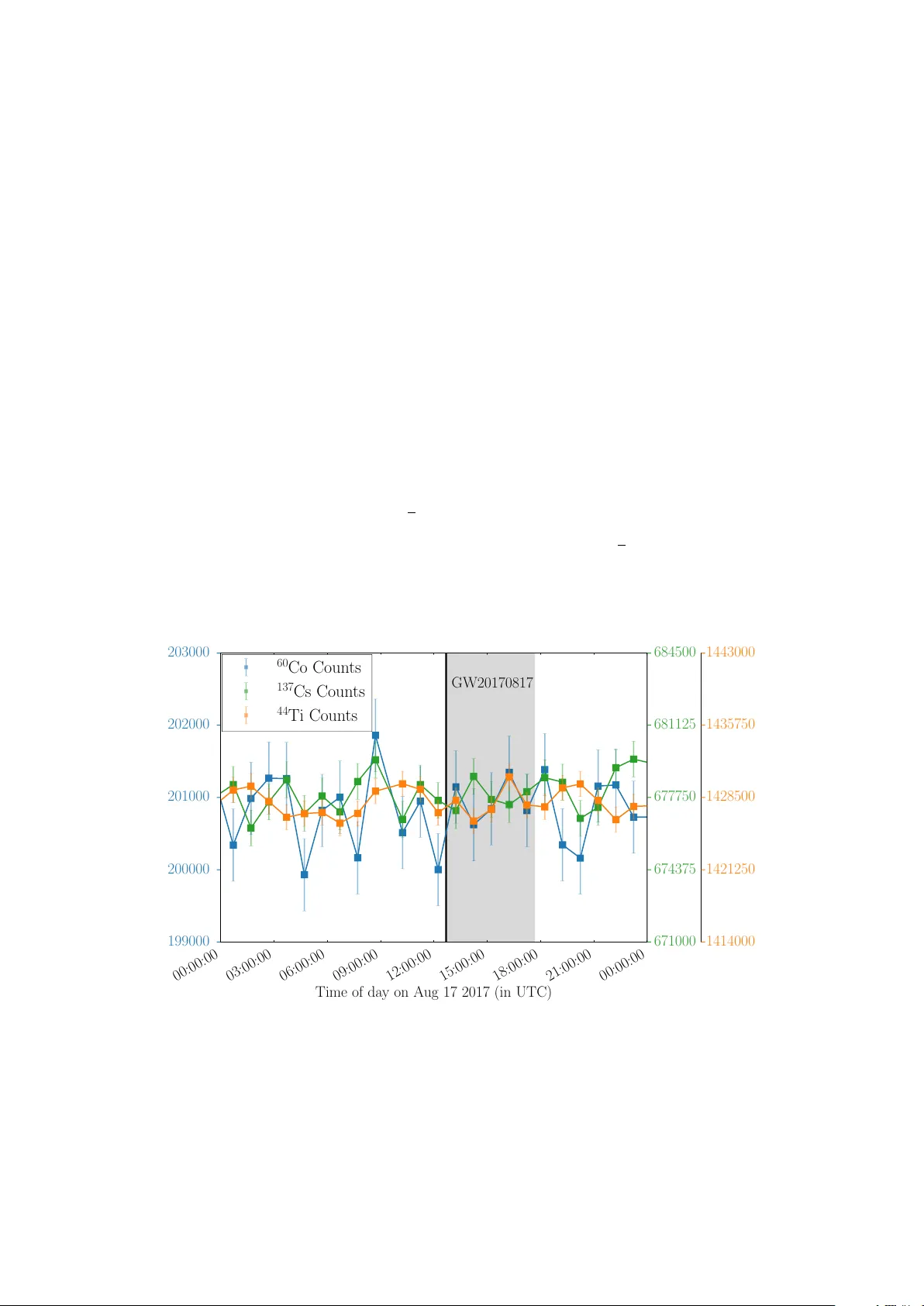
T esting claims of the GW170817 binary neutron star inspiral affecting β -deca y rates P .A. Breur a,1, ∗ , J.C.P .Y. Nob elen a, ∗ , L. Baudis b , A. Bro wn b , A.P . Colijn a,c , R. Dressler d , R.F. Lang e , A. Massafferri f , C. Pumar f , C. Reuter e , D. Sc humann d , M. Sc humann g , S. T o wers h , R. P erci f a Nikhef and the University of Amster dam, Scienc e Park, 1098 XG A mster dam, the Netherlands b Physik-Institut, Universit¨ at Z¨ urich, 8057 Zurich, Switzerland c Institute for Sub atomic Physics, Utr e cht University, Netherlands d Paul Scherr er Institut (PSI), Vil lingen, Switzerland e Dep artment of Physics and Astr onomy, Pur due University, West L afayette, IN 47907, USA f Centr o Br asileir o de Pesquisas F ´ ısic as - COHEP, R. Dr. Xavier Sigaud, 150 - Ur c a, R io de Janeir o, Br azil g Physikalisches Institut, Universit¨ at F r eibur g, 79104 F reibur g, Germany h Arizona State University, T emp e, AZ, USA Abstract On August 17, 2017, the first gra vitational w a v e signal from a binary neutron star inspiral (GW170817) was detected b y Adv anced LIGO and Adv anced VIRGO. Here we present radioactiv e β -deca y rates of three indep endent sources 44 Ti, 60 Co and 137 Cs, monitored during the same p eriod by a precision exp eriment designed to in vestigate the decay of long-liv ed radioactiv e sources. W e do not find any significant correlations b etw een decay rates in a 5 h time interv al follo wing the GW170817 observ ation. This contradicts a previous claim published in this journal of an observ ed 2.5 σ P earson Correlation betw een fluctuations in the num b er of observ ed decays from t w o β -deca ying isotopes ( 32 Si and 36 Cl) in the same time in terv al. By correcting for the c hoice of an arbitrary time interv al, w e find no evidence of a correlation ab o ve 1.5 σ confidence. In addition, we argue that suc h analyses on correlations in arbitrary time interv als should alwa ys correct for the so-called Lo ok-Elsewhere effect b y quoting the global significance. 1. Introduction The first gravitational wa ve signal from a binary neutron star inspiral (GW170817) w as detected on August 17, 2017 at 12:41:04 UTC b y Adv anced LIGO and Adv anced VIR GO [1, 2]. Shortly after this observ ation X-ray , radio and optical counterparts were observ ed [3 – 5]. An additional claim has b een made of observing a correlation of the decay rates of t wo β -deca ying isotop es ( 32 Si with T 1 / 2 ∼ 172 yr and 36 Cl with T 1 / 2 ∼ 300,000 yr), ∗ Corresponding Authors Email addr esses: sanderb@nikhef.nl (P .A. Breur ), jcpynobelen@gmail.com (J.C.P .Y. Nob elen) 1 Now at: SLAC National Accelerator Lab oratory , Menlo P ark, California 94025, USA Pr eprint submitted to Elsevier Septemb er 17, 2019 in a 5 h time in terv al following the inspiral [6]. This correlation w as attributed to a hy- p othesized increase in neutrino flux (created during the inspiral) at Earth. Similar claims b y the same authors of a change in decay rates due to, e.g. Solar flare neutrinos [7], hav e recen tly b een refuted [8, 9]. In this w ork, we present a search for correlations in the decay rates from a ∼ 0 . 8 kBq 44 Ti 2 , a ∼ 0 . 5 kBq 60 Co and a ∼ 0 . 8 kBq 137 Cs source, monitored by a NaI(Tl) detector setup in a 5 h time interv al following the observ ation of the neutron star inspiral on Au- gust 17, 2017. The detector setup [10] lo cated at Nikhef (Amsterdam, the Netherlands), consists of four cylindrical (76 × 76) mm NaI(Tl) detector pairs shielded b y 5 cm of lead. Three detector pairs measure the de-excitation photons after the β -deca y of the sources while the fourth detector pair monitors the ambien t radioactive background. T o obtain the num b er of coun ts contained within the full absorption p eak w e p erform a fitting rou- tine of three different comp onents. Here, we consider the (Gaussian) absorption p eak, the Compton spectrum, which is determined through a GEANT4 Mon te Carlo (MC) sim ulation, and we also accoun t for the monitored background sp ectrum. This routine is p erformed o ver data acquired within one-hour p erio ds (bin size) [10]. 2. Metho dology Figure 1 shows the monitored radioactive decay rates of 44 Ti (orange), 60 Co (green) and 137 Cs (blue) as a function of time on August 17, 2017. W e also indicate the 5 h time in terv al (grey area) follo wing the neutron star inspiral observ ation (blac k line). Due to this short measuring p erio d compared to the half-life of the isotopes, no correction is made for the exp ected exponential decrease in activit y . Because there is no known ph ysics model proposing a correlation b etw een gravitational wa v es and changes in ra- dioactiv e deca y rates, we follow the analysis metho d of [6]. If w e w ould assume such an underlying physical mechanism to exist, describing the influence of neutrinos on the deca y rates of β emitters, w e should find any effect equally in magnitude for all sources deca ying through the β mechanism, as argued in [11]. T o test for a hypothetical correlation b et ween the decay rates of 44 Ti, 60 Co and 137 Cs during the observ ation of the neutron star inspiral signal, we use the P earson Correlation (PC) test [12]. The PC test returns a test statistic r , which indicates the measure of correlation b et ween the measured decay rate of tw o sources ( x and y ) and is defined as r xy = 1 N P N i =1 ( x i − ¯ x )( y i − ¯ y ) σ x σ y , (1) where x i ( y i ) are the num b er of observed decays p er bin i . ¯ x ( ¯ y ) and σ x ( σ y ) are the ex- p ectation v alues and standard deviations, resp ectively , for the N -sized sample of the tw o radioactiv e sources. The test statistic r is by definition a num b er b et ween − 1 (negative correlation) and 1 (p ositive correlation). The lo cal test statistic r xy is used in our tw o- sided test to find a significance ( p -v alue) of the correlation, which we define as p xy . 2 F or this isotop e we measure the annihilation p eak of 44 Sc (daugh ter of 44 Ti), which has a half life of ∼ 4 h. 2 Since a ph ysical mec hanism that causes a correlation as claimed b y [6] is unknown, there are differen t time interv als in whic h one may test for a correlation. Because the selec- tion of time interv als can influence the significance of a correlation, the Lo ok-Elsewhere Effect [13] m ust b e taken into account by referencing the global significance. In this work, we apply a similar metho dology to determine such a global significance as in [8]. W e define five time interv als as [ t 0 , t 0 + t i ], where t 0 is the time of the GW170817 observ ation and t i ∈ [3 , 8] in hours. A MC sim ulation of the experiment is conducted with 30,000 trials. The sample size is chosen such that the expected statistical pow er appro ximates 1 for the reported effect size of r = 0.950 and up to confidence levels of 3 σ ( α = 0 . 003). Data p oints are dra wn from a Poisson distribution under the n ull h y- p othesis (exp onen tial decay without an y systematic influence). F or every trial, a PC test is p erformed on every considered time interv al and on each com bination of the three sources. Subsequently , we define a new test statistic, based on the p-v alue of most ex- treme correlation p er trial: p xy = min t f t i ( p xy ) , (2) where t i and t f are the b oundaries of the chosen time interv al and p xy is the statistic of the local PC test on tw o radioactive decay rates of sources x and y . F rom the distribution of this test statistic under the null hypothesis, we determine the p-v alue of observing at least one suc h extreme correlation during the trial when the null hypothesis is true. 00:00:00 03:00:00 06:00:00 09:00:00 12:00:00 15:00:00 18:00:00 21:00:00 00:00:00 Time of da y on Aug 17 2017 (in UTC) 199000 200000 201000 202000 203000 GW20170817 60 Co Coun ts 137 Cs Coun ts 44 Ti Coun ts 671000 674375 677750 681125 684500 1414000 1421250 1428500 1435750 1443000 Figure 1: The number of observed 44 Ti (orange), 60 Co (blue) and 137 Cs (green) decays p er hour as recorded on August 17, 2017. The grey-shaded region denotes the 5 h following the neutron star inspiral observ ation (black line). The depicted errors are of statistical origin and the ranges of the y-axis are set to ± 1% of the mean decay rate for each source. 3 Isotop e Lo cal σ Global σ com bination (Uncorrected) (Corrected) P erio d P erio d + Source 44 Ti - 60 Co 2.4 1.9 1.4 44 Ti - 137 Cs 1.3 0.8 0.2 60 Co - 137 Cs 1.8 1.3 0.7 T able 1: Results of the Pearson Correlation (PC) test on the measured radioactive decay rates for all combinations of sources ( 44 Ti, 60 Co and 137 Cs) in the 5 h interv al following the GW170817 observ ation. W e correct for the arbitrary choice of the time interv al (‘Period’) with the global significance computed from Eq. (2). Finally , we also correct for monitoring three sources at the same time (‘Period + Source’) with the global significance computed from Eq. (3). W e p erform the PC test ov er three different combinations of sources. F or every trial in the MC, we thus also return the statistic of the most significant correlation regardless of source com bination and the chosen time interv al (b etw een t i and t f ), e p = min t f t i ( p xy , p xz , p y z ) , (3) where p xy , p xz and p y z are the lo cal PC test (Eq. (1)) p -v alues calculated for the fiv e defined time in terv als p er arbitrary combination of sources x , y and z . Finally , by computing the distribution of extreme statistics found in Eq. (2) and (3), w e assess the p -v alues and retriev e t w o unique global significances, whic h are used to correct the lo cal correlation significance: once for the arbitrary c hoice of the 5 h time in terv al, and once for the choice of the 5 h time interv al while monitoring three sources, resp ectiv ely . 3. Results T able 1 shows the results for the three different com bination of sources. W e find uncorrected (lo cal) correlations in the 5 h interv al following the GW170817 observ ation at 2.4 σ ( p = 0 . 015), 1.3 σ ( p = 0 . 19) and 1.8 σ ( p = 0 . 07) significance for 44 Ti − 60 Co, 44 Ti − 137 Cs and 60 Co − 137 Cs, resp ectively . It is imp ortant to stress that these lo cal sig- nificances cannot b e in terpreted as a v alid result to reject the null hypothesis, and can b e straigh tforwardly explained by exp ected sto chastic v ariation in the data. After correcting for the c hoice of time interv als, Eq. (2), and the monitoring of multi- ple sources, Eq. (3), we find correlations of 0.2 σ , 0.7 σ and 1.4 σ for the three isotope com binations. The most extreme correlation at 1.4 σ ( p = 0 . 15) significance is b et ween the decay rates of 44 Ti and 60 Co. This result shows that the neutron star inspiral do es not lead to a significant correlation b etw een the decay rates of indep endent β -deca ying isotop es and that the n ull hypothesis can thus not b e rejected. Exp erimen tal conditions suc h as the temperature, photomultiplier tub e high v oltage, 4 magnetic field strength and radon activity were contin uously monitored during the mea- suremen t p erio d presented in Figure 1. V ariations in these parameters are within op erat- ing range as defined by T able 4 in [10]. The pressure and h umidit y w ere also contin uously monitored and remained stable during the full measurement p erio d at the 1% level with a 68% confidence level. W e conclude that the systematic influences due to these exp er- imen tal conditions remain below 2 × 10 − 5 . This is more than an order of magnitude smaller than the observ ed absolute rate differences in counts b etw een individual data p oin ts in Figure 1, showing that a possible effect has not b een significantly enhanced (or diminished) b y changes in the exp eriment’s environmen t. 4. Discussion Although the results of this work show no statistically significant evidence for a cor- relation in the radioactive decay rate p ost inspiral, the claim of s uc h a correlation by [6] needs to b e discussed. First, the rep orted correlation at 2.5 σ confidence in [6] was not corrected for the ar- bitrary c hoice of a 5 h time interv al. W e conclude that the claimed effect is consistent with exp ected stochastic v ariation in the data and a further analysis, including a MC sim ulation 1 should lead to a similar conclusion. The choice of an arbitrary , 5-hour pe- rio d after the merger observ ation can greatly influence the significance of a correlation as is sho wn in our work. F urthermore, the arbitrary choice of one-hour bin-sizes and its p ossible influences on the global significance were not calculated and accoun ted for. It w as shown in [15] and [16] that the pro cess of fitting with v ariable binning can pro duce biased estimates, whic h may result to the incorrect acceptance of a hypothesis. The claim of a correlation in [6] was th us not prop erly corrected for the arbitrary choice of a time interv al. This led to a problematic interpretation of the data. In the future, we urge the authors of [6] to alwa ys define a mo del to test prior to un-blinding the data to accoun t for any human bias. W e urge the reader to b e critical tow ards presented results without an y correction for such biases. 5. Conclusion W e hav e found no statistically significant evidence of a correlation b etw een the ra- dioactiv e decay rate of β -deca ying isotop es 44 Ti, 60 Co and 137 Cs in a 5 h time in terv al follo wing the observ ation of the neutron star inspiral (GW170817). Correlations cor- rected for the choice of time interv als are within 1.5 σ confidence for all source pairs. The largest observ ed correlation w as found for the deca y rates of 44 Ti and 60 Co at 1.4 σ signif- icance, which also includes a correction for finding spurious correlations while monitoring three sources simultaneously . Thus, we cannot reject the null h yp othesis that describ es exp onen tial β -deca y . 1 F rom the published data [6] we find that the claimed 2.5 σ decreases to 1.9 σ when corrected for the choice of time interv al using a MC. 5 Ac kno wledgements W e are grateful for the supp ort of the Purdue Research F oundation, the Netherlands Organization for Scientific Research (NW O), the Universit y of Zuric h, the Swiss National Science F oundation under Gran t Nos. 200020-162501 and the F oundation for Researc h Supp ort of the State of Rio de Janeiro (F APERJ). References [1] B. P . Abbott et al. [LIGO Scien tific and Virgo Collaborations], Phys. Rev. Lett. 119 , no. 16, 161101 (2017) [ doi:10.1103/PhysRevLett.119.161101 ]. [2] B. P . Abb ott et al. [LIGO Scientific and Virgo Collab orations] [ arXiv:1805.11579 [gr-qc] ]. [3] G. Hallinan et al. , Science 358 , 1579 (2017) [ doi:10.1126/science.aap9855 ]. [4] E. T ro ja et al. , Nature 551 , 71 (2017) [Nature 551 , 71 (2017)] [ doi:10.1038/nature24290 ]. [5] R. Margutti et al. , Astrophys. J. 848 , no. 2, L20 (2017) [ doi:10.3847/2041-8213/aa9057 ]. [6] E. Fisc hbac h et al. , Astropart. Phys. 103 , 1 (2018) [ doi:10.1016/j.astropartphys.2018.06.001 ]. [7] J. H. Jenkins and E. Fischbac h, Astropart. Phys. 31 , 407 (2009) [ doi:10.1016/j.astropartphys.2009.04.005 ]. [8] J. R. Angev aare et al. , Astropart. Phys. 103 , 62 (2018) [ doi:10.1016/j.astropartphys.2018.07.003 ]. [9] E. Bellotti, et al. , Phys. Lett. B 780 , 61 (2018) [ doi:10.1016/j.physletb.2018.02.065 ]. [10] J. R. Angev aare et al. , JINST 13 , no. 07, P07011 (2018) [ doi:10.1088/1748-0221/13/07/P07011 ]. [11] J. H. Jenkins, E. Fisc h bach, D. Ja v orsek, II, R. H. Lee and P . A. Sturro ck, arXiv:1211.2138 [n ucl-ex]. [12] K. Pearson et al. , “Note on Regression and Inheritance in the Case of Two Paren ts.” Pro c. R. Soc. Lond. 58 240-242 (1895). [13] L. Ly ons, Ann. Appl. Stat. 2 , 887 (2008). [ doi:10.1214/08-AOAS163 ]. [14] E. Bellotti, C. Broggini, G. Di Carlo, M. Laub enstein and R. Menegazzo, Phys. Lett. B 710 , 114 (2012) [ doi:10.1016/j.physletb.2012.02.083 ]. [15] S. T ow ers, Phys. Lett. B 735 , 146 (2014) doi:10.1016/j.physletb.2014.06.023 [physics.data-an]]. [16] S. T ow ers, A. Mubayi and C. Castillo-Chav ez, PLoS ONE 13(5): e0196863., 2018, [ doif:10.1371 ] 6
Original Paper
Loading high-quality paper...
Comments & Academic Discussion
Loading comments...
Leave a Comment