Mittag-Leffler functions in superstatistics
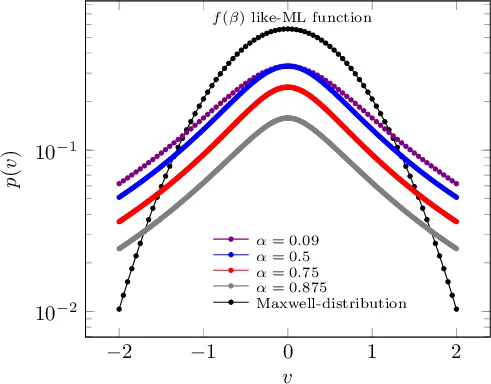
Nowadays, there is a series of complexities in biophysics that require a suitable approach to determine the measurable quantity. In this way, the superstatistics has been an important tool to investigate dynamic aspects of particles, organisms and substances immersed in systems with non-homogeneous temperatures (or diffusivity). The superstatistics admits a general Boltzmann factor that depends on the distribution of intensive parameters $\beta$ (inverse-diffusivity). Each value of intensive parameter is associated with a local equilibrium in the system. In this work, we investigate the consequences of Mittag-Leffler function on the definition of f-distribution of a complex system. Thus, using the techniques belonging to the fractional calculus with non-singular kernels, we constructed a distribution to intensive parameters using the Mittag-Leffler function. This function implies distributions with power-law behaviour to high energy values in the context of Cohen-Beck superstatistics. This work aims to present the generalised probabilities distribution in statistical mechanics under a new perspective of the Mittag-Leffler function inspired in Atangana-Baleanu and Prabhakar forms.
💡 Research Summary
The paper introduces a novel formulation of superstatistics by employing Mittag‑Leffler (ML) functions to construct the distribution of the intensive parameter β (the inverse diffusivity). Superstatistics treats a complex, non‑equilibrium system as a superposition of locally equilibrated “cells”, each characterized by a Boltzmann factor e^{−βE}. The overall statistics depend on the probability density f(β) of β. Traditional approaches often use a Gamma (χ²) distribution for f(β), which leads to Tsallis‑type non‑extensive statistics.
In this work the authors replace the Gamma kernel with a more general ML kernel, motivated by recent developments in fractional calculus with non‑singular kernels. They first recall the one‑parameter ML function Eα(z) and its three‑parameter generalization E_{δ,α,σ}(z). These functions appear naturally in the Atangana‑Baleanu (AB) and Prabhakar fractional derivatives, which are convolution operators with ML kernels and possess advantageous physical properties (e.g., better handling of initial conditions).
The proposed generic form for the β‑distribution is
f(β) ∝ e^{−bβ} β^{σ−1} E_{δ,α,σ}(−aβ^{α}) (9)
where a, b > 0, 0 < α < 1, and σ, δ are additional shape parameters. By taking the Laplace transform of f(β) and of β f(β), the authors derive explicit expressions for the normalization constant c and the mean ⟨β⟩ = h_β, ensuring that f(β) is a proper probability density.
Two concrete cases are examined:
- AB kernel (single‑parameter ML) – Setting δ = σ = 1 and a = α/(1−α) yields
f(β) = C β^{−1} E_{α}
Comments & Academic Discussion
Loading comments...
Leave a Comment