Explicit solution of the Cauchy problem for cellular automaton rule 172
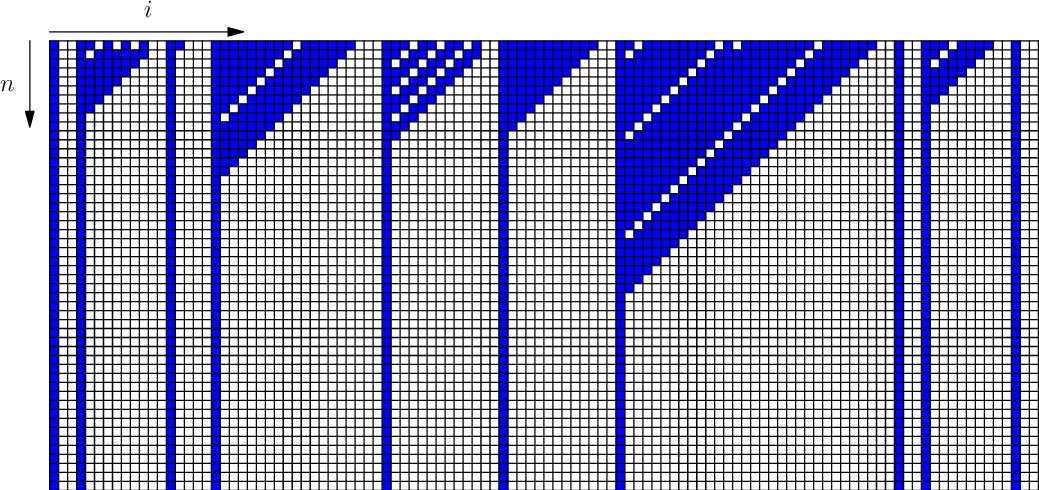
Cellular automata (CA) are fully discrete alternatives to partial differential equations (PDE). For PDEs, one often considers the Cauchy problem, or initial value problem: find the solution of the PDE satisfying a given initial condition. For many PDEs of the first order in time, it is possible to find explicit formulae for the solution at the time $t>0$ if the solution is known at $t=0$. Can something similar be achieved for CA? We demonstrate that this is indeed possible in some cases, using elementary CA rule 172 as an example. We derive an explicit expression for the state of a given cell after $n$ iteration of the rule 172, assuming that states of all cells are known at $n=0$. We then show that this expression (“solution of the CA”) can be used to obtain an expected value of a given cell after $n$ iterations, provided that the initial condition is drawn from a Bernoulli distribution. This can be done for both finite and infinite lattices, thus providing an interesting test case for investigating finite size effects in CA.
💡 Research Summary
The paper addresses the Cauchy‑type initial‑value problem for one‑dimensional binary cellular automata (CA) by presenting a fully explicit solution for elementary rule 172. After introducing the analogy between partial differential equations (PDEs) and CA—where discrete time n replaces continuous time t, lattice index i replaces spatial coordinate x, and the CA radius r plays a role analogous to the order of spatial derivatives—the author focuses on rule 172, whose local update function is
f(x₁,x₂,x₃) = x₂ if x₁ = 0, and = x₃ if x₁ = 1.
This rule is simple enough to be tractable yet non‑trivial, making it an ideal test case.
The core of the analysis is the characterization of the n‑step preimage set f⁻ⁿ(1), i.e., all binary strings that evolve to a single ‘1’ after n iterations. By constructing minimal finite‑state machines (FSMs) that generate these preimages, the author discovers two mutually exclusive structural patterns:
- Fixed “001” block – any string containing the substring 001 at positions (−2,−1,0) will retain that block forever, guaranteeing a ‘1’ at the central site after any number of steps.
- Zero‑free strings – strings that never contain the adjacent pair “00”. For such strings the last three bits must be of the form 01?, 1?1 (where “?” denotes either 0 or 1), ensuring that the central cell becomes ‘1’ after n steps.
These observations are formalized in Proposition 3.1, which provides a rigorous combinatorial description of f⁻ⁿ(1). Leveraging this description, the author derives a closed‑form expression for the state of any site j after n iterations, expressed solely in terms of the initial configuration x:
\
Comments & Academic Discussion
Loading comments...
Leave a Comment