General rogue waves in the Boussinesq equation
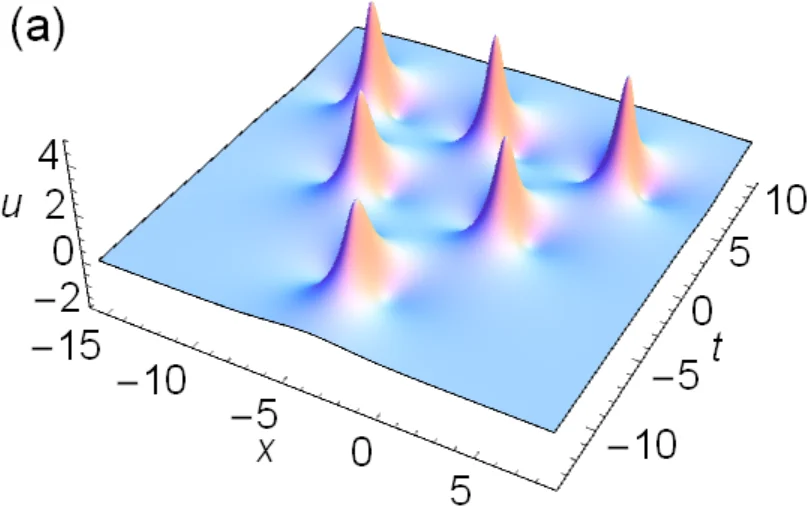
We derive general rogue wave solutions of arbitrary orders in the Boussinesq equation by the bilinear Kadomtsev-Petviashvili (KP) reduction method. These rogue solutions are given as Gram determinants with $2N-2$ free irreducible real parameters, where $N$ is the order of the rogue wave. Tuning these free parameters, rogue waves of various patterns are obtained, many of which have not been seen before. Compared to rogue waves in other integrable equations, a new feature of rogue waves in the Boussinesq equation is that the rogue wave of maximum amplitude at each order is generally asymmetric in space. On the technical aspect, our contribution to the bilinear KP-reduction method for rogue waves is a new judicious choice of differential operators in the procedure, which drastically simplifies the dimension reduction calculation as well as the analytical expressions of rogue wave solutions.
💡 Research Summary
This paper investigates rogue‑wave (large, spontaneous, localized wave) solutions of the Boussinesq equation, a classic integrable model describing long surface waves in shallow water and appearing in various physical contexts such as Fermi‑Pasta‑Ulam chains and ion‑acoustic plasma. After shifting the background to an unstable constant state (requiring 1 + 2 η₀ ≤ 0) and rescaling, the authors work with the normalized form
u_tt + u_xx − (u²)_xx − ⅓ u_xxxx = 0, u → 0 as |x|,|t| → ∞.
Previous studies obtained only first‑order rogue waves or higher‑order waves up to fifth order with merely two free real parameters. Anticipating that, as in the nonlinear Schrödinger (NLS) hierarchy, the number of free parameters should increase with the order, the authors set out to construct rogue‑wave solutions of arbitrary order N with a full set of free parameters.
The method employed is the bilinear Kadomtsev‑Petviashvili (KP) reduction technique. The key technical innovation is a new choice of differential operators in the KP framework: instead of the conventional operators, the authors use f(p)∂_p and f(q)∂_q with f(p)=p(p²−4)/3 (and similarly for q). This choice dramatically simplifies the dimension‑reduction step and leads to compact analytical expressions.
Two main theorems are presented. Theorem 1 gives the solution in Hirota’s bilinear form
u(x,t)=2 ∂_x² ln σ, σ=det
Comments & Academic Discussion
Loading comments...
Leave a Comment