A Case Study of Promoting Informal Inferential Reasoning in Learning Sampling Distribution for High School Students
Drawing inference from data is an important skill for students to understand their everyday life, so that the sampling distribution as a central topic in statistical inference is necessary to be learned by the students. However, little is known about…
Authors: Geovani Debby Setyani, Yosep Dwi Kristanto
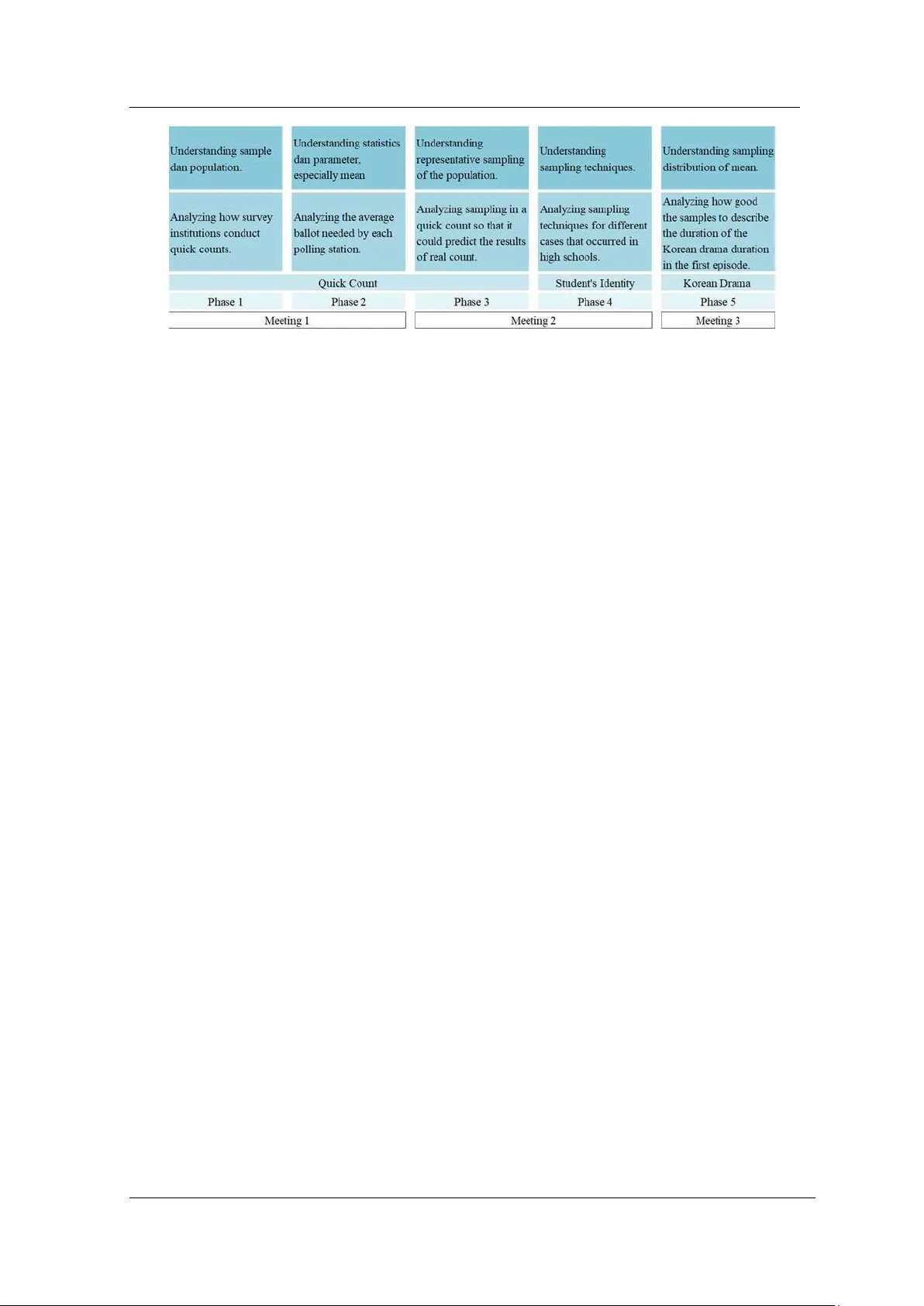
SJME (Supremum Jou rnal of Mathema tics Education) Vol.4, No.1, J an u ar y 2020, pp. 64-77 ISSN: 2548 -8163 (online)| ISSN: 2549-3639 (print) 64 Journal homepage : http://journal.unsika.ac .id/index.php/supremum A Case Study of Promoting Informal I nferential Rea soning in Learning Sampling Dis tribution for High School Students Geovani Debby Setyani Universitas Sanata Dharma , Yogyakarta, Indonesi a geovanidebbys@gmail.com Yosep Dw i Kristanto Universitas Sanata Dharma, Yogyakarta, Indonesia yosepdwikristanto@us d.ac.id Informasi Artikel ABSTRAK Sejarah artikel: Diterima 15 Desember 2019 Direvisi 24 Desember 2019 Disetujui 09 Januari 2020 Penarikan kesimpulan dari data adalah keteram pilan penting bagi siswa untuk memahami kehidupan sehari-hari mereka , se hingga distribusi sampling yang menja di topik utama statistika inferensial diperlukan oleh siswa. Akan teta pi, masih sedikit yang diketahui tentang bagaimana cara mengajarkan topik ini ke pada siswa sekolah menengah atas, terutama dalam konteks Indonesia. Oleh karena itu, penelitian ini mende monstrasikan ekspe rimen pengajaran dengan tujuan untuk menge mbangkan penalaran inferensial inf ormal siswa dalam memahami distribus i sampling, serta mende s kripsikan perse psi siswa terhadap eksperimen pengajaran tersebut. Subjek dalam penelitian ini a dalah tiga s iswa kelas 11 dari salah s atu s ekolah swa sta di Yogyakarta jurusa n matematika dan ilmu pengetahuan alam. Metode pe ngumpulan data yang digunakan adalah obs er vasi langsung terhadap proses pembelajaran distribusi sampling, wawancara, dan dokumentasi. Penelitian ini menemukan bahwa penalaran inferensial informal dengan pembelajaran berbasis masalah menggunakan masalah konteks tual dan data yang riil dapat memfasilitas i siswa memahami topik distribusi sampling, dan siswa memberikan tanggapan positif terhadap pengalaman belajar mereka. Kata kunci: Inferensi Statistik Informal , Distribusi Sampling, Pembelajaran Berbasis Masa lah, Data Riil, Penelitian Pendidikan Statistika Copyright © 2020 by the authors; licensee Department of Mathematics Education, University of Singaperbangsa Karawang . All rights reserved. This is an open access article distributed under the terms of the CC BY-SA license. (http://creativecommons.org/licenses/by-sa/4.0) INTRODUCTION Constructing inference from data is an important skill for students to understand their everyday life. Therefore, it is necessary for students to study c oncepts and procedures i n drawing statistical inference. T he inferential statistics provides form al met hods t o statistically infer the populations’ characteristics based on the s a mple data. Drawing conclusions beyond the sample data which consideri ng the sample va riation is one of the main themes of the inferential statistics (Triola, 2018). The remaining theme i nvolves an investigation of whether a pa ttern in data c an be attributed to a real e ffect (Garfield et al., 2008). Both of the main themes in infe rential statistics are the basis of statistics (Pratt & Ainley, 2008) and considered as stepping stone s for students in working wit h data to solve the problems they encountered. The central concept in the inferential statistics is a sampl ing distribu tion. The sampling distribution is the di stribution of a stat istics for al l possible samples of a c ertain size from the population (Sudjana, 2005; McCla ve, Be nson, & Sincich, 2011; Stockburger, SJME ISSN: 2548-8163 (online) | ISSN: 2549-3639 (prin t) A Case Study of Promoting Informal Inferential Reasoning in Learning Sampling. .. (Geovani & Yosep) 65 2011). With sampling d istribution, it is po ssible to move be yond the known s ample dat a and draw a conclusion with re gard to its popula tion statistics. Drawing such conclusion is plausible since, by the definition, the sampling distribution includes t he statistics from all possible sample outcomes so that it c an be used to estimate the probability of a ny particular sample outcome, a central process in i nfe rential statistics. In gene ral terms, sampling distribution links a known sampl e data to its populati on statistics to draw conclusions regarding populations’ characteristics based on the sample da ta. Aforementioned rationale gives insight on the importance of the inf ere ntial statistics and the conce pt of sam pling distributi on. There fore, it is necessary to teach the distribution sampling to h igh school students. Unfortunately, the topi c is no t c overed expl i citly in Indonesian nati onal curr iculum (Ministry of Education and Cult ure of the Republic of Indonesia, 2018). Mathematics curriculum involves infere ntial statistics topics for the twelve-gra de majoring in mathematics and na tural science, namely binomial and normal distribution. It is neverth eless not clearly stated th e topic of sa m pling distribu t ion. The re fore, the study wit h r egard to t eaching expe ri me nts of sampling distr i bution for high school students will provide constructive nuance for the Indonesian education system. The sam pling distribu t ion is a crucial topic to be learned by students, y et it is difficult to t each. Many scholars have be en propos ed several methods in teaching the distr i bution sampling, one of them i s using simulation. Even though this method is promising (see, L ane, 2015; Turner & Dabney, 2015), the si m ulation method has to be designed and implemented carefully. Watkins, Bargagliotti, & Frankl in ( 2014) show t hat this method leads students t o misunderstand about the sampling di stribu tion s. The broader teaching approach is potential in making students l ea rn sa m pling distribu tion concept. It is the approach that let t he students begin their learning process of sampling distribution by using their informal ideas. Using students’ informal ide as about a concept ma kes the c oncept more accessible for the stude nts (Zieffler, Garfield, Delmas, & Reading, 2008 ). This notion of promoting students’ informal ideas about statistical inference i s described as informal infe rential reasoning or informal statistical inference. Many s c holars have attempt e d to de scribe i nformal inferen t ial reasoning. Pfannkuch (2006 ) define i nformal inferential reasoning as “the d ra wing of conclusions from d a ta t hat is based main l y on l ooking at, c omparing, and reasoning from distributions of data.” Z ieffler et a l. (2008 ) suggested t he term informa l inferential reasoning as “the way in whi ch students use thei r informal s t atistical k nowledge t o make arguments t o support infer enc es a bout unknown populati ons based on obs erved samples.” Makar and Rubin ( 2009) identifi ed three main features which characterize informal infe rential reasoning: (1) generalization beyond the data, (2) the use of da ta to back up this ge neraliz a tion, and (3) the e mploy m ent of probabilistic language (statement of uncertainty) in describing this gen e ralization. In s upport ing stud ent s to utilize their informal i nferential rea soning, a le arning environment should be design ed in a supportive manner. Firs t, studen t s should be facilitated to work with a complex problem (Makar, 2014). Problem-ba sed learning is one of learning methods whic h is fit to the learning en vi ronment criterion. Problem -based learning makes students le arn through facilitated problem solving (Hmel o -Silve r, 2004). Second, students should be fac ilitated to encounter data with authentic context (Makar, 2014). The a uthentic context emerges in the real da ta. Using the real data which interest student s will enga ge them in thi nking about relevant st a tistical concepts de rived from the data (Aliaga et al., 2010 ; Pfannkuch, 2011). T herefore, problem -based learning which empl oys real data in facilitating students’ learning about a statist i cal conc ept has potential in supporting students’ informal inferential reasoning. ISSN: 2548-8163 (online) | ISSN: 2549-3639 (print ) SJME Vol. 4, No. 1, January 2020 : 64-77 66 Given the import ance of sampling distributions for high school students and the potential of problem -based learning, which utilizing real data as authentic context for the problem, in s upporting studen ts’ informal infere ntial r ea soning, the aim of the present study is two- fold. First, the present study provides a de tail analysis on the e mergence of students’ informal inferential reasoning in the designed t eaching expe riments . Second, the present study discuss students’ pe rceptions toward the ir experience during the tea ching experiments. MET HOD Th e presen t s t udy e mpl oyed a qua li tative descriptive a pproach, namely case study to achieve the research a ims. The case study il lustrated t he constructivist teaching experime nt (Steffe & T hompson, 2000 ) that we d esigned and impleme nted to s upport students’ informal inferential reasoning in the understanding s a mpling distribution of mea ns. Data Collection Method The data used along with the acquisition techniques in this study a re observations, interviews, and documentation. We conducted observations by looking a t how subje cts capture the topic and understand the sampling distribution by a direct guide from the first author who also as a teacher in the teaching experiment. Interviews were used to det ermine t he pa rticipants’ perception in learning sam pling distribution with their i nformal inferential reasoning. The interviews were semi -structured interviews, through which we can dig up information ba sed on t he answers from the subjects, not j ust foll owing the guid el ines of i nterviews that have be e n ma de previously. The questions in t he interview were prepared to ask about and know things whic h were not obtained during observation s. It was also used to fa cilitate us in getting information a bout the perceptions and responses of the participants during the teaching exper i ment. Documentation was a complement of obs e rvation and interview methods i n qualitative re search carried out by t h e authors duri ng t he study. We used an audio-visual recorder to record the learning process where as an audio recorder was used during the interviews. The se rec ording devices were useful i n c ollecting data, especially in explaining descriptions of various situations and behaviour of the subject under study. Before recording, we had asked permission to all pa rticipan ts and expla ined the confi dentiality of their data. This complied the research ethics of Univ ersitas Sanata Dharma. Teaching Experiment Participants The participants in the teaching exper i ment w e re three 11 th grader stude nts from one of the private high s chools in Yogyak a rta m ajoring in ma t hematics and natur a l scien ce. The participants were s elected based on their inexperience i n s t udying the s amp l ing distr i bution. Additionally, a criterion for s election was based on previ ous stude nts’ learning a chievement in mathem atics. A s a r esult, the participants consisted of three studen t s who were fro m three different levels of mathematics learning a c hieveme nt , nam ely high, medium, and low. Teaching Experiment Setting The learning process carried out i n the teaching experiment started from the initial topics, namely sa mpl e and population, sampl e and population mean, a nd sampling technique, to sampling distrib ution. The teac hing e xperiment was c onducted in five phases which spanned in three meetings. The teac hing e xperiment structure is show n i n Figure 1. SJME ISSN: 2548-8163 (online) | ISSN: 2549-3639 (prin t) A Case Study of Promoting Informal Inferential Reasoning in Learning Sampling. .. (Geovani & Yosep) 67 Figure 1 . T he structure of t e aching experiment We used problem-ba sed learning to help s t udents understand the topics. The problems used in the learning process were aut hentic -context problems with real data. The context in the problems were quick c ount, students’ i dentity, and Kore an dram a movies. T he context was designe d following the students’ i nterest and expe rience. Hence, be fore carrying out the teaching experiment, the first author c onduct ed interviews to find out the background of the students. In addition, learning scenarios were used to help and guide the authors in conducting learning process. Data Analysis The d ata an al ysis i nvolved four stages, namely collecting the da ta, r e ducing the data, presenting the data, and drawing c onclusio ns . D ata collection w as done through obse rvat ion and int erviews. At this stage, t he dat a t hat has bee n col lected i s changed to tra nscripts by simplifying the information collected in an ea sily understood form of writing. Afte r that, th e data was selected accordi ng to t he focus of thi s research to make it easier for the authors to categorize the c ollected data. Re ducing data means summarizing, choosing key t hings, focusing on important things, looking for t hemes a nd patterns, a nd discardi ng things that are not r elevant in the present study. Thus, the ove rall picture would be more clear and make it easier for the authors to conduct further da ta collection, and look for it as needed (M erri am, 2009). The data t hat has bee n summarized w ere then int erpreted and explained to descri be the process of student s unde rstanding the sampling distribution wit h their informal inferential r easoning. T he data w a s presented in the form of narrative description. After that , we conc lude from t he results of data analys i s that has bee n done. Drawing conclus ions in qualitative re search might answer the research questions. The conclusions in qualitative research are expected to be new fi ndings that have never before existed. T hese findings coul d be in t he form of a description of a n object that was previ ously still unclear so that it bec omes clearer after being investigated (Merriam, 2009). RESULTS AND DISCUSSION We describe the eme rgenc e of students’ informa l infe rential reasoning in learni ng sampling distribution and their perceptio ns toward the teachi ng experiment in the re sult section. Then, the interpretation of the res ults is presented in the discussion secti on. Results From the learning process a nd i nterviews , l e arning outcomes and student perceptions were identified based on t he elements of informal inferential reasoning as re vealed by Makar and Rubin (2009) as foll ows. 1. Gene ralization beyond the data ISSN: 2548-8163 (online) | ISSN: 2549-3639 (print ) SJME Vol. 4, No. 1, January 2020 : 64-77 68 In phase 1, students were asked to a nalyze how the survey institution knew the average ballot s for each polling station, students had thought to use a sample to pre dict the average population of ballots for each polling stati on. Thi s indicated that the sample ’s mean can be used to estimate the population ’s mean . In pha se 3, students were asked to ana lyze how there c ould be predictions of survey institutions t hat missed the r esults of the population. Students answer ed that it was because the sam ples ta ken by each institution were different. Thi s indicated that students understood the variation between s amples in a population. Figure 2 represents the student’s understanding with regard to t he variation be tween samples. Figure 2. Stude nt’s a nswer to quick count problem In phase 4, students analyzed samp l ing te chniques for four different cases. Ea c h case had a population of 500. In this c ase, student s c an use a n a ppropriate sampling technique to predict the populations ’ statistics . In pha se 5, students ana lyzed the mean of duration of the first epi sodes of Korean dramas t hat were popular and provided by seven di fferent Korean dramas. Indeed, the students initially assumed t hat t he population was t he seven dramas so the y choose t o cal culate the population ’s mean of the seven dramas. However, the first author emphasized that outside of the seven Korean dramas there were still m any Korean dramas so what we would kno w was the population ’s mean of all Korean dramas. The seven Korea n dramas here were used as a way to help facilitate sampling and as a substitute for the actual population used to view the most representative samples. So students choose to use a sample of 3. 2. Dat a as evidence In phase 4, s t udents analyzed th e mean of duration of the f irst episode of K ore an dramas that were popular and provided by seven di fferent Korean dramas. Students us ed the seven Korea n dramas as evide nce by calculating the population ’s mean and sample differences. 3. T he employment of probabilistic language (s t atement of uncertainty) in describing this generalization During t he learning pro cess, students used th e t erm sample a nd population because they already knew it beforehand. According to Zieffler, Garf iel d, Delmas, & Reading (2008), there are several types of assignments that ha ve bee n used in several studies and one of them is a n assign m ent to consider two models or statements that are m ore likely to be true. This assignmen t c ould be found in phase 4 when s t udents analyzed the average duration of t he first e pisodes of Korean dramas that a re popular and are provi ded by seven different Korean dramas. To find out which sample best represents the population or know how good the sa mple i s taken, students Translated problem: Several survey institutes which have resulted in the winning of Jokowi-JK have an insignificant di fference to the number above. However, 4 others have contradictory results. Why does this happen? SJME ISSN: 2548-8163 (online) | ISSN: 2549-3639 (prin t) A Case Study of Promoting Informal Inferential Reasoning in Learning Sampling. .. (Geovani & Yosep) 69 calculated the di fference in average population and average samples taken, then compared average samples to consider samples that a re more likely to be true. Prodromou (2013) emphasized that making conclusions i nformally gives students a feeling about the power of st at istics to make judgments and reasonab l e decisions a bout data taken from r eal -world contexts. Every case/problem provided by the authors were in accordance with the student s because cases/problem s a re delibe rately taken from the real - world conte xt. T his was a lso real ized by students. In inte rviews, students stated tha t t he cases/problems provided , which were taken from real -world contexts, felt c loser to them so that they found it easier to underst a nd. In this study, interviews were conducted on three students who had carried ou t the learning process of sampl ing distribution with informal inferential reasoning. The interview aims to find ou t the perc eptions of students on learning distribut ion sampling with informal inferential reasoning. The results of this intervi ew would be discussed based on the fol lowing aspects. 1. Overa ll Learning Process The stude nts stated that the learning proces s was qui te enjoyable. According to them, the learni ng process r an well in the ri ght order, starting from the problems and then analyzing and discussing together to det ermine the right solution. Students empha sized the issues raised in c ases. In the learning process, the authors used problem-based lea rning so that t he authors raise d problems to provoke students’ anal ysis. Students explain ed that these problems ma de topics e asier to understand because the problems could be found around them. In additio n, learning is also more c onducive and e asier to understand because only thre e students took part in learning so that th e teacher c ould intera c t more deep l y and directed in j oint di scussi ons. S1 : In my op i nion, t he learning process was fun and it became e asier than the learning i n s chool. It w a s just three of us s o the teacher could ma ke more interaction wi t h three of us. The problem also made understanding t he topics easier, such as KP U, TPS. S2 : The lea rning proce ss was alrea dy good and so was t he plot, from analyzing the problems to finding the solutions. In my opi nion, the process was successful be cause the problems a nd t he solutions were clear . S3 : It was easy to understand the topics because the teacher g ave t he problems from our interests. 2. Stude nts’ Perceptions of the Learning Process After carrying out learning di stribution sampling with informal inf e rential reasoning, t he students m entioned t he things tha t were obtained from th e l e arning which included sample and population, mean of t he sam ple a nd population, re presentati ve sample, and how good the sample was t aken ba sed on the average sample di fferen ce and average population. S1 : I could know about s a mple and popul a tion, also the sample mean, the population me an, and a sample which bes t re presents a population , based on the diffe rence be tween th e sample mea n and the popul ation mean . S2 : I could know a bout popula tions, s a mple, h ow I can get sample s which represent populations the most, and also quick count. I just found those problems that came from daily life. ISSN: 2548-8163 (online) | ISSN: 2549-3639 (print ) SJME Vol. 4, No. 1, January 2020 : 64-77 70 S3 : I could know a bout th e sample and population’s mean and the population mean, and the difference betw e en t he m to get sample s which represent populations the most. 3. Stude nts’ Feelings towards the Learning P roc ess Students state d t hat during l earning distribution sampling learning wit h i nformal inferential reasoning, students felt that learning took p la ce pleasantly and the y did not feel burdened a t a ll on the first day, the longer it was m ade the learning more difficult because they had t o t hink harder, but it paid off because they could understand and the problems raised made it easier to understand. S1 : I was not burdened by the learning. S2 : It was fun. S3 : The first day was enjoyable because it was still ea sy. The second day became more difficult, we should think harder and I felt slee py. The last day was hard. But it was all good because I could understand. 4. T he Most Interesting Topic about Learning In the le a rning process of distribution sampl ing with infor ma l infe rential reasoning, th e prob le ms r aised were deliberately taken fro m th e things that wer e around the students. T herefore, the se problems bec ame some of t he t hings that were quite interesting for student s, especially in the case of the mean of duration of Korean drama movies. It became someth ing new for them to find mathematical probl em s. In addit ion, quick counts w ere also qu ite interesting because th e y did not know how the quick count results were obtai ned. After this learning, the students realized that the qui ck count conducted by survey institutions ha d to use the right sample so t hat the results were accurate. S1 : The most interesting topic was the Korean dra ma case because it was close to high schoo l students’ life. We usually wa t ch Korean drama but we never kne w it could b e a case. S2 : The most interesting topic was quick counts i n Indonesia, how we count. We usually just watch it on TV a nd don’t know t hat t he quick count is from a sample of a population. I c ould know how to calc ulate it so the results could be this accurate. S3 : The most interesting t opic was sampling t ec hnique s. 5. T he Easiest and The Hardest Topic Based on the interviews, the three students sta ted that the easiest t opic was understanding the sample and popu lation, a lso the a verag e sample and average population. T hey said it was because the thinking process was still quite e asy and did not require a high level of analysis. On t he othe r hand, the topic in phase 5 was the m ost difficult, namely knowing how w e ll a sample is. This was due to the pos sibil ity of huge samples to be regi stered in Microsoft Ex cel. In addition, analyzi ng the sampling techniques for cases presented was also considered difficult because more analysis w as needed among several of these cases. S1 : The easiest topic was qui ck c ount s becaus e we j ust had to know which one was s a mple and population. The hardest t opic was finding how good the sample was because it was hard to analyze. S2 : The easiest topic was the sample mea n and t he population mean . The hardest topic was sampling techniques bec ause we should know the conditions for each case. SJME ISSN: 2548-8163 (online) | ISSN: 2549-3639 (prin t) A Case Study of Promoting Informal Inferential Reasoning in Learning Sampling. .. (Geovani & Yosep) 71 S3 : The easiest topic was sampl e a nd populat ion. T he ha rdest t opic was finding how good the sample was beca use it was hard to analyze. It was also beca use ther e were so many samples. 6. Stude nts’ Perception of the Learning Method During t he sampling distribution learning process, we facilitate students’ informal inferential reasoning with problem -based lea rning to help them to understand the sam pling distribution. Provoking que stions were also us e d along with th e cont e xtual problems and real data to arouse students’ curiosit y. According t o students, it help ed them to understand the topic because of th e problems taken f rom around their real lives. S1 : It was good because we could understand e asily a nd th e problems were close to us. S2 : The method helped us by analyzing the cases w e could understand. S3 : It helped because the problems were arou nd us so we could re late to it. By this approach, students stated that not hing ne eded to be im proved because they felt the learning was very enjoyable , they empha sized the problems taken from around the ir lives. However, i n phase 5 when students bega n to t ake sam ples and calculated the sam ple m ean, the students did not ta ke samples random ly as t hey had studied i n the pre vious pha se. T he students c hose the ir samples based on Korean dramas they kne w. One of the students state d it would be better, before taking s a mples, students were to l d to use the lottery method. We de libe rately did not tell to use random sampling because we hoped that t he students could real ize and a nalyze the sampling method themselves. S1 : No, [There is no need for improvements] S2 : To get th e s a mple [in phas e 5] it would be bett er if the tea c her explain ed how we take the sample. S3 : I think no because I hope there are m any teachers like this. T he problems used came from around us. 7. T he Importance of Sampling Distribution After carrying out learning di stribution sampling with informal inf e rential reasoning, students stated tha t studying the sampling distribution was quite pl easant because they could know t he i mportance of sampling to get accurate re sults and also very useful in dea ling with news to avoid hoaxes. Besides, there were many things around t he stude nts such as hei ght mean and blood types which coul d be ide ntified. However, student s felt tha t the sampling distribut ion ha s not been used yet, but maybe later when worki ng but it also depends on the work as w ell. S1 : For now, it was not useful. Maybe in t he fut ure, when we work, we c an use it . Also, it depends on our job. But it is very useful t o respond to the news. S2 : The problems used can be found around u s so that we can know how t o solve it . We should know how t o ge t t he best sample by fi nding the difference. S3 : It was import ant. Calculating means bec omes ea sier by not ha ving to use the population. 8. T he Students’ Perception of Their Fellow S t udents’ Readiness in Learning Sampling Distribution After carryi ng out the sampling distribution learning with problem -b ased learning, students have understood the topic provide d, namely sample, population, the sample m ean, the population mean, sampling te chniques, and sampling distribution. According to them, other high school students majoring in m a thematics and science , ISSN: 2548-8163 (online) | ISSN: 2549-3639 (print ) SJME Vol. 4, No. 1, January 2020 : 64-77 72 such as thei r classmates, could understand this sampling distribution wit h the same terms of the approach used nam e ly informal infe rential reasoning and problem -based learning with problems taken from around high school students’ life and discuss e a ch other to determine the solution of the problem s. They mentioned that if t he reasoni ng used was forma l reasoning like in school, ma ybe thi s t opic would be more difficult to understand. S1 : I think they can [be applied more wide ly] because the learning method used made it easier t o understand. It can be hard i f it had used formal methods like in school. S2 : By using t he same method, they ca n understand because discussion s make it easier in Stece [Stella Duce 1 High S c hool Yogyakarta ]. S3 : They can understand if the me thod used is the same as ours. If t he teacher uses formal methods, it may be hard. Discussion Based on t he learning process of distribution sampling with informal i nferential reasoning and the interviews tha t had been conducted, there were several aspects tha t we found to be the key aspects in developing 11 th -grader in understa nding the sampling distribution, n a mely informal inferential reasoning, problem -based l earning, and the use of real data. Informal inferential reasoning is an inform al method or proce ss in drawing conclusions and generalizing from a group of data for a wider range of data. Th e essence of informal infe rential reasoning is an approach that is c arried out informally, that is, no t a teacher who gives theories or hypothe ses to be tested. In this reasoning, students start from the problem and, with the abi lity and schema of e xisting knowledge, analyze and conclude which sampl e is better for represen t ing a p opulat ion. Informal inf ere ntial reasoning could be found to appea r i n t he learning process, as expressed i n t he results sec tion, based on informal inferential reasoning frameworks by Makar and Rubin ( 2009), Zieffler, et al ( 2008), a nd Prodromou (2013 ). Based on the learning proc e ss that has be en carried out and the results of interviews, sampling distribution learning was ea sier to unde rstand using infor ma l inferential reasoning. Students sai d if th e reasoning used in the lea rning process of t he sampling distribution ha d been formal reasoning like in school, the sampling distribution topic might have been more difficult to understand. Students felt that the learning tha t has been done was en joyable and they d id not fe el burdened at all with these topi cs because the learning took plac e m ore informally and not rigidly. Problem-based learning is a learning approach that a imed to enable students to solve a probl em to develop their knowledge, deve lop inquiry and high-level thinking skills, and improve self -reliance and self -confiden ce. Problem-based l earning was conducte d t o help students deve lop thinking, problem-solving, a nd int ellectual skills. Culti vating students ’ knowledge, which is then used to share knowledge w ith friends, coul d increa se self - confidence in the l earning. In the learning proce ss of the sampling distr ibut ion, ea ch stude nt was allowed to analyze problem s and then discuss them with others. This discus sion was very helpful for stude nts to jointly build knowledge. This was also supported by the num ber of students who took part in the learning, the re w e re only three students so that the te acher could easily reach every student. The le arning was also conducted in no hurry to provide opportunities for students to think more critically a nd try to find the basis of their arguments and facts that supported the reasons to make conc lusions. SJME ISSN: 2548-8163 (online) | ISSN: 2549-3639 (prin t) A Case Study of Promoting Informal Inferential Reasoning in Learning Sampling. .. (Geovani & Yosep) 73 During the learning process, t here was on e student who only ha d a little discussion and just listened to two other student s convey ing t he results of their analysis. When the student was asked, she found i t difficult to expla in aga in what had been learned. After the teacher a nd other students hel p ed the student by explaining again, the stud e nt was able to understand. It indicated that students were expected to be more active in ana lyzing so tha t they could build their knowledge and then di scuss it together. Problem-based learning was inc luded in ac tive learning to invite students to learn actively, to participate in the lea rning proc e ss . T he students, who onl y received topics from the t eacher and assume d t hat just memorizing the topic was enough , must be c hanged to find knowledge actively so that the re could be an increase i n underst a nding. This le arnin g model was orient ed toward building students’ knowledge inde pendently. In problem -ba sed learning, t he focus of learning was on the proble m c hosen so that stude nts not only learned concepts related to the probl ems but also how to solve the problem. T herefore, s tudents a lso gain ed l earning experiences rel a ted t o problem -solving skil ls. Students who l earned to solve a proble m would apply t he knowledge they had or t r ied to fi nd out the knowledge nee ded. Learning could be more me aningful and expanded when s t udents were faced with situations where the concept was applied. Nowadays, students sometimes are too lazy to analyze and tend just to answer a question by dire ctly answ e ring or sea rchin g from other s ourc es w i thout having th e intention to try t o analyze or express t heir own opinions. If this s i tuation conti nues, the student s in the study would have diffi culty applying t he knowledge ga ined in the classroom in real l ife. Therefore, problem-based learn ing could be a solution to encourage stude nts to think critically and work rather than memorizin g. Based on research conducted by Farida and Kusmanto ( 2014), after the application of probl em-based l earning, there was an increase in inte rest and mathematic al achievement by meeting the minimum completeness c riteria. In a ddition, research conducted by A bdullah (2016) indic ated that t he application of problem-based learning could i mprove t he quality of learners’ mathematics learning process seen from the increase in student learning o utcomes tests. The similar res ult i s also found on Sahrudin a nd Tri snawati ( 2018). These indicated that problem- based l ea rning inc rease s tudents’ interest and learning ou tcomes which indicated t hat the mod el made the learning process better. Problem-based le a rning c ould not be separ a ted from contextual probl ems ta ken from everyday l ife . T he a uthors have interview ed the students reg ardi ng their backgrounds to find out what things could be raised as problems in l earning this sampli ng distribution. As explained in the pre vious section, Prodromou ( 2013) emphasized that making conclusions informally gave students a feeling about the power of stat istic s t o ma ke judgments and sensible decisions about data ta ken from real -world contexts. The use of c ontextual problems was very he lpful for students to understa nd the distribution of sampling with i nformal inferential reasoning because the real- world context was closed to studen t s. Contextual probl ems th a t were the fo c us o f learning could motivate stude nts to solve the problems because the problems c reated disequilibrium between concepts in the cognitive schemes of stude nts and the context s. It encouraged curiosity so that it raised many questions about why and how for the problem. These que stions were the motivation for stud ents to learn. From this explanation, it could be seen that contextual problems c ould encourage students to have initiatives to build their k nowle dge. Contextual probl ems e ncouraged students to ana lyze a phenomenon by the emergence of questions. Conversation and collaboration could help in t he process of answering questions, which ar e c a rried out in di scussions. Informal d i scussions coul d create collaboration. Informal i nferential reasoning was very helpful in solvi ng c ontextual ISSN: 2548-8163 (online) | ISSN: 2549-3639 (print ) SJME Vol. 4, No. 1, January 2020 : 64-77 74 problems be cause th e proble ms em e rge from the students themselves so they coul d collaborate w i th e a ch o the r. T his findin g aligns Rah m adonna & F i triyani ( 2011), tha t participants’ le arning motivation increases with the applicat ion of ma thematics learning with a contextual approach. T his i ndicated that students have more motivation to solve a problem. Motivation is very influential i n bu ildi ng curiosity and willingness to learn. W i th th e problems t hat came from around the stud ent s, students had more willingn e ss to study and analyze these problems. T he learning process was centered on lea rners, where the y could analyze probl ems which then provided the lea rning proc ess experience that encouraged students to condu ct research, integra te theory, and apply the knowledge as w e ll as skills they have in providing solutions to problems. In a ddition to contextual issues, the cases raised also inc lude d real data, that e xis t ed and was not made up. The real data were the results of t he 2014 quic k c ount a nd Korean dramas. T hese data did exist and we took from trusted sources. W e rai sed real dat a so that the problems presented to students were felt mor e real and stud e nts had a sense of trust i n the data provided. Real data that t he we used helped students to understa nd t he main i ssues in real terms. Real data could help students learn t o identify the root of the problem t o improve students ’ critical t hinking skills that a re very useful in li fe. It could e ncourage s tudents to reali z e t hat the problems were in a ccordance with real conditions and were no longer theorie s so t hat problems in the application of a concept could be found during learning. Research conducted by Partono ( 2009) fo und that students ‘learning achievements with contextual learning models were better than students’ learning achievements with direct learning m odels. Based on the results of these studie s, learning based on cont extual problems helps students to relate lea rn i ng topic to real -world situations and encourag e students to make conne ctions between the knowledge t hey have and their application in daily life to produce more meaningful learning process e s and outcomes that valuable for student s. CONCLUSION The present study aimed to provide insight on how informal inferential reasoning and problem-ba sed learning wit h real data and authentic context help students in understanding sampling distribution c oncept, as well as describe students’ perc eptions toward the teach ing experiment. Additi onal l y, the present study provides lea rning scenarios which can be utilized by the resear c her a nd pr a ctitioner to design the learning pro c ess in the topic of a sa m pling distribution. The lea rning sce nario is an e mpirical -based learning design th at supports students’ inform al i nferential reasoning in the understandi ng sampli ng distribution. The present study found that students have pos it ive p e rceptions toward the designed learning scenario. Based on the fi ndings, we suggest future resea rchers conduct similar research in a larger and heterogeneous c lass. It aims to deepen the discussion i n informal inferential studies so that they can be applied to a larger class. In t his study, cont extual problems a nd real data had a positive effect on learning the sampling distribution. Con t extual issues and real data help ed students und e rstand the topic more quick ly. Therefore, we suggest teachers use conte xtual problems in help ing students unde rstand a statistical concept in particular a nd other topics in general. ACKNOWLEDGEMENT SJME ISSN: 2548-8163 (online) | ISSN: 2549-3639 (prin t) A Case Study of Promoting Informal Inferential Reasoning in Learning Sampling. .. (Geovani & Yosep) 75 The authors would like to acknowledge the students who participated in this study and the two anonymous reviewers w ho gave constructive suggestions to improve the ear lier version of this manuscript. REFERENCES Abdullah, I. (2016). P enerapan Model Pembelajaran Berbasis Masalah dengan Pe ndek atan Problem Solvi ng untuk Meningkatkan Kualitas Pe mbelajaran Mat ematika (Studi Materi Fungsi Komposisi dan Fungsi Invers di Kelas XI Al Farisi SMA Negeri 2 Labakkang Boarding School) (Thesis). Universitas Negeri Makasar. Aliaga, M., Cobb, G., Cuff, C., Garfield, J., Gould, R., Lock, R., Moore, T ., Rossman, A., Stephenson, B., Utts, J., Velleman, P., & Witme r, J. (2010). Guidelines for Assessment and Instruction in St atistics Education: College R eport . Technical report, America n Statist i cal Association. Farida, T . Z., & Kusmanto, B. (2014). Upaya Meningkatkan Minat Dan Prestasi Belajar Matematika Melalui Metode Pembelaja ran Be rbasis Masala h Siswa Kel as VIID SMP N e geri 1 Alian . Jurnal Ilmiah Pendidikan Matematika, 2 (2), 11 1-118. Hmelo-Silver, C. E. (2004). Problem-based le arning: What a nd how do students l earn? Educational psychology review , 16 (3), 235-266. https://doi.org/10.1023/B:EDPR.0000034022.16470.f3 Garfield, J., Ben-Z vi, D., Chance, Medina, Roseth, & Zieffler (2008). Developing students’ statistical reasoning: Conn ecting research and teaching . New York: Springer. https://doi.org/10.1007/978 -1-4020-8383-9 Lane, D. M. (2015). Simulations of the Sam pling Dis tribution of the Mea n Do Not Necessarily Mislead and Can F a ci l itate Learning. Journal of Statistics Education , 23 (2). https:/ /doi.org/10.1080/10691898.2015.11889738 Makar, K. (2014). Young children's explorati ons of average t hrough informal inferential reasoning. Educational Studies in Mathemati cs , 86 (1), 61-78. https://doi.org/10.1007/s10649-013-9526-y Makar, K., & Rubin, A. (2009). A framework for thi nking about informal st a tistical inference. Statistics Education Research J ournal, 8 (1) , 82-105. McClave, J. T., Benson, P. G., & Sinc ich, T. (2011). Statistik untuk Bisnis dan Ekonomi (Jilid 1) (11 th ed.). Jakarta: Erlangg a. Merriam, S. B. (2009). Quali tative Resear ch: A Guide to Design and Imple mentation. Revised and E xpanded f rom Qualit ative Re search and Case Study Applications in Education . San Francisco, CA: Jos sey -Bass. Ministry of Education and Culture of the Republic of Indonesia. (2018). Peraturan Menteri Pendidikan dan Kebudayaan Republik Indonesia Nomor 37 Tahun 2018 Tentang Perubahan Atas Peraturan Menteri Pendi di kan dan Kebudayaan Nomor 24 Tahun 2016 Tentang Kompete nsi Inti dan Kompetensi Dasar P elajaran Pada Kurikulum 2013 Pada Pendidikan Dasar dan Pendidik an Menengah . Jakarta: The Ministry of Education and Culture. Ozmen, Z. M., & Guven, B. (2019). Eva luating students’ c onceptual and procedural understanding of s a mpling distributions. International J ournal of Mathematical Education in Science and Technology , 50 (1), 25-45. https://doi.org/10.1080/0020739X.2018.1467507 Partono. (2009). Pengaruh Model Pembelajaran Kontek stual terhadap Prestasi Belaj ar Barisan dan D e ret Dit injau dari Kema mpuan Awal Siswa (Thesis). Universitas Sebelas Maret, Surakarta. ISSN: 2548-8163 (online) | ISSN: 2549-3639 (print ) SJME Vol. 4, No. 1, January 2020 : 64-77 76 Pfannkuch, M. (2006). Informal inferential rea soning. In A. Ross man & B. Cha nce (E ds.), Working cooperatively in statistics education: Proce edings of the Seventh International Conference on Teaching St at istics , Salvador, Brazil. Voorburg, The Netherlands: International Statistical Inst i tute. Pfannkuch , M . (2011). The Role of Conte xt in Developing Informal Statistical Inferential Reasoning: A Classroom Study. Mathematic al Thinking and Learning , 13 (1 & 2) , 27-46. https://doi.org/10.1080/10986065.2011.538302 Pratt, D & Ainley, J. (2008). Introdu cing the Special Issue on Informal Infe rential Reasoning. Statistics Education Research Journal, 7 (2), 3 – 4. Prodromou, T. (2013). Informal Inferenti a l Reasoning Using a Modelling Approach within a Computer-Based Simulation. In A. M. L i ndmeier dan H. Aiso (Eds.), Proceedings of the 37th Conference of the International Group for the Psychology of Mathematics Education ( vol 4 , pp.57-64). Kiel, Germ any: PME. Rahmadonna, S., dan Fitriyani. (2011). Penera pan Pembelajaran Kontekstual Pada Mata Pelajaran Matematika Untuk Meningkatk a n Motivasi B e lajar Siswa SMA. Majalah Ilmiah Pembelajaran, 7 (1), 76 -95. Sahrudin, A., & Trisnawa ti, T . (2018). Pengemba ngan met ode problem based learning melalui permainan engklek untuk meningkatkan thinking math peserta didik MA Global School. SJ ME (Supremum Journal of Mathematics Education), 2 (1), 32 -43. Steffe, L . P., & Thom pson, P. W. (2000). Te aching experiment methodology: Underlying principles a nd essential elements. In A. E. Kell y, & R. A. Lesh (Eds.), Handbook of research design in math ematic s and s c ien c e education (pp. 267 – 306). Hillsdale, NJ : Lawrence Erlbaum Associates. Stockburger, D. W. (2011). Sampling Distribut ion. In : Lovric M. (eds) Inte rnational Encyclopedia of Statistical Science . Berlin: Springe r. https://doi.org/10.1007/978-3- 642-04898-2_502 Sudjana. (2005). Met oda Statistika . Bandung: Tarsito. Triola, M. F. (2018). Elementary Statistics (13 th ed.). Boston, MA: Pearson. Turner, S., & Dabney, A. R. (2015). A Story ‐ based Sim ulation for Teaching Sampling Distributions. Teaching Statistics , 37 (1), 23-25. https://doi.org/10.1111/test.12067 Watkins, A. E ., Bargaglio t ti, A ., & Fr ankl in, C. (2014). Simu la tion of th e sampling distribution of t he mean can mislead. J ournal of Statistics E ducation , 22 (3). https://doi.org/10.1080/10691898.2014.11889716 Zieffler, A., Garfield, J., Delmas, R., & Reading, C. (2008). A framework to support research on inform al inferential rea soning. Statistics Education Research Journal , 7 (2), 40- 58. A C ase Study of Promoting Informal Inferential Reasoning in Learning Sampling Distributi on for High School Students Geovani Debby Setyani Universitas Sanata Dharma, Yogyakarta, Indonesia geovanidebbys@gmail.com Yosep Dw i Kristanto Universitas Sanata Dharma, Yogyakarta, Indonesia yosepdwikristanto@us d. ac.id ABSTRACT SJME ISSN: 2548-8163 (online) | ISSN: 2549-3639 (prin t) A Case Study of Promoting Informal Inferential Reasoning in Learning Sampling. .. (Geovani & Yosep) 77 Drawing i nference fro m dat a is an important skill for students t o understand thei r everyday life, so that the sampling distribution as a central t opic in sta tistical inferen ce is n ecessary to b e learned by the stud ents. H owever, little is known about how to t each the topic for high school stud ents, es pecially in In donesian context. Th erefore, t he p resent study pro vides a t eaching exp eriment to support the stud ents’ informal inferential reas oning in understanding th e s ampling distribution, a s w ell as the stud ents’ perceptions toward the teaching experiment. T he subjects in the present study were three 1 1 th -grader of one privat e school in Yogyakarta majoring in mathematics and natural science. The method of d ata collection was d irect observation o f sampling dist ribution learning process, interviews, and documentation. The present study found that that informal i n ferent ial reasoning w i th pro blem -based lear n ing using c ontextual problems and real data could support the students t o understand the sam pling distribution, and they also gave positive responses about their learning experience. Keywords : Informal Statistical Inference, Sampling Distribution, P roblem-Based Learning, Real Dat a, Statistics Education Research Received De sember 15 th , 2019 Revised De sember 24 th , 2019 Accepted J an uary 9 th , 2020
Original Paper
Loading high-quality paper...
Comments & Academic Discussion
Loading comments...
Leave a Comment