Maximal Spectral Efficiency of OFDM with Index Modulation under Polynomial Space Complexity
In this letter, we demonstrate a mapper that enables all waveforms of OFDM with Index Modulation (OFDM-IM) while preserving polynomial time and space computational complexities. Enabling all OFDM-IM waveforms maximizes the spectral efficiency (SE) ga…
Authors: Saulo Queiroz, Wesley Silva, Jo~ao P. Vilela
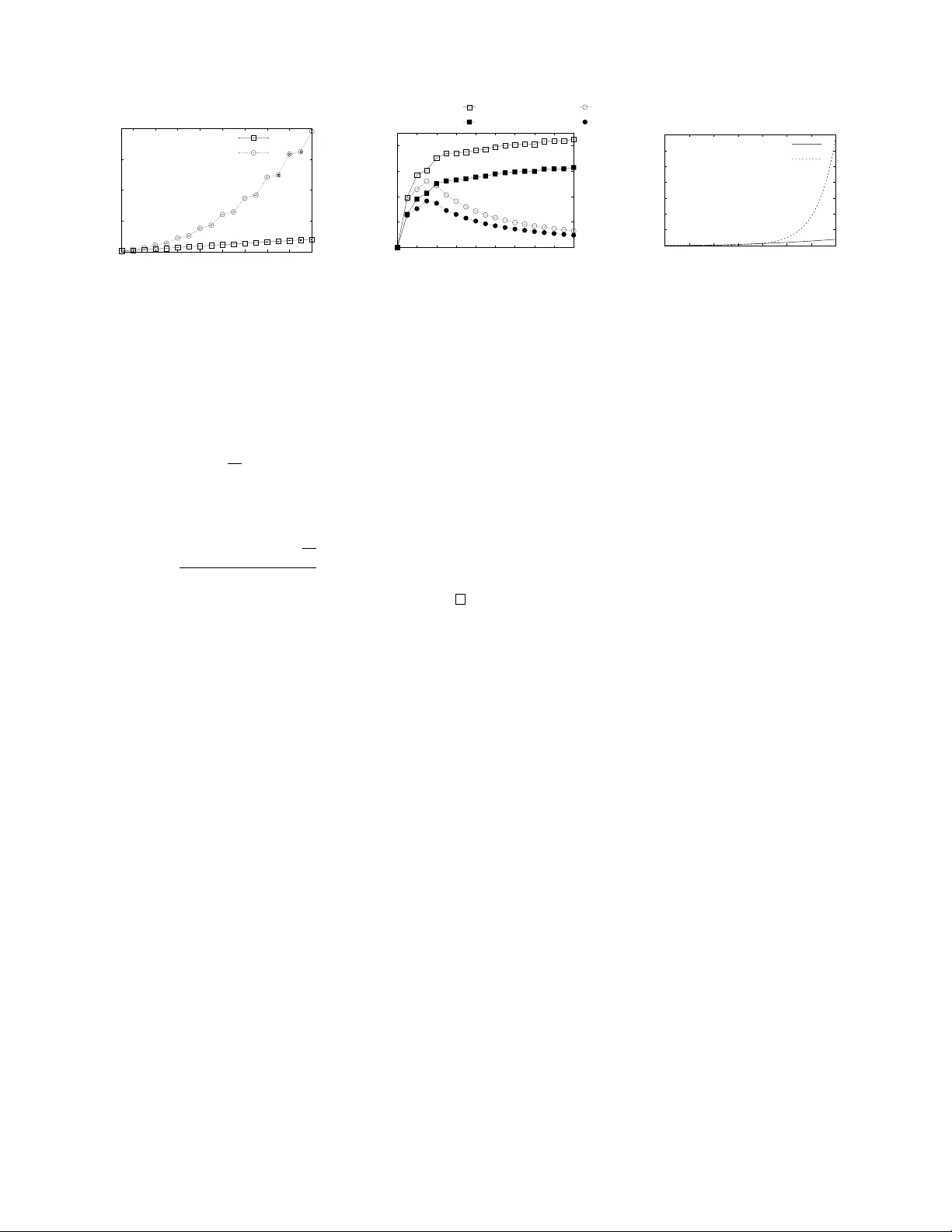
1 Maximal Spectral Ef ficienc y of OFDM with Index Modulation under Polynomial Space Comple xity Saulo Queiroz ∗ † , W esley Silv a ∗ , João P . V ilela † , Edmundo Monteiro † ∗ Academic Department of Informatics (D AINF) Federal Uni versity of T echnology (UTFPR), Ponta Grossa, PR, Brazil. sauloqueiroz@utfpr .edu.br , wesley .1999@alunos.utfpr .edu.br † CISUC and Department of Informatics Engineering Uni versity of Coimbra, Portugal {saulo, jpvilela, edmundo}@dei.uc.pt Abstract —In this letter , we demonstrate a mapper that en- ables all wav ef orms of OFDM with Index Modulation (OFDM- IM) while preserving polynomial time and space computational complexities. Enabling all OFDM-IM wavef orms maximizes the spectral efficiency (SE) gain over the classic OFDM b ut, as far as we know , the computational overhead of the resulting mapper remains conjectured as prohibitiv e across the OFDM- IM literature. W e show that the largest number of binomial coefficient calculations performed by the original OFDM-IM mapper is polynomial on the number of subcarriers, even under the setup that maximizes the SE gain over OFDM. Also, such coefficients match the entries of the so-called Pascal’ s triangle (PT). Thus, by assisting the OFDM-IM mapper with a PT table, we show that the maximum SE gain over OFDM can be achieved under polynomial (rather than exponential) time and space complexities. Index T erms —Computational Complexity , Index Modulation, Look-Up T able, OFDM, Pascal’ s T riangle, Spectral Efficiency . I . I N T R O D U C T I O N Look-up table (LUT) is a fundamental technique for the ef- ficient implementation of OFDM mappers. In an N -subcarrier OFDM system, the mapper translates N log 2 M bits into N complex baseband samples chosen from an M -ary constel- lation diagram. T o achiev e better spectral ef ficiency (SE), nov el physical layer techniques are expected to map more bits in the same amount of spectrum. In this conte xt, index modulation (IM) has gained increasing attention in the liter- ature [1], [2]. In the OFDM with IM (OFDM-IM) reference design [3], only k ≤ N subcarriers of the symbol are acti ve, which enables C ( N , k ) = N k = N ! / ( k !( N − k )!) wa ve- forms. Of these, OFDM-IM emplo ys 2 b log 2 C ( N ,k ) c to map p 1 = b log 2 C ( N , k ) c bits. Further, by employing an M -ary constellation for the activ e subcarriers, more p 2 = k log 2 M bits can be modulated, yielding a total of m = p 1 + p 2 bits per OFDM-IM symbol. This w ork is supported by the European Regional De velopment Fund (FEDER), through the Regional Operational Programme of Lisbon (POR LISBO A 2020) and the Competitiv eness and Internationalization Operational Programme (COMPETE 2020) of the Portugal 2020 framew ork [Project 5G with Nr . 024539 (POCI-01-0247-FEDER-024539)], and by the CONQUEST project - CMU/ECE/0030/2017 Carrier AggregatiON between Licensed Ex- clusiv e and Licensed Shared Access FreQUEncy BandS in HeT erogeneous Networks with Small Cells. The selection of the k indexes to acti vate in the symbol is determined from the p 1 -bit sequence in a DSP step called Index Selector (IxS). The IxS computation can be as ef ficient as OFDM’ s mapping if implemented as a 2 p 1 -entry LUT . Howe ver , it is consensual in the OFDM-IM literature that an IxS LUT should be employed only for small N because the required storage is practically infeasible otherwise. For large N , the OFDM-IM mapper employs an online IxS algorithm. Howe ver , when the setup that maximizes the OFDM-IM SE gain over OFDM is chosen, i.e., M = 2 and k = N / 2 ( N is ev en) [4] (we refer to as the “ideal setup”), the original IxS algorithm runs in O ( N 2 ) steps and becomes the most complex DSP block of the OFDM-IM transmitter [5]. According to [3], the IxS computational ov erhead is the reason why the IM technique is restricted to small parts of the symbol instead of being applied to all N subcarriers. This approach, called subblock partitioning (SP), alleviates the IxS complexity at the penalty of prev enting the SE maximization. Nov el constella- tion designs improve the OFDM-IM SE by modulating e xtra data on the IM subcarriers e.g. [6], [7]. Y et, these proposals employ SP to mitigate the IxS complexity , which prev ents them to reach their respecti ve maximum theoretical number of IM wav eforms. In this letter, we study the asymptotic trade-off between spectral and computational resources (space and time) 1 in the OFDM-IM mapper design. W e demonstrate that OFDM-IM requires a Θ(2 N / √ N ) -entry LUT to reduce the IxS time complexity from O ( N 2 ) to O ( N ) and to keep its maximum SE gain ov er OFDM. Then, we show how both the time complexity reduction and the SE maximization can be met by replacing the traditional LUT with the so-called P ascal’ s triangle (PT). T o the best of our knowledge, this is the first demonstration of an OFDM-IM mapper running at the same asymptotic complexity of a 2 p 1 -entry LUT requiring neither extra exponential space comple xity nor sacrificing the ideal OFDM-IM setup. Our results demonstrate the computational feasibility of the ideal (SP-free) OFDM-IM mapper, which has been conjectured as computationally infeasible in the literature [2]. 1 In this work, we refer to “time” and “space” as the asymptotic number of computational steps and table entries required by an N -subcarrier mapper, respectiv ely . This is the author's version of an article that has been published in this journal. Changes were made to this version by the publisher prior to publication. The final version of record is available at http://dx.doi.org/10.1109/LWC.2020.2965533 Copyright (c) 2020 IEEE. Personal use is permitted. For any other purposes, permission must be obtained from the IEEE by emailing pubs-permissions@ieee.org. 2 Algorithm 1 OFDM-IM index selector algorithm. 1: { X , k , and N are input parameters. Array c is returned}; 2: l arg estC andidate ← N − 1 ; 3: for i = k downto 1 do 4: c i ← l arg estC andidate ; 5: { C ( c i , i ) is computed in O ( i ) from Q i j =1 c i − j +1 j } 6: while C ( c i , i ) > X do 7: c i ← c i − 1 ; 8: end while 9: X ← X − C ( c i , i ) ; 10: lar g estC andidate ← c i − 1 ; 11: end for I I . O F D M - I M M A P P E R S P E C T R O - C O M P U T AT I O NA L T R A D E - O FF S In this section, we revie w the IxS algorithm (Subsec- tion II-A) and deriv e the asymptotic number of entries of the OFDM-IM LUT (Subsection II-B). In Subsection II-C, we present a mapper that enables all 2 p 1 OFDM-IM wav eforms while keeping polynomial time and space complexities. Then, in Subsection II-D, we analyze the throughput of our mapper . A. Spectr o-T ime T rade-Off The IxS algorithm of OFDM-IM (Alg. 1) is based on the combinatorial number system. This system tells us that, for ev ery integer X ∈ [0 , C ( N , k ) − 1] , there exist k integers c k > · · · > c 2 > c 1 ≥ 0 such that X = P k i =1 C ( c i , i ) and c k < N . For OFDM-IM, X is the decimal representation of the p 1 -bit input and the coefficients c k , · · · , c 1 are the index es of the active subcarriers. Gi ven X , k , and N as input, the IxS algorithm computes the acti ve subcarriers from c k to c 1 . In its first round, the IxS algorithm determines the value for c k . T o this end, it assigns c k with the largest candidate v alue N − 1 (line 2) and checks whether C ( c k , k ) ≤ X holds (line 6). If this logic test fails, the inner loop keeps decrementing c k (so, recalculating C ( c k , k ) ) until the test passes. When this happens, X is decremented by C ( c k , k ) and the largest candidate v alue available for the next coefficient c k − 1 is c k − 1 . This process repeats for all remainder coefficients. Since the ef ficient calculation of a single binomial coefficient C ( c i , i ) takes O ( i ) iterations with the multiplicativ e formula Q i j =1 ( c i + 1 − j ) /j , all k coef ficients C ( c k , k ) , · · · , C ( c 1 , 1) computed by the IxS algorithm take a total of k + · · · + 2 + 1 = k ( k + 1) / 2 = O ( k 2 ) iterations. As explained in [5], this complexity becomes O ( N 2 ) if SE maximizes, surpassing IFFT as the most comple x block of the OFDM-IM transmitter . B. Spectr o-Storage T rade-Of f A LUT for all 2 p 1 entries is pointed as an alternativ e to the IxS algorithm for relatively “small” N [3]. In the Lemma 2, we sho w that a 2 p 1 -entry LUT pro vides OFDM-IM with O ( N ) time complexity , the same as the classical OFDM mapper (Corollary 1). This time complexity holds ev en under the ideal SE setup of OFDM-IM. Howe ver , the LUT size becomes prohibitiv e as N grows. In Lemma 3 we demonstrate that the asymptotic number of entries of the OFDM-IM LUT under the ideal OFDM-IM setup is Θ(2 N / √ N ) . Both Lemmas 2 and 3 rely on the fact that p 1 can be asymptotically approximated by N − log 2 √ N under the ideal OFDM-IM setup (Lemma 1). Lemma 1 (Maximum Number p 1 of Index Modulation Bits) . The maximum number of index modulated bits p 1 appr oaches N − log 2 √ N for arbitrarily lar ge N . Pr oof. By definition, p 1 = b log 2 C ( N , k ) c . If the maximum SE gain of OFDM-IM over OFDM is allowed, C ( N , k ) be- comes the so-called central binomial coefficient C ( N , N / 2) = Θ(2 N N − 0 . 5 ) [5]. From this, it follows that p 1 approaches log 2 (2 N N − 0 . 5 ) = N − log 2 √ N as N → ∞ . Lemma 2 (LUT -Based OFDM-IM Mapper Complexity) . A 2 p 1 -entry LUT enables the OFDM-IM IxS to run in O ( N ) . Pr oof. Let 0 ≤ X ≤ 2 p 1 − 1 be the decimal representation of the p 1 -bit input given to the IxS DSP block. If the IxS is a 2 p 1 -entry LUT indexed from 0 to 2 p 1 − 1 , then the k -list of activ e index es corresponding to X is stored in the X -th entry of the table. Since LUTs are based on random access storage technology , any data can be retrieved in O (1) time after the LUT inde x is read (which is X , in this case). Therefore, the time complexity of a LUT -based IxS is determined by the time to read X , which is O ( p 1 ) = O (log 2 C ( N , N / 2)) = O ( N − log 2 √ N ) = O ( N ) (Lemma 1). Also, since the modulation of the k = N / 2 active subcarriers follows as in the classic OFDM for M = 2 , more O ( N / 2) computations are required. Thus, if the IxS is implemented as a 2 p 1 -entry LUT , the o verall OFDM- IM mapper runs in O ( N ) + O ( N/ 2) = O ( N ) time. Corollary 1 (OFDM-IM Mapper As Fast As OFDM’ s) . A 2 p 1 - entry Index Selector (IxS) LUT enables the OFDM-IM mapper to run as ef ficiently as OFDM’ s. Pr oof. The OFDM mapper reads N independent groups of log 2 M bits to produce N complex baseband samples. There- fore, its total number of computational steps is N log 2 M , which reduces to N = Θ( N ) steps under the “ideal OFDM- IM setup” (i.e., M = 2 ). Thus, according to the definition of the asymptotic notation, an OFDM-IM mapper runs at the same time complexity of an OFDM mapper if its total number of computational steps is κN (for some constant κ > 0 and N → ∞ ). As shown in Lemma 2, this is the case of a 2 p 1 - entry LUT mapper . Therefore, by consuming Θ(2 p 1 ) of space, the time complexity of the OFDM-IM mapper becomes as efficient as the time complexity of the OFDM mapper . Lemma 3 (OFDM-IM LUT Size Under Maximal SE) . Under the ideal OFDM-IM setup, a LUT -based OFDM-IM mapper r equires Θ(2 N / √ N ) entries. Pr oof. A LUT -based OFDM-IM mapper has one entry per each one of all possible 2 p 1 = 2 b log 2 C ( N ,k ) c sym- bol wav eforms. Since p 1 approaches N − log 2 √ N as N grows (Lemma 1), the number of LUT entries approaches Θ(2 N − log 2 √ N ) = Θ(2 N / √ N ) . C. Spectral Efficiency Maximization under P olynomial Space In Subsection II-B, we formalize the time and space trade- off of the original OFDM-IM mapper . The mapper needs an This is the author's version of an article that has been published in this journal. Changes were made to this version by the publisher prior to publication. The final version of record is available at http://dx.doi.org/10.1109/LWC.2020.2965533 Copyright (c) 2020 IEEE. Personal use is permitted. For any other purposes, permission must be obtained from the IEEE by emailing pubs-permissions@ieee.org. 3 Fig. 1. Proposed OFDM-IM mapper. Under maximal spectral efficiency , the value of any binomial coef ficient C ( c i , i ) required in line 6 of the IxS block (Algorithm 1) matches an entry of the PT table shown in T able I. By querying the table for each C ( c i , i ) instead of calculating them from scratch, the mapper achie ves the same time complexity of the Θ(2 N / √ N ) -entry OFDM-IM look-up table storing only Θ( N 2 ) entries. exponential amount of space to support all 2 p 1 wa veforms at the same asymptotic time of OFDM. W e note that this trade- off can be improv ed if the OFDM-IM mapper is assisted by the so-called Pascal’ s triangle (PT) instead of being implemented as a 2 p 1 -entry LUT . The proposed mapper is illustrated in Fig. 1. It consists of the original OFDM-IM mapper set to a single subblock and having the IxS algorithm assisted by a PT table. The PT table can be viewed as an N × k matrix that stores the result of C ( c i , i ) in row c i and column i (T able I). This way , the O ( i ) iterations required to compute a single binomial coef ficient C ( c i , i ) is replaced by a single query to the PT table. Therefore, the O ( k 2 ) iterations performed by the IxS algorithm to compute the k binomial coef ficients C ( c k , k ) , · · · , C ( c 1 , 1) (as explained in Subsection II-A) can be replaced by O ( k ) queries to the PT table. Note that the time complexity improvement achieved by the PT table does not change the k binomial coefficients selected by the IxS algorithm. Hence, both the vector of active indexes and the vector of complex baseband samples (denoted as I and s in Fig. 1, respecti vely) remain the same as in the original OFDM-IM mapper . In Lemma 4, we show that the number of binomial coef ficient entries of the PT table grows polynomially on N even if all 2 p 1 OFDM-IM waveforms are enabled. Then, in Thm. 1, we show that the PT table can enable all 2 p 1 OFDM-IM wav eforms at the same time complexity of the OFDM mapper . Lemma 4 (Binomial Coef ficients under Maximal SE) . Un- der the ideal SE setup, the OFDM-IM Index Selector algo- rithm computes O ( N 2 ) distinct binomial coefficients. Thus, a Θ( N 2 ) -entry PT table can be employed to r educe the IxS time complexity fr om O ( N 2 ) to O ( N ) . Pr oof. Under the ideal OFDM-IM setup, the variables c i and i of the IxS algorithm (Alg. 1, Subsec. II-A) decrease by 1 starting from N − 1 and k = N / 2 , respecti vely . Hence, the algorithm needs to compute no binomial coefficient other than C ( c i , i ) , 0 ≤ c i ≤ N − 1 and 1 ≤ i ≤ N/ 2 . Therefore, the Θ( N 2 ) -entry PT of T able I enables any binomial coefficient required by the IxS algorithm to be returned in O (1) time. Thus, the inner loop of the IxS algorithm (Alg. 1) reduces from O ( k ) × O ( i ) to O ( k ) × O (1) , yielding to an overall complexity of O ( k ) = O ( N ) in the ideal OFDM-IM setup. T ABLE I P A S CA L ’ S T R IA N G L E O F T H E P RO P OS E D O F DM - I M M AP P E R ( F IG . 1 ) . c i | i 1 2 3 · · · N/ 2 0 0 0 0 · · · 0 1 1 0 0 · · · 0 2 2 1 0 · · · 0 3 3 3 1 · · · 0 4 4 6 4 · · · 0 . . . . . . . . . . . . . . . . . . N − 1 N − 1 1 N − 1 2 N − 1 3 · · · N − 1 N/ 2 Theorem 1 (OFDM-IM Mapper under Polynomial Space) . All 2 p 1 OFDM-IM waveforms can be mapped at the same asymptotic time of an OFDM mapper at the expense of polynomial space complexity . Pr oof. From Lemma 4, a PT table storing Θ( N 2 ) binomial coefficients enables the IxS algorithm to run in O ( N ) time. This is the same asymptotic number of steps performed by the OFDM mapper (Corollary 1). T o achiev e such time complexity keeping the ideal setup, a traditional LUT -based OFDM-IM mapper requires Θ(2 N / √ N ) entries (Lemma 3). Thus, by replacing a LUT with an IxS algorithm assisted by the PT table, one enables the OFDM-IM mapper to achie ve its ideal SE setup in O ( N ) time at the expense of polynomial (rather than exponential) space. The PT table dates back from ancient times, even before Blaise Pascal 2 . Thus, the improv ement it provides for the calculation of binomial coefficients is not a nov elty for the field of combinatorial algorithms. Nonetheless, how this result turns out to affect the comparati ve SE performance of OFDM- IM and OFDM is beyond the scope of that literature. D. Mapper Thr oughput Analysis In [5] the authors propose the spectro-computational ef- ficiency (SCE) metric to formalize the OFDM-IM trade-off between SE and computational complexity . Based on SCE, in Def. 1 we present the condition for the scalability of the OFDM-IM mapper throughput. In Thm. 2, we show that the throughput of our mapper scales under polynomial space complexity . Definition 1 (Scalable Throughput [5]) . Let T ( N ) be the computational complexity to map m ( N ) bits into an N - subcarrier symbol and m ( N ) /T ( N ) be the thr oughput of the mapper . Then, the thr oughput of the mapper is not scalable unless ineq. 1 does hold. lim N →∞ m ( N ) T ( N ) > 0 (1) Theorem 2 (Scalable OFDM-IM Mapper Throughput under Polynomial Space) . The thr oughput m ( N ) /T ( N ) (Def. 1) of our mapper does scale under polynomial space complexity . 2 for references before Blaise Pascal please, refer to https://en.wikipedia.org/wiki/P ascal’ s_triangle#History . This is the author's version of an article that has been published in this journal. Changes were made to this version by the publisher prior to publication. The final version of record is available at http://dx.doi.org/10.1109/LWC.2020.2965533 Copyright (c) 2020 IEEE. Personal use is permitted. For any other purposes, permission must be obtained from the IEEE by emailing pubs-permissions@ieee.org. 4 0 1 2 3 4 4 8 12 16 20 24 28 32 36 Runtime (microsec.) Number of Subcarriers N (k = N/2) Proposed Mapper OFDM-IM Mapper (a) Runtime. 0 40 80 120 160 0 4 8 12 16 20 24 28 32 36 Throughput (Mbps) Number of Subcarriers N (k = N/2) Proposed (QPSK) Proposed (BPSK) OFDM-IM (QPSK) OFDM-IM (BPSK) (b) Throughput. 0 500 1000 1500 2000 2500 3000 3500 0 2 4 6 8 10 12 14 Number of Entries Number of Subcarriers N (k = N/2) Proposed mapper OFDM-IM LUT (c) Number of Entries. Fig. 2. Proposed mapper vs. OFDM-IM index selector mapper under the maximal spectral efficienc y: runtime (a), throughput (b) and number of table entries compared to the LUT -based OFDM-IM mapper (c). Pr oof. Under its ideal SE, the proposed OFDM-IM mapper run in T ( N ) = O ( N ) time at the expense of a Θ( N 2 ) -entry LUT (Thm. 1). Hence, as N → ∞ , T ( N ) is bounded by κ · N , for some constant κ > 0 . Similarly , b log 2 C ( N , N / 2) c approaches N − log 2 √ N as N → ∞ (Lemma 1). Thus, the throughput of our mapper does not nullify ov er N since it results in a constant κ 0 > 0 (Ineq. 2). Therefore, the throughput of our mapper does scale under polynomial space complexity . lim N →∞ N / 2 + N − log 2 √ N κ · N = κ 0 > 0 (2) I I I . N U M E R I C A L P E R F O R M A N C E In this section, we present a softw are-based case study for our theoretical findings. W e assess the runtime T ( N ) and the throughput m ( N ) /T ( N ) (Def. 1) of our proposed mapper (Fig. 1) and the original OFDM-IM mapper . W e av erage T ( N ) adopting the same infinite-horizon methodology of [5]. W e compute the number of bits m ( N ) assuming k = N / 2 for M = 2 (BPSK) and M = 4 (QPSK). In Figs. 2a and 2b, we plot the runtime and the throughput of the mappers for different v alues of N , respectively . As predicted, in the ideal setup, the runtime growth of the original IxS algorithm (shown in Fig. 2a) nullifies the throughput of the OFDM-IM mapper as N grows (Fig. 2b). This happens ev en if M increases (e.g., from BPSK to QPSK) because the IxS comple xity depends only on N and k . If the PT tabl e assists the IxS algorithm (pro- posed mapper), the time comple xity improves from O ( N 2 ) to O ( N ) (Fig. 2a), and the resulting ov erhead does not nullify the throughput (Fig. 2b). T o achiev e such similar scalability , the current literature [1]–[4], [6] needs a LUT whose space becomes prohibitiv e even for relatively small N , as shown in Fig. 2c. Although non-exhaustiv e, this case study confirms our theoretical predictions, ensuring the OFDM-IM mapper does not need SP to enable all its 2 b log 2 C ( N ,N/ 2) c wa veforms. I V . C O N C L U S I O N A N D F U T U R E W O R K In this letter , we show that the time complexity of a Look- up table (LUT)-based OFDM-IM mapper can be achiev ed under polynomial (rather than exponential) space complexity . By assisting the OFDM-IM index selector algorithm with the so-called Pascal’ s triangle, we demonstrate for the first time the non-necessity of compromise approaches that pre vail in the OFDM-IM literature such as subblock partitioning (SP) [1]– [4], [6] and adoption of fe w acti ve subcarriers [8]. In such approaches, the maximal SE is sacrificed to attenuate the mapping computational complexity . Therefore, our mapper r epresents a step towar ds the deactivation of SP . Future work may improv e our proposal by achieving the same space of the OFDM mapper (i.e., O ( N ) rather than Θ( N 2 ) ) or by considering other relev ant performance indicators e.g., bit- error rate [9]. Also, our mapper can be adapted to spatial IM systems [10] and inspire the deactiv ation of SP in future versions of OFDM-IM and variants thereof [6], [7]. R E F E R E N C E S [1] T . Mao, Q. W ang, Z. W ang, and S. Chen, “No vel index modulation techniques: A survey , ” IEEE Commun. Surveys Tuts , vol. 21, no. 1, pp. 315–348, 1st Quart. 2018. [2] E. Basar , M. W en, R. Mesleh, M. D. Renzo, Y . Xiao, and H. Haas, “Index modulation techniques for next-generation wireless networks, ” IEEE Access , vol. 5, pp. 16 693–16 746, Aug. 2017. [3] E. Basar , U. A ygolu, E. Panayirci, and H. V . Poor, “Orthogonal frequency division multiplexing with index modulation, ” IEEE T rans. Signal Process. , vol. 61, no. 22, pp. 5536–5549, Nov . 2013. [4] R. Fan, Y . J. Y u, and Y . L. Guan, “Generalization of orthogonal frequency division multiplexing with index modulation, ” IEEE T rans. on W ir eless Commun. , vol. 14, no. 10, pp. 5350–5359, Oct. 2015. [5] S. Queiroz, J. V ilela, and E. Monteiro, “What is the cost of the index selector task for ofdm with index modulation?” in IFIP/IEEE Wir eless Days (WD) 2019 , Manchester, UK, Apr . 2019. [6] T . Mao, Z. W ang, Q. W ang, S. Chen, and L. Hanzo, “Dual-mode index modulation aided OFDM, ” IEEE Access , vol. 5, pp. 50–60, Aug. 2017. [7] M. W en, E. Basar, Q. Li, B. Zheng, and M. Zhang, “Multiple-mode orthogonal frequency division multiplexing with index modulation, ” IEEE T rans. Commun. , vol. 65, no. 9, pp. 3892–3906, Sep. 2017. [8] M. Salah, O. A. Omer, and U. S. Mohammed, “Spectral efficiency enhancement based on sparsely inde xed modulation for green radio communication, ” IEEE Access , vol. 7, pp. 31 913–31 925, Mar . 2019. [9] M. W en, Y . Zhang, J. Li, E. Basar , and F . Chen, “Equiprobable subcarrier activ ation method for OFDM with index modulation, ” IEEE Commun. Lett. , vol. 20, no. 12, pp. 2386–2389, Dec. 2016. [10] M. W en, B. Zheng, K. J. Kim, M. Di Renzo, T . A. Tsiftsis, K. Chen, and N. Al-Dhahir, “ A surve y on spatial modulation in emerging wireless systems: research progresses and applications, ” IEEE J. Sel. Ar eas Commun. , vol. 37, no. 9, pp. 1949–1972, Sep. 2019. This is the author's version of an article that has been published in this journal. Changes were made to this version by the publisher prior to publication. The final version of record is available at http://dx.doi.org/10.1109/LWC.2020.2965533 Copyright (c) 2020 IEEE. Personal use is permitted. For any other purposes, permission must be obtained from the IEEE by emailing pubs-permissions@ieee.org.
Original Paper
Loading high-quality paper...
Comments & Academic Discussion
Loading comments...
Leave a Comment