True Nonlinear Dynamics from Incomplete Networks
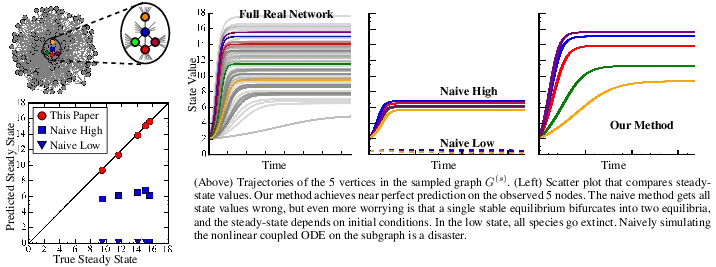
We study nonlinear dynamics on complex networks. Each vertex $i$ has a state $x_i$ which evolves according to a networked dynamics to a steady-state $x_i^*$. We develop fundamental tools to learn the true steady-state of a small part of the network, without knowing the full network. A naive approach and the current state-of-the-art is to follow the dynamics of the observed partial network to local equilibrium. This dramatically fails to extract the true steady state. We use a mean-field approach to map the dynamics of the unseen part of the network to a single node, which allows us to recover accurate estimates of steady-state on as few as 5 observed vertices in domains ranging from ecology to social networks to gene regulation. Incomplete networks are the norm in practice, and we offer new ways to think about nonlinear dynamics when only sparse information is available.
💡 Research Summary
The paper tackles a fundamental problem in network science: how to infer the true steady‑state of a nonlinear dynamical system when only a small, sampled portion of the underlying graph is observable. Traditional practice—simulating the dynamics on the observed subgraph alone—fails dramatically because it ignores the influence of the many unobserved neighbors, often leading to completely wrong equilibrium values or even to spurious multiple equilibria.
The authors propose a mean‑field based methodology that replaces the collective effect of all unseen nodes by a single effective external state, denoted (x_{\text{eff}}). For each observed node (i), the dynamics are rewritten as
\
Comments & Academic Discussion
Loading comments...
Leave a Comment