Hamiltonian structure of peakons as weak solutions for the modified Camassa-Holm equation
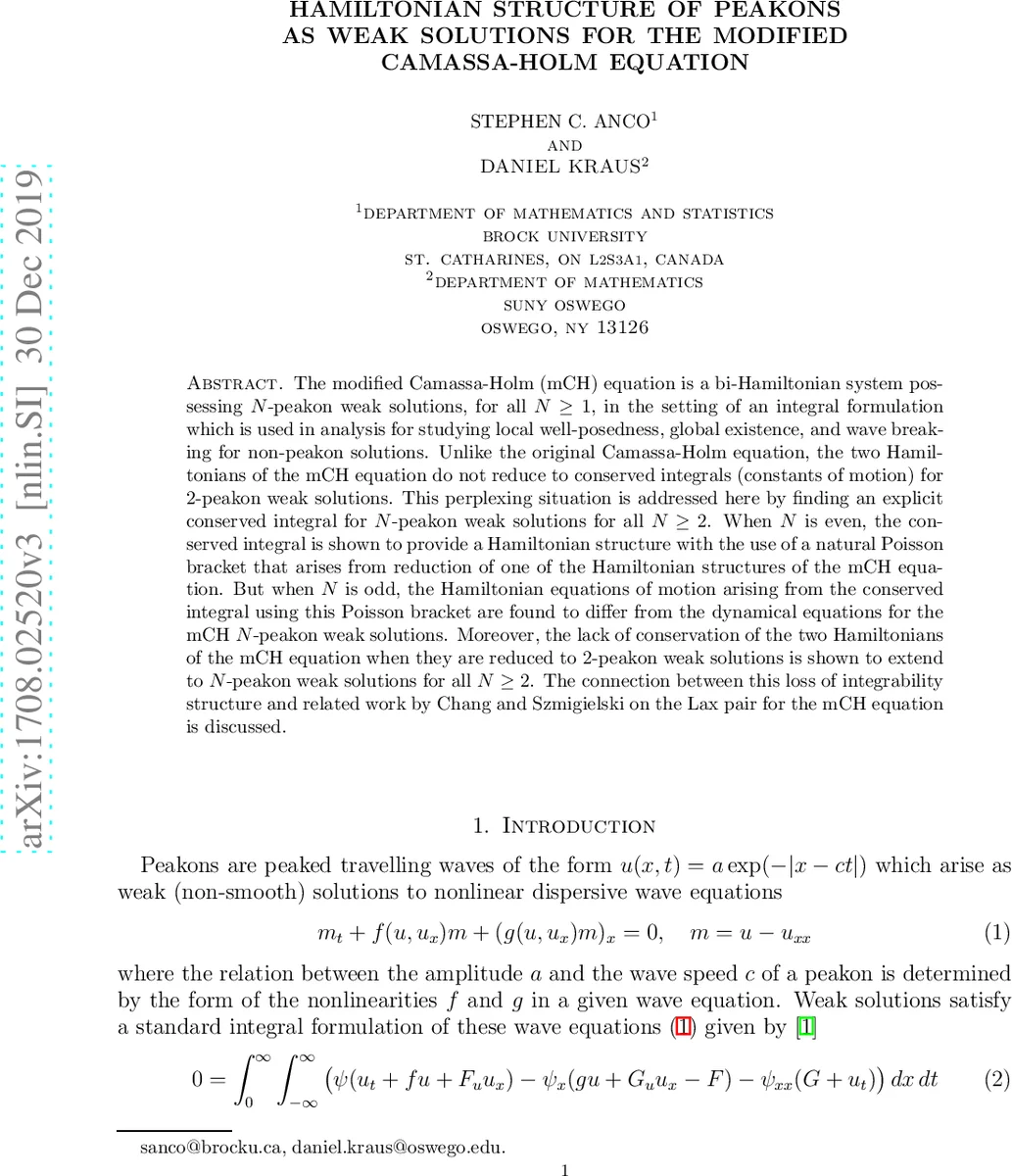
The modified Camassa-Holm (mCH) equation is a bi-Hamiltonian system possessing $N$-peakon weak solutions, for all $N\geq 1$, in the setting of an integral formulation which is used in analysis for studying local well-posedness, global existence, and wave breaking for non-peakon solutions. Unlike the original Camassa-Holm equation, the two Hamiltonians of the mCH equation do not reduce to conserved integrals (constants of motion) for $2$-peakon weak solutions. This perplexing situation is addressed here by finding an explicit conserved integral for $N$-peakon weak solutions for all $N\geq 2$. When $N$ is even, the conserved integral is shown to provide a Hamiltonian structure with the use of a natural Poisson bracket that arises from reduction of one of the Hamiltonian structures of the mCH equation. But when $N$ is odd, the Hamiltonian equations of motion arising from the conserved integral using this Poisson bracket are found to differ from the dynamical equations for the mCH $N$-peakon weak solutions. Moreover, the lack of conservation of the two Hamiltonians of the mCH equation when they are reduced to $2$-peakon weak solutions is shown to extend to $N$-peakon weak solutions for all $N\geq 2$. The connection between this loss of integrability structure and related work by Chang and Szmigielski on the Lax pair for the mCH equation is discussed.
💡 Research Summary
The paper investigates how the bi‑Hamiltonian structure of the modified Camassa‑Holm (mCH) equation behaves when the equation is restricted to its peakon weak solutions. The mCH equation, a cubic‑nonlinear analogue of the Camassa‑Holm (CH) equation, admits weak solutions of the form
(u(x,t)=\sum_{i=1}^{N} a_i(t),e^{-|x-x_i(t)|}),
where the amplitudes (a_i) and positions (x_i) evolve according to a finite‑dimensional dynamical system. By employing distributional calculus the authors recover the well‑known fact that the amplitudes are constant in time ((\dot a_i=0)) while the positions satisfy a non‑linear ODE system (equations (7), (10)–(12) in the manuscript).
The mCH equation possesses two compatible Hamiltonian operators (H) and (E) with corresponding conserved functionals
(H_1=\int m,dx) and (H_2=\frac14\int u(u^2-u_x^2)m,dx).
When these functionals are reduced to the peakon ansatz, they become the finite‑dimensional quantities (E_1) and (E_2) (equations (22)–(25)). A direct computation of (\dot E_1) and (\dot E_2) shows that, except for the trivial case where all amplitudes are equal, neither functional is conserved for the peakon dynamics. Hence the original bi‑Hamiltonian structure is lost for weak solutions, a phenomenon that does not occur for the CH equation.
To understand whether any Hamiltonian description survives, the authors examine the reduction of a generic Poisson bracket ({F,G}_D=\int \delta F/\delta m, D, \delta G/\delta m,dx) to the finite‑dimensional variables ((a_i,x_i)). Using the non‑canonical operator (H) they recover the well‑known Poisson algebra
({x_i,x_j}= \frac12\operatorname{sgn}(x_i-x_j),; {a_i,a_j}=0,; {a_i,x_j}=0).
However, no Hamiltonian (H(a,x)) exists that simultaneously yields (\dot a_i=0) and the correct (\dot x_i) via this bracket; in other words, the reduced bracket does not admit a Hamiltonian generating the peakon ODEs.
The central contribution of the paper is the construction of a new conserved quantity (I_N) that is constant for all peakon solutions with (N\ge2). For even (N=2M) the conserved integral can be written as a sum over pairs, e.g.
(I_{2M}= \sum_{k=1}^{M}\big(\frac23 a_{2k-1}^2+\frac23 a_{2k}^2+4 a_{2k-1}a_{2k}e^{-|x_{2k-1}-x_{2k}|}\big)).
When the non‑canonical Poisson bracket derived from (H) is applied to (I_N), the resulting Hamiltonian equations exactly reproduce the peakon dynamics for even (N). Thus, for an even number of peakons the system regains a Hamiltonian formulation, albeit with a Hamiltonian that is different from the original (H_1) or (H_2).
For odd (N) the same conserved integral fails to generate the correct equations of motion under the same Poisson bracket; the resulting vector field differs from the ODE system (7). This indicates that the non‑canonical Poisson structure does not close on an odd‑dimensional phase space of peakons. The authors discuss possible remedies, such as modifying the Poisson structure by adding extra terms or seeking a different reduction of the Lax pair. They relate these issues to recent work by Chang and Szmigielski, which shows that regularisation conditions are needed to reduce the Lax pair to non‑smooth solutions.
In summary, the paper demonstrates that the cubic nonlinearity of the mCH equation destroys the direct reduction of its bi‑Hamiltonian and Lax structures to peakon weak solutions. While an explicit conserved integral restores a Hamiltonian description for even numbers of peakons, the odd‑peakon case remains unresolved, highlighting a subtle parity effect absent in the quadratic CH equation. The results open several avenues for future research: (i) constructing a suitable Poisson bracket for odd‑peakon configurations, (ii) developing a regularised Lax representation that respects the weak nature of peakons, and (iii) exploring whether alternative integrability notions (e.g., non‑canonical symplectic forms) can accommodate the full family of mCH peakons.
Comments & Academic Discussion
Loading comments...
Leave a Comment