Comparison of the P300 detection accuracy related to the BCI speller and image recognition scenarios
There are several protocols in the Electroencephalography (EEG) recording scenarios which produce various types of event-related potentials (ERP). P300 pattern is a well-known ERP which produced by auditory and visual oddball paradigm and BCI speller…
Authors: S.A. Karimi, A.M.Mijani, M.T. Talebian
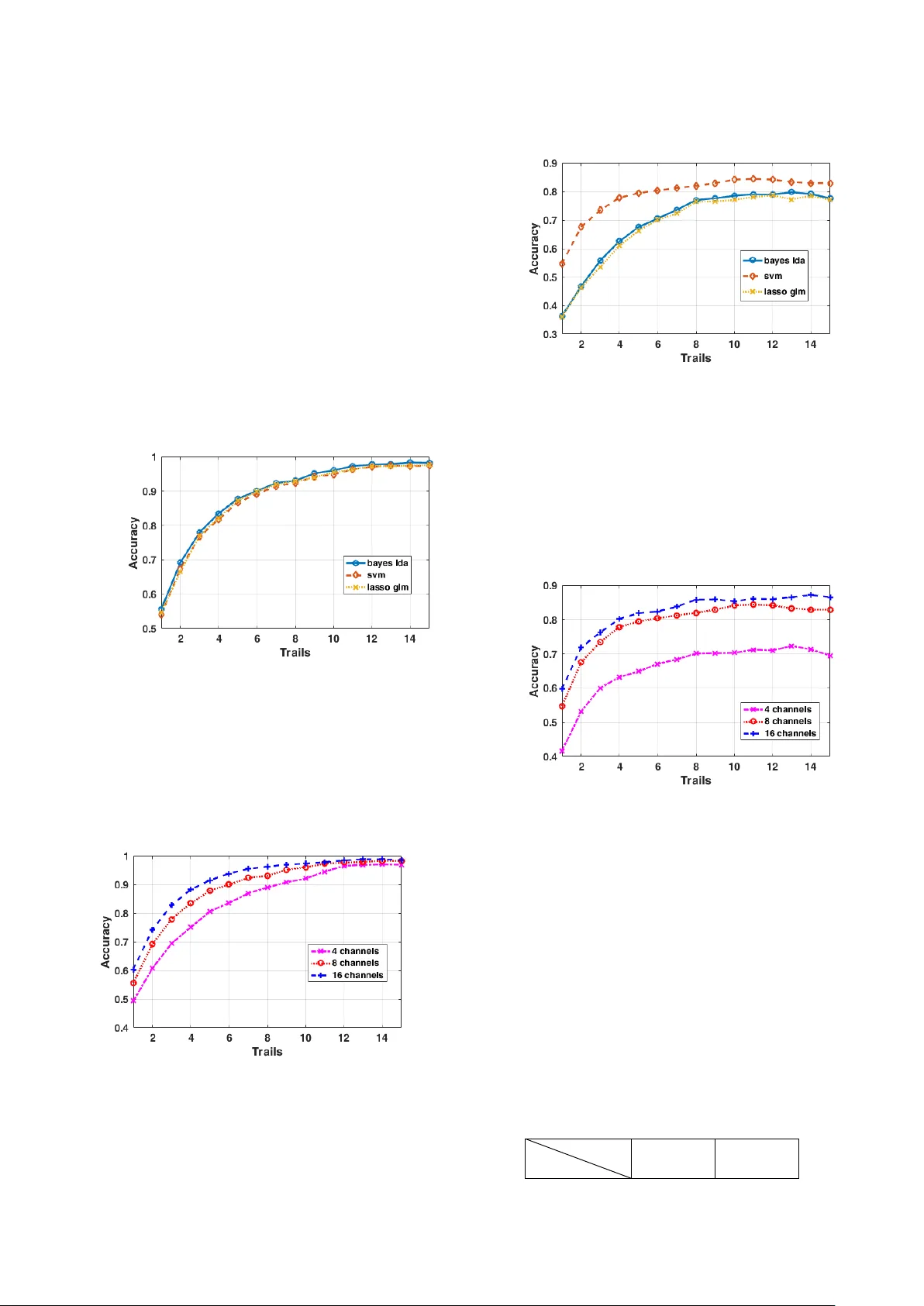
Comparison of the P300 detection accuracy related to the BCI speller and image recognition scenarios S.A. Karimi 1 , A.M.Mijani 2 , M.T. Talebian 1 and S. Mirzakuchaki *1 1. Electronic Rese arch Institutes (ERI ), Departme nt of Electrical engineering, Ir an University of sc ience & technology, Tehran, Iran 2. BiSIPL, Department of Electrica l Enginee ring, Sharif univers ity of Technology, Tehran, Iran . Abstract There are several protocols in the Electroencephal ography (EEG) recording scenarios which produce various types of event-related potentials (ERP). P300 pattern is a we ll -k nown ERP which produced by auditory and visual oddball paradigm and BCI speller system. In this study, P300 and n on-P300 separabil ity are investigated in two scenarios including i m age recogni tion paradigm and BCI speller. Image recognition scenario is an experim ent that examines the participants’ know ledge about an im age that shown to them before by analyzing the EEG signal recorded during the observing of that imag e as visual stimulation. To do this, three types of famous classifiers (SVM, Bayes LDA, and sparse logistic regression) were used to classify EEG recordings in six classes problem. Filtered and down -sampled (temporal sam ples) of EEG recording were considered as feature s in classification P300 pattern. A lso, d ifferent set s of EE G r ecording including 4, 8 and 16 channels and different trial numbers were used t o considering various situations in comparison. The accuracy was increased by i ncreasin g the number of t rials and channels. The results prove that better accuracy is ob served in the case of the image recognition scenario for t he different sets of channels and by using the diff erent number o f t rials. So it can be conclu ded t hat P300 pattern w hich produced in im age recognition parad igm is more sep arable than BCI (matrix speller). Keywords: EEG, P3 00, BCI, Classificat ion, Channel number effect. 1. Introduction The Electroenc ephalograp hy (EE G) signals are generated by the firing of neurons in the brain and their related electr ical activities. German psychiatrist Hans Berger, coined the name Electroencepha logram aft er he could successful ly record this specific activit y of the brain in 1924 [1]. T his electrophysiological monitoring method is a non-invasive procedure of the brain activity recording, which has several advantages over similar methods such as its low cost and ease of the operation [2]. After the spec ific visual and auditory signal s stimulate the br ain, certa in patterns which are called Ev ent-related Po tential ( ERP) a re reco rded by the EEG. One well-known ERP is P300 or P3 which generated as a result of the induction with a rare and m eaningful stimulus, called “oddball ” [3]. It is interpreted as a f ast response of the central nervous system to the stim ulus that is meaningful or in other words; the participant is familiar with it. It is an unconscious response; thus, it mig ht har dly be altered with the participants’ inte ntion [4]. It is a positive-going wave that occurs approximately 300 milliseconds after the stimulation with a cl ear scalp d istribution, i n which the most si gnific ant value is t ypically at the Pz el ectrode and the smallest one at Fz. The intermediate value lies at Cz channel in a standard 10-20 sy stem of the recording EEG [5]. Image recognition scena rio is an experiment that examines the participants ’ knowledge about an image that shown to them before by analyzing the EEG signal r ecorded during the observing of tha t im ag e as a visual s timulation. S everal kinds o f research hav e been done i n order t o detec t the target image among an image string using p300 component, that this paradigm was called rapid serial v isual prese ntation ( RSVP) [6 - 8]. RSVP paradigm in addition to image search applications applied i n the design of p300 speller system [ 9, 10]. Brain-com puter interface that is abbreviated as BCI in the literature is a system t hat crea tes a relationship b etween the brain a nd a c omputer. It means that a BCI s ystem could discover t he processes done in the brain and do t he appropriate tasks according to that by the computer. Such a system is predom inantly utilized in helping the disabled, especially people with motor disabilities [9]. EEG is comm only used in the BCI systems because of its non-invasive nature and i ts direct relationship with the brain f unction. By analysis of the EEG recordings, a c omputer can recognize the brain' s intention and making comm ands for the output devices. P300 is a useful pattern trough EEG signal to this end because it i s unconsciou s and it directly reflects the brain intentions [11]. One of the most common BCI systems that are called BCI spell er is a m echanism that helps the subject to t ype text by cons idering t he letters of the words. Recently various st udies around the world have f ocused o n investigating P300 applications and developm ent of the BCI systems. BCIs have a variety of applica tions, one being Speller systems. The f irst Speller paradigm based on ERP was th e matrix Spe ller which w as introduced by Farwell and Donch in [12] . Research has proven that Matrix Speller has a disadvantage and it is gaze dependent [9]. Many researchers attempted to overcome this i ssue, and their results led to changing the type of modality, and u sing audio [13] and t ouch [14] instead of vision. Erwei Yin et al. [15] pr opo sed a novel hybrid BCI approach f or increasing the spelling spe ed. In this approach, the P300 and the visu ally evoked steady-state potentia l (SSVEP) detec tion mechanism s are devised and integrated in order to make use of two brain sig nals possible for spelling at the same t ime. The results obtained for the fourteen healthy sub jects demonstrate that th e average online practical inform ation t ransfer rate, including the time of the break between selections and error corrections, achieved using t his approach was 53.06 bits/m in [15]. Riccio et al. [16] stud ied the relativ e improvem ent of two modalities of BCI system control; a P300- based and a hy brid P300 elect romy ographic -based mode of control. They consider eleven per sons, eight healthy ones a nd the other thre e with the motor disability . Evaluation of the syst em’s function was rev ealed in three ca tegories, namely , system accuracy , throughput tim e and satisfaction of the user. In bot h groups, higher marks were in the hybrid P300 electromyog raphic-based mode. They used data driven by electromy ographic recording as a correction tool [16]. Akram et al. [17] i n a study in 201 5 proposed a Text o n nine k eys (T9) based on th e w ord typing systems relying on the P30 0 BCI system. For the sake of usability, they integrated a smart dictionary into the system for word suggestion and used a Random Forest classifier for the enhancement of t he accuracy. T heir results showed 51.87 pe rcent improv ement in the typing speed compare d wit h the conventional system s and higher accura cy for their classifi er [17]. Halder et al. tried t o make a solution based on t he P300 BCI system for contr ol of the web-browser and m ultimedia play er. They used dy namic matrices for ac cessing hi gh er spe ed and evalu ated their system by both healthy and end-user persons. They pr esen ted a web b rowser, and a m ultim edia user in terface adapted for control w ith a brain - computer i nterface ( BCI ) which may benefit severely motor disabled individuals. The web browser dynam ically determines t he most efficient P300 BCI matrix size to se lect the l inks on the cu rrent webs ite and the m ultimedia play er corresponding to the piece of software in hand . The results reveal t hat healthy participants experience 90% of accuracy in m edia player and 85% in web browsing predefined tasks, while disabled participants re port 62% and 58% accuracy for abov ementioned task s [18]. Haghighatpanah et a l. wo rked on a single trial, single-channel algorithm . They used wav elet decomposition and ICA method for the feature extraction and LDA algor ithm as the cla ssifier. Reportedly, t hey could achieve 65% detection accuracy [19]. Another application of the P300 signal that has been cont inuously discussed i n the literature is l ie detection or in a bet ter expression, t he deception detection. As discussed before, the rising of P300 pattern in the EEG recordings shows a sig n o f familiarity or intention o f the part icipant with the stimulation. This concept is the base of al l applications of the P300 si gnal. In lie detection applications, we can review an im age detec tion scenario beca use the stimulation is often visual and the goal is to find the knowledg e of participant about the image shown a s the stimulation. One of the most critical problems in lie detection applications is designing the best scenario fo r the test. For a chieving this goal, thi s study w as done to compare t wo primary ty pes of stimulation that use in P300 analy zing based studies. By comprising these methods, we can conclude that which factor involving in the creation of P300 is more important and a better designing o f test scena rio for dec eption de tection could be obtainab le. Wang et al . in a study i n 2013 created a lie detection system based on the P300 by developing a simple and feasible hierarchical knowledge-base construction and test method. In this study, each subject was ask ed to provide to the experimenter five numbers (all f our digits long), one of them being their year of birth. In each test, each number was displayed to the subject randomly with thirty repetitions as stimulations. This type of stimulation is like BCI application. They describe how a hierarchica l feature space w as form ed and which l evel of the feature space was suff icient to accurately predict concea led i nform ation f rom the raw EEG s ignal in a short time. The resu lts indicate a high accuracy of 95.23% in recognizing concealed information with a single EEG electrode with in about 20 seconds [20]. Yijun et al. in research in 2014 introduced a classification m ethod based on t he ICA and ELM for using i n lie detection based on P300. The participants were random ly divided into two groups: the liar group and truth -teller g roup. The images of si x watches with different characteristics were p repared. A box contain ing two watches was given to the guilty. Then, the guilty were instructed t o st eal one, which was served as t he probe (P) stimuli. T he other objects in the box are the Target (T) stim ulus. The remaining four ob jects are i rrelevant (I) stimuli. For the innocent, they only sa w one watch (T stimulus) in the box and st ole nothing. The standard three stimuli protocol was employed in this study. First, they used ICA for identifying the P300 ICs. The features we re extracted from ti me and f requency do main and finally, they used t hese features to train t hree kinds of classifiers: Extreme learning m achine (ELM), Back propagation neural network (BPNN) and Support v ector machine (SVM). Their reports suggest that the method combining ICA with ELM has the best r esult in terms of the accu racy [21]. 2. Methods One of the controversial subjects i n the field of P300 detection is the relationsh ip between the type of stimulation and the clarity of th e P300 pattern in the EEG. Does it mean that which type of stimulation can better and strong er cre ate P300? In this study, we try to find an answer to this question. T wo factors are involved in the creation of P300: f irst, the familiarity of stimulation with the participant, and second , having considera tion from the participant about the concept of the stimulation. For the first case consider a person that rubes a special wallet, when he looks at the pictu re of that special wallet, like the stim ulus, in a m anner, P300 wave in his brain appears. For the second ca se, consider a disabled person willing to type a special l etter by a P300 based BCI sy stem, when the pictu re of that lette r is shown for him as t he stimulation in a particular algorithm, P300 will appear in the EEG recording. This shape is not particularly special, but the concept of the letter and i ntention of the di sabled person mak e it special for him. 2.1. Data Sets The first dataset is t he EPFL image recognition database [ 22]. In this study, five disabled and four healthy i ndividuals were examined. Disabled persons were limited with the wheelchair but have the varying ability to control their m uscles and comm unications. Subjects 1 and 2 were able to perfo rm si mple, slow movements with their arms and hands but were unable to control other extremities. Spoken comm unication with subjects 1 and 2 was possible, although both subjects suffered from mild dysarthr ia. Sub ject 3 was able to perform restricted mov ements with his left hand but was unab le to m ove his arms or other extremities. Spok en communication with sub ject 3 was impossible. However, the patient was able to answer yes or no questions with eye blinks. Subject 4 had very little control over arm and hand movements. Spoken communication was possible with subject 4, although mild dysarthria existed. Subject 5 was only able t o perform extremely sl ow and relatively uncontrolled movem ents with hands and arms. Due t o severe hypophonia and large fluctuations in the level of alertness, communication with subject 5 was challenging. Sixth to ninth participants were Ph.D. students working in the lab (all men were i n the ages (30 ± 2/3)). None of these persons had a known nerve dysfunction. Each person was tested four times, and an image was shown every time. The brain waves of t hese indiv iduals were recorded based on P 300. The first t wo sessions took place one day and two subsequent sessions on the other day. For a ll participants, the time between the first and last session was less than two weeks. Each of these sessions consisted of six runs each included multiple random presentations of s ix images. Before each session, p articipants were asked to select a particular picture and count the number of flashing that through the random presentation. During the stimulations, EEG recording was done from 3 2 channels according to the standard 10-20 system. Counting was intended to monitor the degree of attention from the participants to the examination [22]. The second database analyzed in this study is the BCI2003 mental typing competition database ( Data set IIb ) . Institute of Berl in Brain - Computer Interface competes with other institutions to develop in the context of BCIs. During each competition, several datasets are provided to the participant s that they m ust answer certain questions with analyz ing them. The data of these com petitions is available for free on the website ( http: //bbci.de/competit ion ). One o f thes e datasets is related to the competition that has been held in 2003 named, Berl in BCI Competition II- Data se t IIb. This dataset includes a user's EEG signal t hat was re corded while using a P300 speller [23]. The BBCI Datas et IIb dat a consists of three EEG recording sessions, during which a subject (which was t he same in all three sess ions) has typed some words by the P300 Speller. The P300 Speller is the same as one that was first introduced in 1988 by Donchin and Fawell, then described in 2000 by Donchi n [24]. In this P300 speller, th e subjects viewed a display of a 6*6 matrix filled with alphabets and numbers. The characters were presented as white characters on a black backg round, using a moderate and easily visible intensity. The subjects were i nstructe d to observe the display and to count t he number of times the row, or the column, containing the designated target l etter wa s intensified. Th e rows and the columns were intensified in a random sequence in such a manner that all six rows and six columns were int ens ified before any was repeated. A “tr ial” in the study is thus defined a s the intensification of all 12 elements of the matrix . Simultaneously the EE G was r ecorded from t in electrodes in an elec trode cap accord ing to the standard 10-20 system and right masto id sites, referred to the lef t mastoid. The analysis in this study was done by using the data of 4, 8, and 16 channels. In 4 channel analyzing , data from Fz, Cz, Pz, and Oz was chosen and i n 8 channel ana lyzing data from P3, P4, P7, and P8 were added and in 16 channel analyzing data from FC1, FC2, CP 1, CP2, C3, C4, O1, and O2 were added ac cording to standard 10- 20 system. See th e figure 1. 2.2. Features ex traction Preprocessing and feature selection for both databases are done through the following eight steps: 1. Reference determination: The average signal from two mastoid electrodes wa s used as the referen ce. 2. Filtering: The third-order bandpass butter-worth f ilter was used for filt ering the data. The cut-off frequency was set to 1 Hz and 12 Hz. The MATLAB butter- worth function was used to calculate the filter coefficients. 3. Downsam pling: After passing the signal from the bandpass filter, the sampling rate should be reduced to 32 Hz, so that the calculations and machine learning algorithms could be operational. I n this study, because the initial s ampling rate is 2048, t hen the sampling rate could be reduced by 64. 4. Epoch extraction: Length of each epoch considered 1000 (ms) started definitely after the stim ulation onset. 5. Winsorizing: For rejecting t he artifact effects, the values of ten per cent up and down the range of dom ain were saturated by the value of ninety and ten percent respectively. 6. Normalizing : The samples from each electrode were scaled to lie in the range of [-1, 1]. 7. Electrode selection: Four ele ctrode structures with different numbers o f electrodes were te sted. 8. Building feature vector: Samples of selected electrode s were added to the feature vector. The dimensions of the feature vectors were N t *N e w here N e is the number of electrodes that can be 4, 8, or 16 according to type of channel selection and N t represents the number of time samples in a test t hat according to present datasets wa s 32. Due to th e dura tion of e pochs i n the d atabases under discussion, which is 1000 (ms) and the resulting down sampling rate of 32 Hz, N t is always equal to 32. Depending on the configuration of t he electro des, N e is 4, 8 or 16 . 2.3. Selected clas sifier In t his study for classifying the se parated and preprocessed ep ochs to P3 00 included or without P300 we use three kinds of classifiers as can be seen in the following. T he main challenges in this application are the low level of SNR and th e variability of the ERP pattern between individuals and at different times. T he classification step is essential and se lecting an appropriate classifie r according to t he type of system , and of course, the existing data can have a substantial effect on the overall system efficiency. The first classifier that has been used in this study is Bayesi an linear discriminat ion analysis (Bayes LDA). T his classifi er is the approach of using the Bayesian Formula tion in the LDA, which is opposed to the Fischer-based approach. I n short, in this classifier, in a K class problem, we seek to establish a linear separator for each class, so tha t for each sa m ple belonging to t he class, the term of that sa m ple will be maxim ized. Suppose that there are (x, y) in which x represents input or sample vectors and y repres ents t he labels of classes . According to the Bay esian form ulation we have: Given Gaussian distribution for the probability of samples in each class, the relationship will be as follows This specifies a linear function in separating classes from each other [22]. The second classifica tion method use d here is the support vector m achine (SVM). SVM is a prediction algorithm used in the classification and regression problems. SVM has long been developed and is a combination of computatio nal theories suc h as marg in hyperplane and kernel. In other words, SVM is a technique used to obtain the most probable hyperplane to separate two classes. I t is done by measuring the hyperplane’s marg in and det ermines its maximum point. T he marg in is defi ned as the distance between the corresponding hyperplane and the nearest pattern from ea ch class. Moreov er, this nearest p attern is called support vector. Meanwhile, SVM can also be used to separa te non-linear data. The third classifier that has been used in this study is the generalized linear m ethod (GLM). The problem of the generalized li near model is defined for the Lasso problem or the elastic net. The definition of the se two prob lems is as follow s: For non- negative value of λ, Lasoo sol ves t he following problem : coefficients will fit the deviance of model. Deviance depend s on the res ponse of the model by f it coefficients. Deviance formulation is also dependent on the distribution i s given t o the lassoglm function. Minimizing th e deviance that is pen alized by t he phrase λ is the same as maximiz ing the log- likelihood term that is penalized by the phrase λ. Deviance depends on the response o f the m odel by fi t coefficients. The Deviance formulation is also dependent on the distribution is given to the lassoglm f unction. Minimiz ing the deviance that is penalized by the phrase λ is the same as maximizing the log - likelihood term that i s pen alized by t he ph rase λ. N is the number of observations and λ acts as the regulatory param eter of the function. The parameters of the scalper v ectors are the length of p. are t he scalar vectors with the length of p. N is the number of observations and λ is the regulatory param eter of the function. Due to the variable and noi sy nature of P300 pattern, it i s recommended to find classification methods t hat have t he appropriate performance with a small num ber of trai ning data. 2.4. Evaluation To evaluate t he pe rformance o f the cla ssifier, we use the accuracy criterion. In this s tudy, accuracy was calculated according to Hoffm ann [22] method in EPFL i mag e r ecog nition database [22] . 10-fold cross valida tion used to train each classifier. Clas sifiers are trained t o discrim inate P300 and non- P300 patterns in two classes mode. Then ea ch sequence of six images features is given to t he classifiers and t he images which have a maxim um average score selected as target class. In the same way, every si x rows and every six columns in BCI 2003 competition wer e considered Figure1- Configuration I (4 electrodes), configuration II (8 electrodes), and configura tion III (1 6 electrodes). as a sequence of i m ages in th e EP FL data set. These rows and columns were trained and classified as EPFL data se t. To compare two scenarios accuracy was used and the scenario which has bette r accuracy was considered a bette r scenario in prod ucing P300. 3. Results Figure 1 shows th e c lassification accuracy with three methods of classification for data collect ed from EPFL i mag e recognition database by eight electrodes. This r esult was averaged over all participants. T he horizontal axis in the fi gur e shows the number of stimulat ion trials. As can be seen in t he picture increasing the number of probe stimulation clearly increases the classification accuracy. All three methods used in this study reach to an acceptable accuracy level and between these methods ; Bayesian LD A mildly has a better performance. Figure2- Classification accuracy with three methods for EPFL image recognition database by data from 8 electrodes. Figure 2 shows the relationship between t he numbers of electrodes use d and accuracy gained by t he Bayesian LDA classifier. As the figure shows, by increasing the number of electrode s w e gained better performance in classification and the gradient of acc uracy by the trials also increased. Figure 3- Classification accuracy by the n umbers of electrodes classified with Bayesian LDA for EPFL image recognition database. In the BCI2003 competition database, we have a six classes problem such as the former database. First, figure 3 can represent how is the relationship between the number of tr ials and accuracy for three different classification methods by using data gath ered from the eight channe ls. Figure4- Classification accuracy with three methods for BCI2003 competition database by 8 channe ls. As it i s evident in the picture accuracy will be increased by an increm ent in the number o f trials but the maximum number of accuracy accessed is lower than it was for the former database. For this database, SVM work s better than ot her classifiers. In Figure 4, you can see th e r elationship between increments in the number of channels by the accuracy g ained with using of SVM method. Figure5- Classification accuracy by the numbers of channels classified with SVM for BCI2003 database. It is evident in the picture that increasing the channel num ber causes a better perform ance in classification. Table 1 and 2 provide an appropriate condition for comparing the classificat ion accuracy for two databases. Accura cies reported for EPFL im age recognition database is based on the Bayes -LD A and for BCI 2003 is based on t he SVM because they have the best performance i n the related database for c lassifying. In Table 1, num ber of the trials considered t o be five in each experiment and in Table 2, number of channels was eig ht. Table1- Comparison between the classifica tion accuracy of databases with their best resulted classifier (trials=5). database EPF BCI channels L 2003 4 80 65 8 87 80 16 92 82 max 92 82 Table2- Comparison between the classification accuracy of databases with their best resulted classifier (channels=8). Databas e Trials EPF L BCI 2003 2 75 67 5 93 79 10 99 85 max 99 82 4. Conclusion It was shown that the increase in trials and averaging cause increment of accuracy significantly . Increasing the number of channels also has a positive effect on classificat ion accuracy in both discussed databases. It was shown that the increase in trials and averaging cause increment of accuracy signific antly. Increasing the number of channels also has a positive effect on classifica tion accuracy. The best results were for P300 that was r elated to detec ting image dat a. It has the most reliable type of P300 due to the need for recognizing the type of images. Subsequently, mental typing database had good r esults. We can c onclude f rom these results that familiarity of stimulation with the participant, results stronger P300 than the P300 t hat i s created by having considera tion from the participant ab out the concept of the s timulation. References [1] A. Turnip, K.-S. Hong, and M.-Y. J. B. e. o. Jeong, "Real-ti me feature extracti on of P300 component usin g adaptive nonlinear principal c omponent analysis, " vol. 10, no. 1, p. 83, 2011. [2] A. M. Mijani, M. B. Shamsollahi, M. S. Hassani, and S. Jalilp our, "Comparison between Single, Dual and Triple Rapid Serial Visual Presen tation Paradig ms for P300 Speller," in 2 018 IEEE Internation al Conference on Bioinfo rmatics and Biomedicine (BIB M) , 2018: IEEE, pp. 263 5- 2638. [3] C. J. Gonsalvez and J. J. P. Polich, "P3 00 amplitude is det ermined by target- to - target interval," vol. 39, no. 3, pp. 388- 396, 2002. [4] J. Elshout, "Revie w of brain-co mputer interfaces based on the P300 evok ed potential," 20 09 . [5] J. Gao et al. , "A n ovel concealed information tes t method based on independent comp onent analysis and support vector machin e," vol. 4 3, no. 1, pp. 54-63, 2012. [6] P. Sajda, A. Gers on, and L. Parra, "High- throughput imag e search via single-trial ev ent detecti on in a rapid s erial visual presentation task," in First Internation al IEEE EMBS Conferenc e on Neural Engineering, 20 03. Conference Proceedings. , 200 3: IEEE, pp. 7-10. [7] Y. Huang, D. Erdogmus , M. Pav el, S. Mathan, and K. E. J. N . Hild II, "A framework for rapid visual image s earch using single-trial brai n evoked responses," vol. 74, no. 12-13, pp. 20 41- 2051, 2011. [8] S. Jalilpour, S. H. Sard ouie, and A. M. Mijani, "The Effect of Constant and Variable Stimulu s Duration on P300 Detection," in 201 9 27th Iran ian Conference on Elec trical Engineering (ICEE) , 2019: IEEE, pp. 1807-1811. [9] L. Acqualagna and B. J. C. N. Blankertz, "Gaze-independent B CI-spelling using rapid serial visua l presentation (RSV P)," vol. 124, no. 5, pp. 901-908, 2013. [10] A. M. Mijani, M. B. Shamsollahi, and M. S. Hassani, "A novel du al and triple shifted RSVP paradigm for P300 speller," Jou rnal of neuroscience method s, vol. 328, p. 108420, 2019. [11] U. Orhan, K. E. Hild , D. Erdogmus, B. Roark, B. Oken, and M. Fried-Oken, "RSVP keyboard: An EEG based typing interface," in 20 12 IEEE Internationa l Conference on Acous tics, Speech and Signal Processing (ICA SSP) , 2012 : IEEE, pp. 645-648. [12] L. A. Farwell, E. J. E. Donchin, and c. Neurophysiolog y, "Talking off the t op of your head: toward a mental pr osthesis utilizing event-r elated brain potential s," vol. 70, no. 6, pp. 510-523, 1988. [13] J. Höhne, M. Schreuder, B. Blankertz, and M. J. F. i. n. Tanger mann, "A novel 9-class auditory ERP paradig m driving a predictive text entry system," vol. 5, p. 99, 2011. [14] A. -M. Brouwer and J. B. J. F. i. n. Van Erp, "A tactile P300 brain-computer interface," vol. 4, p. 19, 20 10. [15] E. Yin, Z. Zhou, J. Jiang , F. Chen, Y. Liu, and D. J. I. T. o. B. E. Hu, "A speedy hybri d BCI spelling approach combinin g P300 and SSVEP," vol. 6 1, no. 2, pp . 473-483, 2014. [16] A. Riccio et al. , "Hybrid P300-based brain - computer interfac e to improv e usability for people with sev ere motor disabilit y: electromyograph ic signals for error correction durin g a spelling task, " vol. 96, no. 3, pp. S54-S61, 2015. [17] F. Akram, S. M. Han, T.-S. J. C. i. b. Kim, and medicine, "An efficient word typing P300-BCI syste m using a modified T 9 interface and rand om forest classifie r," vol. 56, pp. 30-36, 2015. [18] S. Halder et al. , "Brain- controlled applications using dyna mic P300 speller matrices," vol. 6 3, no. 1, pp . 7-17, 2015. [19] N. Haghighatpan ah, R. Amirfattahi, V. Abootalebi, and B. Nazari , "A sing le channel-single trial P300 d etection algorithm," in 20 13 21st Iran ia n Conference on Elec trical Engineering (ICEE) , 2013: IEEE, pp . 1-5. [20] D. Wang, D. Miao, G. J. I. t. o. i. f. Blohm, and security, "A n ew meth od for EEG- based concealed inf ormation test," vol. 8, no. 3, pp. 520-52 7, 2013. [21] Y. Xiong et al. , "A no vel classification method based on ICA and ELM: a case study in lie detecti on," vol. 24, no. 1, pp. 357-363, 2014. [22] U. Hoffmann, J.-M. V esin, T. Ebrahimi, and K. J. J. o. N. m. Diserens, "An effici ent P300-based brain – c omputer interface f or disabled subjects," vol. 167, no. 1, pp. 115-125, 2008. [23] M. Kaper, P. Mein icke, U. Grossekathoefer, T. Lingner, and H. J. I. T. o. b. E. Ritter, "BCI competition 2003- data set IIb: suppor t vector machine s for the P300 speller parad igm," v ol. 51, no. 6, pp. 1073-1076, 2 004. [24] E. Donchin, K. M. Spenc er, and R. J. I. t. o. r. e. Wijesinghe, " The mental prosth esis: assessing the spe ed of a P300-based brain-computer inte rface," vol. 8, n o. 2, pp. 174-179, 200 0.
Original Paper
Loading high-quality paper...
Comments & Academic Discussion
Loading comments...
Leave a Comment