Minimal Sufficient Conditions for Structural Observability/Controllability of Composite Networks via Kronecker Product
In this paper, we consider composite networks formed from the Kronecker product of smaller networks. We find the observability and controllability properties of the product network from those of its constituent smaller networks. The overall network i…
Authors: Mohammadreza Doostmohammadian, Usman A. Khan
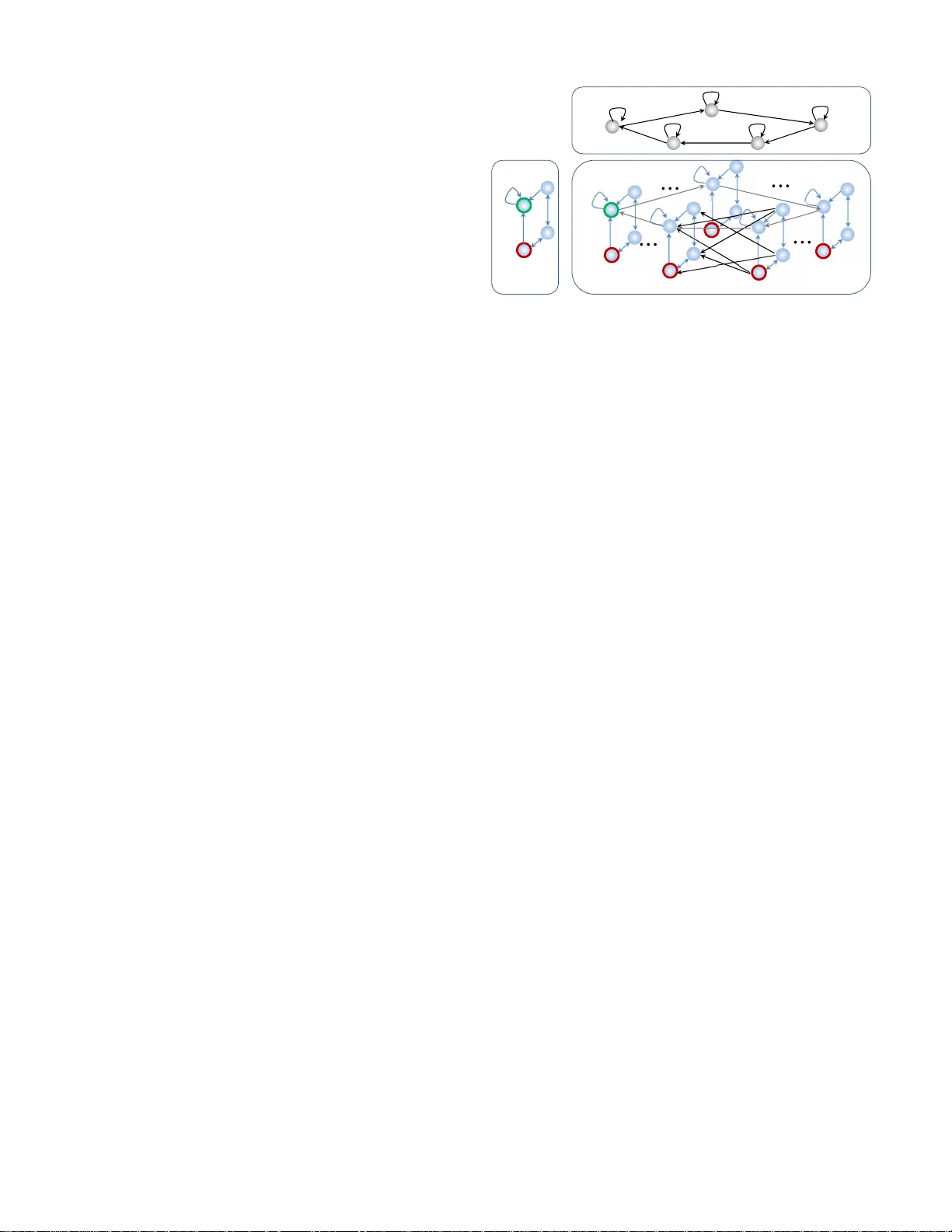
1 Minimal Suf ficient Conditions for Structural Observ ability/Controllability of Composite Networks via Kroneck er Product Mohammadreza Doostmohammadian and Usman A. Khan, Senior Member , IEEE Abstract —In this paper , we consider composite networks formed fr om the Kronecker product of smaller networks. W e find the observability and contr ollability properties of the product network from those of its constituent smaller networks. The overall network is modeled as a Linear-Structure-In variant (LSI) dynamical system where the underlying matrices ha ve a fixed zero/non-zer o structure but the non-zero elements are poten- tially time-varying. This appr oach allo ws to model the system parameters as free variables whose values may only be known within a certain tolerance. W e particularly look for minimal sufficient conditions 1 on the observability and controllability of the composite network, which have a direct application in distributed estimation and in the design of networked control systems. The methodology in this paper is based on the structured systems analysis and graph theory , and theref ore, the r esults are generic, i.e., they apply to almost all non-zero choices of free parameters. W e show the controllability/observability results f or composite pr oduct netw orks resulting from full structural-rank systems and self-damped networks. W e pr ovide an illustrative example of estimation based on Kalman filtering ov er a composite network to verify our results. Index T erms – Distributed Estimation, Sensor Networks, Linear Systems, Structural Controllability/Observ ability , Graph Dilation/Contraction, Kronecker Product. I . I N T R O D U C T I O N C ONTR OLLABILITY and observability of network ed systems arise in situations where a group of intercon- nected devices are influenced or observed by an external entity; examples range from classical applications in robotic systems, multi-agent networks, and sensor networks, to more recent emer ging areas that include social netw orks, Internet-of- Things (IoT) and Cyber-Physical Systems (CPS) [2]–[9]. In all of these applications, there is a layered network that connects individuals and objects leading to a significant interest in composite networks [10]–[14]. The main theme in these w orks is to inv estigate the observability and controllability of large- scale networks resulting from the pr oduct of smaller networks. T wo main network products that arise in real applications are Mohammadreza Doostmohammadian is with the Mechanical En- gineering Department at Semnan Uni versity , Semnan, Iran, email: doost@semnan.ac.ir . Usman A. Khan is with the Electrical and Com- puter Engineering Department at Tufts University , Medford, USA, email: khan@ece.tufts.edu . The work of UAK has been partially supported by NSF under awards #1350264, #1903972, and #1935555. 1 W e emphasize that a minimal sufficient condition is not necessarily a necessary and sufficient condition. In fact, it implies that among all suf ficient conditions that may result in an ev ent, this condition is the least conservativ e but usually is not necessary; see [1] for details. 36 Gr aph Pr o d u c t s Cartesian pro duct Direct pro duct P 4 P 3 P 4 P 3 Strong pro duct FIGURE 4 .1 E xa mples o f p r o ducts. The dir e c t p r o du ct of G an d H is the g r a ph, deno ted a s G × H , w hose v e rt ex set i s V ( G ) × V ( H ), and f or whic h v ertices ( g, h )a n d ( g ,h ) are ad j a cen t p reci sel y i f gg ∈ E ( G ) an d hh ∈ E ( H ). Th us , V ( G × H )= { ( g, h ) | g ∈ V ( G )a n d h ∈ V ( H ) } , E ( G × H )= { ( g, h )( g ,h ) | gg ∈ E ( G )a n d hh ∈ E ( H ) } . F i gu re 4. 1 ( cen t e r) sh o w s t h e d i rect p r o d u c t P 4 × P 3 . N ot i c e t h a t t h i s p art i c u l ar exam p l e is disco nnected. O ther na mes f o r the d ir ect pr o duct t ha t h a v e a pp ea r e d in t he liter a t ur e are t e n s or pr o du c t , Kr on e cker pr o d u ct , c ar din al pr o du c t , r elat ion al pr o d u c t , cr os s p r o du ct , c o n j u n ct ion , we ak dir e c t p r o du ct , Car t es ian pr o d u c t , pr o du c t ,o r ca t eg o r i ca l p rod u c t . F rom t h e p oi n t of vi ew of cat e gory t h eory , o n l y pr o du c t an d ca t eg o r i ca l p rod u c t are ap p rop ri at e. F o r d etails, s ee p. 54. Fina lly , t he str o ng p r o d uct of G an d H i s t h e grap h d en ot ed as G H , a nd defined b y V ( G H )= { ( g, h ) | g ∈ V ( G )a n d h ∈ V ( H ) } , E ( G H )= E ( G H ) ∪ E ( G × H ) . Occasi on al l y on e a l s o e n c ou n t ers t h e n a m e s s t r o n g dir e c t p r o du ct or s y m m e t r ic c om p os it ion fo r t he s t r o n g p r o duct. No te tha t G H an d G × H are su b grap h s of G H . F ig ur e 4 .1 (r ig h t ) s ho ws the s tr o ng pr o duct P 4 P 3 . F or cl ari t y , t h e ed ges o f t h e su b grap h G H are d r a w ni nb o l d . Fig u r e 4 .2 s ho ws o t her e xa mples o f o ur thr e e f unda men t a l pr o ducts. N o t ice t ha t in gen e ral a p ri sm i s t h e C art esi a n p ro d u c t o f a cycl e b y a n e d g e, an d t h e squ are l a t t i ce i s t h e Ca r t esia n p r o duct o f a t w o - sided infinite pa th b y itself. A lso , no te tha t K m K n = K mn . W e can e n v i s i o n t h e ed ges o f t h e Cart esi a n a n d st ron g p ro d u c t s as b e i n g rou gh l y al i g n e d C 5 K 2 Cartesian pro duct Direct Pro duct C 5 × K 2 C 5 K 2 Strong pro duct FIGURE 4 .2 E xa mples o f p r o ducts. © 2011 b y Ta y lor & Francis Group, LLC ࣡ ଶ ࣡ 1 ࣡ 1 ࣡ ଶ × Fig. 1. (Left) The Cartesian product of two line graphs G 1 and G 2 . (Right) The Kronecker product of the same graphs. Cartesian pr oduct and Kronec ker pr oduct 2 . W e refer interested readers to [15] for a better understanding of different graph products. An example of Cartesian product vs. Kronecker product is given in Fig. 1. As it can be seen from the figure, Kronecker product, as compared to Cartesian product, typically results in more complicated composite graphs that may e ven be bipartite in terms of connectivity (see the example in Fig. 1). Different applications of Kronecker composite networks may be found in [16]. W e are particularly interested in the observ ability and controllability of Kronecker composite networks, whereas in contrast most of the related literature studies composite networks via Cartesian products [10]–[14]. The Kronecker composite networks find direct applications in networked control system [17]–[19], distributed Fault De- tection and Isolation (FDI) [20], distributed detection [21], and distributed estimation over sensor networks [22]–[28]. For example, in distributed estimation, the overall distributed system can be considered as Kronecker product of the system digraph and the sensor/estimator network. In this paper, we discuss the structural controllability and observability of the composite networks representing dynami- cal systems. W e assume the underlying dynamical system to be LSI which is pre valent, among others, in social networks [23], [29]–[31]. In LSI systems, the system structure (represent- ing the netw ork) is fix ed while the system parameters (and consequently the link weights in the network) may vary ov er time. In other words, the system dynamics generated from interaction of system parameters is time-in variant while the values of the system parameters may change as free variables. Such LSI systems may also arise in linearization of nonlinear systems [32]. It is known that many properties of such systems are generic, implying that they do not depend on the exact numerical values of system parameters, rather the system 2 Kronecker product of two graphs is also referred to as tensor product or direct product in the literature [15]. 2 structure [33]. Controllability and observability are examples of such properties. The structural controllability is primarily introduced in [34] and further developed in [35]–[42]. In this direction, the concept of structural controllability holds for almost all choices of netw ork link weights [35], while the concept of str ong structural controllability holds for all choices of the system parameters and network link weights [36]–[40]. In case of strong structural controllability , for e xample, see the concept of qualitative class of matrices defined in [36]. The analysis of strong structural controllability is mainly through two key notions: the zero forcing sets [36]–[38], [40], and the constrained bipartite matching 3 [39], [41]. In [36] a one-to-one correspondence between the set of dri ver nodes (the nodes rendering the network controllable) of directed graphs and the zero forcing sets is established. One basic assumption in structural controllability is the independency of all free variables. In this direction, the controllability of undirected networks with symmetric adjacency matrices is studied in [38], [42] as a special case of having dependency in system parameters. The results are particularly of interest as the undirected link in a dynamic network may represent a feedback loop. In [40], the authors explore the strong structural controllability under network perturbations, where they characterize the addition or removal of maximal set of links for which the strong structural controllability is still preserved. In another line of research, Ref. [43] claims that nodal dynamics, not degree distributions, determine the struc- tural controllability of complex networks. The authors define power dominating sets (PDS) and structural control network as key concepts concerning network controllability . Similarly , the work in [44] shows that the minimal number of the inputs/outputs of a system is equal to the maximum geometric multiplicity of its state transition matrix, which is consistent with [43]. The results in [44] are in sharp contrast to minimum controllability/observability problem in some literature, which claim that the sparsest input/output matrix subject to system controllability/observability is NP-hard and e ven impossible to be approximated within a multiplicative factor [44]. Considering the Kronecker composite network G 1 × G 2 , an important problem is to design the network G 1 representing the sensor network or the control actuation network, based on the properties of the network G 2 representing the underlying dynamical system. In this direction, what is missing from the literature, including [10], [11] and references therein, is the effect of network S-rank (or structural-rank) on the composability properties. In this paper, we show that the controllability and observability properties of the Kronecker composite netw ork to a great e xtent depend on the S-rank of the underlying networks and, further , their strong connec- tivity . W e find the minimal conditions to guarantee observ- ability/controllability of the composite network and provide sufficient conditions on the structure of the network G 1 and the observation/input matrix H C . First, similar to [35], we find 3 The constrained bipartite matching is defined o ver bipartite representation of the network. In the bipartite representation, define a t -matching as a set of t links such that no two of them share a node. A t -matching is called constrained if there is no other t -matching with the same matched nodes. For more information refer to [41]. the minimal conditions on the observability/controllability of the general constituent networks, and then extend the results to the product network using structured systems theory . The main results on observability/controllability of the product network are based on the S-rank of the constituent networks and particularly the case of self-damped constituent networks. In particular , for proving our results we adopt the structural methodology in [45]. T o the best of our knowledge, no result in the literature is de veloped on the structural observ ability and controllability of the composite Kronecker product networks, and the fe w related papers study the case of Cartesian product network [10], [11]. W e again remind the reader that the above problem on observ ability/controllability of Kronecker product finds signal processing applications such as in distributed estimation/detection [22]–[27] and control applications in net- worked control systems [17]–[19]. The rest of the paper is organized as follows. In Section II, we state the preliminaries on graphs and structured systems theory and formulate the problem. In Section III, we dis- cuss the main results on minimal conditions for observabil- ity/controllability and extend these results to minimal sufficient observability/controllability of the Kronecker composite net- work in Section IV. In Section V, we provide a representative application in distrib uted estimation. In Section VI, we provide an illustrativ e e xample and simulations. Finally , Section VII states the concluding remarks. I I . P R E L I M I N A R I E S A N D P R O B L E M F O R M U L A T I O N A. Pr oblem Statement In this paper , we consider the composite networks based on Kronecker product, represented by G 1 × G 2 . In the coming sections, we refer to G 2 as the r eplica network with adjacency matrix A 2 ∈ R n × n and G 1 as the factor network with adja- cency matrix A 1 ∈ R N × N . The matrix A 1 ⊗ A 2 ∈ R nN × nN represents the adjacency matrix of the composite network (or network-of-networks as referred by [10]), where ⊗ is the Kro- necker matrix product. W e refer interested readers to [15], [16] for discussion on properties of Kronecker product networks. The replica network G 2 may represent a dynamical system and the factor netw ork G 1 may represent a sensor network or a network of control actuation devices. The structured matrices A 1 ∈ { 0 , 1 } N × N and A 2 ∈ { 0 , 1 } n × n respectiv ely represent the structure (0-1 pattern) of the matrices A 1 and A 2 . The size of the netw orks G 1 and G 2 are respecti vely repre- sented by N and n . The matrix H and H C are, respectiv ely , the measurement/input matrix of the replica network G 2 and of the composite network, G 1 ×G 2 . Their structured representation (0-1 pattern) is denoted by H and H C . In this paper, we define a network G = {V , E } where V and E are the set of nodes and links respectiv ely . ( V i , V j ) is in the set E if there is a link from node V i to node V j . Further , define the neighborhood set of a node V j as N ( V j ) = {V i | ( V i , V j ) ∈ E } . Note that we use the well-known definition for adjacency matrix. The entry A ij of the adjacenc y matrix A is equal to the weight of the link ( V i , V j ) . The diagonal entries of A represent the weights of self-links of the graph G . The problem we study is that giv en the replica network G 2 , what are the sufficient conditions on the factor network G 1 and 3 the measurement/input matrix H C to ensure the structural ob- servability/controllability of the composite network, G 1 × G 2 ? Particularly , we are interested in minimum number of measure- ments/inputs over the composite network. Mathematically , we aim to find the solution for the following problem, Problem 1. argmin A 1 , H C |H C | 0 s.t. ( A 1 ⊗ A 2 , H C ) -observability/contr ollability , (1) where | · | 0 is the standard 0 -norm definition that counts the number of non-zero elements (free entries) in the matrix (or number of 1 ’ s in the structured matrix). Indeed, |H C | 0 represents the number of outputs/inputs of the composite network. W e note here that the observability or controllability constraint on ( A 1 ⊗ A 2 , H C ) is structural , i.e, we derive the results only from the 0-1 pattern (or the structure) of the matrices, H C and A 1 , and not their exact numerical values. In other words, the results we derive are generic and they are applicable to almost all 4 free entries (the entries which are not fixed zeros of the system matrix) in the system matrices as long as the structure is not violated. The parameter values for which the generic results do not hold lie on an algebraic variety of measure zero, see, e.g., [33] for details. In this direction, the networks in this paper may represent LSI dynamical systems, where the system matrix is fixed-structure with possibly time- varying entries. In other words, the system dynamics is in the form ˙ x = Ax where the structure of A is fix ed while its entries may potentially change in time. The only concern is that the time-varying entries do not lie on a certain zero- measure algebraic subspace. It should be mentioned that in this paper we consider the constituent networks to be directed with general non-symmetric adjacency matrices, while con- trollability/observability of undirected networks is considered in [38], [42]. Assumptions: In this paper , we assume the structure of the directed networks G 1 and G 2 to be known and time-in variant. Further , the entries of their adjacency matrices A 1 and A 2 (or the link weights in the networks) are assumed as free v ariables. B. Some Useful Lemmas and Definitions Definition 1. Define the S-rank or structural rank as the maximum numerical rank of the network adjacency matrix over all possible non-zer o entries (or all possible values for the link weights in the network) [46], [47]. In fact, it is kno wn that this is the maximum rank that can be attained over almost all choices of free variables [33]. From this point onwards in the paper , for simplicity , we refer the network as being full S-rank or S-rank-deficient. 4 The term “almost all” mathematically implies that the probability of randomly choosing the free variables for which the specific property does not hold is zero. In other words, the parameter values violating the property lie on an algebraic subspace with zero measure in Lebesgue sense. Therefore, the probability of randomly lying on this subspace is mathematically zero [33]. This random approach is irrespective of the distribution type and holds for any random selection. Lemma 1. A network is full S-rank if and only if it contains a disjoint family of cycles spanning all nodes. Pr oof: The proof directly follows the definition of span- ning cycle family [45] and the proof of Theorem 1 in [46]. Lemma 2. The following holds for S-rank of Kr onecker pr oduct of adjacency matrices of two networks: S-rank ( A 1 ⊗ A 2 ) ≥ S-rank ( A 1 ) · S-rank ( A 2 ) (2) wher e the equality holds for almost all choices of matrices A 1 and A 2 . Pr oof: The abov e lemma directly results from the defini- tion of S-rank as the maximum possible rank of the adjacency matrix. Note that the S-rank is a generic property [33]. Follow- ing the fact that rank ( A 1 ⊗ A 2 ) = rank ( A 1 ) · rank ( A 2 ) [48] and the genericity of the Kronecker product, one can conclude that the equality in (2) holds for almost all choices of matrices A 1 and A 2 . Further , the choices of entries of A 1 and A 2 for which rank ( A 1 ⊗ A 2 ) > rank ( A 1 ) · rank ( A 2 ) lie an algebraic subspace of zero Lebesgue measure in N n -dimensional space. The following is a well-kno wn lemma on (structural) ob- servability/controllability of networks and is originally taken from [45]. Lemma 3. A network is (structurally) observable/contr ollable if and only if the following conditions hold: (i) output/input-connectivity : every node in the network is a be gin/end-node of a connected path to/fr om an output/input. (ii) S-rank recovery : there exist a disjoint family of cycles and output/input-connected paths spanning all nodes in the network. Pr oof: The detailed proof for structural controllability is giv en in [45], and one can easily extend the proof to dual notion of structural observability . The following lemma gives a restatement of condition (ii) in Lemma 3. Lemma 4. The condition (ii) in Lemma 3 reco vers the S- rank of the network. F or e xample in case of observability , if S-rank ( A 2 ) < n the condition (ii) on the (structured) observation matrix H is equivalent to the following: S-rank A 2 H = n. (3) Pr oof: The proof can be found in [14]. In the line of abov e results on structured systems theory a very related concept is self-damped network (system) defined as follows: Definition 2. Define the self-damped network as a network having self-links (or self-cycles) at every node [39]. I I I . M I N I M A L C O N D I T I O N S F O R ( A 2 , H ) - O B S E RV A B I L I T Y / C O N T R O L L A B I L IT Y T o solve the Problem 1, we first need to find the minimal outputs/inputs for observability/controllability of the replica 4 network G 2 . Mathematically , we solve the follo wing problem in this section, Problem 2. argmin H |H| 0 s.t. ( A 2 , H ) -observability/contr ollability . (4) T o solve this problem, we borrow some definitions and con- cepts from our previous works [26], [49]. Similar definitions are introduced in [35]. W e define specific components in the network, which are in volved in the observability/controllability of networks as follows. Definition 3. A Str ongly Connected Component (SCC) is de- fined as a component in whic h every node is connected to every other node via a dir ected path. Define a Str ongly-Connected (SC) network as a network in which there is a dir ected path fr om every node to every other node, i.e., the entire network makes one SCC. In a non-SC network, define a parent SCC as a SCC having no outgoing links to nodes in any other SCC. Similarly , a child SCC is defined as a SCC with no incoming links fr om nodes in other SCCs. Further , S p = {S p 1 , S p 2 , . . . } and S c = {S c 1 , S c 2 , . . . } r espectively r epresent the set of par ent SCCs and child SCCs in the network, and the partial or der 5 is defined as S c i ≺ S p j . The SCCs and their partial order are specifically related to the output/input-connectivity condition in Lemma 3 as stated in the following. Theorem 1. Let S-rank ( A 2 ) = n . F or observability/contr oll- ability of G 2 , it is necessary and sufficient to measur e/contr ol one node in every parent/c hild SCC, i.e., for minimum observ- ability |H | 0 = |S p | and for minimum contr ollability |H| 0 = |S c | , where | · | r epr esents the cardinality of the set. Pr oof: The proof follo ws from the conditions in Lemma 3. The network being full S-rank implies that the condition (ii) in Lemma 3 is satisfied. For condition (i) ev ery node must satisfy output/input-connectivity . W e state the proof for observ ability and it can be easily extended to controllability . Sufficiency : Consider one node measurement in ev ery par- ent SCC. Follo wing the definition of SCC, all nodes in the same parent SCC hav e a connected path to the outputs. Further , based on the definition, for ev ery non-parent SCC for example a child SCC S c i , there exist a parent SCC S p j for which S c i ≺ S p j ; this implies that there is a path from all nodes in S c i to nodes in S p j , which are output-connected and output-connectivity of nodes in S c i follows. This holds for ev ery non-parent SCC, as it has a path to (at least) one parent SCC and thus is connected to (at least) one output. Necessity : Assume that there is only one parent SCC S p j with no output. Following the definition of a parent SCC, there is no path from nodes in S p j to any other measured SCC or any direct measurement, violating condition (i) in Lemma 3. 5 Among SCCs, the partial order is defined as having incoming links (or a sequence of links) from other SCCs, i.e., S a ≺ S b implies that there is (at least) a link/path from a node in S a to a node in S b . Since one measurement from one node in every parent SCC is necessary and sufficient, the minimum number of non-zero entries in H is equal to number of parent SCCs |S p | in the network; and the theorem follows. A very important concept is irreducibility of the adjacency matrix defined as follows, Definition 4. An irr educible matrix is such that it cannot be transformed into block upper-triangular or block lower- triangular by simultaneous r ow/column permutations. A matrix that is not irreducible is r educible. The concept of strong-connectivity and irreducibility are related according to the following: Lemma 5. F or a SC network G , its adjacency matrix A is irr educible. Pr oof: The proof is giv en in [45]. T o better understand the structure of an irreducible matrix we provide an example. For a typical n × n irreducible matrix, there exists a sequence of n non-diagonal nonzero entries that share no row and no column [45]. In a graph-theoretic perspectiv e, this sequence represents a path that spans all nodes in the associated graph. For example an irreducible matrix with 4 components may have the follo wing structure: A 14 A 21 A 32 A 43 Lemma 6. F or a self-damped network G with adjacency matrix A , the output/input connectivity condition for observ- ability/contr ollability r ecovery is that every parent/c hild SCC is measured/contr olled. Pr oof: The key point is that the self-damped network G contains a disjoint family of self-c ycles spanning all nodes, and therefore from Lemma 1 its structured adjacency matrix A is full S-rank. Then, following similar procedure as in proof of Theorem 1, measuring (at least) one state in e very par- ent SCC recovers output-connectivity for observ ability , and controlling (at least) one state in every child SCC recovers input-connectivity for controllability , The idea for Lemma 6 is taken from the proof methodology in chapter 1 in [45]. For a self-damped network G , all diagonal entries of adjacenc y matrix A are non-zero. A path from a node i to a node j in network G represents a sequence of non- zero entries in its adjacency matrix A from diagonal entry A ii to the diagonal entry A j j , as illustrated in Fig. 2. Note that the non-zero entries represent the weights of the links in the sequence of nodes from node i to node j . One may adopt this approach to easily check the output/input-connectivity of the structured adjacency matrix A . Note that, this fact can be generalized for irreducible block diagonals of the adjacency matrix. A non-SC network can be transformed into a block triangular form with irreducible block diagonals, each block representing a SCC, and lower diagonal blocks, defining the partial order of SCCs. For the illustrati ve e xample in Fig. 2, the diagonals A ii , A kk , A ll , and A j j may represent an irreducible 5 ⋱ ⋱ ⋱ ⋱ ⋱ Fig. 2. This figure shows the procedure to check the output/input- connectivity via the nonzero pattern of the network adjacency matrix. This matrix may represent a self-damped network with non-zero diagonal entries, or block triangularization of adjacenc y matrix of a non-SC network with irre- ducible block diagonals. A sequence of nonzero entries/blocks between A ii and A j j as shown in the figure represents a path between two nodes/SCCs i and j in the network. The input-connectivity of node/SCC i implies the input- connectivity of all nodes in the path from node/SCC i to j , and, similarly , the output-connectivity of node/SCC j implies that all nodes in the path from node/SCC i to j are connected to the output. block (a SCC); A ki and A j l represent a block with at least one non-zero entry . For this example, the partial order of SCCs is defined as S c i ≺ S k ≺ S l ≺ S p j . Lemma 7. All par ent and child SCCs are disjoint and share no nodes. Pr oof: As proved in [50] all SCCs obtained from a SCC decomposition (including the parent and child SCCs) are disjoint. This lemma holds generally for all SCCs irrespective of their partial order . Note that, the input/output-connectivity of SCCs are related to condition (i) in Lemma 3. For condition (ii), other than SCCs, graph notions and components regarding the S-rank deficiency of networks are inv olved in the observ- ability/controllability . Definition 5. F or a network, define a maximum matching M as the maximum size set of links that share no common nodes. A node is matched for observability/contr ollability if it is end/be gin node of a link in M ; otherwise, it is unmatched. It is known that the unmatched nodes are not unique, in general. The set of all possible unmatched nodes for observability/controllability is represented by new components described as follows. Definition 6. Define a dilation as a subset of nodes F such that |N ( F ) | < |F | ; where the neighborhood N ( F ) is the set of all nodes V i , which are the begin nodes of links to nodes V j in F , i.e., N ( F ) = {V i | ( V i , V j ) ∈ E , V j ∈ F } . Similarly , de- fine a contraction as a subset of nodes F such that |N ( F ) | < |F | , wher e N ( F ) = {{V j | ( V i , V j ) ∈ E , V i ∈ F } Roughly speaking, contractions are in volved with the sub- graph in which more number of nodes are linked/contracted tow ards less other nodes. Similarly , in a dilation less number of nodes are linked/dilated to more other nodes. It is known that all nodes in the same dilation/contraction are equiv alent for controllability/observability , and therefore, one unmatched node from e very contraction/dilation is necessary and suf fi- cient for S-rank recovery [51], [52]. In this direction, define the set C = {C 1 , C 2 , . . . } and D = {D 1 , D 2 , . . . } as the set of all contractions and dilations, respectively . In general, the sets D and C are unique and, further , the contractions/dilations are not disjoint and may share nodes [52]. Theorem 2. F or observability/contr ollability of SC net- work G 2 , it is necessary and sufficient to measur e/contr ol every unmatched node in the network contractions/dilations, i.e., for observability |H | 0 = |C | and for contr ollability |H| 0 = |D | . Pr oof: The proof is gi ven in our previous work [23], [52] for observ ability . In fact, for any choice of maximum matching, there is one unmatched node in every dilation and similar statement holds for contractions. This directly follows the definition of contraction/dilation. Further, in case two dilations/contractions share a node, controlling/measuring the shared node recov ers the S-rank by one [52], [53]. Therefore, for full S-rank recovery one node in every dilation/contraction must be controlled/measured. From Theorem 2 and Lemma 4 one can conclude that having an observation/input at e very unmatched node recov ers the S-rank; in terms of observability: S-rank A 2 H = n. and in terms of controllability: S-rank ( A 2 |H ) = n. Although in Theorem 1 the results are giv en for S-rank ( A ) = n , one can easily restate Theorem 1 based on the abov e equations. Similar statement holds for Theorem 2. In other words, having the observations/inputs according to Theorem 1 for output/input-connectivity (instead of having SC network), the S-rank can be reco vered according to Theorem 2. Similarly , having the observations/inputs according to Theorem 2 for S- rank recovery (instead of having full S-rank network), the input/output-connectivity can be recovered via Theorem 1. Howe ver , some inputs/observations may recover both con- ditions. Combining Theorems1 and 2, one can deduce the following corollary . Corollary 1. In general, contractions/dilations may shar e nodes with SCCs. Ther efor e, from Theorems 1 and 2, the minimum number of non-zer os in H for observability is, |H| 0 = |S p | + |C | − min( |S p ∩ C | ) (5) and for controllability , |H| 0 = |S c | + |D | − min( |S c ∩ D | ) (6) wher e |S p ∩ C | (respectively |S c ∩ D | ) repr esents the number of par ent SCCs and contractions (r espectively child SCCs and dilations) that share nodes. The abov e corollary generalizes the results in previous work by the authors [23], [49]. In [49], we introduced the 6 concepts of parent SCCs for observ ability recovery and output- connectivity in networked estimation, while in [23] the con- cepts of contractions and maximum matching are adopted for S-rank recov ery . Similar results are stated in [35], where the concepts of non-bottom/top linked SCCs , left/right-unmatched nodes , and maximum bottom/top assignability index are in- troduced. As compared to [35], Theorems 1 and 2 and Corol- lary 1, using dilations/contractions which contain all equi valent nodes in terms of controllability/observability , provide all set of nodes satisfying minimal controllability/observ ability , while [35], using right/left-unmatched nodes, giv es only one minimal set. Note that state nodes in contractions/dilations are all equiv alent in terms of observability/controllability . This is particularly of interest, as using the results of our work, one can choose the minimal-cost set of measurements/inputs among all possible options. Recall that, measuring/controlling the shared node between a parent/child SCC and a con- traction/dilation recovers both conditions in Lemma 3. W e refer interested readers to [54] for examples of S-rank- deficient networks with specific structures containing contrac- tions/dilations. I V . M A I N R E S U LT S In the previous section, we derive the minimal conditions to solve Problem 2. These conditions are required to find the solution for Problem 1. Assuming the conditions in Theorem 1 and Theorem 2 (or Corollary 1) are satisfied, we extend the results to sufficient conditions to solve Problem 1. Theorem 3. Let S-rank ( A 2 ) < n and H includes the mini- mum measurements/contr ol-inputs for S-rank reco very of A 2 (accor ding to Theor em 2). Then, |H C | 0 for S-rank reco very of ( A 1 ⊗ A 2 ) is minimized if S-rank ( A 1 ) = N . Further , for a self-damped network G 1 , a sufficient condition on the matrix H C to r ecover the S-rank is that H C = I N ⊗ H , wher e I N is the N by N identity matrix. Pr oof: Let S-rank ( A 2 ) = m < n . Based on Lemma 2, S-rank ( A 1 ⊗ A 2 ) ≥ S-rank ( A 1 ) · m. Follo wing Lemma 4 for S-rank recovery , H C must be designed such that S-rank A 1 ⊗ A 2 H C = N n. Noting that ev ery non-zero entry in H C may recover (at most) one S-rank deficiency of A 1 ⊗ A 2 and from Lemma 2, we have min( |H C | 0 ) = min( N n − S-rank ( A 1 ⊗ A 2 )) = N n − max( S-rank ( A 1 ⊗ A 2 )) ≤ N n − max( S-rank ( A 1 ) S-rank ( A 2 )) ≤ N n − max( S-rank ( A 1 )) m. Therefore, to minimize |H C | 0 we need S-rank ( A 1 ) = N , which results in min( |H C | 0 ) ≤ N ( n − m ) . (7) From Lemma 2 the equality in equation (7) holds for almost all choices of A 1 and A 2 , i.e., for almost all cases of network products we have min( |H C | 0 ) = N ( n − m ) . T o prove the second part, we borrow the ideas from the structural methodology in [45]. From Lemma 4, we hav e S-rank A 2 H = n. Let A 1 = [ a 1 , a 2 , . . . , a N ] , where [ a i ] represents a column of A 1 . From Lemma 1, network G 1 being self-damped implies that S-rank [ a 1 , a 2 , . . . , a N ] = N and S-rank [ a i ] = 1 , i = { 1 , . . . , N } . Therefore, from the definition of S-rank and from Lemma 2, we have S-rank [ a i ] ⊗ A 2 H = n. (8) From another perspective, since the i th entry of column [ a i ] is non-zero and follo wing the definition of the Kronecker product, the i th n × n block of the nN × n matrix [ a i ] ⊗ A 2 represents the matrix A 2 . W e note that H recovers the S- rank of A 2 ; this is a sufficient condition for S-rank recovery of [ a i ] ⊗ A 2 . Based on the Kroneck er product definition, the struc- ture of A 1 ⊗ A 2 is obtained as a side by side con- catenation of matrices [ a i ] ⊗ A 2 , i = { 1 , . . . , N } , where S-rank [ a 1 , a 2 , . . . , a N ] = N . Having G 1 as a self-damped network implies that the i th diagonal block of [ a 1 , a 2 , . . . , a N ] ⊗ A 2 is A 2 . Therefore, the i th block of I N ⊗ H recov ers the S-rank of i th block of A 1 ⊗ A 2 as a sufficient condition, i.e., S-rank [ a 1 ] ⊗ A 2 [ a 2 ] ⊗ A 2 . . . [ a N ] ⊗ A 2 H 0 0 0 H . . . . . . 0 . . . . . . . . . . . . 0 0 0 H = N n, where the above can be compactly written as S-rank A 1 ⊗ A 2 I N ⊗ H = N n. Theorem 3 implies that giv en a rank-deficient sys- tem A 2 (associated with the replica network G 2 ) when the S-rank ( A 1 ) < N (i.e., the factor netw ork G 1 is rank- deficient) more number of observ ations of the composite network are required. W e further remind the reader that H C = I N ⊗ H is a sufficient condition for observability of the composite network G 1 × G 2 . Theorem 4. Let S-rank ( A 2 ) = n and H includes the minimum measur ements/control-inputs for output/input-connectivity of G 2 (accor ding to Theor em 1). T o minimize |H C | 0 for output/input-connectivity of ( G 1 × G 2 ) , it is sufficient that G 1 is SC and self-damped. Then, |H C | 0 = |H| 0 . Pr oof: The structural approach for the proof is based on the ideas from the methodology in chapter 1 of [45]. W e prov e the case for observability and the dual case of controllability similarly follows. The minimal number of measurements for observability of composite network G 1 × G 2 is equal to the 7 ⋱ ⋱ ⋱ ⋱ ⋱ ⋱ ⋱ ⋱ ⋱ ⋱ ⋱ ⋱ ⋱ ⋱ ⋱ ⋱ Fig. 3. This figure sho ws the structure of A 1 ⊗ A 2 . Based on the definition of Kronecker product, each block represents the structure of A 2 , including an irreducible sub-matrix A ii (a child SCC in G 2 ) connected to an irreducible sub-matrix A j j (a parent SCC in G 2 ). The blocks are mapped based on the irreducible and self-damped structure of A 1 . The irreducible sub-matrices in blocks of A 2 make a larger irreducible block via the path shown by the dashed arrows, thus, making a larger irreducible block (by proper row and column permutations) which represents a larger parent SCC in the Kronecker composite graph. number of measurements for observability of G 2 according to Theorem 1, i.e., min( |H C | 0 ) = |H| 0 . It is sufficient to prove that for self-damped and SC network G 1 , we have |H C | 0 = |H| 0 . Based on the results of Corollary 1, the matrix A 2 being full-rank implies that |H| 0 = |S p | , and therefore, it is suf ficient to prove that |H C | 0 = |S p | . Since G 1 is self-damped, the non-v anishing main diago- nal blocks in the adjacency matrix of Kronecker composite network, A 1 ⊗ A 2 , are reducible structured matrices having the structure of A 2 . This is because, based on the Kronecker product definition, multiplying each scalar entry in A 2 does not change its structure A 2 . Assume in G 2 a child SCC S c i connected via a path to a parent SCC S p j , i.e., S c i ≺ S p j . Then, according to Fig. 2, in the structured matrix A 2 there is a sequence of non-zero blocks from i th irreducible diagonal block to j th irreducible diagonal block. Further , the non-diagonal blocks of A 1 ⊗ A 2 are mapped based on the irreducible structure of A 1 , see Fig. 3. Following the results of Lemma 5, there exists a sequence of non- diagonal blocks in A 1 ⊗ A 2 , each having the structure of A 2 , sharing no hyper-ro w and no hyper-column 6 . As illustrated in Fig. 3, the irreducible sub-blocks of parent SCC S p j in each A 2 block makes a strongly-connected path with each-other via the irreducible structure of A 1 . This implies that by proper permutation of ro ws and columns of A 1 ⊗ A 2 , one can find a larger irreducible block representing a larger SCC in G 1 × G 2 . Note that this SCC has no outgoing links and therefore represents a parent SCC in the composite graph G 1 × G 2 . This generally holds for any type of SCCs in G 2 , i.e., having a self- damped and SC network G 1 , for any SCC in the network G 2 , there exists a larger SCC in the composite network G 1 × G 2 , while the partial order follows the partial order of SCCs in G 2 . 6 By a hyper-ro w we refer to a n by nN row matrix made by block matrices A 2 in the Kronecker matrix A 1 ⊗ A 2 . The definition of hyper- column similarly follows. Therefore, according to Theorem 1, the number of sufficient measurements for observ ability of the composite network is equal to the number of parent SCCs in G 1 × G 2 , which is equal to the number of parent SCCs in G 2 , i.e., |H C | 0 = |S p | . It should be noted that although Theorem 4 is stated for full S-rank networks, one can easily restate and prove the theorem for S-rank-deficient networks possessing all the measurements/control-inputs for S-rank recovery according to Theorem 2. In other words, Theorem 4 holds for either a full S-rank network or a S-rank-deficient network with measure- ments/inputs satisfying conditions in Theorem 2. In such case, one can reduce |H C | 0 by measuring/controlling the shared node between a parent/child SCC and a contraction/dilation. It should be noted that although Theorems 3 and 4 consider the self-damped condition for factor network G 1 , this is a typical assumption in distributed estimation literature, e.g., see [25], [27], [49]. This assumption implies that ev ery sensor/estimator applies its own information to dev elop the state estimation of the dynamical system. V . A P P L I C AT I O N I N D I S T R I B U T E D E S T I M A T I O N In distributed estimation a network of sensors/agents, rep- resented by network G 1 , are tasked to monitor a dynamical system, represented by network G 2 based on the partial mea- surements observed by agents. The observability results in this paper finds direct application in single time-scale distributed estimation. Such distributed estimation protocols, as compared to multi time-scale distrib uted estimation as in Kalman consen- sus filters [55], hav e the advantages of lo w communication on sensors and no constraints on local observability of agents. In this scenario, the structure of the underlying dynamical system dictates the structure of sensor network [51]. The proposed protocol in our previous works [23], [26] is an example application of composite Kronecker network product. The protocol has two steps of pr ediction fusion and observation fusion as follows: b x i k | k − 1 = X j ∈N ( i ) W ij A b x j k − 1 | k − 1 , (9) b x i k | k = b x i k | k − 1 + K i k X j ∈N ( i ) H > j y j k − H j b x i k | k − 1 . (10) where W = [ W ij ] is the adjacency matrix of G 1 , A is the adjacency matrix of G 2 , H j is the measurement matrix at agent j , b x i k | k − 1 is the state prediction at agent i gi ven all the neighboring measurements up to time k − 1 , and b x i k | k is the state estimate at agent i giv en all the neighboring measurements up to time k . The block-diagonal matrix K k = blockdiag [ K 1 k , . . . , K N k ] represents the gain matrix. The error dynamics for the protocols (9)-(10) is as follows [30]: e k = ( W ⊗ A − K k D H ( W ⊗ A )) e k − 1 + q k , (11) where q k collects the noise terms, e i k = x k | k − b x i k | k is the estimation error at agent i , e k is the global estimation error 8 defined as, e k = e 1 k . . . e N k and D H represents the global measurement matrix associated with distrib uted estimation. It is well known that the error dynamics (11) are bounded if the pair ( W ⊗ A, D H ) is observable, also known as distributed observability [23], [26]. The distributed observ ability , in fact, refers to the observability of the composite network G 1 × G 2 , where G 1 and G 2 are respectiv ely associated to matrices sensor communication W and the system matrix A . Follo wing Theorem 3, if the dynamical system A is S-rank- deficient, a full S-rank sensor network minimizes the required number of measurements for distributed observability . Further, if the sensor network is self-damped then for distributed observability it is sufficient that every sensor possesses (in its neighborhood) all the measurements required for observability of the dynamical system. This assumption, for example, is giv en in distributed estimation protocol proposed by [56]. Note that the self-link at each agent implies that each agent uses its own state predictions in equation (9), which is a typical assumption in distributed estimation scenarios. F ollowing The- orem 4, if the dynamical system A is full S-rank, an SC sensor network ensures distrib uted observability . Similar result is used in distributed estimation literature, as in [57]. Further , having an SC self-damped sensor netw ork, Theorem 4 implies that the minimum number of measurements ensuring observability of dynamical system also ensures distributed observability of the distributed estimator (9)-(10). In the same line of research, [58] proposes a distributed estimator to predict the state of networked dynamical system. Sensors take local measurements of the system and share their predictions ov er a network with exact same structure as the networked system. This implies that in the composite network scenario, the structure of the factor network G 1 and the replica network G 2 must be the same. The results of [58] are further extended in [59] where a distributed algorithm for observability analysis of networked system is proposed based on PBH test. Also, some necessary and sufficient conditions on system matrix are gi ven that guarantee the performance of the distributed estimator is equiv alent with the lumped Kalman filter . As a comparison, in the proposed distributed estimator (9)-(10), the sensor network G 1 and the dynamical system G 2 hav e different structures, as we show that the structure of G 1 depends on the S-rank of G 2 . For example, if G 2 is full S-rank, then a sparsely-connected SC network G 1 is sufficient for distributed estimation, while the estimation performance could be improved by adopting more densely- connected sensor networks. In [26], [54], we clearly compare the performance of distributed estimator (9)-(10) with central- ized Kalman filter . W e again recall that here our main goal is the minimal sufficient conditions to ensure observability , while estimation performance is not the focus of this paper and left for future research direction. Finally , it should be mentioned that the results of this paper are not restricted to distributed ࣡ ଶ ࣡ ଵ ࣡ ଵ ൈ ࣡ ଶ Fig. 4. This figure sho ws an e xample of Kronecker product G 1 × G 2 of two graphs. The factor network G 1 is designed such that it is SC and self-damped. The links among two replica networks are shown and the rest of the links are skipped for clarity of the figure. Only the links in volv ed in the main parent SCC of the composite network are shown in gray color . The red-border nodes are observed as sufficient condition for S-rank recovery (Theorem 3), and the green-border node is observed as sufficient condition for output-connectivity (Theorem 4). estimation, b ut also find application in, for example, netw orked control systems and other scenarios mentioned in Section I. V I . I L L U S T R A T I V E E X A M P L E A N D S I M U L A T I O N In this section, we consider a composite graph example and in vestigate its observ ability based on the results of previous sections. Consider the replica network G 2 as shown in Fig. 4. This graph contains two SCCs, among which the self-cycle has no outgoing link and therefore is a parent SCC. The S- rank deficiency of the network G 2 is 1 implying existence of one unmatched node. W e find the unmatched node using the Dulmage-Mendelsohn algorithm [60]. For observ ability , the green-border node in the network G 2 is observed as a parent SCC (Theorem 1) and the red-border node is observed as the unmatched node (Theorem 2). The goal is to design the factor network G 1 to minimize the number of sufficient mea- surements for the observ ability of the Kronecker composite network G 1 × G 2 . According to Theorem 3, for minimal S-rank recov ery , it is sufficient that G 1 is full S-rank. W e consider the network G 1 to be self-damped. Then we hav e H C = I N ⊗ H , implying the observ ation of the unmatched node in every replica network in G 1 × G 2 , as shown by red-border nodes in Fig. 4. According to Theorem 4, for output-connectivity , it is sufficient that the factor network G 1 is SC. Follo wing the results of Theorem 4, there is one parent SCC in the composite network G 1 × G 2 as sho wn in Fig. 4, and the observed node is shown by green-border . The composite network may represent a sensor network monitoring a dynamical system as discussed in Section V. The distributed estimation performance under the proto- cols (9)-(10) is compared with Kalman filter in our previous works [26], [54]. Here, we apply centralized Kalman filter on the composite network representing a linear system as follows: x ( k + 1) = ( A 1 ⊗ A 2 ) x ( k ) + v ( k ) . (12) W e consider initial state x (0) to be random. The entries in A 1 ⊗ A 2 (link weights in G 1 × G 2 ) are considered ran- domly such that the composite system is potentially unstable with ρ = 1 . 93 , where ρ is the spectral radius of the system 9 Iter ation, k 0 10 20 30 40 50 MSE E 10 -4 10 -2 10 0 10 2 10 4 Fig. 5. This figure shows the time evolution of MSEE of the Kalman filtering over the composite network in Fig. 4. matrix. Note that the random link weight consideration is a result of the generic approach adopted in this work, which implies that the observability results hold for almost all v alues of system parameters. W e consider the system noise v ( k ) and measurement noise as N (0 , 0 . 05) and perform simulation ov er 1000 Monte-Carlo trials. The time ev olution of the Mean Squared Estimation Error (MSEE) using the 6 node measure- ments is shown in Fig. 5. Note that although the composite system is potentially unstable, MSEE is bounded steady-state stable implying that the composite system is observable. V I I . C O N C L U D I N G R E M A R K S In this paper , we study the minimal sufficient conditions for observability and controllability of the Kroneck er composite networks based on the S-rank and strong-connectivity of its constituent netw orks. P articularly , the results in Section IV are mainly discussed for full S-rank and self-damped con- stituent networks, which are common assumptions, for exam- ple, in distributed estimation. As a general comment, note that controllability and observ ability are dual concepts and all the results in this paper can be extended to other case by transposing the adjacenc y matrix and re versing the link directions in the network. W e note that the algorithm to find the S-rank of the network is based on Dulmage-Mendelsohn decomposition [60] with computational complexity O ( n 2 . 5 ) . The well-known algorithm for classification of SCCs and defining their partial order is Depth-F irst-Searc h [50] with complexity O ( n 2 ) . The polynomial-order algorithms support the application in large-scale systems. As the direction of future research, optimal design of large-scale sensor networks for distributed estimation and large-scale networked control systems is a promising field of research. R E F E R E N C E S [1] J. L. Mackie, “Causes and conditions, ” American philosophical quarterly , vol. 2, no. 4, pp. 245–264, 1965. [2] J. Gao, S. V . Buldyrev , H. E. Stanle y , and S. Ha vlin, “Networks formed from interdependent networks, ” Nature physics , vol. 8, no. 1, pp. 40, 2012. [3] N. Forti, G. Battistelli, L. Chisci, S. Li, B. W ang, and B. Sinopoli, “Distributed joint attack detection and secure state estimation, ” IEEE T ransactions on Signal and Information Processing over Networks , vol. 4, no. 1, pp. 96–110, 2017. [4] H. Fa wzi, P . T abuada, and S. Digga vi, “Secure estimation and control for cyber -physical systems under adversarial attacks, ” IEEE T ransactions on Automatic Control , vol. 59, no. 6, pp. 1454–1467, 2014. [5] D. Miorandi, S. Sicari, F . De Pellegrini, and I. Chlamtac, “Internet of things: V ision, applications and research challenges, ” Ad hoc networks , vol. 10, no. 7, pp. 1497–1516, 2012. [6] A. Gorod, B. Sauser, and J. Boardman, “System-of-systems engineering management: A revie w of modern history and a path forward, ” IEEE Systems Journal , vol. 2, no. 4, pp. 484–499, 2008. [7] H. Sadreazami, A. Mohammadi, A. Asif, and K. N. Plataniotis, “Distributed-graph-based statistical approach for intrusion detection in cyber -physical systems, ” IEEE Tr ansactions on Signal and Information Pr ocessing over Networks , vol. 4, no. 1, pp. 137–147, 2017. [8] Y . Chen, S. Kar , and J. M. F . Moura, “The internet of things: Secure distributed inference, ” IEEE Signal Pr ocessing Magazine , vol. 35, no. 5, pp. 64–75, 2018. [9] Y . Guan and X. Ge, “Distributed attack detection and secure estimation of network ed cyber -physical systems against false data injection attacks and jamming attacks, ” IEEE T ransactions on Signal and Information Pr ocessing over Networks , vol. 4, no. 1, pp. 48–59, 2017. [10] A. Chapman, M. Nabi-Abdolyousefi, and M. Mesbahi, “Controllability and observ ability of network-of-networks via cartesian products, ” IEEE T ransactions on Automatic Contr ol , vol. 59, no. 10, pp. 2668–2679, 2014. [11] J. F . Carvalho, S. Pequito, A. P . Aguiar, S. Kar, and K. H. Johansson, “Composability and controllability of structural linear time-in variant systems: Distributed verification, ” Automatica , vol. 78, pp. 123–134, 2017. [12] C. Rech and R. Perret, “ About structural controllability of interconnected dynamical systems, ” Automatica , vol. 27, no. 5, pp. 877–881, 1991. [13] K. Li, Y . Xi, and Z. Zhang, “G-cactus and new results on structural controllability of composite systems, ” International journal of systems science , vol. 27, no. 12, pp. 1313–1326, 1996. [14] E. J. Da vison, “Connectability and structural controllability of composite systems, ” Automatica , vol. 13, no. 2, pp. 109–123, 1977. [15] R. Hammack, W . Imrich, and S. Klav ˇ zar , Handbook of pr oduct graphs , CRC press, 2011. [16] J. Leskovec, Dynamics of large networks , Ph.D. thesis, Carnegie Mellon Univ ersity , School of Computer Science, Machine Learning Department, 2008. [17] S. Hu and W . Y an, “Stability of networked control systems under a multiple-packet transmission policy , ” IEEE T ransactions on Automatic Contr ol , vol. 53, no. 7, pp. 1706–1711, 2008. [18] Q. Ling and M. D. Lemmon, “Soft real-time scheduling of networked control systems with dropouts go verned by a marko v chain, ” in American Control Confer ence . IEEE, 2003, vol. 6, pp. 4845–4850. [19] K. Lee and R. Bhattacharya, “Stability analysis of large-scale distributed networked control systems with random communication delays: A switched system approach, ” Systems & Control Letters , vol. 85, pp. 77–83, 2015. [20] M. Dav oodi, K. Khorasani, H. A. T alebi, and H. Momeni, “Distributed fault detection and isolation filter design for a network of heterogeneous multiagent systems, ” IEEE T ransactions on Contr ol Systems T echnology , vol. 22, no. 3, pp. 1061–1069, 2013. [21] F . S Cattivelli and A. H. Sayed, “Distributed detection over adaptive networks using dif fusion adaptation, ” IEEE Tr ansactions on Signal Pr ocessing , vol. 59, no. 5, pp. 1917–1932, 2011. [22] M. Doostmohammadian, H. R. Rabiee, and U. A. Khan, “Structural cost-optimal design of sensor networks for distributed estimation, ” IEEE Signal Processing Letters , vol. 25, no. 6, pp. 793–797, 2018. [23] M. Doostmohammadian and U. Khan, “Graph-theoretic distrib uted inference in social networks, ” IEEE Journal of Selected T opics in Signal Pr ocessing , vol. 8, no. 4, pp. 613–623, Aug. 2014. [24] S. Park and N. Martins, “Necessary and sufficient conditions for the stabilizability of a class of L TI distributed observers, ” in 51st IEEE Confer ence on Decision and Contr ol , 2012, pp. 7431–7436. [25] S. Park and N. Martins, “Design of distributed lti observers for state omniscience, ” IEEE T ransactions on Automatic Contr ol , vol. 62, no. 2, pp. 561–576, 2017. [26] M. Doostmohammadian and U. Khan, “On the genericity properties in distributed estimation: T opology design and sensor placement, ” IEEE Journal of Selected T opics in Signal Pr ocessing , vol. 7, no. 2, pp. 195– 204, 2013. 10 [27] U. Khan, S. Kar , A. Jadbabaie, and J. Moura, “On connecti vity , observability , and stability in distributed estimation, ” in 49th IEEE Confer ence on Decision and Control , Atlanta, GA, 2010, pp. 6639– 6644. [28] M. Doostmohammadian and U. A. Khan, “T opology design in net- worked estimation: a generic approach, ” in American Contr ol Confer- ence , W ashington, DC, Jun. 2013, pp. 4140–4145. [29] N. Friedkin, A structural theory of social influence , vol. 13, Cambridge Univ ersity Press, 2006. [30] M. Doostmohammadian, H. R. Rabiee, and U. A. Khan, “Cyber- social systems: Modeling, inference, and optimal design, ” IEEE Systems Journal , 2019, to appear . [31] J. R. P . French, “ A formal theory of social power , ” Psychological Review , vol. 63, no. 3, pp. 181–194, 1956. [32] J. J. Slotine and W . Li, Applied nonlinear control , Prentice-Hall, 1991. [33] J. M. Dion, C. Commault, and J. van der W oude, “Generic properties and control of linear structured systems: A survey , ” Automatica , vol. 39, pp. 1125–1144, Mar . 2003. [34] C. Lin, “Structural controllability , ” IEEE T ransactions on Automatic Contr ol , vol. 19, no. 3, pp. 201–208, Jun. 1974. [35] S. Pequito, S. Kar, and A. P . Aguiar, “ A framew ork for structural input/output and control configuration selection in large-scale systems, ” IEEE T ransactions on Automatic Control , vol. 61, no. 2, pp. 303–318, 2015. [36] N. Monshizadeh, S. Zhang, and M. K. Camlibel, “Zero forcing sets and controllability of dynamical systems defined on graphs, ” IEEE T ransactions on Automatic Contr ol , vol. 59, no. 9, pp. 2562–2567, 2014. [37] D. Burgarth, D. D’Alessandro, L. Hogben, S. Severini, and M. Y oung, “Zero forcing, linear and quantum controllability for systems evolving on networks, ” IEEE Tr ansactions on Automatic Contr ol , vol. 58, no. 9, pp. 2349–2354, 2013. [38] S. S. Mousavi, M. Haeri, and M. Mesbahi, “On the structural and strong structural controllability of undirected networks, ” IEEE Tr ansactions on Automatic Contr ol , vol. 63, no. 7, pp. 2234–2241, 2017. [39] A. Chapman and M. Mesbahi, “On strong structural controllability of networked systems: A constrained matching approach, ” in American Contr ol Conference , W ashington, DC, Jun. 2013, pp. 6141–6146. [40] S. S. Mousavi, M. Haeri, and M. Mesbahi, “Strong structural control- lability under network perturbations, ” arXiv preprint , 2019. [41] M. Trefois and J. C. Delvenne, “Zero forcing number, constrained matchings and strong structural controllability , ” Linear Algebra and its Applications , vol. 484, pp. 199–218, 2015. [42] T . Menara, D. Bassett, and F . Pasqualetti, “Structural controllability of symmetric networks, ” IEEE T ransactions on Automatic Control , 2018. [43] N. J. Cowan, E. J. Chastain, D. A. V ilhena, J. S. Freudenberg, and C. T . Bergstrom, “Nodal dynamics, not degree distributions, determine the structural controllability of complex networks, ” PloS one , vol. 7, no. 6, pp. e38398, 2012. [44] T . Zhou, “Minimal inputs/outputs for a networked system, ” IEEE Contr ol Systems Letters , vol. 1, no. 2, pp. 298–303, 2017. [45] K. J. Reinschke, Multivariable contr ol, a graph theoretic appr oach , Berlin: Springer, 1988. [46] F . Harary , “The determinant of the adjacency matrix of a graph, ” SIAM Review , vol. 4, no. 3, pp. 202 –210, Jul. 1962. [47] K. Murota, Matrices and matr oids for systems analysis , Springer, 2000. [48] K. Schacke, “On the kronecker product, ” Master’s thesis, University of W aterloo , 2004. [49] M. Doostmohammadian and U. A. Khan, “Communication strategies to ensure generic networked observability in multi-agent systems, ” in 45th Annual Asilomar Conference on Signals, Systems, and Computers , Pacific Grove, CA, Nov . 2011, pp. 1865–1868. [50] T . H. Cormen, C. E. Leiserson, R. L. Rivest, and C. Stein, Introduction to Algorithms , MIT Press, 2009. [51] M. Doostmohammadian, H. R. Rabiee, H. Zarrabi, and U. A. Khan, “Distributed estimation recovery under sensor failure, ” IEEE Signal Pr ocessing Letters , vol. 24, no. 10, pp. 1532–1536, 2017. [52] M. Doostmohammadian, H. R. Rabiee, H. Zarrabi, and U. Khan, “Ob- servational equiv alence in system estimation: Contractions in complex networks, ” IEEE T ransactions on Network Science and Engineering , vol. 5, no. 3, pp. 212–224, 2018. [53] M. Doostmohammadian and U. A. Khan, “On the characterization of distributed observability from first principles, ” in 2nd IEEE Global Confer ence on Signal and Information Processing , 2014, pp. 914–917. [54] M. Doostmohammadian and U. A. Khan, “On the distributed estimation of rank-deficient dynamical systems: A generic approach, ” in 38th International Conference on Acoustics, Speech, and Signal Pr ocessing , V ancouver , CA, May 2013, pp. 4618–4622. [55] R. Olfati-Saber and J. Shamma, “Consensus filters for sensor networks and distributed sensor fusion, ” in 44th IEEE Conference on Decision and Control , Se ville, Spain, Dec. 2005, pp. 6698 – 6703. [56] S. Das and J. M. F . Moura, “Distributed kalman filtering with dynamic observations consensus, ” IEEE Tr ansactions on Signal Processing , v ol. 63, no. 17, pp. 4458–4473, 2015. [57] S. T u and A. Sayed, “Dif fusion strategies outperform consensus strategies for distributed estimation ov er adaptive networks, ” IEEE T ransactions on Signal Pr ocessing, , vol. 60, no. 12, pp. 6217–6234, 2012. [58] T . Zhou, “Coordinated one-step optimal distributed state prediction for a networked dynamical system, ” IEEE T ransactions on A utomatic Control , vol. 58, no. 11, pp. 2756–2771, 2013. [59] T . Zhou, “On the controllability and observability of networked dynamic systems, ” Automatica , vol. 52, pp. 63–75, 2015. [60] A. Dulmage and N. Mendelsohn, “Coverings of bipartite graphs, ” Canadian Journal of Mathematics , vol. 10, pp. 517–534, 1958.
Original Paper
Loading high-quality paper...
Comments & Academic Discussion
Loading comments...
Leave a Comment