5G network slicing using SDN and NFV- A survey of taxonomy, architectures and future challenges
In this paper, we provide a comprehensive review and updated solutions related to 5G network slicing using SDN and NFV. Firstly, we present 5G service quality and business requirements followed by a description of 5G network softwarization and slicin…
Authors: Alcardo Alex Barakabitze, Arslan Ahmad, Rashid Mijumbi
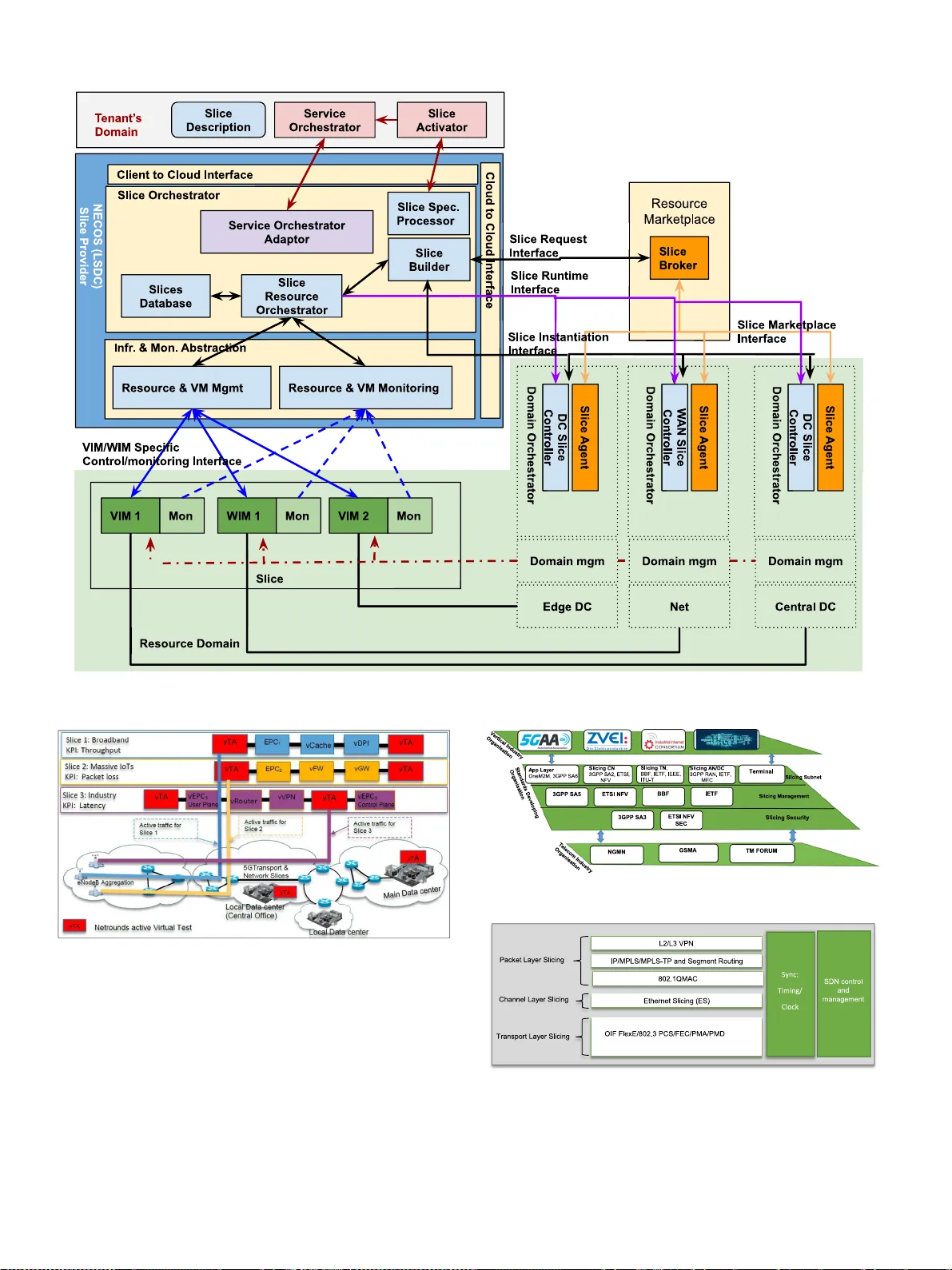
Computer Networks 16 7 (2020) 106984 Contents lists available at ScienceDirect Computer Network s journal homepage: www.elsevier .com/locate/comnet 5G netw ork slicing using SDN and NFV: A surve y of taxonom y , arc hitectures and futur e challenges Alcardo Alex Barakabitze a , ∗ , Arslan Ahmad b , Rashid Mi jumbi c , Andre w Hines d a School of Computing, Electronics and Mathematics, University of Plymouth, UK b IS- Wireless, Pol and c Nokia Bell Labs, Dublin, Ireland d School of Computer Science, University College Dublin, Ireland a r t i c l e i n f o Article history: Rec eive d 21 April 201 9 Revised 1 September 201 9 Accept ed 6 Novem be r 201 9 A vailable online 17 Novemb er 201 9 Key w or d s : 5G SDN NFV Network slicing Cloud/edge computing Network sof twarization a b s t r a c t The increasing consumption of multimedia services and the demand of high-quality services from cus- tome rs has triggered a fundamental cha nge in how we administer networks in term s of abstraction, sep- aration, and mapping of f orwarding, control and management aspects of services. The industry and the academia are embracing 5G as the future network capable to support next gen erat ion ver tic al appli- cations with different service requir ements. To reali ze this vision in 5G network, the ph ysical networ k has to be sliced into multiple isolated logical networ k s of var yi ng sizes and structur es which are ded- icated to different types of services based on their requir ements with different characteristics and re- quir ements (e.g., a slice for massi ve Io T devices, smartphones or a utonomous cars, etc.). Softwarization using Software-Defined Netwo rking (SDN) and Netwo rk Function Virtualization (NFV)in 5G networks are exp ec te d to fill the voi d of programmable control and management of network resources. In this paper , we provide a comprehensiv e rev iew and updated solutions re late d to 5G network slicing us- ing SDN and NFV. Firstly, we present 5G service qua li ty and business requirements follow ed by a descrip- tion of 5G network softwarization and slicing paradigms including essential concepts, history and differ - ent use cases. Secondl y, we provide a tut orial of 5G ne twork slicing technology enablers including SDN, NFV, MEC, cloud/Fog computing, netw ork hy p er v i s or s , virtual machines & containers. Thidly , we compre- hensivel y survey different industrial initiatives and projects that are pushing forward the adoption of SDN and NFV in accelerating 5G network slicing. A comparison of var io us 5G architectural approaches in te rms of practical implementations, technology adoptions and deployment strate gies is presented. Moreov er, we provide a discussion on va ri ou s open source orchestr ators and proof of concepts representing industrial contribution. The work also investigates the standardization efforts in 5G networks re gardin g network slicing and softwarization. Additionally , the article presents the management and orchestration of net- work slices in a single domain followed by a comprehensi ve survey of management and orchestr ation approaches in 5G netw ork slicing across multiple domains while supporting multiple tenants. Furt her- more, we highlight the future challenges and rese arch directions regardin g networ k softwarization and slicing using SDN and NFV in 5G networks. Crown Copyright ©2 0 1 9 Published by Elsevier B.V. This is an open access article under the CC BY-NC -N D license. ( http://creativ ecommons.org/licenses/by-nc-nd/4.0/ ) 1. Introduction The e xponential gr owth of mobile video services (e.g., Y ouTube and Mobile TV ) on smart devices and the adv ances in the Interne t of Things (Io T) have triggered global initiatives towards dev eloping the fifth-generation (5G) mobile and wireless communication sy s- ∗ Corresponding au thor. E-mail address: alcardoalex.barakabitze@pl ymouth.ac.uk (A .A . Barakabitze). tems [1 ,2,3] . The increasing number of smart devices (e.g., tablets and smartphones) and the gro wing number of bandwidth-hungry mobile applications (e.g., live video streaming, online video gam - ing) which demand higher spectral efficiency than that of 4G sys- tems are posing significant challenges in 5G. The Cisco Visual Net- wor king Index (VNI) Forecast [4] predicts that IP video traffic will be 82% of all consumer Internet traffic by 2022, up from 75% in 20 1 7 . Mobile video traffic alone will account for 78% of the global mobile data traffic. While the traffic for virtual/augmented re al ity https://doi.org/1 0.1 01 6/j.comnet.201 9. 1 06984 1 389-1 286/Crown Copyright ©2 0 1 9 Published by Elsevier B.V. This is an open access article under the CC BY - NC- ND license. ( http://creativ ecommons.org/licenses/by-nc-nd/4.0/ ) 2 A .A . Barakabitze, A. Ahmad and R. Mijumbi et al. / Computer Net work s 16 7 (2020) 1 06984 (VR/AR) will increase at a Compound Annual Growth Rat e (CAGR) of 82% between 201 7 and 2022, the traffic growth ra tes of TVs , tablets, smartphones, and M2M modules will be 2 1%, 29%, 49%, and 49%, respectivel y. Such a tremendous gr owth will be the re sul t of 12 . 3 billion mobile-connected devices, which is exp ec te d to even exce ed the wo rld ’s projected population of 8 billion by 2022. A 5G connection is exp e cte d to gene rate 4.7 times more data than that of 4G [4] . With the increasing number of ne w applications be yon d per - sonal communications, mobile devices will probably rea ch hun- dreds of billions till the commercial deployment of 5G networks. The 5G network systems around 2020 and bey ond will need to deliv er as much as 10 0 0 times capacity compared to the current commercial 4G cellular syst ems [2,5] . The Key Performance In- dicators (KPIs) of 5G are expe ct e d to include: bette r , ubiq uitous and increased coverage of almost 10 0 % c overage for “an ytime any- where” connectivity , 10 – 10 0 times higher user data rates, abo ve 90% energy savings, an aggr egate service r eliability and av ailability of 99.999%, an End-to-End (E2E) over -the-air latency of less than 1 ms and low ered electro-magnetic field levels compared to LT E [2,6] . The 5G has been triggered by increasing stro ng demand of a well-connected socie ty conte xt with smart grid and smart cities, critical infrastructure systems such as e-health and telemedicine as well as educat ion sectors which are surging to ex pl oi t the to - tal benefits of wireless connectivity by 2020. While 5G is ex pe ct ed to enable the global economic output of $1 2.3 trillion by 2035 [7] , some of the 5G market drivers include the needs for virtual real it y , rich media services such as video gaming, 4K/8K/3D video, and ap- plications in smart cities, edu catio n and public safety [8] . Industry and academia are embracing 5G as the future networ k that will enable ver ti cal industries with a div erse set of performance and service requir ements. The 5G “theme“ has captured attention and imaginations of researc hers and engineers around the wo rl d with preliminary discussions, debates and a var i et y of que st io n s such as: (a) What will 5G be? [3] (b) What are the potential technology- enablers and requir ements for 5G networ ks? [2] (c) What are the challenges of 5G? [5] , (d) how , and to what ext en t can future 5G networ k management be automat ed to ensure that dif ferent ser - vice requir ements and Experience Level Agreement (ELAs) 1 are ful- filled in the cloud/heter ogeneous-native supported sof twarized en- vironments [1 0, 1 1] ? (e) How to incorporate the driving syst em- level principles (e.g., flexibility and programmability) that will al- low implementing the vision of 5G network/infr astructure/resource sharing/slicing across netw ork softwarization technologies (SDN, NFV, and MEC)? (f) How to allow and perform dynamic and flex- ible creation as well as operational contr ol of both Virtual Net- work s (VNs) and its under lying 5G infras tructure re so urce pool? (g) What is the disruptive network archit ecture that can harness all av ailable network technologies and new services to address the 5G challenges? Although the vision and targets of 5G are clear , the rese arch que st io ns regarding the infrastructure of 5G networks, the en- abling t echnologies, and application scenarios remai n open. This attracts global efforts and initiativ es from government, organiza- tions, academia and important industry for pr oviding innov ative solutions and tackling the critical res earch que st i on s mentioned above . One of the disruptive concepts that could pro vide answers to these que st i on s and re ali ze the 5G vision is networ k slicing (NS) [1 2, 1 3] . With NS, a single 5G phy sical networ k has to be slice d into multiple isolated logical networks of varying sizes and str uctu res dedicated to dif ferent types of services. According to the Global 1 Experience Level Agreements (ELAs): Indicat e a QoE-enabled counter piece to traditional QoS-based Service Level Agreements (SLA) that conve ys the performance of the service in term s of QoE. The ELAs establish a common understanding of an end-user experience on the quality levels whiling using the service [9] . Syst em for Mobile Communications (GSMA) repo rt [1 4] , networ k slicing is an integral component to unlocking the enterprise oppor - tunity amounting to $30 0 billion by 2025 for the 5G era. Net work slicing will give operators capabilities of cr eating different level of services for different enterprise verti ca ls, enabling them to cus- tomi ze their oper ations [1 4] . Howev er , one of the significant que s - tions is how to meet the req uirements of dif ferent vert ic als over 5G netw orks. This paper pr ovides preliminary answers to some of the abo ve open qu e st io ns by giving a comprehensi ve surv ey of 5G networ k slicing using SDN and NFV. 1.1. Re la ted wor k and open questions Follo wing the conception of networ k slicing, different work s in the past ha ve been proposed to identify the potential approac hes, uses cases, architectur es and the huge benefits brought by networ k slicing technology in meeting the demands of ver tic al applications in 5G ne tworks [1 0, 1 6, 1 7 , 1 9,23–29] . Casellas et al. [26] present a control, management, and orches- tration of optical systems. Mu ˜ n oz et al. [25] describ e an inte- grated SDN/NFV-based management and orchestr ation architectur e for dynamic deployment of instances of Virtual T enant Network s (VTN). Richart et al. [1 6] pro vide a review of resou rce slicing in virtual wireless networ k s by analyzing SDN and NFV for networ k slicing. An analysis of 5G network slicing with a focus on the 3GPP standardization process is given in [1 7] . Habibi et al. [30] pro- vide a discussion on the concept and a system archit ecture of networ k slicing with particular focus on its business aspect and profit modeling. The two dif ferent dimensions of profit modeling are discussed including (a) Own-Slice Implementation and, (b) Re - source Leasing for Outsourced Slices. Fouka s et al. [1 9] presented a survey of network slicing in the 5G conte xt and identify some challenges reg arding service-oriented 5G. Yo u s a f et al. [1 0] pre- sented the design of a flexible 5G architectur e for network slic- ing with an emphasis on tec hniques that ultimatel y provide flexi- ble service-tailored mobility, service-aw are Quality of Service (QoS) or Quality of Experience (QoE) control as well as efficient utiliza- tion of substrat e resour ces for slicing. A survey of proposals that exp lo i ts softwarization and virtualization for the netw ork design and functionality implementation of 5G networks is presented by Massimo et al. [23] . While re cen t effort s in [24,28,29] provide the description of 5G networ k slicing in the aspects of SDN/NFV, we note that, these work s are limited in at least one of the following: (1) They pro vide limited revi ew and standardization activities related to 5G netw ork slicing, (2) No comprehensi ve descriptions of ongo- ing re sea rch projects, St at e- of -t h e- Ar t (So tA) efforts and challenges as well as concrete res earch directions on how SDN, NFV and Cloud/edge computing can accelerate and exp lo i t the 5G network slicing transformation with embe dded intellig ent techniq ues, and (3) With rega rd to scope, they do not provide important aspects of SDN and NFV for 5G network slicing such as different archi- tect ural approaches, their implementations and deployment st rate- gies. T able 1 indicates a summary of r elated survey papers on net- work softwarization and 5G network slicing. 1. 2 . Scope and contributions The major objectiv es of this paper are to giv e the re ade r a com- prehensi ve state-of-the-art and updated solutions related to 5G networ k slicing using SDN and NFV. We first provide the 5G ser - vice qual it y and business req uirements, the description of 5G net- work softwarization and slicing concepts and different use cases. We also describe standardization acti vities and differ ent industrial initiativ es and projects pushing forw ard the implementation of 5G networ k slicing. We summarize our contributions as follows: A .A . Barakabitze, A. Ahmad and R. Mijumbi et al. / Computer Net work s 16 7 (2020) 1 06984 3 Ta b l e 1 A Summary of Rel ate d Survey Papers on Network Sof twarization and 5G Network Slicing. Contributions and covered scope [1 5] -201 6 [1 6] -201 6 [1 7] -201 6 [1 8] -201 7 [19] -20 1 7 [20] -20 1 8 [2 1] -201 8 [22] -201 8 [23] -201 8 Our paper -201 9 5G Service Quality Req uirements ✗ ✗ ✗ ✗ ✗ ✗ ✗ 5G Market Drivers & Key Vertical Segments ✗ ✗ ✗ ✗ ✗ ✗ ✗ Network Softwarization ✗ 5G Network s Considerations ✗ ✗ Network Slicing concepts, history and principles ✗ ✗ ✗ ✗ ✗ ✗ Virtualization Hypervisors ✗ ✗ ✗ ✗ ✗ ✗ ✗ Placement of Virtual Res ou rce s and VNFs ✗ ✗ ✗ 5G Network Slicing Standar dization Efforts ✗ ✗ ✗ ✗ ✗ ✗ ✗ ✗ ✗ 5G network slicing PoC ✗ ✗ ✗ ✗ ✗ ✗ ✗ ✗ ✗ 5G Collaborative Projects ✗ ✗ ✗ ✗ ✗ ✗ ✗ ✗ ✗ Orchestr ators fo r Network Slices ✗ ✗ ✗ ✗ ✗ ✗ ✗ ✗ ✗ Multi-Domain Orchestration and Management ✗ ✗ ✗ ✗ ✗ ✗ Single-Domain Orchestration and Management ✗ ✗ ✗ ✗ Network Slicing Management in MEC and Fog ✗ ✗ ✗ ✗ ✗ ✗ ✗ ✗ ✗ RAN Slicing ✗ 5G Network Slicing Archit ectures and Implementations ✗ ✗ ✗ ✗ ✗ ✗ ✗ ✗ ∗∗ Proof of Concepts = PoC . “ ” indicates that the attributes are provided or applicable in the research wo rk. “ ✗ ” indicates that the attributes are unspecified or non applicable in the research wo rk ∗∗ 4 A .A . Barakabitze, A. Ahmad and R. Mijumbi et al. / Computer Net work s 16 7 (2020) 1 06984 Fig. 1. St ru ct ure and organization of the paper . • We describe the prominent service and business req uirements for the upcoming 5G netw ork of 2020 and beyo nd. • We provide an in-depth discussion on networ k softwarization along with use cases and scenarios for 5G netw ork slicing. • We provide a detailed comparison of different SDN/NFV-based archit ectural approaches and their deployment strateg ies for 5G networ k slicing. • We provide a detailed discussion of standardization activities, rese arch pr ojects and results in netw ork and cloud slicing. • We further provide a landscape of 5G network slicing or - chest ratio n and management in 5G single-domain and multi- domain softwarized infrastructures. • We further discuss 5G network slicing challenges and exp l ore key research areas in SDN and NFV for future research. 1. 3 . Pap er structure and organization The re st of this paper is organized as follows: we start our dis- cussion with an introduction to the 5G qu al it y of service and busi- ness requir ements in Section 2 . Section 3 introduces the 5G net- work sof twarization and slicing concept, its history and use cases. In Section 4 we present the cutting-edge technologies for enabling the concep t of slicing on future 5G netw orks. In Section 5 , we ex- plore different architectures and the state-of-the-art on 5G net- work slicing from different academic and industry projects. Then in Section 6 we present the open-source orches trators, proof of concepts (PoC) and standardization activities for 5G networ k slic- ing as re ali ze d today by the industry and different sta ndard bod- ies. We provide the converg ence and the first realization of SDN and NFV for orchestration and management of 5G networ k slices in Section 7 in both single-domain and multi-domain environments. We summarize our main findings in Section 8 in the form of future challenges and possible re sea rch opportunities bef ore concluding our remark s in Section 9 . For a be tte r understanding of the struc - ture and organization of this paper , we refe r the read er to Fig . 1 . T able 2 pr ovides a list of commonly use d acron yms in this paper . 2. 5G service q uality and business requir ements 2. 1 . 5G Service quality r equirements New 5G applications are for eseen to faci litate domains such as M2M, health (e.g., e-health, telemedicine) and educati on sector . Different 5G applications will need dif ferent req uirements for their performance. New wa ys with enhanced capacity (e.g., small cells deployment), intelligent traffic and offload schemes will have to be developed and implemented in order to meet these performance req uirements. Moreov er , the complexity and high degree of heter o- geneity towards 5G also impose the requir ements for autonom ous Fig. 2. 5G service quality & business requir ements [1 ,3,5] . networ k management [3 1] . Although there ar e no detailed specifi- cations and gen eral req uirements of 5G, exploring 5G req uirements (e.g., from users & networ k perspective) as shown in Fig. 2 that de- fine user’s satisf action in the deliver ed services is of crucial impor - tance. 2.2. Data ra te and ultra low-latency The 5G network is exp ec te d to pro vide 1–1 0 Gbs data rate s which are almost ten times of 4G LT E networ k’s theoretical peak data rate of 15 0 Mbps [1] . With this data rates, 5G will be able to pro vide a high level of services with guaranteed end-users service qua li t y and a genuinely ubiquit ous unlimited mobile broadband exp er i en ce s even in crowded areas (e.g., stadiums, cars, trains, con- certs or shopping malls) through terminals enhanced with Artifi- cial Intelligence (AI) capabilities [32] . 5G networks are also envisaged to pro vide almost 10 0 % cov- erage for “an ytime an ywhere” connectivity and a 1ms roun d trip latency for tactile Internet [3 3] . In particular , peak data rates in the order of 10 Gb/s will be requi red to support services such as 3D g aming and mobile telepresence with 3D rendering capa- bilities [3] . The 5G networks will need to support a higher data rate and deliver higher res ol uti on videos with bette r QoE to con- sumers. The red uce d latency and high data ra te in 5G will easily A .A . Barakabitze, A. Ahmad and R. Mijumbi et al. / Computer Net work s 16 7 (2020) 1 06984 5 Ta b l e 2 A list of commonly used acronyms in this paper . Abb. Definition Abb. Definition Abb. Definition 5G Fifth Generation LSDC Lightweight Slice Defined Cloud RLC Radio Link Control ACT N Abstraction and Control of Traffic Engineered Network s M2M Machine to Machine RRM Radio Re so urc e Management B2B Business-to-Business MANO Management and Orchestr ation SaaS Software as a Service B2C Business-to-Customer MdO Multi-domain Orchestr ator SDMC Software Define d Mobile Network Control BSS Business Support System MDSO Multi-Domain Slice Orchestr ator SDMO Software-Defined Mobile network Orchestr ation BSSO Business Service Slice Orchestr ator MEC Multi-Access Edge Computing SFC Service Function Chaining CAPEX Capital Expenditure MIo Ts Massive Internet of Things SG W Service Gateway CC Cloud Computing MO Management and Orchestr ation SLAs Service Le vel Agreements CDNs CDNs Content Distribution Networks MTC Machine Type Communica- tions SRO Slice Re sou rce Orchestr ator C-RAN Cloud RAN MTCP Mobile Transport and Computing Platform SBS Service Broker Stra tu m D2D Device to Device NAT Network Addr ess Tr anslation SDO Stan da rd Developing Organisations DHCP Dynamic Host Configuration Protocol NFs Netwo rk Functions TN Tr ansport Network s DSSO Domain -Specific slice Orchestr ation NFV Network Function Virtualization TOSCA To p o l o g y and Orchestr ation Specification for Cloud Applications EC2 Elastic Compute Cloud NFVIPoP NFVI Point of Presence USDL Uni versal Service Definition Language ELA Experience L evel Agreement NFVO Network Functions Virtualisation Orchestr ator VMN Virtual Mobile Networks ETSI European T elecommunication Stan da rd Institute NGN Next Generation Networks VMS Virtual Machines FoC Fog Computing ONF Open Network Found ati on VNF-FGs VNF Forwar ding Graphs IRTF Internet Researc h T ask Force OPEX operational expenditure VNFs Virtual Network Functions ISPs Internet Service Providers OSS Operations Support Systems VPN Virtual Private Network s ITU International T elecommunication Uni on PG W Packet Data Network Gatew ay VR/AR Virtual/Augmented Re al it y KPR Ke y Performance Req uirements PoP Point of Presence WWRF Wireless Wo r l d Research Forum KQIs Key Quality Indicators QoBiz Quality of Business XCI Xhaul Control Infrastructure LAN Local Area Network RAN Radio Access Network ZOOM Zero-time Orchestr ation, Operations and Management support high-definition streaming from cloud-based technologies and enhanced VR devices such as Google Glass and ot her we ar- able computing devices. It will also provide faster web downloads and enable pr emium user ex pe r ie nc e when deli vering services, for example, Y ouTube videos with high-resolution regardless of access method. 2.3. Enhanced service a vailability , security and mobility The 5G needs to be rob ust enough reliable and resilient net- work to support timel y communications for emergency and public safety . M2M/D2D communicating devices such as smart grid ter - minals, cars, health monitoring devices, and household appliances will be dominant in 5G network. These devices will nee d an en- hanced service av ailability with a high-speed connection to the Internet. While today ’s mobility management prot ocols are highly centralized and hierar chical [34] , 5G network has to cope signifi- cantly with such ext re me situations by providing mobility on de- mand base d on each device and service’s requirement s. Howev er , for the full mobility support, enhancements to the current mobil- ity management procedures are needed. For exa mp le the handover procedures and a topology-a war e gateway selection and r elocation algorithm [35] . The new introduced distributed mobility manage- ment (DMM) [34,36] proposals for 5G seems to be a solution to over come the current mobility manag ement limitations. In ter ms of security , the current 4G network has limited protec- tion needs on users (e.g., data encryption) and network (e.g., strong authentication for billing). This is different in 5G networ k which needs to support new business and trust models, new service deliv ery models with increased privacy concerns and an evolved 6 A .A . Barakabitze, A. Ahmad and R. Mijumbi et al. / Computer Net work s 16 7 (2020) 1 06984 Fig. 3. Summary and tutorial contributions of Section 3 . threat landscape. The 5G networ k will ther efore need to ensur e and have the ability towards defending against security attacks such as Denial of Service (DoS) for critical mission applications such as smart grids, public safety , wa te r distribution and natural gas ne tworks [8,37] . 2.4. Consistency , transparency , user’s QoE personalization and service differentiation Consistency should be the central req uirement for ensuring high level of QoE [38,39] while delivering service to end-users in 5G ecosystem. For 5G to guarantee the re quire d end-user’s QoE, the fluctuations in networ k qu al it y and performance, disruptions and unpredictable interference should be at minimal le vel. 5G net- work s should allow high level of transparency in the ef fort s of de- liv ering services with high QoE to end-users by hiding its com- plexity . The 5G transparent network has to faci litate the “Best ex- perience” for pr oviding an efficient delivery of remote services and data to end-users particularly through cloud data centres hosted by cloud provider’s infrastructur e. Different types of 5G applications will need different QoE re - quir ements. For e xample, va r io us media types ha ve dif ferent set of KPI metrics. In this case, service qu al i ty differentiation and ap- plication type using a personalized QoE management solution are exp ec te d in 5G ecosy stem [40] . Each user’s QoE [38,4 1 ,42] and ser - vice on the 5G network should be well and au tono mou sly man- aged. Fo r such QoE personalization, specific modeling of charging mechanisms reg arding qu al it y levels, purchases, and content for a user/service have to be developed in 5G networ ks. Perso nali z- ing User Interfaces(UI) in the context of Video-On-Demand/Live- T V services to learn from a user’s content consumption patterns can be another approach for QoE personalization on 5G ne tworks [43] . Fort una tely, with the development of cloud computing, real-time computations and large-scale online modeling are a vailable, such as Netfl ix mo vie and Google adv ertising [40,44] . 2.5. Longer battery lif e, seamless user e xperience and cont ext awar e networking A billion of cellular -enable d Io T applications involving a bat- ter y operated sensor networks will be dominant in 2020 and be- yon d. The 5G deplo yment based sensor networ ks will only be pos- sible if their daily operations will guarantee much longer battery life and the re d uce d energy consumption of 5G devices for sev- eral ye a rs [8,45] . With the emerging spectrum bands and the inter -networking among technologies, future 5G networks should be able to deliver and provide a consistent user exp er ie n ce irre- spectiv e of the user’s location while the qua li t y of achiev able la- tenc y and data rate being the KPIs. Moreo ver , 5G solutions should hav e attributes that will enable the ne twork to adapt to the re- quir ements of connected smart devices and applications. 5G should be a netw ork of varying capabilities with an alternati ve small cell, multi-RA T and macro networks, with applications and devices QoE req uirements. 2.6. QoE-based service billing and pricing QoE-based service billing and pricing ar e the requir ements that hav e a strong correlation with the end user’s percei ved qua li ty on 5G systems. The Quality of Business (QoBiz) [46] aspects should be based on well defined QoE-based service billing/charging poli- cies or rules by service providers. For example, a premium IPT V customer who pay s more for a service ex pe ct s a bett er service qua li t y [4 7] . Therefore, providing a QoE differentiation in future 5G networ ks should be concurrently implemented with an appropriate QoE-based service billing and pricing mechanisms that will trans- late directly into the qual it y of business. 2.7. QoE-rich reso urce and energy efficient The base stations (BSs) in 4G LT E networ k s are inefficient be- cause of their operational cost and high energy consumption. They contribute between 60% and 80% of the whole cellular networ k en- ergy consumption [4 8] . While that is the case, mobile video is one of the definitiv e energy intensi ve consuming services from user’s side. The mobile terminals, for example, consume to around 10 % of the tota l energy consume d by the BSs [4 8,4 9] . The rea son is that, a mobile video service needs to cooperate with screen dis- play , video/audio decoder , CPU, and networ k interface. In areas with a high density of users and time va ri a nt traffic patterns, 5G should provide an efficient way to optimize the numb er of ac- tiv e network elements as the traffic grow s/decreases and make the networ k more efficient in terms of energy consumption. The de- ployment of low-cost low -power access nodes such as small cells [50] and relays has been proposed to be an approach to redu ce energy in 5G networ k s. Such an approach wo ul d enable the dy- namic res ourc e allocation management that will avo id wa s ta ge of energy by adopting different network load variations to crucial net- work performance indicators/par ameters while satisfying the end user’s demands. High power consump tion of traditional macro BS hav e trigger ed resear chers and standardization bodies tow ard s de- signing an energy efficient 5G wireless netw orks. Projects such as Energy Aw a r e Radio and neTw ork tecHnology (EARTH) [5 1] Green- To u c h [52] and Gr een 5G Mobile Networks (5GrEEn) [53] ha ve al- read y rea liz ed and pr omoted the valu e of energy-efficient 5G net- work s. 2.8. 5G market driv ers & key vert i ca l segments The industry foresees 5G as the ne twork where different appli- cations and services will be served by a highly integrated and con- figurable network autom atic ally. In the 5G era, users will merely reque st services they need, and the information will be deliver ed to their desired location and device [8,54] without interruptions on service qu a li ty. The 5G netw ork is about enabling new services and devices, connecting ne w indus tries and empowering new user exp er i en ce s. This will entail connecting people and things across a di verse set of ver ti cal segments including (a) Io Ts for smart grid and critical infrastructure monitoring; (b) smart cities for use cases like smart transportation, smart homes and smart building; (c) M- health and telemedicine; (d) autom otive industry for use cases like A .A . Barakabitze, A. Ahmad and R. Mijumbi et al. / Computer Net work s 16 7 (2020) 1 06984 7 Ta b l e 3 A summary of 5G network slicing business rol es and emerging markets . 5G Business Drivers Business Rol es /O bj ect ive s Application providers Offer different applications and services to the end users base d on their demands and qual it y requir ements. Vertical markets Provide different services to third parties that exp lo it re sou rces (network and cloud) specifically from operators and cloud service providers. Service broker To map reques ts coming from application pro viders, VNO and different industry vert ical s to MNO’s resources. Virtual Network Operators (VNO) Wo rk with infrastructure providers to offer their tel eco m services by acquiring the requi red network capacity to customers. Cloud Providers Provide computation and storage res ourc es to third parties including cloud res ourc es such as Amazon web service’s Elastic Compute Cloud (EC2). Infrastructure Providers To provide both physical (hardwar e) and software reso urce s including 5G network connectivity . vehicular Internet/infotainment, cooperativ e vehicles, inter -vehicle information exch an ge ; (e) media and entertainment (e.g., immer - siv e and interacti ve media, cooperati ve production, collaborative gaming). The business roles that are to be fa cilita ted by the up- coming 5G architectur e through network sof twarization and slicing are summarized in T able 3 . 2.9. Summary and lesson learned This section surveys service qu al i ty and business requir ements in 5G netw orks. Requir ements related to service qua li ty include (a) high data rate (e.g., 1–1 0 Gbps connections to end points) and 1 ms E2E ro und trip latency , (b) enhanced service av ailability (e.g., 99.999% av ailability and 10 0 % c overage ), security and mobility , (c) consistency , transpar ency, user’s QoE personalization and service differentiation, (d) seamless user ex pe ri e nc e and context awa r e networ king, (e) QoE-based service billing and pricing, and (f) QoE- rich res ourc e and energy efficient (e.g., up to te n year s battery life for low power and machine-type devices). The 5G networ k busi- ness drivers and ver ti cal segments are summarized in T able 3 . It is important to mention that, new 5G applications and services in 5G netw orks are foreseen to facili tate domains such as M2M, Io T s for smart grid and smart cities, immersiv e/interacti ve media and man y more. The new ve rt ica l applications and services will need different requir ements for their performance. Therefore, new solu- tions with enhance d capacity (e.g., small cells deployment), intelli- gent control and manag ement schemes using netw ork softwariza- tion paradigms will have to be developed in order to meet these 5G performance r equirements. 3. 5G network sof twarization and slicing: Concepts & use cases 3. 1 . 5G network sof twarization Network softwarization is an approach that inv olves the use of software progr amming to design, implement, deploy , manage and maintain network equipment/component s/services [20,55] . Net - work sof twarization aims to deliver 5G services and applications with great er agility and cost-effectiv eness. Along with the r ealiza- tion of 5G netw ork r equirements (e.g., progr ammability , flexibility , and adaptability), networ k softwarization is se t to provide E2E ser - vice management and improve the end user’s QoE [39,56] . Network slicing as-a-service [57] and the ove rall 5G E2E service platform unification will be rea liz e d by netw ork softwarization, and virtual- ization using SDN, NFV and cloud computing technologies. The col- lectiv e expressi ve pow er of softwarization and virtualization tech- nologies are the main driv ers of innovations in the 5G era where developers and operators can qu ic kly build application-a ware net- work s and network -aw are applications to match their business de- mands. In order to achieve ne twork softwarization goals , new de- sign and implementation is neede d in different 5G network seg- Fig. 4. Software network technologies in 5G architecture. A indicates RAN; B = transport networks; C = core networks and D represent s the Internet. ments (e.g., RAN, transport networ k s, core networ ks, mobile-edge networ ks, and network clouds). This is so beca use each segment has different requir ements or t echnical char acteristics and level of softwarization [58] . Fig. 4 illustrates the software network tech - nologies applied in 5G network segments. In the follo wing subsec- tions, we provide an over vi ew of softwarization focusing on RAN, mobile edge networks, core networ k s, and tr ansport ne tworks. 3 .1.1. Sof twarization in mobile edge networks Mobile edge networ k aims to mov e contents, network func- tions, and resources closer to the end-user by extending the con- ventional data-center to the edge of 5G networks. Softwarization in mobile edge networks will be implemented based on the vir - tualized platform that le verage s SDN, NFV and Information-Centric Netw orking (ICN) [59,60] . MEC [61] is a new technology with the main idea of implementing a c onte nt- ori ente d and emb edded in- telligence at the edge in 5G network. Char acterized by high band- width, low latency , location awar eness, and real-time insight radio networ k information, MEC provides cloud computing capabilities to satisfy high-demanding requirement s of 5G suc h as throughput and an improved QoE for the end-users [62] . Through caching con- tent s at the MEC server , a similar concept to ICN, softwarization of MEC in 5G promises to re duc e the vol um e of data transmitted at the 5G core network for processing, enable real-time and applica- tion flow information as well as efficient use of av ailable resources [63] . 3. 1 .2. Sof twarization in cor e netw orks The design of most core networ k s and service plane functions in the era of the 5G network are exp ec te d to be implemented as VNFs follo wing the envisaged SDN/NFV architectural principles. This will make them run in Virutal Machines (VMs) potentially over standard servers enable d on F og/Cloud Computing (CC) en- 8 A .A . Barakabitze, A. Ahmad and R. Mijumbi et al. / Computer Net work s 16 7 (2020) 1 06984 vironments [64,65] . These sof twarization capabilities can be de- ploy ed at different network sites based on specific service requ ire- ments. For ex ample, network slices can use CN and service VNFs based on the requ ire d storage capacity and latency of the re - que ste d service. 3. 1 .3. Sof twarization in tr ansport networks To adapt to the needs of 5G RANs, futur e programmable trans- port networ k s should be implemented as a platform where var io u s user and netw ork services can be accommodated. The design of such sof twarized transport network can be done using appropriate interfaces in SDN/NFV infrastructures. That way, re sou rce discov- ery , and optimization mechanisms can be easily implemented in the 5G control plane [66] . It is important to mention that, a soft- war i ze d 5G transport netw ork will allow for tightly coupled inter - actions with the RAN where aspects such as mobility and load bal- ancing can be coor dinated efficientl y [66] . 3. 1 .4. Programmability considerations in 5G Network programmability is a concept that in volves network softwarization and virtualization using SDN/NFV infrastructure. 5G programmability needs a systematic splitting and abstraction of NFs to cope with the emerging nee ds of 5G network efficiency and reliability , service flexibility and security [66] . 5G programmabil- ity empowers the fast, flexible and dynamic deplo yment of new networ k and management services that can be execu te d as gr oups of VMs in all segments of the networ k (control and manage- ment plane). 5G programmability will fac ilita te the cr eation of 5G ecosyst ems that could benefit different control and management planes intuitivel ynetwork -wide by utilizing open Application Pro- gramming Interface (API) and Sof twar e Dev elopment Kit (SDK). 3.2. 5G network slicing concept, history & principles 3.2. 1 . Network slicing: definition and hist ory Since 1 960s [67] the concept of network slicing has relied heav- ily on virtualization concept s [68] following the first IBM’s operat- ing system (CP-40) design that supported time-sharing and virtual memory . Such a design introduced a system that was able to ac- commodate up to fif teen users simultaneousl y [69] and an indi- vidual could be allow e d to wo rk independently on a separate set of both hardwar e and software [67 ,69] . Since then, the idea of net- work virtualization, where a virtual entity could be created from a physical entity was formed. The vision wa s to span virtual sys- tems across different network resources, computing infrastructur es, and storage devices [6 8] . In the 197 0 s and early 1 980s, network virtualization wa s widely adop ted in data centers where remote sites were connected with a secured and controlled performance through the Internet. In the late 1 980s, overlay netw orks we re proposed where net- work nodes were connected ove r logical links to form a virtual networ k running ove r a common physical infrastructure. Overla y networ ks are an ear ly form of the network slicing concep t since it combines dif ferent resources over var i ou s administrativ e domains while guaranteeing the QoS to the end-users. Although, over lay networ ks are flexible, they lack auto mat ion and programmability features in the network controls. Throughout the 1 990s and in early 20 0 0s, an activ e and programmable network where a node operating syst em can provide res ourc e control framewor ks was proposed. Since then, different platforms and Fed erate d Te s t b e d (e.g., Planet Lab USA (20 02) [70] , PlanetLab EU (20 05) 2 , OneLab EU (20 07) 3 , PlanetLab Japan (20 05), OpenLab EU (201 2) 4 ) where 2 https://www .fed4fire.eu/testbeds/planetlab- europe/ . 3 https://cordis.europa.eu/pr oject/rcn/872 73 _ en.html . 4 https://cordis.europa.eu/pr oject/rcn/1 0 07 40 _ en.html . Fig. 5. The NG MN networ k slicing concept. new networ k protocols can be verified and evaluate d we re estab- lished. For example, PlanetLab [70,7 1] adopted a common software package called MyPLC 5 that enables a distributed virtualization where users can obtain slices for specific applications. In 20 08, a US Nati on al Science Foun dat ion (NSF) 6 project, introduced a GENI [72] testb ed based on network virtualization concepts. The aim was to promo te research on a clean slat e networ k while consider - ing fe derated resources and mobile networ k envir onments. GENI 7 is a shared network testbe d where multiple e xperimenters may be running multiple experiments at the same time. Following this trend, in 20 09, SDN [73] enable d researchers to run experiments in a networ k slice of a campus networ k where capabilities of pro- grammability we re emplo yed through open int erfaces [7 4] . 3.2.2. 5G network slicing principles 5G network slicing was coine d and first introduced by the Next Generation Mobile Network (NGMN) [75] . As defined by the NGMN , a network slice is an E2E logical netw ork/cloud running on a common underlying (phy sical or virtual) infrastructur e, mu- tually isolated, with independent control and management that can be created on demand. A network slice may consist of cross- domain components from separ ate domains in the same or differ - ent administrations, or components applicable to the access net- work , transport networ k, core network, and edge networks. Net- work slices are therefor e self-contained, mutually isolat ed, man- ageable and programmableto support multi-service and multi- tenancy . Fig. 5 represent s the NGMN slice capabilties which con- sists of following three layers [45] :N GMN slice capabilities [45] as shown in Fig. 5 consist s of 3 lay ers as described below: • 5G Service Ins tance Lay er (5GSIL): repr esents different services which are to be supported. A Service Instance represents each service. Typicall y, services can be provided by the networ k op- erator or by third parties. • 5G Network Slice Instance (5GNSI): provides network character - istics which are require d by a 5GSI. A 5GNSI may also be shared across multiple 5GSIs provided by the networ k operat or . The 5GNSI may be composed by none, one or mor e sub-netw ork instances, which ma y be shar e d by ano ther NSI. • 5G Re so u rce La yer (5GRL): It consists of ph ysical resources (as- set for computation, storage or transport including radi o access) and logical r esources (partition of a physical reso urce or group- ing of multiple physical resources dedicated to a Network Fun c- tion (NF) 8 or shared b etween a se t of NFs). 5 https://www .planet- lab.org/doc/myplc- 3.3 . 6 https://www .nsf.gov/ . 7 http://www .geni.net/ . 8 Network Function (NF) is a functional building block within a network infras- tructure, which has well-defined exte rn al interfaces and a well-defined functional beha vior A .A . Barakabitze, A. Ahmad and R. Mijumbi et al. / Computer Net work s 16 7 (2020) 1 06984 9 Network slicing concep t can facilita te multiple logical and self- contained networks on top of a shared physical infrastructur e plat- form [76] . Since then, different standardization bodies have ex- plored the definition of network slicing from a dif ferent perspec- tiv e. The ITU envisag e network slicing as the basic concept of net- work softwarization that facilita tes a Logical Isolated Net work Par - titions (LINP) composed of multiple virtual r esources, isolated and equipped with a programmable control and data plane [77] . The 3GPP [78] defines network slicing as a “technology that enables the operator to create networks, customized to provide optimized solutions for different market scenarios which demand diverse re- quirements (e.g., in ter ms of functionality, performance, and isola- tion)” [79] . From a business perspectiv e, a slice includes a com- bination of all relev ant networ k resources, functions, and assets requi red to fulfill a specific business case or service, including OSS, BSS and DevOps processes. As such there are two types of slices: (a) internal slices, understood as the partitions used for internal services of the provider , r etaining full control and man- agement of them, (b) exte r na l slices, being those partitions host- ing customer services, appearing to the customer as dedicated networ ks/clouds/data-centers. Network slicing can of fer rad io, cloud and networ king resources to application providers or different ve rti ca l segments who have no ph ysical network infrastructure. That way, it enables service differ - entiation by customizing the netw ork oper ation to meet the re- quir ements of customers based on the type of service [80] . Basic principles that encompass network slicing and its related opera- tion on 5G sof twarized networks are the follo wing: [24,7 6,81] : • Autom at ion of network oper ation : Au to m at i on allows dynamic life-cy cle management of networ k slices (e.g., deploying, changing, deleting), optimization of networ k resources (aut o- scaling/migration/aut o-healing) as well as a dynamic interplay between management and data planes [76] . • High-Reliability , Scalability and Isolation : These are the ma jor features of 5G networ k slicing that ensures performance guar - antees and security for each tenant using immediate fault de- tect ion mechanisms for services with different performance re - quir ements [2 1] . • Progr ammability : Pr ogrammability simplifies the pr ovisioning of services, manag eability of networks and integr ation and opera- tional challenges especially for supporting communication ser - vices [83] . For example, it allows third parties to control the allocated slice resources (e.g., networ king and cloud resources using open APIs that expo se ne twork capabilities. This, in turn, facil itates on-demand service-oriented customization and re - source elasticity on 5G softwarized and virtualized networ ks [84] . • Hierar chical Abstraction : Network slicing introduces an addi- tional lay er of abstraction by creating logically or phy sically separate gr oups of network r esources and (virtual) NFs config- urations [75] . This abstr action facili tates service pr ovision fr om a network slice service on top of the prior one. For example, networ k operators and ISP can exp lo it network slicing to en- able oth er industrial companies to use networks as a part of their services (e.g., ver ti cal players like a connected car with the highly reliable netw ork, an online ga me with ultra-low la- tenc y , video s treaming with guar anteed bandwidth, etc.) [1 4] . • Slice customization: Slice cust omization is real ize d at all lay ers of the abstracted network top olo gy using SDN that decouples the data and control plane. On the data plane, NFV capabili- ties describ ed in Section 4.3 provides service-tailored NFs and data forw arding mec hanisms where value-added services can be enabled using Artificial Intellig ence (AI). It is wor th men- tioning that, customization assures network resources allocated Fig. 6. Network slicing use case [82] . to a particular 5G tenant are efficiently utilize d in order to meet the requir ements of a particular service [85] . • Network Resou rce s Elasticity : The elasticity of ne twork re- sources is re al ize d through an effective and non-disruptiv e re-pro visioning mec hanism where the allocated r esources ar e scaled up/down. As such, elasticity ensures that the desired SLA/ELAs of users regardless of their g eographical location is achiev e d [86] . 3.3. 5G network slicing use cases and application scenarios Aligned with the anticipated NGM N industrial vision for 5G as summarized in [75] to address sever al emerging services and busi- ness demands bey ond 2020, the 3GPP initiated a study named New Services and Market Enablers (SMARTER) [9 1] in the 3GPPP Ser - vices Wor king Group SA 1. More than 70 use cases focusing on new marke t segments and differ ent business opportunities that could be launched with the arrival of 5G we re identifie d and grouped into the following main categories summarized in T able 4 . As an example, Fi g. 6 sho ws an application scenario of network slicing. A tenant in this context is define d as a logical entity that own s and operate either one or more Virtual Infrastructures (VIs) or networ k services. That way, it can allocate VIs ove r its substrate networ k and provide multiple L2 network slices to offer services to different tenant s. Each tenant such as a Mobile Virtual Net work Operator (MVNO) own s and operates a networ k slice. In that as- pect, virtual L2 slice 1 is ow n ed by tenant 1 and tenant 2. It is important to note that, oth er tenants can share any tenant’s infras- tructure. The MVNO tenants can, therefore, deploy their netw ork services or allow multiple third-party tenants, for exam ple, over -the-top (OTT) or service providers to instantiate their services on to p of the VI. Following a rec urs ive approach [92] , it is possible to instan- tiate a VI on top of another one. That way, the VI of t enant 2 can be instantiated ove r the VI of tenant 1. As shown in Fig. 6 , the SDN controller maintains and coordinat es tenant’s access to the shared infrastructure and driv e re sou rce allocation for instances that are assigned to dif ferent tenantswhich can enable the deliv- ery of multi-tenancy r elated services using dedicated APIs. Similar to the ETSI NFV MANO proposal, the controller manag es the logi- cal mapping b etw een tenants, assigned services (in terms of VNFs instances) and the underlying virtual resources allocations, in com- pliance with the established ELAs/SLAs [26,85,93] . 10 A .A . Barakabitze, A. Ahmad and R. Mijumbi et al. / Computer Net work s 16 7 (2020) 1 06984 Ta b l e 4 A summary of 5G Network Slicing Use Cases and Application Scenarios . 5G Use Case Contribution/Objecti ves/Functionality Enhanced Mobile Broadband (eMBB) To provide high data rates on 5G systems so as to cope with huge data traffic volumes and UE connectivity per area [87] . Critical Communications (CriC) To fa cilita te mission critical services such as the tactile Internet [33] , public safety , disaster and emergency response [88] and AR/VR. Enhanced Vehicular to Everything (eV2X) Focus es on safety-relat e d services such as rem ote driving, vehicle platooning, autonomous and cooperative collision avoidance by allowing direct vehicular communications [89] . Massive Internet of Things (MIoT) To provide a common communication conenctivity and inter -networking for vari ou s smart devices in the area of smart cities, smart homes and smart farmin g [90] . Fig. 7. A summary and a tutorial contribution of Section 4 . 3.4. Summary and lesson learned This section presents the concepts of networ k sof twarization and slicing including their history and operational principles as summarized in Fig. 3 . We include the softwarization mecha- nisms in mobile edge networ ks, core and transport networ ks us- ing promising technologies such as SDN, NFV and MEC. The ba- sic principles of 5G network slicing include au toma tio n of networ k operation, high-reliability , scalability , isolation, and programmabil- ity , hier archical abstraction and slice cust omization as well as ne t- work resources elasticity . We summarize main groups of 5G net- work slicing and use case scenarios such as that shown in Fig. 6 . We note that, 5G network softwarization and slicing is set to fa- cilitate future network management and orchestr ation of resources from service providers to the end-users. The E2E multi-domain and multi-tenancy support in 5G network slicing promise to provide services across multiple network segments and different adminis- trati ve domains such that one slice can combine resources b elong- ing to distinct infrastructur e providers. Multi-domain aspects in 5G networ k slicing will also enable to unify different netw ork layers and different technologies from RAN, core networ k , cloud transport networ ks [94] . Moreover , the network slicing may enable service oriented networ k auto mat ion via 5G netw ork technology enablers such as SDN, NFV and MEC. A dditionally , ne twork slicing ma y cr e- Fig. 8. A comparison of SDN and networ k operation to day. ate new mark et opportunities for the network pro viders in future such as offering “Networ k as a Service“ to third party. Howev er , it may also cr eate re sea rch c hallenges regarding new techniq ues and algorithms for networ k reso urce management in the virtual- ized networks. 4. 5G network slicing enabling technologies 4. 1 . Sof tware defined networking (SDN) SDN is an approach that brings intelligence and fle xible pro- grammable 5G networ k s capable of orchestr ating and controlling applications/services in more fine-grained and network -wide man- ner [73,95] . The Open Network Founda tio n (ONF) [96] defines SDN as “ the physical separation of the network control plane from the for- wardi ng plane, and where a control plane controls sev eral devices ”. This separ ation results int o flexibility and centralized control with a global vie w of the entir e ne twork. It also provides capabilities of responding rapi dly to changing network conditions, business, mar - ket and end user nee ds. As shown in Fig. 8 , SDN creates a virtu- alized control plane that can enforce intelligent management deci- sions among networ k functions bridging the gap between services pro visioning and network management. With SDN, the network control becomes directl y progr ammable using stand ardiz ed South- bound Interfaces (SBI) suc h as OpFlex [97] , Fo RCES [98] and Open- Flow [7 4] . These stand ards define the communication between for - war ding devices in the data plane and the elements in the con- trol and management plane. The forwarding plane of SDN can be implemented on a specialized commodity server [99] such as VMwar e’s NSX platform [1 0 0] which consists of a contr oller and a virtual switch (vSwitch). How ever , such implementations depend on the performance needs and capacity req uirements of SDN environments. Str i ct ly narrating, the academia, industry and sta ndard bodies suc h as the ONF , the Software Defined Networ king Re se a rch Group (SDNRG) of the Interne t Res ea rc h Ta s k Forc e (IRTF) and the Internet Engineer - ing Ta s k Forc e (IETF) hav e already reali ze d the pot ential of SDN and defined its archit ectural components, interfaces and functional req uirements for the future 5G networks [39] . SDN is set to ad- A .A . Barakabitze, A. Ahmad and R. Mijumbi et al. / Computer Net work s 16 7 (2020) 1 06984 11 Ta b l e 5 A summary of SDN controllers for networ k orches tration and dynamic network slicing. SDN Controller Contributions/Objectives/F unctionality Mobile Central Office Re-arc hitected as a Datacenter (M-CORD) [102] M-CORD is a cloud-native solution that employs SDN, NFV to provide services to carriers deploying 5G mobile wireless networks. The RAN programmability and virtualization acts as a building blocks for E2E slicing in M-CORD. The Open Net work Operating System (ONOS) [103] ONOS can enable the network slicing concept through VNF composition in the central office where tenants can easily create network services using northbound abstractions. OpenDayLight (ODL) ODL is set to provide dynamic services in the era of 5G by optimizing softwarized and virtualized networks in order to meet the continuously evolving service demands from the end-users. Fig. 9. ONF SDN networ k slicing architectur e [86] . dress limitations of the traditional ne tworks (see Fig. 8 ) which ar e ill-suited for the dynamic network configuration, control, and man- agement as well as storage needs for tod ay’s data cent ers, cam- puses, and he terogeneous environments. The SDN par adigm for 5G networ k slicing analysis is elabor ated comprehensiv ely by the ONF [86] . Ev ery SDN client context in the ONF arc hitecture indicates a potential slice as shown in Fi g. 9 . The SDN controller manages networ k slices using a set of rules or policies. The SDN controller facil itates the creation of both server and client contexts as well as the installation of their associated policies [1 2] . In particular , the SDN controller maintains a network slice client conte xt. That way, it allows an SDN controller to dynamically manage networ k slices by grouping slices that b elong to the same context [1 01] . The SDN controller gover ns its slices and performs resou rce orchestr a- tion on the server context. The client context consists of support, client and virtual resources to satisfy an y incoming reques ts from end users. T able 5 shows some of SDN solutions that can support networ k slicing in 5G systems. 4.2. Tr affic management applications for stateful SDN data plane Traffi c management in SDNs is achieved by OpenFlow which pro vides a platform-agnostic programmatic interface between the data plane and control plane. OpenFlo w focuses solely on L2/L3 networ k transport and it dynamically updates the match/action forwarding rules only via the explicit involv ement of an ex te r - nal controller . Although the OpenFlow specification contains mul- tiple flow tables in the OpenFlow pipeline, it cannot maintain state information in the SDN data plane. OpenFlow also relies heav - ily on the SDN controller to maintain the states of all packe ts [1 0 4, 1 05] . Such sta tic nature of the OpenFlow forwarding abstrac- tion could rais e scalability , reliability and security problems in 5G networ k slicing becaus e of the control channel bottleneck and pro- cessing delay impose d between the SDN controller and switches [1 05] . Thanks to the advanced switch interface technologies such as OpenSt ate [1 0 6] , P4 [1 07] , POF [1 08] , Sta te fu l Data Plane Ar - chitectur e (SDP A) [1 09] and SNAP [1 1 0] that provide enhanced stateful forw arding and expo se persistent state on the SDN data plane [1 06] . P4 is a high-lev el languag e for programming pro to- col independent that enables programmers to ch ange the way SDN switches process packet s. The advanced data plane programmability (ADPP) enhances the networ k softwarization capabilities with more agility and flexibility to meet the requir ements of 5G network slicing. The ADPP woul d allow developers to fully exp lo i t the resources of SDN data plane for their 5G networ k applications [ 111 ] . Fur th er mor e, it will sup- port res ourc e slicing and isolation as well as facilitating an effi- cient and automat e d deployment of new 5G network services over the progr ammable SDN data plane. With stateful forwar ding tech- nologies, the ne twork slices of softwarized 5G ar chitecture are re- qui re d to be monitored, controlled and managed independently while supporting diversified protocols and data transport mecha- nisms [ 111 ] . 4.3. Network function virtualization (NFV) NFV [84] is the virtualization of networ k functions (e.g., Fire- walls, TCP optimizers, NAT 6 4 , VPN, DPI) on to p of commodity hardw are devices. NFV envisag es the instantiation of VNFs on com- modity hardwar e. This way, it breaks the unified approach to use software and hardw are that exi st s in traditional ven dor offerings. With NFV, Network Func ti on s (NFs) can be easily deploy ed and dynamically allocated. In addition, network resources can be effi- ciently allocated to Virtual Network Fu nc ti on s (VNFs) through dy- namic scaling to achiev e Service Fun ct ion Chaining (SFC) 9 With software-based NFV solutions, some of the NFs are moved to the Service Providers (SPs) to run on a shared infrastructur e such as gene ral purpose servers. Therefore, adding, removing or updating a function for all or subset of customers becomes much more manageable since chan ges could only be done at the ISP rat her than at the customer premises as being done tod ay . For SPs, NFV promises to provide the n eeded flexibility that wo ul d enable them to scale up/down services to address c hanging cust omer demands, red uce their capital expenditure (CAPEX) and operational expendi- ture (OPEX) through low er -cost agile network infrastructures, de- crease the deployment time of ne w ne twork services to market. In the conte xt of future 5G networks, NFV ensur es optimization of reso urce provisioning to the end-users with high QoS and guar - antee the performance of VNFs operations including minimum la- tenc y and fa ilure ra te. Essentially , it can ensure the compatibility of VNFs with non-VNFs [1 1 3] . To achiev e the above benefits, NFV 9 Service Function Chaining (SFC) is an ordered list of abstract service functions that should be applied to a packet and/or frames and/or flow s selected as a re sul t of classification [1 12] . 12 A .A . Barakabitze, A. Ahmad and R. Mijumbi et al. / Computer Netwo rks 16 7 (2020) 106984 Fig. 10 . An integration of SDN controllers into the ETSI NFV refe renc e architectur e at the two levels re quire d to achieve network slicing. brings three differences on how networ k services are pro visione d compared to tr aditional pr actice as state d in [1 1 4] . • Decoupling of software from h ardwa re platform : Hardw are and software entities in NFV are not integrated, and their functions can progress separatel y fr om eac h other. • Greater fle xibility for network functions deployment : Since sof t- war e ar e detached fr om hardwar e, bo th sof twar e and har dware can perform different functions at var i ou s times. This enables operators to deploy new innovati ve services using the same hardw are platform. • Dynamic network operation and service provisioning : Network operators can introduce tailored services based on customer de- mands by scaling the performance of NFV dynamicall y . It is important to note that, while the full-blown software- based implement ation using SDN and NFV concepts comes with these b enefits, the que st i on is whether the 5G design considera- tions can meet some technical performance req uirements of dif- ferent vert ic als nee ded by T elco Cloud or service providers. A blueprint of the ETSI NFV framewor k is discusse d next. 4.3. 1 . NFV management and orc hestration (NFV MANO) fr amework The NFV concept in operator infrastructures [1 1 5] wa s first exp lo re d by the European T elecommunication St an d ard Institute (ETSI), mostly to address the challenges toward s flexible and ag- ile services and to create a platform for future netw ork monetiza- tion. Since then, the NFV refe ren ce archit ecture shown in Fig. 10 was proposed [1 1 6] followed by a proof of concept (PoC) [1 1 7] . The ETSI MANO framew ork consists of functional blocks which can be grouped into the following categories: the NFV Infr astructure (NFVI), NFV Management and Orchestr ation, Network Management Syst em and VNFs and Services. These entities or blocks are con- nected togeth er using ref eren ce points 10 For a complete descrip- tion of the NFV MANO frame work and its entities, we refer the read er to [39,84, 1 1 4] . Apart from the building blocks of the NFV MANO shown in Fig. 10 , the ETSI proposal includes two SDN controllers in the ar - chitectur e [1 1 8] . Each controller centralizes the contr ol plane func- tionalities and pro vides a ge nera l view of all the connectivity- related components it manages. These contr ollers ar e: • Infrastructur e SDN Controller (ISDNC) : Pro vides the requi red con- nectivity for communicating the VNFs and its components by managing the underlying networ king resources [1 1 9] . As man- aged by the VIM, this controller may ch ange NFV infr astructure beha vior on demand according to VIM specifications adapt e d from tenant reque sts [1 2] . 10 A ref eren ce point defines a point where two communicating functional entities or blocks are connected. Fig. 11 . The role of MEC for 5G network slicing. • T enant SDN Controller (T SDNC) : Dynamically manages the perti- nent VNFs, the underlying forwarding plane resources used to real iz e the tenant’s network service(s). The TSDNC is instanti- ated in the tenant domain [1 2] as one of the VNFs or as part of the NMS. Note that, both controllers manage and control their underlying r esources via programmable southbound interfaces, implementing pr otocols like OpenFlow , NETCONF , and I2RS. 11 Each controller pro vides a different level of abstraction. While the TSDNC provides an ov erlay comprising tenant VNFs that de- fine the netw ork service(s), the ISDNC pr ovides an underla y to support the deployment and connectivity of VNFs [76,92] . For the TSDNC, the networ k is abstracted in ter ms of VNFs, without notions of how those VNFs are ph ysically deplo yed. The ISDN C is neither awa re of the number of slices that utilize the VNFs it connects, nor the tenants which oper ate such slices. Despite their different abstraction levels, both controllers have to co- ordinate and synchronize their actions in order to achiev e the management of netw ork slices on 5G netw orks [1 1 8] . 4.4. Multi-access edge com puting (MEC) MEC [1 20] offers application and content providers cloud- computing capabilities and an IT service environment at the edg e of the mobile network [1 2 1] . MEC processes data close to where it is gen erate d and consume d. This enables the network to de- liv er ultra-low latency require d by business-critical applications and support interactive user exp er i en ce s in busy ve nu es such as shopping malls and train stations. By processing data locall y, MEC applications can also significantly re duc e data transfer costs [6 1] . With this position, MEC results in sever al essential network impro vements, including: (a) enhanced QoS/QoE to end users in case of video streaming enabled through the use of 5G network slicing, (b) optimization of mobile resources by hosting compute- intensi ve applications at the network edge, and (c) transforming access nodes into intelligent service hubs where context-a ware ser - vices (e.g., user location, cell load and allocated bandwidth) can be pro vide d with the help of RAN information. A blueprint of the ro le play ed by MEC for 5G networ k slicing is shown in Fig. 11 . As presented by Sciancalepore et al. [122] in a compound archit ectural evalu ation of MEC and NFV, the funda- mental element of MEC is the MEC application server , which runs on top of the MEC NFVI infrastructur e and provides services to the end-users, implemented as individual MEC Applications (MEC Apps). MEC Apps shar e communication interfaces with the MEC 11 https://datatrack er.ietf.or g/wg/i2rs/about/ . A .A . Barakabitze, A. Ahmad and R. Mijumbi et al. / Computer Net work s 16 7 (2020) 1 06984 13 Fig. 12 . Cloud computing service models and their mapping to part of the NFV re feren ce archit ecture [84] . platform, where MEC services are hosted. The latter provides ser - vices to the Apps and act as an API intermediate b etween the MEC platform and App. MEC service nodes can operate locally inside the deploy ed data center or re mote ly in the cloud. Both MEC Apps and MEC services incorpor ate interfaces to the Tra ffic Offload Func ti on (TOF) which is locat e d in the data plane and prioritizes traffic via transparent, policy-based packet monitoring and re di rect io n. This simplifies MECs’ integration to the RAN and pla ys a vital rol e as a gene ri c monitoring-assisting element [63] . 4.5. Cloud/fog computing Cloud computing [123] offers on-demand provisioning of var i - ous applications, platforms, and heterog eneous computing infras- tructures such as servers, networks, storage, service and applica- tions. According to Mijumbi et al. [84] , the traditional role of ser - vice provider on a cloud computing environment is divided into two cat egories namely : (a) the Infr astructure Pro viders (InPs), and (b) Service Pro viders (SPs). The InPs manage cloud platforms and lease resour ces according to a usage-based pricing model while SPs rent resour ces from one or many InPs to serv e the end users. The cloud model consists of three service models [84, 123] as shown in Fig. 12 which also indicate their mapping to the NFV refere nc e archit ecture describe d in Section 4.3 . The service models of cloud computing as define d in [84] include: • Software as a Service (SaaS) : The user can utilize some applica- tions and services running on a cloud infrastructure. A service pro vider hosts the applications at its data center and a cus- tomer can access them via a sta ndard we b br owser . • Platform as a Service (PaaS) : Provides a platform that allows cus- tome rs to develop, run, and manage different applications with- out the complexity of building and maintaining the cloud in- frastructur e. • Infrastructur e as a Service (IaaS) : Pro vides self-service models for accessing, monitoring, and managing rem ote data-center infrastructur es, such as compute, storage and networking ser - vices. Examples of IaaS includes the Amazon We b Services (A WS), Micr osoft Azure and Google Compute Engine (GCE) 12 . 4.6. Network hypervisors Network hy p e rv i s o r s [12 4] are the networ k elements that ab- stract the ph ysical infrastructure (e.g., communication link s, net- work elements, and control functions) into logically isolated vir - tual networ k slices. In physical SDN network, a network hy p e r v i- sor of fers high-level abstractions and APIs that greatly simplify the 12 https://apprenda.com/library/paas/iaas- paas- saas- ex pla in ed - compared/ . task of creating comple x networ k services. Moreover , the netw ork hy pe r v i s o r is capable of inter -networ king va ri o us SDN providers toget her under a single interface/abstraction so that applications can establish E2E flows without the nee d to see or deal with the differences between SDN providers [1 25] . Through hy p e rv i s o r s , it is possible even to implement higher layer services such as load balancing servers and fire walls or link and network prot ocol ser - vices belonging to L2 and L3 [84] . In the conte xt of networ k hy - pervisors [1 5] , the concept of network slicing has b een exp lo re d in several wo rk s such as OpenVirteX [1 26] and FlowVisor [1 27] , OpenSlice [1 28] , MobileVisor [1 29] , RadioVisor [1 30] and Hyper - Flex [1 3 1] . The MobileVisor [1 29] can slice the mobile pack et core networ k infr astructure into different virtual networks b elonging to different MVNOs. How ever , most of the network hyp e r v i s o r s (e.g., OpenVirteX and FlowVisor) ha ve been designed for slicing a fixed and wired SDN network. We re fer the re ade r to [1 5] for a more comprehensi ve work on network virtualization hy p er v i s o r s using SDN. 4.7. Virt ua l Mac hines Virtual Machine (VM) [1 32] enables the virtualization of a phy s- ical resou rce where an exp e ri me n ter can run his/her own Operat- ing System (OS). The basic principle of a VM is that resources such as computing, storage, memory , and networ k are shared among VMs. Howe ver , the entir e oper ational functions of a VM is isolated completel y from that of the host and another gues t VMs [24, 1 33] . It is also possible to run multiple VMs at the time on one ph ysical machine. 4.8. Containers Containers are light-weight alternativ es to hy pervisor -based VMs [1 34] and are created based on the idea of OS-level virtualiza- tion. A phy sical server in containers is virtualize d such that stan- dalone applications and services can be instantiated on an isolated servers [24] . Different from VM-based counterparts, containers do not need hardwar e indirection and run more efficiently on host OS leading to higher application density . Examples of container -base d virtualization include: Docker [1 35] , Linux- Vserver [1 36] , OpenVZ [1 37] , and Oracle Solaris Container 13 . In this vein, VMs and con- tainers are capable of running VNFs chained toget her to deliver a 5G network service or application flexible and therefore forming a base functionality for 5G network slicing. It is important to note that, while containers can efficiently support 5G network slices 13 https://www .oracle.com/technetw ork/server - stor age/solaris/containers- 169 72 7 . html . 14 A .A . Barakabitze, A. Ahmad and R. Mijumbi et al. / Computer Networ ks 16 7 (2020) 1 06984 Ta b l e 6 The rel ati ons hip and comparison between SDN and NFV. Category NFV (T elecom Net works) SDN (Data Center Net works) Already Adopte d Network Control Seamless control and dynamic provisioning of NFs Provide a centralized network control Ye s Archit ectural Design Service or NFs abstractions Networking Abstractions Ye s Main Adva nta ge Offering flexibility needed by network Offering programmable network with open control interfaces Ye s Cost Efficiency Replace hardwar e with software Operational efficiency and energy consumption re duc tio n Ye s Stan da rd Protocol Supporting multiple control protocols OpenFlow is the de-factor stand ard prot ocol Ye s Leaders/Business Initiator Born in Te l c o m Service Providers Born for networking software and hardware vend ors N/A Formalization ETSI ONF N/A with highly mobile users, VMs may offer full logical isolation for operating VNFs in a network slice [24] . 4.9. Summary and lesson learned Fig. 7 shows a summary and a tutorial contribution of section 4 . To summarize, an achievable step so far in the design patterns of networ k softwarization has been to identify on how network ser - vices and the associated resources that are implemented, according to an SDN archit ecture, might be int egrated within the NFV archi- tect ural framew ork [1 1 8] . It is wor th stressing that, both SDN and NFV seek to dri ve a future software-based 5G netw orking solution that offers a flexible and automated feature selection for network connectivity and QoE provisioning to the end-users. For example, while SDN decouples the control plane from the data/pack et for - war ding plane, the NFV decouples NFs from dedicated har dware devices. To this end, SDN and NFV have b een accoladed for networ k softwarization tow ard s 5G syst ems. Although the two (SDN and NFV) ha ve a lot in common, yet their main difference is that SDN requi res a new networ k platform where the control and data for - war ding planes are decouple d. This is not the case with NFV which can run on legacy networ k s since NFs can res ide on commodity servers. We giv e the relationship and comparison of SDN and NFV in T able 6 . We also provide a highlight on the relationship between VMs, cloud computing and NFV using Fig. 12 . What remains to be seen from both, the academia and industry is the output of all these technologies toward making 5G network slicing a rea lit y as foreseen and proposed by vendor s, oper ators, and SPs. We discuss next the state-of-the-art of 5G networ k slicing architectures and their implementations. 5. State-of-the-Art: 5G ne twork slicing architectures and implementations The dev elopment of 5G netw ork and its standardization is tak - ing place within several projects and standa rd bodies. In order to deploy 5G in alignment with market demands, a number of stan- dard bodies (e.g., 3GPP [54] , ITU [1 38] , IEEE [1 39] ), associations (e.g., ETSI [63] , TIA [1 40] , alliances (e.g., NG MN [45] and Wireless Wo r l d Res e arc h Foru m (WWRF) hav e devo ted some initiatives for conducting resea rch and standard s on the futur e mobile networ ks specifically targeting on 5G of 2020 and beyo nd. Major telecommu- nication companies such as Nok ia Solutions and Network s [1 4 1] , Huaw ei [32] , Ericsson [1 42] , ZTE [1 43] , Samsung Electronics [1 44] , Datang [1 45] , Qualcomm [1 46] and NTT -DOCOMO [1 47] have al- read y presented and contributed white papers on 5G. The HORI- ZON 2020 14 and METIS (Mobile and wireless communications En- ablers for the Twenty-twenty (2020) Information Society) are the ma jor 5G re sea rch projects initiated and funded by the European Union (EU) [ 2 ,15 0 ,151 ] . 14 A complete list of other 5G-PPP Phase I and II Projects which are funded bythe EU under H2020 can be found in [1 4 8] and [1 49] . Fig. 13 . Summary of 5G networ k slicing projects, ar chitectures and implement a- tions in Section 5 . The common goa l and vision of industrial and rese arch per - spectiv e have b een to design 5G as a network that can meet the req uirements of different ver ti cal s while satisfying the end-users’ service qu al it y demands. For e xample, focusing on QoE manage- ment in the future 5G architectur e, the PPP FP7 FIW ARE [1 52] , 5G-NORMA [1 53, 1 54] and MIUR PLA TINO project [1 55] hav e been wor king towards the realization of orchestration algorithms for control decisions, and different mechanisms for subjective QoE per - sonalization/differentiation and the end-users’ QoE. Projects such as 5G-Xhaul [ 151 ] and SELFNET [1 56] ha ve b een initiated to re - alize self-healing, self-configuration and self-op timization capabili- ties for 5G networks. As the NGM N continues to work on 5G net- work slicing concept, several other standard s organizations (e.g., ETSI, ITU- T , 3GPP), academic and industrial re sea rch projects (5G- NORMA, 5GEX) and ven dor s are working in parallel with different objectiv es, and some of them in close collabor ation with the ETSI. In this section, we expl ore 5G network slicing resea rch projects in term s of their architectures and different implementation details. Fig. 13 shows a summary of collaborative 5G network slicing re - search projects. 5. 1 . Collaborative 5G network slicing resea rch projects 5 .1.1. 5G Exc hange (5GEx) 5GEx [1 57] is set to provide a multi-operator collaborati ve ap- proach by developing an SDN/NFV based multi-domain, multi- service orchestration platform to provide services “manufactured by software” on 5G networ k s. 5GEx will allow E2E networ k and service elements to be combined and operate toget her in multi- vend or and re sou rce 5G virtualize d environments. From the tech- nical perspective of orchestrating resources on 5G sy stems, the de- veloped ar chitecture is to ensure that both ne twork resources and slices ar e prov ide d on demand-basis. To summarize, 5GEx’s objec- tiv es are: (1) to develop a multi-domain and multi-service infras- tructure for 5G networ ks based on SDN/NFV, (b) enable or chestra- tion of services and an IaaS model for multiple carriers forming the so-called “5G network f actory ,” [1 58] . As point e d out by Sgambelluri et al. [1 58] , apart from cat er - ing to the needs of future 5G services, 5GEx is positioned to A .A . Barakabitze, A. Ahmad and R. Mijumbi et al. / Computer Net work s 16 7 (2020) 1 06984 15 Fig. 14 . 5GEx network slicing conceptual architecture. over come also the historical, tec hnological and mark et fragmen- tation of the European telecommunications sector . Such a gene ric , open, and standa rdize d offering of va ri o us connectivity modes sup- ported with oth er 5G capabilities will enable the numerous small to medium-size d enterprises (SMEs) and content pro viders to dif- ferentiat e and monetize their online content and application pro- vision [1 59] . It is intuitively mentioning that the core element in the 5GEx infrastructur e is a slice that efficiently serves 5G ver ti- cals by relying on low er -level 5GEx basic services and SDN/NFV techniq ues. St an d ard interfaces are use d to connect and exch an ge information among entities as sho wn in Fi g. 14 . The multi-domain orchestr ator interface (1) is used to translate 5GEx service reque sts from customers to a cha in of VNFs with their associated res ourc e req uirements. Interface 2 trade slices inline with the ELAs/EL As and 5GEx higher -level services among 5GEx-enabled orchestr ator . Interface 3 is responsible for the management of own or leased re- sources through interface 2. It is wo rt h noting that, precursor projects containing ideas and code for 5GEx interfaces include the UNIFY (interface 3, [1 60] ), and T- N O V A (interface 1, [1 61] ). The 5Gex framework supports a va - riety of collaborati ve models such as the “Direct peering” for dis- tributed multi-party collabor ation. It also supports higher -level ab- stractions and advanced models covering views, resources, and ser - vices across sever al exch an ge points or points of presence (PoPs). The customer -facing “3rd party orc hestrator” in Fig. 14 re fer s to a virtual mobile network operator who implements the multi- domain orc hestrator functionality but does not ow n an infrastruc- ture. 5. 1 .2. MATILD A MA TILDA [1 62] aims to design and implement a holistic 5G E2E services operational framew ork that solves the orchestr ation of 5G-ready applications and services over sliced programmable in- frastructur e [1 62] . Smart and unified orc hestration st rategi es are applied for creating and maintaining the requi red netw ork slices [1 63] . Cloud/edge computing and I oT- b a s e d resources are mainly supported by a multi-site virtualize d infrastructure manager , while the lifecy cle management of the supported VNF Forwarding Graphs (VNF-FGs) and a set of netw ork management activities ar e pro- vided by a multi-sit e NFV Orchestrat or (NFVO). 5. 1 .3. SliceNet SliceNet aims at maximizing the potential of infrastructure sharing across multiple oper ator domains in SDN/NFV-enabled 5G networ ks [1 6 4] . The project int ends further to achiev e a genuinely Fig. 15 . The main innovations of 5G NORMA concept. E2E netw ork slicing through a highly innovati ve slice provision- ing, control, management and orches tration mechanisms which are QoE oriented to 5G ve rt ica ls [1 65] . SliceNet aims towards the max- imization of network resources sharing within and across different administrati ve domains. That way, Slicenet is to create and form a close partnership between industry and ver ti cal business sectors in achieving the fully connected society vision in 5G [1 66] . Build- ing on these objecti ves, SliceNet co vers three verti cal use-cases, namely , (1) 5G smart grid self-healing, (2) 5G smart m-health, and (3) 5G smart city [1 67] . 5. 1 .4. 5GTANGO 5GT ANGO [1 6 8] addresses significant challenges associated with both the development and deployment of the complex services en- visioned for 5G networks. The core objectiv e of 5G TAN GO [1 6 8] is to dev elop an ex te nd e d DevOps model that accelerates the NFV uptake in the industry at a scale of netw ork service capabilities of the 5G platform in ver tic al show cases [1 69] . To date, a ge ne ral 5G architecture for multi-site NFVI PoP that supports network slic- ing and multi-tenancy has b een presented in [1 69] while a net- work slicing reso urce allocation and monitoring framework over multiple clouds and networks called “ Netsl ic e planner ”i s demon- strate d in [1 70] . Kapassa et al. [1 71] present an automat ed propo- sition and management mec hanisms for enforcing QoS/QoE agree- ments. Kapassa et al. [1 72] further propose a framewor k that fa- cilitates the VNF and ne twork slices- tailored SLAs management in 5G. In that aspect, 5GT ANGO puts fort h the flexible programmabil- ity of 5G networks with a modular service platform having an in- nov ative or chestrat or in order to bridge the gap between business needs and netw ork operational management systems [1 73] . 5. 1 .5. 5G NORMA 5G NORMA [1 53] proposes a multi-service and multi-tenant ca- pable 5G system archit ecture base d on the concept of netw ork slicing [1 7 4] . The transition from legacy to the 5G NORMA sys- tem architecture builds on two enablers, namely (a) adaptive de- composition and allocation of ne twork functions using a Sof twar e- Defined Mobile network Orches tration (SDMO) and (b) network programmability via a Software-Defined Mobile Network Control (SDMC). Fig. 15 show s the fundamental entities of the 5G NORMA archit ecture including [1 53] : (1) the Edge Cloud which is composed of the bases stations and the re mote controllers that are deployed at the radi o or aggregation sites, (2) the Netw ork Cloud , one or more data-centers that are deploy ed at central sites, and (3) the Controller that organizes and ex ecutes the NFs which are co-located in the ne twork cloud. 16 A .A . Barakabitze, A. Ahmad and R. Mijumbi et al. / Computer Ne twor ks 16 7 (2020) 1 06984 Fig. 16 . 5G NORMA archit ecture building blocks and their interactions. Fig. 15 also illustr ates five main pillars (A to E) and three in- nov ative functionalities of 5G NORMA architectur e. The five pillars include Pillar A that indicates the adapti ve decomposition and al- location of mobile NFs between the edge and netw ork cloud, ba- sically depending on the deployment needs and service re quire- ments. Pillar B indicates the SDMO which use the principles of SDN to perform mobile ne twork specific functions. Pillar C signifies the joint optimization of both mobile access and core NFs localized to- gethe r , either in the edg e cloud or the ne twork cloud. The two in- nov ative aspects of 5G NORMA functionalities are included in pillar D to pro vide multi-service and context-a ware adaptation of NFs as well as supporting a va ri et y of services and their corresponding QoS/QoE req uirements. Finally , pillar E highlights the mobile net- work multi-tenancy that supports the on-demand allocation of ra- dio and core resources towards virtual operators and verti ca l mar - ket play ers. One of the key strengths and the spirit of 5G NORMA is softwarization described in Section 3. 1 that pr ovides the nee ded flexibility in the implementation of mobile NFs ot her than routing and for war ding. The 5G NORMA provides flexible connectivity of 5G networks using six building blocks: the Software Defined Mo- bile Network Controller (SDM-C), Orches trator (SDM-O), Coordina- tor (SDM-X), the QoE/QoS Mapping and Monitoring module and the Mobility Manag ement module. Fig. 16 show s an over view of 5G NORMA functional blocks as well as the interactions among them. The numbers in Fig . 16 in- dicate the follo wing entities: (1) res ou rce pool management (2) reso urce re ques ts (3) service requir ement extr actions (4) mobility information feed (5) mobility-driven orchestr ation (6) mobility re - quir ements and (7) QoE/QoS reporting. We next describe each of the building bloc ks as follow s: • SDM-C : Is set to enable flexible netw ork management and op- eration within a networ k slice. It specifies both northbound and southbound interfaces whic h enable different functional- ity [1 75] . As such, the northbound interface is used to control networ k operation in te rms of QoE/QoS and mobility manage- ment, whereas the southbound interface conv eys the requi red actions within a given networ k slice. The SDM-C re ceive s the networ k req uirements through the northbound interface and, once processed, triggers the necessary operations through the southbound interface [1 7 6] . • QoE/QoS Mapping and Monitoring : Enables the monitoring of QoE/QoS parameters within a netw ork slice and therefor e al- lowing the SDM-O to act accordingly in order to fulfill the net- work requirement s and the agreed ELAs/SLAs. It further allows allocating the minimal amount of resources for achieving the requi red QoE which in turn avoi d s user’s chur n and improves energy efficiency [1 77] . • SDM-X : Enables the control of shared NFs or resources among selected networ k slices. It rece ives information from the SDM- O block and process them so that it can decide whether shared resources among netw ork slices upon a reque st coming from SDM-C can be modified or not. The SDM-X is also responsi- ble for controlling VNFs/PNFs in a common 5G netw ork data and control lay er . As such, it needs to ensure the fulfillment of the receive d req uirements within its corresponding ne twork slice [1 78] . • SDM-O : Enables the support of multi-service and multi-tenancy using network slicing to orchestrat e resour ces between slices belonging to different administrative domains. The SDM-O an- alyzes service request s and fee ds the results to the networ k slice creation life-cycle. The SDM-O is further broken down into Service Orchestration, Slice Orchestration, and Inter -slice/Inter - tenant Orc hestration. SDM-O has complet e knowledge of the networ k and is responsible for managing resources needed by all tenants’ slices. That way, it enables the orchestr ator to per - form the re quire d optimal configuration in order to adjust the number of used resources and, hence, making efficient use of the networ k resources [1 53, 1 7 4] . Fig. 17 shows the lif e-cycle of a networ k slice creation and operation base d on the 5G NORMA archit ecture. Similar to the process of the IETF Service Fu nct io n Chaining (SFC) WG 4 [1 79] , the SDM-O maps the gen eral service req uirements in terms of KPIs (e.g., SLAs) to req uirements that are used to build the actual chain of VNF , st arting from a tem- plate library. It is wo rt h mentioning that, SDM-O handles slices creation reque sts associated with a well-defined service (e.g., Vehicular , Io T), possibly those belonging to differ ent t enants. • Mobility management : This block is implement ed as an SDM- C application that collects information from the QoE/QoS mod- ule and enfor ces new rules through the SDM-C southbound in- terfa ce s. Two sub-modules, namely , the mobility management scheme selection and the mobility management scheme design are considered in the mobility manag ement component. The latter includes all the algorithms needed to perform a certain mobil- ity management functions, while the former performs the se- lection of the most appropriate slice design based on the slice req uirements [1 53, 1 7 6] . 5. 1 .6. SONAT A SON AT A aims at increasing the flexible progr ammability of the 5G network by developing (a) a novel Service Development Kit (SDK) [1 81] , and (b) a modular Service Platform & Orchestrat or (SPO) [1 82] . Intuitivel y, four innovations in the SONA TA system stand out among NFV MANO platforms namely : (1) the modular and customizable MANO architecture as proposed in [1 83] that pro vides flexibility to networ k operat ors and ability to add new features via plug-ins, (2) an interoperable and ven dor agnostic framew ork to provide a multi- VIM, multi-vendor and multi-site ca- pabilities on the underlying ETSI-based architectur e, (3) an efficient networ k service development and NFV DevOps [1 84] that provide service developers with a SDK for efficient creation, deployment and management of VNF-based network services, and (4) the 5G slicing support and recursion support . The slicing support in SONA TA is set to deliver performance isolation and b espoke network con- figuration for industry ver ti cal s that are foreseen in 5G networ ks while the rec urs io n support allows stacked tenant and large-scale deployments in new sof twar e ne twork business models [1 85] . A .A . Barakabitze, A. Ahmad and R. Mijumbi et al. / Computer Net work s 16 7 (2020) 1 06984 17 Fig. 17. The life-cycle of a network slice in 5G NORMA architecture. 5. 1 .7. 5G-MoNArch 5G-MoN Arch leve rages the concept of network slicing to de- sign and develop a flexible, adaptable, and programmable 5G ar - chitectur e that will support a va ri et y of use cases in ve rt ica l indus- tries such as automoti ve, healthcare, and me dia [1 86] . The project evolves and enhances the concepts from 5G NORMA [1 7 4] and METIS II 15 to a fully-fledged arc hitecture and dev elop prot otype implementations that can be applied to typical use cases. In order to achieve this, three novel innovations are exp lo re d, namely: (a) inter -slice control and cross-domain management, specifically to enable the coordination acr oss slices and domains, (b) ex pe r im en t - driven optimization 5G performing algorithms, and (c) cloud- enabled protocol stack that provides the nee ded flexibility in the orchestr ation of VNFs. One of the key element in the 5G-MoN Arch archit ecture is the M & O layer which complies with 3GPP spec- ifications for the management and orchestration of networ k re - sources [1 87] . The current 5G-MoNArc h architecture [1 88] exp li c- itly takes into account the interaction with the 3GPP manag ement entities dedicated to networ k management. 5. 1 .8. 5G- Tr ansformer 5G- Transformer aims to transform today ’s mobile transport net- work into an SDN/NFV-based Mobile Transport and Computing Platform (MTCP) to manag e slices tailored to the specific needs of vert ic al industries [1 89] . In this aspect, 5G- Transformer is set to deliv er a scalable MTCP by adding the support of (a) an int egrated MEC services, (b) dynamic placement and migration mechanisms of VNFs, (c) new mechanisms for sharing VNFs by multiple tenants and slices, (d) new abstraction models for ver tic al services [1 90] , and (e) customized profiles for the C-RAN functional split consider - ing the req uirements from differ ent verti cal s. To dat e, SDN control solution for automatic operations and management of services in a fixed-mobile converged packe t-optical 5G netw ork is proposed in [1 91] while the techno-economic solution for future software- defined 5G conv erged access netw orks are highlighted in [1 92] . Aissioui et al. [1 93] introduce the Follow Me edge-C loud (FMeC) concept that l evera ges the MEC arc hitecture to sustain the 5G au- tomot ive syst em requir ements. The FMeC is to ensur e low-lat ency access to autom otive services and applications that are deployed at the edge- cloud in the conte xt of 5G. 5. 1 .9. 5G-Crosshaul Futu re 5G networ k s will re quire fronthaul and backhaul solu- tions between the RAN and the packet core networks [4] . As an at- tempt to address this, the 5G-Crosshaul has dev oted efforts to de- velop a flexible and software-defined 5G integrated backhaul and 15 https://5g- ppp.eu/metis- ii/ . fronthaul transport network where reconfiguration of network ele- ments is done in a multi-tenant environment [1 96,202] . The 5G- Crosshaul archit ecture implementation consists of: (i) a control plane that provides an abstraction of a network model and in- tegra tes the Xhaul Control Infrastructure (XCI); (ii) a unifie d data plane to pro vide nov el Xhaul Packet Forw arding Element (XFE). It is wort h highlighting that, 5G-Crosshaul is to enable networ k slic- ing as a service that addresses the dynamic allocation of slices over a shared softwarized infrastructur e [93] . Such allocation of slice invol ves the selection of NFs, their constrained placement, and the composition as well as configuration of the underlying ph ysical/virtual infrastructures. That way, it fulfills the 5G services’ req uirements for example, in te rms of latency , bandwidth, and pro- cessing capacity . Ke y network slicing services considered to en- able e xplicit control, au toma tio n and slice management include: (a) the provisioning of a tenant’s owne d network services simi- lar to those defined by the ETSI NFV archit ecture [1 1 4] , and (b) virtual infrastructures (VIs) [203] . This go es along with an IaaS model that enables provisioning of 5G services under the control and operation of different tenants. The VIs deployment is oriented to the business-t o-business (B2B) mark et, targ eting customers like MVNOs and cloud providers specializing in cust omizable IaaS ser - vices. Conv ersely , networ k services target customers operating in the B2C segment such as application/service pro viders (e.g., mul- timedia content providers) that of fer streaming services to end users. 5. 1 . 1 0. 5G!P AGOD A 5G!P AGOD A [81] represents the next evol ution step in sof t- war i ze d networ k s through the development of a scalable 5G slicing architecture that supports network slices composed on multi-vendor NFs [7 6,81] . The 5G!P AGOD A arc hitecture is aimed at providing efficient networ k slice management and orchestra- tion mechanisms in distribut e d, edge dominated netw ork infras- tructures through a lightweight control plane and data plane programmability [24] . It is wor th stressing that, the proposed 5G!P AGOD A architecture ta kes the concept of mobile network - ing to the next level such that slices of Virtual Mobile Network s (VMN) are created on-demand basis and customized according to the changing needs of mobile services using ph ysical resources across multiple-domains [7 6] , an approach that le verage s the ETSI NFV ar chitecture. Fro m multi-slice management system perspec- tiv e, the ETSI NFV MANO is exte nd e d with three functional mod- ules, namely (a) a Multi-Domain Slice Orchestrat or (MDSO) , (b) Busi- ness Service Slice Orc hestrator (BSSO) and (c) the Domain -Specific slice Orchestr ation (DSSO) . In this article we only give highlights on these modules since the functionality of all ot her entities are simi- lar to those st ipula ted in the ETSI MANO fr amework (see in [1 1 4] ). 18 A .A . Barakabitze, A. Ahmad and R. Mijumbi et al. / Computer Netwo rks 16 7 (2020) 1 06984 The MDSO pro vides a slice on top of multiple administrative domains. It announces and informs the tenant through the MSSO and/or the slice-specific OSS of any ELAs/SLAs breaches or any othe r types of ma jor failures of the deployed slice. The MDSO also implements a Slice Placement Fu nct io n (SPF) that allocates and interconnect slice-specific VNFs according to service requir ements (e.g., latency) and oth er networ k resou rce constraints. The DSSO rece ives information regarding the life-cy cle management of net- work slices from the multi-domain slice orchestrat or . It commu- nicates and tr ansfer these information to multiple NFVOs that are within the same administrati ve domain. The BSSO is responsible to advertise the available services and reconfigure tenant’s slices af- ter their deployment. As such, it pr ovides the API for tenants and different vert ic als to quer y network resources av ailability and slice pricing information. The BSSO pro vides capabilities for tenants or vert ic als to destr oy slices and deploying new ones [204,205] . 5. 1 . 1 1 . NECOS NECOS [20 6] builds on the concept of Cloud Slicing (CS) 16 to propose the Lightw eight Slice Defined Cloud (L SDC) solution, an approach set to achieve the pr ocess of optimal cloud configur ation autom ati cal ly . The NECOS ex te nd s the virtualization concept de- scribed in Section 4.5 to all resources whic h spans multiple cloud infrastructur es, from the data center to the edg e [20 6] . The key nov el aspects of the LSDC are to: (a) present a new SaaS model, (b) enable the configuration of slices across phy sical resources in the cloud to bett er accommodate var io u s 5G service demands, (c) al- low each tenant that comprises the cloud environment to be man- aged via software, and (d) utilize lightweight and uniform man- agement systems, with small footprint component s, deploy able on a large number of small serv ers and cloud sys tems [20 4] . In light with the concept of CS, the NECOS archit ecture shown in Fig . 19 adopts elements from ot he r 5GPPP EU project archi- tect ures (e.g., the SONA TA [1 82] , the 5GEx, and [1 58] ) to build a unified environment that int egrates connectivity , computation, and storage in order to create the SaaS model. The NEC OS plat- form exposes interfaces for both service deployment and resou rce allocation using several modules such as the Network Manager , Cloud Manager, Control Element for VMs and the Service Orchestr a- tion within a single deploy able and distributed 5G infrastructur es. The tenant of NECOS can be a CDN compan y that requi res slices for running their services. The LSDC or the NECOS Slice Provider is the component that enables the creation of full E2E slices from a set of fundamental slice parts [205] . The LS DC indicates a northbound API that is compatible with a t enant’s service or chestrator . That way, it enables tenants either to operate on the full infr astructure or to choose to interact with SaaS pro viders. The Slice Re so u rce Orches trator (SRO) is the component responsible for the orchestra- tion and management of slices at the run-time of their lifecycle. The SRO is also responsible for embedding and the actual place- ment of VMs as w ell as virtual links for the services into different reso urce domains. The Slice Builder within the LSD C is responsible for build- ing a full E2E multi-domain slice from the relevant constituent slice part s by sear ching r esources that are a vailable from the mar - ketpla ce. This re sou rce lookup inv olves continuous communica- tion with a Slice Broker , an entity responsible for contacting Slice Agents. As shown in Fig. 19 each Slice Broker have access to many Slice Agents from different geographical domains, which can pro- vide of fers for the requi red slice parts that match a set of re - que st constraints. To interact with the actual re mote cloud ele- 16 Cloud Slicing pro vides concurrent deployment of multiple logical, self- contained, independent, shared or partitioned slices on a common infrastructure platform. CS also enables dynamic multi-service and multi-tenancy support for 5G vert ica l market players. ments, the LSD C uses an Infras tructure and Monitoring Abstr ac- tion (IMA) mechanism which allow s the Slice Provider to interact with var i ou s re mote VIMs, WIMs, and monitoring sub-systems in a ge ner ic way using plug-in adaptors with the relev ant API inter - actions [206] . It is wo rt h mentioning that, the Re so u rce Providers represent organizations such as data centers that can pro vide re- sources in the form of servers, st ora ge, and network, etc . To aid in flexibility , the Re so u rce Marketplace (e.g., telecoms) provides the way for the NECOS Slice Provider to find the slice parts to build up a slice [205] . 5.2. Summary and lesson learned This section pro vides var i ou s collaborati ve 5G network slicing rese arch projects. We note that multi-service and multi-tenancy is a concept that has been addressed in many rese arch 5G slic- ing projects. In the scope of 5GPPP , projects like 5G-NORMA and SESAME are addressing RAN multi-tenancy [85] while CHARISMA covers 5G access networ ks. The 5G-Crosshaul complements with these effort s by f ocusing on the tr ansport ne twork aspect s directly related to the combined fronthaul and backhaul, targe ting per - tenant services that combine computing, storage, switching and transmission reso urce management. T able 7 presents a summary of academia/industry 5G projects in ter ms of their focus area, QoS/QoE support and their SDN/NFV related work s . Table 8 also pro vides comparison summary of dif ferent 5G archit ectural ap- proaches in te rms of practical implementation, technology adop- tion and deployment strat egy . These 5G collectiv e efforts will en- able cross-domain orchestration of services over multiple adminis- tration multi-domain. It will also allow the cont ext-a ware adap ta- tion of NFs to support a va ri et y of services and their corresponding QoE/QoS requir ements. 6. Open source orchestrat ors, pr oof of concepts & standardization ef forts 6. 1 . Open sour ce or chestrators for network slicing Orches trators for 5G networ k slicing are becoming complemen- tary to allow fa st innovation, which is wh y most of the current solutions are open-sour ce [207] . In order to re al ize the netw ork slicing vision, an Orc hestrator , a softw are responsible for automa t- ing the creation, monitoring and deplo yment of resources and ser - vices in the underl ying softwarized and the virtualize d en viron- ment is requi red . The ETSI defines two different types of orchestr a- tors [208] : (a) Res ou rc e Orchestr ator (R O) that coordinates, autho- rizes, releases and engages NFVI resources among different Point of Presence (PoPs) or within one PoP , and (b) Service Orches trator (SO) - that creates E2E service between dif ferent VNFs). To date, man y open source orchestr ators hav e been developed to re ali ze the dynamic network slices management and orchestr ation of re- sources in 5G networ k s. The following subsections provide a com- prehensi ve survey of orchestrat ors of which some of them are cur - rent ly used for realizing the 5G slicing ne twork concept. 6 .1.1. OSM An open source management and orchestr ation (OSM) stack has been developed in accordance with the ETSI NFV information mod- els [209] . The OSM includes the SO, RO and a configuration man- ager and targets the req uirements of commer cial NFV networks. Using the OSM orchestrator , an automated assurance and DevOps in service chains and 5G ne twork slices are demonstrated in [2 1 0] . As an example, Fig. 20 shows three slices with dif ferent QoS re- quir ements running on a network that spans several elements. Throughput is the KPI for a mobile broadband slice that is re quire d for residential subscrib ers to assure their SLA/EL As req uirement. A .A . Barakabitze, A. Ahmad and R. Mijumbi et al. / Computer Net work s 16 7 (2020) 1 06984 19 Ta b l e 7 A summary of academia/industry 5G projects and implementation base d on SDN/NFV. Name Focus Area QoE SDN/NFV Rel at ed Wo r k SDN NFV 5G-NORMA [153] Ye s Ye s Ye s Multi-service and context-aw are adaptation of networ k functions to support a var ie ty of services and corresponding QoE/QoS requir ements. 5G-MEDIA Ye s Ye s Ye s A flexible network architecture that provides dynamic and flexible UHD (4K/8K) content distribution ove r 5G CDNs 5G-MoNAr ch Ye s Ye s Ye s Employ network slicing to support the orchestr ation of both access and core network functions, and analytics, to support a va ri ety of use cases in vert ica l industries such as auto motive, healthcare, and media. 5GT ANGO Ye s Ye s Ye s To devel op a flexible 5G progr ammable network with an NFV-enabled Service Development Kit (SDK) that supports the creation and composition of VNFs and application elements as “Network Services”. SESSAME Ye s Ye s Ye s Deve lop programmable 5G network infrastructure that support multi-tenancy , decrease network management OPEX whilst increasing the QoS/QoE and security. MATILD A Ye s Ye s No Orchestration of 5G-ready applications and network services ove r sliced programmable platforms. 5G- Transformer Ye s Ye s No D evelo p an SDN/NFV-based 5G network architectur e that meet specific vert ical industries’ (e.g., eHealth, au tomot ive, industry 4.0 and media) requirements. 5G-Crosshaul [93] Ye s Ye s Ye s The design of 5G transport architectural solution that supports multi-domain orches tration among multiple network operators or service providers (e.g.,., multiple tenants). 5G-XHaul Ye s Ye s Yes Develo p a scalable SDN control plane and mobility awa re demand prediction models for optical/wireless 5G networks. CogNET [180] Ye s Ye s No Dynamic adaptation of network reso urce s of VNFs, whilst minimizing performance degradations to fulfill SLA/ELAs requirements. CHARISMA Ye s Yes Ye s To d evelo p a software-defined c onver ged fixed 5G mobile network architectur e that offers both, multi-technology and multi-operator features. SaT5G Ye s Ye s Ye s Integrated management and orchestration of network slices in 5G SDN/NFV base d satellite networks. SLICENET Ye s Ye s Ye s Deve lop a cognitive network control, management and orchestr ation framew ork, that supports infrastructure sharing across multiple operator domains in SDN/NFV-enabled 5G networks. SONA TA Ye s Ye s Ye s Enable an integrated management and control to be part of the dynamic design of the softwarized 5G network architectur e. COHE RE NT Ye s Ye s No Efficient radi o re sou rce modelling and management in programmable radio access networ ks. 5G Exchange [158] Ye s Ye s No Enabling cross-domain orchestration of services over multiple administrations or ove r multi-domain single administrations. 20 A .A . Barakabitze, A. Ahmad and R. Mijumbi et al. / Computer Net work s 16 7 (2020) 1 06984 Ta b l e 8 A qualitativ e comparison of orchestrat ors and deployment options [201] . Reference Net work Slicing Evaluation Methodology Deployment Stra teg y Main Objectives [194] —P r o t o t y p e and simulation Control and data plane Optimal use of network resources. [157] Prototyp e control and data plane Realization of network slices. [158] Prototyp e and simulation Control and data plane Pro vide automa ted network services across multiple operators. [195] —P r o t o t y p e and simulation Control and data plane Optimization of 5G network load costs. [196] Prototyp e Control and data plane R ealization of network slices. [197] —P r o t o t y p e and simulation Data plane 5G Radio access trials over NOMA channels. [198] —P r o t o t y p e and simulation Control and data plane Multi-domain orchestr ation of services. [12] P rototyp e Control and data plane R ealization of network slices. [199] —P r o t o t y p e Control and data plane To provide a scalable, flexible and res ili ent 5G networ k archit ecture. [200] Prototyp e and simulation Control plane Pro visioning of network slices to MNOs. [13] P rototyp e data plane Realization of NS in RANs. [153] Prototyp e Control and data plane QoE management in 5G. [174] Prototy pe Control and data plane Network slice management. [93] P rototyp e Control plane Network slice management. For [1 97] , only a PoC fo r 5G radio access is given using Non-Orthogonal Multiple Access (NOMA) experiments. Note that, neither SDN nor NFV is considered in their implementation. Some of VNFs for this network service may include vCache and vDPI. 6. 1 .2. OpenMANO OpenMANO [2 1 1] is an open source project that provides a practical realization of the Management and Or chestration ref er - ence architectur e (NFV MANO), currently under the ETSI’s NFV ISG standardization. The OpenMANO address aspects related to per - formance and portability by applying Enhanced Platform Awa r e - ness (EP A) 17 principles. While encouraging the industry and sof t- war e developers to expl or e new NFV possibilities, the OpenMANO pro vides three software module namel y: Openmano, Open vim and the Openmano-GUI. The Open vim is a lightw eight that support for the high and predictable performance of the NFV-specific VIM im- plementation. It directly interfaces with the compute and storage nodes in the NFVI and OpenFlo w controller to pr ovide comput- ing and netw orking capabilities. It offers an OpenStack -like north- bound interface (openvim API), wher e enhanced cloud services are offered including the creation, deletion, and management of in- stances and networ k s. It is wo r th noting that, the OpenMANO is directly provided with a background of NFV for 5G networks. Also, the OpenMANO has a northbound interface (openmano-API), based on REST , where MANO services are offered including the creation and deletion of VNF te mpl ates , VNF instances, network service temp late s, and instances [84] . 6. 1 .3. OpenNFV OpenNFV [21 2] is a platform developed by HP to faci litate the development and evolu tion of NFV components and SDN infr as- tructure across var i ou s open sour ce ecosy stems. Based on the ETSI NFV ref eren ce arc hitecture, the OpenNFV consist s of three parts, namely NFV director , NFV manager and OpenStac k (HPE Helion). The NFV director performs operations regarding automatic deploy- ment and monitoring of the VNF ecosystem. The NFV director also enables virtualization environment s that can efficiently de- ploy VNF instances while supporting heterog eneous hardwar e plat- forms. The NFV manager is responsible for the life cycle manage- ment of the VNF instances and enabling scale-up or scale-down of these instances accordingly . The Helion OpenStack offers an open source platform supporting VNFs. To date, the Virtual Central Office (VCO) 18 is one of the use cases supported by OpenNFV to pro vide a slice of mobile infr astructure for VNO or a tenant. 17 https://wiki.openstack.org/wiki/Enhanced- platform- a wareness- pcie . 18 https://www .opnfv.org/r esources/virtual- central- office . 6. 1 .4. CloudNFV CloudNFV [2 1 3] is an open source platform for implementing NFV- based on cloud computing and SDN in a multi-v endor en- vironment. CloudNFV consists of thee components, namely: the or - chestr ator , manager and an active virtualization . The orchestr ator ad- dresses the VNF location for a particular service and the connectiv- ity between them. The manager operates on existing resour ces and maintains an information base of the running services. The NFs and services are all represented by active virtualization using the activ e resou rce and active contract sub-elements. It is import ant to note that, the activ e contract defines service te mpl ates accord- ing to the characteristics of the available NFs wher eas the existing reso urce represents the statu s of infr astructure resources [2 1 3] . 6. 1 .5. OpenBaton The OpenBaton [1 21] is set to impr ove the NFV performance and grant the security of the overal l infrastructure by integrating the underlying software and hardware archit ectures, networking, management, and orchestration. In essence, it ensures the devel- opment of virtual network infrastructures by adapting NFs to the specific cloud envir onment. The OpenBaton integrates two differ - ent engines: (a) the auto scaling engine for managing scaling oper - ations, and (b) the event management engine for dispatching ne t- work functions. It is important to mention that, in order to de- ploy Juju Charms 19 the OpenBaton considers a ge ner ic VNFM for the life cycle management of the VNFs based on the corresponding descriptors and a Juju VNFM Ad apte r . Juju Charms of fer an amaz- ing ex pe r ie nc e for privat e and public cloud deployments, including bare metal with MAAS, OpenStack, AWS , Azure, Google Cloud and more. 6. 1 .6. Cloudify Cloudify [2 1 4] is a cloud orchestr ator based on TOSCA that pro vides compute, networ k and storage resources. It provides a complete solution for automating and managing applications de- ployment and DevOps processes on to p of a multi-cloud envi- ronm en t using the IaaS API. That way, Cloudify enables an auto- matic re act ion to pre-defined events with the appropriate correc- tiv e measur es. It also eliminat e the boundaries between orchestr a- tion and monitoring of NFs. Cloudify red uce s multi-vendor loc k -in by of fering interoperability among vari o us cloud platforms suc h as VMwar e, Cloudstac k , Amazon, and Azure. Hess [2 1 5] demons trates the 5G netw ork slicing implementation where vEPC services are deploy ed over multiple containerize d OpenStac k clouds, and E2E orchestr ation of each network slice is performed. 19 https://cloudbase.it/juju/ . A .A . Barakabitze, A. Ahmad and R. Mijumbi et al. / Computer Net work s 16 7 (2020) 1 06984 21 6. 1 .7. T- N OVA T- N O V A [1 61] leve rage s the benefits of cloud management ar - chitectur es and SDN to enable automated provisioning, monitor - ing, configuration, and efficient operations of Network Function-as- a-Service (NFaaS) on top of virtualize d 5G network infrastructur e. Follo wing the same principle from the ETSI NFV architecture, the VIM and NFVI are also separated in the T- N O V A design based on OpenStac k and OpenDaylight. The T- N O V A consist s of tw o compo- nents namely , (a) the Virtualized Res o urc e Orchestrat or (VRO) re- sponsible for managing to compute, storage and networ k resources, and (b) the Network Service Orchestr ator (NSO) which maintains the lifecy cle of the network services connectivity . The T- N O V A hav e an additional mar ketplace lay er on top of the orc hestrator for im- plementing business-related functionalities in a multi-user setting, employing the paradigm of “APP -store”. The cust omer -facing mod- ule on this lay er can allow operat ors to of fer their infrastructures as a v alue-added service [221] . 6. 1 .8. OPNFV OPNFV [222] is an open source platform that facil itates the de- velopment and evolution of multi-vendor NFV components. The OPNFV ensures certain performance ta rgets and interoperability by accelerating the development of emerging NFV products and ser - vices. That way, the OPNFV work focuses on particular NFV use cases to conduct performance and use case-based testing on cur - rent stand ard specifications. Note that, the OPNFV takes into con- sideration components from ONOS, OpenDay light, OpenStack, KVM, Open vSwitch, DPDK and Linux to mainly concentrates on NFVI and VIM [222] . 6. 1 .9. ExperiaSphere ExperiaSphere [223] revolves ar ound the concept of flexible 5G service models to provide abstractions of the a vailable resour ces in softwar e-defined and virtualized infrastructur es. The manage- ment and orchestration of the cloud, SDN, NFV, and even legacy networ ks resources in ExperiaSphere are formed on a universal service-lay er using TOSCA and the Univ ersal Service Definition Lan- guage (USDL) principles. TOSCA and USDL define the ExperiaSphere struct ured intelligence that links data models to service events and the derived operations of virtual ne twork elements. 6. 1 . 1 0. M-CORD The Mobile - Central Office R e-architect ed as a Data center (M- COR D) [224] is an innovativ e solution that leve rage s the pillars of SDN, NFV and cloud technologies to disaggregate and virtual- ize RAN and core functions of 5G mobile wireless networks. The main objecti ves of M-CORD ar e to (a) provide customized services and bet ter QoE to customers by offering a redu ce d latency and increased throughput, (b) enhance reso urce utilization by ex p lo it - ing real-time re sou rce management, and (c) an agile and cost- efficient deployment of innov ative 5G applications and services. M-CORD brings data-center economics and cloud agility to oper - ator’s networ k s. That way, M-CORD lays the foundation for 5G net- work s to enable the creation of use case-specific services that can be dynamically scaled via a single SDN control plane using ONOS [1 03] to control the virtual network infrastructur e resour ces [225] . In [226] , auth ors propose a M-CORD-based MEC - enabled archit ec- ture for traffic offloading that brings the com putation to the pro x- imity of the user in 5G networks. The traffic offloading approach is incorporated to minimize the latency and the load of the core net- work . It also enables content pro viders to provide conte xt awa re 5G services to the end-users using the collected RAN information. Abbas et al. [227] ex p lo it the M-CORD architecture to propose net- work management mechanisms for slicing the transport network, core network and the virtualized broadband base unit (vBBU). The slice management application running over ONOS can manage and associates the network slices to user equipment when a service re - que st is rec eive d. It is importnat to mention that, M-CORD trans- forms the 5G mobile network such that the SDN control plane is logically centralized wher e specific services offered by mobile op- erators are monitored and scaled dynamically [228] . 6. 1 . 1 1 . ZOOM Zero-time Orchestr ation, Operations and Management (ZOOM) [229] is a TM Forum project that faci litate s the development of vir - tualization and NFV/SDN best pr actices and standa rds. It is aimed at identifying new security mechanisms that will protect NFVI. It also defines an operations environment necessary to enable the de- liv ery and management of VNFs. Currently , the ongoing wo rk un- der ZOOM is divided into sever al collaborativ e project areas includ- ing: (a) the hy b r i d infrastructure management platform, (b) net- work reso urc e lifecycle management, (c) the operations center of the future, and (d) catalysts proof-of-concept projects. Within the conte xt of the catalyst project, ZOOM has b een pro viding demos supported by operators and vend ors that establishes DevOps, Ne- tOps and ServOps user scenarios [201] . 6. 1 . 1 2. NG SON The Next genera tio n service over lay networks (NGSON) [230] is the official name related to standardization ef fort under IEEE Project 19 0 3 20 . NGS ON is meant to enable service/content prov iders, network operators, and end-users to provide and con- sume composite services by the deployment of self-organizing, conte xt-aw are, and adapti ve 5G netw orking capabilities [230] . To support these capabilities, the NGS ON functional ar chitecture doc- ument [23 1] specifies a set of functional entities and r elationships among them to show how these entities are connected. The essen- tial capabilities of NGS ON architectur e are service composition, ser - vice discov ery and negotiation, service routing, conte xt information management, content delivery , and service policy decision to en- force service and tr ansport QoS to the under lying networks [230] . 6. 1 . 1 3. ONAP ON AP [232] wa s formed as a merger of the open source ver- sion of AT &T ’ s ECOMP and the Open-Orchestr ator projects. ONAP pro vides a com prehensive platform for real- tim e, policy-dri ven or - chest ratio n and au tomat ion of physical and VNFs that will en- able developers and service providers to autom ate and support complete life-cycle management of new services. It consists of both design-time (on-boarding new types of services) for VNF and PNF at run-time. The ONAP decouple the details of spe- cific services and technologies from standa rd information mod- els, core orchestr ation platform, and gene ric management en- gines (for discovery , pro visioning, assurance, etc .). Fu rt he rm ore , it marries the speed and style of a DevOps/N etOps approac h with the formal models and processes an operator requi re to intro- duce new services and technologies [201] . It l evera ges cloud- nativ e technologies including Kub e r ne t es to manage and rapi dly deploy the ON AP platform and related components. This is in con- trast to traditional OSS/management software platform arc hitec- tures where hardcoded services and t echnologies require d length y software development and integr ation cycles to incorporat e chan ges. 6.2. Global standardization ef forts on 5G network slicing This section provides the standardization efforts on network slicing from different telecom industry and bodies as shown in Fig. 21 . The current discussions in the industry hav e been focused 20 https://standards.ieee.org/s tandard/1 903 _ 2- 201 7 .html . 22 A .A . Barakabitze, A. Ahmad and R. Mijumbi et al. / Computer Net work s 16 7 (2020) 1 0698 4 on the concept and requir ements of ne twork slicing, anal ysis of its impact on different levels or lay ers of the netw ork stack (e.g., CN, the RAN,). Fo r example, from the perspective of vertic al industries, the 5G Aut om ot ive Association (5GAA) 21 is wor king with ot her companies from the aut omotive, technology , and telecommunica- tions industries (ICT) to develop E2E solutions for future mobility and transportation services. To date, the first work st rea m wa s es- tablished in 5GAA WG 5 to unders tand the business model aspects of network slicing in the autom otive industry . Note that, manu- facturing industry organizations like Zentr alverband Elektrotechnik und Elektronikindustrie (ZVEI) 22 and the Industrial Internet Con- sortium (IIC) 23 hav e been actively engaging in the development of 5G-based smart manufacturing solutions. From the operator’s point of view , telecom industry organiza- tions like the GSMA and NGMN ha ve been wor king on exploring the concepts, business drivers and high-level req uirements of E2E 5G network slicing. The GSMA Network Slicing T askforce (NEST) project was initiated to harmonize slicing definition, identify slice types with distinct characteris tics and consolidate parameter and functionality requir ements [1 4] . The NG MN Alliance wa s among the first to introduce the concep t of netw ork slicing named “5G slicing” as stipul ated in its white paper [75] . Since then the NG MN has b een developing, consolidating and communicating 5G net- work slicing req uirements and its architectur e. The TM For um ZOOM project 24 desc ribed in Section 6. 1 . 1 1 has been working on developing business models and scenarios with rega rds to service prov iders, ver ti cal industries, and oth er pot ential 5G netw ork slic- ing consumers. Sta nd a rd Dev eloping Organisations (SDO) are not behind in the standardization of 5G networ k slicing. As of to day, technical specifications of vari o us domains has been define d by different SDOs, including the (a) Radio A ccess Netwo rk (RAN) and Core Network (CN) (e.g., in 3GPP), Tr ansport Network (TN) (e.g., in BBF and IETF), (c) Application Layer (e.g., 3GPP). We pro vide the ma jor highlights of these standardization activities in the next sec- tion. 6.2. 1 . ET SI Acti vities with rega rds to 5G network slicing from the ETSI spans across dif ferent working groups. With the vision of en- abling full au toma tio n in term s of deployment, configuration, as- surance, delivery , and optimization of 5G networ k services, the ETSI Zero to uch network and Service Management Industry Spec- ification Group (ZSM ISG) has been actively working to resolv e the 5G E2E network slicing management issues. The ETSI NFV ISG [233] pro vides technical solutions for networ k slicing resources such as computing and storage. The ETSI recognize SDN and NFV as enablers for multi-tenant and multi-domain enviro nments in 5G infrastructur e. To date, seven use cases have been defined includ- ing: single operator domain networ k slice, network slice instance creation network slice subnet instance creation, network slice in- stance creation, configuration and activation with VNFs, the prior - ity of NSI for re-allocating the limited resources, netw ork slice as a service and network slice instance across multiple oper ators. 6.2.2. 3GPP 3GPP is considered the forefront ambassador for 5G network slicing standar dization activities. This is so beca use it consists of man y working groups related to netw ork slicing. The 3GPP SA1 defines use cases and req uirements while 3GPP SA2 specifies the first system archit ecture choice to support network slicing. SA3 21 http://5gaa.org/ . 22 https://www .zvei.org/en/ . 23 h ttp://www.iiconsortium.org/ 24 https://www .tmforum.org/ . WG specifies security capabilities of E2E networ k slicing that re- qui re triggering, and coordination with the ETSI ISG NFV on the isolation of network slices [1 4] . The 3GPP SA5 defines the man- agement of slices in coordination with oth er relevant SDOs to gen - erate a complete E2E netw ork slice. It is wort h noting that, the 3GPP RAN1/2/3, is responsible for the RAN slicing aw areness fea- tures [79] . 6.2.3. ITU- T The IMT2020 [234] is a proposal fr om ITUT - T that supports di- vers e service req uirements with an E2E network slicing function- ality to prov ide dedicated logical networks to customers. Specific functionality include: (a) networ k capability exposur e, (b) soft- war i za t io n everyw here leveraging existing tools such as SDN and NFV, (c) dif ferent mobility and di verse E2E QoS (data rate, reli- ability , lat ency etc.) req uirements, (d) edg e cloud support (MEC) with distributed content and services, and (e) separation of con- trol plane (CP) and user plane (UP) functions, allowing indepen- dent scalability and evolution. Standardization activities from ITU- T SG1 3 [23 5] include the development of requir ements and a frame- work for networ k management and orchestration with regard to vert ic al (service to network resources) and horizontal slicing. The ITU- T SG1 3 also defines an independent management of each plane (service, control data) and association of a user with multiple type of slices which is very closely coupled with 3GPP wo rk. It further define high-lev el technical characteristics of networ k softwariza- tion for IMT -2020, and data plane progr ammability (allow t enants of slices to provide top design tight integr ation data plane). ITU- T SG1 5 has developed an architectur e of Slicing Packet Network (SPN) for 5G tr ansport along with netw ork slicing requir ement for a tr ansport networ k with SDN. A snapsho t of this concept is illus- trated in Fig. 22 . The proposed architectur e can support all kinds of services in the metro network such as wireless backhaul, enterprise Ethernet- Line (point-to-point) and Ethernet LAN (multipoint-to-multipoint) services, and residential broadband. It can also support a simple switching mec hanism to achieve lo w latency and lo w delay v aria- tion of E2E services. 6.2.4. ONF The ONF [86,236] recognize that 5G will necessarily evolve in a brownfield while the SDN archit ecture will provide gradual mi- gration and long-term coexist ence with current management and signaling systems and network devices. The ONF was the first to apply SDN arc hitecture to 5G network slicing as shown in Fi g. 9 . Since then, the functional req uirements for Tr ansport API (TAPI) 25 were specified. Potential use cases of TA P I include the integration of control and monitoring of optical transport networ k with higher level applications. This in volves the support of netw ork slicing en- abling connectivity for high bandwidth or ultra-low latency 5G ser - vices through isolation and secure virtual subsets of the networ k [236] . 6.2.5. BBF The main activities of BBF are to define the slicing management archit ecture for TN and clarify the req uirements for 5G bear er net- work s. In collaboration with the 3GPP , the BBF faci litate s the trans- mission requirements from 3GPP and coordinate the interface re- quir ements between the bearer slicing management sy stem and 3GPP slicing management syst em [1 4] . This also includes recom- mending the tec hnical definition for a specific int erface and the 25 TAPI is a standa rd NorthBound Interface for a transport SDN controller defined by the ONF. It allows a TAPI client (e.g., customer’s application or a carrier’s orches- tration platform) to retrieve information from and control a domain of transport network equipment controlled by a transport SDN controller. A .A . Barakabitze, A. Ahmad and R. Mijumbi et al. / Computer Net work s 16 7 (2020) 1 06984 23 corresponding slicing creation and management processes. The BBF has been wor king on defining specifications of Fixed Access Net- work sharing (FAN). Some of the BBF standardization activities include broadband network infrastructure sharing among service pro viders to support management and control of resources. That way, operat ors can run their differentiated service operations at the minimum cos t [1 64] . 6.2.6. IETF Standar dization activities in the IETF invol ve the specification of gene ral req uirements and the development of 5G networ k slicing archit ecture, networ k slice management and orchestr ation mecha- nisms including lifecy cle management to coordinat e E2E and do- main orc hestration. It is important to mention that, some of the rece nt wo rk s in the IETF include: applicability of Abstraction and Control of Tra ffic Engineered Net works (ACTN) to network slicing, gateway function for networ k slicing 26 , management of precision networ k slicing and pac ket netw ork slicing using segment rou t- ing. 27 6.3. Proof of concepts (PoC) for 5G netw ork slicing There are hav e been a significant number of PoC ranging from RAN slicing [237] , multi-tenant hy b r i d slicing [238] , 5G edg e res ou rce slicing [239] etc. Ko u t l ia et al. [237] emplo y 5G- EmPOWER 28 to demonstrate a RAN slicing for multi-tenancy sup- port in a WLAN. A hy p e r v i s or is proposed that can assign ever y AP the appropriat e resources per tenant according to their traffic re- quir ements. Pries et al. pr esent a demo on 5G network slicing us- ing an ex am pl e of a health insurance provider who can requ est a networ k slice to offer services to customers. Liang et al. [24 1] pro- pose a networ k slicing system for multi-vendor multi-standard Passi ve Optical Net work(P ON) in 5G networks while Guo et al. [238] demonstrat e a multi-tenant scheme with unified manage- ment of vari ou s resources and resour ces isolation. Zanzi et al. [242] proved the feasibility and reliability of Over - booking Network Slices (OVNES) solution in re al cellular deploy - ments. Costanzo et al. [243] present an SDN-based networ k slic- ing in C-RAN. Aut h or s demonstrate a spectrum slicing proto- type that shares the bandwidth res ou rce efficiently among dif- ferent slices while considering their requirement s. Thr ough a PoC, Boubendir et al. [239] illustrate on-demand creation and deployment of network slices dynamicall y over multiple do- mains for live content services in a stadium . A network oper - ator can achieve the fede ration of access and edge resources own e d by priv ate third-party actors through B2B relationships. Capitani et al. [244] demonstrate the deployment of a 5G mo- bile networ k slice through the 5G- Transformer ar chitecture expe r - imentally . Raza et al. [245] present a Po C demonstration of an SDN/NFV-based orches trator that enables re so urce sharing among different tenants. The profit of an infras tructure provider is max- imized by the proposed orches trator using a dynamic slicing ap- proach based on big data analytics. Fro m the industry , a slice- management function and network slices based on service requ ire- ments were demonstrated by DOCOMO and Ericsson in [246] , en- abling widely varying services to be deliver ed simultaneously via multiple logical networks. The Po C shows how 5G services could be connected flexibly between networ ks accor ding to a se t of poli- cies in order to meet specific service req uirements for latency , se- curity or capacity . 26 https://datatrack er.ie tf.org/doc/draft- homma- nmrg- slice- gateway/ . 27 https://datatrack er.ie tf.org/doc/draft- peng- lsr - network - slicing/ . 28 5G-emPOWER is an open platform for agile 5G service development [240] . 6.4. Summary and lesson learned We provide in Fig. 23 a summary of open source orches tra- tors , standardization efforts and PoC for 5G networ k slicing. It is eviden t that the networ k slice orchestrat ors have been developed in re cen t yea r s from the industry and academia mainly to enable the orchestration and management of resources in future 5G net- work s. The area of concern has been to support the development and evolutio n of NFV components and SDN infrastructure across different lev els of 5G ecosy stems. Projects suc h as OPNFV focus on multi-vendor NFV components to ensure performance targets and inter operability by accelerating emerging NFV products and 5G services. Projects such as CloudNFV, Cloudify and T- N O V A lev erage the benefits of NFV-base d cloud management solutions and SDN to enable automated provisioning, monitoring, configuration, and efficient operations of NF aaS on top of virtualized 5G network in- frastructur es. Table 9 provides a summary and a comparison of dif- ferent orchestr ators for enabling network slicing on 5G networ k s. Based on the presented PoC in Section 6.3 and standardization ef- forts in Section 6.2 from the telecom industry and different bodies, it is eviden t that networ k slicing concept is an appealing solution for meeting ve rti ca l requirements and user’s demands on 5G sys- tems. 7. 5G ne twork slicing orchestration and management This section presents the management and orchestration ap- proaches in 5G networ k slicing across differ ent administrati ve do- mains while supporting multiple tenants. We first present the management and orchestration of networ k slices in a single do- main followed by a comprehensiv e survey of approaches that consider management and orchestration of slices in multiple do- mains. The last part of this section covers the networ k slicing management and orchestr ation in edg e and fog networks. A ccord- ing to the analysis of the industry and standardization resources [1 4,75,83,85,86,94,24 7 ,248] , the requir ements for an E2E manage- ment and orchestration in 5G networ k slicing include: flexibil- ity , customization, simplification, exposur e, elasticity , cloudifica- tion, legacy support, lifecy cle management, automation, isolation and multi-domain and multi-tenant support. The identified re - quir ements illustrate the need for centralized management and or - chest ratio n of networ k slice instances. This is so becau se the cur - rent management elements, network managers and OSS/BSS hav e no such capabilities. As a starting point for example, popular SDN controllers (e.g., [1 03,249,250] ) are used for controlling the net- work resources within a single domain. Although, these solutions are very potential in managing networ k resources in a centralized manner , they do not provide stan dard virtualization featu res which allow , for example, to exp o se the PNFs like a physical OpenFlow- enabled switch as VNFs to the layers above. 7. 1 . Single domain management and or chestration There exi st a numb er of re search work s on network slicing management focusing on orches trating resources from either a single type of network infrastructure reso urc e domain (e.g., NFV) [256] , a single networ k domain type (e.g., RAN) [25 7] , or using a single type of reso urce domain manager (e.g., SDN controller) [1 7 6,258] . Iov anna et al. [259] provide a novel information model as part of the networ k abstraction that describes the flexible capa- bility of the underlying transport network. Moreover , the proposed model defines a solution that pro vides efficient intra-domain re- source management and allow s a transport cost optimization us- ing an E2E service routing algorithm. It provides dynamic and carrier -grade E2E transport connectivity combining heter ogeneity , 24 A .A . Barakabitze, A. Ahmad and R. Mijumbi et al. / Computer Netwo rks 16 7 (2020) 106984 Ta b l e 9 Summary of Orchestration Enabling technologies in 5G Networks [201] . Orchestr ator T echnology Organization Objectives T echnology Feat ures Management Feat ures OpenMANO SDN, NFV T elefonica To provide a practical implementation of the NFV MANO refe rence architecture OpenMANO, OpenVIM, REST API — OSM Cloud networ k s and services ETSI NFV MANO with SDN control, multi-site/multi- VIM capability OpenMANO, OpenVIM, JuJu, OpenStac k — OPNFV NFV Linux Fou ndat ion To fa cilita te the development of mult- vendo r NFV solutions across va ri ou s open source ecosystems OpenStac k, OpeDaylight — ECOMP SDN/NFV, Cloud and legacy networks AT & T Sof twar e centric network capabilities and automa ted E2E services. TOSCA, YA NG , OpenStac k, REST -API Improv ed OSS/BSS, service chain, policy management T- N O V A Network services and virtual res ourc es European Uni on Network function as a service. OpenStac k, OpenDaylight OSS/BSS, service lifecycle OpenBaton [121] H eteroge neo us virtual infrastructures FOCUS Enables virtual network services on a modular archit ecture. TOSCA, YA NG , OpenStac k, Zabbix Event management and auto-scaling Cloudify NFV, Cloud Gigaspaces A multi-cloud solution for automa ting and deploy network services data centers. TOSCA, OpenStac k, Docker , Kub e r ne te s Service chaining, OSS/BSS ZOOM NFV and cloud services TM For um Monitoring and optimization of Network Functions-as-a-Service (NFaaS). — Imp roved OSS/BSS CloudNFV SDN/NFV enabled cloud services European Uni on Enables the NFV deployment in a cloud environment OpenStac k, TM For um SID Service chaining and OSS/BSS HP OpenNFV NFV European Uni on An NFV-architectur e that allocates re sou rces from an appropriate pool based on global re sou rce management policies. Helion OpenStack — Intel ONP SDN & NFV Intel Corporation Accelerat es the adoption of SDN and NFV in tele com , enterprise, and cloud markets. OpenStac k, OpenDaylight — M-CORD SDN, NFV- edge clouds for mobile networks ON.Lab and partners Anything as a Service, Micro-services archit ecture. ONOS, OpenStac k, XO S Rea l-t im e reso urce management, monitoring/analytics, service chaining OPEN-O SDN, NFV and Cloud Linux Founda tio n Enable an E2E service agility across SDN, NFV, and legacy networks via vendor -specific data models (e.g., TOSCA and YA N G ) TOSCA, YA NG , OpenStac k, REST -API, OpenDaylight, ONOS, Multi-VNFM/VIM Improv ed OSS/BSS, service chain, policy management ExperiaSphere SDN, NFV & Cloud CIMI Corporation Fle xible service model USDL, TOSCA Service events , d erive d operations NETCONF is the Network Configuration Protocol [21 6] that provides mechanisms to install, manage, and delete the configurations of network devices. YA N G [2 1 7 ,21 8] is a data modeling language for configuration data, state data, remote procedure calls, and notifications for network management protocols, e.g., NETCONF and RESTCONF [2 1 9] . TOSCA [220] is a language that describes the relationships and dependencies between services and applications that reside on a cloud computing platform. A .A . Barakabitze, A. Ahmad and R. Mijumbi et al. / Computer Net work s 16 7 (2020) 1 06984 25 elasticity , and traffic engineering capabilities in each domain. Mo- hammed et al. in [260] present an SDN controller that performs or - chest ratio n of network connectivity resources. The controller ta kes appropriate actions whenever data delivery degradations (e.g., con- gestions) are detected in the netw ork paths. That way, the pro- posed orches trator provides elasticity at the level of data service deliv ery chain. Chatras et al. [26 1] propose to add a “Slice Con- troller”, the functional bloc k within the OSS/BSS responsible for interacting with the NFV management and orchestr ation system to control slicing. The Slice Controller is a consumer of the REST APIs exposed by the NFV which is responsible for assigning ser - vices to network slices, managing the life-cy cle of these slices and mapping networ k slices to NFV network services. A SDN-based T echnology Readiness Level (TRL-7) protot ype for cross-domain slicing orchestr ation operations for the case of industrial applica- tions with fle xible QoS req uirements is introduced in [262] . Ta - larico et al. [263] present an integrated service model that enables dynamic service disco very in the cont ext of 5G network slicing us- ing the concept of CloudCasting prot ocol [264] . The proposed ap- proach pro vides sev eral advantages such as enhanced scalability , accommodation of heterog eneous connectivity , lightweight signal- ing to establish service disco very and distribution, service isola- tion and pr ompt reac tio n to mobility . Celdrán et al. [263] pr opose a mobility-aw are architectur e that combines NFV/SDN techniq ues with innov ative components r esponsible for managing and orches- trating the network slices. Kammounán et al. [265] propose a new mechanism for the admission contr ol for netw ork slicing manag e- ment in SDN/NFV environment. Aut h or s introduce a network or - chest rator that determines whether an existing slice can serve new users’ reque sts demands or not. We n et al. [266] investigat e the robu stn ess of netw ork slicing mechanisms for the ne xt gene rati on of mobile networ ks. Au t ho r s propose an optimal joint slice recov- ery and reconfiguration algorithm for stoch astic traffic demands by exploiting rob ust optimization where slice remapping is emplo yed for re-selecting VNFs and links in order to accommodate the fai led demands. Ko t ul s k i et al. [267] provide a constructive approach to E2E slice isolation in 5G networ ks. Ku k l i ´ nski et al. [268] pro- pose an approach for a single domain consisting of management and orchestration of slices which ar e dis tributed int o sev eral func- tional blocks. The NFV MANO complaint orchestr ation mechanisms employ ed in [26 1] for enabling 5G netw ork slicing are adapt ed without any modifications. A high-level ove rv iew of single do- main management and orchestration is shown in Fig . 24 . The first group of Global OSS/BSS building entities include the generi c eTOM functions and portals for operat ors and t enants. The second group (Single Domain OSS) is responsible to pro vide a single do- main slice management and orchestr ation. Generall y speaking, the Global OSS/BSS is a logically centralised master block that drives the behaviour of the entire system including the MANO compli- ant orchestration. Users and operators’ policies are analysed by the Slice Configurator as soon as the slice reques t is made. The NFVO Support block is responsible to create the Network Slice Descrip- tion (NSD) that is used by the NFVO for slice deployment. It also keeps the catalogue of networ k slices. The Domain Manager per - forms reso urce allocation to slices based on their demands and priorities. As sho wn in Fi g. 24 , the Slice Manag er (SM) is an entity that handles faul ts and performance of a slice or sub-slice. In co- operation with the Global OSS/BSS, which pla ys the mast er role in the overal l management and orchestration, the SM is also respon- sible for managing the sliced networ k. It is important to mention that, all re quest s regarding slice creation and termination as well as access to current and historical data related to a particular slice from tenants are made through the Global OSS T enants Po rtal . One of the shortcomings in single domain management and orchestra- tion in 5G network slicing is a scalability issues [1 3] . This is so beca use, only a single network domain type (e.g., RAN) [25 7] , or Fig. 18 . Illustration of 5G!Pagoda network slice orchestration and management ar - chitec ture . using a single type of res ourc e domain manager is used. Scalability problems can be solved by using multi-domain orches trator (MdO) implementation. The MdO represent s the first ste p for a fa st and automat ed network slices provisioning ove r multiple-technologies spanning across multiple-operators [1 58,255] . 7.2. Multi-domain orchestr ation and management Multi-domain pro vides a realization of E2E management and orchestr ation of resources in 5G sliced networ k s [269] . The im- plementation of multi-domain in 5G networks is set to enable the interaction of multiple administrative domains at differ ent lev- els with different service and infras tructure providers. It ensures that service reque sts from different domains are mappe d into multi-operator and multi-technology domains while matching each service ELA req uirements [255] . Per ez-Caparros et al. [270] was among the first to design the MdO use cases and its re quire - ments. This was followed by several rese arch work s [27 1–27 3] that suggest e d where and how to place VNF in multi-domain archi- tect ures . An initial analysis of multi-domain orchestration frame- work s is given in [208] . Guerzoni et al. [255] present an E2E management and or chestration functional arc hitecture for multi- domain 5G environments. The first implementation of the 5GEx MdO protot yp e obtained follo wing an e xtension of this architec- ture is av ailable in [1 58] where aut hors demonstrat e how it is possible to create and deploy networ k slices in the context of a Slice as a Service (SlaaS) use-case based on a multi-operator scenario. Vaishnavi et al. [27 4] provide an exp e ri me nt al imple- mentation of multidomain orchestr ation where multi-operator ser - vices can be deployed and monitor the service for ELA/SLA com- pliance ove r 5G networks. Dräxler et al. [2 75] propose a 5G Op- erating System (5GOS) that can provide control and management for services running on top of a multi-domain 5G infrastructure. In 5GOS, the control and manipulation of resources in differ - ent administrati ve and technological domains is done by domains specific SDN contr oller and NFV MANO systems. It is important to mention that, multi-domain orchestr ators handle the life-cy cle management of E2E slices across multiple administr ative domains while domain-specific orchestrat ors build slices of the network, compute, and storage resources. As the vision of 5G!P AGOD A , Afolabi et al. [254] propose a 5G network slicing architectur e whereby slices of virtual mobile networks are created on-demand and customized according to the changing needs of mobile services using physical resources across multiple domains. All network slices in the 5G!P AGOD A showed in Fig. 18 (see Section 5. 1 . 1 0 ) can be implemented following the slice temp late as illustrated in Fig. 25 . 26 A .A . Barakabitze, A. Ahmad and R. Mijumbi et al. / Computer Net work s 16 7 (2020) 1 0698 4 Fig. 19 . The NECOS slice pro vider and data center / network provider ro le. Fig. 20. Three network slices with different critical key performance indicators. The Massive Io T slice may include VNFs like vEPC, vFW , and vGW . Packet loss is the KPI to meet SLA requirements fo r this slice. The industry slice may include VNFs such as vR outer and vVPN. Lat ency is the KPI for this slice to meet SLA requirement s [2 1 0] . In 5G!P AGOD A design, a networ k slice consists of all the net- work components such as a RAN, transport, cor e netw ork and dif- ferent application enablers (e.g., video s treaming op timizer). In or - der to optimize the netw ork slice functionality , the RAN, for ex- ample, can be shared betw een multiple-domains and pro vide spe- cific services to the end users in an efficient way using the life- cycle management plane [24] . It is wor th noting that, differ ent 5G slices are instantiated and run in isolation on top of the same Fig. 21. Network slicing rele vant industry groups and SDOs landscape. Fig. 22. High level over view of an archit ecture of Slicing Packet Network (SPN) fo r 5G transport. infrastructur e which can be operated and managed by multiple operators and providers (e.g., telecom operators, MVNOs, cloud prov iders, etc. ). An essential module in 5G!PA GODA proposal is the A .A . Barakabitze, A. Ahmad and R. Mijumbi et al. / Computer Net work s 16 7 (2020) 1 06984 27 Fig. 23. A summary of Section 6 . Fig. 24 . High-level ove rview of management and orchestration in a single domain. The “Enhanced Te l e c o m Operations Map (eTOM) is a re fere nce framewor k that cat- egorizes the business processes that a service provider will use. Fig. 25. 5G!Pagoda slice tem plate and instantiated slices. Res ou rc e Orchestration (RO) which hav e a global view of all the resources inside an administrati ve domain. This makes it easy to place VNFs and create related Netwo rk Fun ct io n Forwarding Graph (NFFG) across dif ferent resources (e.g., across multiple data cen- ters ) efficientl y [254] . The concepts of ver tic al and horizontal slicing 29 is invoked by Li et al. [27 6] to enable 5G syst em with E2E network slicing. Au- thors provide a sy stem archit ecture with E2E verti cal and horizon- tal slicing follo wed by a discussion of promising technologies in 29 Vertical slicing (VS): is a viable solution that provides different needs of ver tic al industry and markets with reso urce sharing mechanisms among services and appli- cations. Horizontal slicing (HS) - ex ten ds the capabilities of the mobile device by providing res ourc e sharing mechanisms among network nodes and devices [276] . the air interface, the RAN and CN. In order to enable slicing in the RAN, auth ors suggest for each slice to hav e its RAN architec- ture where the control-plane (C-plane) and user -plane (U-plane) configuration can be tailored considering the slice-specific oper - ation. That way, RAN operations (e.g., access contr ol, mobile as- sociation and load balancing) schemes have to be slice-specific. This is different from the traditional operations in mobile networks where a cell-specific is considered [27 6] . NFV and SDN are tech- nical enablers of networ k slicing in the CN such that, each CN slices is defined to support different services/applications. While that is the case, slice pairing functions ar e also defined to pair the rad io, RAN, and CN slices with the endpoint of forming E2E slices. Katsalis et al. [277] propose 5G networ k slicing re fere nce archit ecture for the problem of multi-domain NFV orchestr ation with a specific focus on LTE networks. In [93] , author s present an SDN/NFV-based control plane that enables multi-tenancy through networ k slicing. The architectur e pr ovides an efficient allocation of transport network resources to multiple tenants [1 96] . On multi- operators network sharing perspective, Caballero et al. [2 78] ad- dressed RAN slicing of multiple tenants managed by multiple vir - tual wireless operators and service providers. Based on a weighted proportionally fair objectiv e, au thor s consider dynamic res ourc e allocation to achieve desirable fairness across the network slices of different tenants and their associated users. DA S M O [2 79] is multiple in-slice auto nom ous management platform that enables the creation of distributed and a utomated network slicing. DAS M O consists of an embe dded management intelligence of slice nodes and allows for local (e.g., at the slice le vel) management decisions. That way, DA S M O re du ce delays and provide efficient management of netw ork traffic. Raza et al. [280] present a comprehensive as- sessment of b enefits giv en by dynamic slicing in a 5G transport networ k. The results base d on a mixed integer linear program- ming (MILP) formulations and heuristic algorithms indicate that both re-sizing and re-mapping of slices provide efficient utilization of phy sical network r esources. As the vision of SliceNet presented in Section 5. 1 .3 , Wa n g et al. [281] demonstrate a QoE-dri ven 5G networ k slicing framew ork focusing on cognitiv e network manage- ment and control for E2E slicing operation and slice-based/enabled services acr oss multiple operator domains. Aut ho r s in [282] inves- tigate the reso urce allocation problem of achieving maximum ca- pacity with the transmit power , allocated bandwidth as part of the constraints in a sliced multi-tenant network. A ne twork slice man- ager in SONA T A Service Platform (SP) [256] is proposed in [282] for multi-site NFVI-PoP that supports multi-tenancy . NESMO is among the re cen t netw ork slicing management and or chestration archi- tect ure proposed in [1 01] that ext en d the 3GPP management re f- erence framewor k [83] . NESMO consists of the Network Slice De- sign and Multi-Domain Orc hestrator components that are needed to design, deploy , configure and activat e an NSLI in multiple net- work infrastructure reso urce domains. It also consists of a mul- tiple network infrastructure res ourc e domains that can manage not only NFVI but also dif ferent types of infrastructure resources [1 0 1] . T aleb et al. [253] propose a multi-domain management and or - chest ratio n archit ecture for 5G networ k slicing that can pro vide services across fede rated domains. The pr opose d archit ecture for multi-domain 5G network slicing shown in Fig. 26 consists of the following functional entities: Multi-domain Service Conduc- tor Stra tu m , Domain-specific Fully- Fle d ged Orchestr ation St ra tu m, Sub-Domain Manag ement and Or chestration (MANO) and Connec- tivity Stra tu m , and Logical Multi-domain Slice Instance stratum . We pr ovide a brief descrip tion of each entity herein. • The multi-domain service conductor str atum : Is responsible for mapping all service req uirements of different multi-domain re- que st s to their resp ect ive adminis trative domains. It consists of two modules namely , Service Conductor (SC) and Cross-domain 28 A .A . Barakabitze, A. Ahmad and R. Mijumbi et al. / Computer Net work s 16 7 (2020) 1 0698 4 Fig. 26. A multi-domain slicing architectur e in 5G networks (adapted from [253] ). Slice Coordinator (CSC) . The SC performs re-adjustment of net- work re sou rce in different fe derated administrativ e domains during network performance degr adation or service policy pro- visioning cha nges . • Domain-specific fully-fledged orchestr ation stratum : It allocates internal domain resources for establishing a federated NSI and pro vides the corr esponding LCM using the service management, Sub-domain NFV MANO, Sub-domain SDN Controller and slice life- cycle management functions. The former functional entity analy- ses the slice reques t rec eived from the Cross-domain Slice Coor - dinator and identifies the RAN and core networ k functions, in- cluding value-added services. The latter is used to identify the appropriate networ k slice temp late from an associated catalog and forms a logical networ k gr aph whic h is then mapped to the underlying resources (e.g., compute, storage and networ k) corresponding to a technology-specific slat e [253] . Sub-domain SDN controller pro vides the network connectivity and service chaining among the allocat e d VNFs that connects remote cloud envir onments using PNFs. • Service Broker Stra tum (SBS) : This is introduced as a service bro- ker in the functional plane to handle all incoming service re- que st from application providers, MVNO and different ver tic als . The SBS is responsible for the management of NSI reven ue that inv olves charging and billing of slice ow n er s. It also performs networ k slicing admission control and nego tiation by consider - ing different service re quest s from va r io us administrative do- mains. • Sub-domain Infrastructure Stra tum (SIS) : It consists of the phys- ical and virtual infrastructure (e.g., VNFs, virtual r esources, vir - tualization layer , and ph ysical infrastructur e): T aleb et al. [253] also pro vide a discussion on multi-domain networ k slice orchestration and management procedures for multi- domain network slice configuration and multi-domain networ k slice modification. Thr ee fundamental design challenges r ele- van t to the realization of service management in 5G network slicing include: res ou rce isolation and sharing, service manage- ment interfaces & service profiling and service-based manage- ment plane. Fo r service management interface, the RESTfull mod- els like L3SM/L2SM [283,284] and NFVIFA Os-Ma-Nfvo 30 are cur - rent ly being considered for facilitating the information exch an ge . These models are used for progr ammability purposes to pro vide control capabilities among different administrati ve and technol- ogy domains and third parties such as ve rt ica ls. Howe ver , the problem with these models is the lack of resiliency and perfor - mance measurement capabilities, multi-domain connectivity and control consider ations on fede rated resources. It is therefore ar - gued that new data models ha ve to be developed that can ana- lyze and map service requirement s of the corresponding slice into the relev ant cloud and netw orking resour ces. Besides that, service profiling algorithms for op timizing the mapping of allocated re- sources are highly needed in future 5G networ k slicing environ- ments [253] . Au th o rs in [285] propose an E2E slices archit ecture platform that ex pl oi ts feedback information from mobile network slices to make orchestration decisions via a hierarchical control plane. Efficient manag ement mechanisms are proposed that per - 30 5ETSI GS NFV-IFA, Os-Ma-Nfvo refe renc e point, Interface, and Information Model Specification, Oct. 20 1 6 A .A . Barakabitze, A. Ahmad and R. Mijumbi et al. / Computer Net work s 16 7 (2020) 1 06984 29 form reso urce reserv ation and slice admission control decisions across all mobile ne twork domains [285] . 7.3. Network slicing management in edge/cloud and fo g computing MEC promises to of fer an en vironment characterized by high bandwidth and low latency for applications and content providers. An efficient QoE monitoring and management approach that is awa re of the RAN type, cell to pol ogy and reso urce allocation for adapting to the service delivery charact eristics and end user’s QoE demand is proposed in [62] . A joint heterogeneous statistical QoS/QoE provisioning for edge-computing based Wi-Fi off-loading over 5G mobile wireless networks is presented in [286] . Ge et al. [287] propose an Edge-based T ransient Holding of Li ve Segment (ETHLE) strategy to ac hieve seamless 4K live streaming exp er i en ce by eliminating buffering and substantially reducing initial startup delay and live stream latency . Husain et al. [288] propose a MEC with network re sou rce slicing for Io T de vices. Tru on g et al. [289] is among the earliest to propose an SDN- based architectur e that supports Fog Computing in the context of Vehicular Adh oc Net works (VANETs). Aut h or s demonstrate the benefits of their proposed architectur e using two use-cases in data streaming and lane-change assistance services. SDN controller is used to control and manage resources/services and to optimize their migration and replication. Bruschi et al. [290] introduced a network slicing scheme that supports multi-domain fog/cloud services. The ex p er im en ta l results show that the number of uni- cast forwarding rules installed in the over lay ne twork significantly drops compared to fully-meshed and OpenStac k cases. Based on the NFV MANO framewor k and OpenFog Consortium (OFC) 31 ref- erence architecture, Lingen et al. [291] introduce a model-driven and service-centric architecture that addresses technical challenges of integr ating NFV, Fog, and MEC on 5G networks. One of the use cases use d in their pilot st udy is the physical security of Fog nodes using a two-la yer abstraction model along with Io T -specific mod- ules. In [292] , an ONOS SDN controller is used to design a Fog operating syst em archit ecture calle d FogOS for Io T services while Diro et al. [293] propose a mixed SDN and Fog archit ecture that giv es priority to critical network flows while taking into account fairness among othe r flows in the Fog-to- Things [294] communica- tion. The proposed Fo g architecture can satisfy QoS requir ements of heterog eneous Io T applications. Rec en t development with re gards to 5G network slicing in MEC and/or cloud/Fog computing domain include [295–299] . Au - thors in [295] present a MEC-enabled 5G arc hitecture that sup- ports the flexible placement/migration of network and applica- tion VNFs. NFVO orches trates the VNFs with admission control and management capabilities that can manage the NFs and re - sources on-the-fly . While streaming li ve content services in a sta- dium, Boub endir et al. [296] illustrat e on-demand creation and de- ployment of ne twork slices dynamicall y over multiple administra- tiv e domains. Zanzi et al. [29 7] intr oduce the concept of MEC bro- ker (M 2 EC) that l evera ge the network slicing paradigm to allo w renting part of MEC facilities. This in turn, enables both the sys- tem provider and the MEC tenants to ex pa nd their business oppor - tunities. M 2 EC is an entity that exposes administration and man- agement capabilities while handling heterogeneous tenant privi- leges. That way, it optimally allocates re queste d resour ces in com- pliance with the tenants SLAs/ELAs. Amemiya et al. [299] pro- pose a nov el slicing method for softwarized BS to isolate a lo w latency slice from a broadband slice. The Au t ho r s’ evaluati on in- dicates reasonable re so urce isolation and minimal lat ency in the 31 The OFC offers uniform management of Io T services that span through the cloud to the edge network. proposed method. By adapting the NFV to MEC network, autho rs in [298] present an SFC slicing scheme that utilizes the popular - ity of 5G network services to decide the number of re pli ca s (of networ k services) which can minimize service time. The presented work s for 5G netw ork slicing using Fog/Ed ge and cloud com puting indicates that, a lot of work s have to be done with rega rds to the development of algorithms for QoS/QoE monitoring and manage- ment of r esources in softw arized infr astructures. 7.4. RAN slicing for multi-Service 5G networks RAN slicing is stemmed from the RAN sharing concept such as Multi-Operator RAN (MORAN) and Multi-Operator CN (MOCN). The MORAN approac h enables sharing the same RAN infras truc- ture but with dedicated fr equency bands for different operators. The MOCN concept enables sharing the spectrum among oper a- tors as stand ardi zed by 3GPP [30 0] . These solutions can utilize the available rad io r esources efficiently and are widely survey ed as networ k virtualization substrate (NVS) [30 1 ,302] . Radio resources for different re sou rce pro visioning approaches can be virtualized in order to coexist several mobile MVNOs in a single physical RAN. Mahindra et al. [303] propose a Net Sh are approach as an ext en - sion to the NVS solution. A central gateway-le vel component is ap- plied to ensure optimization and isolation of resources distribution for each entity . The CellSlice architectur e is proposed by Ko k ku et al. [304] as a ga teway-level solution for slice-specific re sou rce virtualization that can indirectly impact individual BS schedul- ing decision. The application-oriented framewor k called AppRAN is presented in [305] that defines a serial of ge ne ral applications with distinct QoS guarantees. Aijaz [306] proposes a Hap-SliceR ra- dio res ou rce slicing framew ork which is based on the r einforce- ment learning approach that considers slice utility req uirements and resou rce utilization. How ever , this approac h is onl y focused on reso urc e customization for haptic communication. It is wo rt h noting that, RAN virtualization [30 7–309] gen eral ly provides func- tional isolation in te rms of customized and dedicated control plane functionalities for each MVNO. The above appr oaches consider ei- ther functional isolation or radi o re sou rce sharing while less re- search attention is given to satisfying the concerns of functional isolation and radio resou rce sharing simultaneously . Sever al 5G RAN design requirements, and paradigms have to be fulfilled as stipula ted by Marsch et al. [3 1 0] in order to en- able the RAN slicing concept. For example, based on the under- lying principles of SDN/NFV, cloud computing, and software engi- neering, future RAN design patterns are present ed in [25 7] . More- over, the RAN 3GPP ex pl or es slicing realization principles includ- ing RAN aw areness slicing, QoS support, re so urce isolation, SLA en- forcement among oth er s [ 31 1, 312 ] . Howe ver , the sof twar e-define d RAN (SD-RAN) concept that decouples CP processing from the UP processing can enable RAN slicing principles. In line with SD-RAN concept, several work s argue the level of centralization of CP func- tionalities. This include the fully centralized architectur e propos- als such as OpenRAN [31 3] and SoftAir [1 99] that may face the challenge of real-time control giv en the inherent delay betw een the controller and underlying RAN. In order to perform the con- trol functionalities through the APIs, the Sof tMobile [3 1 4] abstracts the CP processing in va r io u s layers. The control functions are re - factor e d statically int o the centralized and distributed functions in the SoftRAN [31 5] archit ecture based on the central view require- ment and time criticality . The OpenRadio [31 6] and PRAN [3 1 7] are pioneered to decompose the ove ral l processing into sever al func- tionalities that can be chained for the UP programmability and modularity . An SD-RAN platform is rea liz ed by Fle xRAN [31 8] to implement a custom RAN southbound API through which pro- grammable control layer can be enforced with different levels of centralization, either by RAN ag ent or the contr oller . 30 A .A . Barakabitze, A. Ahmad and R. Mijumbi et al. / Computer Net work s 16 7 (2020) 1 06984 The RAN slicing work s are initiated based on the enablers men- tioned above. The R adioVisor [1 30] can isolat e the control cha n- nel messages and primary r esources (e.g., CPU and ra dio r esource) to pro vide the customized service for each slice. FLARE [3 1 9] is a full isolation solution with dif ferent virtual base stations (vBSs) that represent different slices. The only dra wback of this approach is the lack of multiple xing benefits in the ra di o re so urce alloca- tion since the spectrum is partitioned disjointly . Again, this work does not consider multiplexing and networ k function sharing. Pe- ter et al. [1 3] pr opose to separ ate the radio resourc e scheduling of a BS into the intra-slice scheduler and inter -slice scheduler . How- ever , onl y a portion of functions are isolated, and the res ourc e ab- straction/virtualization is not included in this work . Using a novel reso urce visor for each slice, authors in [320] proposes a RAN slic- ing architectur e that allows Radi o Res ou rc e Management (RRM) policies to be enforced at the level of Ph ysical Re so u rce Blocks (PRBs) through providing the Virtualize d Re so ur ce Blocks (vRBs). Nev ertheless, neither reso urc e customization/abstr action per slice reque st nor function isolation are considered in this wo rk. In [321] , different approaches to split rad io resources are compared in ter ms of the reso urce granularity and the degrees of isolation and cus- tomization. The re sou rce multiple xing capability among slices is not considered. The concept of BS hy p e r v i so r is introduced by Fouk as et al. [322] to share the ra dio resources and isolate slice- specific control logics simultaneously . This work ex p lo it s the pre- req uisites of re sou rce virtualization and function isolation, but cus- tomi za tio n and multiplexing of CP/UP functions in both disaggre- gate d and monolithic RAN deployments ar e not considered. Ph ysi- cal resourc e partitioning based on the service descriptions to fle x- ibly share RAN functions over different networ k lay ers is achie ved in the proposed RAN slicing framewor k [323] –h o w e v e r , no an y reso urce virtualization and multiplexing considered in this work. 7.5. Summary and lessons learned This section has presented the management and orchestr ation approaches in 5G network slicing for single and multiple admin- istrati ve domains. The networ k slicing management in edge/ cloud and fog computing as well as RAN slicing for multi-service 5G net- work s is given. T able 10 summarizes the de tails of the quantitativ e analysis, sho wing the functional and operational features of some approaches discussed above from major 5PPP res earch projects (5G-EX, 5G!P AGOD A , and 5G-NORMA) and those from sta ndard bodies, namel y the 3GPP , ONF-SDN, ITU- T , and ETSI NFV-MANO. We summarize in T able 11 the stat e-of-the-art solutions and a comparison of 5G RAN slicing appr oaches in term s of rad io re- source allocation model, control plane function, and user plane function. It is int eresting to see how the academia and industry are pushing forward the implementation and adoption of 5G net- work slicing in dif ferent aspects. The common goa l is to make sure that customers do not nee d individual agreements with dif ferent service providers or mobile operators for global service ex pe ri e nc e. 8. Fut ure challeng es and re sea rch dir ections It is indomitable that the maturity and the inherent potentials of SDN, MEC, Fog/Cloud computing, and NFV are paving the way to transform the future 5G network infrastructure. Although, the net- work softwarization and netw ork slicing concepts using SDN and NFV in 5G come with b enefits (e.g., flexibility , agility , et c.) many challenges need to be resolve d befor e the realization of this novel paradigm [328] . This section provides essential c hallenges and fu- ture research directions that need to be compr ehensively res olve d by the res earch community focusing on 5G network slicing. Ta b l e 10 Comparison of Netwo rk Slicing Orchestration Architectur es and their Offered Support. NS Architectures Multi Te c h . Domains Uni f. Cloud Med. Uni f. Connct. Mgmt. Rec urs ive Virtualization Programability 3 rd Party Contl./Orch Fede rate d LCM Service Mang. Service Chain & SDN Broker: AC/ Ne g . RAN Orch. Multi- Te c h . D o m a i n s 3GPP TS 28.530 [251] ✗ ✗ ✗ ✗ ✗ ✗ √ √ ✗ ✗ √ √ ITU- T Y .3011 [77] √ ✗ √ √ √ √ √ √ ✗ √ ✗ √ ONF TR-526 [86] √ ✗ ✗ √ √ √ √ √ √ ✗ ✗ ✗ ITU- T Y .3011 [233,252] √ √ ✗ ✗ √ ✗ √ ✗ ✗ ✗ ✗ √ Ta l e b et al. [233,253] √ √ √ √ √ √ √ √ √ √ √ √ 5G-NORMA [174,176] ✗ ✗ ✗ ✗ √ √ ✗ ✗ √ √ √ √ 5G!Pagoda [24,254] √ √ √ ✗ ✗ √ √ ✗ √ ✗ √ √ 5G-Exc hange [157,158,255] √ √ ✗ ✗ √ ✗ √ √ ✗ ✗ ✗ √ NS = Net work Slicing; LCM = Life-Cycle Management; AC = Admission Control A .A . Barakabitze, A. Ahmad and R. Mijumbi et al. / Computer Net work s 16 7 (2020) 1 06984 31 Ta b l e 11 A Summary and comparison of RAN slicing Approaches [327] . Reference CP Function UP Function Radio Res ou rce Solution Level Naka o et al. [319] Dedicat e d Dedicated Dedicated Spectrum allocation BS leve l Ksentini and Nikaein [324] Dedicated Shared Flexible between dedication and sharing BS l evel Fouka s et al. [322] Split into cell and user specific Dedicated till PHY layer Virtualized re sou rce sharing BS leve l Fouka s et al. [318] Shared Shared Phy sical or virtualized reso urce sharing BS le vel Nikaein et al. [325] De dicated Dedicated —N e t w o r k - w i d e leve l Kok k u et al. [301] —— P h y s i c a l or virtualized res ourc e sharing BS le vel Mahindra et al. [303] —— P h y s i c a l or virtualized reso urce sharing Gatew ay and BS leve l Kok k u et al. [304] — — Virtualized re sou rce sharing Gatew ay le vel He and Song [305] — — App-oriented Virtualized re sou rce sharing Gatew ay le vel Aijaz et al. [306] — — Learning-based virtualize d res ourc e sharing Gate way leve l Zaki et al. [308] Dedicated Dedicated Ph ysical re sou rce sharing BS leve l Gudipati et al. [130] Dedicated Dedicated till programmable ra dio Ph ysical 3D reso urce sharing BS leve l Rost et al. [326] Split into cell and user specific Dedicated till real -ti me RLC Physical re sou rce sharing BS leve l Ferr ús et al. [323] Dedicated Dedicated or shared till PHY Phy sical resou rce sharing BS le vel 8. 1 . Network sharing and slicing in 5G Moving from hardware-based platforms to sof twar e-based plat- forms could potentially simplify the multi-tenancy support where multiple services/applications from different vertical-specific use cases can be accommodated ove r a common SDN/NFV-based in- frastructur e in 5G systems as discussed in Section 7 . Besides, evolv- ing the netw ork sharing paradigm to the concept of network slic- ing that enables multiple VNFs to be configured on the same NFV platform creat es many management problems of large slices. It is wo rt h mentioning that, although the dynamic reso urce shar - ing among slice tenants wou ld make network reso urce utilization more efficient, it calls for intelligent scheduling algorithms that will allocate resources among these slices. Besides, the problems concerning NFs placement within the slice, intra-slice manage- ment, and inter -slice management st ill need significant effort s in order to achieve and reali ze the ef fectiv eness of the network slic- ing concept in 5G networks. Also, the problems related to the placement of networ k func- tions within a slice, slicing or chestration, or int er -domain services slicing also need to be further st udie d to achieve the effecti veness of networ k slicing. Again, another resea rch direction that needs ex- tens ive explorations is related to isolation betw een slices, mobility management, dynamic slice cr eation, and security [329] . Concern- ing isolation, a set of consistent policies and appropriat e mecha- nisms have to be clearly defined at each 5G virtualization layer . Moreov er , in te rms of performanceincluding QoS/QoE requir ements hav e to be met on each slice, regardless of the networ k conges- tion and performance levels of othe r slices. Fur th er mo re, in order to provide “Networ k as a Service“ to the 3rd parties sta ndard ize interfaces for the information flow , req uirements and management are needed. 8.2. End-to-end slice orchestration and management Shifting from hardw are-centric to software-centric paradigms using SDN and NFV in 5G networ k s will need change s on how networ ks are deplo yed, operat ed and managed. It also demands new wa ys on how resour ces are orches trated while making sure that networ k functions are instantiated dynamically on-demand basis [39] . The ETSI MANO framework has already shown direc- tion, with anticipated capabilities of life-cycle management and configuration of VNFs. Follo wing that trend, other effort s that pr o- vide solutions for a management platform for VNFs, for example, the AT & T ’ s ECOMP project [330] , the OSM project [33 1] , and ON AP project [232] implement the SO on top of NFVO. With ONAP , op- erators can synchronously orchestrate both phy sical and virtual NFs. The OPNFV [222] creates a re fere nce NFV platform to accel- erate the transformation of enterprise and service provider net- work s. Related MANO framewor k s and 5G archit ectures for 5G net- work slicing that considers the management and orchestration of both virtualize d and non-virtualize d functions are comprehensi vely elaborated in Sections 6 and 7 . Despite these effort s, a significant challenge for 5G netw ork slicing realization in term s of infrastruc- ture and NFs as stipu lated in [1 9] is how to move from a high-level description of the service to the concret e network slice. This calls for the development of domain-specific service/ re so urce descrip- tion slicing languages that woul d allow the e xpression of KPIs, re- quir ements, and characteris tics of 5G network service KPIs. Flexi- bility and ext ensibility should be an essential ontologies for such networ k service/resource description [332] languages to support multi-vendor environment s and accommodate new 5G network el- ements (e.g., new RAT s). NFV MANO framew orks such as OSM promise to rea liz e the E2E 5G network slice. How ever , one of the major concerns is the holistic orchestration and management of different slices such that, each slice meets its service and ELAs/SL As requir ements while uti- lizing the underlying resources efficiently . This calls for sophisti- cated E2E or chestration and management plane and adap tive solu- tions that manage resources holistically and efficiently by making decisions (e.g., for slice gen erat io n and res ourc e allocations) based on the current state of slices as w ell as their predicted future sys- tem state and user’s demands [1 99] . 8.3. Security and priv acy challenges in 5G network slicing The notion of sharing resources among slices may create secu- rity problems in 5G ne twork slicing. This is so beca use network slices that serve dif ferent types of services for different ver tic al s may hav e dif ferent levels of security and privacy policy requi re- ments. This calls for the new development of 5G netw ork slicing security and privacy prot ocols that consider the impact on oth er slices and the entire network systems while allocating resources to a particular slice(s). Also, security issues become even more com- plicated when 5G network slicing is implemented in multidomain infrastructur es. In order to address this problem, security policy and efficient coordination mechanisms among different adminis- trati ve domains infrastructure in 5G systems must be designed and developed. Generally speaking, efficient mechanisms hav e to be de- veloped to ensure that any att acks or faults occurring in one slice must not have an impact on oth er slice [12,3 33] . That way, net- work sharing and slicing in 5G networ ks using SDN and NFV can be re ali ze d in the practical implementation without any security concerns. 32 A .A . Barakabitze, A. Ahmad and R. Mijumbi et al. / Computer Net work s 16 7 (2020) 1 0698 4 8.4. Challenges of RAN virtualization in 5G network RAN virtualization will be an integral part of 5G such that com- modity IT platforms will have the potential to hos t cloud RAN net- work s [326] . RAN Slicing in virtualized 5G syst ems is still in its infancy stage. Applying containers such as Docker and VM-based solutions for RAN virtualization does not adequately address the problem. This is so beca use these solutions do not add any dimen- sion of radi o resources (e.g., spectrum or hardwar e) virtualization and isolation. While multiple RA T s including emerging technolo- gies like 5G new ra dio and NB-Io T) are expe cte d to be a univ ersal norm in 5G networks, it is of great importance for RAN virtual- ization approaches to be able to support multiple RAT s. This calls for RAN slicing st rategi es that can flexibly support va r io u s slice re- quir ements such as isolation and elastically improve multiplexing benefits (e.g., sharing) in ter ms of (a) netw ork service composition and customization for modularized RAN, (b) flexibility and adapt- ability to different RAN deplo yment scenarios ranging from mono- lithic to disaggreg ated, and (c) the new set of ra dio res ou rce ab- stractions. Again from the RAN virtualization perspecti ve, the RaaS realization is another significant challenge in 5G network slicing paradigm. It is vital for RaaS paradigm in 5G networks to go be- yon d ph ysical infrastructure and rad io resourc e sharing. In that as- pect, RaaS realization should have the capability to create virtual RAN instances on-the-fly with a simple set of virtualize d control functions such as mobility management and scheduling of radi o resources. With this in mind, the aim of R aaS r ealization in 5G networ k slicing should simultaneously suit individual slice/service req uirements and ensur e isolation b etween different slices (virtual RAN instances) [3 1 8] . 8.5. Business model dev elopment and economic challenges fo r 5G network slicing For many yea r s, the telecoms industry has been providing ser - vices with guaranteed QoS to dif ferent customers using var i ou s levels such as the Integrated services (IntServ) [334] and the Dif- ferentiat e d services (DiffServ) models [335 ] . 5G networks will sup- port new services such as ultra-reliable and low-latency communi- cations (URLLC), enhanced mobile broadband (eMBB) and massive machine-type communications (mMTC). That way, 5G networ k s is positioned to meet the requir ements of different ver tic al indus trial applications and services in term s of latency and bandwidth. In- dustry ver tic al s in 5G netw orks will be able to order a network slice through a Nor th Bound Interface (NBI) of the MNO. To deploy and manage network slices, some of these ve rt ica ls will rely on MNO. The char ging/billing also for 5G vert ica ls related to QoS, re- sources assigned to them and the overal l performance will be dif- ferent. 5G ne twork slicing should pr ovide solutions and dri ve ne w business models for delivering heterog eneous 5G- oriented services of interes t for different industry vert ic als [336] . In this rega rd, mul- tiple business models have to be developed for managing different services and applications as well as customers of the ve rt ica ls in 5G networks. There ar e three different possible business models for network slice commercialization, namely (a) Business to Business (B2B), (b) Business to Consumers (B2C), and Business to business to con- sumer (B2B2C) [57] . In the B2B domain, customized 5G network resources will be sold to enterprises by MNO. The full control of consumers in this service delivery cha in is released to enter - prises. The B2C domain in volves customers pur chasing customized 5G network resour ces base d on their requir ements. Howev er cus- tome rs does no t take into consider ations whic h MNO provides the reque sted resources. The B2C domain will allows quic k monetiza- tion by evolving from video streaming towards making future per - sonal li ves digital. Howev er , B2C poses a lot of challenges to MNO beca use the business model will need to change in ter ms of ser - vice model and and char ging/billing metrics. B2B2C domain, on- line, or e-commerce, businesses and portals reach new 5G mar - kets and customers by partnering with consumer -oriented prod- uct and service businesses. That way, MNOs have to provide cus- tomized network resources to a broker . The broker then engages with customers dir ectly and gets mor e control of 5G network. The Network Slice Broker (NSB) in 5G systems proposed by Samdanis et al. [85] which can enable industry ve rt ica l market play ers, OTT pro viders and MVNO to request and lease r esources from InPs dy - namically via signaling means can be a starting point to re ali ze the B2B2C model de velopment. Profit-maximization strateg ies of resourc e management for multi-tenant slices and the economics of 5G network slicing has been expl or ed in rece nt stu dies [337] . Beg a et al. [338] propose to optimize the 5G infrastructure markets in order to maximize the overa ll revenue of network slices. Re so u rce allocation st rate- gies for solving the profit maximization problem of a set of inde- pendent MVNOs that reque st slices from an MNO are analyzed in [339–34 1] . Au t ho r s in [342,342] propose an optimal reso urc e al- location approaches within the conte xt of 5G network slicing for enabling customization in multi-tenant networks in geographically distributed resources. Guijarro et al. [343] employ a ga me theory to propose a business model for VNOs where the network resources are outsourced to an InP and supplied to the VNOs through net- work slicing. Despite these effort s, ex ten siv e res earch is needed for developing new business models for networ k slices base d on nov el pricing and auc tion mechanisms that consider joint resourc e and reven ue optimization in 5G networ k s. Moreo ver , comprehen- siv e resea rch is also ne eded to investig ate f airness problem during resources allocation to 5G network slices that are re queste d by dif- ferent MVNOs [34 4] . 8.6. Mobility management in 5G network slicing 5G networ k slicing will fa ce mobility management challenges caused by the incr easing number of end smart-devices and differ - ent verti cal industries. 5G networ k slices need different character - istics and req uirements with regard s to mobility and latency . The mobility management and hando ver support r equirements for au- tomated driving services is different from mobile broadband slice management. For e xample, over a ver y short period of time, high- speed trains can trigger multiple hando vers for railway communi- cations in 5G ne tworks [345] . Fas t handov er with seamless mobil- ity support is crucial for real-time services (e.g., multimedia) and has a direct influence to the end-user’s QoS/QoE. Howev er , some networ k slices does no t need the mobility management support for 5G network slicing. For e xample, netw ork slices serving indus- trial control do not need mobility management functions due to fixed position of devices. Re c en t stud ies has investigat e d the mo- bility management and handover mechanisms in 5G networks slic- ing [346–34 8] . Hucheng et al. [348] propose a mobility driven network slic- ing (MDNS) approach that takes into consideration mobility sup- port requirements into account while customizing networ k s for different mobile services. Jain et al. [34 7 ] propose a Mobility Man- agement as a Service (MMaaS) mechanism that enables the pro- vision of globally optimized solutions for managing user mobil- ity by allocating resources to users on-demand basis. Zhang et al. [346] introduce new mobility management schemes that can guar - antee seamless handover in networ k -slicing-based 5G networ ks. Aut h or s demonstrate that the proposed resou rce allocation mech- anisms can allocate the av ailable network resources between dif- ferent slices in 5G systems. Moreov er , authors in [349] pr opose an I oT- b a s e d mobility management frame work that enables radi o re- source access to mobile roaming users across heterogeneous net- A .A . Barakabitze, A. Ahmad and R. Mijumbi et al. / Computer Net work s 16 7 (2020) 1 06984 33 work s (e.g., 5G core network and 4G evolved packet core service via the network slicing paradigm. Despite these effort s, novel ap- proaches for mobility management have to be developed for net- work slicing that support service-aw are QoS/QoE control in 5G sys- tems [1 0] . Moreover , a seamless mobility management stra tegi es for network slicing that can enable users to move from different SDN controllers in 5G heterogeneous systems have to be developed [350] . 8.7. OTT-ISP collabor ation for QoE-based service management in 5G network slicing A major challenge in 5G networ k s is associated with the QoE pro visioning to the vert ic al applications via netw ork slicing. The QoE based service delivery in 5G network re quire s the inclusion of the QoE monit oring and QoE manage ment concepts in the net- work management and or chestration paradigm [35 1] . In the era of the end-to-end encryption of the OTT services, the QoE monitoring and measurement requi res a collaboration b etw een the OTT and ISP/MNOs for the information ex c ha ng e regarding QoE influencing factors which are in hands of OTT pro vider due to the fac t that OTT application runs in the users terminals [4 7 ,352,353] . Rega rd - ing collaborative QoE monitoring, the approaches in [354,355] pro- pose the installation of the passi ve monitoring probes with OTT applications at the UE (user terminal) and excha n ge of information via cloud databases with ISPs/MNOs. How ever , the monit oring fr e- que nc y of the monitoring probe may have high impact on the over- all performance in term s of the accuracy of the predicted QoE, data gene rate d and latency in the control actions performe d by the SDN controllers/MANO to ensure QoE [356] . Therefor e, further studies are need ed to find optimal monitoring freq uency which can pro- vide a trade off between the accuracy of the monitor ed QoE and latency in network operations of the end-to-end QoE-aw are net- work slicing in collaborati ve network management. Fur th er mo re, standa rdize d interfaces to driv e information-centric for the collab- orati ve QoE-a war e service management and end-t o-end slicing are requi red . The studie s in [47 ,353,35 7 ,358] propose architectures for the information centric collaborativ e QoE management in future networ ks. However , future stu dies are requ ire d to investig ate scala- bility and effectiveness of QoE-aw are collaborati ve service manage- ment. Moreo ver , standardization of the interfaces in 5G networks to dri ve collaborativ e service management is also re quire d. 8.8. Summary and lesson learned We note that, despite the rec en t effort s toward s ov ercom- ing RAN virtualization in 5G netw orks, there are many cha l- lenges bey ond those summarized in Table 10 such as paralleliza- tion of RAN functions, sta te maintenance, communication inter - faces within data centers, and the impact of the RAN protocol stack. It is essential to mention that, man y of these aspects are comprehensi vely detailed in [309,3 1 0,323] . As stated in [359] , more rese arch is needed to (1) ex ten d the resourc e abstraction approach and support additional performance metrics such as lat ency, re- liability , etc., (2) ex amine the performance impact on NFs de di- cation/sharing on different 5G network lay ers (3) formulate the QoS/QoE satisfaction objective when partitioning/accommodating radi o resources, and (4) establish a collabor ation scheme between multiple RAN run-time instances to enable large-scale control logic. 9. Conclusion Both academia and industry are embracing SDN and NFV at un- precedented speed as t echnologies to over come the challenge of management and orchestr ation of resources in 5G networ ks and meet different ver ti cal ’s requir ements. SDN and NFV pr omise to pro vide and implement new capabilities and solutions for enabling future 5G networks control and management to be adaptable, pro- grammable and cost-effective. The concep t of networ k slicing is the heart of 5G and will play a significant role in addressing more stringent and business-critical requirement s of the vert ica l indus- tries, such as real-time capabilities, latency , reliability , security and guaranteed EL As/SLAs. In this paper , we provide a comprehensiv e state-of-the-art and updated solutions related to 5G network slicing using SDN and NFV. We first present 5G service qu al i ty and business req uirements follow e d by a description of 5G network softwarization and slicing paradigms including its concepts, history and different use cases. We then provide a tutorial of 5G networ k slicing technology en- ablers including SDN, NFV, MEC, cloud/Fog computing, network hy- pervisors, Virtual Machines & containers. We also comprehensi vely pro vide dif ferent industrial initiatives and projects that are push- ing forward the adop tion of SDN and NFV in accelerating 5G net- work slicing. A comparison of va ri o us 5G ar chitectural appr oaches in ter ms of practical implementation, technology adoption and de- ployment st rategy is given. Moreover , we provide var io u s open source orchestr ators and proof of concepts that represent an im- plementation from the industry. Moreov er , the landscape of stan- dardization effort s of 5G networ k slicing and network softwariza- tion from both the academia and industry is highlighted. We also present the manag ement and orchestration of netw ork slices in a single domain followed by a comprehensive survey of management and orchestration approaches in 5G networ k slicing across multiple domains while supporting multiple tenants. Also, we also pro vide highlights 5G network slicing management and orchestr ation in edge and fog networks. The last part of this pa- per provides future challenges and rese arch directions related to 5G network slicing. Declaration of Competing Interest The aut hors declare that the y ha ve no known competing finan- cial interests or personal relationships that could ha ve appeared to influence the work re por ted in this paper. Ac knowledgment This wo rk wa s supported in part by the CONNECT Re s ea rch Centre through Science Foun dat ion Ir eland, and in part by the Eu- rope an Reg i on al De velopment Fu nd under Gr ant 1 3/RC/20 77 . Supplementary material Supplementary material associated with this article can be found, in the online v ersion, at doi: 1 0.1 01 6/j.comnet.20 1 9.1 069 84 . Ref ere n ce s [1] M. Agiwal , A. Roy , N. Saxena ,N e x t gen erat ion 5G wireless networks:a com- prehensiv e survey, IEEE Commun. Surv . Tu tor. 18 (3) (201 6) 1 61 7–1 655 . [2] F. B . Osseiran , V. Braun , K. K usume , M.M. P. Marsch , O. Queseth , M. Schell- mann , H. Schotten , H. Ta o k a , H. Tullberg , B.T. M. Uusitalo , M. Fallgren , Sce- narios for 5G mobile and wireless communications: the vision of the METIS project, IEEE Commun. Mag. 52 (5) (201 4) 26–35 . [3] J.G. Andrew s, S. Buzzi, W. Choi, S.V. Hanly, A. Lozano, A.C.K. Soong, J.C. Zhang, What will 5G be? IEEE J. Sel. Areas Commun. 32 (6) (201 4) 1 0 65–1 082, doi: 1 0.1 1 09/JSAC.20 1 4.2328098 . [4] Cisco Visual Networki ng Inde x: Forecast and Tren ds , (20 1 7–2022) - White Paper , Febru ary, 201 9, [Online]. Av a i l a bl e : https://www.cisco.com/ c/en/us/solutions/collateral/service- pro vider/visual- networ king- index- vni/ white- paper - c1 1- 7414 9 0 . p d f . [5] S. Chen , J. Zhao , The requir ements, challenges, and technologies for 5G of te r - restr ial mobile telecommunication, IEEE Commun. Mag. 52 (5) (201 4) 36–43 . [6] A . Md Abbas , A .B. Alcardo , Evolution of LT E and relate d technologies towards IMT -Advanced, Int. J. Adv. Re s. Comput. Sci. Sof tw . Eng. 5 (1) (201 5) 1 6–22 . 34 A .A . Barakabitze, A. Ahmad and R. Mijumbi et al. / Computer Ne twork s 16 7 (2020) 1 06984 [7] K. Dongwook , K. Sungbum , Network slicing as enablers for 5G services: state of the art and challenges for mobile industry , T elecommun. Syst. (201 8) 1–1 1 . [8] 4GAmericans, 4G Americans’ Recommendations on 5G req uirements and Solutions, ( http://www.5gamericas.or g/files/27 1 4/1 47 1/2645/4G _ Americas _ Recommendations _ on _ 5G _ Requirements _ and _ Solutions _ 10 _ 14 _ 201 4- FINALx. pdf ). [9] M. Varela, P. Zwickl, P. Re ic hl, M. Xie, H. Schulzrinne., Fro m service level agreements (SLA) to experience level agreements (ELA): the challenges of selling QoE to the user, Proceedings of the IEEE ICC QoE-FI, (201 5). [1 0] Y. Fa qi r Zarrar , M. Gramaglia, F. Vasilis, B. Gajic, D. vo n Hugo, B. Say adi, V. Sciancalepore, M.R. Crippa, Network slicing with flexible mobility and QoS/QoE support for 5G networks, Proceedings of the IEEE International Con- ference on Communications Workshops (ICC Workshops) (201 7). [1 1] F. Z . Y ousaf , M. Bredel , S. Sc haller , F. Schneider , NFV And SDN-K ey technol- ogy enablers for 5G networ k s, IEEE J. Sel. Areas Commun. 35 (1 1) (201 8) 2468–24 78 . [1 2] J. Ordonez-Lucena , P. Ameigeiras , D. Lopez , J.J. Ramos-Munoz , J. Lorca , J. Folgue ira , Network slicing for 5G with SDN/NFV: concepts, ar chitectures, and challenges, IEEE Commun. Mag. 55 (5) (201 7) 80–87 . [1 3] P. Ro st , C. Mannweiler , D.S. Michalopoulos , C. Sartori , V. Sciancalepore , N. Sas- try , O. Holland , S. Ta y a d e , B. Han , D. Bega , D. Aziz , H. Bakker , Network slicing to enable scalability and flexibility in 5G mobile netw orks, IEEE Commun. Mag. 55 (5) (201 7) 72–79 . [1 4] Ke lv in Q., Michelle Z., GSMA - Netwo rk Slicing Use Case Re- quirement s - White Paper , Febr uar y , 20 1 8, [Online]. A vailable at https://www .gsma.com/futurenetworks/wp- content/uploads/201 8/07/ Network- Slicing- Use- Case- Req uirements- fixed.pdf . [1 5] A. Blenk , A. Basta , M. Reisslein , W. Keller er , Survey on networ k virtualization hypervisors for softwar e defined networking, IEEE Commun. Surv. Tu tor. 18 (1) (201 6) 655–685 . [1 6] R. M , J. Baliosian , J. Serrat , J.-L. Gorricho , Re so urc e slicing in virtual wireless networks: a survey , IEEE Tranc. Net w. Serv. Manag. 13 (3) (201 6) 462–47 6 . [1 7] A. Kaloxylos , A survey and an analysis of network slicing in 5G networks, IEEE Commun. St an d. Mag. 2 (1) (201 6) 60–65 . [1 8] V.-G. Nguyen , A. Brunstrom , K.-J. Grinnemo , J. Ta h e r i , SDN/NFV-Based Mobile packet core networ k architectur es: A Survey , IEEE Commun. Surveys Tutor. 19 (3) (201 7) . 1–1 [1 9] F. Xe n of on , P. Georgis , E. Ahmed , K.M. Mahesh , Net work slicing in 5G: survey and challenges, IEEE Commun. St an d. Mag. 55 (5) (201 7) 94–1 0 0 . [20] A. Ibr ahim , T. Ta r i k , S. Konstantinos , A. Ksentini , H. Flinc k , Network slicing & sof twarization: A Survey on principles, enabling technologies & solutions, IEEE Commun. Surv. Tu tor. (201 8) 1–24 . [2 1] U. Habiba , E. Hossain , Auc ti on mec hanisms for virtualization in 5G cellular networks: basics, trends, and open challenges, IEEE Trans. Netw. Serv. Man- age. 20 (3) (201 8) 2264–2293 . [22] A. Laghrissi , T. Ta l e b , A survey on the placement of virtual resour ces and vir - tual network functions, IEEE Commun. Surv. Tu tor. (201 8) . 1–1 [23] C. Massimo , M. To k t a m , Softwarization and virtualization in 5G mobile net- work s: benefi ts,tr ends and challenges, Comput. Net w. 14 6 (20 1 7) 65–84 . [24] I. Afolabi, M. Bag aa, T. Tal e b , H. Flinck, End-to-End network slicing enabled through networ k function virtualization, Proceedings of the IEEE Conference on Standards fo r Communications and Networking (CSCN) (5) (201 7) 30–35. [25] M. Raul , R. Vilalta , R. Casellas , R. Martinez , T. Szyrkowiec , A. Aut en ri et h , V. Lopez , D. Lopez , Integrated SDN/NFV management and orchestr ation archi- tectu re for dynamic deployment of virtual SDN control instances for virtual tenant networks, IEEE/OSA J. Opt. Commun. Network. 7 (1 1) (201 5) A62–B70 . [26] R. Casellas , R. Martínez , R. Vilalta , R. Muñoz , Control, management, and or - chestration of optical networks: evolution, trends, and challenges, J. Light- wave T echnol. 36 (7) (201 8) 1 390–1 402 . [27] N. Pedro , C. Ru i , C. Mário , G. Goncalo , A.-C . Jose , W. Qi , N. James , B. Gia- como , C. Gino , L.J. García Villalbad , M. Barrose , A. Gra vase , J. Santosf , R. Maiaf , R. Pret og , Fut ure mode of operations for 5G - The SELFNET approach enabled by SDN/NFV, Comput. Sta nd . Interf. 54 (4) (201 7) 229–246 . Á/Liu201 5/rengel Valdiviesod [28] Q. CHEN, C.-X. LIU, A survey of network slicing in 5G, Proceedings of the 3rd International Conference on Computer Science and Mechanical Auto ma ti o n (CSMA) (201 7) 27–35. [29] K. Dongwook , K. Sungbum , Network slicing as enablers for 5G services: state of the art and challenges for mobile industry , T elecommun. Syst. 55 (5) (201 7) 60–65 . [30] M.A . Habibi, B. Han, H.D. Schott en, Network slicing in 5G mobile commu- nication architecture, profit modeling, and challenges, in Proceedings of the 14 t h International Symposium on Wireless Communication Systems, Septem- ber , 20 1 7 , Bologna, Italy [3 1] E. Liotou , D. Ts o l k a s , N. Passas , L. Merakos , Quality of experience management in mobile cellular networks: key issues and design challenges, IEEE Commun. Mag. 53 (7) (201 5) 1 45–1 53 . [32] We n To n g . , Peiying Zhu., Huaw ei, 5G: A T echnology Vision - White Paper , March, 20 1 4, https://www.hua wei.com/mediafiles/CORPORA TE/PDF/Magazine/ WinWin/HW _ 329327 .pdf , [Online accesse d on 18 October 20 1 9]. [33] G.P . Fettweis , The tactile internet: applications and challenges, IEEE Veh. T echnol. Mag. 9 (1) (201 4) 6 4–70 . [34] T. -T. Nguyen, C. Bonnet, J. Harri, SDN-Based Distributed mobility management for 5G networks, Proceedings of the IEEE Wireless Communications and Net- worki ng Conference(W CNC) (201 6). [35] J. Heinonen, P. Ko r ja , T. Partti, H. Flinck, P. Pöyhönen, Mobility management enhancements fo r 5G low latency services, Proceedings of the IEEE ICC201 6- W orkshops: W01- Third Wo r k s h o p on 5G Architecture (5GArch 201 6) (201 6). [36] G. Fa bi o , C. Luca , B. Carlos J , Distributed mobility management for future 5G networks: ove rvi ew and analysis of exis tin g approaches, IEEE Commun. Mag. 53 (1) (201 5) 1 42–1 49 . [37] D. Fa ng , Y. Qian , R.Q. Hu , Security fo r 5G mobile wireless networ k s, IEEE Ac- cess 6 (201 7) 4 850–4 87 4 . [38] A .A . Barakabitze, L. Sun, I.-H. M kwawa , E. Ifeachor, A novel QoE-Centric SDN- based multipath rou tin g approach of mutimedia services over 5G networks„ Proceedings of the IEEE International Conference on Communications,(201 8). [39] A. Barakabitze , N. Barman , A. Ahmad , S. Zadtootaghaj , L. Sun , M. Martini , L. Atz ori , QoE Management of multimedia services in future networks: A Tu - tori al and survey , IEEE Commun. Surv . Tu tor. (201 9) . [40] Y. Wa ng , P. Li , L. Jiao , Z. Su , N. Cheng , X.S. Shen , P. Zhang , A data-Driven ar - chitec ture fo r personalized QoE management in 5G wir eless networks, IEEE Wirel. Commun. Mag. 24 (1) (201 6) 10 2 – 110 . [4 1] M. Is-Haka, A .A . Barakabitze, S. Lingfen, Video quality management ove r the software define d networking, Proceedings of the IEEE International Sympo- sium on Multime dia (ISM)(201 6) 559–56 4. [42] E. Grigoriou, A .A . Barakabitze, A . Luigi, S. Lingfen, P. Virginia, An SDN- approach for QoE management of multimedia services using reso urce alloca- tion, Proceedings of the IEEE International Conference Communications (ICC), (201 7). [43] S.C. Guntuku, S. Roy, W. Lin, Ke lv in , W. Ke on g, V. Jakhetiya, Personalizing user interfaces for improving quality of experience in VoD recommender systems, Proceedings of the Eighth International Conference on Quality of Multimedia Experience (QoMEX), (201 6). [44] A. Sackl, P. Zwickl, P. Re ich l, The trouble with choi ce: an empirical stud y to inves tigate the influence of charging strate gies and content selection on QoE, Proceedings of the 9th (CNSM), (201 3). [45] M. Iwamur a, NGMN View on 5G architecture, Proceedings of the IEEE Vehic- ular T echnology Conference (VTC Spring), (201 5) 1–5. [46] D. Rivera, N. Kushik, C. Fuenzalida, A. Cavalli, N. Y evtushenko, QoE Evaluation based on QoS and qobiz parameters applied to an OTT service, Proceedings of the IEEE International Conference on We b Services(201 5) 57–64. [4 7] A . Ahmad , A . Floris , L. At zor i , Qoe-centric service delivery: a collaborative ap- proach among otts and isps, Comput. Netw. 11 0 (20 1 6) 1 6 8–1 79 . [48] A.D . Domenico , E.C. St ri na ti , A. Capone , Enabling green cellular networks: a survey and outlook, comput er communications, Comput. Commun. 37 (1) (201 4) 5–24 . [49] S. Buzzi , C.-L. I , T. E . Klein , H.V. Poor , C. Ya n g , A. Zappone , A survey of energy– Efficient techniq ues for 5G networks and challenges ahead, IEEE J. Sel. Areas Commun. 34 (4) (201 6) 5–24 . [50] O. Galinina , A. Pyattaev , S. Andreev , M. Dohler , Y. Ko u ch er yav y , 5G Multi- -RAT LT E -W i fi u l t ra - D e n s e small cells: performance dynamics, architecture, and trends, IEEE J. Sel. Areas Commun. 33 (6) (201 5) 122 4–12 40 . [5 1] M. Grub er , O. Blume, D. Ferli ng, D. Zeller , M.A . Imran, E.C. St ri na ti, EARTH – Energy A ware radio and network technologies, Proceedings of the IEEE 20th International Symposium on Personal, Indoor and Mobile Radio Communica- tions (20 09). [52] FI-Core, The Green T ouch Project, 201 6, ( http://www.greent ouch ). [Online: ac- cessed 0 6-March-20 1 8]. [53] M. Olsson, C. Cavdar , P. Fre nge r, S. Tombaz, D. Sab ella, R. Jantti, 5GrEen: towards green 5G mobile networks, Proceedings of the 9th International Conference Wireless and Mobile Computing Net works, Communications (WiMob), (201 3). [54] 5Americans, Wireless technology evol ution towards 5G: 3GPP release 13 to release 15 and bey ond - White Paper, Febr uar y, 201 7 , [On- line]. Avai l a b l e : https://www .5gamericas.org/wp- content/uploads/201 9/ 07/3 GP P _ Re l _ 13 _ 15 _ Final _ to _ Up lo ad _ 2.28.1 7 _ AB.pdf . [55] C. Massimo , S. Fr agkiskos , M. To k t a m , Softwarization and virtualization in 5G networks for smart cities, Int. Int. Things Summit (201 6) 1 79–1 86 . [56] A .A . Barakabitze, I.-H. M kwawa, L. Sun, E. Ifeachor , Qualitysdn: improving video quality using MPTCP and segment rou ting in SDN/NFV, Proceedings of the IEEE Conference on Network Sof twarization,(20 1 8). [57] X. Zhou , R. Li , T. Chen , H. Zhang , Network slicing as a service: enabling en- terprises’ own software-defined cellular networ k s, IEEE Commun. Mag. 54 (201 6) . 1 46–1 46 [58] J. Sanchezl, I.G.B. Yahia1 , N. Crespi2, T. Rasheed, D. Siracusa, Sof twarized 5G networks resiliency with self-Healing, Proceedings of the 1st International Conference on 5G fo r Ubiquitous Connectivity (5GU) (201 4) 229 –233. [59] R. Ravindran , A. Chakraborti , S.O. Amin , A. Azgin , G. Wa n g , 5G-ICN: Delivering ICN services over 5G using network slicing, IEEE Commun. Mag. 55 (5) (201 7) 1 01–1 07 . [60] A .A . Barakabitze , T. Xiaoheng , Caching and data ro uti ng in information centric networking (ICN): the future internet perspective, Int. J. Adv. Re s. Comput. Sci. Softw. Eng. 4 (1 1) (201 4) 26–36 . [61] T. X . Tra n , A. Hajisami , P. Pandey , D. Po mpili , Collaborative mobile edge com- puting in 5G networks: new paradigms,scenarios, and challenges, IEEE Com- mun. Mag. 55 (4) (201 7) 54–61 . [62] C. Ts e l i o s , G. Tso li s , On QoE-awar eness through virtualized probes in 5G net- work s, Proceedings of the IEEE 21 st International Wo r k s h o p on Computer Aided Modelling and Design of Communication Links and Net works (CA- MAD),(201 6) 1 59–1 6 4. [63] Y .C. Hu , M. Patel , D. Sabella , N. Sprecher , V. Yo u n g , Mobile edge computing – A key technology toward s 5G, ETSI White Paper 11 (20 15) . A .A . Barakabitze, A. Ahmad and R. Mijumbi et al. / Computer Net work s 16 7 (2020) 1 06984 35 [64] Y. Liu , J.E. Fieldsend , G. Min , A frame work of fog computing: architectur e, challenges, and optimization, IEEE Access Spec. Sect. Cyb er -Phy s. Soc. Com- put. Network . 5 (201 7) 25445–25454 . [65] S. Yi, Z. Hao, Z. Qin, Q. Li, Fog computing: platform and applications, Proceed- ings of the 3rd IEEE Wo r k s h o p Hot To p i c s We b Syst em T echnology (HotW eb), (201 5) 73–78. [66] View on 5G Architecture:5G PPP Arc hitecture Wor k- ing Group, ( https://5g- ppp.eu/wp- content/uploads/201 4/02/ 5G- PPP- 5G- Architecture- WP - For - public- consultation.pdf ). [Online: accessed 20-March-20 1 9]. [67] S. Nan da , T. Chiueh, A Survey on Virtualization Tec hnologies, ( http://citeseerx. ist.psu.edu/viewdoc/download?doi=1 0.1 .1 .7 4.37 1&rep=rep1&type=pdf ). [On- line: accessed 06-October -201 8]. [68] R. Goldberg , Surv ey of virtual machine research, IEEE Comput. 7 (6) (1 97 4) 34–45 . [69] A. Lindquist , R. Seeber , L. Comeau , A time-Sharing system using an associative memory , IEEE Proc. 54 (12) (1 96 6) 1 77 4–1 779 . [70] B. Chun , D. Culler , T. Ro sc oe , A. Bavier , L. Peters on , M. Wa wrzoniak , M. Bow- man , Planetlab: an ove rlay te stbe d for b road -covera ge services, AC M SIG- COMM Comput. Commun. Rev 33 (3) (20 03) 3–12 . [7 1] L. Peter son , T. Ros co e , The design principles of planetlab, AC M SIGOPS Operat. Syst. Rev. 40 (1) (200 6) 1 1–1 6 . [72] B. Mark , J.S. Chase , O. Max , R. D , R. Ro be r t , S. I , GENI: A Fed erate d Te s t b e d for innovativ e networ k experiments, Comput. Net works 61 (1) (201 4) 5–23 . [73] D. Kreutz , F. M . V . Ramos , P. E . Verissimo , C.E. Rothe nb e rg , S. Azodolmolky , S. Uhlig , Software-Defined networking: A Comprehensive survey , Proceedings of the IEEE, 10 3 (1) (201 5) 1 4–76 . [7 4] A . Lar a , A . K olasani , B. Ramamurthy , Network inno vation using openflow: a survey , IEEE Commun. Surv. Tu tor. 16 (1) (201 4) 493–5 12 . [75] NGMN 5G Initiative White Paper , Fe brua ry, 201 5, https://www .ngmn.org/ wp- content/uploads/NGMN _ 5G _ White _ Paper _ V1 _ 0.pdf , [Online: accessed 06- October -201 8]. [7 6] I. Afolabi , A. Ksentini , M. Bagaa , T. Ta l e b , M. Corici , A. Nakao ,T o w a r d s 5G network slicing over multiple-Domains, in IEICE Trans. Commun. (1 1) (201 7) 1 992–200 6 . [77] ITU- T Y. 3 0 1 1, Framew ork of Network Virtualization for Futu re Network s, Jan- uary , 201 2, https://www .itu.int/rec/T - REC- Y. 3 0 11- 201 201- I , [Online: accessed 06-October -201 9]. [78] 3 TR GPP23.799, Stud y on Architectur e for Next Generation System, Re l.1 4 (December , 201 6) https://portal.3gpp.org/desktopmodules/Specifications/ SpecificationDetails.aspx?specificationId=3008 . [79] X. de Foy , A. Rahman , Network slicing -3GPP Use case draft-defoy -net- slices-3GPP-Ne twork -Slicing-02, InterDigital Communications, LL C, 201 7 . [80] J. Menglan, C. Massimo, T. Mahmoodi, Network slicing management & priori- tization in 5G mobile systems, European Wireless 201 6; 22th European Wire- less Conference (201 6). [81] T. Ta l e b , B. Mada , M. Corici , A. Na ka o , H. Flinck , PERMIT : Network slicing for personalized 5G mobile telecommunications, IEEE Commun. Mag. (5) (201 7) 88–93 . [82] A . Hakiri , A . Gokhal , P. Berthou , D.C. Schmidt , T. Ga yraud , Software-Defined networking: challenges and research opportunities for future internet, Com- put. Netw. 75 (201 4) 453–47 1 . [83] J. Kima , K. Dongmy oung , C. bSunghyun , 3GPP SA2 Architecture and functions for 5G mobile communication system, ICT Express 3 (1) (201 7) 1–8 . [84] R. Mijumbi , J. Serrat , J.-L. Gorricho , N. Bouten , F. D . Turck , S. Memb er , R. Boutaba , Net work function virtualization: state-of-t he-Art and researc h challenges, IEEE Commun. Surv . Tutor. 18 (1) (201 6) 236–262 . [85] K. Samdanis , X. Costa-Perez , V. Sciancalepore , From networ k sharing to mul- ti-tenancy: the 5G netw ork slice broker , IEEE Commun. Mag. 54 (7) (201 6) 32–39 . [86] ONF TR-526, Applying SDN Architecture to 5G Slicing(201 6). [87] 3GPP TR 22.863, Feasibility Stu dy on New Services and Markets T echnology enablers for enhanced Mobile Broadband, Re l.1 4 , (201 6a). [88] 3GPP TR 22.862, Feasibility Stu dy on New Services and Markets T echnology enablers for Critical Communications, (201 6b). [89] 3GPP TR 22.886, St ud y on enhancement of 3GPP Support for 5G V2X Services, Re l.1 5, December , 201 6, https://portal.3gpp.org/desktopmodules/ Specifications/SpecificationDetails.aspx?specificationId=3 1 08 , [Online ac- cessed on 1 8-October , 201 9]. [90] 3GPP TR 22.861 , Feasibility St ud y on New Services and Markets Te c h - nology enablers for Massiv e Internet of Things, Re l. 14, March, (201 6d), https://portal.3gpp.org/desktopmodules/Specifications/SpecificationDet ails. aspx?specificationId=2897 , [Online accessed on 1 8-0ctober-20 1 9]. [91] 3GPP TR 22.891 , Stud y on New Services and Markets T echnology Enablers, Rel . 1 4 , March, (201 6e), https://portal.3gpp.org/desktopmodules/Specifications/ SpecificationDetails.aspx?specificationId=2897 , [Online accessed on 18 - October -201 9]. [92] G. Wa n g , G. Feng , W. Ta n , S. Qin, R. We n , S. Sun, Re so urc e allocation for network slices in 5G with network re sou rce pricing, Proceedings of the IEEE Global Communications Conference, (201 7). [93] X. Li , R. Casellas , G. Landi , A. de la Oliva , X. Costa-Perez , A. Garcia-Saav edra , T. DeiB , L. Cominardi , R. Vilalta , 5G-Crosshaul Network slicing: enabling mul- ti- T enancy in mobile transport networks, IEEE Commun. Mag. 55 (8) (201 7) 1 28–1 37 . [94] 3GPP TR 23.799, St ud y on architecture for next gene rati on system - White Paper , December , (201 6), https://portal.3gpp.org/desktopmodules/ Specifications/SpecificationDetails.aspx?specificationId=3008 , [Online ac- cessed on 1 8-October -201 9]. [95] A .A . Barakabitze , L. Sun , I.-H. M kwawa , E. Ifeachor ,A Nove l QoE-Aw are SD- N-enabled, NFV-based Manag ement Architecture for Future Multimedia Ap- plications on 5G Systems, in: Proceedings of the Eighth International Confer - ence on Quality of Multimedia Experience (QoMEX), Lisbon, Portugal, 201 6 . [96] Open Network ing Fo unda tion (ONF), 201 8, ( https://www .opennetworking. org/ ). [97] M. Smith , M. Dvorkin , Y. Laribi , V. Pand ey , P. Garg , N. Weidenbache , OpFlex Control Prot ocol, in: Proceedings of the Internet Draft, Internet Engineering T ask Fo rce, 201 4 . [Online: accessed 06-March-201 8]. [98] A. Doria, J.H. Salim, R. Haas, H. Khosravi, W. Wa n g , L. Dong, R. Gopal, J. Halpern, Internet Eng. Task Forc e (IETF): Forwarding and Control Element Separation (ForCES): 201 0. [99] M. Ta y l o r, A guide to NFV and SDN. White paper , in: Proceedings of the Metaswitch Networking, London, U. K. , 201 4. ( http://www .metaswitch.com/ sit, es/default/files/Metaswitch _ WhitePaper _ NFVSDN _ final _ rs.pdf ). [Online: accessed 0 6-March-20 1 8] [1 00] The VMware NSX network virtualization platform. T echnical white pa- per , VMwar e, Palo Alto, CA, USA, 201 5, ( https://www .vmwar e.com/ content/dam/digitalmark eting/vmw are/en/pdf/whitepaper/products/nsx/ vmw are- nsx- network - virtualization- platform- white- paper .pdf ). [Online: accessed 0 6-March-20 1 8]. [1 01] A . Devlic, A . Hamidian, D. Liang, M. Eriksson, A. Consoli, J. Lundstedt, NESMO: Network slicing management and orchestr ation framew ork, Proceedings of the IEEE International Conference on Communications Wor k shops (201 8). [1 02] Mobile Central Office Re-arc hitected as a Data center (M-CORD, ( https:// www .opennetworking.org/m- cord/ ). [Online: accesse d 1 0-April-201 9]. [1 03] P. Berde, M. Gerola, J. Hart, Y. Higuchi, M. K obayashia, T. K oide, B. Lantz, B. O’Connor , P. Radoslavov , W. Snow , G. Parulkar , ONOS: To wa r d s an open, dis- tributed SDN OS, Proceedings of the Third Wo r k s h o p on Hot T opics in Sof t- ware Defined Networki ng, (20 1 4) 1–6. [1 04] S. Zhu, J. Bi, C. Sun, C. Wu, H. Hu, SDP A: Enhancing statef ul forwarding for software-Defined networking, Proceedings of the IEEE 23rd International Conference on Network Prot ocols (ICNP) (201 5). [1 05] Y. Soheil Hassas , A. Too toonchian , Y. Ganjali , On scalability of sof twar e-dene d networking, IEEE Commun. Mag. 51 (2) (201 3) 1 36–1 4 1 . [1 06] G. Bianchi , M. Bonola , A. Capone , C. Cascone , Openstate: programming plat- form-independent statef ul openflow applications inside the switch, AC M SIG- COMM Comput. Commun. Rev. 44 (2) (201 4) 44–5 1 . [1 07] P. Bosshart , D. Daly , G. Gibb , M. Izzard , J.R. N. McKeo wn , C.S.D. Ta l a y c o , G.V. A. Vahdat , D. Wa l k e r. , P4: Programming protocol-independent packet proces- sors, AC M SIGCOMM Comput. Commun. Rev. 44 (3) (201 4) 87–95 . [1 08] H. Song , Prot ocol-oblivious forwarding: unleash the power of SDN through a fut ure- proo f forwarding plane, SIGCOMM HotSDN (201 3) 12 7–1 32 . [1 09] M.T. Arashloo, Y. Ko ra l, M. Greenberg, J. Rexfo rd, D. Wa l k e r, SDPA: Enhancing stateful forwar ding fo r software-Defined networking, Proceedings of the IEEE 23rd International Conference on Netwo rk Protocols (201 5) 323–333. [1 1 0] M.T. Arashloo, Y. Kora l, M. Greenberg, J. Rexford , D. Wal k e r, SNAP: Sta te fu l network -Wide abstractions for packet processing, Proceedings of the AC M SIGCOMM Conference (201 6) 29–43. [ 111 ] ITU- T , Y. 31 5 2 : Advanced data plane programmability fo r imt-2020, 201 9, ( https://www .itu.int/rec/T - REC- Y .3 1 52- 201 904- P ). [1 1 2] J. Halpern, C. Pignataro, IETF:Service Function Chaining (SFC) Archit ecture„ 201 5, ( http://www.t- nova.eu/ ). [1 1 3] S. Abdelwahab , B. Hamdaoui , M. Guizani , T. Znati , Net work function virtual- ization in 5G, IEEE Commun. Mag. 54 (4) (201 6) 84–9 1 . [1 1 4] ETSI, ETSI GS NFV-MAN 00 1 V 1.1.1 : Network Functions Virtualisation (NFV); Management and orchestration, ETSI Ind. Spec. Group (ISG) Netw. Functions Virtualisation (NFV), (201 4) 1–1 83. [1 1 5] ETSI, ETSI GS NFV V 1.1.1 : Network Functions Virtualisation (NFV); Architec- tural Fram ewo rk, 201 3, ( http://www.etsi.or g/deliver/etsi _ gs/nfv/0 01 _ 099/0 02/ 01 . 01 . 01 _ 60/gs _ nfv0 02v01 01 01p.pdf ). [Online: accesse d 06-March-201 8]. [1 1 6] ETSI, ETSI GS NFV 003 V1 .2. 1: Network Functions Virtualisation (NFV);T erminology for main concepts in NFV, ETSI Ind. Spec. Group (ISG) Netw. Functions Virtualisation (NFV), 201 4a, ( http://www.etsi.org/deli ver/ etsi _ gs/NFV- MAN/001 _ 099/0 01/0 1 .01 .01 _ 60/gs _ nfv- man001v01 01 01p.pdf a). [Online: accessed 06-March-20 1 8]. [1 1 7] ETSI, ETSI GS NFV-PER 002 V1 . 1 .2: Network Functions Virtualisation (NFV);Proof of Concepts; Fra mewo rk , 201 4b, ( http://www.et si.org/deliver/ etsi _ gs/NFV- PER/001 _ 099/0 02/01 .01 .02 _ 60/gs _ N F V - P ER 0 02 v 0101 02 p . pd f . [On- line: accessed 06-March-20 1 8]. [1 1 8] ETSI, Netwo rk Functions Virtualisation (NFV); Ecosystem; Report on SDN Us- age in NFV Architectural Fram ewor k, 201 5, ( http://www.e tsi.org/deliver/etsi _ gs/NFV- EVE/0 01 _ 099/0 05/01 .01 .01 _ 60/gs _ NFV- EVE0 05v01 01 01p.pdf ). [Online: accessed 0 6-March-20 1 8]. [1 1 9] ETSI GS NFV-INF 00 1 , Network Functions Virtualisation (NFV); Infrastruc- ture Overview , v. 1.1. 1, January, (201 5), https://www .etsi.org/deliver/etsi _ gs/ NFV- INF/0 01 _ 099/0 01 / 01 . 01 . 01 _ 60/gs _ NFV- INF001v0 10 1 01p.pdf , [Online ac- cessed 1 8-October -201 9]. [1 20] Y. Mao , C. Yo u , J. Zhang , K. Huang , K.B. Letaief , A survey on mobile edge computing: the communication perspective, IEEE Commun. Surv . Tu tor. 19 (4) (201 7) . [1 21] G.A. Carella , M. Pau ls , T. Magedanz , M. Cilloni , P. Bellavista , L. Foschini , Pro- totyping NFV-based multi-access edge computing in 5G ready networks with open baton, IEEE Conference on Network Sof twarization (NetSoft) (201 7) . 36 A .A . Barakabitze, A. Ahmad and R. Mijumbi et al. / Computer Net work s 16 7 (2020) 1 0698 4 [1 22] V. Sciancalepore, F. Giust, K. Samdanis, Z. Y ousaf, A doubletier MEC-NFV ar - chitec ture : design and optimization, Proceedings of the IEEE CSCN (201 6) 1– 6. [1 23] Z. Sanaei , S. Abolfazli , A. Gani , R. Buyya , Heterogeneity in mobile cloud com- puting: taxonomy and open challenges, IEEE Commun. Surv. Tutor. 16 (1) (201 4) 369–392 . [1 24] H. S , G. J , L. K , Network hypervisors: enhancing SDN infrastructure, Comput. Commun. 46 (201 4) 87–96 . [1 25] A . Blenk , A . Basta , J. Zerwas , M. Reisslein , W. Kellerer , Control plane latency with SDN network hypervisors: the cost of virtualization, IEEE Trans. Netw. Serv . Manage. 13 (3) (201 6) 366–380 . [1 26] A. Al-Shabibi, M.D. Leenheer, A. Ko sh i b e, G. Parulkar, B. Snow, M. Gerola, E. Salvadori, OpenVirteX: make yo ur virtual SDNs programmable, Proceedings of the 3rd Wo r k s h o p Hot To p i c s Softw. Defined Net w . (HotSDN) (201 4) 25–30. [1 27] R. Sherwood , G. Gibb , K.-K. Ya p , G. Appenzeller , M. Casado , N. McKeown , G. Paru lkar , SFlowVisor: A network virtualization layer , OpenFlow Consortium (2009) . [1 28] L. Liu, R. Mun ˘ oz, R. Casellas, T. Tsuritani, I.M. Ricardo Martínez, OpenSlice: An OpenFlow-based control plane for spectrum sliced elastic optical path net- work s, Proceedings of the 38th European Conference and Exhibition on Opti- cal Communications (201 2). [1 29] V.G. Nguyen, Y. H . Kim, Slicing the next mobile packet core network, Proceed- ings of the ISWCS (201 4) 901–904. [1 30] A. Gudipati, L.E. Li, S. Katti, RadioVisor: A slicing plane for radio access net- work s, Proceedings of the 3rd Wo r k s h o p Hot To p i c s Sof tw . Defined Netw (201 4) 237–238. [1 3 1] A . Blenk, A . Basta, W. Kellerer , HyperFlex: An SDN virtualization archit ecture with flexible hypervisor function allocation, Proceedings of theIFIP/IEEE Int. Symp. IM Netw (201 5) 397–405. [1 32] J. Smith , R. Na ir , The Archit ecture of Virtual Machines, Computer , Computer Netw. 5 (3) (20 05) 32–38 . [1 33] W. Felter , A. Ferreira , R. Ra jamony , J. Ru bio ,A n updated performance com- parison of virtual machines and linux containers, IBM Research Report, 201 4 . [1 34] G.X. Miguel, M.V. Neves , F. D . Rossi, T .C. Fer reto, T. Lange, C.A.F.D. Rose, Pe r - formance ev alua tion of container -Based virtualization for high performance computing environments, Proceedings of the 21 st Euromicr o International Conference on Parallel, Distributed, and Networ k-Based Processing (201 3) 233–240. [1 35] C. Boettiger , Introduction to docker for reproducible research, SIGOPS Oper . Syst. Re v 49 (1) (201 3) 71–79 . [1 36] B. des Ligneris, Virtualization of Linux based computers: the Linux- VServer project, Proceedings of the High Performance Computing Systems and Appli- cations, 19 t h International Symposium on (20 05). [1 37] OpenVz: Open source container -based virtualization for Linux., ( https:// openvz.org/ ). [Online: accessed 20-October-20 1 8]. [1 38] ITU, Re c. ITU-R M.2083-0: IMT Vision Framew ork and over allobjectives of the future development of IMT for 2020 and beyon d(20 1 5) 1 59–1 64. [1 39] IEEE, 5G Training and Certification:An Initiativ e Project in Preparing G Com- petence,(20 1 4), ( http://www.ieee- 5g.org/about/ ). [1 40] TIA, The Path to 5G Network at TIA(201 7), ( http://www.tiaonline.or g/ path- 5g- networks- tia ). [1 41] NokiaNetw orks , Looking ahead to 5G: Building a Virtual zero Latency Gigabit Experience, White paper, 201 4 . [1 42] E. Dahlman, G. Mildh, S. Parkvall, J. Peisa, J. Sachs, Y. Selén, 5G Radio Access, 201 5. [1 43] ZTE, Evolution, Converge, and Innovation 5G, 201 4, ( http://wwwen.zte.com. cn/en/products/bearer/20 1 402/P0201 40221 4 1 532957 1 322.pdf ). [1 4 4] Samsung Electronics Co, 5G Vision, White Paper (201 5) https://www. slideshare.net/imth/samsung- 5g- vision- white- paper . [1 45] Datang, Ev olution, conv erge, and inno vation 5G, 201 3, ( http://www. datanggroup.cn/upload/accessory/20 1 31 2/201 3 129 1 94 4552653 72.pdf ). [1 46] Q. T echnologies, Qualcomm’s 5G vision - White paper , Qualcomm, 201 4 https://www .slideshare.net/allabout4g/qualcomms- 5g- vision (Accessed date: 18 October 201 9) . [1 47] T. Nakamura, et al., 5G Radio access: requir ements, concepts technologies- White paper, E98, IEICE Transactions on Communi- cations, 201 5, pp. 1 397–1 40 6 https://pdfs.semanticscholar.or g/3243/ 1 0dc2f981 3abe35b1 21 43e2ea1 563ecf7b8e.pdf . [1 4 8] 5G PPP PHASE 1 PROJECTS, ( https://5g- ppp.eu/5g- ppp- phase- 1- projects/ ). [1 4 9] 5G PPP PHASE 2 PROJECTS, ( https://5g- ppp.eu/5g- ppp- phase- 2- projects/ ). [1 50] 5PPP , 5G-Infrastructure Public-Private Partnership, 201 3, ( http://5g- ppp.eu/ ). [1 5 1] M. Dr yjanski, To w a r d s 5G – researc h activities in Europe (HORI- ZON 2020 pr ojects, 201 7 , ( http://grandmetric.com/blog/20 1 6/03/1 0/ towards- 5g- research- activities- in- europe- part- 2- h2020- projects/ ). [1 52] FIWARE, FIW ARE (Future Internet Wa r e ) , EU FP7-ICT Large-scale Integrating Project (IP), 201 1- 201 4, grant agreement no., ( http://www .fi- war e.eu/ ). [1 53] M. Gramaglia, I. Digon, V. Friderikos, D. von Hugo, C. Mann weiler , M. Puente, K. Samdanis, B. Sa yadi, Fle xible connectivity and QoE/QoS management for 5G networks: the 5G NORMA„ Proceedings of the IEEE International Confer- ence on Communications W orkshops (ICC) (201 6). [1 54] FI-Core, FI-Core (Future Internet -Core Platform), EU FP7-ICT Large-scale In- tegrating Project (IP), 201 4- 201 6, grant agreement no. 632893, ( http://cordis. europa.eu/project/r cn/1 9227 4 _ en.html ). [1 55] PLATINO-project, Platform fo r Innovativ e Services in Fut ure Internet”, Ital- ian Ministry of Unive rs ity and Research (MIUR) PLATINO project,Grant Agree- ment no. PON01_01 0 07 , ( http://www.prog ettoplatino.it/ ). [1 56] A. Nightingale , Q. Wa n g , J.M.A. Calero , E. Chirivella-Perez , M. Ulbricht , J.A. Alonso-López , R. Preto , T. Batista , T. Te i xe i r a , M.J. Barros , C. Re in sc h. , QoE– Driven, Energy-A ware video adaptation in 5G networks: the SELFNET self-Op- timisation use case, Int. J. Distrib. Sens. Netw. (201 6) 1–1 5 . [1 57] G. Biczok , M. Dr amitinos , L. To k a , P. E . Heegaard , H. Lonsethag en , Manufac- tured by software: SDN-Enabled multi-Operator composite services with the 5G exc hange, IEEE Commun. Mag. 55 (4) (201 7) 80–86 . [1 58] A. Sgambelluri, F. Tusa, L.T .M. Gharbaoui, E. Maini, J.M. Pe rez, F. Paolucci, B. Martini, W. Y. Poe, A.M. J. Melian Hernandes, A. Ramos, O.G. de Dios, B. Sonkoly , P. Monti, I. Vaishnavi, C.J. Bernardos, R. Szabo, Orches tration of net- work services across multiple operators: the 5G exch an ge prototype, Proceed- ings of the European Conference on Network s and Communications (EuCNC) (201 7) 1–5. [1 59] C.J. Bernardos , B.P . Ger , M.D. Girolamo , A. Ke rn , B. Martini , I. Vaishnavi , 5GEx: Realising a europe-wide multi-domain framew ork for software-defined in- frastructures, Trans. Emerging Te l . Te c h 27 (9) (20 1 6) 1 27 1–1 280 . [1 60] B. Sonkoly , R. Szabo, D. Jocha, J. Czentye, M. Kind, F. Westphal, UNIFYing Cloud and carrier network resources: an architectur al view , Proceedings of the IEEE Global Communications Conference(GLOBECOM), (201 5) 1–7 . [1 61] G. Xilouris, E. Trou va, F. Lobillo, J. Soares, J. Carapinha, M.J. McGrath, G. Gardikis, P. Paglierani , E. Pallis, L. Zuccaro, Y. Reb ah i, A. Ko u rt i s, T- N OV A : A marketplace for virtualized ne twork functions, Proceedings of the European Conference on Network s and Communications (EuCNC) (201 4). [1 62] P. Gouvas, A. Zafeiropoulos, C. Vassilakis, E. Fotop oul ou, G. Ts i ol i s , R. Bruschi, R. Bolla, F. Davoli, Design, development and orc hestration of 5G-Ready ap- plications ove r sliced programmable infrastructure, Proceedings of the First International Wor k sh o p on Sof twarized Infrastructures for 5G and Fog Com- puting (Soft5G) (20 1 7) 1 3–1 8. [1 63] M. Bagaa , T. Ta l e b , A. Laghrissi , A. Ksentini , H. Flinck , Coalitional game for the creation of efficient virtual core network slices in 5G mobile systems, IEEE J. Sel. Areas Commun. 36 (3) (201 8) 1–15 . [1 64] C.-Y . Chang , N. Nikaein , Closing in on 5G control apps: enabling multiservice programmability in a disaggregated radio access network, IEEE Veh. T echnol. Mag. 13 (4) (201 8) 80–93 . [1 65] Slicenet: E2E cognitive network slicing and slice management in 5G net- work s, EuCNC20 1 8 (201 8) . [1 66] Slicenet: enabling 5G use cases for verti cal businesses, EuCNC201 8 (20 1 8) . [1 67] O. Elena-Madalina, I. Marius, P. Cristian, C. Costea, I. Marghescu, Development and implementation of a smart city use case in a 5G mobile Net work’s oper - ator , Proceedings of the 25th T elecommunications fo rum TELFOR(201 7). [1 68] C. Parad a, J. Bonnet, E. Foto pou lou , A. Zafeiropoulos, E. Kapassa, M. T ouloupou, D. K yriazis, R. Vilalta, R. Mu ´ noz, G.K.X. Ramo n Casellas, Ricardo Martinez, 5G TANGO: A Bey ond-MANO Service platf orm, Proceedings of the IEEE European Conference on Network s and Communications (EuCNC) (201 8). [1 69] R. Vilalta, A. Mayor al, R. Mu ´ noz, R. Martínez, R. Casellas, Op tical networks Virtualization and slicing in the 5G era, Proceedings of the Optical Fi ber Com- munications Conference and Exposition (OFC) (201 8). [1 70] R. Martínez, R. Vilalta, R. Casellas, R. Mu ´ noz, L. Fei, P. Ta n g , V. Lopez, Net - work slicing reso urce allocation and monitoring ove r multiple clouds and networks, Proceedings of the Optical Fi ber Communications Conference and Exposition (OFC) (201 8). [1 71] K. Evgenia, T. Marios, M. Argyro, K. Dimosthenis, 5G & SLAs: Aut om at ed proposition and management of agreements towards QoS enforcement, Pro- ceedings of the 21 s t Conference on Innovation in Clouds, Internet and Net- work s and W orkshops (ICIN) (201 8a). [1 72] K. Evgenia, T. Marios, K. Dimosthenis, SLAs In 5G: A Complete framework fa - cilitating VNF- and NS- Ta i l o r e d SLAs management, Proceedings of the 32nd International Conference on Advanced Information Net working and Applica- tions Wor k shops (W AINA) (201 8b). [1 73] P. Twamley , M. Müeller , P. - B . Bök, G. Xilouris, C. Sakkas, M. Peuste r , S. Schnei- der , M. Ko ur t is , D. Kyriazis, P. Sta vrianos, 5GT ANGO: An approach fo r testin g NFV deployments, Proceedings of the European Conference on Network s and Communications (EuCNC) (201 8). [1 7 4] R.C. Marcos, A. Paul , F. Vasilis, G. Borislava, G. Carmen, H. Oliver , L. Ignacio, S. Vincenzo, v. H. Dirk, S. Wo n g , Z.Y. Fa q i r, S. Bessem, Res ou rce Sharing for a 5G Multi-tenant and Multi-service Archit ecture, Proceedings of the 23th Eu- ropean Wireless Conference, (201 7). [1 75] B. Sayadi, M. Gramaglia, V. Friderikos, D. von Hugo, P. Arnold, M. Alberi- Morel, M.A. Puente, V. Sciancalepore, I. Digon, M.R. Crippa, SDN For 5G mo- bile networks: NORMA perspective, Proceedings of the 10 t h Competition Law and Economics European Net work (CLEEN) Wo r k s ho p (201 6). [1 76] 5G NORMA , Deli verable 3.2: 5G NORMA netw ork arc hitecture intermediate report (201 7). [1 77] 5G NORMA , Deliverable 5. 1: Definition of connectivity and QoE/QoS manage- ment mechanisms - intermediate report, (201 6). [1 78] C. Mannweiler , M. Breitbach, H. Droste, I.L. Pavon, I. Ucar , P. Schneider , M. Doll, J.R. Sanchez, 5G NORMA: Sys tem arc hitecture fo r programmable & multi- T enant 5G mobile ne tworks, Pr oceedings of the Eur opean Conference on Network s and Communications (EuCNC) (201 7). [1 79] Internet Engineering Task Force (IETF) :Service Function Chaining (SFC), ( https://datatrack er.ietf.or g/wg/sfc/documents/ ). [Online: accesse d 04-August- 201 8]. [1 80] L. Xu, H. Assem, T. S . Buda, D.R. López, I.G.B. Ya h i a , M. Smirnov , D. Raz, O. Ury up in a, A. Martin, A. Mozo, D. Gallico, R. Mullins, Cognet: A Network man- agement archit ecture featuring cognitive capabilities, Proceedings of the Eu- A .A . Barakabitze, A. Ahmad and R. Mijumbi et al. / Computer Net work s 16 7 (2020) 1 06984 37 ropean Conference on Network s and Communications (EuCN C) (20 1 3) 325– 329. [1 81] SONA TA, D3.3 SONA TA SDK final release, July, (201 7a), http://sonatanfv . org/content/new - project- deliverables- released , [Online accesse d on 18 - September , 201 8] [1 82] SONA TA, D5.4 Fi nal release of SONA TA platform, Febr uary, (201 7b), https: //5g- ppp.eu/do- not- miss- sonata- deliver able- d5- 4- final- release- of- sonata- platform/ , [Online accesse d on 1 8-October 201 9]. [1 83] SONA TA, D2.2 Archit ecture Design, Novemb er, (201 5), https:// pdfslide.net/documents/d22- architectur e- design- sonata- nfvsonata- nfveupagessonatad22ar chitectureand.html , [Online accessed on 18 Octo- ber 201 9]. [1 84] A. Galis , D. Valocchi , S. Clayman , F. Tusa , G. Xilouris , H. Karl , S. Castro , J. Mar - trat , J. Bonnet , M. Bredel , P. Hasselme yer , DevOps for 5G Network Function Virtualization, Transactions on Emerging T elecommunications Tec hnologies, (27), (9), Wiley , 201 6 . [1 85] L. Qiang, P. Martinez-Julia, L. Geng, J. Dong, K. Makhijan, A. Galis, S. Hares, S. Kuklinski, Gap Analysis for Network Slicing draft-qiang-netslices-gap- analysis-00 (201 7). [1 86] S. Lars Christoph, B. Albert, B. Mauro, O. Bulakci, C.S. Emilio, G.-E. David, D.S. Michalopoulos, J.E.G. Blazquez, H. Droste, Mobile network architecture: end- to-E nd network slicing fo r 5G and bey ond, Proceedings of the Wireless Wo r l d Researc h Forum(20 1 7). [1 87] J.M. Meredith, Management and orchestr ation of networks and network slic- ing; 5G core network (5GC) network resourc e model (NRM) -S tage 1, Pro- ceedings of the 3GPP T echnical Specification (TS)(201 7). [1 88] 5G-MoNarch: deliver able D2.2: initial overall architecture and concepts for enabling innov ations, Proceedings of the 3GPP T echnical Specification (TS)(201 8). [1 89] P. Iov anna , T. Pepe , C. Guerrero , F. Moscatelli , A. Ksentini , C. Chiasserini , M.-B.J. CasettiC , L. Valcarenghi , B. Martini , G. Zennaro , X. Li , 5G Mobile transport and computing platform for verticals, in: Pr oceedings of the IEEE Wireless Communications and Net working Conference W orkshops (WCNCW), 201 8, pp. 26 6–27 1 . [1 90] K. Antevski, J. Martín-Pérez Nu ri a Molner, C.F . Chiasserini, F. Malandrino, P. Fr angoudis, A. Ksentini, X. Li, J. Salvat Lozano, R. Martinez, I. Pascual, J. Mangues, J. Baranda, B. Martini, M. Gharbaoui, Res ou rce Orchestr ation of 5G Tr ansport Net works for Vertical Industries, Proceedings of the Wo r k sh o p 5G Cell-Less Nets, (201 8). [1 91] R. V. R.R.M.C.R.-M.R.M. J. Martínez, Experimental SDN Control Solutions for Auto m at ic Operations and Management of 5G Services in a Fixed Mobile Con- verge d Pa cket-Opti cal Network, Proceedings of the IEEE International Confer - ence on Optical Net work Design and Modeling (ONDM) (201 8) 2 1 4–21 9. [1 92] A. Marott a, K. Kondepu, D. Cassioli, C. Antonelli, L. Correia, L. Valcarenghi, Software Defined 5G Converged Access as a viable T echno-Economic Solution, Proceedings of the IEEE Optical Fibe r Communication Conference(201 8). [1 93] A . Aissioui , A . Ksentini , A .M. Gueroui , T. Ta l e b , On enabling 5G au tomotive systems using follow me edg e-Cloud concept, IEEE Trans. Veh. T echnol. 67 (6) (201 8) 5302–531 6 . [1 94] P. Agyapong , M. Iwamura , D. Staehle , W. Kiess , A. Benjebbour , Design consid- erations for a 5G netw ork architecture, IEEE Commun. Mag. 52 (1 1) (20 1 4) 65–75 . [1 95] A . Basta , A . Blenk , K. Hoffmann , H.J. Morper , M. Hoffmann , W. Kellerer , To - ward s a cost optimal design for a 5G mobile core network based on SDN and NFV, IEEE Trans. Netw. Serv . Manage. 14 (4) (201 7) 1 061–1 075 . [1 96] X. Costa-Perez , A. Garcia-Saav edra , X. Li , T. Deiss , A. de la Oliva , A. di Giglio , P. Iovanna , A. Mourad , 5G-Crosshaul: An SDN/NFV integrated fron- thaul/backhaul transport network architectur e, IEEE Commun. Mag. 21 (1) (201 7) 38–45 . [1 97] T. Nakamura , A. Benjebbour , Y. Kishiyama , S. Suyama , T. Imai , DOCOMO 5G White paper:5G radio access:requirements, concept and experimental trials, IEICE Trans. Commun. 8 (E98) (201 5) 1 397–1 405 . [1 98] SK Te l e c o m 5G White Paper , 201 4. ( http://www .sktelecom.com/img/ pds/press/SKT _ 5G%20White%20Paper _ V1 .0 _ Eng.pdf ). [Online: accessed 17 - February-20 1 8]. [1 99] I.F. Akyildiz , P. Wa n g , S.-C. Lina , Sof tair: a sof twar e defined networking archi- tectu re fo r 5G wireless systems, Comput. Netw. 85 (20 15) 1–1 8 . [200] P. K . Chartsias, A. Amir as, I. Plevrakis, I. Samar as, K. Katsaros, D. Kritharidis, I.A .E. Trou va, A . Kou r ti s , A .V.M.S. Siddiq ui, E. Escalona, SDN/NFV-Based end to end network slicing for 5G multi-tenant networks, Proceedings of the Eu- ropean Conference on Network s and Communications (EuCNC) (201 7). [201] T. Ta l e b , K. Samdanis , B. Mada , H. Flinck , S. Dutta , D. Sabella ,O n multi-Access edge computing: A Survey of the emerging 5G network edge cloud archit ec- ture and orchestration, IEEE Commun. Surv . Tu tor. 19 (3) (201 7) 1 657–1 6 81 . [202] F. Cav aliere , P. Iovanna , J. Mangues , J. Baranda , Tow a r d s a Unifi ed Fro n- thaul-Backhaul Data Plane for 5G, The 5G-Crosshaul Project Approach, in: Proceedings of the Elsevier Computer St andards & Interfacesg, 51, 201 8, pp. 56–62 . [203] A. Mayoral , Need for a Transport API in 5G for Global Orchestration of Cloud and Networks Through a Virtualized Infrastructure Manager and Planner, IEEE/OSA J. Optical Commun. Net work. 9 (1) (201 7) A55–A62 . [204] L.A . Freitas, V.G. Braga, S.L. Correa, L. Mamatas, C.E. Rot he nb e rg, S. Clayman, K.V. Cardoso, Slicing and Allocation of T ransformable Resources for the De- ployment of Multiple Virtualize d Infrastructure Managers (VIMs), Proceedings of the IEEE Conference on Network Sof twarization (NETSOFT) (20 1 8). [205] F. L . Verdi, D5. 1: Architectural update, Monitoring and Control Po licies Fram e- work s, ( http://www.maps.upc.edu/public/D5.1 _ final.pdf/ ). [Online: accessed 1 0-April-201 9]. [206] S. Felip e Dantas, L. Mar cilio, M. Alisson, N. Augusto Venancio, P. Rafael, M. David, R. Christian, M. Lefteris, C. Sand Luz, C. Kleber Vieira, M. Cesar , A. An- toni o, N. Marcelo, G. Ale x, C. Luis, S. Joan, P. P anagiotis, NECOS Project: to - ward s lightweight slicing of cloud-Federated infrastructures, Proceedings of the IEEE Conference on Network Sof twarization (NETSOFT) (20 1 8). [207] K. Katsalis, N. Nikaein, A. Huang, JO X: An Event-Driven Orchestrat or for 5G Network Slicing, Proceedings of the IEEE/IFIP Network Operations and Man- agement Symposium (201 8) 1–9. [208] R. Guerzoni , I. Vaishnavi , D.P . Capar ros , e. A. Galis , Analysis of end-to-end multi-domain management and orches tration framewor ks fo r software de- fined infrastructures: an arc hitectural survey , T rans. Emerg. T elecommun. T echnol. 28 (4) (201 7) 1–1 9 . [209] OSM Release Fo ur T echnical Overview , May, 201 8, ( https://osm.etsi.or g/ images/OSM- Whitepaper - Te c h C o n t e n t - ReleaseFOUR - FIN AL.pdf ). [Online: ac- cessed 20-November -201 8]. [2 1 0] PoC-Demonstrat es Auto ma te d Assur ance and DevOps in Service Chains and 5G Net work Slices, ( https://osm.etsi.org/wikipub/images/3/3c/PoC _ 1 _ White _ Paper .pdf ). [Online: accesse d 20-November -201 8]. [2 1 1] T elefonica Research Institute, ( https://github.com/nfvlabs/openmano ). [On- line: accessed 2 7-February-201 8]. [2 12] HP , HP OpenNFV Reference Architectur e, 20 15, ( http://www8.hp.com/us/en/ cloud/nfv- overview .html? ). [Online: accessed 06-March-201 8]. [2 1 3] CloudNFV, [Online], Av ailable:, 20 1 5, ( http://www.cloudnfv .com/ ). [Online: accessed 0 6-March-20 1 8]. [2 1 4] Cloudify , ( https://cloudify.co/ ). [Online: accessed 1 0-April-20 1 9]. [2 1 5] J. Hess, Cloudify Orchestrates HCL’s 5G Net work Slicing Implementa- tion Concept On Multi-Cloud OpenStack, ( https://cloudify .co/201 8/05/24/ cloudify- orchestrat es- hcls- 5g- network - slicing- implementation- concepton- multi- cloud- openstack/ ). [Online: accessed 20-Feb-20 1 9]. [2 1 6] R. Enns, M. Bjorklund, A. Bierman, J. Schoenw aelder , Netwo rk configura- tion pro tocol (NETC ONF), “Internet Eng. Task Force , Frem on t, CA , USA , RFC 624 1 , Jun., 201 1( https://www .rfc- e ditor .org/rfc/rfc624 1 .txt ). [Online: accessed 20-March-20 1 9]. [2 1 7] A. Bierman, Guidelines for auth ors and reviewers of YA N G data model docu- ments, Internet Eng. Task Force, Fre mo nt , CA ,USA , RFC 6087 , Jan.201 1( https: //tools.ietf.org/html/rfc6087 ). [Online: accessed 20-March-201 9]. [2 1 8] M. Bjorklund, YA NG - A data modeling language fo r the network configuration prot ocol (NETCONF), Internet Eng. T ask Force,Fr emont, CA , USA , RFC 6020, Oct.( https://www .rfc- editor .org/rfc/rfc6020.txt ). [Online: accessed 20-March- 201 9]. [2 1 9] A. Bierman, M. Bjorklund, K. Wa t s e n , RESTCONF pro tocol, Internet Eng. T ask Force , Fre mo nt, CA , USA , RFC 8040, Jan. 201 7 , ( https://rfc- editor .org/rfc/ rfc8040.txt ) [Online: accessed 20-March-201 9].201 7 [220] A. Brogi, J. Soldani, P. Wa n g , TOS CA in a Nutshell: Promises and Perspectives, Proceedings of the European Conference on Service-Oriented and Cloud Com- puting (201 4). [22 1] Overall Syst em Architectur e and Interfaces, ( http://www.t- nova.eu/ ). [Online: accessed 1 0-April-201 9]. [222] Open Platform for NFV (OPNFV)„ 201 5, ( https://www .opnfv.or g/about ). [223] ExperiaSphere Original Architecture, ( http://www.e xperiasphere.com/page1 0. html ). [Online: accesse d 1 0-April-201 9]. [224] ( https://opencord.org/ ). [Online: accesse d 1 0-April-201 9]. [225] L. Peter son, S. Baker, M.D. Leenheer , A. Bavier , B. Sapan, J. Nelso n, M. Wa w r- zoniak, XOS : an exte ns ib le cloud operating sy stem, Pr oceedings of the 2nd International Wo rk s h o p on Sof twar e-Define d Ecosystem (201 5). [226] K. Srini vasan, N.K. Agraw al, A stu dy on m-cor d based architecture in tr affic offloading for 5g-enabled multiaccess edge computing networks, Proceedings of IEEE International Conference on Applied System Innovation (201 8) 303– 307 . [227] M.T . Abbas, T. A . Khan, A . Mahmood, Introducing Net work Slice Management inside M-CORD-Based-5G Framewo rk , Proceedings of the IEEE/IFIP Network Operations and Management Symposium (201 8). [228] S. Kathirav an, K.A . Nitesh, K.C. Aswani, P. Jennifer, Introducing Network Slice Management inside M-CORD-Based-5G Framewo rk , Proceedings of the IEEE International Conference on Consumer Electronics- Taiw an (ICCE-TW) (201 8). [229] Zero-time Orchestration, Operations and Management(ZOOM), – T ele- Manage. Forum, T echnical Report (201 4), https://www .tmforum.org/ wp- content/uploads/201 4/1 0/ZoomDownload.pdf , [Online accessed on 18 October 201 9]. [230] F. Paganelli , M. Ulema , B. Martini , Context-a ware service composition and de- livery in NGSON s ove r SDN, IEEE Commun. Mag 52 (8) (201 4) 97–1 05 . [23 1] M. Ulema, IEEE 1903–20 1 1 -IEEE Stan da rd for the Functional Architecture of Next Generation Service Overlay Net works, ( https://standards.ieee.org/ standard/1 903- 20 1 1 .html ). [Online: accessed 20-March-201 9]. [232] ONAP:Linux Foun dati on Project, ( https://www .open- o.org/ ). [Online: accessed 27-F ebruary-201 8]. [233] ETSI GR NFV-EVE 012 V 3 .1.1 : N e t w o r k Functions Virtualisation (NFV) Re- lease 3; Evolution and Ecosystem;Report on Network Slicing Support with ETSI NFV Architectur e Framew ork , ( https://www .etsi.org/deliver/et si _ gr/NFV- EVE/0 01 _ 099/0 1 2/03.01 .01 _ 60/gr _ NFV- EVE01 2v0301 01p.pdf ). [Online: accessed 20-Feb-201 9]. 38 A .A . Barakabitze, A. Ahmad and R. Mijumbi et al. / Computer Net work s 16 7 (2020) 1 0698 4 [234] 5G Network Architectur e Design, ( http://www.imt- 2020.org.cn/en/ documents/3/ ). [Online: accesse d 1 0-April-201 9]. [235] ITU- T , Progress of 5G studies in ITU- T: overv iew of SG13 standardization activities, ( https://www .itu.int/en/ITU- T/W orkshops- and- Seminars/20 1 8060 4/ Documents/Session1 .pdf ). [Online: accessed 20-Feb-201 9]. [236] ONF , Tr ansport API (TAPI) 2.0 Overview Version 0.0 August , 201 7 , ( https: //www .opennetworking.org/wp- content/uploads/20 1 7/08/TAPI- 2- WP _ DRAFT. pdf ). [Online: accesse d 20-Feb-201 9]. [237] K. Kou t li a , A. Um be rt , S. Garcia, F. Casadevall, RAN slicing for multi-tenancy support in a WLAN scenario, Proceedings of the IEEE Conference on Net work Softwarization (NetSof t) (201 7). [238] G. Qize, R. Gu, C. Mingyu, X. Kang, T. Zhao, L. Bai, Y. Ji, Multi-tenant Hy- brid Slicing with Cross-layer Heterogeneous Res ou rce Coordination in 5G Tr ansport Network, Proceedings of the Optical Fib er Communication Confer- ence(201 8). [239] A. Boubendir, F. Guillemin, C.L. To q u i n , M.-L. Alberi-Morel, S. Ke rb oe u f, J.- L. Lafragette, B. Orlandi, 5G edge resou rce fe deration: dynamic and cross- domain network slice deployment, Proceedings of the IEEE International Con- ference on Network Softwarization (NetSoft 201 8) - Demo Sessions (20 1 8) 338 –340. [240] 5G-EmPOWER, ( https://5g- empower .io/ ). [Online: accessed 10-Mar ch-201 9]. [24 1] A. Rost am i, P. Ohlén, M.A .S. Sant os, A . Vida, Multi-Domain Orchestr ation across RAN and T ransport for 5G, Proceedings of the ACM SIGCOMM Con- ference(20 1 7) 61 3–61 4. [242] L. Zanzi, V. Sciancalepore, A. Garcia-Saav edra, C.-P . Xavier , OVN E S: Demon- strating 5G network slicing overbooking on real deployments, Proceedings of the IEEE Conference on Computer Communications Poster and Demo (INFO- COM’ 1 8 Poster/Demo) (201 8). [243] S. Costanzo, I. Fa jjari, N. Aitsaadi, R. Langar , DEMO: SDN-based network slic- ing in C-RAN, Proceedings of the 15 t h IEEE Annual Consumer Communica- tions & Net working Conference (CCNC) (201 8). [244] M. Capitani, F. Giannone, S. Fichera , A. Sgambelluri, K. Kondepu, E. Kraja, B. Martini, G. Landi, L. Valcarenghi, Experimental Demons tration of a 5G Net - work Slice Deployment through the 5G-T ransformer Archit ecture, Proceed- ings of the European Conference on Optical Communication (ECOC) (201 8). [245] M.R. Raza, C. Na tal ino , A. Vidal, M.A.S. Santos, P. Ohlen, L. Wosinska, P. Monti, Demonstration of reso urce orchestr ation using big data analytics for dynamic slicing in 5G networks, Proceedings of the European Confer ence on Optical Communication (ECOC) (201 8). [246] DOCOMO and Ericsson perform successful Proof of Concep t of dy- namic 5G netw ork slicing, ( https://www.ericsson.com/en/new s/201 6/6/ docomo- and- ericsson- perform- successful- proof- of- concept- of- dynamic5g- network - slicing/ ). [Online: accesse d 1 0-March-20 1 9]. [24 7] IMT-2020 (5G) Promo tion group, 5G vision and requirements, White Paper , September , (201 4), https://www .wwrf.ch/files/wwrf/content/files/5GHuddles/ 1sthuddle/Shaoli%20Kang.pdf , [Online accesse d on 18 September 201 9]. [248] Q. Wei , Docomo euro-Labs, an oper ator’s vie w on 5G network - Tow a r d s a flexible network architectur e, Proceedings of the In Wo r k s h o p on 5G: Visions, Req uirements, Solutions (201 5). [249] OpenDayLight, ( http://www.openday light.org ). [Online: accessed 06-March- 201 8]. [250] N. T elegraph, T. Corporation, Ryu Network Operating Sy stem, 20 1 2, ( http:// osrg.github.com/ryu/ ). [Online: accessed 06-March-201 8]. [25 1] 3GPP TS 28.530, Management of 5G networ ks and network slicing; Concepts, use cases and req uirements, Re l.1 5 (201 8). [252] ETSI GR NFV-IFA 028 V 3 .1.1 : N e t w o r k Functions Virtualisation (NFV) Release 3; Management and Orchestration;R eport on architecture options to sup- port multiple administrative domains, ( https://www .etsi.org/deliv er/etsi _ gr/ NFV- IFA/001 _ 099/028/03.01 .01 _ 60/gr _ n f v- i f a0 2 8v 0 3 0101p. p d f ). [Online: ac- cessed 1 0-March-201 9]. [253] T. Ta r i k , I. Afolabi, S. Konstantinos, F. Z . Y ousaf, On Multi-domain Net work Slicing Orchestr ation Archit ecture & Fe dera ted Res ou rce Control, ( http:// mosaic- lab.org/uploads/papers/3f772f2d- 9e0f- 4329- 9298- aae4ef8ded65.pdf ). [254] A.K. Ibrahim AFOLABI and , M. BAG A A , T. TAL E B , M. CORIC I , A. NAKA O , To - ward s 5G netw ork slicing over multiple-Domains, IEICE Trans. Commun E1 00-B (1 1) (201 7) 1 992–20 06 . [255] R. Guerzoni, D.P . Caparros, P. Monti, G. Giuliani, J. Melian, R. Figueir edo, A. Ramos, B. et al., Orchestration of network services across multiple operators: the 5G excha nge prototype, Proceedings of the European Conference on Net- work s and Communication (201 6). [256] S. Draxler , H. Karl, M. Pe uster, H.R. Kouc hak saraei, M. Bredel, J. Lessmann, T. Soenen, W. Ta v e r n i e r, S. Mendel-Brin, G. Xilouris, SONA TA: Service program- ming and orchestration for virtualized software networks, Proceedings of the IEEE International Conference on Communications W orkshops (201 7). [257] K. Katsalis, N. Nikaein, E. Schiller , R. Fav ra u d, T. I . Braun, 5G Architectur al de- sign patterns, Proceedings of the of IEEE ICC Wo rk s h o p on 5G Architectur es (5GArc h 201 6) (201 6) 32–3 7 . [258] 5G NORMA D3. 1 , Functional Network Architecture and Security Requirements (201 5). [259] I. Paol a, F. Ubaldi, F. Giurlanda, S. Noto, P. Alessandro, J.P .F .-P . G. Luis M Con- treras, Victor Lopez, Effectiv e elasticity fo r data centers interconnection in multi-domain WA N : information modelling and routin g, Pr oceedings of the European Conference on Optical Communication (ECOC) (201 5) 32–37 . [260] A. Mohammed, M. Gharbaoui, B.M.F . Paganelli, P. Castoldi, SDN Controller fo r network -awar e adaptive orches tration in dynamic service chaining, Proceed- ings of the Net Sof t Conference and W orkshops (NetSoft)(20 1 6) 1 26–1 30. [261] B. Chatras, S.T. Kwong, N. Bihannic, NFV Enabling network slicing for 5G, Pro- ceedings of the 20th Conference on Innov ations in Clouds, Internet and Net - work s (ICIN) (201 7) 2 1 9–225. [262] V. Theodorou, K.V. Katsaros, A. Roos, E. Sakic, V. Kulkarni, Cross-Domain net- work slicing for industrial applications, Proceedings of the European Con- ference on Networks and Communications (EuCNC)- Network Sof twarisation (NET) (201 8) 209–21 3. [263] T. Salv atore, M. Kir an, P. - E . Padm a, Efficient service auto-Di scover y for next gene rati on ne twork slicing architectur e, Pr oceedings of the IEEE Conference on Network Function Virtualization and Software Defined Network s (NFV- SDN) (201 7). [264] R. Li, K. Makhijani, L. Han, Cloudcasting: A New architecture for cloud centric networks, Proceedings of the lARlA International Conference on Communica- tion Theory, Reliability , and Quality of Service (201 6). [265] A. Kammoun, N. Tabbane, G. Diaz, N. Ach ir, Admission control algorithm for network slicing management in SDN-NFV environment, Proceedings of the International Conference on Multime dia Computing and Systems (ICMCS) (201 8) 1–6. [266] R. We n , G. Feng , J. Ta n g , T. Q . S . Quek , G. Wa n g , W. Ta n , S. Qin , On ro bust nes s of network slicing for next-Gener ation mobile networks, IEEE Trans. Com- mun. 67 (1) (201 9) 430–4 4 4 . [267] Z. Kot ul s ki , T. W. Nowak , M. Sepczuk , M. Tun ia , R. Artych , K. Bocianiak , T. Osko , J.-P . Wa r y , To wa r d s constructive approach to end-to-end slice isolation in 5G networks, EURASIP J. Inf. Secur. 2 (201 9) 1–23 . [268] S. Kuklinski, L. Tomasze wski, T. Osinski, A. Ksentini, P. A.Frangoudis, A refe r - ence architectur e for network slicing, Proceedings of the 4th IEEE Conference on Network Softwarization and Wor k shops (NetSoft) (201 8). [269] Q. Liu , T. Han , Virtualedge: multi-Domain res ourc e orchestration and virtual- ization in cellular edg e computing, IEEE ICDCS (201 9) . [27 0] D. Perez-C apar ros, I. Vaishna vi, S. Schmid, A. Khan, An architectur e for cre- ating and managing virtual networks, Proceedings of the IEEE 24th Annual International Symposium on Personal, Indoor , and Mobile Radio Communica- tions (PIMRC)(20 13) 2984–29 88. [27 1] I. Houidi , W. Louati , W. B . Ameur , D. Zeghlache ,V i r t u a l network provisioning across multiple substrate networ k s, Comput. Net w . 55 (4) (201 3) 10 1 1–1 023 . [27 2] I. Vaishnavi, R. Guerzoni, R. Tri visonno, Re cu rsiv e, hierarchical embedding of virtual infrastructure in multi-domain substrates, Proceedings of the 1st IEEE Conference on Network Softwarization (NetSoft) (201 5) 1–9. [27 3] N.M.M.K. Chowdhury , M.R. Rahman , R. Boutaba , Virtual network emb edding with coordinated node and link mapping, IEEE INFOCOM (20 09) 783–791 . [27 4] I. Vaishnavi, J. Czentye, M. Gharbaoui, G.G. et al., Realizing services and slices across multiple operator domains, Proceedings of the IEEE/IFIP Network Op- erations and Management Symposium (201 8). [275] S. Draxler, H. Karl, H.R. Kouchaksaraei, A. Machwe, C. Dent- Y oung, K. Katsalis, K. Samdanis, 5G OS: Control and orchestration of services on multi-Domain heterog eneous 5G infrastructures, Proceedings of the European Conference on Networks and Communications (EuCNC):Netw ork Softwarisation (NET) (201 8) 1 87–19 1 . [27 6] Q.C. Li, G. Wu , A.T . Papathanassiou, U. Mukherjee, An end-to-end net- work slicing framew ork for 5G wireless communication syst ems, arXiv: 16 0 8 . 005 7 2v 1 , (201 6). [27 7] K. Katsalis, N. Nikaein, A. Edmonds, Multi-Domain orchestr ation for NFV: challenges and research directions, Proceedings of the 15 t h International Con- ference on Ubiquitous Computing and Communications and 201 6 8th Inter - national Symposium on Cyberspace and Security (201 6). [278] P. Caballer o , A. Banchs , G. de Veciana , X.C.-P . rez , Multi- T enant radio access network slicing: statistical multiplexing of spatial loads, IEEE/ACM Trans. Net- work . 25 (5) (201 7) 304 4–3058 . [279] S. Ku k li ´ nski, L. Tomasze wski, D ASMO: A Scalable Approach to network slices management and orchestration, Proceedings of the IEEE/IFIP Net work Opera- tions and Management Symposium (20 1 8). [280] R. Muhammad Re ha n , M. Fiorani , A. Rostami , P. Ohlen , L. Wo s i n s k a , P. Monti , Dynamic slicing approach for multitenant 5G transport networ k s, J. Opt. Commun. Netw 10 (1) (201 8) A78–A90 . [281] Q. Wa n g , J. Alcaraz-Calero, M.B. Weiss, A. Gavras, Slicenet: end-to-End cogni- tive network slicing and slice management fr amework in virtualised multi- Domain, multi- Tenant 5G networks, Proceedings of the IEEE International Symposium on Broadband Multimedia Systems and Broadcasting (BMSB) (201 8). [282] R. Vilalta, P. Alemany , R. Casellas, R. Martinez, C. Parada, J. Bonnet, F. Vicens, R. Muñoz, Zero- T ouch network slicing through multi-Domain tr ansport net- work s, Proceedings of the 20th International Conference on Transpar ent Op- tical Network s (ICTON) (201 8). [283] G.F . Wen , C. Xie, L. Jalil, A YA N G Data Model for Lay er 2 Virtual Priv ate Network (L2VPN) Service Delivery , IETF RFC 8466, October , (201 8), https: //tools.ietf.org/html/rfc8466 , [Online accessed on 18 October 201 9]. [284] Q. Wu , S. Litkow ski, K.O. L. To m o t a k i , A YA N G Data Model fo r Layer 2 Virtual Priv ate Net work (L2VPN) Service Delivery , IETF RFC 8466, October, (201 8), https://datatrack er.ietf.or g/doc/rfc846 6/ , [Online accessed on 18 September, 201 9]. [285] J. Salvat , L. Zanzi , A. Garcia-Saa vedra , V. Sciancalepore , X. Costa-Per ez , Overbooking networ k slices through yield-driven end-to-end orchestr ation, CoNEXT (201 8) 353–365 . [286] X. Zhang, J. Wan g , Joint heterogeneous statistical-Qos/QoE pr ovisionings for edge -compu ting base d wifi offloading over 5G mobile wireless networks, Pro- A .A . Barakabitze, A. Ahmad and R. Mijumbi et al. / Computer Net work s 16 7 (2020) 1 06984 39 ceedings of the 52nd Annual Conference on Information Sciences and Sys- tems (CISS) (201 8). [287] C. Ge , N. Wa n g , W. K . Chai , H. Hellwagner , QoE-Assured 4K HTTP Live stream- ing via transient segment holding at mobile edge , IEEE J. Sel. Areas Commun. 36 (8) (201 8) 1 816–1 830 . [288] S. Husain, A. Ku n z, A. Prasad, K. Samdanis, J. Song, Mobile edge computing with network res ourc e slicing for internet-of- Things, Proceedings of the IEEE 4th Wo r l d For um on Internet of Things (WF-IoT) (201 8). [289] N.B. Tru on g, G.M. Lee, Y. Ghamri-Doudane, Software defined networking- based vehicular adhoc network with fog computing, Proceedings of the IFIP/IEEE International Symposium on Integrat e d Network Management (IM) (201 5) 1202–1 207 . [290] R. Bruschi, F. Davoli, P. Lago, J.F . Pajo, A scalable SDN slicing scheme for multi- domain fog/cloud services, Proceedings of the IEEE Confer ence on Network Softwarization (NetSof t) (201 5) 1–6. [291] F. va n Lingen, M. Y annuzzi, A. Jain, R. Irons-Mclean, O. Lluch, D. Carrera, J.L. Perez, The unav oidable convergence of NFV, 5G, and fog: a model-Driven ap- proach to bridge cloud and edge , Proceedings of the IEEE Commun. Mag. 8(55) (201 7) 28–35. [292] S.J.L.N. Choi , D. Kim , Y. Yi , A fo g operating system fo r user -Oriented IoT ser - vices: challenges and research directions, IEEE Commun. Mag. 8 (55) (201 7) 44–5 1 . [293] A. Diro , H. Re da , N. Chilamkurti , Differential flow space allocation scheme in SDN based fog computing for Io T applications, J. Ambient Intell. Humaniz Comput. 8 (55) (201 8) 1–1 1 . [294] P. Illy, G. Kaddoum, C.M. Moreira, K. Kaur , S. Garg, Securing fog-to- Things en- vironment using intrusion detection system base d on ensemble learning, Pro- ceedings of the IEEE Wireless Communications and Net working Conference (201 9). [295] O. Sarrigiannis, E. Kartsakli, K. Ramantas, A. Antonopoulos, C. Verikoukis, Ap- plication and network VNF migration in a MEC-enabled 5G architectur e, Pro- ceedings of the IEEE 23rd International Wo r k s h o p on Computer Aide d Mod- eling and Design of Communication Links and Network s (CAMAD) (201 8). [296] A. Boubendir , F. Guillemin , C.L. To qu i n , M.-L. Alberi-Morel , F. Faucheux , S. Ker- boeuf , J.-L. Lafraget te , B. Orlandi ,5 G Edge res ourc e fe deration: dynamic and cross-domain network slice deployment, IEEE NETSOFT (201 8) . [297] Z. Lanfranco , G. Fa b i o , S. Vincenzo , M 2 EC:a multi-tenant reso urce orchestra- tion in multi-access edg e computing systems, IEEE WC N C (20 1 8) . [298] S. Sooeun, C. Jong-Moon, Sliced NFV service chaining in mobile edge clouds, Proceedings of the 19 t h Asia-Pacific Network Operations and Management Symposium (APNOMS) (201 8). [299] A. Ko i ch ir o, Y. Akiyama, K. Kobay ashi, Y. Inoue, S. Yamamo to, A. Nak ao, On- Site evaluat ion of a software cellular based MEC system with downlink slicing technology , Proceedings of the 7th International Conference on Cloud Net- worki ng (CloudNet) (9) (201 8). [300] D. Nilsson, 3GPP:Network Sharing-Archit ecture and Functional Description, document TS 23.251 (20 09). [301] R. Ko k k u , R. Mahindra , H. Zhang , S. Rangarajan , NVS: A substrate for virtu- alizing wireless resources in cellular networks, IEEE/ACM Trans. Netw. 20 (5) (201 2) 1 333–1 346 . [302] X. Costa-Pér ez , J. Sw etina , T. Guo , R. Mahindra , S. Rangarajan , Radio access network virtualization for future mobile carrier networ ks, IEEE Commun. Mag. 51 (7) (201 3) 27–3 5 . [303] R. Mahindra, M.A. Khojast epour, H. Zhang, S. Rangarajan, Radio A ccess Net- work sharing in cellular networks, Proceedings of the 21 s t IEEE International Conference Network Protocols (ICNP) (201 3) 1–1 0. [304] R. Ko k ku , R. Mahindra, H. Zhang, S. Rangarajan, Cellslice: cellular wireless re - source slicing for acti ve RAN sharing, Proceedings of the 5th International Conference communications System Net work (COMSNETS) (201 3) 1–1 0. [305] J. He, W. Song, Appran: application-oriented radio access network sharing in mobile networks, Proceedings of the IEEE International Conference Commun. (ICC)(201 5) 3788–3 794. [306] A. Aijaz , Hap-Slicer: A Radio re sou rce slicing framework for 5G networks with haptic communications, IEEE Syst. J. 12 (3) (201 8) 2285–2296 . [307] C. Liang , F. Yu , Wireless network virtualization: a survey , some research is- sues and challenges, IEEE Commun. Surv . Tu tor. 17 (1) (20 15) 1–1 3 . [308] Y. Zaki , L. Zhao , C. Goerg , A. Timm-Giel , LT E Mobile network virtualization, Mobile Netw. Appl 16 (4) (201 1) 424–2296 . [309] C. Liang , F. R . Yu , Wireless virtualization for next ge nerat ion mobile cellular networks, IEEE Wireless Commun. 12 (3) (20 15) 61–69 . [3 1 0] P. Marsch , I.D. Silva , O. Bulakci , M. Tesano vic , S.E.E. Ayo u b i , T. Roso wsk i , A. Kaloxylos , M. Boldi , 5G Radio access network architecture: design guide- lines and key considerations, IEEE Commun. Mag 54 (1 1) (201 6) 24–32 . [3 1 1] 3GPP , St ud y on New Radio Access T echnology: Radio Access Architec- ture and Int erfaces (Release 14 ) , document TR 38.801 , 3GPP ,(201 7a), https://portal.3gpp.org/desktopmodules/Specifications/SpecificationDet ails. aspx?specificationId=3056 , [Online accesse d on 18 September 201 8] [ 312 ] 3GPP , St ud y on New Radio Access T echnology Radio Int erface Pro- toco l Aspects (Release 14 ) , document TR 38.804, 3GPP (201 7b), https://portal.3gpp.org/desktopmodules/Specifications/SpecificationDet ails. aspx?specificationId=3070 , [Online accessed on 1 7-September 201 9]. [3 1 3] M. Ya n g , Y. Li , D. Jin , L. Su , S. Ma , L. Zeng , Openr an: a softw aredefined ran architectur e via virtualization, AC M SIGCOMM Comput.Commun. Re v. 43 (4) (201 3) 54 9–550 . [3 1 4] T. Chen , H. Zhang , X. Chen , O. Tirkkonen , Softmobile: control evolution for future heterogeneous mobile networks, IEEE Wireless Commun. 21 (6) (201 4) 70–78 . [3 1 5] A. Gudipati, D. Perr y, L.E. Li, S. Katti, Softran: software defined radio access network, Proceedings of the 2nd AC M SIGCOMM Wo r k s h o p Hot To p i c s Soft- ware Defined Network (201 3) 25–30. [3 1 6] M. Bansal , J. Mehlman , S. Katti , P. Levis , Openradio: a programmable wireless data plane 21 (6) (201 2) 1 09–1 1 4 . [3 1 7] W. Wu , L.E. Li, A. Pa nda, S. Shenker, Openradio: a programmable wireless data plane, Proceedings of the1 3th ACM Wo r k s h o p Hot To p i c s Network (201 4) 1–7 . [3 1 8] X. Foukas, N. Nikaein, M.M. Kassem, M.K. Marina, K.P . Konto vasilis, Flexran: a exi ble and programmable platform for software-dened radio access networks, Proceedings of the 12 t h International Conference On Emerging Networkin g EXperiments T echnology (201 6). [3 1 9] N. Akihiro , P. Du , Y. Kiriha , F. Granelli , A .A . Gebremariam , T. Ta l e b , M. Bagaa , End-to-end network slicing for 5G mobile networ k s, J. Inf. Process 25 (201 7) 1 53–1 63 . [320] C.- Y . Chang , N. Nikaein , RAN Ru nti me slicing system for flexible and dynamic service exec ut i on environment, IEEE Access 6 (201 8) 3401 8–34042 . [32 1] O. Sallent , J. Pe rez- Romero , R. Fer rus , R. Agusti ,O n radio access network slic- ing from a radio res ourc e management perspective, IEEE Wireless Commun. 24 (5) (201 7) 1 1 6–1 7 4 . [322] X. Foukas, M.K. Marina, K. Konto vasilis, Orion: RAN slicing for a flexible and cost-effective multi-service mobile network architectur e, Proceedings of the 23rd Annual International Conference on Mobile Computing and Network - ing(201 7) 1 27–1 40. [323] R. Fer rús , O. Sallent , J. Pe rez- Romero , R. Agusti , On radio access network slic- ing from a radio res ourc e management perspecti ve, IEEE Commun. Mag 56 (5) (201 7) 1 84–1 92 . [324] A. Ksentini , N. Nikaein , Tow a r d enforcing network slicing on RAN:flexibility and resources abstraction, IEEE Commun. Mag 55 (6) (201 7) 1 02–1 08 . [325] N. Nikaein, E. Schiller , R. Fav ra ud , K. Katsalis, D. St avr op ou lo s, I. Alyaf awi, Z. Zhao, T. Braun, T. Kor ak i s, Network sto re: exp lo rin g slicing in future 5G net- work s, Proceedings of the 10 t h International Wo r k s h o p on Mobility in the Evolving Internet Architecture (201 5) 8–1 3. [326] P. Rost , I. Berb erana, A. Maeder, H. Pau l, V. Suryaprakash, M. Valenti, D. Wübben, A. Dekorsy , G. Fettweis, Benefits and challenges of virtualization in 5G radio access networks, Proceedings of the IEEE Communications Magazine - Communications Standards Supplement (201 5) 75–82. [327] C.- Y . Chang , N. Nikaein , RAN Run tim e slicing system for flexible and dynamic service exec ut i on environment, IEEE Access 6 (201 8) 3401 8–34042 . [328] R. Mi jumbi , J. Serrat , J. Gorricho , C. Latre , S.M. , D. Lopez , Management and orchestr ation c hallenges in network functions virtualization, IEEE Commun. Mag. 54 (1) (201 6) 98–105 . [329] L. Xin , S. Mohammed , C. H. Anthony , D. Bhamar e , L. Gupta , G. Chengcheng , R. Jain , Network slicing for 5G: challenges and opportunities, IEEE Internet Comput. 21 (201 3) 20–27 . [330] AT & T. Enhanced Contr ol, Or chestration, Management, and Poli cy (ECOMP) Archit ecture, ( https://about.att.com/content/dam/snrdocs/ecomp.pdf ). [On- line: accessed 2 7-February-201 8]. [33 1] OSM Scope, Functionality , Operation and Integration Guidelines, https://osm. etsi.org/images/OSM _ EUA G _ White _ Paper _ OSM _ Scope _ and _ Functionality .pdf , [Online: accessed 2 7-February-201 8]. [332] I.F . Akyildiz, P. Wa n g , S. Lin, SoftWater :Software-defined networking for next- gene rati on under wat er communication systems, 46, (201 6), 1-1 1 . [333] J. Ordonez-Lucena , P. Ameigeiras , D. Lopez , J. Ramos-Munoz , J. Lorca , J. Fo lgue ira , Network slicing in 5G: survey and challenges, IEEE Commun. Mag. 55 (5) (201 7) 94–1 0 0 . [334] I. Mahadevan y, K.M. Sivalingamz, Quality of service architectures for wireless networks: intserv and diffserv models, Proceedings Fourt h International Sym- posium on Parallel Architectures, Algorithms, and Net works (1 999). [335] J. Rubi o-L oyol a, M. Charalambides, I. Aib, J. Serrat, G. Pavlou, R. Boutaba, Business-driven management of differentiated services, Proceedings of the IEEE Network Operations and Management Symposium (201 0). [336] J.F . Gomes, P. Ahokangas, S. Moqaddamerad, Business modeling options for distributed ne twork functions virtualization: operator perspective, Proceed- ings of the 22th European Wireless Conference (201 6) 1–6. [33 7] M. Jiang, M. Condoluci, T. Mahmoodi, L. Gui jarro, Economics of 5g netw ork slicing: Optimal and revenue-based allocation of radio and core resources in 5g, 201 9, ( https://nms.kcl.ac.uk/toktam.mahmoodi/files/T WC- 1 6.pdf ). [338] D. Bega, M. Gr amaglia, A. Banchs, V. Sciancalepore, K. Samdanis, X. Cos ta- Perez, Optimising 5G infrastructure markets: the business of network slicing, Proceedings of the 36th IEEE International Conference on Computer Commu- nications (INFOCOM) (201 7) 1–9. [339] B. Han, S. Ta ya d e , H. Schotten, Modeling profit of sliced 5G networks fo r ad- vanced network resourc e management and slice implementation, Proceed- ings of the IEEE Symposium on Computers and Communications (ISCC) (201 7) 57 6–581 . [340] B. Han , J. Lianghai , H. Schotten , Slice as an evolut ionary service: ge neti c opti- mization for inter -Slice reso urce management in 5G networks, IEEE Access 6 (201 8) 33 1 37–33 14 7 . [34 1] B. Han , D. Feng , L. Ji , H. Schotten ,A profit-Maximizing strateg y of netw ork reso urce management for 5G tenant slices, IEEE Access (201 7) 1–5 . [342] S. Oladejo , O. Fa l owo , 5G Network slicing: a multi-tenancy scenario, IEEE GlobalWireless Summit (GW S) (20 1 7) 88–92 . 40 A .A . Barakabitze, A. Ahmad and R. Mijumbi et al. / Computer Net work s 16 7 (2020) 1 06984 [343] G. Luis , J.R. Vidal , V. Pla , Competition in service provision between slice op- erators in 5G networks, Electronics (Basel) 7 (1 1) (201 8) 1–1 0 . [344] T. Ya n Kya w, H.T. Nguyen, T. N . Duy , R.P . Shashi, Z. Han, S.H. Choong, Wire- less networ k slicing: generalized kel ly mechanism based re sou rce allocation, arXiv: 19 0 7. 0 2 18 2 , (201 9) 1–1 4. [345] H. Song , X. Fa n g , L. Ya n , Hando ver scheme for 5G c/u plane split heteroge- neous network in high-spee d rai lway, IEEE Trans. Veh. T echnol. 63 (9) (201 4) 4633–4646 . [346] H. Zhang , N. Liu , X. Chu , K. Long , A.-H. Aghvami , V.C.M. Leung , Network slic- ing based 5G and future mobile netw orks: mobility , resourc e manag ement, and challenges, IEEE Commun. Mag. 55 (8) (201 7) 138–1 45 . [34 7] J. Akshay , E. Lopez-Aguilera, I. Demir kol, Mobility management as a service for 5G networks, IEEE ISWCS 201 7 Wo r k , pp. 1–6, Au g. 201 7 . Ava i l a b l e : http: //arxiv .org/abs/1 705.09 10 1 , [Online accessed on 18 July 201 9]. [348] W. Hucheng , S. Chen , S.C.A . Ming , S. Ya n , Mobility driv en networ k slicing: an enabler of on demand mobility management for 5G, J. China Un iver s. Posts T elecommun. 24 (4) (201 7) 1 6–26 . [349] V. Balasubramanian, F. Zaman, M. Aloqaily , I.A. Ridhawi, Y. Jararweh, A mo- bility management architecture for seamless delivery of 5G-Iot services, Proceedings of the IEEE Int ernational Conference on Communications (ICC) (201 9). [350] A. Alfoudi , S. Newaz , R. Ramlie , G. Lee , T. Baker , Seamless mobility manage- ment in heterogeneous 5G networks: A Coordination approach among dis- tributed SDN controller , IEEE VTC Spring (201 9) . [35 1] W. Ro bi tz a , A. Ahmad , P. A . Kara , L. At zor i , M.G. Martini , A. Raake , L. Sun , Chal- lenges of future multimedia QoE monitoring for internet service pro viders, Multimed. Tools Appl. (201 7) 1–24 . [352] A . Ahmad, A . Floris, L. At zor i, Qoe-aw are service delivery: a joint-venture ap- proach fo r content and network providers, in: Proceedings of the Eighth In- ternational Conference on Quality of Multimedia Experience (QoMEX), IEEE, 201 6, pp. 1–6. [353] A . Floris , A . Ahmad , L. Atz ori , Qoe-aware ott-isp collaboration in service man- agement: architecture and appr oaches, T rans. Multimed. Comput. Commun. Appl. (201 8) . [354] A. Ahmad, L. At zor i, M.G. Martini, Qualia: A Multilay er Solution fo r QoE Pas- sive Monitoring at the User Terminal, in: Proceedings of theIEEE International Conference on Communications (ICC), Paris , France, 201 7a. [355] A . Ahmad , A . Floris , L. Atz ori , Tow a r d s Qoe monitoring at user terminal: A monitoring approach based on quality degradation, in: Proceedings of the IEEE International Symposium on Broadband Multimedia Syst ems and Broad- casting (BMSB), IEEE, 201 7 , pp. 1–6 . [356] A . Ahmad , A . Floris , L. Atz ori , To w a r d s information-centric collaborative QoE management using SDN, in: Proceedings of the IEEE Wir eless Communica- tions and Networkin g Conference (WCNC) (IEEE WCN C 201 9), Marrakech, Mo- rocco, 201 9 . [35 7] A . Ahmad , A . Floris , L. Atz or i , Ott-isp joint service management: a customer lifetime va lu e base d approach, in: Proceedings of the IFIP/IEEE Symposium on Integrat ed Netwo rk and Service Management (IM), IEEE, 201 7 , pp. 10 1 7–1 022 . [358] A . Ahmad , A . Floris , L. Atz or i , Ti mber: An Sdn Based Emulation Platform for QoE Management Experimental Researc h, in: Proceedings of the Te n t h In- ternational Conference on Quality of Multimedia Experience (QoMEX), IEEE, 201 8, pp. 1–6 . [359] C.- Y . Chang , N. Nikaein , RAN Ru nti me slicing system for flexible and dynamic service exe cu ti on environment, IEEE Access 6 (201 8) 3401 8–34042 . Alcardo Alex Barakabitze is a Research Fellow in the School of Computing, Electronics and Mathematics at the Unive rs it y of Plymouth, UK. He completed his PhD in QoE control and management of multimedia services in sof t- ware defined and virtualized netw orks. He receive d the degree in Computer Science with Honours from the Uni - vers ity of Dar es Salaam, Ta n z a n i a in 201 0 and Master De- gree of Electronics and Communication Engineering with first class from Chongqing U niversity , PR China, in May 201 5. Barakabitze is recogn ise d as the 201 5 outstanding International Graduate Stud ent of Chongqing University , China due to his ex cellent performance. He wa s a visiting researc her in the Department of Electrical and Electronics Engineering, Unive rs it y of Cagliari, Italy and the ITU- T -Standardization Department in 201 6 and 201 7 respectively . He has numerous publication in International peer - revi ewed conferences and journals. Barakabitze has serv ed as session chair of Fu - ture Internet and NG N Architectur es during the IEEE Communication Conference in Kansas City, USA. He wa s also the Key not e and Pane l Chairs at the Interna- tional Yo u n g Researcher Summit on Quality of Experience in Emerging Multimedia Services (QEEMS 20 1 7), that was held from May 29–30, 201 7 in Erfurt, German y. Mr .Barakabitze is a Re vi ewer for var io us journals and serves on technical program committees of leading conferences focusing on his research areas. His research in- terests are 5G, Quality of Experience (QoE), networ k management, video streaming services, SDN and NFV Arslan Ahmad is a Senior R&D Engineer at the IS- Wireless, Pol and. He rec eive d his Ph.D. degree in Elec- tronics and Computer Engineering from the Department of Electrical and Electronics Engineering, Unive rs it y of Cagliari, Italy in 201 9. He rec eive d his engineering de- gree in Av i a t i o n Electronics (Avionics Engineering) in 201 1 from PA F College of Aero naut ica l Engineering, Na tio nal Unive rs it y of Sciences and Tec hnology, Pakistan. In 201 4, he re ceive d Master’s degree in Computational Sciences and Engineering from Research Center for Modeling and Simulation, Na tio nal Un ive rsi ty of Sciences and Te c h - nology , Pakistan. He has wo rked as Marie Curie Fellow (201 5–201 8) in MSCA ITN QoE-Net. He has served as a Postdoc toral researcher at Unive rs it y of Cagliari from 201 8 to 201 9. He has nu- merous publication in International peer -reviewed confer ences and journals, two of which has been aw arded Best paper a ward at IFIP/IEEE IM 201 7 and IEEE Multi- media Tec hnical Committee. He has been the reviewe r of IEEE Transaction on Mul- timedia, Springer Multimedia T ools and Application, and Elsevier Image Communi- cation. He has been We b Chair of the 10 t h International Conference on Quality of Multimedia Experience (QoMEX 20 18) and Tec hnical Program Committee member of IEEE ICC and IEEE WC N C. His research interests are 5G network, SDN, Quality of Experience in multime dia communication and QoE management in future Internet. Rashid Mijumbi is currently a Software Systems Reli - ability Engineer with Nok ia Bell Labs, Dublin, Ireland. He receive d the B.Sc. degree in electrical engineering from Make rere Uni versity , Kampala, Uganda, in 20 09, and the Ph.D. degree in telecommunications engineer- ing from the Un iversitat P olitecnica de Catalun ya (UPC), Barcelona, Spain. He was a Post- Doctoral Researc her with the UPC and the Telecommunications Software and Sy s- tems Group, Wa t e r f o rd , Ireland, where he participated in several Spanish national, European, and Irish Nat io nal Re- search Project s. His current researc h focus is on all as- pects involving future Internet, 5G, NFV, and SDN. He was a recipient of the 201 6 IEEE Tr ansactions O utstanding Re- viewer A ward recognizing outstanding contributions to the IEEE Transactions on Network and Service Management. He is a Rev ie wer for va ri ou s journals and serves on technical program committees of leading confer ences f ocusing on his r esearch areas. And rew Hines is an Assist ant Pr ofessor with the Sc hool of Computer Science, Unive rs ity College Dublin, Ireland. He leads the QxLab r esearch group and is an investig a- tor in the Science Foun dati on Ireland CONNECT and IN- SIGHT research centres, that are leaders in future net- work s and machine learning and data analytics respec- tivel y. He was aw arded the US-Ireland R esearch Innova- tion awar d in 201 8 by the Royal Irish Academy and Amer - ican Chamber of Commerce for leading collaboration with Google since 201 2 that has le d to two patents, 10 in- dustry collaborative research papers and three technology licences. The technology developed is currently used at Google for QoE modelling and te sting QoE for the 30,0 0 0 most popular videos per day in Y ouTube. Dr Hines is a senior member of the IEEE and a leading expert in Quality of Experience for media technology . Dr Hines rep- rese nte d Ir eland on the management committee of the European COST action on Quality of Experience, Qualinet. His primary researc h interests are in video sig- nal processing, 5G, SDN and network management and machine learning fo r data driven quality of experience prediction across a var iet y of domains.
Original Paper
Loading high-quality paper...
Comments & Academic Discussion
Loading comments...
Leave a Comment