A Densest ternary circle packing in the plane
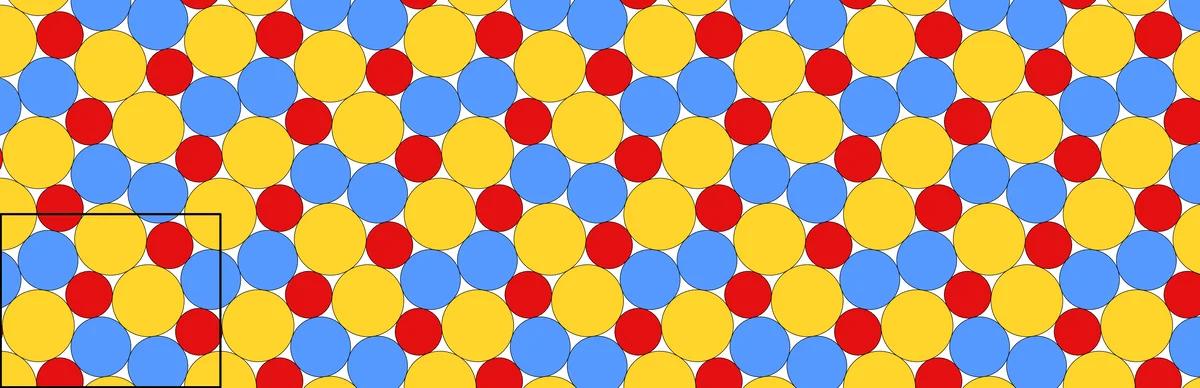
We consider circle packings in the plane with circles of sizes $1$, $r\simeq 0.834$ and $s\simeq 0.651$. These sizes are algebraic numbers which allow a compact packing, that is, a packing in which each hole is formed by three mutually tangent circles. Compact packings are believed to maximize the density when there are possible. We prove that it is indeed the case for these sizes. The proof should be generalizable to other sizes which allow compact packings and is a first step towards a general result.
💡 Research Summary
The paper addresses the problem of determining the densest packing of circles in the plane when three distinct radii are allowed: a unit radius (1), a medium radius r≈0.834, and a small radius s≈0.651. These particular values are algebraic numbers that satisfy specific polynomial equations, and they are known to admit a “compact” packing – a configuration in which every interstitial hole is bounded by exactly three mutually tangent circles. Compact packings are conjectured to be optimal whenever they exist, but a rigorous proof has been lacking for ternary (three‑size) packings.
The authors focus on one of the 164 known (r, s) pairs that permit a compact ternary packing. They identify a unique compact arrangement (illustrated in Figure 1 of the paper) and compute its density δ≈0.9093, which is slightly higher than the density of the classic hexagonal (single‑size) packing (π/√12≈0.9067). The main theorem asserts that this compact arrangement is in fact the densest possible packing for circles of the three given sizes.
The proof strategy adapts and extends techniques previously used for binary packings. The key steps are:
-
FM‑Triangulation: For any packing, the authors define the “cell” of each circle (the set of points closer to that circle than any other). The dual of this cell decomposition yields a triangulation of the circle centers, known as the FM‑triangulation (or additively weighted Delaunay triangulation). Each triangle T in this triangulation possesses a unique “support circle” that is interior‑disjoint from all packing circles and tangent to the three circles at the triangle’s vertices. In a saturated packing (no additional circles of size s can be inserted), the support circle’s radius is strictly less than s, and the geometry of the triangle is tightly constrained.
-
Excess Function: For each triangle T, the authors define an excess \
Comments & Academic Discussion
Loading comments...
Leave a Comment