Addict Free -- A Smart and Connected Relapse Intervention Mobile App
It is widely acknowledged that addiction relapse is highly associated with spatial-temporal factors such as some specific places or time periods. Current studies suggest that those factors can be utilized for better relapse interventions, however, th…
Authors: Zhou Yang, Vinay Jayach, ra Reddy
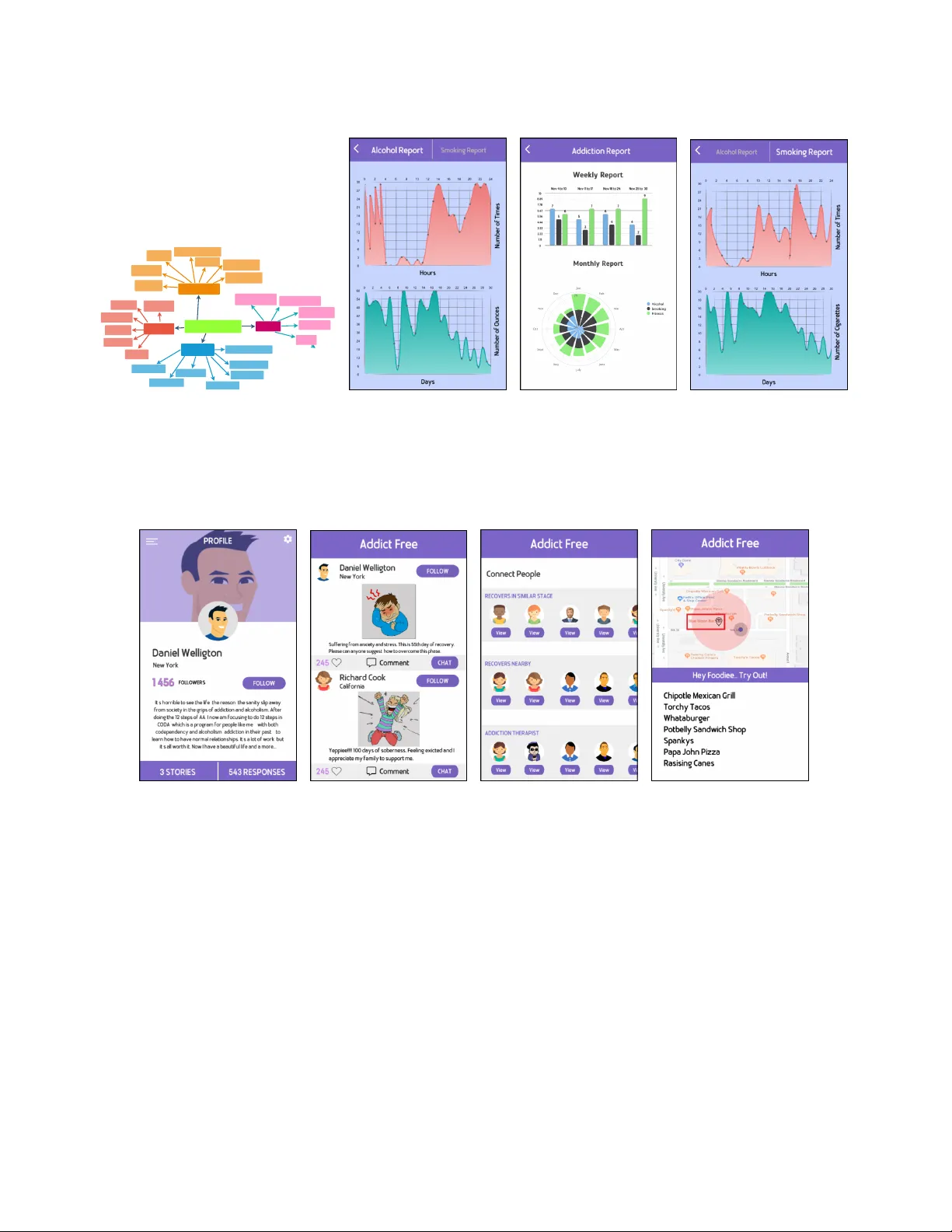
Addict Free - A Smart and Conne cted Relapse Inter vention Mobile App Zhou Y ang, Vinay Jayachandra Reddy , Rashmi Kesidi, Fang Jin T exas T ech University Lubbock, T exas (zhou.yang, vinay .jayachandra, rashmi.kesidi, fang.jin)@ttu.edu ABSTRA CT It is widely acknowledged that addiction r elapse is highly associ- ated with spatial-temporal factors such as some specic places or time periods. Current studies suggest that those factors can be uti- lized for better relapse interventions, however , there is no relapse prevention application that makes use of those factors. In this paper , we introduce a mobile app called “ Addict Free " , which records user proles, tracks relapse history and summarizes recovering statistics to help users b etter understand their recovering situations. Also, this app builds a relapse recovering community , which allows users to ask for advice and encouragement, and share relapse prevention experience. Moreov er , machine learning algorithms that ingest spa- tial and temporal factors are utilized to predict relapse, based on which helpful addiction diversion activities are recommended by a recovering recommendation algorithm. By interacting with users, this app targets at providing smart suggestions that aim to stop relapse, especially for alcohol and tobacco addiction users. CCS CONCEPTS • Applied computing → Health care information systems . 1 IN TRODUCTION Alcohol and tobacco are among the leading causes of preventable deaths in the United States. Approximately 46 million adults used both alcohol and tobacco in the past year . Alcohol and tobacco use may lead to major health risks when used alone and together . Due to an increase in the mortality rate of addicts, it is critical to help individuals recover from addiction. Though there ar e several treatments and rehabilitation methods available in the market, in- dividual’s opt to engage in self-management strategies to get rid of their addiction, whereas relapse is a top threat to self-management strategies. T o prevent the problems in the relapse period and to stay away from addiction, one has to distinguish high-chance cir- cumstances in which an individual is defenseless against relapse and to utilize psychological methods to stay away from addiction. Most of the previous studies on r elapse prevention only concentrate on exploring ecient treatments, and presenting the consolidated amount of alcohol/tobacco they consume d, but lacking the dynamic Permission to make digital or hard copies of part or all of this work for personal or classroom use is granted without fee provided that copies are not made or distributed for prot or commercial advantage and that copies bear this notice and the full citation on the rst page. Copyrights for third-party components of this work must be honored. For all other uses, contact the owner /author(s). SSTD ’19, August 19–21, 2019, Vienna, Austria © 2019 Copyright held by the owner/author(s). ACM ISBN 978-1-4503-6280-1/19/08. https://doi.org/10.1145/3340964.3340986 monitoring, and individualized advice/recommendations, which is not much appealing to the users. In this paper , we present a mobile app that closely monitors addicts’ health statuses in their relapse p eriod and assist them throughout the recovery span. Rather than motivating the users with inspirational quotes and treatments, this app enables them to engage themselves with a community . In our mobile app, the community comprises of people who have recov ered completely , also who are in the process of recovery and addiction therapists. In particular , the following features make Addict Free mobile ap- plication, a smart and connected platform, benecial for various addicts. • Addict Free colle cts user’s addictive b ehavioral data and generates recovery reports, and relapse prediction. • Addict Free intensively monitors users location using Geo- fence and pr ovides personalized diversion r e commendations. • Addict Free oers an interconnected support community , where users can share their experiences, p ost queries to overcome complications in the r elapse p eriod and oer sug- gestions for other users. Figure 1: Framework of Addict Free mobile application 2 SYSTEM FRAMEWORK Figure 1 illustrates the system framework of Addict Free. The frame- work is divided into three main components: (a). A front-end com- ponent which collects data about spatial-temporal relapse pattern and diversion interest either manually or from social networking site; ( b). A back-end component that includes not only multiple algorithms for predicting relapses that ar e associate d with spatial factors and temporal factors, but also smart and personalize d re- lapse diversions; (c). A relapse supp ort community that enables users to share recovering e xperience and ask for suggestions. (a) (b) (c) Figure 2: (a). The mobile application interface where the user enters the data of alcohol consumed and cigarettes smoked, add their own alcoholic spot. ( b). Dierent notica- tions to provide motivational quotes, recommendations in alert zones and to collect feedback. (c). Daily fe edback screen implemented by a short survey . 3 GENERAL MODULES Dataset: The dataset used in this paper is collected from the application which is entered by each user as shown in Figure 3. The applications is still under development. The data type includes geo-spatial locations such as where users drink alcohol, time period at which user smokes, time at which user drinks, numeric numbers such as the quantity of cigarettes smoked and a number of ounces of alcohol user consumed. The collected data will be anonymize d to remove personal information and stored in a database. 3.1 Location T racking Geo-fence is created by storing latitude, longitude, and radius of harmful areas, which is used to track the user’s present location[ 8 ]. Geo-fence empowers remote checking of ge ographic zones encom- passed by a virtual fence (which is usually dened by the user) and automatic identications when followed mobile devices enter or then again leave these zones. Geo-fence became important by supporting smart notications in case the user enters or leaves a specic geographical ar ea that is frequently associated with relapse When a mobile device enters or leav es a particular location, a no- tication pops up to give a suggestion with a time constraint. For example, if an addict is spotted in any of the addiction-prone areas, the addict will be recommended with personalized diversion as shown in Figure 2(b). 3.2 User Notication 3.2.1 Alert zone for alcohol consumption. Highlights of various places would directly or indirectly inuence individuals life and work[ 6 ]. These places have an inuence on an individual‘s addiction or b ehavior . There is a need to identify those likely places for a particular individual to divert or make the individual out of focus for their addiction. This can be achieved by pro viding a diversion in those areas. A notication pops up when a user enters public alcoholic lo cations or user spe cic alcoholic spots as shown in Figure 2(b) . Based on the interests of the user , a place nearby to the spot is suggested along with the alert. 3.2.2 Diverting notifications. The idea behind diversion techniques is simple: if users focus on something (i.e, cravings for tobacco), their nee ds will seem more intense. If they were distracted, they can trick their mind into ‘forgetting’ the craving and it will pass. This behavioral observation can be utilized for stopping smoking and drinking because cravings rarely last for longer than a couple of minutes. Specically , the craving is diverted by a pop-up notica- tion that is personalized according to the user prole and a couple of alternative activities that are useful for relapse div erting are also incorporated into the notication. As shown in Figure 2(b), noti- cations will pop up 10 minutes b efore the time when the relapse is most likely to occur . 3.3 Recovering Summaries Soberness and relapse states are also tracked on dierent time gran- ules, which enables app users to have a better understanding of their recovering statuses. A W eekly recovering summary is presented in Figure 3(c). It depicts consolidated statistics of an individual’s urge towards recov ering on a weekly basis with a normalized score of range 1 to 10. For each day , three scores are built for alcohol, smok- ing and tness respectively . Plots in Figure 3( b) and 3(d) depict the user’s trend of consumption of alcohol/tobacco over a month. One plot depicts a number of times the user consume d alcohol/tobacco at an average time, and the other depicts the number of ounces of alcohol/number of cigarettes an individual consumed in a day for about a month. User Recommendations and Fe edback: User interests are collected initially to provide personalized recommendations as shown in Fig- ure 3(a). Interests ar e sub categorized from the main themes which help our application to provide more p ersonalized recommenda- tions according to their interests and provide adequate ways to divert the user from his addiction and the places in which he is more prone to addiction.Ev er y individual thinks of going back to a particular time in a day to complete things which they hav e left around. The user might not enter the data about alcohol or cigarette he consumed. Stress levels also have an impact on the day of the user . Considering all these, feedback is collected at the end of the day . Screenshot of fee dback is shown in Figure 2( c). 3.4 Addiction Community Addiction recovery calls for not only me dical treatment such as replacement therapy but also support from families, medical pro- fessionals and communities. The function of community support is also incorporated into the Addict Free application. This commu- nity support function groups users and therapist with a similar background. Thus, it enables people to take suggestions from the ones who are a similar status and background. As shown in the Figure 4(a), Figure 4(b) and Figure 4(c), recov ering users and thera- pists with the similar background are gr oupe d to enable potential connections between them. Also, users are allowed to post ques- tions and other users in the community can pr ovide suggestions by commenting or chatting directly with the post authors. 2 Recommendations Fitness Running Y oga Shopping T oy shop Cloth shop Book shop Art Exhibitions Circus Concert Food Fast food Restaurants Food trucks Cafe or Bistro Swimming Cycling Aerobics Gym Text Museum Theater Tv shows Vedio games Entertainment Buffet Music shop Pet shop Super Market Jewellery store (a) (b) (c) ( d) Figure 3: (a). Personalized points of interest collected from the user to provide recommendations; (b).Snapshot of user’s statis- tics about the number of times drank in a day and Numb er of ounces of alcohol consumed in a month; (c). W eekly statistics of alcohol, smoking and tness and progress towards health; (d).Snapshot of user’s statistics about the number of times smoked in a day and Number of cigarettes consume d in a month. (a) (b) (c) (d) Figure 4: (a). Addict’s prole screen; (b). A blog post made by a user which is visible to other users in the community; (c). Addiction community connectivity options provided to the user based on vicinity and stage; (d). Snapshot of recommendations provided to a user(whose point of interest is food) when the user enters into an alcoholic spot. 4 METHODS 4.1 Relapse Prediction Addict Free incorporated algorithms for relapse prediction that is fundamental for relapse diversion and intervention [ 7 ]. Given a group of users A = { a 1 , a 2 , a 3 , . . . } , and their corresponding feature variable F j = < X 1 , . . . , X m > and r elapse label Y j ∈ [ 0 , 1 ] , a prediction algorithm is implemented to learn a function f : R m → R 1 , such that the prediction errors are minimized. ar д s = arg min Ψ m Õ j = 1 | | f ( X 1 , . . . , X m ) − Y j | | 2 (1) where X j and Y j are feature variable and relabel label respectively . The classier is implemented in a LSTM Model with time series data. T o capture the real-time dynamics of input, Addict Free utilizes a LSTM model for relapse time series prediction due to its well- handling ability of long and short term time dep endency . The model is also utilized in other types of prediction as in [ 4 ] and [ 1 – 3 ]. Figure 5 shows the basic structure of LSTM. It has an input gate 3 Figure 5: LSTM Architecture. i t , output gate o t , forget gate f t and memory cell C t . Equations 2 shows how to update the output values each step. f t = д ( W f . x t + U f . h t − 1 + b f ) , i t = д ( W i . x i + U i . h t − 1 + b i ) , c t = f t . c t − 1 + i t . k t , o t = д ( W o . x t + U o . h t − 1 + b o ) , h t = o t . t anh ( c t ) . (2) Where x t is the input vector and д is the activation function such as ReLU or Sigmoid function. W is the weight vector . The proposed model ingests multiple variables, including smok- ing (drinking) time, the number of cigarettes smoked (the amount of alcohol consumed). The model can extract the hidden patterns from these variables and output the probability of relapse in the next hour . For accuracy , previous 30-day data is utilized to predict the probability of relapse. Once the relapse probability for each hour is available, Addict Free will notify users with some diverting activities that may trick users’ mind and lead to a successful relapse intervention. 4.2 Monitoring and Notifying User Since relapse is highly associated with locations such as bars, it’s also crucial to divert app users when they are at such locations where they used to drink (smoke). Addict fr ee also provides noti- cations to divert users form location-based relapse. As mentioned in Section 3.1, Addict Free uses Geo-fence to identify and provides diverting notications when a user enters or leaves such Geo-fences with a time and radius constraint. A Geo-fence state and transi- tion can be annotate d with duration constraints. These constraints specify that a mobile device needs to remain within a Geo-fence or remain in motion between Ge o-fences for a limited duration out of a duration inter val [ l m i n , l m a x ] , respectively ( l m i n , l m a x ) ∈ D . l m i n denes the minimum duration and l m ax the maximum dura- tion allowed [ 5 ]. This allows our application to accurately conrm the existence of a user in a particular Geo-fence before leaving the location or entering into another Geo-fence. Thereby , the follow- ing conditions need to be fullled for Geo-fence-related duration constraints ∀ ( l m i n , l m ax ) ∈ D | l m i n ∈ R ≥ 0 ∧ lmax ∈ R > 0 ∧ l m i n < l m ax for duration constraints related to transitions ∀ ( l m i n , l m ax ) ∈ D | l m i n ∈ R ≥ 0 ∧ l m ax ∈ R > 0 ∧ l m i n ≤ l m ax If a Geo-fence state is not annotate d with a duration constraint, the allo wed duration is implicitly assumed to be arbitrary , d ∈ R > 0 . For a transition without duration constraints, the allowed duration can be arbitrary but including zero as well, d ∈ R ≥ 0 . In case a transition is annotated with ( 0 , 0 ) ∈ D , a mobile device can e.g. enter д 2 immediately after leaving д 1 where д 1 and д 2 are two Geo-fence areas. Recommendations are provided to users base d on their interests like food, tness, shopping, entertainment, etc., collected from their prole information. Figure 4(d) shows how p ersonalized notication works. For example, an Addict Free user with the e drinking problem, entered into a Geo-fence area such as bar , then the user is notied to try out nearby food places which the user would be interested in according to Addict Fr e e database. 5 SUMMARY W e developed a mobile application and relapse intervention assis- tant to help users stay clean from alcohol and smoking addiction. The platform incorporates a variety of data to provide insight into trends of smoking and alcohol consumption on a daily , weekly and monthly basis. Those trends allow users to comprehend their activities throughout the span of recovery . Also, spatial and tempo- ral factors are utilized to predict the most likely r elapse locations and time period. Embracing the Geo-fence technique for monitor- ing users’ lo cations makes Addict Free progressively eectively prevent location-based relapse. Addict Free has a unique way of recommending diversions, which also consider the addict’s per- sonal preferences. Besides, this app builds a smart and connected addiction-free community where users share relapse prevention experience. Instead of struggling with addiction individually , users here can benet from community support that is working towards the common goal to stay clean. A ddict Free additionally encourages addicts to share involvement and get proposals fr om addiction ther- apists, which helps them to overcome complexities encountered during the relapse period. 6 A CKNO WLEDGEMEN T This work was supported by the U.S. National Science Foundation under Grant CNS-1737634. REFERENCES [1] Sisheng Liang, Long Nguyen, and Fang Jin. 2018. A Multi-variable Stacked Long- Short T erm Memory Network for Wind Speed Forecasting. In Proc. of Big Data . IEEE, 4561–4564. [2] Long Nguyen, Zhou Y ang, and Fang Jin. 2018. Forecasting People’s Nee ds in Hurricane Events from Social Network. arXiv preprint arXiv:1811.04577 (2018). [3] Long Nguyen, Zhou Y ang, and Fang Jin. 2018. Spatial-temporal Multi- Task Learn- ing for Within-eld Cotton Yield Prediction. arXiv preprint (2018). [4] Long H Nguyen, Rattikorn Hewett, Akbar S Namin, Nicholas Alvarez, Cristina Bradatan, and Fang Jin. 2018. Smart and connected water resource management via social media and community engagement. In Proc. of ASONAM . IEEE, 613–616. [5] Sandro Rodriguez Garzon and Bersant Deva. 2014. Geofencing 2.0: taking location- based notications to the next level. In Proceedings of the 2014 ACM International Joint Conference on Pervasive and Ubiquitous Computing . ACM, 921–932. [6] Helena VZ T unstall, Mary Shaw , and Danny Dorling. 2004. P laces and health. Journal of Epidemiology & Community Health 58, 1 (2004), 6–10. [7] Zhou Y ang, Long H Nguyen, and Fang Jin. 2019. Opioid Relapse Prediction with GAN. In Proc. of International Conference on Advances in So cial Networks Analysis and Mining (ASONAM 2019) . IEEE/A CM. [8] Shubham Y elne and Vishal Kapade. 2015. Human Protection with the Disaster Management Using an Android Application. International Journal of IJSRSET 1, 5 (2015), 15–19. 4
Original Paper
Loading high-quality paper...
Comments & Academic Discussion
Loading comments...
Leave a Comment