Complex Laplacian based Distributed Control for Multi-Agent Network
The work done in this paper, proposes a complex Laplacian-based distributed control scheme for convergence in the multi-agent network. The proposed scheme has been designated as cascade formulation. The proposed technique exploits the traditional met…
Authors: Aniket Deshp, e, Pushpak Jagtap
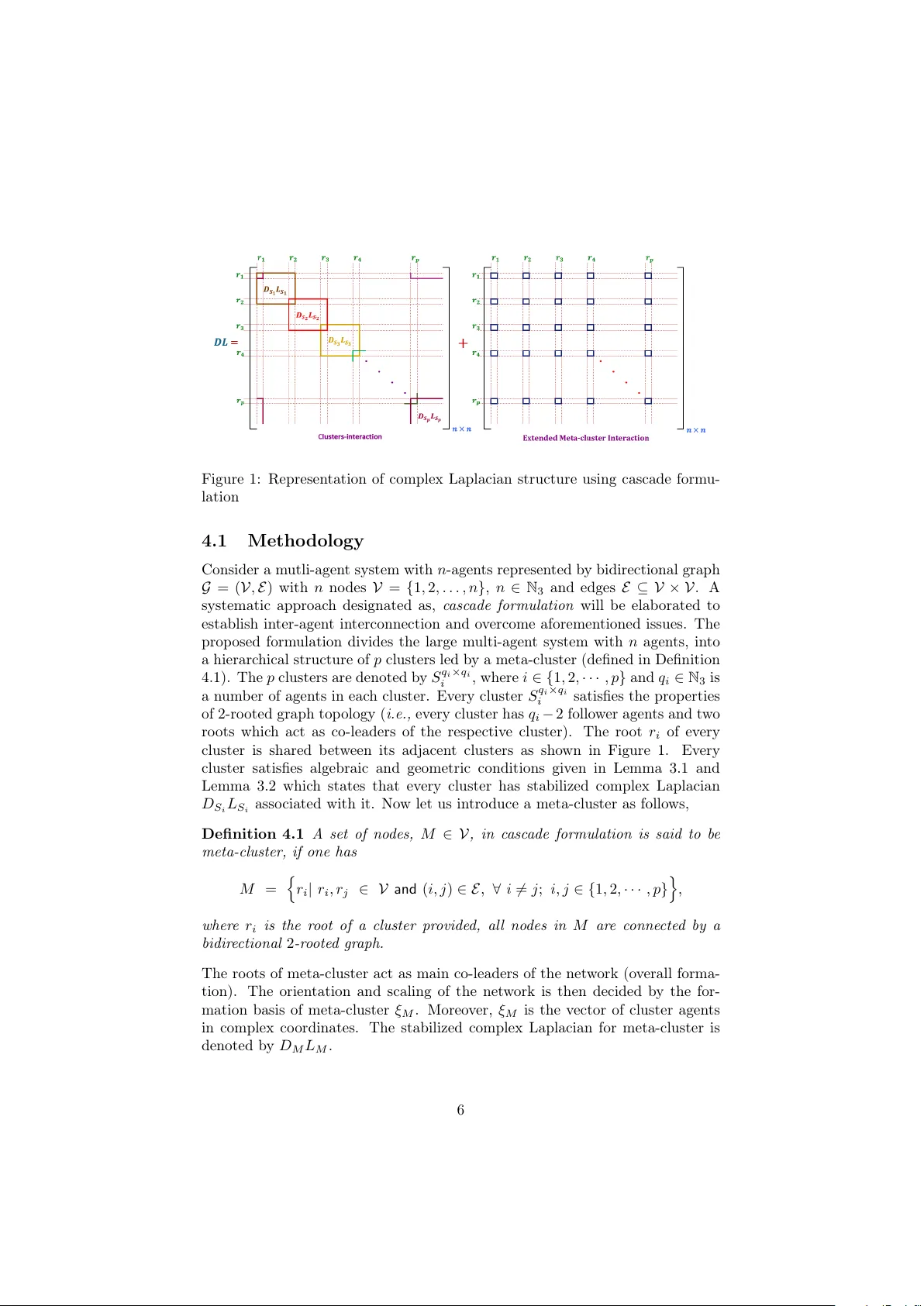
Complex Laplacian-based Distributed Con trol for Multi-Agen t Net w ork ∗ Aniket Deshpande Pushpak Jagtap Prashant banso de Arun D. Mahindrak ar Navdeep M. Singh Abstract The w ork done in this paper, proposes a complex Laplacian-based distributed con trol sc heme for con vergence in the multi-agen t netw ork. The proposed scheme has been designated as cascade formulation. The prop osed technique exploits the traditional method of organizing large scattered net works in to smaller interconnected clusters to optimize infor- mation flow within the netw ork. The complex Laplacian-based approach results in a hierarchical structure, with formation of a meta-cluster leading other clusters in the netw ork. The prop osed form ulation enables flexibility to constrain the eigen sp ectra of the o verall closed-lo op dynamics, ensuring desired conv ergence rate and control input intensit y . The sufficient condi- tions ensuring globally stable formation for prop osed formulation are also asserted. Robustness of the proposed formulation to uncertainties like loss in communication links and actuator failure has also b een discussed. The effectiveness of the proposed approac h is illustrated by simulating a finitely large netw ork of thirty vehicles. 1 In tro duction The broad application domain of distributed control metho ds in m ulti-agent systems hav e attracted a considerable attention of researc hers in recent y ears. Some ma jor application areas include formation control of unmanned air ve- hicles (UA V) [1], co op erativ e con trol of mobile vehicles [2], and distributed sensor netw orks [3]. The key challenges include minimization of control efforts, impro vization in conv ergence time, comm unication constraints, a nd reducing computational cost. F ormation control problems hav e b een serving as b enc hmark problems for decen tralized con trol of multi-agen t systems [4, 5]. Significan t amoun t of re- searc h has b een done to develop metho ds for addressing issues related to con- sensus problems suc h as co operative control of multi-agn t systems sub jected ∗ Preprint of an article submitted for consideration in [Adv ances in Complex Systems] c [copyrigh t world scientific publishing compan y] https://www.w orldscien tific.com/worldscinet/acs 1 to switching netw orks and communication delay [6, 7], collision av oidance [8], robustness to link and node failure [9], time v arying formation con trol [10], and consensus of agent under input saturation [11]. Differen t tec hniques and framew orks ha ve also b een prop osed to address agreement problems suc h as graph Laplacian-based metho d for formation stabilization [12], planar forma- tion using complex Laplacian [13], formation con trol of heterogeneous nonlinear agen t using passivity framework [14], leader follow er architecture [15, 16], and hierarc hical formation control [17]. The recen t work in [13], has reported a complex Laplacian-based approac h to ac hieve rigid planar formation. The w ork provides algebraic and geometrical conditions that ensure a globally stable formation. Laplacian-based metho ds often result in a slow er mo ving a v erage, as the num b er of comm unicating neigh- b ours increase, dela ying the netw ork consensus whic h in turn, affects the system adv ersely . Rep orted literature intends to present a formulation to address such issues. F or this purp ose, the con ven tional clustering metho d is exploited to sys- tematically reorganize a large complex netw ork into a num b er of distributed clusters. Such an arrangement is exp ected to channelize information exchange within the net w ork leading to faster conv ergence. The inclusion of complex Laplacian-based metho dology results in a hierarc hical structure of the clusters led by a meta-cluster. The orientation and formation of clusters are controlled b y the meta-cluster that commands the co-leaders of clusters. The metho d in- corp orates a bidirectional 2 - ro oted graph top ology [18] that pro vides additional flexibilit y to control the ov erall formation along four degrees of freedom (viz, translation, rotation, and scaling) through the co-leaders of the meta-cluster. Rest of the pap er is organized as follows. Section II describ es the prelimi- naries of graph theory and complex Laplacian with its necessary and sufficient conditions. Section I II, includes discussion on the c asc ade formulation metho d to shap e the information flow in large m ulti-agent systems by divides a large net work into decoupled stable clusters with lo cal decentralized control la w. Sec- tion IV summarizes sim ulation results and comparative analysis of proposed form ulation. The conclusions and op en problems are discussed in Section V. 2 Preliminaries The symbol N k denotes the set of natural num b ers greater than k − 1 . W e use C n × m to denote a vector space of complex v alued matrices with n ro ws and m columns. F or c ∈ C , Re( c ) and Im( c ) represen t the real and imaginary parts of a complex n umber c , resp ectiv ely . F or a square matrix F ∈ C n × n , eig ( F ) = λ 1 , λ 2 , . . . , λ n ∈ C represents eigen v alues of F and the largest eigenv alue of F is giv en as λ max ( F ) = max { Re( λ 1 ) , Re( λ 2 ) , . . . , Re( λ n ) } . The interaction top ology in a m ulti-agent system is represented using bidi- rectional graph G = ( V , E ) with n nodes V = { 1 , 2 , . . . , n } and edges E ⊆ V × V . Let the neighbor set of i th agen t b e defined as N i = { j ∈ V | ( j, i ) ∈ E } , where i ∈ { 1 , 2 , . . . , n } . 2 In order to pro ve results of this pap er and to select prop er in teraction topol- ogy , it is imp ortant to introduce tw o definitions from [18]. Definition 2.1 F or a bidir e ctional gr aph G , a no de υ ∈ V is said to b e 2 - r e achable fr om a non-singleton set U of no des, if it is p ossible to r e ach no de υ fr om any no de in U after eliminating any one no de exc ept no de υ . Definition 2.2 A bidir e ctional gr aph G is said to b e 2 -r o ote d, if ther e exists a subset of two no des, fr om which every other no de is 2 -r e achable. These two no des ar e terme d as r o ots of the gr aph G . Readers can refer to [13], for the graphical explanation of these definitions. The complex Laplacian L for bidirectional graph G is giv en as L ( i, j ) = − w ij , if i 6 = j and j ∈ N i , 0 , if i 6 = j and j / ∈ N i , P j ∈N i w ij , if i = j , (1) where w ij ∈ C is the complex weigh t asso ciated with edge ( i, j ) . The definition of complex Laplacian also ensures that the row sum should b e equal to zero ( i.e., it has at least one eigenv alue at origin with the corresp onding eigenv ector 1 n ). 3 Planar formation using complex Laplacian Consider a group of n agents in a plane, with an ob jective to achiev e a desired formation using distributed control laws. The control laws are assumed to b e implemen table with lo cal information like relative distances with neighbors. In complex Laplacian approac h, the formation configuration or shap e of final for- mation is represented by assigning lo cation ξ i ∈ C in the complex plane to i th agen t of the group. This complex formation vector ξ = [ ξ 1 , ξ 2 , . . . , ξ n ] T ∈ C n is referred to as formation b asis . The F ξ is a function that acts on the formation basis ξ along four degree-of-freedoms (translation, rotation, and scaling) to steer the formation as p er the requirement and is written as, F ξ = c 1 1 n + c 2 ξ , c 1 , c 2 ∈ C . Here, the bidirectional graph G with n nodes is used as a sensing gr aph with edges ( i, j ) representing a measure of relativ e p osition b etw een agent j and agent i as ( z j − z i ) , where z j , z i ∈ C denotes the p ositions of j th and i th agen ts, resp ectiv ely . Supp ose eac h agent is mo deled as a fully actuated p oin t mass with single- in tegrator kinematics given by , ˙ z i = u i , i ∈ { 1 , 2 , . . . , n } (2) where u i ∈ C is the velocity control input and the saturation limits are con- sidered as v min ≤ Re( u i ) ≤ v max , v min ≤ Im( u i ) ≤ v max , v min and v max are 3 the minimum and maximum velocities resp ectiv ely , and are dep enden t on the actuator saturation limit. The lo cal distributed control law to ac hieve a stable formation is then written as, u i = d i X j ∈N i w ij ( z j − z i ) , i ∈ { 1 , 2 , . . . , n } (3) where d i ∈ C is a design parameter whic h decides the p erformance and global stabilit y of the formation and w ij is the complex weigh t on edge ( i, j ) represented in complex Laplacian L . The ov erall dynamics of the n agent system with control la w (3) is ˙ z = − D Lz , (4) where z = [ z 1 , z 2 , . . . , z n ] T ∈ C n , L is the complex Laplacian of the comm u- nication graph G , and D = diag ( d 1 , d 2 , . . . , d n ) is stabilizing diagonal matrix. The diagonal matrix D transforms the eigen v alues of (4) to the left half of the complex plane. The necessary and sufficien t conditions to a design complex Laplacian L and stabilizing matrix D are discussed next. 3.1 Necessary and sufficien t conditions The necessary and sufficient conditions for construction of complex Laplacian and stabilizing matrix are stated in the following Lemmas [13]. Lemma 3.1 L et the formation b asis ξ ∈ C n satisfy ξ i 6 = ξ j , ∀ i, j . The e qui- librium state of (4) forms a glob al ly stable ge ometric formation F ξ if and only if ther e exists matric es D , L ∈ C n × n satisfying eig ( − D L ) ≤ 0 , Lξ = 0 , and r ank ( L ) = n − 2 . Lemma 3.2 F or a bidir e ctional gr aph G and ξ ∈ C n satisfying ξ i 6 = ξ j , ∀ i, j . The algebr aic c onditions, r ank ( L ) = n − 2 . and Lξ = 0 satisfies for al l L ∈ C n × n if and only if G is 2 -r o ote d. The Lemma 3.1 presents necessary algebraic condition to guaran tee stationary formation and Lemma 3.2 gives graphical sufficiency condition to satisfy neces- sary condition men tioned in Lemma 3.1. The stabilit y of the closed-lo op system (4) dep ends on eigenv alues of D L . As complex Laplacian L has its eigen v al- ues scattered o ver the whole complex plane, it is not alwa ys stable. Thus, it is imp ortan t to design a diagonal matrix D which stabilizes the closed-loop dynamics. Lemma 3.3 If the bidir e ctional gr aph G is 2 -r o ote d then ther e exists a stabiliz- ing matrix D for the system ˙ z = − Lz such that (4) is stable. Pro of ’s for the ab o v e lemmas are not included for the obvious and readers are referred to [13] for the same. 4 3.2 P erformance analysis of consensus algorithm Eigen v alues of the stabilized complex Laplacian matrix exhibit imp ortan t infor- mation ab out p erformance of consensus algorithm such as stability , con vergence rate, and control efforts. Some properties of eigen v alues of complex Laplacian are 1. Complex Laplacian L for 2 -ro oted graph topology has tw o eigenv alues at origin with corresp onding eigenv ectors 1 n and formation basis ξ . 2. Unlik e a real-v alued Laplacian, complex Laplacian may hav e eigenv alues in left half of complex plane. 3. All non-zero eigen v alues of L can b e shifted to right half of complex plane b y pre-m ultiplying it with real v alued in v ertible diagonal matrix D without affecting prop ert y 1 [19]. Let the stabilized complex Laplacian D L hav e its eigenv alues at λ 1 = λ 2 = 0 < Re( λ 3 ) ≤ Re( λ 4 ) ≤ · · · ≤ Re( λ n ) . The smallest non-zero eigen v alue of sta- bilized complex Laplacian matrix λ 3 is considered as an extension to the concept of algebraic connectivity [20] of real-v alued Laplacian to complex Laplacian with 2 -ro oted graph top ology and is used as a measure of p erformance of collective dynamics. The largest eigenv alue of D L , λ n , is used as a measure of the inten- sit y of con trol signal [21]. It is v ery important to limit control signal magnitude ( i.e., by placing λ n prop erly), as it can pro duce instability due to saturation. Our main ob jectiv e is to strengthen the algebraic connectivity of the complex Laplacian while limiting intensit y of the control inputs to improv e the sp eed of con vergence in large multi-agen t system. This is achiev ed b y conv erting consen- sus problem into sp ecial formulation by cascading small clusters as discussed in the next section. 4 Prop osed F orm ulation The complex Laplacian-based consensus algorithm requires 2 -ro oted graph topol- ogy with t w o ro ots acting as co-leaders for orien tation and scaling of formation. It is observ ed that as the num ber of agents increases, λ max ( D L ) increases which ma y result in instability due to saturation of control inputs [22, 23]. The sys- tem can b e stabilized by scaling do wn the complex Laplacian by appropriate factor k as k D L , where k ∈ (0 , 1) . Ho wev er, it affects the algebraic connec- tivit y of net work whic h in turn affects the con vergence time. This sets the trade-off b et w een conv ergence time and the con trol input intensit y rendering the design of stabilizing matrix D , a tedious task. Another ma jor issue with complex Laplacian-based con trol la w is its inability to deal with comm unication and actuation failure of an agent. The ov erall dynamics lead to instabilit y in case of failure of communication link or actuator of an agen t due to interruption in information flow. Robustness can b e incorp orated in a complex Laplacian- based control by implementing the prop osed systematic metho dology of Casc ade F ormulation . 5 Figure 1: Represen tation of complex Laplacian structure using cas cade form u- lation 4.1 Metho dology Consider a m utli-agen t system with n -agen ts represen ted b y bidirectional graph G = ( V , E ) with n no des V = { 1 , 2 , . . . , n } , n ∈ N 3 and edge s E ⊆ V × V . A systematic a p pr oac h designated as, c asc ade formulation will b e elab orated to establish in ter-agen t in terconnection and o v ercome aforemen tioned issues. The prop osed form ulation divides the large m ulti-agen t system with n agen ts, in to a hierarc hical s tr u cture of p clusters led b y a meta-cluster (defin ed in Definition 4.1). The p clusters are denoted b y S q i × q i i , where i ∈ { 1 , 2 , · · · , p } and q i ∈ N 3 is a n um b er of agen ts in eac h cluster. Ev ery cluster S q i × q i i satisfies the prop erties of 2 -ro oted graph top o logy ( i.e., ev ery cluster has q i − 2 follo w er agen ts and t w o ro ots whic h act as co-leaders of the resp ectiv e cluster). The ro ot r i of ev ery cluster is shared b et w een its adjacen t clus ters as sho wn in Figure 1. Ev ery cluster satisfies algebraic and geometric conditions giv en in Lemma 3 . 1 and Lemma 3.2 whic h states that ev ery c luster has stabilized complex Laplacian D S i L S i asso ciated with it. No w let us in tro duce a meta-cluster as follo ws , Definition 4.1 A set of no des, M ∈ V , in c asc ade formulation is said to b e meta-cluster, if one has M = n r i | r i , r j ∈ V and ( i, j ) ∈ E , ∀ i 6 = j ; i, j ∈ { 1 , 2 , · · · , p } o , wher e r i is the r o ot of a cluster pr ovide d, al l no des in M ar e c onne cte d by a bidir e ctional 2 -r o ote d gr aph. The ro ots of meta-cluster act as main co-leaders of the net w ork (o v erall forma- tion). The orien tation and sc a li ng of the net w ork is then decided b y the for- mation basis of meta-cluster ξ M . Moreo v er, ξ M is the v ec to r of cluster agen ts in complex co ordinates. The stabilized complex Laplacian for meta-cluster is denoted b y D M L M . 6 Lemma 4.2 Consider a multi-agent network of n -agents having close d lo op dy- namics ˙ z = − D Lz , inter c onne cte d in c asc ade formulation. Then the eigenval- ues of e ach cluster S i and meta-cluster M ar e indep endent of e ach other if e ach cluster and the meta-cluster satisfy 2 -r o ote d gr aph top olo gy and the clusters ar e c onne cte d only thr ough r o ots r i . Pro of: 4.3 Consider the stabilize d c omplex L aplacian is designe d for e ach of the clusters and meta-cluster indep endently as D S i L S i and D M L M , r esp e ctively. This me ans that the clusters and meta-cluster satisfy c onditions in L emma 3.1 and L emma 3.2. By using similarity tr ansform of matrix to tr ansform stabilize d c omplex L aplacian into diagonal matrix with diagonal entries as c orr esp onding eigenvalues [24], [25]. L et P S i ∈ C q i × q i and P M ∈ C p × p b e the matric es of right eigenve ctors of the cluster S i , i ∈ { 1 , 2 , . . . , p } and meta-cluster M , r esp e ctively. The c orr esp onding diagonal matrice s c an b e r epr esente d as Λ S i = P − 1 S i ( D S i L S i ) P S i = diag (0 , λ S i 2 , λ S i 3 , . . . , λ S i q i − 1 , 0) , (5) Λ M = P − 1 M ( D M L M ) P M = diag (0 , λ M 2 , λ M 3 , . . . , λ M p − 1 , 0) . (6) The 2 -r o ote d gr aph top olo gy of p clusters le d by a meta-cluster ensur es that ther e exist two eigenvalues at origin c orr esp onding to r o ots of the gr aph. The first and last r ow of Λ S i and Λ M in (5) and (6) r epr esents r o ots of clusters and meta-cluster, r esp e ctively. The pr op ose d formulation c onsiders that the adjac ent clusters ar e c onne cte d only thr ough its r o ots as shown in Fig.1. This implies that eigenvalues of cluster S i wil l not affe ct the eigenvalues of its adjac ent clusters. The 2-r o ote d structur e of meta-cluster and Definition 4.1 ensur e that meta- cluster has p − 2 non-zer o eigenvalues c orr esp onding to r o ots of clusters r i . This r esults in the two zer o r o ots acting as c o-le aders of the network without affe cting the other eigenvalues of clusters. Remark 4.4 L emma 4.2 implies that e ach cluster and meta-cluster c an b e tr e ate d as de c ouple d systems. Ther efor e, it is p ossible to design stabilize d c om- plex Laplac ian D L for individual cluster and meta-cluster. Theorem 4.5 Consider a multi-agent network of n -agents and L emma 4.2. The close d-lo op dynamics ˙ z = − D Lz under c asc ade formulation r esults in a glob al ly stable formation if individual cluster and meta-cluster ar e stabilize d us- ing complex L aplacian-b ase d c ontr ol law. Pro of: 4.6 The pr o of of this the or em is a dir e ct c onse quenc e of L emma 4.2. Assume that the individual stabilizing diagonal matrix D S i and D M for every cluster and meta-cluster ar e designe d to plac e eigenvalues of D S i L S i and D M L M to right-hand side, r esp e ctively. As discusse d in Subse ction 4.1, e ach cluster and meta-cluster satisfies algebr aic and ge ometric c onditions. Consider a cluster S i with its c orr esp onding formation b asis ξ S i , the algebr aic c ondition is ( D S i L S i ) ξ S i = 0 , fo r i ∈ { 1 , 2 , . . . , p } (7) 7 and the algebr aic c ondition for meta-cluster M and formation b asis ξ M is ( D M L M ) ξ M = 0 . (8) A t r o ots of a cluster, ther e is an inter action b etwe en its adjac ent clusters and meta-cluster which gives, X i ∈ Ω r j ( D S i L r j S i ) ξ S i + ( D M L r j M ) ξ M = 0 , for j ∈ { 1 , 2 , . . . , p } , (9) wher e Ω r j is the set of adjac ent clusters of r o ot r j , D S i L r j S i and D M L r j M r epr esent r ow cor r esp onding to r th j r o ot of cluster S i and meta-cluster M r esp e ctively. By using (7), (8) and (9), one has algebr aic c ondition of over al l formulation for the complete formation b asis ξ as ( D L ) ξ = 0 . (10) In the cluster inter action (se e Figur e 1), ther e ar e p zer o eigenvalues c orr e- sp onding to r o ots of clusters r 1 , r 2 , . . . , and r p . This r esults in r ank of cluster inter action as n − p and the meta-cluster has n − 2 non-zer o eigenvalues at r o ots b e c ause of 2 -r o ote d top olo gy. Thus the over al l r ank of pr op ose d formulation is n − 2 . This satisfies the algebr aic c ondition given in L emma 3.1 to achieve glob al ly stable formation. Let the algebraic connectivity and largest eigenv alue of p clusters b e denoted b y λ a ( D S 1 L S 1 ) , λ a ( D S 2 L S 2 ) , . . . , λ a ( D S p L S p ) and λ max ( D S 1 L S 1 ) , λ max ( D S 2 L S 2 ) , . . . , λ max ( D S p L S p ) , resp ectiv ely . F or meta-cluster, it is represen ted as λ a ( D M L M ) and λ max ( D M L M ) , resp ectiv ely . As mention in Lemma 4.2, the eigen v alues of eac h cl uster is indep endent of other. Thus, the algebraic connectivity and largest eigen v alue of formulation are given as λ a = min { λ a ( D S 1 L S 1 ) , λ a ( D S 2 L S 2 ) , . . . , λ a ( D S p L S p ) , λ a ( D M L M ) } , λ max = max { λ max ( D S 1 L S 1 ) , λ max ( D S 2 L S 2 ) , . . . , λ max ( D S p L S p ) , λ max ( D M L M ) } . Remark 4.7 One c an e asily incr e ase the hier ar chy of formulation by c asc ading sever al meta-clusters whose formation b asis is describ e d by meta-meta-cluster without affecting the stability and p erformanc e of over al l formation. Prop osition 4.8 The stabilize d formation of multi-agent network of n -agents under pr op ose d formulation, do es not lo ose its over al l stability even if it is sub- je cte d to unc ertainties like actuation or c ommunic ation link failur e. Pro of: 4.9 The pr op osition is a dir e ct c onse quenc e of L emma 4.2, R emark 4.4, and The or em 4.5. W e have se en that the stability achieve d in pr op osed formula- tion is cluster-wise indep endent. Thus, even if one of the agent fr om a p articular cluster losses its c ommunic ation or actuation, it c annot affe ct the stability (i.e., eigenvalues) of adjac ent clusters or meta-cluster. Thus a major p art of the lar ge network rem ains undisturb e d and stable. 8 -2 0 2 Real -2 0 2 Imag -40 -20 0 20 40 X -40 -20 0 20 40 Y 5 10 15 -10 0 10 u x 0 5 10 15 20 Time(Sec) -10 0 10 u y r 1 r 2 (c) (b) (a) Figure 2: Using con ven tional approach: (a) In terconnection, (b) Closed-lo op resp onse, (c) Control inputs u x and u y . 4.2 Designing stabilization matrices Unlik e real-v alued Laplacian, the eigenv alues of a complex Laplacian are scat- tered randomly in the en tire complex plane due to complex parameter matrix (whic h, in most cases do not app ear in conjugate pairs). T o the b est of au- thor’s kno wledge, the existing conv en tional optimization frameworks are not suitable to handle such complex parameter systems. Thus, an evolutionary al- gorithm based technique has b een adopted to design stabilizing matrices. In the proposed form ulation, the matrices D S i and D M are designed using ge- netic algorithm [26, 27] with an ob jective of restricting the eigenv alue sp ectrum bandwidth of the complex Laplacian to a desired range. Note that, the genetic algorithm is only used to find one of the infinite solutions of stabilizing matrices ensuring desired range o ver eigenv alue sp ectrum. The trade-off b et ween conv ergence time and control efforts can be form ulated in the form of an ob jective function as describ ed b elo w, min τ = | 2 min( Re ( eig ( DL ))) − λ min − λ max | , σ = | 2 max( Re ( eig ( D L ))) − λ min − λ max | , (11) where τ represen ts an ob jective function for the rate of conv ergence, σ denotes the ob jective function for control input intensit y , λ min and λ max are low er and upp er b ounds on the sp ectrum of nonzero eigenv alues of complex Laplacian. The ob jective function τ ensures that the all non-zero eigen v alues of clusters and meta-cluster are greater than required algebraic connectivity , λ a , whic h con trols the rate of con vergence. The magnitude of control input u i is restricted b y b ounding the eigenv alues b elo w λ max using ob jectiv e function σ . This helps to a void instability in case of saturation on control inputs. One can select the v alue of λ max > λ a and close to the desired algebraic connectivity λ a . 5 Sim ulation and Results In this section, we present comparative simulation results to sho w efficacy and robustness of prop osed formulation. 9 Figure 3: Using cascade formulation: (a) Clusters, meta-cluster and their in ter- action, (b) Closed-lo op resp onse, (c) Control inputs u x and u y . 5.1 P erformance analysis F or the purp ose of simulation, a netw ork of 30 agen ts mo deled by single in- tegrator kinematics as giv en in (2) has b een considered. The velocity input constrain ts are − 10 ≤ Re( u i ) ≤ +10 and − 10 ≤ Im( u i ) ≤ +10 . The system is simulated using MA TLAB r Sim ulink. The target formation of agents repre- sen ted by formation basis ξ in complex plane and communication top ology is sho wn in Figure 2(a). The black no des indicate ro ots of the graph G . Simula- tion tra jectories using control law (3) are shown in Figure 2(b). The stabilized complex Laplacian has its algebraic connectivit y at λ 3 = 0 . 0027 + ı 0 . 1447 and the largest eigenv alue at λ max = 16 . 44 − ı 6 . 6786 . Conv ergence time and control signals are sho wn in Figure 2(c). The prop osed c asc ade d formulation is applied to the net work discussed ab o ve b y dividing the netw ork into six homogeneous clusters ( S 1 , S 2 , . . . , S 6 ) as sho wn in Figure 3(a). The blac k nodes represen t roots of clusters that comprise a meta-cluster. Considering uniformit y in clusters, a single complex Laplacian L S and a stabilizing matrix D S can b e designed for all clusters. The algebraic connectivit y and largest eigenv alue of ov erall formation are at 1 . 5762 − ı 3 . 4779 and 23 . 352 − ı 2 . 4619 , resp ectiv ely . The response using prop osed approac h is giv en in Figure 3(b). Figure 3(c) shows control signals u x and u y . It is observ ed that the structured and distributed information flow due to the prop osed algo- rithm reduces the con vergence time while satisfying constraints on the control inputs. 5.2 Robustness to comm unication and actuation failure W e now illustrate the robustness prop ert y of prop osed formulation for the case of failure in any communication link or actuator of an agent. It is easily observed from stability conditions that the con v entional complex Laplacian-based control la w causes instability due to comm unication interruption and actuation failure. The prop osed formulation incorp orates stability in individual clusters and 10 0 50 100 X 0 50 100 Y -40 -20 0 20 40 X -40 -20 0 20 40 -40 -20 0 20 40 X -40 -20 0 20 40 -40 -20 0 20 40 X -40 -20 0 20 40 (a) (b) (c) (d) Figure 4: Response to loss of comm unication in (a) cluster agen t, (b) meta- cluster agen t; Resp onse to actuator failure in (c) cluster agent, (d) meta-cluster agen t, where star indicates agent with failure the meta-cluster. Due to this, the comm unication and actuation failure of any agen t of a particular cluster will not affect the stabilit y of other clusters. Re- sults ha ve b een illustrated considering t wo cases. In the first case, failure of comm unication link of an agent within cluster is considered by making its cor- resp onding edge w eight in the Laplacian equal to zero. Simulation result is sho wn in Figure 4(a). The result establishes the fact that the failure will not affect the stabilit y of other clusters and meta-cluster. In the second case, failure of link in meta-cluster agent is sim ulated similarly and it is observed that all clusters approach stable formation. The failure only affects the orientation and scaling of clusters adjacen t to affected link (see Figure 4(b)). The simulation results for actuation failure of an agent in cluster and meta- cluster are sho wn in Figures 4(c) and 4(d), resp ectively . One can readily observ e that the prop osed formulation forms stable formation around the agent ev en under actuation failure. 6 Conclusions and Op en Problems A no vel approach is form ulated to solve formation control problem in large multi- agen t systems while attaining robustness to communication link and actuation failure. The cascade formulation prop osed in this paper channelizes information flo w throughout the netw ork efficiently . The formulation divides the complex net work into small clusters to incorp orate decentralized information exchange b et w een meta-cluster and agents of individual clusters. The 2–ro oted bidirec- tional graph top ology is adopted to form clusters and meta-cluster which allows them to b e a decoupled dynamical systems. This offers flexibilit y in designing individual con trol laws, that satisfies the b ounds on control inputs and achiev es stable formation in desired con vergence time. Moreov er, it is illustrated that the prop osed form ulation is relativ ely robust even if the information flo w in netw ork is sub jected to uncertainties like comm unication link and actuation failure in agen ts. The cascade form ulation also provides for organization of distributed clusters at different hierarchies in complex systems, whic h is helpful in many applications lik e sync hronization and collectiv e task handling in m ulti-rob ot 11 systems. As an extension to the prop osed metho dology , our future research is fo cused on some c hallenging issues like collision av oidance, self organizing cascade for- m ulation, etc. Moreo ver, the control strategy can b e cast into well structured optimization framew ork to design a stabilizing diagonal matrix for optimization of con trol efforts and conv ergence time. References [1] Reza Olfati-Sab er. Flocking for m ulti-agent dynamic systems: Algorithms and theory . IEEE T r ansactions on A utomatic Contr ol , 51(3):401–420, 2006. [2] Ali Jadbabaie, Jie Lin, et al. Co ordination of groups of mobile autonomous agen ts using nearest neighbor rules. IEEE T r ansactions on Automatic Con- tr ol , 48(6):988–1001, 2003. [3] P etter Ögren, Edw ard Fiorelli, and Naomi Ehrich Leonard. Co op era- tiv e control of mobile sensor net w orks: Adaptiv e gradient climbing in a distributed environmen t. IEEE T r ansactions on Automatic Contr ol , 49(8):1292–1302, 2004. [4] Reza Olfati-Sab er, Alex F ax, and Richard M Murray . Consensus and co- op eration in net work ed multi-agen t systems. Pr o c e e dings of the IEEE , 95(1):215–233, 2007. [5] J Alexander F ax and Richard M Murra y . Information flo w and co operative con trol of vehicle formations. IEEE T r ansactions on Automatic Contr ol , 49(9):1465–1476, 2004. [6] Reza Olfati-Sab er and Richard M Murra y . Consensus problems in netw orks of agen ts with switching top ology and time-delays. IEEE T r ansactions on A utomatic Contr ol , 49(9):1520–1533, 2004. [7] Sh uai Liu, Lih ua Xie, and F rank L Lewis. Synchronization of multi-agen t systems with delay ed control input information from neigh b ors. Automat- ic a , 47(10):2152–2164, 2011. [8] Dong Eui Chang, Shawn C Shadden, Jerrold E Marsden, and Reza Olfati- Sab er. Collision a v oidance for m ultiple agent systems. Pr o c e edings of IEEE Confer enc e on De cision and Contr ol , 2003. [9] W en te Zeng and Mo-Y uen Chow. Resilient distributed control in the pres- ence of misb eha ving agen ts in netw orked control systems. IEEE T r ansac- tions on Cyb ernetics , 44(11):2038–2049, 2014. [10] Lara Brinón-Arranz, Alexandre Seuret, and Carlos Can udas-de Wit. Co op- erativ e control design for time-v arying formations of multi-agen t systems. IEEE T r ansactions on A utomatic Contr ol , 59(8):2283–2288, 2014. 12 [11] Housheng Su, Michael ZQ Chen, James Lam, and Zongli Lin. Semi-global leader-follo wing consensus of linear m ulti-agent systems with input satura- tion via low gain feedback. IEEE T r ansactions on Cir cuits and Systems I: R e gular Pap ers , 60(7):1881–1889, 2013. [12] Zhiyun Lin, Mireille Brouck e, and Bruce F rancis. Lo cal control strategies for groups of mobile autonomous agen ts. IEEE T r ansactions on Automatic Contr ol , 49(4):622–629, 2004. [13] Zhiyun Lin, Lili W ang, Zhimin Han, and Minyue F u. Distributed formation con trol of multi-agen t systems using complex laplacian. IEEE T r ansactions on Automatic Contr ol , 59(7):1765–1777, 2014. [14] Murat Arcak. P assivity as a design tool for group coordination. IEEE T r ansactions on Automatic Contr ol , 52(8):1380–1390, 2007. [15] Florian Dörfler and Bruce F rancis. Geometric analysis of the formation problem for autonomous robots. IEEE T r ansactions on Automatic Contr ol , 55(10):2379–2384, 2010. [16] Pushpak Jagtap, Anik et Deshpande, Navdeep M Singh, and F aruk Kazi. Complex laplacian based algorithm for output sync hronization of multi- agen t systems using internal model principle. IEEE Confer enc e on Contr ol Applic ations (CCA) , pages 1811–1816, 2015. [17] Ji-W ook Kw on and Dongkyoung Ch wa. Hierarchical formation con trol based on a vector field metho d for wheeled mobile rob ots. IEEE T r ansac- tions on R ob otics , 28(6):1335–1345, 2012. [18] Lili W ang, Zhimin Han, Zhiyun Lin, and Gangfeng Y an. Complex laplacian and pattern formation in m ulti-agent systems. 24th IEEE Chinese Contr ol and Decision Confer enc e (CCDC) , pages 628–633, 2012. [19] CS Ballantine. Stabilization by a diagonal matrix. Pr o c e e dings of the Amer- ic an Mathematic al So ciety , 25(4):728–734, 1970. [20] Mirosla v Fiedler. Algebraic connectivity of graphs. Cze choslovak mathe- matic al journal , 23(2):298–305, 1973. [21] Daniel Y Abramo vitch and Gene F F ranklin. On the stabilit y of adaptive p ole-placemen t controllers with a saturating actuator. IEEE T r ansactions on Automatic Contr ol , 35(3):303–306, 1990. [22] Tingsh u Hu and Zongli Lin. Contr ol systems with actuator satur ation: analysis and design . Springer Science & Business Media, 2001. [23] Sophie T arb ouriec h, Germain Garcia, and A dolf Hermann Glattfelder. A d- vanc e d str ate gies in c ontr ol systems with input and output c onstr aints . Springer, 2007. 13 [24] Gene H Golub and Charles F V an Loan. Matrix c omputations , volume 3. JHU Press, 2012. [25] Roger A Horn and Charles R Johnson. Matrix analysis . Cambridge uni- v ersity press, 2012. [26] Manda villi Sriniv as and Lalit M P atnaik. Genetic algorithms: A surv ey . Computer , 27(6):17–26, 1994. [27] Kim-F ung Man, Kit-Sang T ang, and Sam K wong. Genetic algorithms: concepts and applications. IEEE T r ansactions on Industrial Ele ctr onics , 43(5):519–534, 1996. 14
Original Paper
Loading high-quality paper...
Comments & Academic Discussion
Loading comments...
Leave a Comment