Prediction of gaze direction using Convolutional Neural Networks for Autism diagnosis
Autism is a developmental disorder that affects social interaction and communication of children. The gold standard diagnostic tools are very difficult to use and time consuming. However, diagnostic could be deduced from child gaze preferences by loo…
Authors: Dennis Nu~nez-Fern, ez, Franklin Porras-Barrientos
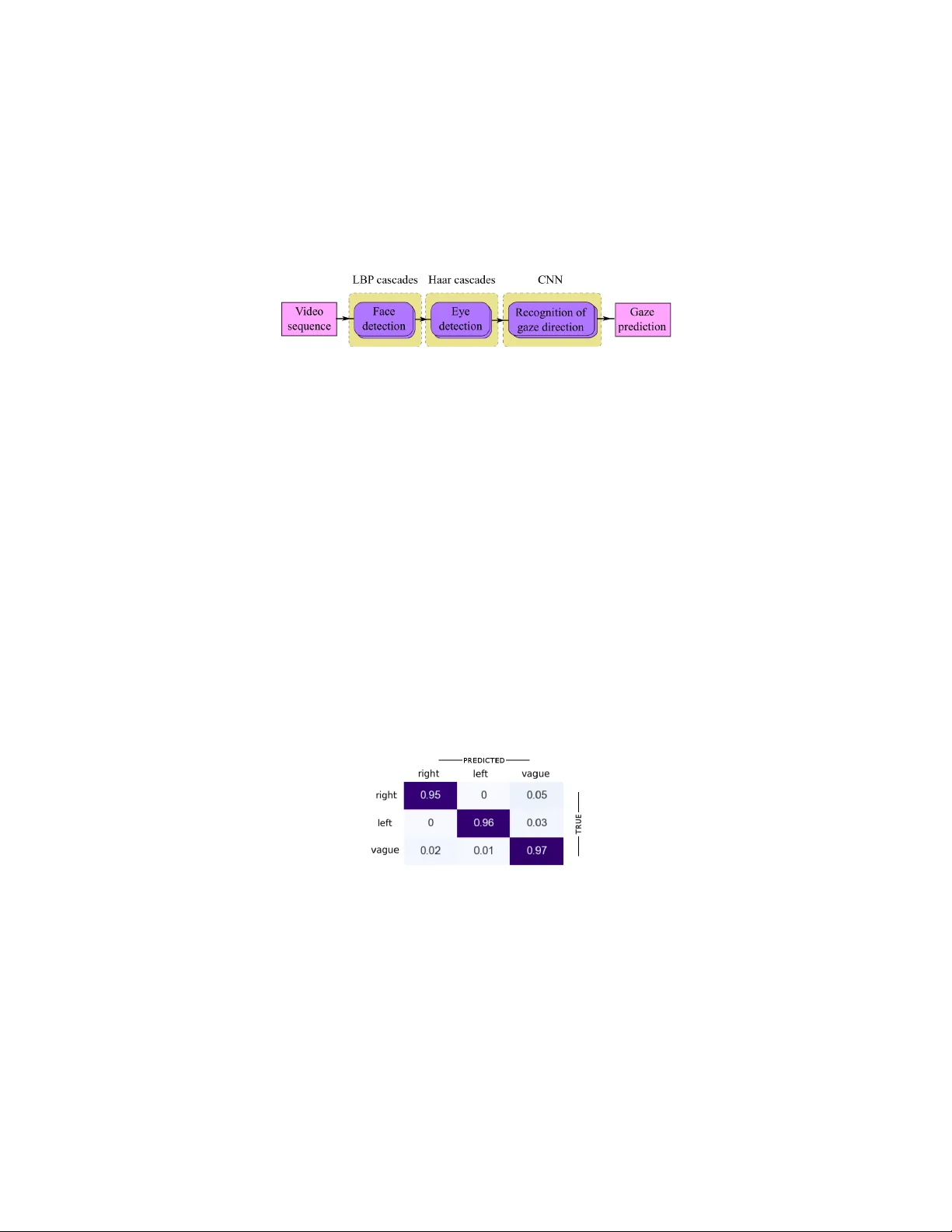
Pr ediction of gaze dir ection using Con volutional Neural Networks f or A utism diagnosis Dennis Núñez-Fer nández 1 , Franklin Porras-Barrientos 1 Macarena V ittet-Mondoñedo 1 , Robert H. Gilman 2 , Mirko Zimic 1 1 Laboratorio de Bioinformática y Biología Molecular , Uni versidad Peruana Cayetano Heredia, Peru 2 Department of International Health, Johns Hopkins Univ ersity , USA {dennis.nunez, franklin.barrientos.p, macarena.vittet.m}@upch.pe rgilman1@jhmi.edu, mirko.zimic@upch.pe Abstract Autism is a dev elopmental disorder that af fects social interaction and communica- tion of children. The gold standard diagnostic tools are very dif ficult to use and time consuming. Howe ver , diagnostic could be deduced from child gaze preferences by looking a video with social and abstract scenes. In this work, we propose an algorithm based on con volutional neural networks to predict gaze direction for a fast and ef fectiv e autism diagnosis. Early results show that our algorithm achiev es real-time response and robust high accurac y for prediction of gaze direction. 1 Introduction Around 1 in 160 children worldwide is af fected by Autism spectrum disorder (ASD). It generates a deficit social interaction [2] and result in delay in cognitiv e dev elopment [6]. Recent studies ha ve shown that early intervention for children with ASD is effecti ve in improving quality of life, e very dollar spent on early intervention helps to sa ve eight dollars in special education [4, 5]. The reasons to the low utilization of the gold standard diagnostic tools are the duration of the tests and the extensi ve training for the technician [1], and dev eloping countries hav e very fe w of them. Recent studies hav e sho wn strong e vidence for utilizing gaze direction as an early biomarker of ASD [8, 9, 12, 13]. Indeed, children with ASD show a preference for geometric scenes rather than social scenes [9, 12]. In recent years, several approaches to gaze direction recognition were proposed and some open source eye-tracking algorithms are currently a vailable; ho wever , these algorithms demand extensiv e calibration, se veral settings and training processes that are not appropriate for young children. For instance, most of current gaze direction systems for the ASD diagnosis need to be e v aluated under controlled en vironments by using expensi ve devices that require holding the head to av oid undesirable mov ements [9, 12]. None of such systems are appropriate in children due its restless behavior . In a more recent work [11], eye movements are used to asses ASD. Based on the gaze patterns and using K-means clustering and a support vector machine classifier , they are able to identify children with ASD with an accuracy of 88.51%. Nonetheless, since this process in volv es a high- acuity eye tracker , it is not a scalable screening process. In [3], a CNN-based approach is used to predict gaze in a natural social interaction and assess ASD in children. They dev eloped two CNNs, one for face detection and another for gaze prediction. Despite gaze direction is precisely predicted by the CNNs, wearing glasses inv olves equipment, which disturb child’ s attention.In addition, to date there are se v eral popular open source tools for e ye tracking. One of the most popular is https://github.com/pupil- labs/pupil , which provides an accurate tool for eye tracking, howe ver , this system makes use of glasses. As explained abov e, external hardw are is not suitable for children. Another popular tool for eye tracking is http://www.pygaze.org , ho wev er , calibration is difficult and e ye region should be in a fix ed position, which is dif ficult to set in children. 33rd Conference on Neural Information Processing Systems (NeurIPS 2019), V ancouver , Canada. 2 Methodology Our proposed system recognizes gaze direction based on images obtained from a video sequence. Face and e ye detection are performed by cascade classifiers using LBP and Haar features that were found with the V iola-Jones mechanism [14]. Face detection uses LBP cascades ov er the whole image due its better performance, and eye detection employes Haar cascades into the facial region since they are much smaller than the full image. Later, we generate a single square image with both e ye regions. Finally , the CNN classifies it into right, left or vague direction, see Fig. 1. Figure 1: Diagram for the proposed system The dataset was collected in our research facilities, the Laboratory of Bioinformatics and Molecular Biology , Univ ersidad Peruana Cayetano Heredia, Peru. W e enroled 30 adults between 22-35 years old, working in our laboratory . The videos were recorded under a controlled en vironment and using a standard web camera. The eye glace directons were three: right, left and vague. After frame extraction, we obtained a total of 420 images, which increased to 66,750 after data augmentation. The proposed CNN is a variation of the LeNet model [10], with 60K learnable parameters. The training of the proposed CNN has been carried out on the 80% of the collected dataset (53,400 images) and testing on the remaining 20% (13,350 images). The CNN input are 72x72 pixel binary images, follo wing the architecture: C(5x5)-S(2x2)-C(5x5)-S(2x2)-FC(120)-FC(3), where C: Con v . layer , S: Sub sampling, FC: Full connection. W e employed Caffe frame work [7]. 3 Early Results For all shuffle testing on adult dataset, we obtain 96.01% of accuracy . Howe ver , for a rigorous testing, we ev aluated our model using a 5-fold cross-validation and using dif ferent groups of people who do not appear in the training dataset. For testing on the dataset using 3 classes and employing 5-fold cross-v alidation, we obtained an average accurac y of 89.54%. T ests were conducted with people who do not appear in the training dataset. Figure 2: Confusion matrix for three classes 4 Conclusions In this work we have presented the first results of a CNN-based methodology for eye glance pre- diction using a web camera with the aim to help in autism diagnosis. The system recognizes three gaze directions and works on a desktop PC. W e show that our proposed method achieves a high classification accuracy of 96.01% for testing. Furthermore, the system shows a real-time response of about 90 ms. The pre vious results demonstrate that the proposed system is a useful, fast, eff ectiv e and accessible autism diagnosis tool. 2 References [1] Natacha Akshoomoff, Christina Corsello, and Heather Schmidt. The role of the autism diagnostic observation schedule in the assessment of autism spectrum disorders in school and community settings. The California school psyc hologist : CASP , 11:7–19, 2006. 17502922[pmid]. [2] American Psychiatric Association. Autism spectrum disorder . In: Diagnostic and Statistical Manual of Mental Disor ders, F ifth Edition, American Psychiatric Association, Arlington, V A 2013. P , 50, 2013. [3] Eunji Chong, Katha Chanda, Zhefan Y e, Audrey Southerland, Nataniel Ruiz, Rebecca M. Jones, Agata Rozga, and James M. Rehg. Detecting gaze tow ards eyes in natural social interactions and its use in child assessment. Proc. A CM Interact. Mob . W earable Ubiquitous T echnol. , 1(3):43:1–43:20, September 2017. [4] Flavio Cunha and James Heckman. The technology of skill formation. American Economic Review , 97(2):31–47, May 2007. [5] Orla Doyle, Colm P . Harmon, James J. Heckman, and Richard E. Tremblay . In vesting in early human dev elopment: Timing and economic ef ficiency . Economics & Human Biology , 7(1):1 – 6, 2009. [6] Centers for Disease Control and Prev ention. Prev alence of autism spectrum disorders-autism and dev elop- mental disabilities monitoring network, united states, 2006. MMWR Surveillance Summaries , 58:1–20, 2009. [7] Y angqing Jia, Evan Shelhamer, Jeff Donahue, Sergey Karayev , Jonathan Long, Ross Girshick, Sergio Guadarrama, and T rev or Darrell. Caffe: Con volutional architecture for fast feature embedding. In Pr oceedings of the 22Nd A CM International Confer ence on Multimedia , MM ’14, pages 675–678, Ne w Y ork, NY , USA, 2014. A CM. [8] W arren Jones, Katelin Carr , and Ami Klin. Absence of Preferential Looking to the Eyes of Approaching Adults Predicts Lev el of Social Disability in 2-Y ear-Old T oddlers W ith Autism Spectrum Disorder. JAMA Psychiatry , 65(8):946–954, 08 2008. [9] Ami Klin, David J. Lin, Phillip Gorrindo, Gordon Ramsay , and W arren Jones. T wo-year-olds with autism orient to non-social contingencies rather than biological motion. Nature , 459(7244):257–261, 2009. [10] Y . Lecun, L. Bottou, Y . Bengio, and P . Haffner. Gradient-based learning applied to document recognition. Pr oceedings of the IEEE , 86(11):2278–2324, Nov 1998. [11] W enbo Liu, Ming Li, and Li Y i. Identifying children with autism spectrum disorder based on their face processing abnormality: A machine learning framework. Autism resear ch : official journal of the International Society for Autism Resear ch , 9, 04 2016. [12] Karen Pierce, David Conant, Roxana Hazin, Richard Stoner, and Jamie Desmond. Preference for Geometric Patterns Early in Life as a Risk F actor for Autism. JAMA Psychiatry , 68(1):101–109, 01 2011. [13] Karen Pierce, Stev en Marinero, Roxana Hazin, Benjamin McKenna, Cynthia Carter Barnes, and Ajith Malige. Eye tracking reveals abnormal visual preference for geometric images as an early biomarker of an autism spectrum disorder subtype associated with increased symptom se verity . Biological Psychiatry , 79(8):657–666, Apr 2016. [14] P . V iola and M. Jones. Rapid object detection using a boosted cascade of simple features. In Pr oceedings of the 2001 IEEE Computer Society Confer ence on Computer V ision and P attern Recognition. CVPR 2001 , volume 1, pages I–I, Dec 2001. 3
Original Paper
Loading high-quality paper...
Comments & Academic Discussion
Loading comments...
Leave a Comment