Riccati-type pseudopotentials, conservation laws and solitons of deformed sine-Gordon models
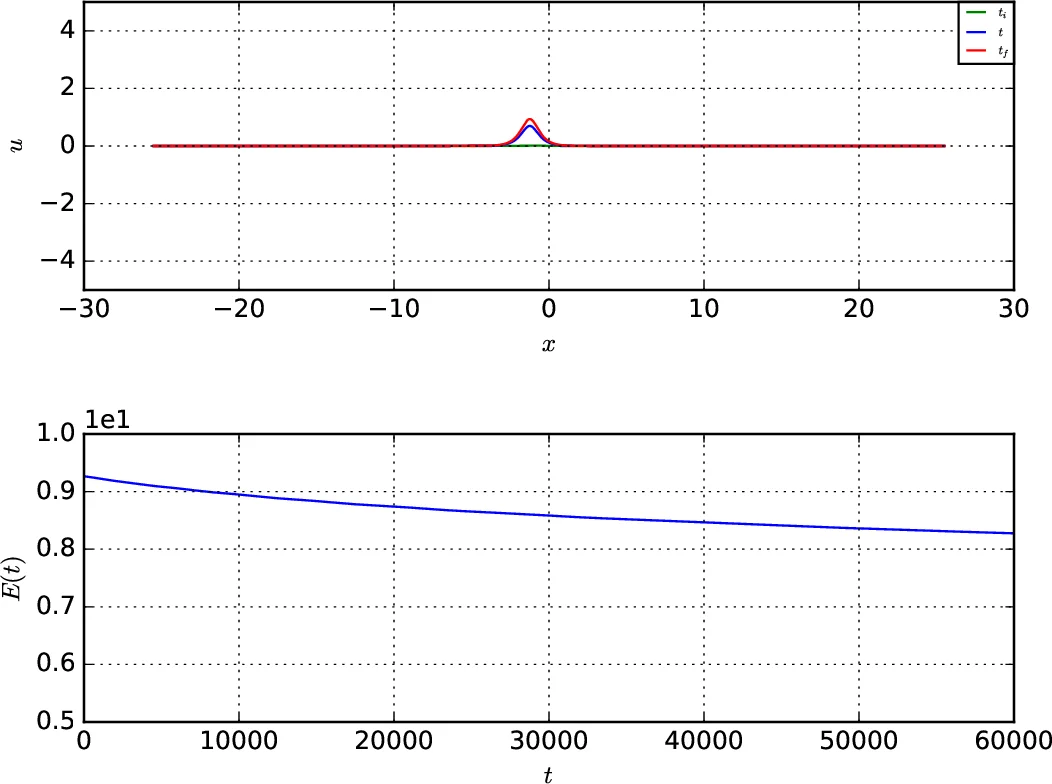
Deformed sine-Gordon (DSG) models $\partial_\xi \partial_\eta , w + \frac{d}{dw}V(w) = 0$, with $V(w)$ being the deformed potential, are considered in the context of the Riccati-type pseudopotential approach. A compatibility condition of the deformed system of Riccati-type equations reproduces the equation of motion of the DSG models. Then, we provide a pair of linear systems of equations for DSG model, and provide an infinite tower of non-local conservation laws. Through a direct construction and supported by numerical simulations of soliton scatterings, we show that the DSG models, which have recently been defined as quasi-integrable in the anomalous zero-curvature approach [Ferreira-Zakrzewski, JHEP05(2011)130], possess new towers of infinite number of quasi-conservation laws. We compute numerically the first sets of non-trivial and independent charges (beyond energy and momentum) of the DSG model: the two third order conserved charges and the two fifth order asymptotically conserved charges in the pseudopotential approach, and the first four anomalies of the new towers of charges, respectively. We consider kink-kink, kink-antikink and breather configurations for the Bazeia {\sl et al.} potential $V_{q}(w) = \frac{64}{q^2} \tan^2{\frac{w}{2}} (1-|\sin{\frac{w}{2}}|^q)^2 , (q \in R)$, which contains the usual SG potential $V_2(w) = 2[1- \cos{(2 w)}]$. The numerical simulations are performed using the 4th order Runge-Kutta method supplied with non-reflecting boundary conditions.
💡 Research Summary
The paper investigates deformed sine‑Gordon (DSG) field theories of the form
∂_ξ∂_η w + V′(w)=0,
where V(w) is a general deformation of the standard sine‑Gordon potential. The authors adopt a Riccati‑type pseudo‑potential framework, originally used for the integrable SG model, and extend it to accommodate arbitrary deformations. By introducing auxiliary fields (often denoted u₁, u₂, …) they construct a set of Riccati‑type equations whose compatibility condition reproduces exactly the DSG equation of motion. From this extended system they derive a pair of linear Lax‑type operators L₁ and L₂, providing a new linear representation of the deformed model.
With the linear representation in hand, the authors systematically generate three infinite families (“towers”) of quasi‑conservation laws.
-
First tower (standard quasi‑charges) – This reproduces the previously known odd‑order charges q_{2n+1}^a and their duals e q_{2n+1}^a obtained from the anomalous zero‑curvature approach. Their associated anomalies β_{2n+1} possess odd parity under a combined space‑time reflection symmetry P, guaranteeing that the integrated anomalies vanish for configurations with definite parity.
-
Second tower (∂_ξ w‑based) – Multiplying the DSG equation by (∂_ξ w)^{N‑1} (N≥3) and rearranging yields a continuity‑type equation
∂_η
Comments & Academic Discussion
Loading comments...
Leave a Comment