Semi-supervised acoustic model training for five-lingual code-switched ASR
This paper presents recent progress in the acoustic modelling of under-resourced code-switched (CS) speech in multiple South African languages. We consider two approaches. The first constructs separate bilingual acoustic models corresponding to langu…
Authors: Astik Biswas, Emre Y{i}lmaz, Febe de Wet
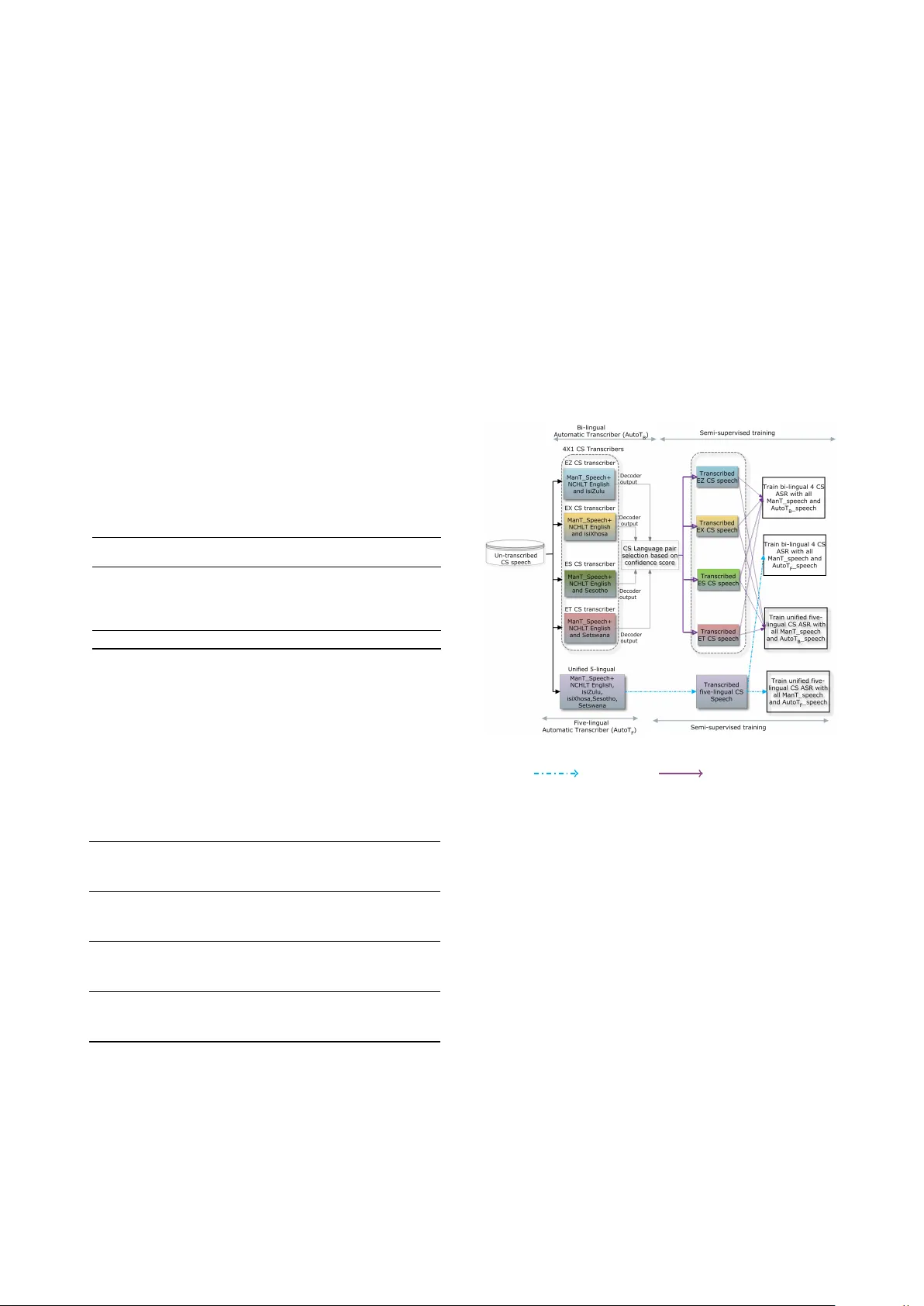
Semi-supervised acoustic model training f or fiv e-lingual code-switched ASR Astik Biswas 1 , Emr e Yılmaz 2 , F ebe de W et 1 , Ewald van der W esthuizen 1 , Thomas Niesler 1 1 Department of Electrical and Electronic Engineering, Stellenbosch Uni versity , South Africa 2 Department of Electrical and Computer Engineering, National Uni versity of Singapore, Singapore abiswas@sun.ac.za, emre@nus.edu.sg, fdw@sun.ac.za, ewaldvdw@sun.ac.za, trn@sun.ac.za Abstract This paper presents recent progress in the acoustic modelling of under-resourced code-switched (CS) speech in multiple South African languages. W e consider two approaches. The first constructs separate bilingual acoustic models corresponding to language pairs (English-isiZulu, English-isiXhosa, English- Setswana and English-Sesotho). The second constructs a sin- gle unified fiv e-lingual acoustic model representing all the lan- guages (English, isiZulu, isiXhosa, Setswana and Sesotho). For these two approaches we consider the ef fectiveness of semi- supervised training to increase the size of the very sparse acous- tic training sets. Using approximately 11 hours of untran- scribed speech, we show that both approaches benefit from semi-supervised training. The bilingual TDNN-F acoustic mod- els also benefit from the addition of CNN layers (CNN-TDNN- F), while the five-lingual system does not show any significant improv ement. Furthermore, because English is common to all language pairs in our data, it dominates when training a unified language model, leading to impro ved English ASR performance at the expense of the other languages. Ne vertheless, the fiv e- lingual model of fers fle xibility because it can process more than two languages simultaneously , and is therefore an attracti ve op- tion as an automatic transcription system in a semi-supervised training pipeline. Index T erms : semi-supervised training, code-switching, under- resourced languages, acoustic modelling, TDNN, CNN. 1. Introduction South Africa is a multilingual country with a population of 57 million people and 11 official languages, including English which is used as a lingua franca and widespread in the me- dia and entertainment. Due to this variety of geographically co-located languages, code-switching (CS)—the alternation be- tween languages during discourse—is common. The development of speech recognition systems able to process code-switching is a topic that has attracted increasing research interest [1–5]. The task becomes more challenging when some of the languages are under-resourced, since small text and acoustic datasets limit the application of state-of-the- art language and acoustic modelling methods. While English- Mandarin CS speech is the most studied [2, 6–8], other lan- guage pairs such as Frisian-Dutch [4, 9], Hindi-English [10, 11], English-Malay [12] and French-Arabic [13] hav e also been considered. Recently , a 14.3-hour corpus of manually seg- mented and transcribed CS speech has been compiled from South African soap opera episodes [14]. This corpus con- tains four language-balanced South African CS pairs: English- isiZulu (EZ), English-isiXhosa (EX), English-Setswana (ET), and English-Sesotho (ES). In South Africa, code-switching is most prev alent between English, a highly-resourced language, and the nine official African Bantu languages, which are all under-resourced. W e hav e demonstrated that multilingual training is effecti ve for ASR of bilingual code-switched speech when additional train- ing data consists of closely-related languages [15]. Since isiZulu, isiXhosa, Sesotho and Setswana belong to the same Bantu language f amily , they were found to complement each other and allow the development of better acoustic models. Howe ver , 12.2 hours of training data remains insuf ficient for robust ASR. In further work, it was demonstrated that better- resourced but out-of-domain monolingual English and Bantu speech could further improve ASR performance for code- switched speech [16]. Here, approximately an order of mag- nitude more out-of-domain monolingual speech was av ailable for acoustic model training than in-domain soap opera speech. Howe ver , the large amount of monolingual, out-of-domain data prov ed less effecti ve than a modest amount of in-domain code- switched data. The out-of-domain data was prompted speech and poorly matched with the in-domain CS speech. Hence, ob- taining more in-domain data remains the ideal solution. The collection of multilingual code-switched speech from soap opera episodes and its manual segmentation and anno- tation is extremely intensiv e in terms of effort and time. It has recently been shown that, in the absence of manually- annotated material, automatically-transcribed training mate- rial may be useful in under-resourced scenarios using semi- supervised training [17–19]. In order to ev aluate this for our corpus, we considered the automatic transcription of new and untranscribed soap opera speech using our best existing code- switched speech recognisers. In this study , we in vestigated semi-supervised training of ASR systems capable of processing all four code-switch pairs in our soap opera corpus. T o the best of our knowledge, this is the first report of semi-supervised training applied to multiple code- switch pairs, and to South African code-switch pairs in partic- ular . W e used our best in-house models, trained on all av ail- able in-domain mixed-language and out-of-domain monolin- gual speech, to automatically transcribe additional segmented but untranscribed code-switched speech. These se gments lack language labels, and were therefore presented to all our code- switched transcription systems as input. T wo such systems were considered. The first comprises four bilingual code-switched recognisers while the second is a single unified fiv e-lingual acoustic system. The transcriptions produced by both these sys- tems were used to retrain the respectiv e acoustic models. For retraining the acoustic models, we used only soap opera speech and no out-of-domain monolingual speech. W e report on the effecti veness of semi-supervised training for both the bilingual and the fiv e-lingual systems. 2. Multilingual soap opera corpus A multilingual corpus containing examples of code-switched speech has been compiled from 626 South African soap opera episodes. The soap opera speech in question is typically fast and often expresses emotion. The spontaneous nature of the speech and the high prev alence of code-switching makes it a chal- lenging corpus for ASR. The data contains examples of code- switching between South African English and four Bantu lan- guages: isiZulu, isiXhosa, Setswana and Sesotho. isiZulu and isiXhosa belong to the Nguni language family while Sesotho and Setswana are Sotho languages. 2.1. Manually transcribed data The soap opera corpus, which is still under dev elopment, currently consists of 14.3 hours of speech divided into four language-balanced sets, as introduced in [14]. This corpus was used in some of our previous w ork [15, 16, 20]. Approximately 9 hours of manually transcribed monolin- gual English soap opera speech was av ailable in addition to the language-balanced sets. This data was initially omitted to a void a bias toward English. Howe ver , pilot experiments indicated that its inclusion enhanced recognition performance. The bal- anced set was therefore pooled with the additional English data for the experiments described here. The composition of this larger b ut unbalanced data set summarised in T able 1. T able 1: Duration in minutes (min) and hours (h) as well as wor d type and token counts for the unbalanced corpus. Language Mono (m) CS (m) T otal (h) T otal (%) W ord tokens W ord types English 754.96 121.81 14.61 69.26 194 426 7 908 isiZulu 92.75 57.41 2.50 11.86 24 412 6 789 isiXhosa 65.13 23.83 1.48 7.03 13 825 5 630 Sesotho 44.65 34.04 1.31 6.22 22 226 2 321 Setswana 36.92 34.46 1.19 5.64 21 409 1 525 T otal 994.43 271.54 21.10 100 276 290 24 170 An overvie w of the statistics for the de velopment ( Dev ) and test ( T est ) sets for each language pair is giv en in T able 2. Be- sides the total duration, the duration of the monolingual (m) and code-switched (c) segments is included in the table. A total of 1 464, 691, 798, and 1 025 language switches are observed in the EZ, EX, ES, and ET test sets, respectiv ely . T able 2: Duration (minutes) of English, isiZulu, isiXhosa, Sesotho, Setswana monolingual (mdur) and code-switched (cdur) utterances in CS de velopment and test sets [14]. English-isiZulu emdur zmdur ecdur zcdur T otal Dev 0.00 0.00 4.01 3.96 8.00 T est 0.00 0.00 12.76 17.85 30.40 English-isiXhosa emdur xmdur ecdur xcdur T otal Dev 2.86 6.48 2.21 2.13 13.68 T est 0.00 0.00 5.56 8.78 14.34 English-Setswana emdur tmdur ecdur tcdur T otal Dev 0.76 4.26 4.54 4.27 13.83 T est 0.00 0.00 8.87 8.96 17.83 English-Sesotho emdur smdur ecdur scdur T otal Dev 1.09 5.05 3.03 3.59 12.77 T est 0.00 0.00 7.80 7.74 15.54 2.2. Manually segmented untranscribed data In addition to the transcribed data introduced in the previous section, 23 290 segmented but untranscribed soap opera utter- ances were av ailable for experimentation. These utterances cor- respond to 11.05 hours of speech from a total of 127 speakers (69 male and 57 female). The languages used in these unsub- scribed utterances ha ve not been identified. Ho wever , several South African languages not among the five present in the tran- scribed data are known to occur . 3. Semi-supervised training A recent study demonstrated that semi-supervised training can improve the performance of Frisian-Dutch code-switched ASR [18]. W e took a similar approach here, using the sys- tem configuration illustrated in Figure 1. The figure shows how semi-supervised training consists of two phases: automatic transcription followed by acoustic model retraining. T wo differ- ent automatic transcription systems were used to transcribe the manually segmented data described in Section 2.2. Both sys- tems used factorised time-delay neural networks (TDNN-F) as acoustic models, which have recently been demonstrated to be effecti ve in resource-constrained situations [21]. Figure 1: Semi-supervised training frame work for the five- lingual ( ) and 4 × CS ( ) transcription systems. (ManT : Manually transcribed data; AutoT : Automatically tran- scribed data) T wo different systems were maintained for semi-supervised training and ASR evaluation respectively with the goal of acous- tic model development using in-domain data only . This was motiv ated by the results reported in previous work that simi- lar performance gains can be obtained using a much smaller amount of in-domain training data compared to out-of-domain data [16]. Using less data is also computationally efficient gi ven the reduced amount of automatic transcribed speech data used during the semi-supervised training. 3.1. Parallel bilingual code-switch transcription The first transcription system (AutoT B ) consists of four subsystems, each corresponding to a code-switch language pair (4 × CS). Acoustic models were trained on the manually transcribed soap opera data described in Section 2.1 pooled with monolingual NCHL T speech data for the two languages (on a v- erage 52 hours per language) in each pair [22]. Because the languages in the untranscribed data were un- known, each utterance was decoded in parallel by each of the bilingual decoders. The output with the highest confidence score provided both the transcription and a language pair la- bel. In this way 7 951 EZ, 3 796 EX, 11 415 ES and 128 ET automatically transcribed utterances were obtained. 3.2. Unified five-lingual code-switch transcription The second transcription system (AutoT F ) was based on a sin- gle acoustic model trained on all fiv e languages [20]. The fiv e- lingual system was trained on the manually transcribed soap opera data introduced in Section 2.1 pooled with monolingual NCHL T data for all fi ve target languages [22]. Since the five- lingual system is not restricted to bilingual output, Bantu-to- Bantu language code-switching was also observed in the tran- scriptions. Interestingly , it was also observ ed that the automati- cally generated transcriptions sometimes contain more than tw o languages. Although using three dif ferent languages within a single utterance is not common, the soap opera corpus does con- tain such examples. Of the 23 290 untranscribed utterances, the fiv e-lingual system classified 3 390 as isiZulu, 142 as isiXhosa, 657 as Setswana, 1 069 as Sesotho, 3 952 as English and 14 080 as containing code-switching. 4. Experiments 4.1. Language modelling The EZ, EX, ES, ET vocab ularies respectiv ely contain 11 292, 8 805, 4 233, 4 957 word types and were closed with respect to the train, development and test sets. The SRILM toolkit [23] was used to train and evaluate all language models. T able 3 provides o verall dev elopment set perplexities and a detailed per- plexity breakdown for the test set. The code-switch perplexity (CPP) is the perplexity computed only across a language switch, while the monolingual perplexity (MPP) calculation excludes language switches. T able 3: Development and test set language model perple xities. (EB: English to Bantu switch; BE: Bantu to English switc h.) Dev T est all CPP CPP EB CPP BE all MPP MPP E MPP Z Bilingual 3-gram language model EZ 425.82 601.69 3 291.95 3 834.99 2 865.41 358.08 121.15 777.76 EX 352.87 788.81 4 914.45 6 549.59 3 785.64 459.04 96.82 1 355.65 ES 151.47 180.47 959.01 208.61 4 059.13 121.24 126.87 117.84 ET 213.34 224.53 1070.18 317.34 3 798.06 160.40 142.15 176.14 Unified five-lingual 3-gram language model EZ 599.93 1 007.15 6 708.18 17 371.00 2 825.16 561.80 94.45 2 013.00 EX 669.07 1 881.82 15 083.65 50 208.32 5 058.00 1 015.93 87.61 5 590.05 ES 365.48 345.35 3 617.44 2 607.15 5 088.76 207.84 103.88 355.76 ET 236.96 277.48 2 936.63 1 528.38 5 446.35 158.15 99.76 211.25 4.1.1. Bilingual language modelling Each bilingual language model was trained using the respecti ve bilingual training set transcriptions, monolingual English and corresponding Bantu language training texts. Further details re- garding these 3-gram language models are presented in [16]. T able 3 shows that, for each CS pair, the monolingual Bantu perplexity is much higher than the corresponding English v alue. This is expected giv en the much larger text training corpus av ailable for monolingual English than for the Bantu languages (471M vs. 8M words respecti vely). The CPP for switching from English to isiZulu/isiXhosa is much higher than when switch- ing from these languages to English. This can be ascribed to the much larger vocab ularies for isiZulu and isiXhosa, which are in turn due to the high degree of agglutination and the use of conjunctiv e orthography in these languages. 4.1.2. F ive-lingual language modelling A fi ve-lingual trigram was obtained by interpolating (1) a tri- gram trained on all code-switched te xt, (2) a 4-language trigram trained on all monolingual text from the four African languages, and (3) an English trigram. The interpolation weights were op- timised on the transcriptions of the de velopment data. The fi ve- lingual trigram had ov erall perplexities of 412 and 617 on the dev elopment and test transcriptions respectiv ely . The perplexi- ties for each individual code-switch language pair are reported in the T able 3. It is apparent that the perplexities of the fi ve- lingual trigram are substantially higher than those of the the bilingual language models. This is because the fi ve-lingual tri- gram allo ws language switches not permitted by the bilingual models. Due to their agglutinati ve orthography , EZ and EX suf- fer most. This effect is most pronounced for EX, which has the smallest training set. On the other hand, English monolin- gual perplexities are better for the unified model than for the the bilingual language models. Since English is common to all four CS language pairs, much more in-domain English training data was a vailable. 4.2. Acoustic modelling All ASR experiments were performed using the Kaldi ASR tookit [24] and the data described in Section 2. For acoustic model retraining, only soap opera speech was used. A total of 33 hours of speech (including manually and automatically tran- scribed data) was used to retrain the acoustic models for both the bili ngual and fi ve-lingual South African code-switch speech recognisers. For multilingual training, the training sets of all the rel- ev ant languages were pooled. All acoustic models are lan- guage dependent, implying that no phone merging was per- formed between languages. First, a context-dependent Gaus- sian mixture model - hidden Markov model (GMM-HMM) acoustic model with 25k Gaussians was trained using 39 di- mensional mel-frequency cepstral coefficient (MFCC) features including velocity and acceleration coefficients. This GMM- HMM was used to obtain the alignments required for neural network training. The same pool of training data was used to deriv e acoustic features for neural network training. Three- fold data augmentation [25] was applied prior to the extrac- tion of MFCCs (40-dimensional, without derivati ves), pitch fea- tures (3-dimensional) and i-vectors for speaker adaptation (100- dimensional). T wo types of neural network-based acoustic model archi- tectures were ev aluated: (1) the recently proposed TDNN-F models [21], which hav e been sho wn to be effecti ve in under- resourced scenarios, and (2) TDNN-F with added con volutional layers (CNN-TDNN-F). It has recently been shown that the locality , weight sharing and pooling properties of the con vo- lutional layers have potential to improve the performance of ASR [26]. The TDNN-F models (10 time-delay layers followed by a rank reduction layer) were trained according the standard Kaldi Librispeech recipe (v ersion 5.2.164). The CNN-TDNN-F mod- els consisted of 2 CNN layers followed by 10 time-delay lay- ers and a rank reduction layer . The default hyperparameters of the standard recipes were used and no hyperparameter tuning was performed for neural net training. For the bilingual exper - iments, the multilingual acoustic models were adapted to the four different tar get language pairs. 5. Results and discussion ASR quality was measured by ev aluating the word error rate (WER) on the EZ, EX, ES and ET dev elopment and test sets de- scribed in T able 2. Note that these test utterances alw ays contain code-switching and are nev er monolingual. The results for dif- ferent configurations of semi-supervised training are reported in T able 4. In this table, AutoT B indicates that the transcrip- tions produced by the bilingual transcription system were used to retrain acoustic models, while AutoT F indicates that tran- scriptions produced by the fiv e-lingual system were used. 5.1. Bilingual semi-supervised experiments T able 4 sho ws that, for the TDNN-F acoustic model architec- ture, one iteration of semi-supervised training using the output of the bilingual system led to an absolute WER reduction of 2.68% relative to the baseline. Using a CNN-TDNN-F affords an additional absolute WER reduction of 2.43%. T able 4: Mixed WERs (%) for bilingual and five-lingual ASR. Bilingual code-switched ASR CS Pair TDNN-F (Baseline) ManT TDNN-F ManT+AutoT B CNN-TDNN-F ManT+AutoT B CNN-TDNN-F ManT+AutoT F Dev T est Dev T est Dev T est Dev T est EZ 41.35 47.45 39.50 44.93 38.23 44.01 36.26 43.20 EX 45.74 52.28 42.35 48.74 39.74 47.27 40.39 46.74 ES 58.59 60.16 56.34 56.17 53.96 53.58 53.80 52.86 ET 54.06 51.04 51.71 50.37 48.53 45.62 46.99 45.45 Overall 49.93 52.73 47.47 50.05 45.11 47.62 44.36 47.06 Unified five-lingual code-switched ASR CS Pair TDNN-F (Baseline) ManT TDNN-F ManT+AutoT F CNN-TDNN-F ManT+AutoT F CNN-TDNN-F ManT+AutoT B Dev T est Dev T est Dev T est Dev T est EZ 39.69 50.27 36.64 46.24 35.81 44.80 37.28 47.26 EX 44.52 63.64 43.57 59.86 42.17 60.13 42.26 59.22 ES 54.81 50.39 53.54 48.94 53.93 48.82 51.45 48.15 ET 48.26 46.04 47.37 43.33 45.05 42.94 51.17 49.12 Overall 46.82 52.58 45.28 49.59 44.24 49.17 45.54 50.94 The acoustic model retrained with the text from the fiv e- lingual syst em (AutoT F ) shows further improv ement on the de- velopment and test sets. This improvement may be due to this systems’ s ability to transcribe in more than tw o languages, since the untranscribed soap opera speech does contain such data. 5.2. Five-lingual semi-super vised experiments The values in T able 4 also show that, when training a five- lingual acoustic model, the CNN-TDNN-F neural network does not achie ve a significant WER improvement compared with the TDNN-F baseline. This is in contrast to the bilingual system, where CNN-TDNN-F showed a substantial benefit. It should be remembered, ho wever , that fiv e-lingual recognition is more difficult since it allo ws more freedom in terms of the permiss- able language switches. In this light, the WER achiev ed by the fiv e-lingual system, which is not far from that achiev ed by the bilingual system, is promising. In fact, it is observed that the WER for the ES and ET test sets are better than for the corre- sponding bilingual systems. The deteriorated performance for EX and EZ might be attributable to the higher corresponding perplexities shown in T able 3, which are in turn due to the ag- glutinating property of isiZulu and isiXhosa. Finally , in contrast to the bi-lingual system, training the five-lingual ASR with the AutoT B transcription does not offer any improvement over the AutoT F transcription. 5.3. Language specific WER analysis For additional insight, language specific WERs are presented in T able 5 for the different semi-supervised training strategies. For code-switched ASR, the performance of the recogniser at T able 5: Language specific WERs (%) for English (E), isiZulu (Z), isiXhosa (X), Sesotho (S), Setswana (T) and code-switched bigram accuracy (CBA) (%) of the differ ent semi-supervised training configur ations evaluated on the test set. Acoustic Model EZ EX ES ET E Z CBA E X CBA E S CBA E T CBA Bilingual CS ASR TDNN-F (baseline) (ManT) 41.81 51.80 28.96 45.17 57.72 22.87 52.43 66.27 21.93 41.73 57.17 32.10 CNN-TDNN-F (ManT) 39.98 49.92 30.81 42.47 57.26 23.30 45.67 63.53 24.31 36.89 54.78 33.76 CNN-TDNN-F (ManT+AutoT B ) 33.02 48.77 35.59 39.16 54.26 25.18 44.27 60.84 27.07 34.64 52.87 35.32 CNN-TDNN-F (ManT+AutoT F ) 36.72 48.17 32.99 38.21 53.26 26.92 43.21 60.49 27.32 35.15 52.23 34.63 5-lingual CS ASR TDNN-F (baseline ) (ManT) 34.53 62.36 24.93 45.43 77.56 11.14 31.83 65.13 16.54 29.09 57.29 24.88 CNN-TDNN-F (ManT) 34.40 61.58 25.82 45.60 76.50 12.01 33.95 66.37 15.41 27.87 58.03 24.68 CNN-TDNN-F (ManT+AutoT B ) 33.31 57.99 25.20 39.43 74.37 11.58 31.16 61.64 22.43 27.11 63.73 17.66 CNN-TDNN-F (ManT+AutoT F ) 29.61 56.49 28.48 40.73 74.97 11.87 29.77 63.94 16.17 25.38 54.60 27.02 the code-switch points is an important factor to consider . The values in T able 5 rev eal that the five-lingual recogniser is more biased to wards English (lower WER) than the bilingual CS ASR system, for which the Bantu language WERs are better . As pointed out for the language model, the bias of the five-lingual system towards English is due to the much larger proportion of in-domain English training material a vailable when pooling the four CS language pairs. Furthermore, the accuracy at the code- switch points is better when using the bilingual system. This is to be expected, since the unified fi ve-lingual system faces a greater ambiguity at code-switch points than the bilingual sys- tems. 6. Conclusions W e have ev aluated semi-supervised acoustic model training with the aim of improving the performance of an under- resourced code-switched ASR system operating in four South African language pairs. Approximately 11 hours of manu- ally segmented but orthographically untranscribed soap opera speech containing code-switching was processed by two au- tomatic transcription systems: one consisting of four separate bilingual code-switched speech recognisers and the other of a single unified fiv e-lingual code-switched recogniser . The re- sults indicate that both systems were able to reduce the overall WER substantially . Ho wever , the unified five-lingual system exhibited a greater bias towards English than the system em- ploying four bilingual recognisers. W e also found that the ad- dition of CNN layers to TDNN-F acoustic models (thus provid- ing a CNN-TDNN-F architecture) provided improved speech recognition for the bilingual systems, but not for the unified fiv e-lingual system. Despite the added confuseability inher- ent in decoding fi ve languages, the fi ve-lingual system achieved an error rate that was almost as good as that attained by the bilingual systems. Future work will focus on incorporating im- prov ed automatic se gmentation as well as speaker and language diarisation into the pipeline in order to further extend the pool of in-domain training data. 7. Acknowledgements W e would like to thank the Department of Arts & Culture (D AC) of the South African government for funding this re- search. W e also gratefully acknowledge the support of the NVIDIA corporation for the donation of GPU equipment. 8. References [1] T . I. Modipa, M. H. Davel, and F . de W et, “Implications of Sepedi/English code-switching for ASR systems, ” in 24th An- nual Symposium of the P attern Recognition Association of South Africa , 2013, pp. 64–69. [2] N. T . V u, D.-C. L yu, J. W einer, D. T elaar, T . Schlippe, F . Blaicher , E.-S. Chng, T . Schultz, and H. Li, “A first speech recognition sys- tem for Mandarin-English code-switch con versational speech, ” in Pr oc. ICASSP . IEEE, 2012, pp. 4889–4892. [3] C.-H. W u, H.-P . Shen, and C.-S. Hsu, “Code-switching event de- tection by using a latent language space model and the delta- bayesian information criterion, ” IEEE/ACM T ransactions on Au- dio, Speech, and Language Pr ocessing , vol. 23, no. 11, pp. 1892– 1903, 2015. [4] E. Yılmaz, H. van den Heuvel, and D. van Leeuwen, “Code- switching detection using multilingual DNNs, ” in Proc. SLT . IEEE, 2016, pp. 610–616. [5] H. Adel, N. T . V u, F . Kraus, T . Schlippe, H. Li, and T . Schultz, “Recurrent neural network language modeling for code switching con versational speech, ” in Proc. ICASSP . IEEE, 2013, pp. 8411– 8415. [6] Y . Li and P . Fung, “Impro ved mixed language speech recognition using asymmetric acoustic model and language model with code- switch in version constraints, ” in Pr oc. ICASSP . IEEE, 2013, pp. 7368–7372. [7] Z. Zeng, Y . Khassano v , V . T . Pham, H. Xu, E. S. Chng, and H. Li, “On the end-to-end solution to Mandarin-English code-switching speech recognition, ” arXiv pr eprint arXiv:1811.00241 , 2018. [8] Y . Li and P . Fung, “Language modeling for mixed language speech recognition using weighted phrase extraction. ” in Pr oc. In- terspeech , 2013, pp. 2599–2603. [9] E. Yılmaz, M. McLaren, H. van den Heuv el, and D. van Leeuwen, “Language diarization for semi-supervised bilingual acoustic model training, ” in Pr oc. ASRU . IEEE, 2017, pp. 91–96. [10] A. Pandey , B. M. L. Srivasta va, R. Kumar , B. T . Nellore, K. S. T eja, and S. V . Gangashetty , “Phonetically balanced code-mixed speech corpus for Hindi-English automatic speech recognition, ” in Pr oc. LREC , 2018. [11] J. Emond, B. Ramabhadran, B. Roark, P . Moreno, and M. Ma, “T ransliteration based approaches to improv e code-switched speech recognition performance, ” in Pr oc. SLT . IEEE, 2018, pp. 448–455. [12] B. H. Ahmed and T .-P . T an, “ Automatic speech recognition of code switching speech using 1-best rescoring, ” in Pr oc. IALP . IEEE, 2012, pp. 137–140. [13] D. Amazouz, M. Adda-Decker , and L. Lamel, “ Addressing code- switching in French/Algerian Arabic speech, ” in Interspeech , 2017, pp. 62–66. [14] E. v an der W esthuizen and T . Niesler , “A first South African cor- pus of multilingual code-switched soap opera speech, ” in Pr oc. LREC , 2018, pp. 2854–2859. [15] A. Biswas, F . de W et, E. van der W esthuizen, E. Yılmaz, and T . Niesler , “Multilingual Neural Network Acoustic Modelling for ASR of Under-Resourced English-isiZulu Code-Switched Speech, ” in Pr oc. Interspeech , 2018. [16] A. Biswas, E. v an der W esthuizen, T . Niesler , and F . de W et, “Im- proving ASR for code-switched speech in under-resourced lan- guages using out-of-domain data, ” in Pr oc. SLTU , 2018. [17] S. Thomas, M. L. Seltzer, K. Church, and H. Hermansk y , “Deep neural network features and semi-supervised training for lo w re- source speech recognition, ” in in Pr oc. ICASSP , 2013, pp. 6704– 6708. [18] E. Yılmaz, M. McLaren, H. van den Heuv el, and D. van Leeuwen, “Semi-supervised acoustic model training for speech with code- switching, ” Speech Communication , v ol. 105, pp. 12–22, 2018. [19] P . Guo, H. Xu, L. Xie, and E. S. Chng, “Study of semi- supervised approaches to improving English-Mandarin code- switching speech recognition, ” in Pr oc. Interspeech , 2018, pp. 1928–1932. [20] E. Yılmaz, A. Biswas, E. van der W esthuizen, F . de W et, and T . Niesler, “Building a unified code-switching ASR system for South African languages, ” in Pr oc. Interspeech , 2018. [21] D. Po vey , G. Cheng, Y . W ang, K. Li, H. Xu, M. Y armohammadi, and S. Khudanpur , “Semi-orthogonal low-rank matrix factoriza- tion for deep neural networks, ” in Proc. Interspeech , 2018, pp. 3743–3747. [22] E. Barnard, M. H. Davel, C. v . Heerden, F . de W et, and J. Baden- horst, “The NCHL T speech corpus of the South African lan- guages, ” in Pr oc. SLTU , 2014. [23] A. Stolcke, “SRILM-an extensible language modeling toolkit, ” in Seventh international confer ence on spoken language pr ocessing , 2002. [24] D. Povey , A. Ghoshal, G. Boulianne, L. Burget, O. Glembek, N. Goel, M. Hannemann, P . Motlicek, Y . Qian, P . Schwarz et al. , “The Kaldi speech recognition toolkit, ” in Pr oc. ASRU . IEEE Signal Processing Society , 2011. [25] T . Ko, V . Peddinti, D. Povey , and S. Khudanpur , “ Audio augmen- tation for speech recognition, ” in Pr oc. Interspeech , 2015. [26] O. Abdel-Hamid, A.-R. Mohamed, H. Jiang, L. Deng, G. Penn, and D. Y u, “Conv olutional neural networks for speech recogni- tion, ” IEEE/A CM T ransactions on audio, speech, and languag e pr ocessing , vol. 22, no. 10, pp. 1533–1545, 2014.
Original Paper
Loading high-quality paper...
Comments & Academic Discussion
Loading comments...
Leave a Comment