GeoSES -- um Indice Socioecon^omico para Estudos de Saude no Brasil
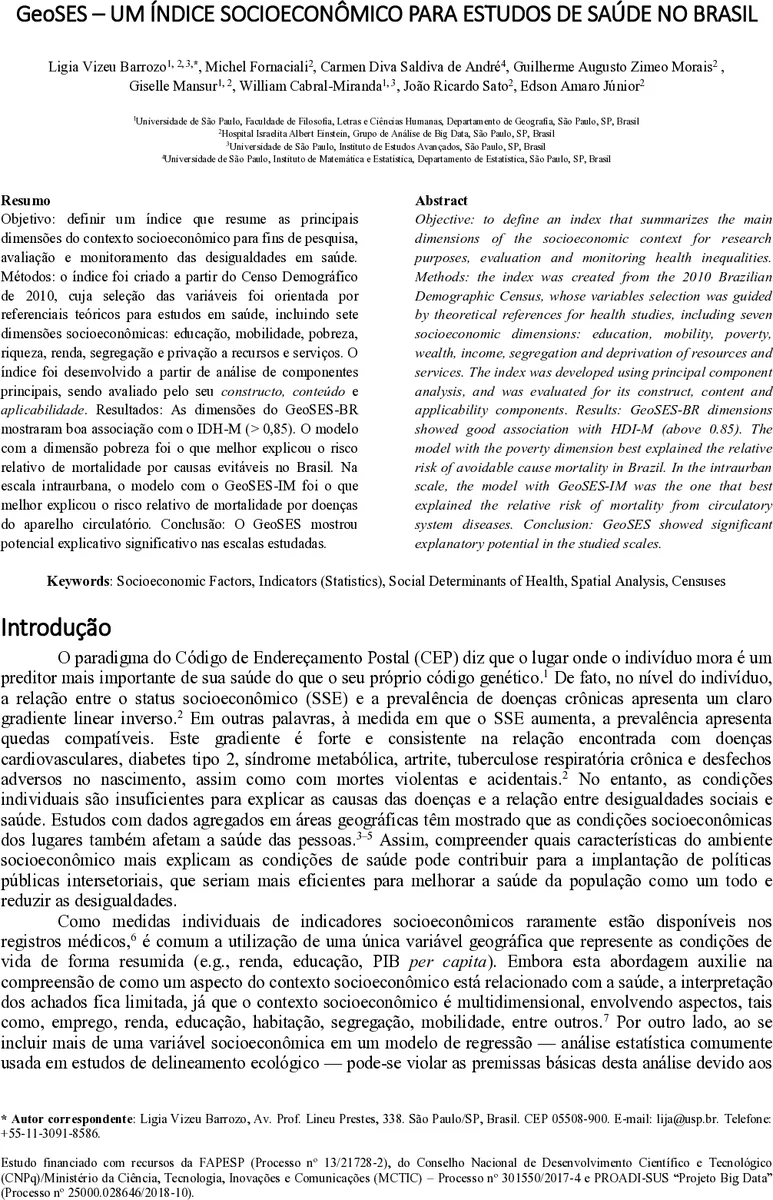
Objective: to define an index that summarizes the main dimensions of the socioeconomic context for research purposes, evaluation and monitoring health inequalities. Methods: the index was created from the 2010 Brazilian Demographic Census, whose variables selection was guided by theoretical references for health studies, including seven socioeconomic dimensions: education, mobility, poverty, wealth, income, segregation and deprivation of resources and services. The index was developed using principal component analysis, and was evaluated for its construct, content and applicability components. Results: GeoSES-BR dimensions showed good association with HDI-M (above 0.85). The model with the poverty dimension best explained the relative risk of avoidable cause mortality in Brazil. In the intraurban scale, the model with GeoSES-IM was the one that best explained the relative risk of mortality from circulatory system diseases. Conclusion: GeoSES showed significant explanatory potential in the studied scales.
💡 Research Summary
The paper addresses a critical gap in Brazilian health‑inequality research: the lack of a comprehensive, theory‑driven socioeconomic index that can be applied at multiple geographic scales. Existing studies often rely on single proxies such as household income, education level, or the Municipal Human Development Index (IDH‑M). While useful, these single‑variable measures fail to capture the multidimensional nature of the socioeconomic environment that influences health outcomes.
To fill this void, the authors develop GeoSES (Geographic Socio‑Economic Index for Health Studies) using data from the 2010 Brazilian Demographic Census. Variable selection follows a health‑science theoretical framework and groups 46 census variables into seven dimensions: education (7 variables), mobility (6), poverty (5), wealth (3), income (1), segregation (5), and deprivation of resources and services (19). Each dimension is first subjected to a principal component analysis (PCA) until the cumulative explained variance reaches at least 75 %. The most influential variables in each component are retained for further analysis. A second PCA is then performed on the pooled set of selected variables, and the first principal component of this final analysis is defined as the GeoSES score. Scores are linearly transformed to a standardized range of –1 to +1, where higher values indicate more favorable socioeconomic conditions.
The index’s validity is examined on three fronts. Content validity is assured because the chosen variables are theoretically representative of their respective dimensions. Construct validity is demonstrated by high internal consistency: Cronbach’s α values of 0.93 (national), 0.89 (state), and 0.97 (intramunicipal) indicate that the items cohere strongly. External construct validation compares GeoSES with the widely used IDH‑M. Correlation coefficients exceed 0.85 for the overall index and for most dimensions, especially education, poverty, and resource‑service deprivation, which show correlations above 0.90. Wealth and segregation display lower but still meaningful correlations, confirming that GeoSES captures socioeconomic aspects not fully reflected in IDH‑M.
Predictive utility is tested by linking GeoSES to health outcomes. At the national level, a model that includes the poverty dimension of GeoSES‑BR explains the relative risk of avoidable‑cause mortality better than alternative specifications. At the intra‑urban level, the GeoSES‑IM model most effectively explains the relative risk of mortality from circulatory system diseases. These findings illustrate that distinct socioeconomic dimensions exert differential influences on specific health outcomes, allowing policymakers to target interventions more precisely.
From a technical perspective, the authors implement the entire workflow in Python, modularizing data ingestion, preprocessing, PCA, and score standardization. This enables rapid, reproducible generation of GeoSES for every Brazilian municipality, state, and, where data permit, intra‑municipal weighting areas. Results are visualized through interactive HTML maps that display the overall index and each constituent dimension, facilitating intuitive exploration by researchers and decision‑makers. The codebase is designed to be adaptable to future censuses or to other countries’ datasets, ensuring scalability and long‑term relevance.
In summary, GeoSES represents a robust, multidimensional socioeconomic index tailored for health research in Brazil. It surpasses single‑indicator approaches by integrating education, mobility, poverty, wealth, income, segregation, and resource deprivation into a single, statistically sound metric. High internal consistency, strong correlation with established development indices, and demonstrable explanatory power for mortality outcomes collectively validate its utility. By providing a nuanced, geographically granular view of socioeconomic conditions, GeoSES equips public health analysts and policymakers with a powerful tool for monitoring health inequities, guiding resource allocation, and designing targeted interventions aimed at reducing the social determinants of health disparities.
Comments & Academic Discussion
Loading comments...
Leave a Comment