Online reactions to the 2017 Unite the Right rally in Charlottesville: Measuring polarization in Twitter networks using media followership
We study the Twitter conversation following the August 2017 Unite the Right' rally in Charlottesville, Virginia, using tools from network analysis and data science. We use media followership on Twitter and principal component analysis (PCA) to compute a Left’/Right' media score on a one-dimensional axis to characterize nodes. We then use these scores, in concert with retweet relationships, to examine the structure of a retweet network of approximately 300,000 accounts that communicated with the #Charlottesville hashtag. The retweet network is sharply polarized, with an assortativity coefficient of 0.8 with respect to the sign of the media PCA score. Community detection using two approaches, a Louvain method and InfoMap, yields largely homogeneous communities in terms of Left/Right node composition. When comparing tweet content, we find that tweets about Trump’ were widespread in both the Left and Right, though the accompanying language was unsurprisingly different. Nodes with large degrees in communities on the Left include accounts that are associated with disparate areas, including activism, business, arts and entertainment, media, and politics. Support of Donald Trump was a common thread among the Right communities, connecting communities with accounts that reference white-supremacist hate symbols, communities with influential personalities in the alt-right, and the largest Right community (which includes the Twitter account FoxNews).
💡 Research Summary
This paper investigates the Twitter discourse that followed the August 2017 “Unite the Right” rally in Charlottesville, Virginia, by constructing and analyzing a large‑scale retweet network centered on the hashtag #Charlottesville. The authors first collected 486 894 publicly available tweets posted by 270 975 distinct accounts over a six‑day window (16–21 August 2017). In parallel, they obtained the complete follower lists of 13 media accounts that span the ideological spectrum—from conservative outlets such as Breitbart, FoxNews, and TheBlaze to liberal sources such as NPR, MotherJones, and The Nation.
Using these follower lists, they built a binary matrix M (99 412 × 13) indicating whether each user follows each media account. A principal component analysis (PCA) on M revealed that the first principal component (PC1) cleanly separates conservative from liberal media: the component’s loadings are positive for the conservative outlets and negative for the liberal ones. Each user was therefore assigned a scalar “media‑preference score” equal to its PC1 coordinate; users with a positive score were labeled “Right,” those with a negative score “Left.” This approach requires no manual labeling or text‑based classification and leverages the well‑documented correlation between media consumption and political affiliation.
The retweet relationships among the #Charlottesville tweets were then used to construct an undirected retweet network comprising roughly 300 000 nodes and several million edges. By examining the sign of the media‑preference score on either side of each edge, the authors computed an assortativity coefficient of 0.8, indicating a very strong tendency for users to retweet others who share the same media orientation. In other words, the conversation is highly polarized into two echo chambers.
Community detection was performed with two complementary algorithms: the modularity‑optimizing Louvain method and the flow‑based Infomap algorithm. Both yielded a partition of the network into dozens of communities, each of which was overwhelmingly homogeneous with respect to the Left/Right label (over 90 % of members shared the same orientation). This confirms that the structural polarization observed at the edge level also manifests at the mesoscopic scale.
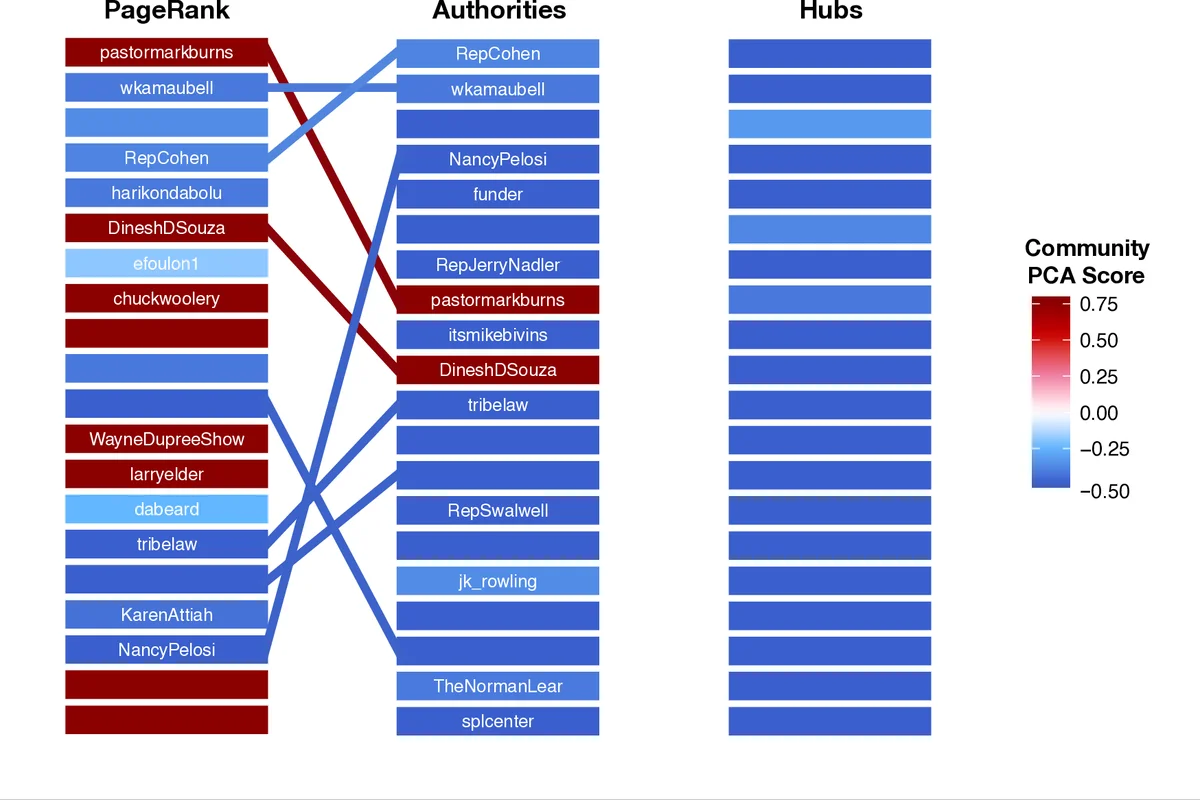
To identify influential accounts, the authors calculated several centrality measures, including degree, PageRank, betweenness, and the HITS algorithm (which distinguishes hubs from authorities). HITS analysis showed a larger number of hub nodes on the Left, reflecting a diverse set of influential accounts spanning activism, arts, business, media, and politics. On the Right, authority nodes were dominated by well‑known conservative media accounts (e.g., FoxNews, Breitbart) and alt‑right personalities.
Content analysis focused on the keyword “Trump.” The term appeared frequently in both Left and Right communities, but linguistic inspection revealed stark differences: Left‑leaning tweets employed critical language (“lies,” “dangerous”), whereas Right‑leaning tweets used supportive phrasing (“great,” “America First”). Moreover, Right communities were linked by shared references to white‑supremacist symbols (e.g., “1488,” “OK”), alt‑right figures (e.g., Richard Spencer), and a central FoxNews account that acted as a hub connecting disparate Right sub‑communities.
Overall, the study demonstrates that a simple PCA‑based media‑preference score can effectively quantify political polarization in large‑scale Twitter data. By coupling this scalar with retweet network analysis, the authors reveal both the micro‑level homophily (high assortativity) and macro‑level community segregation that characterize the online response to a highly contentious political event. The paper also acknowledges methodological limitations, including hashtag‑based sampling bias, potential bot activity, and the constraints of Twitter’s API. Future work is suggested to incorporate temporal dynamics, cross‑platform comparisons, and more sophisticated bot detection to deepen our understanding of digital political discourse.
Comments & Academic Discussion
Loading comments...
Leave a Comment