Revisiting the Bethe-Hessian: Improved Community Detection in Sparse Heterogeneous Graphs
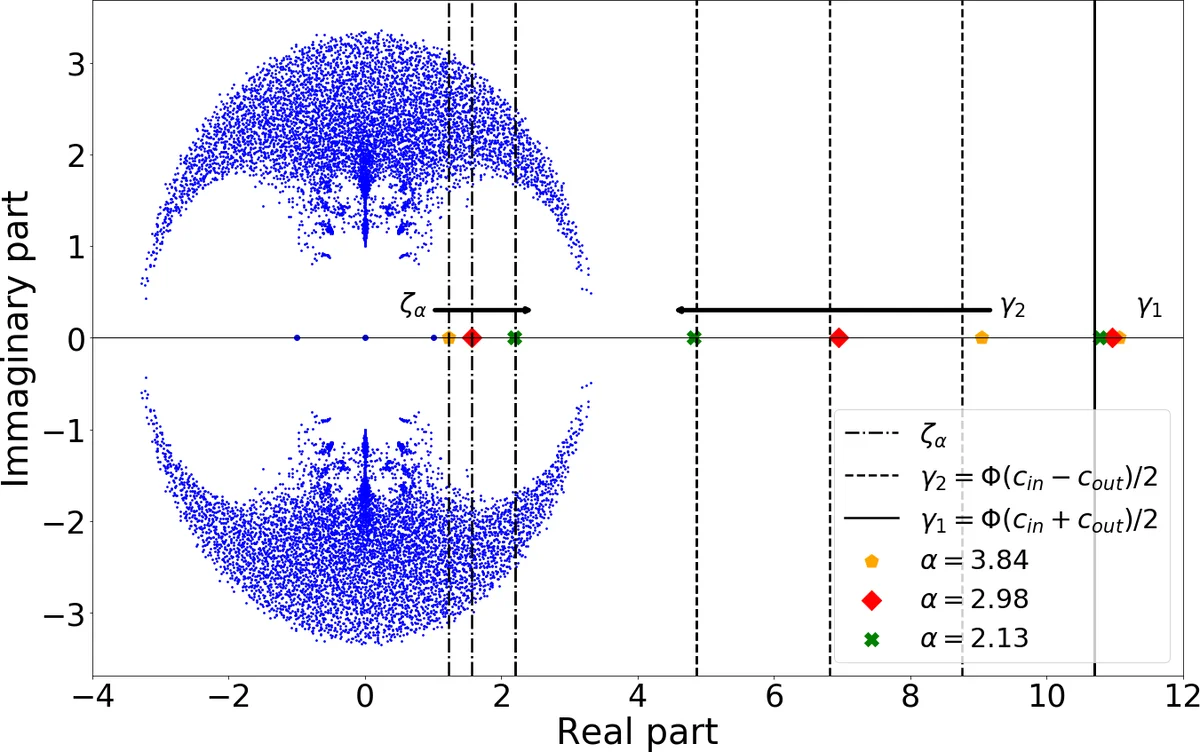
Spectral clustering is one of the most popular, yet still incompletely understood, methods for community detection on graphs. This article studies spectral clustering based on the Bethe-Hessian matrix $H_r = (r^2-1)I_n + D-rA$ for sparse heterogeneous graphs (following the degree-corrected stochastic block model) in a two-class setting. For a specific value $r = \zeta$, clustering is shown to be insensitive to the degree heterogeneity. We then study the behavior of the informative eigenvector of $H_{\zeta}$ and, as a result, predict the clustering accuracy. The article concludes with an overview of the generalization to more than two classes along with extensive simulations on synthetic and real networks corroborating our findings.
💡 Research Summary
The paper addresses community detection in sparse heterogeneous graphs modeled by the degree‑corrected stochastic block model (DC‑SBM). Spectral clustering based on the Bethe‑Hessian matrix H_r = (r²‑1)I + D − rA has been successful for homogeneous graphs when the parameter r is set to √(cΦ), where c is the average degree and Φ captures degree heterogeneity. However, in heterogeneous settings the eigenvector associated with the second smallest eigenvalue of H_r becomes strongly biased by the intrinsic node propensities θ_i, degrading performance.
The authors propose a new choice of the parameter, r = ζ, defined as ζ = (c_in + c_out)/(c_in − c_out) = 2√c·α, where α = (c_in − c_out)/√c is the signal‑to‑noise ratio and c_in, c_out are intra‑ and inter‑class connection strengths. This value of r makes the expected action of (D − rA) on the true label vector σ vanish, i.e., E
Comments & Academic Discussion
Loading comments...
Leave a Comment