Shoaling on Steep Continental Slopes: Relating Transmission and Reflection Coefficients to Greens Law
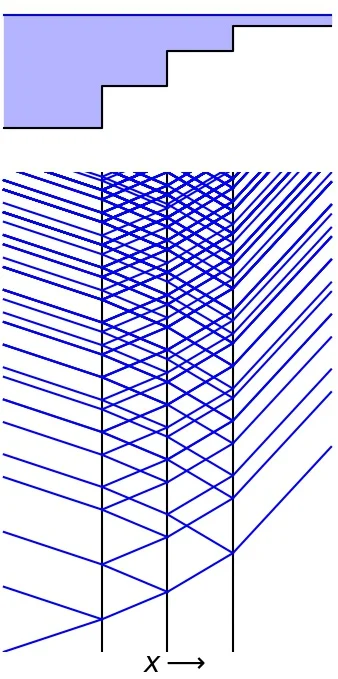
The propagation of long waves onto a continental shelf is of great interest in tsunami modeling and other applications where understanding the amplification of waves during shoaling is important. When the linearized shallow water equations are solved with the continental shelf modeled as a sharp discontinuity, the ratio of the amplitudes is given by the transmission coefficient. On the other hand, when the slope is very broad relative to the wavelength of the incoming wave, then amplification is governed by Green’s Law, which predicts a larger amplification than the transmission coefficient, and a much smaller amplitude reflection than given by the reflection coefficient of a sharp interface. We explore the relation between these results and elucidate the behavior in the intermediate case of a very steep continental shelf.
💡 Research Summary
The paper investigates how long waves, such as tsunamis, are amplified and reflected when they encounter a continental shelf. Using the one‑dimensional linearized shallow‑water equations (η_t + (h u)_x = 0, u_t + g η_x = 0), the authors treat the bathymetry as a piecewise‑linear profile: deep ocean depth h₀ for x < −ε, a linear slope of width 2ε joining h₀ to the shelf depth h_r, and constant depth h_r for x > ε. Two limiting cases are examined.
In the “sharp interface” limit (ε → 0) the problem reduces to a classic Riemann problem with a vertical step in depth. Matching eigen‑vectors on each side yields the familiar transmission and reflection coefficients
C_T = 2√h₀ / (√h₀ + √h_r), C_R = (√h₀ − √h_r) / (√h₀ + √h_r) = C_T − 1.
For the realistic values h₀ = 3200 m and h_r = 200 m, C_T≈1.6 and C_R≈0.6. The transmitted wave’s amplitude is increased by C_T, its width is reduced by the factor h_r/h₀ (because the wave speed drops), and the product of amplitude and width (i.e., the “mass” of the wave) changes by a factor (\bar C_T = (h_r/h₀) C_T). Energy is conserved: the sum of potential and kinetic energy in the transmitted and reflected parts equals the initial energy.
In the opposite limit (ε → ∞) the slope is so gentle that the wave experiences a slowly varying depth. Green’s Law then applies: the amplitude scales as (C_G = (h₀/h_r)^{1/4}). With the same depth ratio, C_G = 2, which is larger than C_T. The reflected wave becomes negligible; its energy spreads over an increasingly wide region and its amplitude decays to zero, while the transmitted wave carries essentially all the energy.
The core contribution of the paper is to bridge these two extremes by keeping ε finite. The authors solve the problem analytically where possible and numerically with the high‑resolution Clawpack finite‑volume code for a range of ε values. They use an initial square pulse (width 10 km, height 1 m) that is purely right‑going (u = √(g/h₀) η).
Results show a smooth transition: for a broad slope (ε = 60 km) the transmitted pulse’s peak amplitude is close to C_G A, the reflected component is practically invisible, and a small negative trailing wave appears. For a vertical step (ε = 0) the solution matches the Riemann prediction with amplitudes C_T A and C_R A. For intermediate slopes (ε ≈ 5 km) the transmitted amplitude lies between C_T A and C_G A, and the reflected wave is clearly present. The negative trailing wave behind the transmitted pulse carries just enough negative mass to offset the excess mass introduced by the larger amplitude, thereby preserving the total “wave mass” (\int η dx).
The authors also discuss mass and energy conservation in detail. The “wave mass” (\bar η = \int η dx) is invariant; the transmitted mass is (\bar C_T \bar η) and reflected mass is (\bar C_R \bar η) with (\bar C_T = (h_r/h₀) C_T) and (\bar C_R = C_R). Energy is partitioned equally between potential and kinetic forms for pure right‑ or left‑going waves, and the total energy remains constant across all ε. In the Green‑law limit the reflected energy tends to zero because the reflected amplitude decays faster than its width grows.
Finally, the paper connects the theory to realistic tsunami scenarios. Many tsunamis encounter continental slopes whose width is comparable to the tsunami wavelength, placing them in the intermediate regime. Relying solely on Green’s Law or on sharp‑interface transmission coefficients can therefore misestimate shoreline amplitudes. The ε‑dependent framework presented here offers a more accurate, physics‑based tool for coastal hazard assessment, especially when detailed bathymetric data are available.
In summary, the study provides a unified description of shoaling on steep continental slopes, quantifies how transmission and reflection coefficients evolve from the sharp‑step to the gentle‑slope limit, validates the theory with high‑resolution simulations, and highlights the practical importance of the intermediate regime for tsunami modeling.
Comments & Academic Discussion
Loading comments...
Leave a Comment