PowNet: a power systems analysis model for large-scale water-energy nexus studies
PowNet is a free modelling tool for simulating the Unit Commitment / Economic Dispatch of large-scale power systems. PowNet is specifically conceived for applications in the water-energy nexus domain, which investigate the impact of water availabilit…
Authors: AFM Kamal Chowdhury, Jordan Kern, Thanh Duc Dang
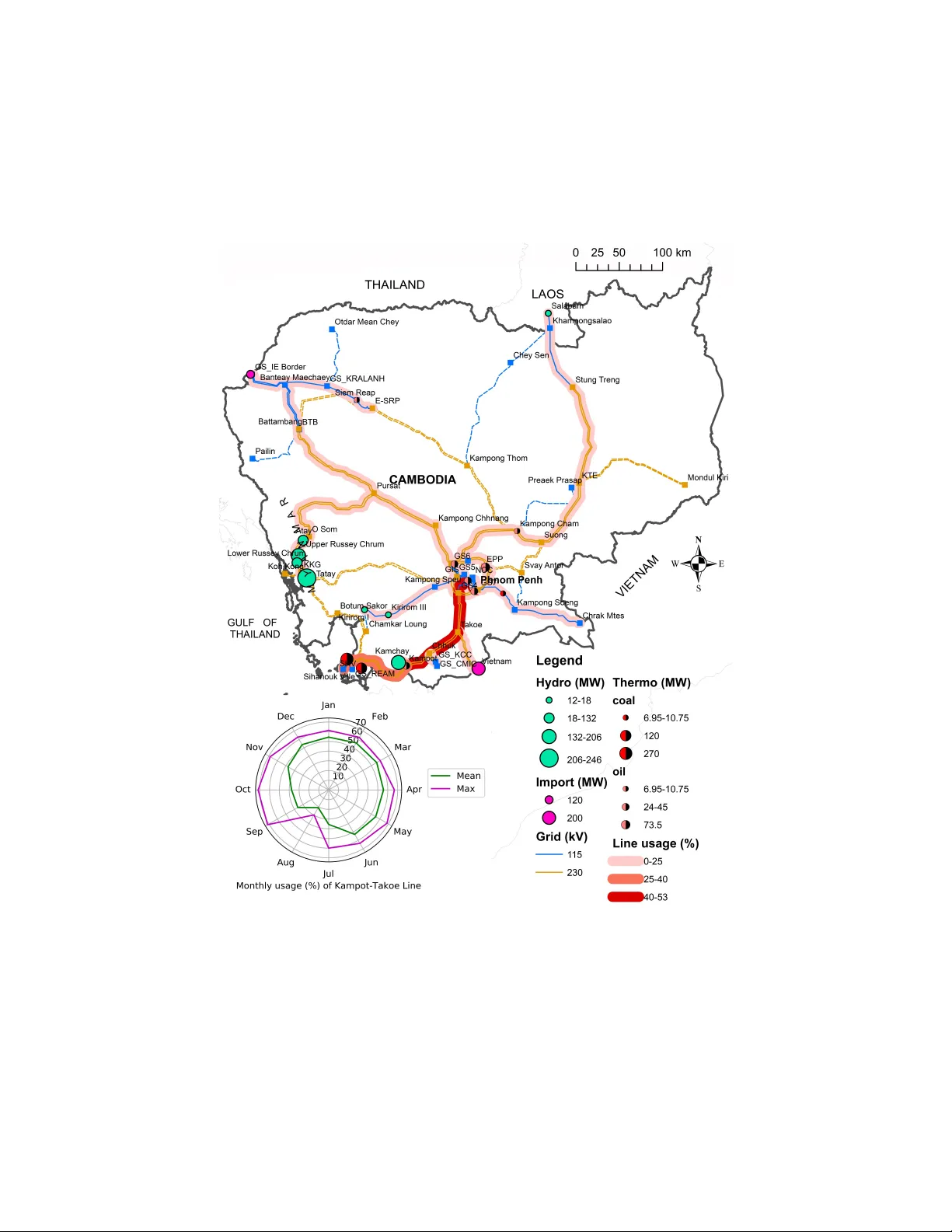
P o wNet: a p o w er systems analysis mo del for large-scale w ater-energy nexus studies AFM Kamal Cho wdhury 1 , Jordan Kern 2 , Thanh Duc Dang 1 , Stefano Galelli 1 1 Pillar of Engineering Systems and Design, Singap ore Univ ersity of T ec hnology and Design, Singap ore 487372 2 Departmen t of F orestry and En vironmental Resources, North Carolina State Univer- sit y , Jordan Hall Addition, 2820 F aucette Dr., NC 27695 Corresp onding author: AFM Kamal Cho wdhury (c howdh ury@sutd.edu.sg) Abstract P owNet is a free mo delling to ol for simulating the Unit Commitm en t / Economic Dispatc h of large-scale p o w er systems. P owNet is sp ecifically conceiv ed for applications in the w ater-energy nexus domain, whic h in v estigate the impact of w ater a v ailabilit y on electricit y supply . T o this purp ose, P owNet is equipp ed with features that guarantee accuracy , reusabilit y , and computational efficiency o ver large spatial and temp oral domains. Sp ecifically , the model (i) accounts for the techno-economic constraints of b oth generating units and transmission netw orks, (ii) can b e easily coupled with mo dels that estimate the status of generating units as a function of the climatic conditions, and (iii) explicitly includes imp ort/exp ort no des, which are often found in cross-border systems. P owNet is implemen ted in Python and runs with the help of an y standard optimization solv er (e.g., Gurobi, CPLEX). Its functionality is demonstrated on the Cam b o dian p ow er system. Keyw ords Unit commitment; economic dispatc h; transmission net works; w ater-energy nexus; en- ergy systems; p o w er systems; Python (1) Ov erview 1 In tro duction F uelled b y economic and p opulation gro wth, electricity demand is rapidly increasing in man y parts of the world. A t the same time, sev eral coun tries are cutting carb on dio xide emissions through a larger dep endance on renew able resources (e.g., hydro, wind and solar) [1]. Y et, electricit y supply from these resources v aries o ver m ultiple temp oral scales—from hourly to seasonal and in ter-annual—thereb y requiring more 1 flexible p ow er grids [2, 3]. These c hallenges hav e prompted the dev elopmen t of several mo delling to ols for energy and electricit y systems; see [4] for a comprehensiv e review. Broadly sp eaking, mo dels are used for t wo main tasks, long-term planning (e.g., ca- pacit y expansion, in vestmen t optimization) and short-term managemen t (e.g., pow er flo w analysis, unit commitmen t). Hereafter, w e refer to these t w o groups as ener gy and p ower systems analysis mo dels [5]. Imp ortan tly , mo delling to ols are used not only for ‘traditional’ tasks in the energy and pow er domains, suc h as in vestmen t optimization and grid analysis, but also for in terdisciplinary researc h spanning across multiple engineering domains. F or example, mo dels are increasingly being used in studies on the w ater-energy nexus, whic h aim to c haracterize the interdependencies b et ween these tw o critical sectors and introduce planning and management solutions that span across coupled systems [6]. The strate- gic imp ortance of energy and p o wer mo dels is thus lik ely to increase in the near future, as climatic changes are exp ected to transform b oth supply and demand of electricit y [7, 8, 9]. An important application in the w ater-energy nexus domain is Unit Commitmen t / Economic Dispatc h (UC/ED), in which a computer mo del is used to optimize the op- erations of pow er generating units—more precisely , UC determines when and which generating units to start-up and sh ut-down, while ED establishes the amoun t of p ow er supplied by each unit [10]. The correct simulation of the UC/ED decision-making pro- cess is indeed a critical step if one seeks to decipher the effect of w ater av ailability on the p erformance of a p o w er system. T o this purp ose, researc hers and practitioners typ- ically rely on p o w er systems mo dels—such as PR OMOD [11] or GENESYS [9]—that accoun t for the techno-economic constrain ts of the generating units, but often adopt simplified representations of the transmission netw orks; an assumption that may lead to a misrepresentation of p ow er system’s p erformance [12, 13]. T o explicitly account for electricit y transmission in a UC/ED exercise, one can only rely on a handful of mo dels, namely PSA T [14], PyPSA [5], and PLEXOS [15]. Y et, the latter is a propri- etary soft ware, and thereb y not freely av ailable to researc hers. Here, w e con tribute to this growing field and in tro duce P o wNet, a UC/ED modelling to ol sp ecifically conceived for applications in the water-energy nexus domain. P owNet builds on the UC/ED mo del first presented by [16], and complements it with a com- prehensiv e representation of the high-voltage transmission lines. As we shall see later, P owNet has a few desirable features. First, it bases the p o wer flow calculation on a Direct Current (DC) netw ork; a choice that strik es a reasonable balance betw een mo delling accuracy and data and computational requiremen ts. This is particularly imp ortan t for w ater-energy applications, which are generally carried out o ver extensiv e spatial and temporal domains. Moreov er, it should b e noted that the error introduced b y DC flow is generally negligible (as compared to a full-scale p ow er system mo del), except for high loadings with increased reactive p o wer [17, 18]. T o minimize suc h in- 2 stances, Po wNet incorp orates the N-1 criterion, whic h leav es part of the lines’ capacity un used, thereb y allowing for reactiv e p ow er flo ws [18, 19]. Second, Po wNet accounts for the p oten tial effect of w ater av ailability on the UC/ED pro cess. Sp ecifically , the user can soft link P owNet with any mo del able to pro cess climatic data and pro vide information on the status of renewable and non-renewable resources. Third, Po wNet explicitly includes the exp ort/imp ort nodes—as substations and generators–which are k ey comp onents of cross-b orders in terconnections. F ourth, Po wNet is fully written in Python, a programming language that should enhance its dissemination and reusabilit y . The next section describ es the mathematical mo del on which P owNet is based, while its Python implementation and arc hitecture are describ ed in Section 3. Section 4 presen ts the qualit y control, along with a sample implementation for the Cambo dian p ow er system. The concluding remarks are outlined in Section 5. 2 F unctionalit y In P owNet, a p ow er system is represen ted b y a set of no des ( n N ) that include p ow er plan ts and high-v oltage substations. Giv en a pre-defined planning horizon (e.g., 24 hours), the mo del (1) schedules the op erating status of the dispatc hable p ow er plant units (e.g., coal, gas, oil, and biomass), and (2) determines the hourly dispatch of electricit y from the committed units and v ariable renewable resources (e.g., h ydro, solar, wind) that meets the system’s demand at a minim um cost. As illustrated in Figure 1, the electricity a v ailable through the v ariable renewable resources is an input that can b e obtained from existing data or sim ulated b y a separate mo del (e.g., a h ydrological-hydraulic mo del for the a v ailable hydropow er). P owNet can also include imp ort stations as dispatc hable units. The scheduling and dispatc h of hourly electricit y is constrained by the design features of the p ow er plan ts as well as the capacity and susceptance of the transmission lines. Ov erall, Po wNet solv es a Mixed Integer Linear Program (MILP), whose ob jectiv e function, decision v ariables, and constraints are describ ed next (the notation used in the following sections is summarized in T able 1). 2.1 Ob jective function and decision v ariables The goal of Po wNet is to meet the hourly electricit y demand at the substations while minimizing the pro duction cost o v er a planning horizon, sa y 24 hours ( t T ). The pro- duction cost of the dispatc hable units ( g G ) dep ends on their fixed op eration and main- tenance (O&M) costs ( F ixedC ost g ), start-up cost ( S tar tC ost g ), v ariable costs for heat rate ( H eatR ate g ) and fuel price ( F uelP r ice g ), and v ariable O&M costs ( V ar C ost g ). The sh ut-do wn costs of the units are generally negligible when compared to the other costs [20], and are thus not considered in our mo del. The cost of imported electricity dep ends on the import price ( I mpor tP r ice i ), which is sp ecified for each imp ort source ( i I ). The pro duction cost of the r n -th v ariable renew able resource ( r n RN ) dep ends on the unit pro duction cost ( U nitC ost rn ), which is typically smaller than the one of 3 Hourly energy production mix, Po wer flow throug h the grid Electricity available fr om dispatchable units start and fixed costs, variable O&M costs, fuel price , heat rate Full/derated capacity , Ramp up/down limit, up/down time T ransmission capacity , susceptance Hourly electricity demand (at the substations) Climatic data (e .g., rainfall, temperature, wind speed, solar radiation ) Po w N e t ( MILP pr oblem: minimize costs, me et electr icity demand) Electricity available fro m variable resour ces Statistical or process- bas ed model Figure 1: Graphical representation of P o wNet. Blac k and red b oxes represen t input and output elemen ts, resp ectively . Grey b o xes represent elemen ts not included in the mo del. the dispatc hable unit [16]. The ob jective function is thus form ulated as follows: min T X t =1 G X g F ixedC ost g × O N g ,t + E l ec g ,t × ( H eatRate g × F uelP r ice g + V ar C ost g ) + S tar tC ost g × S w itch g ,t + I X i ( E l ec i,t × I mpor tP r ice i ) + RN X rn ( E l ec rn,t × U nitC ost rn ) , (1) where O N g ,t and S w itch g ,t are t wo decision v ariables describing the op erational status (on-line or off-line, and to b e started-up or shut-do wn) of the g -th dispatc hable unit at hour t , while E lec g ,t , E l ec i,t , and E l ec rn,t denote the hourly electricity pro duction of the g -th dispatc hable unit, i -th imp ort source, and r n -th v ariable renewable resource, resp ectiv ely . At eac h hour t , P owNet optimizes a few additional decision v ariables, namely , the v oltage angle V ol tAng l e n,t at eac h no de n of the netw ork (needed to esti- mate the transmission through each line), and the spinning and non-spinning reserv es S pinR es g ,t and N onS pinR es g ,t . 2.2 Constrain ts The sc heduling and dispatc h of hourly electricity is sub ject to m ultiple constrain ts accoun ting for the technical sp ecifications of generating units (i.e., capacit y , minim um 4 T able 1: Notations used to describ e Po wNet. Indices and sets: n any no de in the system N set of all no des in the system g dispatchable unit G set of all dispatchable units i import no de I set of all imp ort no des rn v ariable renewable resource (e.g., hydro, wind, solar) RN set of all v ariable renewable resources k sink no de connected by the transmission line to any no de n t time-step (hour, h) T planning horizon (e.g., 24 h) P arameters of the dispatc hable units ( g ): M axC ap g maximum capacity (MW) M inC ap g minimum capacity (MW) F ixedC ost g fixed O&M cost ($) S tar tC ost g start-up cost ($/start) H eatRate g heat rate (MMBtu/MWh) F uelP r ice g price of fuel ($/MMBtu) V ar C ost g v ariable O&M cost ($/MWh) Ramp g ramping limit (MW/h) M inU pT ime g minimum up time (h) M inD ow nT ime g minimum down time (h) P arameters of the imp ort no des ( i ): M axC ap i maximum allowable imp ort (MW) I mpor tP r ice i price of imp orted electricity ($/MWh) P arameters of the transmission netw ork: LineS us n,k susceptance (Siemens) of the transmission line b etw een no des n and k LineC ap n,k capacity (MW) of the transmission line b etw een no des n and k Input time series (hourly): Renew Av ail rn,t av ailable electricity (MWh) from the rn -th renewable resource Demand n,t electricity demand (MWh) (or exp ort) at any no de n Decision v ariables (at each hour t ): ON g,t binary (0,1) v ariable indicating if unit g is online (1) or offline (0) S w itch g,t binary (0,1) v ariable indicating if unit g m ust b e started-up ( S w itch g,t =1 only when O N g,t − 1 =0 is follow ed by O N g,t =1) E l ec g ∗ ,t electricity (MWh) generated by dispatchable unit g (*or any other p ow erplant) V ol tAng l e n,t voltage angle (radian) at any no de n S pinR es g,t spinning reserve (MWh) at unit g N onS pinRes g,t non-spinning reserve (MWh) at unit g 5 up/do wn time, ramping limit), energy balance at eac h no de (demand and supply), capacit y and susceptance of the transmission lines, transmission loss and N-1 criterion, and minim um requirements of spinning and non-spinning reserv es. Logical constraints. Similarly to [16], we adopt a set of logical constrain ts to bind the operational status of the v arious p ow er plan t units. First of all, we introduce a constrain t (equation (2)) on the op erational status of the dispatc hable units, according to whic h an off-line unit can b e started up but not sh ut do wn, and vice versa: S w itch g ,t ≥ 1 − O N g ,t − 1 − (1 − O N g ,t ); O N g ,t { 0 , 1 } , S w itch g ,t { 0 , 1 } , ∀ g , ∀ t , (2) where, the binary v ariable ON g ,t determines whether the g -th dispatchable unit is off- line (or on-line) at hour t , while S w itch g ,t indicates whether an off-line unit m ust b e started up (or not). The op erational status of each unit is also constrained b y the minimum up and down time ( M inU pT ime g and M inD ow nT ime g ) required to start it up or sh ut it do wn, that is: O N g ,t − O N g ,t − 1 ≤ O N g ,j ; ∀ g , t { 2 to ( T − 1) } , t < j ≤ min( t + M inU pT ime g − 1 , T ) , (3) O N g ,t − 1 − O N g ,t ≤ 1 − O N g ,j ; ∀ g , t { 2 to ( T − 1) } , t < j ≤ min( t + M inD ow nT ime g − 1 , T ) . (4) Ov er a planning horizon T , equations (3) and (4) th us force Po wNet to account for the minim um n umber of hours necessary to start the g -th unit up (or to sh ut it do wn) at hour j . Ramping limits. The ramping up and do wn hourly limits of the g -th unit ( Ramp g ) are constrained b y equations (5) and (6): E l ec g ,t − E l ec g ,t − 1 ≤ Ramp g ; ∀ g , ∀ t , (5) E l ec g ,t − 1 − E l ec g ,t ≤ Ramp g ; ∀ g , ∀ t . (6) In other words, equations (5) and (6) ensure that the increase or decrease of the p ow er generation during t wo consecutive hours ( E lec g ,t and E l ec g ,t − 1 ) is b elo w the ramping limit ( Ramp g ) of the g -th unit. 6 Capacit y constrain ts. Equation (7) accounts for the minimum and maximum ca- pacit y of the generating units. In particular, equation (7) indicates that the hourly electricit y pro duction E l ec g ,t from the g -th dispatchable unit is bounded b y its mini- m um and maximum capacit y ( M inC ap g and M axC ap g ): M inC ap g × O N g ,t ≤ E l ec g ,t ≤ M axC ap g × O N g ,t × D er ateF g ,t ; ∀ g , ∀ t . (7) The term D er ateF g ,t is used to account for the impact of droughts on freshw ater- dep enden t dispatchable units—during a prolonged dry sp ell, for example, a thermo- p o w er unit ma y not b e able to run at full capacity b ecause of its limited co oling capabilit y . The default v alue of D er ateF g ,t is one, but it can b e mo dified to a smaller v alue if water a v ailabilit y b ecomes a limiting factor. Note that the v alue of D er ateF g ,t m ust b e supplied b y the user, which can rely on a v ariet y of methods for suc h task [11, 21]. Similarly , the hourly electricit y imp ort E lec i,t from the i -th imp ort source is constrained b y the maximum allo wable imp ort ( M axC ap i ), as indicated b y equation (8): 0 ≤ E lec i,t ≤ M axC ap i × O N i,t ; ∀ i , ∀ t . (8) Finally , the amoun t of electricit y E l ec rn,t dispatc hed from the r n -th renew able resource (e.g., h ydro, wind, and solar) is b ounded b y its av ailability ( R enew Av ail rn,t ): 0 ≤ E lec rn,t ≤ Renew Av ail rn,t ; ∀ rn , ∀ t . (9) The v alue of RenewAv ail rn,t is generally modelled through the use of climatic data. F or example, the a v ailable h ydro-electricit y can be estimated b y feeding a hydrological- h ydraulic mo del with rainfall and temp erature data [22]. Similarly , the electricity a v ailable in wind and solar pow er plan ts can b e sim ulated b y harnessing data on wind sp eed [23] and solar radiation [24]. Energy balance. Equation (10) applies the energy balance at each no de n connected to any other no de k of the p o wer system [10]. The left-hand side of equation (10) accoun ts for (1) the electricit y inputs ( E l ec n,t ) from the a v ailable p o wer plan ts and/or imp ort-sources connected to n , and (2) the electricit y used to meet domestic demand or export ( Demand n,t or E xpor t n,t ) at the no de. The righ t-hand side indicates that the electricit y transferred (in or out) b etw een n and k is prop ortional to the difference of the v oltage angles at these no des ( V ol tAng l e n,t and V ol tAng l e k,t ), where the susceptance of the transmission line ( LineS us n,k ) is the prop ortionalit y constan t [25]. The voltage angle at an arbitrary reference no de (usually , the no de with highest demand) is set to zero, while the voltage angle at any other node can b e p ositive or negative [10]. The parameter T r ansL oss is used to discount the energy production, or imp ort, b y a giv en 7 p ercen tage, so as to account for the transmission losses (similar to [26]). Equation (10) is form ulated as: (1 − T r ansLoss ) × X E l ec n,t − D emand n,t ( − E xpor t n,t ) = X k N LineS us n,k × V oltAng l e n,t − V ol tAng l e k,t ; ∀ n , ∀ t . (10) The hourly demand (and export) time series at the substations represent an input to the mo del. These data can b e obtained from observ ed records (see Section 4.1) or mo delled through relev an t factors, such as p opulation or temp erature [3]. T ransmission capacity constrain ts. With equation (11), known as the N-1 crite- rion, Po wNet limits the electricity transfer b etw een an y no de-pair ( n and k ) b elow a certain percentage ( N 1 C r iter ion ) of the line-capacit y ( LineC ap n,k ), thereb y lea ving the remaining fraction as a safet y margin: − N 1 C r iter ion × LineC ap n,k ≤ LineS us n,k × V oltAng l e n,t − V ol tAng l e k,t ≤ N 1 C r iter ion × LineC ap n,k ; ∀ n , ∀ t , k N . (11) A common v alue for the parameter N 1 C r iter ion is 75% (c.f., [19]). As illustrated in App endix A, the parameters LineC ap n,k and LineS us n,k are estimated from design sp ecifications of the transmission lines (e.g., size and length, voltage level, num b er of circuits and conductors, and capacit y p er circuit), whic h can b e easily obtained from tec hnical rep orts. Electricit y reserv e. The last tw o equations ensure that (1) the hourly electricit y reserv e is larger than a predefined p ercen tage of the system’s demand at time t (e.g., ResM ar g in = 15%, [26]), and (2) the minimum spinning reserv e is a predefined p er- cen tage of the total reserve (e.g., S pinM ar g in = 50%, [16]): G X g S pinR es g ,t + N onS pinR es g ,t ≥ ResM ar g in × N X n D emand t ; ∀ t , (12) G X g S pinR es g ,t ≥ S pinM ar g in × ResM ar g in × N X n D emand t ; ∀ t . (13) Tw o additional constraints are used to ensure that spinning and non-spinning reserves are served by on-line and off-line generators, resp ectively . F urthermore, users can allo cate all or some sp ecific generators (e.g., oil-fired units) for the minimum reserve requiremen ts. 8 3 Implemen tation and arc hitecture P owNet is implemented in three Python scripts, namely ‘Po wNetMo del.py’, ‘Po wNet- DataSetup.p y’, and ‘P o wNetSolver.ip ynb’. ‘Po wNetMo del.p y’ con tains the main model structure, with the ob jective function and constrain ts describ ed in Section 2. The mo del structure is based on the Py omo optimization pac k age [27]. ‘P owNetDataSetup.p y’ prepares the data required to execute the mo del. Sp ecifically , it outlines the input data in to several .csv files that are read as DataF rame ob jects. Then, the script generates a .dat file in whic h all data are specified in a format that is executable by Py omo. Finally , ‘Po wNetSolver.ip yn b’ executes the mo del and solves the optimization problem using a standard solv er, suc h as Gurobi or CPLEX. The script also generates .csv files con taining the v alue of each decision v ariable. P owNet input data are categorized as: (i) parameters of the dispatc hable units, (ii) parameters of the transmission lines, (iii) hourly time series of electricit y demand at the substations, and (iv) hourly time series of electricity av ailable from v ariable renew able resources. The techno-economic parameters of the dispatchable units are provided in a .csv file that also includes iden tification data, suc h as the name and type of each unit and the no de to whic h they b elong. The type of unit dep ends on fuel and turbine (e.g., ‘coal st’ stands for a coal-fired unit with steam turbine). The techno-economic parameters are considered constan t ov er the simulation p erio d. In addition, the .csv file contains the v alue of the derating factor (see Section 2.2). The data concerning the parameters of the transmission lines (i.e., susceptance and capacity), hourly electricity demand, and electricit y av ailable from renew able resources are pro vided in separate .csv files. The data regarding the length of the sim ulation p erio d, planning horizon, transmission loss, N-1 criterion, and hourly reserve margins are pro vided directly by the user in the script ‘P owNetDataSetup.p y’. 4 Qualit y con trol So far, P owNet has b een tested on the Laotian [28, 29] and Thai [30] p o wer systems. In b oth cases, the mo del output w as v alidated against observ ed statistics, suc h as the seasonal or ann ual generation mix. Here, w e present an implemen tation of P owNet for the Cam b o dian p ow er system. The data and co de used for this demonstration are a v ailable in GitHub along with step-by-step instructions on ho w to customize them. The next section presen ts an ov erview of the mo del setup, follow ed by an ev aluation of its p erformance. 4.1 Setup Our implemen tation is based on the infrastructure built and op erated in 2016. The system consists of 30 no des—including pow er plan ts and substations—connected b y high-v oltage transmission lines (Figure 2) [31]. The total generating capacit y is 2,000 MW, with the national p eak demand equal to 1,192 MW. The domestic capacity in- 9 cludes three coal-fired units (400 MW), 15 oil-fired units (282 MW), and six h ydrop o wer plan ts (930 MW). The system is also connected to t wo import stations (dispatchable) from Vietnam (200 MW) and Thailand (120 MW), and a hydropow er plant in Laos. T o set P o wNet, data on the parameters of dispatc hable units and transmission lines w ere extracted from differen t tec hnical rep orts [20, 31, 32]. (F urther details ab out the estimation of the transmission parameters are giv en in App endix A.) W e also extracted data on province-wise, monthly-v aried p eak electricit y demand from [31]. Spatially , the pro vince-wise demand data were disaggregated to substations based on their v oltage-lev els. F or the disaggregation of monthly data to hourly resolution, w e used a w eek-daily and a clo ck-hourly demand profile to incorp orate the v ariabilit y of demand o ver da ys in a week and hours in a day , respectively . The time series of a v ail- able h ydrop o wer w as simulated by a conceptual hydrologic model (see App endix B). The mo del was run with a 24 hour planning horizon, threshold for the N-1 criterion equal to 75% (of the line’s capacity), and reserve margin equiv alen t to 15% of the system’s demand. The model was calibrated against the 2016 (observ ed) ann ual gen- eration mix by tuning the fuel price v alue in Equation (1). F or eac h day (24 hours) of sim ulation, P owNet optimizes around 2,600 v ariables (contin uous and binary). The mo del was tested with t wo solvers (Gurobi and CPLEX) on an In tel(R) Core(TM) i7-8700 CPU @ 3.20 GHz with 8 GB RAM running Microsoft Windows 10. They b oth yield the same output, with sligh tly differen t computational requirements— ∼ 3.5 and ∼ 3.0 seconds p er da y of simulation, resp ectively . F urther tests on a Linux op erating system sho w similar p erformance. 4.2 P erformance The sim ulation for the year of 2016 pro vides the follo wing hourly time series: (1) op- erational status of dispatc hable units, (2) generation provided by dispatchable units and v ariable renew able resources, (3) v oltage angles at eac h no de, and (4) spinning and non-spinning reserves. These v ariables represen t an imp ortant information for the op eration, planning, and management of p ow er systems. F or example, detailed information on the op erational status can supp ort the unit commitmen t and economic dispatc h ov er the planning horizon, while statistics on the generation mix pro vide an o verview of the system’s dep endance on the v arious energy sources. These concepts are further exemplified in Figure 3, whic h illustrates the energy generation mix. Here, w e can notice the ‘signature’ of w et and dry seasons: during the monso on (May to No vem b er), the system hea vily relies on hydropow er pro duction, while during the pre- and p ost-monso on months the electricity generation is largely based on coal and im- p ort. The use of these tw o resources is not only controlled b y economic factors—coal is c heap er than imported electricit y—but also b y the sev eral tec hno-economic constraints describ ed in Section 2.2. F or example, there are a few da ys in August in whic h the concomitance of limited load and high fixed and start-up costs make imp orted elec- 10 tricit y preferable ov er coal. The ab o ve analyses could b e readily extended to longer sim ulation p erio ds or m ultiple demand patterns, so as to explore the effect of different driv ers on the p erformance of the p ow er system (e.g., [3, 11]). Apart from the detailed representation of the aforemen tioned v ariables, another fea- ture of P owNet is the explicit representation of the hourly transmission of electricity through the lines (estimated from the v oltage angle at each no de). This information is syn thesized in Figure 4, which depicts the ann ual av erage usage of eac h line. Results indicate that usage is limited, with only a few lines sho wing v alues larger than 40% of their capacit y . Unsurprisingly , these lines connect the coal plants in the Southw estern coast and imp ort station from Vietnam to the capital (Phnom Penh), namely the area with the highest load. The radar c hart indicates that the a verage usage of these lines is higher during the dry mon ths, when the system heavily relies on the coal units due to the lo w hydropow er av ailability . Despite the limited av erage usage, the maxim um usage of the lines during w et mon ths is high ( ∼ 70%), mainly b ecause of the p eak-hour supply from the imp ort station. Note that the transmission of electricity through the lines can also b e used to calculate the num b er of N-1 violations (not observ ed in this example), a pro xy of the netw ork’s stress conditions. T o further demonstrate the imp ortance of a detailed representation of the high-voltage transmission lines, w e run Po wNet using a sligh tly altered net w ork. In the ‘altered’ net work, we assume that the capacit y of the t wo lines transferring electricity from the South western coast and Vietnam to the capital (see Figure 4) is halv ed—these are double circuit transmission lines, so suc h scenario represents an instance in which one of the t wo circuits fails to op erate. (All other parameters and input v ariables remain unc hanged.) Figure 5 compares the system’s performance obtained with the ‘existing’ and ‘altered’ transmission net works. Lo oking at the generation mix (left panel), we note that the mo del with altered netw ork dispatches less electricity from coal plan ts and Vietnam’s imp ort station. That is b ecause the tw o lines with reduced capacit y are frequen tly stressed (ab out 18% of the time), so they do not allow the coal plan ts and imp ort station to run at their full capacit y . The reduced dispatch from the coal plan ts and Vietnam’s imp ort station is partially offset by higher production from the oil-fired units and Thai imp ort station (we also observe a shortage of electricit y supply of ab out 25 GWh). In turn, such higher reliance on oil affects op erating costs and CO 2 emissions. Ov erall, these results indicate that the altered functioning of just a few lines can influence the b eha viour of an entire p ow er system. Capturing suc h dynamics is therefore paramount to supp orting effectiv ely the op erations and planning of large-scale energy systems. 5 Conclusions P owNet is a least-cost optimization mo del for sim ulating the UC/ED of national and regional pow er systems. The model accoun ts for the techno-economic constraints of 11 generating units and DC transmission net work, thereb y pro viding functionalities for b oth grid and economic analyses. In particular, P owNet is conceiv ed for applications in the water-energy nexus domain, and it can easily incorp orate information on the effect of w ater a v ailabilit y on renew able and non-renewable resources. The data requiremen ts for the DC transmission net work are limited, thereb y making P owNet applicable to data-scarce regions, particularly dev eloping countries. (2) Av ailabilit y Op erating system Windo ws 10, Linux, and an y other op erating systems running Python and a standard solv er (e.g., Gurobi, CPLEX). Programming language Python 3.5 Additional system requirements None. Dep endencies P owNet is written in Python 3.5. The follo wing Python pack ages are required for P owNet: (i) Pyomo, (ii) NumPy , (iii) Pandas, and (iv) Matplotlib (optional for plot- ting). The Jupyter Noteb o ok (freely a v ailable as part of Anaconda Python with the aforemen tioned pac k ages) is required to run the script ‘P o wNetSolver.ip ynb’, whic h also requires an optimization solv er (e.g., Gurobi, CPLEX). Soft ware lo cation: Name: Zeno do P ersistent identifier: h ttps://doi.org/10.5281/zeno do.3462879 Licence: MIT Publisher: AFM Kamal Cho wdhury V ersion published: v1.1 Date published: 27-September-2019 Co de rep ository Name: GitHub P ersistent identifier: h ttps://github.com/k amal0013/Po wNet Licence: MIT Date published: 27-September-2019 12 Language English (3) Reuse p otential P owNet is av ailable on GitHub with step-by-step instructions on how to form ulate and implemen t the mo del of a giv en p o wer system. While the data and scripts demonstrate its use for the Cam b o dian pow er system, the user can easily build a new mo del or customize an existing one b y mo difying (or adding) dispatchable generators, renew able resources, substations, and transmission lines. The GitHub rep ository also includes a few additional scripts that help users p erform some standard analyses on Po wNet’s output. Note that Pyomo is free, and that academic users can obtain a free license of state-of-the-art standard solvers (e.g., Gurobi, CPLEX) to solve the mo del. W e also note that Po wNet has been tested on Windows and Lin ux operating systems. Overall, the av ailability of a dedicated rep ository , instructions, and extensiv e examples should mak e Po wNet easy and straightforw ard to reuse. Ac knowledgmen t/F unding statement This researc h is supp orted by Singap ore’s Ministry of Education (MoE) through the Tier 2 pro ject ‘Linking water a v ailability to hydropow er supply—an engineering sys- tems approac h’ (Award No. MOE2017-T2-1-143). Comp eting in terests The authors declare that they ha ve no competing interests. App endix A. Estimation of transmission parameters P owNet uses tw o parameters for each transmission line, namely susceptance ( LineSus ) and capacity ( LineCap ). F or each transmission line, LineCap is estimated as the pro duct b etw een the capacity per circuit and num b er of circuits in the line. LineSus is estimated as the recipro cal of line reactance X , which is calculated as follows [25]: X = 4 π f L × 10 − 7 × ln D m GM R , (A1) where, f and L are the line frequency (Hz) and length (km), D m the geometric mean distance b etw een phases, and GMR the geometric mean radius of line p er phase. As- suming that the lines are in a three-phase system with symmetrically arranged conduc- tors, the geometric mean distance D m can b e considered equal to the cen tre-to-centre distance D (m) b etw een any t wo conductors [10]. D is calculated as a function of the v oltage level (kV), as recommended b y [33, 34]: D m = D = 0 . 0348 × 0 . 077 × V ol tag e − 3 . 11 . (A2) 13 The GMR asso ciated with line is calculated as follows [10]: GM R = C Y c =1 e − 1 / 4 × r j × C Y j =1 ,j 6 = c d c,j 1 /C 1 /C , (A3) where, r j is the radius of an y conductor j , and d c,j is the centre-to-cen tre distance b et w een j and each of the other conductors of a phase of C conductors. F or the Cam b o dian p ow er system, we obtained data on v oltage level (kV), n umber of circuits, line length (km), size (mm 2 ) and num b er of conductors, and capacity (MW) p er circuit from [31, 35]. B. Simulation of h ydrop o wer a v ailabilit y T able B1 shows the design sp ecifications (collected from [36, 37]) of the Cambo dian h ydrop o wer reserv oirs. T o calculate the hydropow er av ailable in each dam, w e adopted the following pro cedure. First, w e estimated the inflo w to the reservoirs ( Q t ) through the use of the rational metho d, that is: Q t = c × I t × A, (B1) where c is a runoff co efficient, I t the rainfall intensit y (mm/day), and A the drainage area of each dam (km 2 ). The runoff co efficient was estimated as a function of the soil t yp e and slop e of the drainage basins, while the rainfall in tensity was extracted from the APHR ODITE gridded rainfall dataset. Then, w e calculated the mass balance of each reserv oir, namely: S t +1 = S t + Q t − R t , (B2) s.t. 0 ≤ S t ≤ S cap , (B4) where S t , Q t , and R t represen t the water storage, inflow, and release at time t . S cap is the capacity of the reservoir. T o calculate the release R t , w e adopted rule curv es aimed to maximize the h ydrop o wer production [38]. Finally , we used the hydropow er equation to estimate the p o w er av ailable at each h ydrop o wer plan t: hy dr opow er t = η × ρ × g × R t × H t , (B5) where hy dr opow er t is the a v ailable h ydrop ow er (MW), η a non-dimensional turbine efficiency term, ρ the water density (1,000 kg/m 3 ), g the gravitational acceleration (9.81 m/s 2 ), and H t the hydraulic head at time t (calculated from the storage S t ). The daily time series of av ailable hydropow er was transformed into an hourly time series b y assuming equal water a v ailabilit y throughout a single day . 14 T able B1: Design sp ecifications of the Cambo dian hydropow er dams. Name Installed capacit y Dam heigh t Storage Design disc harge Hydraulic head Basin area Runoff co efficien t (MW) (m) (Mm 3 ) (m 3 /s) (m) (km 2 ) Kamc hay 194.1 110 680 163.5 122 710 0.62 Kirirom I 12 34 30 20 373.5 99 0.48 Kirirom I I I 18 40 30 40 271 105 0.48 L.R. Chrum 338 68 62 300 132 1,550 0.51 Stung A tay 240 45 443.8 125 216 1,157 0.75 Stung T atay 246 77 322 150 188 1,073 0.71 References [1] Dolf Gielen, F rancisco Boshell, Deger Sa ygin, Morgan D. Bazilian, Nicholas W ag- ner, and Ricardo Gorini. The role of renew able energy in the global energy trans- formation. Ener gy Str ate gy R eviews , 24:38 – 50, 2019. [2] Manuel W elsch, P aul Deane, Mark How ells, Brian ´ O Gallach´ oir, Fionn Rogan, Morgan Bazilian, and Hans-Holger Rogner. Incorporating flexibilit y requirements in to long-term energy system mo dels–A case study on high levels of renewable electricit y p enetration in Ireland. Applie d Ener gy , 135:600–615, 2014. [3] Y ufei Su, Jordan D. Kern, and Gregory W. Charac klis. The impact of wind p ow er gro wth and h ydrological uncertain ty on financial losses from o versupply ev en ts in h ydrop o wer-dominated systems. Applie d Ener gy , 194:172–183, 2017. [4] Hans-Kristian Ringkjøb, Peter M. Haugan, and Ida Marie Solbrekk e. A review of mo delling to ols for energy and electricit y systems with large shares of v ariable renew ables. R enewable and Sustainable Ener gy R eviews , 96:440 – 459, 2018. [5] Thomas Bro wn, Jonas H¨ orsch, and Da vid Schlac h tb erger. PyPSA: Python for Po wer System Analysis. Journal of Op en R ese ar ch Softwar e , 6(1), 2018. [6] Jiangyu Dai, Shiqiang W u, Guoyi Han, Josh W ein b erg, Xinghua Xie, Xiufeng W u, Xingqiang Song, Ben you Jia, W anyun Xue, and Qianqian Y ang. W ater-energy nexus: A review of metho ds and to ols for macro-assessmen t. Applie d Ener gy , 210: 393–408, 2018. [7] Michelle T. H. v an Vliet, Da vid Wib erg, Sylv ain Leduc, and Keywan Riahi. Po w er- generation system vulnerability and adaptation to changes in climate and w ater resources. Natur e Climate Change , 6:375–380, 2016. [8] Sean W.D. T urner, Jia Yi Ng, and Stefano Galelli. Examining global electric- it y supply vulnerability to climate change using a high-fidelit y hydropow er dam mo del. Scienc e of The T otal Envir onment , 590-591:663–675, 2017. 15 [9] S. W. D. T urner, N. V oisin, J. F azio, D. Hua, and M. Jourab chi. Comp ound climate even ts transform electrical p o wer shortfall risk in the Pacific Northw est. Natur e Communic ations , 10:1–8, 2019. [10] A.J. Conejo and L. Baringo. Power system op er ations . Springer, 1st. edition, 2018. [11] N. V oisin, M. Kin tner-Mey er, R. Sk aggs, T. Nguy en, D. W u, J. Dirks, Y. Xie, and M. Hejazi. V ulnerability of the U.S. western electric grid to h ydro-climatological conditions: How bad can it get? Ener gy , 115:1–12, 2016. [12] J.P . Deane, Alessandro Chio di, Maurizio Gargiulo, and Brian P . ´ O Gallach´ oir. Soft-linking of a p ow er systems mo del to an energy systems mo del. Ener gy , 42(1): 303–312, 2012. [13] Georgios Savvidis, Kais Siala, Christoph W eissbart, Luk as Schmidt, F rieder Borggrefe, Subhash Kumar, Karen Pittel, Reinhard Madlener, and Kai Hufendiek. The gap betw een energy p olicy c hallenges and mo del capabilities. Ener gy Policy , 125:503 – 520, 2019. [14] F. Milano. An op en source p ow er system analysis to olb o x. IEEE T r ansactions on Power Systems , 20(3):1199–1206, 2005. [15] O’Connell, Nathalie V oisin, Macknic k, and F u. Sensitivit y of western u.s. p ow er system dynamics to droughts comp ounded with fuel price v ariabilit y . Applie d Ener gy , 247:745 – 754, 2019. [16] Jordan D. Kern and Gregory W. Characklis. Ev aluating the financial vulnerabilit y of a ma jor electric utility in the Southeastern U.S. to drough t under climate change and an evolving generation mix. Envir onmental Scienc e & T e chnolo gy , 51(15): 8815–8823, 2017. [17] B. Stott, J. Jardim, and O. Alsac. DC pow er flow revisited. IEEE T r ansactions on Power Systems , 24(3):1290–1300, 2009. [18] T. Brown, P . Schierhorn, E. T r¨ oster, and T. Ac kermann. Optimising the europ ean transmission system for 77% renewable electricit y b y 2030. IET R enewable Power Gener ation , 10(1):3–9, 2016. [19] Ingmar Schlec ht and Hannes W eigt. Swissmo d - a mo del of the Swiss electricity mark et. F oNEW Discussion Pap er , page 31, 2014. [20] Johannes T ruby . Thermal p o w er plant economics and v ariable renew able energies: A mo del-based case study for German y . T ec hnical report, International Energy Agency (IEA), 2014. 16 [21] William Naggaga Lub ega and Ashlynn S Stillwell. Maintaining electric grid reli- abilit y under hydrologic drough t and heat w av e conditions. Applie d Ener gy , 210: 538–549, 2018. [22] T. D. Dang, A. K. Cho wdhury , and S. Galelli. On the represen tation of water reserv oir storage and op erations in large-scale hydrological mo dels: implications on mo del parameterization and climate c hange impact assessmen ts. Hydr olo gy and Earth System Scienc es Discussions , 2019:1–34, 2019. doi: 10.5194/hess- 2019- 334. [23] A. P apav asiliou, S. S. Oren, and I. Ara v ena. Sto c hastic mo deling of multi-area wind p o wer pro duction. In 2015 48th Hawaii International Confer enc e on System Scienc es , pages 2616–2626, 2015. [24] N. Blair, A. Dob os, J. F reeman, T. Neises, M. W agner, T. F erguson, P . Gilman, and S. Janzou. System advisor mo del, SAM 2014.1.14: General description, 2014. url: https://sam.nrel.go v, last accessed on 05/09/2019. [25] Arthur R. Bergen and Vijay . Vittal. Power systems analysis . Pren tice Hall, Upp er Saddle Riv er, New Jersey , 2nd. edition, 1999. [26] Omar J. Guerra, Diego A. T ejada, and Gin taras V. Reklaitis. An optimization framew ork for the in tegrated planning of generation and transmission expansion in in terconnected p o wer systems. Applie d Ener gy , 170:1–21, 2016. [27] W E Hart, W J Paul, and L W Da vid. Pyomo: Mo deling and solving mathematical programs in Python. Mathematic al Pr o gr amming Computation , 3:219–260, 2011. [28] A. K. Chowdh ury , T. D. Dang, and S. Galelli. Coupling h ydrologic and net- w ork constrained unit commitment mo dels to understand the water-energy nexus in Laos, 2018. Presen ted in AGU F all Meeting 2018, W ashington D.C. url: h ttp://adsabs.harv ard.edu/abs/2018AGUFM.H23F..03C. [29] S. Galelli, A. K. Cho wdhury , and T. D. Dang. A coupled w ater- energy mo del rev eals key interdependencies b etw een h ydro-climatic v ariabil- it y , energy generation, and p ow er distribution in the Greater Mekong Sub- region, 2019. Presen ted in EGU General Assembly 2019, Vienna. url: h ttps://meetingorganizer.cop ernicus.org/EGU2019/EGU2019-6293.p df. [30] A. K. Cho wdhury , T. D. Dang, and S. Galelli. Impacts of hydro-climatic v ariabilit y on the energy system of the Greater Mek ong Sub-region, 2019. Presented in A OGS Ann ual Meeting 2019, Singap ore. [31] EDC. Annual rep ort 2016. T echnical rep ort, Electricite Du Cambo dge (EDC), 2016. 17 [32] EIA. Average tested heat rates by prime mo ver and energy source, 2007 - 2016 (Form EIA-860, ann ual electric generator rep ort). T echnical rep ort, U.S. Energy Information Administration (EIA), 2016. [33] L.O. Barthold, R.E. Clayton, I.S. Grant, V.J. Longo, J.R. Stewart, and D.D. Wil- son. T ransmission line reference b o ok: 115–138 kV compact line design. T ec hnical rep ort, Electric P o wer Researc h Institute, Inc., Palo Alto, CA, 1978. [34] D.D. MacCarthy . EHV T r ansmission Line R efer enc e Bo ok . Pro ject EHV, General Electric Compan y , Edison Electric Institute, 1968. [35] JICA. Final rep ort: Preparatory survey for Phnom Penh city transmission and distribution system expansion pro ject phase ii in the Kingdom of Cambo dia. T ech- nical rep ort, Japan In ternational Co op eration Agency (JICA), 2014. [36] C. Middleton and S. Chanth y . Cambo dia’s h ydrop ow er dev elopment and China’s in volv ement. T echnical rep ort, In ternational Rivers, 2008. [37] Prach vuthy Men, V athana Th un, Soriy a Yin, and Louis Leb el. Benefit sharing from Kamcha y and Low er Sesan 2 h ydrop o wer watersheds in Cambo dia. Water R esour c es and R ur al Development , 4:40 – 53, 2014. [38] T. Piman, T. A. Cochrane, M. E. Arias, A. Green, and N. D. Dat. Assessmen t of flo w c hanges from h ydrop o wer dev elopment and op erations in Sek ong, Sesan, and Srep ok Riv ers of the Mek ong basin. Journal of Water R esour c es Planning and Management , 139(6):723–732, 2013. 18 Figure 2: Main generation and transmission comp onents of the Cambo dian p o wer system, as of 2016. The dashed lines denote components that are either planned or under construction. 19 J a n F e b M a r A p r M a y J u n J u l A u g S e p O c t No v De c J a n 0 . 0 2 . 5 5 . 0 7 . 5 1 0 . 0 1 2 . 5 1 5 . 0 1 7 . 5 2 0 . 0 E l e c t r i c i t y g e n e r a t i o n ( G W h / d a y ) h y d r o c o a l i m p o r t ( L a o s) i m p o r t ( T h a i l a n d ) i m p o r t ( V i e t n a m ) o i l sl a c k Figure 3: Daily generation mix for 2016. 20 Figure 4: Ann ual av erage usage of the transmission lines, expressed as a p ercentage of the lines’ capacity . The radar chart sho ws the monthly a verage and maxim um usage of the line connecting Kamp ot to T ak o e (one of the lines with relativ ely high usage). 21 e x i st i n g a l t e r e d 0 1 0 0 0 2 0 0 0 3 0 0 0 4 0 0 0 5 0 0 0 6 0 0 0 E l e c t r i c i t y g e n e r a t i o n ( G W h / y e a r ) e x i st i n g a l t e r e d 0 5 1 0 1 5 2 0 2 5 E l e c t r i c i t y sh o r t a g e ( G W h / y e a r ) e x i st i n g a l t e r e d 2 4 0 2 4 1 2 4 2 2 4 3 2 4 4 2 4 5 O p e r a t i n g c o st ( M . Do l l a r s/ y e a r ) e x i st i n g a l t e r e d 2 . 5 2 . 6 2 . 7 2 . 8 2 . 9 3 . 0 3 . 1 C O 2 e m i ssi o n ( m e g a t o n n e s/ y e a r ) h y d r o c o a l i m p o r t ( L a o s) i m p o r t ( T h a i l a n d ) i m p o r t ( V i e t n a m ) o i l sh o r t a g e c o st e m i ssi o n Figure 5: Sim ulation results obtained with the ‘existing’ and ‘altered’ transmission net works. System’s p erformance is measured in terms of generation mix, electricit y shortage, op erating costs, and CO 2 emissions. 22
Original Paper
Loading high-quality paper...
Comments & Academic Discussion
Loading comments...
Leave a Comment