Perovskite PV-powered RFID: enabling low-cost self-powered IoT sensors
Photovoltaic (PV) cells have the potential to serve as on-board power sources for low-power IoT devices. Here, we explore the use of perovskite solar cells to power Radio Frequency (RF) backscatter-based IoT devices with a few {\mu}W power demand. Pe…
Authors: Sai Nithin R. Kantareddy, Ian Mathews, Shijing Sun
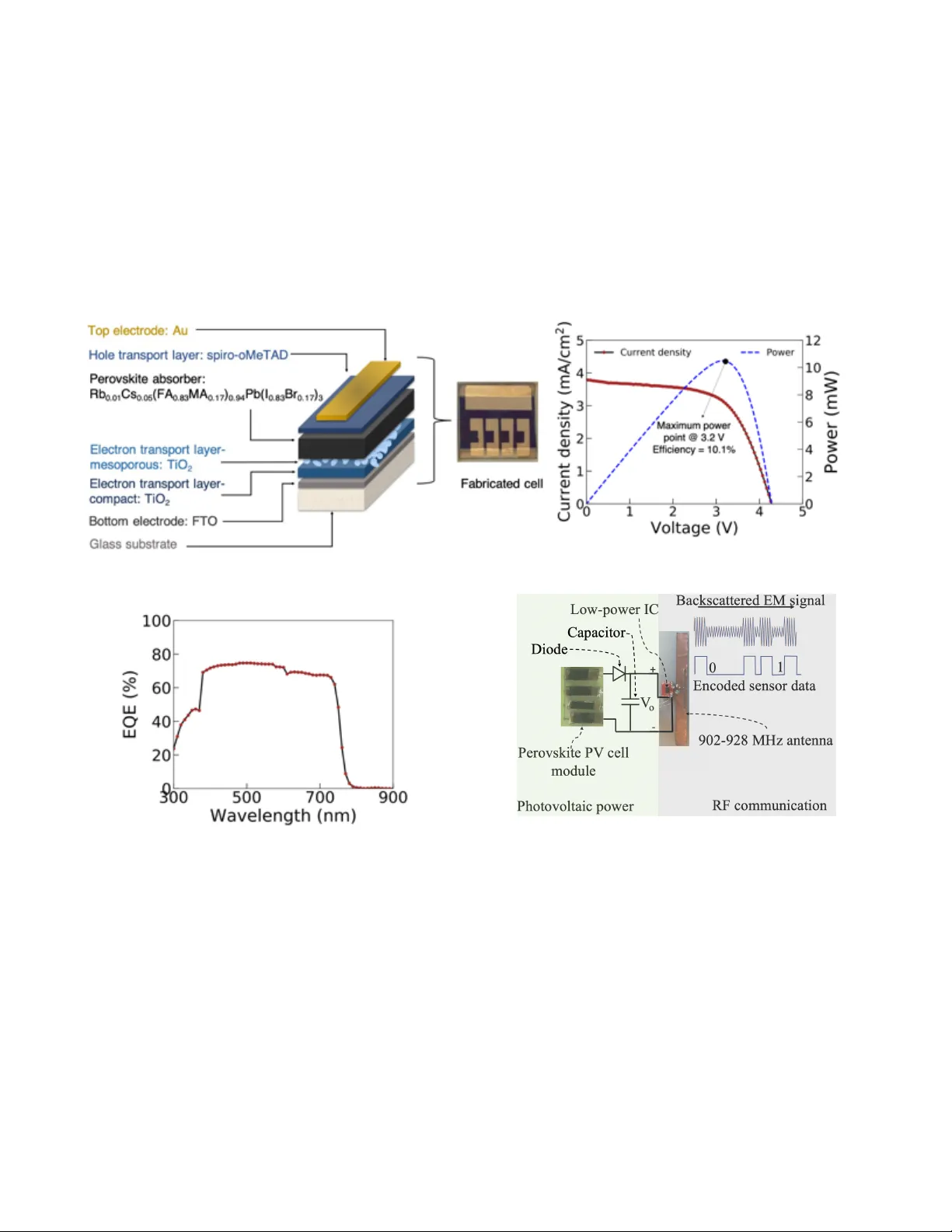
Abstract — Photovolta ic (PV) cells have the pote ntial to se rve as on - board power sources for low - power IoT devices. Here, we explore the use of perovskite solar cells to power Radio Frequency (RF) backsc atter - based IoT devices with a few µ W power dema nd. Perovskites are suitable for low - cost, high - performance, low - temperature p rocessing, and f lexible light energy harvesting that hold the possibility to signif icantly extend the range and l ifetime of current backscatt er te chniques such as Radio Frequency Identification (RFID). For these reasons, perovskite so lar cells are prominen t candidates for future low - power wirel ess applicati ons. We repo rt on real izi ng a f unct iona l per ovsk ite - powered wireless temperature sensor with 4 m c ommunication range. We use a 10.1% efficient perovskite PV module generating an output voltage of 4.3 V wi th an active area of 1 .06 cm 2 under 1 sun illumination, w ith AM 1.5 G spectrum, to power a commercial off - the - shelf RFID IC, requiring 10 - 45 µ W o f powe r. Havi ng an on - board energy harvester provides extra - energy to boost the range of the sensor (5x) in add ition to providing energy to carry out high - volume sensor measurements ( hundreds of measurements per min). Our eval uatio n o f t he protot ype suggests that perovskite photovoltaic cells are able to meet the energy needs to enable fully autonomous low - power RF backscatter applicati ons of the fut ure. We c oncl ude with an outlo ok into a ra nge of appli cati ons th at we envision to leverage the synerg ies offered by comb ining perovskite photovoltaics and RFID. Index Terms — Energy Harvester s, RFID, Inte rnet o f Things, Battery - less sensors, Photovoltaics, P erovskites I. I NTRODUCTION Photovoltaic (PV) energy harvesters have the potential to enable power - autonom ous Internet of Things (IoT) sensors that can operate for years without any need to replace batteries [1] . Recently, perovskite - based photovoltaics have evolved as potential low - cost, high - performance, low - temp erature processable, and flexible light energy harvesters [2] . Combining such a low - cost energy harves ting technology with low - power wireless sensor t echnologies will reduce the constraints in deployment and maintenance (by eliminating Sai Nithin R. Kantareddy is with the Department of Mechanical Engineering, Massachu setts In stitute of Techn ology, MA - 02139. E - mail: nithin@mit. edu Ian Mathews is with the MIT PV La b and the Department of M echanical Engineering, Massachusetts Institute of Technology, MA - 02139. E - mail: imathews@mit.ed u Shijing Sun is with the MIT PV Lab and the Department of Mechanical Engineering, Massac husetts Institute of Technology, MA - 02139. Janak Thapa is with the MI T PV Lab and the D epartment of Mech anical Engineering, Massac husetts Institute of Technology, MA - 02139 Mariya Layurova is with the MIT PV Lab and the Department of Mechanic al Engineering, Massac husetts Institute of Technology , MA - 02139 Janak Thapa is with the MI T PV Lab and the D epartment of Mech anical Engineering, Massac husetts Institute of Technology, MA - 02139 battery replacements), power availability and the communication range of sensors in industrial IoT and w ireless environmental monitoring applications [3] – [5] . Advances in l ow - power electronics and communication techniques have enabled a variety of low - power wireless sensing technologies leveraging Radio Frequency (RF) backscattering wit hout any active radio components. Passive Radio Frequency Identific ation (RFID) is the most prominent RF - backscattering based wireless technology, with globally accepted standards, and is widely used in industrial automation and supply chain applications. RFID (and similar RF - backscatter techniques) consumes ultra - low power (a few µWs) compared to active radio techniques and harvests the incident RF signal s to meet th is ener gy demand. However, the purel y RF - based power and communication links constrain the device’s communication range to a few meters and data - rate to 100s of kbps due to the li mited tot al RF signal strength (1W at the source). For example, longer communication ranges require more powe r avai lable for bac kscatter or a slowe r data rate, similarly, reducing the dev ice’s energy consumption increases the energy available for higher data - rate and longer communication range. Passive RFID uses a single communication channel for RF power and data - transmission, thus the communication range suffers (limited to a few m eters ). New t echniques such as LoRa backscat ter [6] promise extended ranges (100s of m), using separate chan nels for power and data - transmission, at slower data - rate s, but still in the nascent stages of development. We pro pose an alterna te sol ution to in creas e the communication range by using perovskite ph otovoltai cs as on - board energy harvesters that decouple power and communication links — thereby potentially enabling low - cost long - range battery - less IoT devices. Large scale outdoor PV energy production is generally achieved using well - establi shed Si - based PV technology due to its balance of s uitable efficiency and price point. Using PV as a power source for RFID type devices requires addi tional Juan - Pablo Correa - Baena is with the Sc hool of Material Science and Engineering, Geor gia Instit ute of Technology , GA- 30332 E- mail: jpcor rea@gatech.edu Tonio Buonassisi is with the MIT PV Lab and the Department of Mechanical Engineering, Massachusetts Institute of Technology, MA - 02139. E - mail: buonassisi@mit.edu Ian Marius Peters is with the MIT PV Lab an d the Department of Mechanical Engineering, Massachusetts Institute of Technology, MA - 02139. E - mail: impeters@mit.edu Sanjay E. Sarma is with Auto - ID Labs and the Department of Mechanical Engineering, Massachusetts Institute of Technology, MA - 02139. E - ma il: sesarma@mit.edu Perovskite PV -powered RFID: enabling low- cost self-powered IoT sensors Sai Nithin R. Kantareddy, Ian Mathews, Shijing Sun, Mariya Layurova, Janak Thapa, Juan - Pablo Correa - Baena, Rahul Bhattac haryya Tonio Buonassisi , Sanjay E. Sarma an d Ian Marius Peters attributes beyond efficiency such as low - cost integration, light - weight modules, mechanical flexibility, tunable opacity, etc [7] – [9] . Perovskite PV technology offers, at least in principle, these additional benefits, making it a highly interesting candidate for the integration of PV with RFID. However, it is impo rtant to note that other emerging thin film PV technologies such as CdTe, organic PV, amorphous - Si, GaAs are al so interesting candidates for p owering IoT devices [10] – [13] . Perovskites can potentially enable multi - year system lifet imes, however, the current environmental stabili ty (due to temperature and humidity) of the materials is low. Many research groups are currently work ing on reducing the material degradation rate with new chemical composition and encapsulation techniques [14 ] . Table 1 summarizes the major synergies of combining perovskite PV with RF - backscatter sensors compared to alterna te pow er source s such as Li battery, and RF, Piezoelect ric or thermoelectric [15] energy harvesters. PV is a high energy density source, which reduces the footprint of the energy harvester required to meet IoT device’s power demand. It is important to note that thermoelectric energy harvesters are also capable of high energy densit ies [16] , for example, a conventional 40 mm x 40 mm thermoelectric generator can harvest enough energy to power soi l moisture sensors. Additi onally, rapid adv ances in efficien cies of perovskite PV cells from 3.81 % to 23.7 % in just 9 years has positioned perovski te materials as promising in developing future high - performance and low - cost photovoltaic cells [17] . Perovskites have the potential for roll - to - roll manufacturing on flexible substrates, which makes integration with RFID tags highly economical and practically feasible as compared with any other PV technology. Scalable perovskite – RFID integration can ena ble long - rang e wireless sensin g tags without significantly increasing the current passive tag price (7 - 15 cents). Research ha s extensiv ely been conducted to develop perovskite PV cells with strong performance both outdoors and indoors. Few perovskite PV - powered devices such as texti le based flexible perovskite PV powered LED [18] and perovskite PV powered electroc hromic batteries for smart windows [19] are already shown in the available l iterature, but there ar e no reports of fully functional wireless sensor prototypes. Herein, we present a perov skite P V - RFID sensor, with an onboard digital temperature s ensor, that can wirelessly transmit temperature data to a reader within a distance of 4 m under sufficient illumination. Figure 1 shows a graphical illustration of our device where the power and th e communication links are decoupled: energy converted from li ght using perovskite PV (layer - wise device architectur e is al so shown in the figure) powers t he Int egrated Circuit (IC) and the RF signal is used as the communication link. The reader acts as a g ateway between hundreds of such nodes and the i nternet. Our device operates in the standard unlicensed 902 - 928 MHz band, meaning it is scalable with the existing infrastructure, which is prominently used for the industrial, scientific and medical applicati ons in the United States . The same energy harv esting mechanism can be still used in other bands, for example, EU and Asian countries, and it is independent of the regulations. In this paper, we show how the perovskite PV cell and RFID s ensor are integrated into a single s ystem. We show how the perovskite solar cell meets the energy needs of our device and extends the range by 5 times. We also pres ent an out look int o few poten tial per ovski te PV - RFID applications and the synergies offered by this combination. This article is organized as follows: In Section II , we dis cuss the materials, fabrication steps and integration of t he energy harvester module with the wire less sensor. In Sect ion III , we discuss the results of testi ng the functional prototypes as well as the factors i mpacting the performance of the devices. In Table 1 : Advantages of perovskite PV over other potential power sourc es for RF backscatter sensors Desired fea tures Potential e xternal energy sour ces for RF - backscatter sensors Perovskite PV Silicon PV Lithium battery RF Piezoelectric Thermoelectric Thin form factor (< 5 mm) ü û ü ü ü ü Plastic inlays ü ü û ü ü ü Integration with roll - to - roll manufactur ing ü û û ü ü û Cost competitiveness with 10 cents sensor ü û û ü û û Energy density High ü High Low Low High Full/Semi - transparent ü û ü û ü ü Ubiquitous environment ü ü ü ü û û Lifetime of th e system Potentially few years > 10 Yrs 1- 2 Yrs > 10 Yrs > 10 Yrs > 10 Yrs References [7], [8], [31] [32] [33] [34] [35] [36] [15] Section IV, w e present few potential applications for these sensors and how perovskite PV - RFID offers unique advantages as a single platform. II. E NERGY H ARVESTER A. Perovskite sol ar cell devic e archite cture and f abrication Following our previously reported methods, we fabricate d perovskite solar cells usi ng the state - of - the - art deposition recipe for Rb 0.01 Cs 0.05 (FA 0.83 MA 0.17 ) 0.94 Pb(I 0.83 Br 0.17 ) 3 with excess PbI 2 added for passivation following our previously reported methods [27] . The layer - by - layer device architecture is shown in Figure 2 (a) along wit h the fabr icated device. Detailed fabrication steps and the roles of each layer are outlined in the additional information section. The optical band gap of our perovskite material i s 1.6 eV, which is larger t han the traditi onal CH 3 NH 3 PbI 3 band gap (1.5 eV) [21] , leading to higher voltages desired for powering low - power IoT ele a ctronics. Figure 2 (b) shows the curr ent - voltage (IV) relationship for our fabricated device under one sun i llumination with a photoactive area of 1.06 cm 2 and an overall area of 2. 8 cm 2 . We measured the de vice’s power conversio n efficie ncy considering the photoactive area as 10.1 % at 3.7 mA cm - 2 short - circuit current density (J sc ), 4.3 V open - circuit voltage (V oc ), and 0.6 Fill Fa ctor ( FF). In addition to Voc and Isc, FF is another param eter, defined as the ratio of the maximum power from the solar cell to the product of Voc and Isc, that determines the maximum power output. Graphic ally, F F is th e measure of the "squareness" of the IV cu rve (solid line in Figure 2 (b)). Further optimizing the fabrication process and perovskite recipe can yield higher efficiencies. For our purpose, a 10.1 % efficient cell is sufficient to solve the on - board energy demand of the sensors, therefore, fabricating high efficiency modules is not our objective in this study. However, the device’s efficiency calculated by considering the total exposure area is 3.5 %, which requires improvement as t he reduction in device footprint will reduce the manufacturing costs. Moreover, improving voltage is more important than improving current, because t he current , even in the sub - optimal device used here , exceeds all needs. Our target voltage for the device is 3 V at the peak power point f or charging the capacitor, which i s achieved by connecting 4 of the perovskite solar cells in series (V oc ’s of individual cells add up) We eval uate the p erforma nce o f th e cel l und er di ffere nt wavelengths of ligh t by measuring the Externa l Q uantum E fficiency (EQE) as shown in Figure 2 (c). Measurements show high values (> 70%) in the 400 - 750 nm range, which is consistent with light available from a variety of sources ( sun, LED and other light ing). An interesting feature of perovskite material s i s the ban d g ap tunability to optimize the light harvesting efficiency for specific environmental conditions (for specific lighting conditions). For example, perovskite cells’ bandgap can be tuned to derive high performance in low - light indoor conditions (und er LED, fluorescent lighting, etc. [22]). B. Integration with RFID For the RFID ta g, we made use of the commercially available EM 4325 IC containing an on - board digital temperature sensor. The device’s schematic is shown in Figure 2 (d) and consists of an antenna T - matche d [23] to the IC’s impedance in 902 - 928 MHz frequency , and the perovskite PV module connected to power the IC. The device’s schematic is shown in Figure 2 ( d). All components are assembled on a plastic s ubstrate. However, it is important to note that the perovskite cells are currently fabricated on glass and fabric ating perovskites on plastic is still an ongoing research topic in this field. There are also startups like Saule Technologies exploring the commercialization of printed perovskite cells. In this work, the prototype is realized with perovski te on gl ass with tag and the capacitor on plastic. The tag communicate s its ID and other information from ICs memory bank (when the rea der issues a read c ommand) by Figure 1 : Illustration of perovskite PV - RFID wir eless network; Layout of the device showing the material architecture of perovskite energy harvester . ETL and HTL refer to electron transport layer and hole tran sport layer, respectively encoding information (0 s and 1s) on to t he modulated backscattered signal. The backscat tered signa l is generated by merely reflecting the incident RF radiation from the reader system, therefore, the tag does not require any active trans - receiver. Information is encoded on to this signal by switching IC’s its interna l impedance follow ing the rules dict ated by globally standard EPC Gen 2 protocol. Our device’s performance is evaluated by acqui ring the sensor measurements using standard industrial RFID equipment. For the purposes of these tests, we made use of an Impinj Speedway RFID reader connected to a circularly polarized antenna with a gain of 8.5 dBi and separated from the tag by a distance of 1 m. III. R ESULTS AND DISCUSSIO N RF - backscatter tag ICs require extremely low - power (few µW) to bootup and backscatter the modulated signal with encoded information. Currently, available ICs are designed to harvest an equivalent portion of the incident RF signal to power themselves (IC sensitivity ranging from - 8.3 dBm to - 22 dBm) . However, by providing external energy through perovskite PV, maximum RF s ignal (withou t an y co nsumption at the IC) is backscattered -- thereby increasing the communication range. ICs typically can operate in several mo des such as sleep, ready, write, sensor measuremen ts, etc. Average cur rent consumpti on data, taken directly from the manufacturer, for different operation modes of the IC , are presented in Figure 3 (a). IC can be put in sleep mode, consuming the lowest current (1.6 µ A), to conserve o n - board ene rgy. In the ready mode , when the IC is ready to receive temperature measurement acquisition commands, the IC consumes an aver age of 6 µ A. However, every temperature measurement requires 5x higher curr ent (30 µ A) for 8ms dur ation. Based on these values, we simulated the overall power cons umption of t he sens or dependi ng on how heavily the sensor is used (number of sensor measurements per hour). Fi gure 3 (b) shows this in a plot, for example, 20,000 measurement s per hour requir e around 20 µ W power (computed by taking constant 6 µ A of current in ready state and 30 µ A for 8 ms during each t emperature measurement at 1.5V input voltage) . We compared this power dem and with the power harvesting potential for perovskites under outdoor and indoor conditions. For the re cord perovskite efficiencies reported in the literature [24], [25] , 2 mm 2 large perovskite can harvest 30 µ W in ou tdoor co nditio ns in Boston , MA a nd a 2 00 mm 2 large perovskite module can harvest 20 µ W unde r indo or fluorescent lighting. These results show that small area modules can sufficiently meet the po wer demand by PV - RFID sensors (a) (b) (c) (d) Figure 2: Perovskite PV cell architecture (a) , curr ent densi ty - voltage cur ve of the device ( b), plot of EQE of the cell (c), perovskite PV - RFID sensor integration showing the PV power and RF co mmunication path s (d) at high temporal data res olution modes. We use an ext ernal capacitor as an energy buffer to store the energy on - board during low - light conditions as a backup power supply to the device. However, the charge leakage in capacito rs significantly affects the life time of the device. Figure 3 (c) shows simulated results of estimated persistence (availability of the device in a day) of the device at varyi ng leakage currents from 0 t o 40 µ A for a range of capacitor sizes (1 µ F to 100 F) at the maximum charging voltage of 3 V (safe voltage for the IC). Availability of the device is the fraction of the total duration the sensor is available to transmit data. This duration is calculated by comparing the total energy required to take measu rements in a day with the total amount of energy harvestable by the cells minus t he en ergy d issipate d due to charge leak in th e capa citors. To minimize costs and foo tprint of the device, we selec ted 1 F capacitor (commercially available , AVX corporation) t hat is estimated to provide 100 % persistence when charged fully to 3 V. Als o, b rand new capacitors tend have higher leakage currents than aged capacitors, therefore, the obtained results could be improved by appropriately aging the capacitors. However, for appl ications where sensor measurements are made only when the light is avail able (e.g. moist ure sensors for precision agriculture), an external buf fer capacitor is not necessary and perovskite PV can be directly connected to the IC, which further reduces the o verall cost of the device. Additionall y, developing syst em - on - chip solutions for perovskite PV with on board tiny energy buffers will also reduce the need for external capacitors. From the test results, using a solar simulator with one sun intensity (AM 1. 5G spectrum), the device shows sharp charging times and takes around 300 second s to reac h the threshold voltage (1.5 V for read and EEPROM operations on the IC) required to boot up the IC. The capacito r fully charges to a 3 V limit in 50 mins (see Figure 4 (a), while simultaneously powering the device (see temperature measurements in Fi gure 4 (b)). The device can function in the semi - passive mode while simultaneously being charged, therefore, the interrogator need not wait till the capacitor is fully charged. Once the equilibrium is reached (the terminal voltage negligibly increases thereafter), the light source is switched off to measure the device’s discharge rate. As shown in Figure 4 (a), the device discharges at a slower rate than its charging rate. Ter minal volta ge drops from full 3 V to 2 V in 5000 sec onds and discharges to threshold limit (1.5 V) in 8000 seconds. Therefore, around 45 min light availability powers the wireless sensor prototype for a total of 185 min (4 x time). Capacitor’s self - discharge cur rents significantly affect the persistence level, there fore, a higher capacitance with low self - discharge currents is an ideal design choice. Figure 4 (b) shows the plot of temper ature measurement s obta ined whi le th e devic e went through the charging and discharging cycles in Figure 4 (a). This shows that the prototype is simultaneously taking and transmitting temperature measurements while the capacitor is being charged. We compar ed the re ad rang e of our perovs kite PV - RFID device with a purely passi ve RFID device using Voyantic’ s (a) (b) (c) Figure 3: Aver age c urrent consumption for different operation modes (a), average current consumption for different interrogat ion rates (b), and device’s persistence at different capacitances and current leaks (c) Tagformance Pro setup. The tag is placed at a known distance (equivalent to one wavelength) from the Tagformance’s antenna, thres hold RF power (minimum RF power required to boot up the IC) is measured as a functi on of frequency over a wide band from 85 0 to 9 50 MHz. Tagformance then cal culates the read range indirectly from RF power measurements and tag - antenna separation. As shown in Figure 4 (c), a purely pas sive device can transmit over a range of less than 1 m, whe reas the p erovskite PV - RFID device of the same antenna can transmit to around 4 m distance. Hence, the perovskite PV - RFID device shows a 5x boost in range with 0.9 m variance. This device is a generic prototype, without optimizing the antenna for a specific applicat ion, however, communication range can be further increased by optimizing the antenna’s design (for antenna’s gain and transmission co - efficient parameters) using high - frequency electromagnetic sim ulations considering the environment and surrounding dielect ric materials in play. Theoretically, 1 0s of m range can be achi eved as estimated i n [10] . The trend in increas ing read range with energy harv esters is also comparable to the boost in range found in available literature [26] . In addition, Perovskite photovoltaics provide additional benefit of realizing this potential at a fr action of the cost with advantages of mechanical flexibility, optical transparency, etc. Long - range sensors reduce the need for extensive physical gateways/readers and antennas in the field — thereby reducing the overall infrastructure cost needed to set up. IV. A PPLICATION A NALYSIS Perovskite PV powered RF backscatter sensors (RFID or any other emerging protocols) will have numerous potential applications, for example, as sensors embedded in car windshields [27] , long - range soil moisture sen sors for precision agriculture, as set trackers in supply chain, and battery - less indoor sensors [28] – [30] . These applications will benefit from the perovskite – RFID int egration’ s unique advantages such as transparent and flexible features, ubiquitous energy harvesting in different environmental conditions (indoors and outdoor lighting conditions), long - communication ranges, low - cost manufactur ability and scala ble batt ery - less sensing. Figure 5 shows the landscape of few potential applications requiring diverse set of t hese desired features. For example, windshield sensors need transparent, outdoor performance, long range and sparse scale features, on the other hand, senso rs for supply (a) (b) (c) Figure 4: Charge a nd discharge cycles in t he device (a), temperature data from t he sensor during the charging and dischargi ng cycles (b), and range improvement in perovskite PV - RFID compa red to passi ve RFID sensor chain need low - light energy harvesting, low - cost, flexible, highly - scalable and moderate range features. Energy harvesting requirements and sizing of the PV cell and capacitor would change depending on the application. For example, soil moist ure s ensors will be used outdoors with reader interrogating once or twice a day, therefore, require s smaller PV cell area and smaller energy storage. On the other hand, indoor battery - less sensors require larger PV cell area with higher band gap to harvest low intensity light and larger energy storage capacity to provide energy backup throughout the night. Depending on t he use case , t he components on our device can be customized accordingly. Thus, perovski te PV - RFID sensors could function as one sensor plat form usable in multiple different application scenarios. Although perovsk ites offer numerou s excellent syner gies to combine with low - cost backscatt er sensors such as RFID, environmental stabilit y (due to temperature and humidity) and environmental hazard (due to lead content in the material) are two major problems that require further research and development. Many research groups are currently working towards developing lead - free perovskite cells [30] and encapsulation techniques to prevent material degradati on [14] . Lead - free perovskites currently have lower efficiency than lead - containing ones , so in our pape r we work ed with the state - of - the - art recipe . Any commercialization effort in real - world would aim to use lead - free perovskites. Another area t o investigate is the RF dielectric properties of perovskite PV material s in t he high frequency ranges ( 915 MHz, 2.4 GHz, 5 GHz and beyo nd). High - frequency material ch aracterization will enable us to opt imize antenna’ s radiation cap abilities wi th respect to background dielectrics (induced by perovskite and substrate materials) to de rive maxim um communication ranges depending on the operating frequency. Progress in these areas can potentially address t he implementation concerns on thes e material s to enable low - cost long - range perovskite PV - powered sensors that can be deployed for years without requiring any human intervention V. C ONCLUSION Low - cost energy harvesters will enable the design of power - autonomous wireless IoT sensors that persist for years without any need for human access or maintenance. We introduce perovskite PV - RFID sensors that le verage the low - cost, high performance and flexibl e mechanical properties of perovskites and the low - cost, s calable, low - power nature of RF backscattering to enable inexpensive, battery - less IoT devices. We reduce t he idea to practic e by devel oping a fu nction ing prototype of a perovskite - powered wireless temperature sensor. We use a 1 0.1 % ef ficie nt, 1. 06 cm 2 active area perovskite PV module to pow er our commer cial off - the - shelf RFID IC with on - board digit al t emperature s ensor. The device is capable of high temporal resolution m easurements at few (up to 4) meters distance, a 5 - fo ld enhancement compared to traditional passive RFID sensors, due to by decoupling power an d communication links. T he device features steep charging cyc les and slow - discharging cycles , which are favorable patt erns for battery - less sensors in environments with intermittent light availability. The ext remely low - power demand (10 µ W) of R FID only requires small area perovskite cells — thereby reducing the overall footprint and material required. Integrating low - cost RFID manufacturing with roll - to - roll manufactur ing of perov skite PV modul es has the potential to make perovskit e PV - RFID sensors highly cost competitive, compared to battery - based IoT sensors with applications requiring few meters of range. These dev ices could find use in varying applicat ion ranges such as auto windshield sensing, soil moisture sensing , ass et t racking, and batter y - less indoor sensors that can b enefit from the m echanical flexibility, material’s band gap tunability, low - cost manufacturi ng, long - range communication and scalable protocol of PV - RFID technol ogy. VI. A CKNOWLEDGEMENT Authors would like to acknowle dge the sources of fundi ng for this work. S.N.R.K. has received funding from GS1 organization t hrough the GS1 - MIT Aut oID labs collabor ati on. I.M. has received funding from the European Union’s Horizon 2020 research and innovation programme under the Marie Skłodowska - Curie grant agreement No. 746516. I.M.P. was financially supported by the DOE - NSF ERF for Quantum Energy and Sustainable So lar Technologies (QESST ) and by funding from Singapore's National Research Foundation through the Singapore MIT Alliance for Research and Technology's “Low e nergy electroni c systems (LEES)” IRG. R EFERENCES [1 ] N. Sahraei , E. E. Loon ey, S. M. Wat son, I. M. P eters, and T. Buonassisi, “Adaptive power cons umption improves t he reliability of solar - powered devices for inter net of things,” Applied Energy , vol. 224, no. October 2017, pp. 322 – 329, 2018. [2] S. Kazim, M. K. Nazeer uddin, M. Grätzel, and S. Ahmad, “Perovskite as light harvester: A game changer in photovoltaics,” Angewandte Chemie - International Edition , vol. 53, no. 11, pp. 2812 – 2824, 2014. [3] T. Ruan, Z. J . Chew, and M. Zhu, “Ene rgy - aware A pproaches for Energy Harvesting Powered Wireless Sensor Node s,” IEEE Sensors Journal , vol. 17, no. 7, pp. 21 65 -- 2173, 2017. [4] S. Li, “Light - Har vesting Wirel ess Sensors f or Indoor Lig hting Control,” IEEE Sensors Journal , vol. 13, no. 12, pp. 459 9 – 4606, 2013. [5] V. Leonov, “Thermoelect ric Energy Ha rvesting of Human Body Heat for Wearable Sensor s,” IEEE Sensors Journal , vol. 13, no . 6, Figure 5: Landscape of few po tential applications w.r.t Perovskite PV - RFID related performance metrics pp. 2284 – 2291, 2013. [6] V. Talla, M. Hessar, B. Kellogg, A. Najafi, J. R. Smith, a nd S. Gollakota, “LoRa Backscat ter: Enab ling The Vision of Ubiquitous Connectivity, ” 2017. [7] K. Hwang et al. , “Toward la rge scale roll - to - roll produ ction of fully printed perovskite solar c ells,” Advanced Materials , vol. 27, no. 7, pp. 1241 – 1247, 2015. [8] C. D. Baili e et al. , “Semi - transparent pe rovskite solar cells for tandems with silicon an d CIGS,” Energy and Environmental Science , vol. 8, no. 3, pp. 956 – 963, 2015. [9] F. Di Giacomo, A. Fakh aruddin, R. Jose, and T. M. Brown, “Progress, challenges and perspectives in flexible perovskite sola r cells,” Energy and Envi ronmental Science , vol. 9, no. 10, pp. 3007 – 3035, 2016. [10] S. N. R. Kantareddy, I. Mathews, R. Bhattachary ya, I. M. Peters, T. Buonassisi an d S. E. Sarma, "Lo ng Range Battery - Less PV - Powered RFID Tag Sensors," in IEEE Internet of Thi ngs Journal, vol. 6, no. 4, pp. 6989 - 6996, Aug. 2019. [11] I. Mathews, G. Kelly, P. J. King, and R. Frizzell, “GaA s solar cells for Indoor Light Harvesting,” 2014 IEEE 40th Photovoltaic Specialist Conference, PVSC 2014 , pp. 510 – 513, 2014. [12] B. R. Haight and W. Haensch, “Sol ar - powering th e Internet of Things,” vol. 3 53, no. 6295, pp. 12 4 – 126, 2016. [13] H. K. H. L ee et al. , “Organic photovolta ic cells - promising indoor light harvesters for self - su stainable electronics,” Journal of Material s Chemistry A , vol. 6, no. 14, pp. 5 618 – 5626, 2018. [14] J. Idígoras et al. , “Enhancing Moisture and Water Resista nce in Perovskite Solar Ce lls by Encapsulation wit h Ultrathin Plasma Polymers,” ACS Applied Materials and Interf aces , vol. 10, no. 14 , pp. 11587 – 11594, 2018. [15] Hi - Z, “Hi - Z’s TEG energy harves ter,” https://hi - z.com/wp - content/uploads/2019/03/DataSheets/Data%20Sheet%20HZ - 20.pdf , 1AD. . [16] P. Carvalhaes - Dias, A. Cabot, an d J. Siqueira Dias, “Eval uation of the Thermoelectric En ergy Harvesting Pote ntial at Different Latitudes Using Sol ar Flat Pan els Systems with Buried Heat Sink,” Applied Sciences , vol. 8, no. 12, p. 2641, 2018. [17] S. Yun et al. , “New - generation integrated devices based on dye - sensitized and perovskite solar cells,” Energy and En vironmental Science , vol. 11, no. 3, pp. 476 – 526, 2018. [18] J. Y. Lam et al. , “A stable, efficient textile - based flexible perovskite solar cell with improved washable and deployable capabilities for wearable de vice applicat ions,” RSC Advanc es , vol. 7, no. 86, p p. 54361 – 54368, 2017. [19] X. Xia et al. , “Perovskite solar cell powered electro chromic batteries for smart windows,” Materials Ho rizons , vol. 3, no. 6, pp. 588 – 595, 2016. [20] J. - P. Correa - Baena et al. , “Homogenized halides and alka li cation segregation in alloyed organic - inorganic perovskites,” Science , vol. 363, no. 6427, pp. 627 – 631, Feb. 2019. [21] H. S. Kim et al. , “Lead iodide p erovskite sensitized all - solid - state submicron thin film mesoscopic so lar cell with efficiency exceeding 9%,” Scientific Reports , vol. 2, pp. 1 – 7, 2012. [22] I. Matthews, S. N. R. Kantateddy, T. Buon assisi, and I. M. Peters, “Technology and market perspective for indoor photovoltaic cells,” Joule , vol. 3, no. 6, pp. 1415 - 142 6 , 2019 [23] G. M arrocco, “The art of UHF RFID antenna design : impedance matching a nd size - reduction techniques,” IEEE Antennas and Propagation Magazine , vol. 50, no. 1, pp. 1 – 21, 2008. [24] Editorial, “A d ecade of perovskite photovoltaics,” Nature Energy , vol. 4, no. 1, p. 1, 2019. [25] C. - T. Lin et al. , “Outstanding Indoor Perform ance of Perovsk ite Photovoltaic Cells - Effect of Device Archit ectures and Interla yers,” Solar RRL , vol. 3, no. 1, p. 18002 07, 2018. [26] A. E. Abdul hadi and R. Abh ari, “Multipo rt UHF RFID - tag a ntenna for enhanced energy harvesting of self - powered wireless sensors,” IEEE Transactions on Industria l Informatics , vol. 12, no. 2, pp. 1 – 16, 2016. [27] J. P. Lombardi et al. , “Copper transparent a ntennas on flexible glass by subtractive and semi - additive fabrication f or automotive applications,” Proceedings - Electr onic Components and Technology Conference , vol. 2018 - May, p p. 2107 – 2115, 2018. [28] D. Pubill, J. Serra, and C. Verikou kis, “Harvest ing artific ial light indoors to power perpe tually a Wireless Sensor Network node,” IEEE International Workshop on Computer Aided Mode ling and Design of Communication Lin ks and Networks , CAMAD , vol. 2018 - Septe, pp. 1 – 6, 2018. [29] P. Taylor and R. Ange les, “Emerging Technologies : RFID technologies Applicatio ns and implementa tion issues,” Information Systems , no. 781191585, p p. 51 – 65, 2010. [30] T. A. Berhe et al. , “Organometal halide perovskite so lar cells: Degradatio n and stabil ity,” Energy and Environmental Science , vol. 9, no. 2, pp. 323 – 356, 2016. [31] Z. Song e t al. , “A technoeconomic analysis of perovs kite solar module manuf acturing wit h low - cost materials and techniques,” Energy and Environment al Science , vol. 10, no. 6, pp. 1297 – 1305, 2017. [32] S. De Wolf, A. Descoeudr es, Z. C. Holman, and C. Bal lif, “High - e fficiency Silicon Heterojunction Solar Cells: A R eview,” Green , vol. 2, no. 1, 2012. [33] G. Zhou, F . Li, and H. M. Cheng, “P rogress in f lexible lit hium batteries and future pros pects,” Energy and Environmental Science , vol. 7, no. 4, pp. 1307 – 1338, 2014. [34] V. Chawla a nd D. S. Ha, “An Overview of Passive RFID, ” IEEE Communications Mag azine , vol. 45, no. 9, pp. 11 – 17, 2007. [35] K. Il Par k et al. , “Highly - efficient, flexible piezoelectric PZT thin film nanogenerator on plastic substrates,” Advanced Materials , vol. 26, no. 16, pp. 2514 – 2520, 2014. [36] G. A. T. Sevilla, S. Bin Inayat, J. P. Rojas , A. M. Hussai n, and M. M. Hussa in, “Fle xible an d semi - transparent thermoelectric ener gy harvesters from low cost bulk silicon (100),” Small , vol. 9, no. 23, pp. 3916 – 3921, 2013. Electronic suppl ementary Informat ion A. Device Fabr ication Etched FTO gl ass (10 Ω/ sq) was cl eaned in Hel lmanex (2% in water) followed by deionized water and ethanol for 15 min at each step. Further cleani ng of UV ozone treatment fo r 15 min was then employed. For the electron - transport layer, a compact TiO 2 layer was grown by depositing solution of the titanium diisopropoxide bis(acetylacetonate) 75% wt. (Sigma - Aldrich) in ethanol (1:10 V/V ratio) using spray pyrolysis method at 500° C. A TiO 2 mes oporous la yer was s pincoated on top of the compact TiO 2 layer by mixing 1:5 W/W of TiO 2 paste (SureChem, SC - HT040): solvent mix (3.5:1 W/W of terp ineol: 2- methoxy ethanol). In mesoporous configuration, scaffold structures of the mesoporous mat erials such as TiO2 help in crystallization of the Perovskite material. These structures define the grain size and crystal orientation dur ing the crystallization process. The su bstrate was th en heated at 50 0°C for 1 hour to remove the organic solvent. The perovskite precursor solution was prepared by mixing FAI (1 M, Dyenamo), PbI 2 (1.1 M, TCI ), MABr (0.2 M, Dyenamo) and PbBr 2 (0.22 M, TCI) in a 9:1 (v: v) mixtur e o f anhydrou s DMF:DMSO (Sigma Al drich). We then add ed soluti ons of Cs I (Sigma Aldrich) and RbI ( Signma Aldric) respectively, both prepared as 1.5 M stock solution in DMSO, in a 5:1:95 volume ratio of CsI:RbI:p erovskite solution. The above precursor solution was spincoated onto the substrate using a tw o - step spin coating program (10 s at 1000 rpm, 20 s at 6000 rpm). 150 μL of chlorobenzene was added as anti - solvent during the second step. T he films were then annealed at 100 °C for 20 min . Spiro - OMeTAD (2, 2′7,7′ - tetrakis - (N,N - di -p- methoxyphenyl amine) - 9,9′ - spirobifluorene, LumTec LT - S922) was used as the hole - transport layer. For every gram of spiro - OMeTAD, 227 μL of Li - TFSI (Sigma - Aldri ch, 1.8 M in ace tonitrile) soluti on, 394 μL of 4 - tert - butylpyridine (Sigma - Aldrich) solutio n, 98 μL cobalt complex (FK209, Lumtec, 0.25 M tris(2 - (1H - pyrazol -1- yl) -4- tertbutylpyridine) cobalt(III) tris(bis(trifluoromethylsulfon yl)imide) in acetonitrile) solution, and 10,938 μL of chlorobenzene was added as dopants. 65 μL of the mixed spiro solut ion w spincoated onto the perovskite films at 3000 rpm for 30 s. A 100 nm gold top electrode was then deposited on the perovskite cel l via thermal evaporation.
Original Paper
Loading high-quality paper...
Comments & Academic Discussion
Loading comments...
Leave a Comment