Performance Analysis of Massive MIMO Multi-Way Relay Networks with Low-Resolution ADCs
High power consumption and hardware cost are two barriers for practical massive multiple-input multiple-output (mMIMO) systems. A promising solution is to employ low-resolution analog-to-digital converters (ADCs). In this paper, we consider a general…
Authors: Samira Rahimian, Yindi Jing, Masoud Ardakani
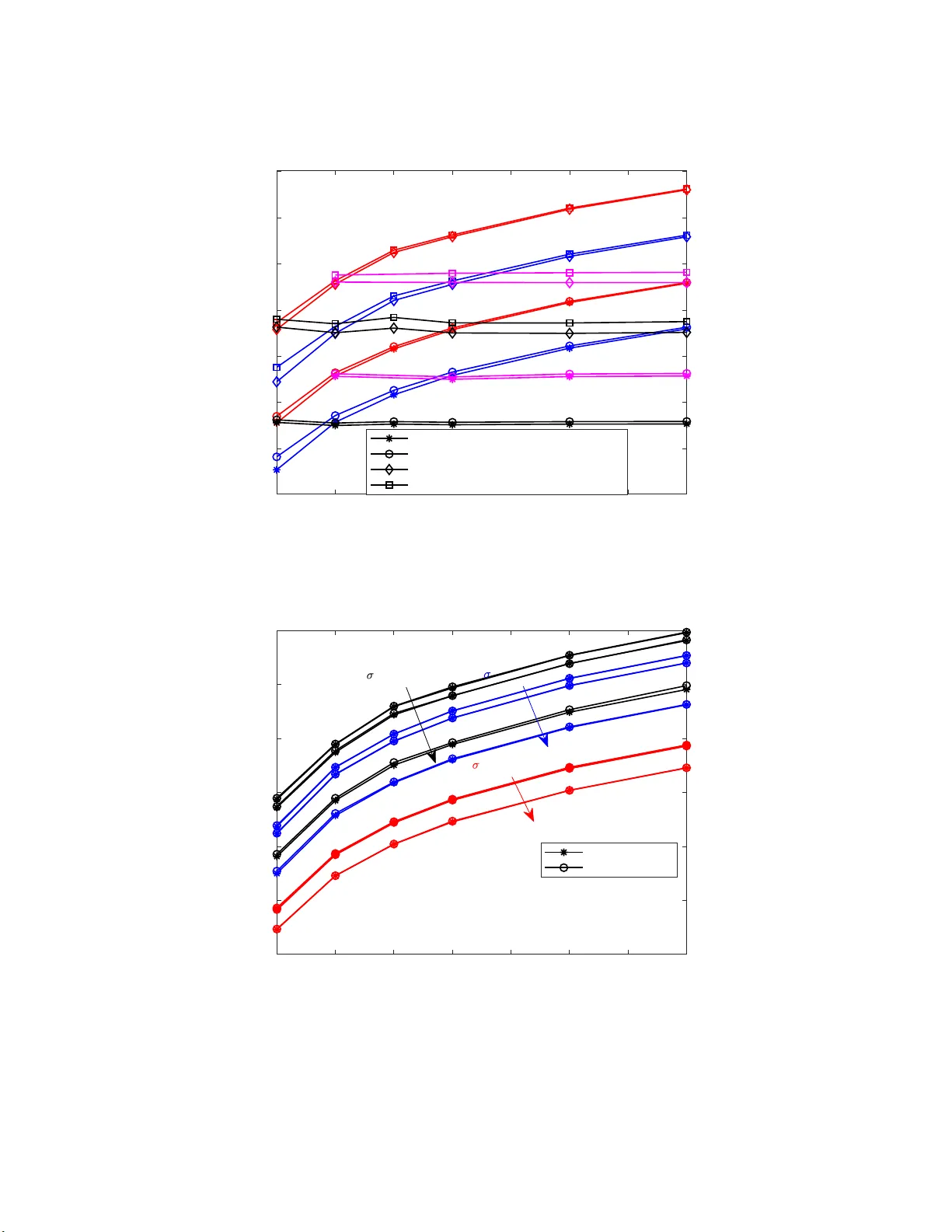
1 Performance Analysis of Massi v e MIMO Multi-W ay Relay Netw orks with Lo w-Resolution ADCs Samira Rahimian, Y indi Jing, Masoud Ardakani Uni versit y of Alberta, Canada Abstract High power consumption and hardware cost are two barriers for pra ctical massi ve multiple-in p ut multiple-ou tput (mMIMO) system s. A p romising solution is to employ low-resolution analog - to-digital conv erters (ADCs). In this pap e r , we consider a gen eral mMIMO multi-way relaying system with a multi-level mixed-ADC architecture, in which each an tenna is connected to an ADC p air of an arbitrary resolution. By le veraging on B ussgan g’ s decomp osition theorem and Lloyd-Max alg orithm for qua n tization, tight c lo sed-for m appro ximations are derived for the average achie vable rates of ze r o- forcing (ZF) relaying considering both perfect and imperfect channel st ate info rmation (CSI). T o conqu e r the challenges caused by multi-way relayin g , the comp licated ZF beam -formin g matrix, and the gener a l mixed-ADC struc tu re, w e develop a novel method f or the achiev able rate analysis using the sin g ular- value decomp osition ( SVD) fo r Gaussian m atrices, d istributions of the singular values of G a u ssian matrices, an d p roperties of Haar matrices. Th e results explicitly show the achiev able rate behavior in terms o f the user and relay tran smit powers and the number s of relay an te n nas and users. Most importan tly , it q uantifies th e perform ance degradation caused b y low-resolution ADCs and ch a nnel estimation erro r . W e demon strate tha t the average achiev able rate h as an almo st lin e ar relation with th e square of the average of q uantization coefficients pertainin g to th e ADC resolution pro file. In addition, in the medium to high SNR r egion, th e ADC r esolutions hav e mo r e significan t effect on the rate com p ared to the number of antennas. Our work rev eals that the perfo r mance g ap between the perfect an d imperf ect CSI cases in c r eases as the a verage ADC reso lution increases. For mor e in sights, simplified ach iev able rate expressions f or asymp to tic cases a n d the unif orm-ADC case are obtained . Numerical results verify that the theoretical results can accurate ly predict the perfo rmance o f the c o nsidered system . Part of this work on the performance analysis of mMIMO multi-way relay netwo rks with low-resolution uniform-ADC structures has been presented at the IE EE International Conference on Communications (ICC ) 2019 [1]. 2 Index T erms Massi ve MI M O, mu lti-way c ommun ications, low-resolution ADC, mixed-ADC, unifo rm-ADC, achiev able rate, im perfect chann el state info rmation, asy mptotic analysis I . I N T RO D U C T I O N As one of the key technologies for t h e fifth generation (5G) of wireless comm unications, massive m ulti-inpu t multi-output (m MIMO) has attracted extensi ve research interests in recent years [2], [3]. By exploiting quasi-ortho gonal random channel vectors between dif ferent users, mMIMO can m itigate t h e int er -user interference to provide high spectral and energy efficienc y via simple linear sign al processing, e.g., maximum-ratio combi ning (MRC) and zero-forcing (ZF). On the other hand, relayin g is an im portant way of extending coverage and improving service. In mult i-way relay n etworks (MWRNs) multip l e interfering users communicate simul taneously to exchange m essages such that each user multi-casts its message to all other users. Compared to one-way and two-way relayin g, multi-way relaying [4]–[7] can signi ficantly reduce the number of time s l ots for ful l mut ual comm unications among users which consequently improves the spectral and ener gy effi ciencies. Hence, mMIM O MWRNs, where the relays are equipped with large-scale antenna arrays, benefit from the advantages of both mult i -way relaying and mMIMO structures. For mMIMO MWRNs with ZF processing, [8], [9] hav e obtained closed-form approx i mations for the spectral and energy ef ficiencies. It is concluded that the transm it power of each user and the relay can be made in versely proportional to the number of relay antennas while maintainin g required quality of service. The practical i mplementation o f mMIMO s y stems wi th lar ge-scale antenna arrays is challenged by the high hardware cost and energy consum ption [10 ], [11]. T ypically , each receiv e and transmit antenna is connected to an analog-to-dig ital con verter (ADC) and a digit al-to-analog con verter (D A C) in t h e radio frequency (RF) chain, respectiv ely . Compared to mMIMO systems with all high-resolution ADCs and D AC s (e.g., 8-12 bits), it i s less cost l y and more energy efficient to employ lo w-cost, low- power , low-r esolut ion ADCs and D A Cs (e.g., 1-4 bits) [12], [13]. Especially , the hardware cost and power consum ption of AD Cs grow exponentially wi th the number of quantization bits [14]. Naturally , signal processing challenges and complex front-end designs occur due to the nonlinear characteristic o f coarse quanti zati on [15], [16]. 3 As this work considers the ADCs only , in what follows, we revie w the literature on mMIM O with low-resolution ADCs. The primary works on this topic hav e considered that all ADCs ha ve the same resolution, also referred to as uniform-ADC [12], [13], [15]–[18]. For instance, con- sidering frequency-selectiv e channels, uplink performance o f an mMIMO syst em with uniform- ADC that deploys orthogo nal frequenc y-division mult iplexing (OFDM) is in vestigated in [18], where new algori t hms for quant i zed maximu m a-posteriori channel estim ation and data det ecti o n are proposed. It is shown that coarse quantizatio n (e.g., 4-6 b its) in mM IMO-OFDM systems entails no performance lo s s compared with the ful l -resolution case. Later , a two-le vel mixed- ADC archit ecture is proposed, in whi ch part of the antennas are connected to low-resolution ADCs wi th th e same resolution (usually 1 -bit), whi l e the remaining are connected to hi gh- resolution (usually the id eal i n finite-resolution) ADCs [19], [20]. In [19], the achie vable uplink spectral efficienc y of a mMIMO system with two-le vel mixed-ADC receiver ass u ming perfect CSI is in vestigated for MRC detector in the multi-cell scenario and ZF detector in t he si ngle-cell system. Further , for the two-lev el ADC st ruct u re the channel state inform ation (CSI) obt ainment schemes are proposed in [20]–[24], for example, by usi n g the high-resolution ADCs in a round- robin m anner [20]. Recently , a general mul t i-lev el mixed-ADC structure is propos ed in [25] that allows mul t iple ADC lev els and arbitrary ADC resoluti o n profile for the l ar ge-scale antenna array . It p rovides more d egrees-of-fre edom compared t o the two-le vel mi xed-ADC and uniform- ADC architectures in achie ving the desirable balance between performance and (hardware and ener gy) cost. A. Relevant Prior W ork There have been many recent works on s ingle-hop mMIMO syst ems wit h a m ixed-ADC architecture. Am ong them, the mutual i n fo rm ation and t h e spectral efficienc y for the uplink of two-le vel mixed-ADC systems are in vestigated in [20] and [26], respectiv ely . For t h e uplink of mMIM O s ystems with mul t i-lev el m ixed-ADC architecture and MRC processin g, closed- form approximation s for t he spectral efficienc y , receiv e energy ef ficiency , and out age probability are deriv ed i n [25] and [27]. Also, these works study the optim ization of A DC resolutions with certain goals on the achiev able sum-rate, o utage probabil ity , and receiv e energy efficienc y . These cont ributions h ave sh own that the po wer consumption and hardware cost of the singl e-hop 4 mMIMO system wit h a mixed-ADC architecture can be con s iderably reduced whil e m aintaining most of the gains i n the achie vable rate. There are a fe w research results o n the two-hop mMIMO relaying syst em with low-resolution ADCs. Among them, [28]–[31] hav e in vestigated the performance of multi-pair m MIMO one- way relayi n g systems. In [28], the relay and all the users are assumed to hav e uniform -ADC where closed-form expressions fo r the achiev able sum-rate are derived consid ering imperfect CSI and MRC/maxim um-ratio transmi s sion (MR T) processing at the relay . It is s h own that with only low-re solu t ion ADCs at th e relay , increasing the number of relay antennas is eff ective to compensate for the rate loss caused by coarse quant ization. Howe ver , it becomes ineffecti ve to handle the detrim ental effect of low-resolution ADCs at t he u s ers. Further , for mMIMO o ne-way relay system s with two-le vel mixed-ADC and MRC detection, the achiev able rate is in vestigated in [29], where it is shown that the performance lo s s due to the low-resolution ADCs can be compensated by increasing the number of relay ant ennas. The work in [30] and [31] are on mMIMO one-way relay systems with both low-resolution AD Cs and low-resolution D A Cs under CSI error and maximum ratio (M R) processing. In [30 ], for t he case of uniform 1-bit ADCs and D AC s, a closed-form asymptot ic approxim at i on for the achiev able rate is deriv ed. For the two-le vel m ixed-ADCs and mi xed-D A Cs, the work in [31] has deriv ed exact and approximate closed-form expressions for the achiev able rate. The trade-off between the achiev able rate and power consumptio n for diffe rent numbers of low-resolution ADCs/D A Cs i s also in vestigated. B. Contributions T o the best of our knowledge, performance analysis of mMIMO relayin g systems wit h low- resolution ADCs has mainly focused on one-way relaying with uniform-ADC and two-level mixed-ADC, and there has been n o result on the general mult i-lev el m ixed-ADC structure. Compared to uniform-ADC and two-lev el mixed-ADC profiles, t he mu l ti-lev el mixed-ADC structure is m ore general and provides the system d esi gners with extra degrees-of-fre edom for the desig n and o p timization of the system. For example, it enables t he achievement of many more optimal point s on the trade-of f between th e achiev able rate and ener gy consumpti on, as shown in Figu re 2 i n [25] and Figure 5 in [27]. On t he other hand, t h is general assum ption imposes extra complication in performance analys is where existing methods cannot be applied 5 directly . Further , t here has been no work on the performance analysis of mult i -lev el mi xed-ADC structure with ZF beam-form i ng ev en for single-hop (upl ink) scenarios, as previous studies are limited to MR processing [25], [27]. The comp licated ZF beam-forming brings furth er challenges in the analysis. Moreover , compared to uplink communications and o n e-way relaying syst em s that were stud i ed before, the multi-way relaying further comp licates the performance analysis through the following aspects. 1) It has multiple broadcast time sl ots, each having a distinct ZF beam-forming m atrix; and 2) the channel of the mult i ple access ph ase i s the transp ose of the channel of the broadcast phase, causin g more contam i nation among di ff erent tim e slots. In this paper , for the first ti m e, we deriv e the average achie vable rate for mMIMO multi-way relay systems with a general mu lti-leve l mi xed-ADC receiv er . Both perfect and im perfect CSI cases are in vestigated. Further , Z F beam-formi ng is assum ed at the relay as one of the mo st popular beam-formi ng desig ns that brings high p erformance in MWRNs, especially for the high SNR range [9]. The main contributions of this work are summ arized as fol l ows: • T o d eriv e the ADC quantization model, Buss g ang’ s d ecom position t heorem [32] is adopted to find the uncorrelated quant ization n o ise to th e qu antization input. This is di fferent from the additive quantization noise mod el (A QNM) that roughly mod el s the quantization noise as an i n d ependent sign al to the quantization input with Gaussian distribution. Furthermore, our work uses the mean squared error (MSE)-optimal sets of quantization labels and t hresholds obtained from Lloyd-Max algorit hm for the quant ization. • Wh i le existing deriv ation methods for mM IMO sys t ems cannot b e applied directly for the multi-way network under ZF , in th i s work, we develop a new met h od by firstly u sing singular-v alue decompositi on (SVD) for Gaussian matrices to sim p lify the expressions, th en applying properties of W ishart distributed matrices, Haar (isotrop ically distributed) matri ces, and the distribution of singular va lues for the Gaussi an matrices wi t h i.i .d. entri es. T his novel method enables u s to find a tight expression for the a verage achiev able rates and can be applied to other si m ilar scenarios under ZF beam-forming. The propo s ed m ethod is fundam ent ally different from the t runcation-based approxi mation in [19] and t run cation error is av oided. Further , it can be applied i n other systems w i th ZF beam-forming or oth er beam-forming schemes with a s imilar structure. • T h e obtained results provide ins i ghts into the effects of user transmi t po wer , relay transmi t 6 power , the number of relay ant enn as , the number o f users, channel esti m ation error and most imp ortantly the ADC resoluti on profile on th e achie vable rate. It is shown that in the medium to hi gh SNR region, the ADC resoluti ons have more signi ficant ef fect on the rate compared to the nu mber of antennas. • For two asymptotic cases, si mplified expressions are deriv ed for t h e average achiev able rates. O n e case is when the num ber o f relay antennas approaches infinity while t h e nu mber of users is fixed. The result in this case revea ls a lin ear relationship between the average achie vable rate and the num ber of antennas at t h e relay . The other case i s when the num bers of users and relay antennas increase toward infinity with a fixed ratio, referred to as the loading f actor . Th e resul t proves an inv erse linear relationship bet ween th e achie vable rate and the loading fac tor . In addition , we have provided results for the special case of uniform- ADC which shows that the a verage achiev able rate has a linear relatio n with the square of the ave rage of the qu antization coef ficients pertaining to the ADC resolution. Also, th e square of the a verage of the quantization coeffic ients and t he user power always appear together and can compensate for each o ther . • T h e achi eva ble rate analysis is extended to the imperfect CSI case where a closed-form approximation i s deri ved. It is shown that the gap between the achiev able rates for perfect and imperfect CSI cases gets larger as t he a verage of the ADC resolutions increases. This inspires that for practical systems with limit ed CSI quality , u s ing lower resolution ADCs can gain significantly bett er energy effi ciency and hardware cost while maintaining most of the rate performance. C. P a per Outline and Notations The rest of this p aper is organized as follows. Our system mo d el is presented in Section II. The performance analysis for th e perfect CSI case is elaborated in Section III, while dis cus sions on special and asymptotic cases are provided in Section IV. Section V shows the extension t o the imperfect CSI case. In Section VI, simulation results are provided, and finally we conclud e the paper in Section VII. For a matrix A , the trace, t ranspose, Hermi t ian, conjugate, and in verse are operators denoted as tr { A } , A T , A H , A ∗ , and A − 1 , respectiv ely . Al s o, a ij and a i denote the ( i, j ) th entry and the i th column of A . F or vector a , k a k deno t es the 2-norm, and diag { a } denotes a diagon al matrix with the elements of a as its diagonal ent ri es . T h e N × N i d entity 7 matrix reads as I N . Notation E {·} is the expectation operator . F or a com plex v ariable, ℜ{ . } and ℑ{ . } denot e the real and imaginary parts, respectiv ely . Finally , mo d N ( x ) d eno t es x modulo N . I I . S Y S T E M M O D E L This work considers a M WRN con sisting of K sin gle-antenna users whi ch exchange their information via a mul ti-antenna relay with N antennas where N ≫ 1 and N ≥ K . Frequency- flat narro wband channels are ass u med. Let H = ˜ HD 1 2 be t h e N × K channel matrix between the users and the relay , wh ere ˜ H ∈ C N × K is the fast fading channel matrix whose entries are independently and identically distributed (i.i.d.) circularly symm et ri c complex Gaussian with zero-mean and uni t-variance , i.e., C N (0 , 1) and D ∈ R K × K is a diagonal m atrix whose k t h diagonal element denoted as β k stands for the large-scale fading of the channels from user k to the relay . W e define β sum , tr { D } = K X k =1 β k , β \ i = K X k =1 ,k 6 = i β k . Further , denote the k th col u mns o f ˜ H and H as ˜ h k and h k which are the fast fading and overall channel vectors from us er k to the relay , respecti vely . It is ass umed that the relay has perfect CSI. The imperfect CSI case is considered in Section IV. In a M WRN, each user d etects signals from all ot her K − 1 users. Un d er the half-duplex mod e, the comm u nications are composed of two phases: the multi ple access (MAC ) phase con s isting of one tim e sl ot, and t h e broadcast (BC) phase cons i sting of K − 1 tim e sl ots to enable each user to recei ve information from all others. A. The MA C Phas e a n d the ADC Q u antizatio n In the MA C phase, all users t ransmit their informati on signals simult aneou s ly to the relay . Denote the vector of normali zed informat i on sym bols of the users as x ∈ C K × 1 , and the a verage transmit p ower of each user as p u . This implies that all users have t he same transm i t power . The k th element of x correspon d s to t he signal of user k normalized to have unit power E x k ∈S k {| x k | 2 } = 1 for k ∈ { 1 , 2 , · · · , K } , where S k is the modulation s et of user k . Hence, the 8 baseband representation of the recei ved discrete-tim e analog-valued signal 1 at the relay , denoted as r a ∈ C N × 1 , can be written as r a = √ p u Hx + z R = K X i =1 √ p u h i x i + z R , (1) where z R ∼ C N ( 0 N , I N ) i s the vector of additive white G aus sian noi s e (A WGN) at the relay . Denote the n th element of r a as r n, a . W e assume t h at each relay antenna is equipped with a radio-frequency chain inclu d ing a pair of low-resolution ADCs for the in-phase and quadrature components. W e cons i der a generic mixed- ADC structure in which the ADC pairs of differ ent antenna can have d iffe rent resolut i ons. Denote the ADC resolution for the n th antenna as b n bits w h ich is a pos itive i nteger value between b min and b max . Let b = [ b 1 , · · · , b N ] wh i ch is the resolution profile of the relay antennas. The ADC quantization corresponding to the n th antenna can be characterized by a set o f 2 b n + 1 quanti zation thresholds T b n = { τ n, 0 , τ n, 1 , · · · , τ n, 2 b n } , where −∞ = τ n, 0 < τ n, 1 < · · · < τ n, 2 b n = ∞ , and a set of 2 b n quantization labels L b n = { l n, 0 , l n, 1 , · · · , l n, 2 b n − 1 } , where l n,i ∈ ( τ n,i , τ n,i +1 ] . W e d escrib e the joint operation o f t h e n th ADC pair at the relay by t he function Q b n ( · ) : C → R b n , w h ere R b n , L b n × L b n . W e denot e the quantized si gnal vector at the relay by ˆ r with ˆ r n being its n th entry corresponding to t he n th antenna. The quanti zation functi o n Q b n ( · ) m aps the analog recei ved s ignal, r n, a , to the quantized signal, ˆ r n , in a way that ˆ r n = Q b n ( r n, a ) = l n,k + j l n,p , if ℜ{ r n, a } ∈ ( τ n,k , τ n,k +1 ] and ℑ{ r n, a } ∈ ( τ n,p , τ n,p +1 ] . Therefore, the quantized vec tor at the relay is ˆ r = Q ( r a ) = Q ( √ p u Hx + z R ) , (2) where Q ( · ) is th e functi on that quantizes the n th entry of its in p ut vector usi n g Q b n ( · ) for n ∈ { 1 , 2 , · · · , N } . The optimal sets of L b n and T b n for n ∈ { 1 , 2 , · · · , N } that m inimize the MSE between the non-quant ized recei ved vector r a and the quantized vector ˆ r depends on the dist ribution of the input r a , which changes wi th respect to the channels and the information si g n als. From a practical point of view [32 ], we use th e set of quantization labels and t he set of threshol ds that are 1 This is referred to as “analog signal” for short afterwards. 9 optimal for Gaussian si gnals 2 . From (1), th e variance of each entry of r a can be straightforwardly calculated to be v , 1 + p u β sum . (3) Then, using Lloyd-Max algorithm [34], [35], we can find the optimal sets of labels and t hresholds, L ∗ b n = { l ∗ n, 0 , l ∗ n, 1 , · · · , l ∗ n, 2 b n − 1 } and T ∗ b n = { τ ∗ n, 0 , τ ∗ n, 1 , · · · , τ ∗ n, 2 b n } , respectiv ely , that mi nimize the MSE when the analog s i gnal follows C N (0 , v ) . W it h the set of labels L ∗ b n , t he set of thresholds T ∗ b n , and the Gaussian assump tion of t h e quantization input, the variance of the n th entry of ˆ r with ADC resolu tion b n , denoted as C n, ˆ r , can be straightforwardly obtained based on the definit ion of va riance, qu antization function, and Gaussian distribution of the input, as C n, ˆ r = 2 b n − 1 X i =0 l ∗ n,i 2 erf τ ∗ n,i +1 √ v − erf τ ∗ n,i √ v , (4) where erf ( · ) is the error functio n d efined as erf ( x ) , 1 √ π R x − x e − t 2 dt . Thus, the cov ariance matrix and the a verage p ower of the received quant ized vec tor at the relay are respecti vely , C ˆ r = diag { C 1 , ˆ r , C 2 , ˆ r , · · · , C N , ˆ r } , (5) ˆ c , 1 N tr { C ˆ r } = 1 N N X n =1 C n, ˆ r . (6) B. The BC Ph ase The BC phase takes K − 1 t i me slots. ZF relay b eam-form ing [36] is u sed, in which the beam-forming matrix for the t th t ime slot is G ( t ) = √ α ( t ) H ∗ ( H T H ∗ ) − 1 P t ( H H H ) − 1 H H , (7) where P is the p ermutation matrix obtained by shifting the colum ns of I K circularly to the right one tim e, and α ( t ) is the ZF transm it power coef ficient. Th en, the transmit signal at the relay is r ( t ) t = G ( t ) ˆ r . (8) 2 The Gaussian assumption is accurate in the low-SNR regime or when the number of users is sufficiently large [33]. Simulation results have verified the validity of this assumption for normal ranges of user number and SNR. 10 Let P R denote the ave rage transmissi o n power of the relay . Then, α ( t ) must satisfy P R = E {k r ( t ) t k 2 } . W i t h channel reciprocity , th e channel from t he relay t o the u sers is H T . Thus, the recei ved signal vec tor of all users in the BC time slot t , r ( t ) u , is r ( t ) u = H T r ( t ) t + z ( t ) u , (9) where z ( t ) u = [ z 1 ( t ) , z 2 ( t ) , ..., z K ( t ) ] T is the noise vector at the users whose elements are i.i.d. C N (0 , 1) . In th e BC time slot t , user k is su pposed t o decode user i ( k , t ) ’ s information symbol, where i ( k , t ) , mo d K ( k + t − 1) + 1 , (10) which is a function of the recei ving user’ s index, k , and t he t ime slo t, t . T o help the presentation, it is simplified to i ( k ) when there i s no confusion. I I I . A V E R AG E A C H I E V A B L E R A T E A N A L Y S I S This section considers the perfect CSI case. W e first analyze t h e ADC quantization process, then deriv e t h e relay power coefficient for the ZF beam-forming in each BC time slot, and finally , obtain the a verage achie vable rate of the MWRN. In general, the quant i zation at the low-re solu tion A DCs leads to si g nal dist ortion t hat is correlated wit h the quanti zation input si gnal. According t o Bussgang’ s theorem [37], when the input to the ADCs is G aus sian, the quantized output can be writt en as a li near combinatio n of the quantizati on input signal, r a , and a quantization distortion , d , that is uncorrelated to the quantization input si g nal. Thus , the quantized received signal vector at the relay can be written as ˆ r n = Q b n ( r n, a ) ≈ G b n r n, a + d n , or ˆ r = Q ( r a ) ≈ G b r a + d , (11) where G b n is the quantization coef ficient corresponding to the n th ADC pair and G b = diag { G b 1 , · · · , G b N } . F or an arbitrary n , the value of G b n can be calculated to be G b n = 1 √ π v 2 b n − 1 X i =0 l ∗ n,i " exp − τ ∗ n,i 2 v ! − exp − τ ∗ n,i +1 2 v !# . (12) 11 W e define g 1 , 1 N tr { G b } = 1 N N X n =1 G b n , and g 2 , 1 N tr { G 2 b } = 1 N N X n =1 G 2 b n , which are needed for the achiev able rate expression. They represent the a verage of the quanti - zation coef ficients and quantization coef ficients squared, respectiv ely . The variance of each entry of r a is v , so the covariance m atrix of th e quantization distortion , C d = E [ dd H ] , is C d ≈ C ˆ r − E { G b r a r H a G b } = C ˆ r − v G 2 b . (13) Next, we calculate the ZF power coeffic ient. Th e result is given in the following theorem. Theor em 1. F or a multius er ma ssive MIMO MWRN with K sin g le-antenna users, N r ela y antennas, mixed-ADC with r esolution pr ofi l e b at t he relay , r elay power constraint P R , and perfect CSI, the r elay power coefficient for ZF beam-fo rming i n time slot t is α ( t ) ≈ P R ( N − K ) p u g 2 1 P K m =1 1 β m + N K + N − K 2 ( N − K ) 2 ( K +1) (ˆ c − p u β sum g 2 ) P K m =1 1 β m β i ( m ) . (14) Pr oof: Please see Appendi x A. In wh at fol lows, t he average achiev able rate from user i ( k ) to u s er k wi ll be derived where i ( k ) is given in (10). From (9) and Bussgang’ s decompos ition in (11), the receiv ed signal vector at the users in t he BC time slot t can be written as r ( t ) u ≈ √ p u H T G ( t ) G b Hx + H T G ( t ) G b z R + H T G ( t ) d + z ( t ) u . (15) Hence, the recei ved si gnal by user k , denoted as r k ( t ) , is r k ( t ) ≈ √ p u h k T G ( t ) G b h i ( k ) x i ( k ) + √ p u h k T G ( t ) G b N X j =1 ,j 6 = i ( k ) h j x j + h k T G ( t ) G b z R + h T k G ( t ) d + z k ( t ) , (16) where in (16), the first, second, third, and fourth terms are the desired signal, the interference from other users, the nois e propagated from the relay , and the q u ant ization di stortion propagated from the relay , respectively . Thu s, the interference-plus-noise p ower is I k ,i ( k ) = p u K X j =1 ,j 6 = i ( k ) | h T k G ( t ) G b h j | 2 + k h k T G ( t ) G b k 2 + k h k T G ( t ) d k 2 + 1 . (17) 12 It can be seen from the first t erm in (17) that due to th e mixed-ADC structure at the relay , the user int erference i s not fully eliminated by the ZF design i n (7). For the special case of uniform-ADC structure, we have G b = G b I N , and the user interference can be fully eliminated. The a verage achie vable rate from user i ( k ) to user k , denoted by R k ,i ( k ) , is giv en as R k ,i ( k ) ≈ E ( log 2 1 + p u | h k T G ( t ) G b h i ( k ) | 2 I k ,i ( k ) !) . (18) Next, th e average achiev able rate of two arbitrary users in the MWRN is d eriv ed and the result is presented in the fol lowing theorem. Theor em 2. F or a multius er ma ssive MIMO MWRN with K sin g le-antenna users, N r ela y antennas, ZF beam-forming in (7), mixed-ADC with r esolut i on pr ofil e b at t he r el a y , and perfect CSI, the avera ge achie vable rate fr om user i ( k ) to user k is R k ,i ( k ) ≈ log 2 1 + F 1 F 2 , (19) wher e F 1 , p u β i ( k ) ( N K + N − K 2 − 2 K ) g 2 1 + K g 2 K + 1 , F 2 , ˆ c + ( N − K ) α ( t ) β i ( k ) − p u β \ i ( k ) g 2 1 − p u β i ( k ) g 2 . (20) Pr oof: Please see Appendi x B. The formula in (19) and parameter values in (14) and (20) s how ho w quantitatively the ave rage achie vable rate is af fected by system setti ngs such as the user power , relay powe r , number of users, and num ber of relay antennas. The ef fect of the ADC resolution is shown via t he parameters g 1 and g 2 . Specifically , it can be seen th at the avera ge achiev abl e rate increases as p u or P R increases. I V . R E S U L T S F O R A S Y M P TO T I C C A S E S A N D U N I F O R M - A D C 13 In w h at follows, we discuss two asymptotic cases and the sp ecial uniform-ADC case to gain insights on the ef fects of other parameters on the average achiev able rate. A. Asymptotic Cases The first asympt o t ic case commonl y considered in mMIM O i s when N → ∞ with fixed K . The result on the achie vable rate can be simplified from (14) (19) (20) as R k ,i ( k ) , 1 ≈ log 2 1 + N p u β i ( k ) g 2 1 ˆ c + p u P R β i ( k ) P K m =1 1 β m g 2 1 − p u β \ i ( k ) g 2 1 − p u β i ( k ) g 2 . (21) It shows that t h e signal-to-i n terference-plus-noise ratio (SINR) increases linearly in N . The effect of ADC-resolution is through ˆ c , g 2 1 , and g 2 . Further , th e expression directly shows that the sum - rate is monotoni cally increasing wi th respect to p u and p R , b ut with finite ceiling as p u → ∞ or p R → ∞ . The ceili ng depends on the ADC resolution profile, indicating t hat the penalty brought by low-resolution ADCs may not be fully compensated b y increasing t h e user or relay transm it power . The second asym p totic case is when N , K → ∞ with fixed ratio K / N = c . Th e constant c is referred to as the l oading factor . Notice t h at β sum is lin ear in K , thus v g iv en i n (3) and ˆ c giv en in (5) and (6) are also linear i n K . W e assum e t hat as K → ∞ , the values ¯ ˆ c , ˆ c/K , ¯ β , β sum /K , ¯ β − 1 , P K m =1 1 /β m , and ¯ β − 2 , P K m =1 1 / ( β m β i ( m ) ) all con ver ge to posi tive cons t ants. It can be shown that lim K →∞ ¯ β − β \ i ( k ) /K = 0 . Thus, for this case, the ZF power coef ficient is α ( t ) 2 ≈ N P R 1 1 − c p u g 2 1 ¯ β − 1 + c (1 − c ) 2 ¯ ˆ c − p u ¯ β g 2 ¯ β − 2 , and the a verage achieva ble rate is simpli fied as R k ,i ( k ) , 2 ≈ log 2 1 + (1 − c ) c · p u β i ( k ) g 2 1 ( ¯ ˆ c − p u ¯ β g 2 1 ) . (22) It shows that when the number of users increases linearly with the number of relay antennas, the a verage achiev able rate becom es independent of N and decreases as c increases. The SINR for this asymptotic case is li near in ( 1 − c ) /c . The ef fect of ADC resolution profile is shown throu gh ¯ ˆ c and g 2 1 . The expression indicates t hat the achiev able rate degradation caused by low-re solu tion ADCs can be compens ated b y decreasing c . It also shows that the sum -rate is monotonically increasing with respect t o p u , but with a finite ceiling as p u → ∞ . The ceiling depends on the ADC resolution profile, indicating t h at the penalty brought by low-resolution ADCs may not be 14 fully compensated by increasing th e user power . Finally , it indicates that the aver age achieva ble rate in this case is i ndependent of p R . B. Achie vable Rate for the Uni form-ADC Case For the s p ecial case of uni form-ADC with b -bit resoluti o n, denote th e qu antization coefficient as G b and the correspondin g variance of the quantization out p ut as C ˆ r . W e ha ve G b n = G b and C n, ˆ r = C ˆ r for all n . Consequentl y , the ZF relay p ower coefficient and the av erage achie vable rate can be simplified as α ( t ) uni ≈ P R ( N − K ) K X m =1 1 β m h p u G 2 b + 1 β i ( m ) ( C ˆ r − p u β sum G 2 b ) ( N K + N − K 2 ) ( N − K ) 2 ( K +1) i , (23) R k ,i ( k ) , uni ≈ log 2 1 + ( N − K ) β i ( k ) ( √ p u G b ) − 2 N − K α ( t ) uni β i ( k ) + C ˆ r − β sum . (24) The result reveals that the relay po wer , the quant ization coeffic ient squared, and the user power hav e sim ilar ef fect on the achie vable rate. Increasing each of them has a positive effec t on th e achie vable rate with a negative acceleration. Furthermore, G 2 b and p u appear together as a product in the formulas. Thi s means that they can be adjusted to compensate each other’ s contribution to the achiev abl e rate. Another imp ortant fact that can be conclu d ed from (23) and (24) is that the achie vable rate l inearly decreases with the number of users while it has an in creasing relation with the number of antennas. V . E X T E N S I O N T O T H E I M P E R F E C T C S I C A S E In thi s section, we extend our results to th e imperfect CSI case with the following wi d ely used channel model 3 : ˜ H = ˆ ˜ H + ∆ ˜ H , where ˆ ˜ H ∼ C N ( 0 , (1 − σ 2 e ) I N ) is the estimati on of the small-scale fading channel, ∆ ˜ H ∼ C N ( 0 , σ 2 e I N ) is the CSI error , and σ 2 e represents t he power of the CSI error . Furthermore, ˆ ˜ H and ∆ ˜ H are ass u med to be independent. ZF relay beam-form ing matrix considering the channel estimation ˆ ˜ H , is ˆ G ( t ) = √ ˆ α ( t ) ˆ H ∗ ( ˆ H T ˆ H ∗ ) − 1 P t ( ˆ H H ˆ H ) − 1 ˆ H H , (25) 3 Channel esti mation schemes for MIMO systems wit h low- or mixed-resolution ADCs can be found in [20]–[23]. 15 where ˆ H = ˆ ˜ HD 1 2 . Therefore, the recei ved sig nal by user k is r k , ICSI ( t ) ≈ √ p u h k T ˆ G ( t ) G b h i ( k ) x i ( k ) + √ p u h k T ˆ G ( t ) G b N X j =1 ,j 6 = i ( k ) h j x j + h k T ˆ G ( t ) G b z R + h T k ˆ G ( t ) d + z k ( t ) , (26) and the po wer of the interference-plus-noise terms is I k ,i ( k ) , ICSI = p u K X j =1 ,j 6 = i ( k ) | h T k ˆ G ( t ) G b h j | 2 + k h k T ˆ G ( t ) G b k 2 + k h k T ˆ G ( t ) d k 2 + 1 . (27) Therefore, the a verage achie vable rate from user i ( k ) to user k is R k ,i ( k ) , ICSI ≈ E ( log 2 1 + p u | h k T ˆ G ( t ) G b h i ( k ) | 2 I k ,i ( k ) , ICSI !) . (28) By following similar steps as in Appendix A and modifying the SVD in (34) as ˆ ˜ H = U ˆ ΣV H , where ˆ Σ = p 1 − σ 2 e Σ , the relay ZF transmit p ower coeffic ient for t h e imperfect CSI case i s found as in Theorem 3. Theor em 3. F or a multius er ma ssive MIMO MWRN with K sin g le-antenna users, N r ela y antennas, mixed-ADC with r esolution pr ofi l e b at t he relay , r elay power constraint P R , and imperfect CSI, the r elay ZF power coefficient in t h e BC time s lot t is ˆ α ( t ) ≈ P R ( N − K )(1 − σ 2 e ) p u g 2 1 P K m =1 1 β m + N K + N − K 2 ( N − K ) 2 ( K +1)(1 − σ 2 e ) ( ˆ c − p u β sum g 2 (1 − σ 2 e )) P K m =1 1 β m β i ( m ) . (29) Further , by following similar steps as in Append ix B , the av erage achie vable rate can be found as in Theorem 4. Theor em 4. F or a multius er ma ssive MIMO MWRN with K sin g le-antenna users, N r ela y antennas, mixed-ADC with r eso lution pr ofile b at the r elay , imperfect CSI, and ZF beam-forming in (25), the avera ge achie vable rate fr om user i ( k ) to user k is R k ,i ( k ) ≈ log 2 1 + ˆ F 1 ˆ F 2 ! , (30) 16 wher e ˆ F 1 , p u β i ( k ) K + 1 " g 2 1 (1 − σ 2 e ) 2 ( N K + N − K 2 − 2 K ) + g 2 (1 − σ 2 e )( K + σ 2 e )+ ( N K + N − K 2 ) ( N − K ) 2 β k β i ( k ) σ 4 e K X m =1 1 β m β i ( m ) !# , ˆ F 2 , ˆ c + ( N − K )(1 − σ 2 e ) ˆ α ( t ) β i ( k ) − p u β i ( k ) g 2 + p u g 2 1 − β \ i ( k ) (1 − σ 2 e )+ β i ( k ) β k σ 2 e K X j =1 ,j 6 = k 1 β j + β i ( k ) β 2 k σ 4 e N ( N − K ) K (1 − σ 2 e ) K X m =1 1 β m β i ( m ) ! . (31) As it can be seen from ˆ F 1 and ˆ F 2 , the dominant terms in the numerator are the first and t he second terms, while the domi nant terms in th e denomin ator are the first four t erm s with the first one being th e most dominant. Thi s means that the effect of decrease in t h e av erage achiev able rate d u e to the channel es t imation error , gets scaled by g 2 1 and g 2 in th e numerator . In other words, the hi gher the av erage of the resolu tion p rofile, the high er the decrease in the a verage achie vable rate due to the channel estimati on error . V I . S I M U L A T I O N R E S U L T S This s ecti on shows simulati o n results on the a verage achie vable rates for mMIMO MWRNs. The closed-form result s in T heorems 2 and 4 are compared with t h e M onte-Carlo sim u lated ones. Also, the asympto t ic results in (21)-(22) are compared with t he general theoretical results. While R 1 , 2 , the average achie vable rate of user 2 at user 1 is used, similar results can be obt ained for other user p airs. The simulatio n contains two parts : the quantizer optim ization and the achiev able rate simul a- tion. A training set of 10 5 points is generated based on complex Gaussian channels and quadrature amplitude modulati on (QAM). Then, L l oyd-Max algo ri thm is used to find the qu ant izer for each value in the resolution profile b . For the second part, the q uantizers obtained in the pre vious step are used. 10 3 channel realizations are g enerated, and for each channel 10 2 information vectors are generated. Unl ess otherwise menti oned, networks with homogeneous channels are consi dered, i.e., the same lar ge-scale fading for all u sers, where we set β k = 0 dB for k ∈ { 1 , 2 , · · · , K } . 17 -5 0 5 10 15 p u in dB 1 2 3 4 5 6 7 8 9 R 12 in bits/sec Theoretical result Simulation result uniform 1-bit uniform 2-bit uniform 3-bit mixed-ADC-#1 uniform -bit Fig. 1. Theoretical and simulation r ate results versus averag e user power for dif ferent ADC profiles, N = 100 , K = 5 , and P R = 15 dB. T ABL E I N U M B E R O F A N T E N N A S W I T H E AC H R E S O L U T I O N L E V E L I N M I X E D - A D C - # 1 P RO FI L E ❍ ❍ ❍ ❍ ❍ ❍ ❍ N bits 1 2 3 4 5 6 7 8 50 3 6 7 6 7 11 5 5 100 7 12 15 11 1 4 22 9 10 In Figu re 1, a M WRN where N = 100 , K = 5 , and P R = 15 dB is considered wh ere the simulatio n and theoretical results obtained by (14) and (19) are compared when p u changes from − 5 t o 15 dB. Five resol u tion profiles are considered: uniform 1-bit, 2-bit, 3-bit, ∞ -bit ADCs, and a mixed-ADC (referred to as mixed-ADC-#1) sp ecified in T abl e I. In mixed-ADC-#1 profile, the ADC resol ution fo r each antenna is randomly and independently generated according to the discrete uniform dis t ribution on [1 , 8] . It is sho wn that the sim ulation and theoretical results perfectly m atch for all power range and A D C profiles. Also, the figure s h ows the rate degradation due to low-resolution ADCs, especially in the high SNR region. For instance, when p u = 15 18 5 10 15 20 K 1 2 3 4 5 6 7 8 9 R 12 in bits/sec Theoretical result Simulation result uniform -bit uniform 1-bit uniform 5-bit mixed-ADC-#1 uniform 3-bit mixed-ADC-#2 uniform 4-bit Fig. 2. Theoretical and simulation rate results versus the number of users for different ADC profiles, N = 100 , p u = P R = 15 dB. dB, the achiev able rate for mixed-ADC-#1 is abo u t 74 % of the full precision case, im p lying the importance of the ADC resolutio n s on the rate performance for m MIMO M WRNs. Finally , it can be ob s erved that for all low- resoluti on ADC cases, as p u increases, t he achieva ble rate saturates quickly . Figure 2 shows the rate results when N = 100 , p u = P R = 15 dB, and K = 5 , 10 , 1 5 , 20 . Fi ve uniform-ADC profiles with the bi t le vels of 1 , 3 , 4 , 5 , ∞ are tested. Also, two mixed-ADC profiles are examined: the mixed-ADC-#1 explained i n T able I and the mixed-ADC-#2 for which the resolut i ons are 1 to 4 b its and the num bers of antennas are 21, 27, 22, and 30, respectively , for the 4 resolution lev els. This figure confirms the perfect match b etween the sim u lation and theoretical results for all numbers of users and ADC profiles. It also rev eals the degradation in the achiev abl e rate with the increase i n the number of users. This is due to the decrease in ZF beam-forming p ower scaling fac tor α ( t ) that causes loss in the SINR. Further , Figures 1 and 2 show that the higher the a verage ADC resolution, t h e higher the a verage achieva ble rate. Next, a MWRN wi th 5 us ers and heterogeneous channels is consid ered where β 1 = 1 , β 2 = 0 . 5 , β 3 = 0 . 5 , β 4 = 2 , β 5 = 3 , and P R = 15 dB. Resolution profiles of uniform 1-bit, 2-bit, and 19 -5 0 5 10 15 p u in dB 1 2 3 4 5 6 7 8 9 10 R 12 in bits/sec Theoretical result N=200 Simulation result N=200 Theoretical result N=100 Simulation result N=100 unifrom 2-bit unifrom 1-bit unifrom -bit mixed-ADC-#1 Fig. 3. Theoretical and simulation rate results versus av erage user power for networks with heterogeneous channels when K = 5 , β 1 = 1 , β 2 = 0 . 5 , β 3 = 0 . 5 , β 4 = 2 , β 5 = 3 and P R = 15 dB for N = 100 and N = 200 . ∞ -bit along with the mixed-ADC-#1 are considered. For N = 100 , th e mixed-ADC-#1 profile is shown in T able I. For N = 200 the num ber of ADC pairs for each resol ution level is twice the number for N = 100 . Fig u re 3 approves the prefect match between t he deriv ations and simulatio n results for b o th cases when p u changes from − 5 to 1 5 dB. An important observation here is that in the medi um t o high SNR region, increasing the ADC resoluti o ns has hig her i mpact on the rate compared to increasing the number o f antennas. In other words, a lar ge number of low-resolution ADCs cannot keep up with lower numb er of high-resolution ADCs in the sense of achie vable rate. Figure 4 compares the results in Theorem 2 with t he two asym ptotic results in (21) and (22). For th e first asymptot ic case, K = 5 , 10 are tested and for the second one, c = 0 . 05 , 0 . 1 are tested. In all sim ulations, the number of ant ennas changes from 50 to 40 0 except for the K = 0 . 0 5 N case that N takes multiples of 100 . The results are shown for two ADC profiles: uniform 2 -bit and mixed-ADC-#1. For mixed-ADC-#1, the ADC profiles when N = 50 , 100 are specified in T able I. For N = 150 , 200 , 300 , 4 00 the ADC profiles are fo u n d by scalin g the ADC 20 50 100 150 200 250 300 350 400 N 3 4 5 6 7 8 9 R 12 in bits/sec Result in Theorem 2 for uniform 2-bit ADC Asymptotic result for uniform 2-bit ADC Result in Theorem 2 for mixed-ADC-#1 Asymptotic result for mixed-ADC-#1 K=5 K=10 K=0.05N K=0.1N Fig. 4. Results in Theorem 2 are compared with the asymptotic results in (21) when K = 5 , 10 (in red and blue), and the asymptotic results in (22) when c = 0 . 05 , 0 . 1 (i n pink and black). In all simulations p u = P R = 15 dB. 50 100 150 200 250 300 350 400 N 2 3 4 5 6 7 8 R 12 in bits/sec Theoretical result Simulation result uniform 3-bit mixed-ADC-#1 uniform 2-bit e 2 =0, 0.01, 0.1 e 2 =0, 0.01, 0.1 e 2 =0, 0.01, 0.1 Fig. 5. T heoretical and simulation rate results versus the number of relay antennas for the imperfect CS I cases, σ 2 e = 0 , 0 . 01 , 0 . 1 , K = 8 and p u = P R = 15 dB. 21 profile for N = 50 three t imes and the ADC profile for N = 100 , two, t h ree, and four times, respectiv ely . Figure 4 con firms that o ur asympt o tic analysis for case 1 perfectly matches the general results for N ≥ 200 , while it is a ti ght upper bound for N < 200 . Al so, the gap between the results from (21) and Theorem 2 shrinks as the num ber of users decreases. In addition, Figure 4 i ndicates that t he asympt o tic result for case 2 works well for the uniform-ADC cases while for mixed-ADC cases, it is an upper bound wit h a small gap that shrinks as c decreases. This figure also confirms that for asympto t ic case 1, the rate li nearly increases with N , whil e for case 2 it o n ly increases if c decreases. Finally , for the imperfect CSI case th e rate results versus the number of relay antennas are illustrated in Figure 5 where σ 2 e = 0 , 0 . 01 , 0 . 1 , K = 8 , and p u = P R = 15 dB. This figure shows that our result in (29 )-(31) is accurate. Also, it shows that higher estimation error leads t o lower rate. In addition , the higher t h e average resolution of the AD Cs, the lar ger the gap between the rates of the perfect and im perfect CSI cases im plying t h at higher resolu tion ADCs are more sensitive to CSI error . V I I . C O N C L U S I O N In t his paper , we h ave examined the multi-level mixed-ADC receiv e architecture in mMIMO MWRNs and deriv ed tight closed-form approximations for the a verage achiev able rates under ZF relay beam-formi n g considerin g both perfect and imperfect CSI. W e have de veloped a ne w analytical met h od usin g SVD for Gaussian matri ces, distributions of t he singu l ar values of Gaussian m atrices, and properties of Haar matrices. The results characterize the achie vable rate in terms of the sys tem parameters and sp ecifically , quantify th e performance degradation caused by low-resolution ADCs and channel estimation error . It is shown t hat in the medium to hi gh SNR region th e ADC resolut ion has more significant ef fect on the rate compared to the number of antennas. Insightful asympto tic expressions are derive d when the num ber of antennas grows tow ards infinity . Als o, the special case of uniform-ADC is studied for comparison with the mixed- ADC case. M onte-Carlo simulati ons ha ve verified the accuracy of our t heoretical deriv ations. Our simulatio ns show that t h e s y stem wi th higher resolution ADCs is more sensitive to the CSI quality . Therefore, under channel esti mation error , low-re solut ion ADCs are able to bo t h keep the rate performance and sa ve si gnificant hardware cost and energy . 22 A P P E N D I X A P R O O F O F T H E O R E M 1 The coeffic ient α ( t ) is the solution of P R = E {k r ( t ) t k 2 } , where the right-hand-si de can be written as th e sum of sev eral terms. In calculating each term, we first simplify the expression by the SVD of the channel matrix. Then, we use properti es of W ishart distributed m atrices, Haar di stributed matrices, and the sing ular values for Gaussian matrix to calculate t he value. The following lemma is provided on the the properties of Haar distributed matrices. Lemma 1. If 1 ≤ i, j, i ′ , j ′ ≤ N , i 6 = i ′ , j 6 = j ′ , a nd U is an N × N Haar (isotr opically) distributed matri x, then the fo l lowing h o l d [38]. 1) E ( | u i,j | 2 ) = 1 N , 2) E ( | u i,j | 4 ) = 2 N ( N + 1) , 3) E ( | u i,j | 2 | u i ′ ,j | 2 ) = E ( | u i,j | 2 | u i,j ′ | 2 ) = 1 N ( N + 1) , 4) E ( | u i,j | 2 | u i ′ ,j ′ | 2 ) = 1 N 2 − 1 , 5) E ( u i,j u i ′ ,j ′ u ∗ i,j ′ u ∗ i ′ ,j ) = − 1 N ( N 2 − 1) . All other multiple moments up t o the fou r th or der ar e zer o. From (1), (8), and (11 ) we can write r ( t ) t ≈ G ( t ) G b ( √ p u Hx + z R ) + G ( t ) d . As r a and d are uncorrelated, we can writ e E {k r ( t ) t k 2 } ≈ c 1 + c 2 + c 3 where c 1 , p u E [tr { G ( t ) G b HH H G b ( G ( t ) ) H } ] , c 2 , E [tr { G ( t ) G 2 b ( G ( t ) ) H } ] , c 3 , E [tr { G ( t ) dd H ( G ( t ) ) H } ] . For th e calculation of c 1 , we us e the following approximati o n 4 E [tr { G ( t ) G b HH H G b ( G ( t ) ) H } ≈ 1 N N X n =1 G b n ! 2 E [tr { G ( t ) HH H ( G ( t ) ) H } ] . By using the G ( t ) expression in ( 7 ), c 1 ≈ α ( t ) p u g 2 1 E [tr { ( H T H ∗ ) − 1 } ] . Since H has i.i.d. rows following C N (0 , D ) , where D = diag { β 1 , β 2 , · · · , β K } , H T H ∗ is a K × K central W ishart matrix 4 This approximation is obtained by replacing the G b matrices on the left-hand side by 1 N P N n =1 G b n I N . Our simulation results show that t his approximation is tight. 23 of N degrees of freedom. Therefore, according to the properties of in verse W is h art m atrices [ 39 ], we ha ve E ( H T H ∗ ) − 1 ii = 1 ( N − K ) β i . Thus, c 1 ≈ p u α ( t ) N − K g 2 1 K X i =1 1 β i . (32) The next is to calculate c 2 . After using t he G ( t ) expression i n ( 7 ), c 2 = α ( t ) tr { G 2 b E [ B ] } , (33) where B , ˜ H ( ˜ H H ˜ H ) − 1 D − 1 2 ( P t ) T D − 1 2 ( ˜ H T ˜ H ∗ ) − 1 D − 1 2 P t D − 1 2 ( ˜ H H ˜ H ) − 1 ˜ H H . Consider the singular-v alue decom position (SVD) ˜ H = UΣV H , (34) where U , V , and Σ are N × K , K × K , and K × K matrices. U and V contain singul ar vectors of ˜ H and Σ = diag { σ 1 , σ 2 , · · · , σ K } contains the singul ar -values of ˜ H . Further , according to Definition 2.5 in [ 40 ], U , and V are Haar (isotropically) distributed matri ces. W e have B = UΣ − 1 V H D − 1 2 ( P t ) T D − 1 2 V ∗ Σ − 2 V T D − 1 2 P t D − 1 2 VΣ − 1 U H . Let P ij be the unitary permut ation matrix that chang es the pos i tions of the i -th and t h e j -th rows of a matrix if it is m ultipli ed from the left side. Then, using the fact that U and P ij U hav e the same distribution, we conclude that B ′ , P ij BP H ij = P ij UΣ − 1 V H D − 1 2 ( P t ) T D − 1 2 V ∗ Σ − 2 V T D − 1 2 P t D − 1 2 VΣ − 1 ( P ij U ) H , has the same distribution as B . From the construction o f B ′ , w e hav e b ii = b ′ j j . It can thus be concluded that E { b ii } is the s am e for all i ∈ { 1 , 2 , · · · , N } and ( 33 ) can be written as: c 2 = α ( t ) 1 N N X n =1 G 2 b n ! E [tr { B } ] . (35) Next, we calculate tr { B } . tr { E [ B ] } = K X m =1 1 β m β i ( m ) K X k 1 =1 K X k 2 =1 E | v i ( m ) k 1 | 2 | v mk 2 | 2 σ 2 k 1 σ 2 k 2 . (36) 24 According to Lemma 1 , for k 1 6 = k 2 and any m we hav e: E [ | v i ( m ) k 1 | 2 | v mk 2 | 2 ] = 1 K 2 − 1 . (37) Moreover , according to Theorem 1 in [ 41 ], the eigen values of t he W ishart matrix ˜ H H ˜ H , whi ch are { σ 2 1 , σ 2 2 , · · · , σ 2 K } , become independent as N → ∞ . Thus, when k 1 6 = k 2 and N ≫ 1 , E 1 σ 2 k 1 σ 2 k 2 ≈ E 1 σ 2 k 1 2 = 1 ( N − K ) 2 , (38) where for the l ast step we ha ve used the equality E h 1 σ 2 k i = 1 K E [tr { ( ˜ H H ˜ H ) − 1 } ] = 1 N − K , for any k . Also, s ince entries of ˜ H foll ow i.i.d. C N (0 , 1) , U , V , and Σ are independent. By using ( 37 ) and ( 38 ) in ( 36 ), for k 1 6 = k 2 , E | v i ( m ) k 1 | 2 | v mk 2 | 2 σ 2 k 1 σ 2 k 2 = E [ | v i ( m ) k 1 | 2 | v mk 2 | 2 ] E 1 σ 2 k 2 σ 2 k 1 ≈ 1 ( K 2 − 1)( N − K ) 2 . (39) Also, according to Lemma 1 , for k 1 = k 2 = k , and any m and k we ha ve: E [ | v i ( m ) k | 2 | v mk | 2 ] = 1 K ( K + 1) . (40) Moreover , for any k , E 1 σ 4 k = 1 K E tr ( ˜ H H ˜ H ) − 1 ( ˜ H H ˜ H ) − 1 H = 1 K E [tr { ( ˜ H H ˜ H ) − 2 } ] = 1 ( N − K )( N − K − 1) , (41) where the last step is from results of the second order statisti cs of the in verse W ishart matrix in [ 39 ]. By combining ( 40 ) and ( 41 ), for k 1 = k 2 = k , E | v i ( m ) k | 2 | v mk | 2 σ 4 k = 1 K ( K + 1)( N − K )( N − K − 1) . ( 42) By using ( 39 ) and ( 42 ) in ( 36 ) and th en ( 35 ), we hav e c 2 ≈ α ( t ) g 2 ( N K + N − 2 K − K 2 ) ( N − K ) 2 ( N − K − 1)( K + 1) K X m =1 1 β m β i ( m ) . (43) For c 3 , with similar ar gument s as c 2 , we can show that c 3 =tr { E [ dd H ] E [( G ( t ) ) H G ( t ) ] } = tr { C d E [( G ( t ) ) H G ( t ) ] } ≈ α ( t ) ( ˆ c − v g 2 )( N K + N − 2 K − K 2 ) ( N − K ) 2 ( N − K − 1)( K + 1) K X m =1 1 β m β i ( m ) . (44) The details are omit ted due to t he page l i mit. By combini ng ( 32 ), ( 43 ), and ( 44 ) and also ig n oring lower order terms of N for lar ge N , i.e., ( N K ≫ K when N ≫ 1 ), ( 14 ) is obtained. 25 B P RO O F O F T H E O R E M 2 W e use the comm on approxim ation E { log 2 (1 + X Y ) } ≈ log 2 (1 + E { X } E { Y } ) for mass iv e M IM O systems. It is tight when N → ∞ and X and Y are both sums of nonnegativ e random variables which con verge to their means due to the law of large nu mbers [ 42 ]. Therefore, R k ,i ( k ) ≈ log 2 1 + A 4 A 1 + A 2 + A 3 + 1 , where A 1 , p u E K X j =1 ,j 6 = i ( k ) | h T k G ( t ) G b h j | 2 , A 2 , E [ k h k T G ( t ) G b k 2 ] , A 3 , E [ k h k T G ( t ) d k 2 ] , A 4 , p u E [ | h k T G ( t ) G b h i ( k ) | 2 ] . Similar to the proof in A p pendix A, in calculating A 1 , A 2 , A 3 , and A 4 , we first si m plify the expressions by the SVD of the channel mat ri x . Then, we use properties of W ish art di stributed matrices, Haar dist ri buted matrices, and the si ngular v alues for Gaussian matrix to calculate the values. Let e k be the k th canonical basis. Substitut i ng G ( t ) from ( 7 ) in A 1 , we ha ve A 1 = p u α ( t ) K X j =1 ,j 6 = i ( k ) E e T i ( k ) ( H H H ) − 1 H H G b h j h H j G H b H ( H H H ) − 1 e i ( k ) = p u α ( t ) β i ( k ) K X j =1 ,j 6 = i ( k ) β j E (( ˜ H H ˜ H ) − 1 ˜ H H G b ˜ H ) i ( k ) j 2 . By using the SVD in ( 34 ), A 1 = p u α ( t ) β i ( k ) K X j =1 ,j 6 = i ( k ) β j E h ( VΣ − 1 U H G b UΣV H ) i ( k ) j 2 i = p u α ( t ) β i ( k ) K X j =1 ,j 6 = i ( k ) β j E K X k 1 =1 K X k 2 =1 σ k 2 σ k 1 v k 1 u H k 1 G b u k 2 v H k 2 i ( k ) j 2 = p u α ( t ) β i ( k ) K X j =1 ,j 6 = i ( k ) β j X k 1 ,k 2 X k ′ 1 ,k ′ 2 E σ k 2 σ k ′ 2 σ k 1 σ k ′ 1 v i ( k ) ,k 1 v ∗ j,k 2 v ∗ i ( k ) ,k ′ 1 v j,k ′ 2 u H k 1 G b u k 2 u H k ′ 2 G b u k ′ 1 . (45) As menti oned before, U , V , and Σ are independent. Thus , from Lemma 1 , if at least one of k 1 , k 2 , k ′ 1 , k ′ 2 is different from the others, the corresponding expectation term in ( 45 ) is 0 . The remaining terms in t he summation in ( 45 ), are considered in the following four cases. 26 1) If k 1 = k 2 , k ′ 1 = k ′ 2 , and k 1 6 = k ′ 1 , b 1 , K X k 1 =1 K X k ′ 1 =1 , 6 = k 1 E v i ( k ) ,k 1 v ∗ j,k 1 v ∗ i ( k ) ,k ′ 1 v j,k ′ 1 u H k 1 G b u k 1 u H k ′ 1 G b u k ′ 1 = − 1 ( K + 1) " P N n =1 G 2 b n N ( N + 1) + P N n 1 =1 P N n 2 =1 , 6 = n 1 G b n 1 G b n 2 N 2 − 1 # . 2) If k 1 = k ′ 1 , k 2 = k ′ 2 , and k 1 6 = k 2 , b 2 , K X k 1 =1 K X k 2 =1 , 6 = k 1 E σ 2 k 2 σ 2 k 1 | v i ( k ) ,k 1 | 2 | v j,k 2 | 2 | u H k 1 G b u k 2 | 2 = K X k 1 =1 K X k 2 =1 , 6 = k 1 E σ 2 k 2 σ 2 k 1 1 ( K 2 − 1) " P N n =1 G 2 b n N ( N + 1) − P N n 1 =1 P N n 2 =1 , 6 = n 1 G b n 1 G b n 2 N ( N 2 − 1) # . As mentioned earlier i n the proof of Theorem 1, for k 1 6 = k 2 , σ 2 k 1 and σ 2 k 2 are unordered eigen values of W ishart matrix which become independent as N → ∞ . Thus, for N ≫ 1 , K X k 1 =1 K X k 2 =1 , 6 = k 1 E σ 2 k 2 σ 2 k 1 ≈ K X k 1 =1 K X k 2 =1 , 6 = k 1 E [ σ 2 k 2 ] E 1 σ 2 k 1 . For any k 1 6 = k 2 , using properties of W ishart matrix, we ha ve E h 1 σ 2 k 1 i = 1 N − K and E [ σ 2 k 2 ] = 1 K E [tr { ˜ H H ˜ H } ] = N . Therefore, b 2 ≈ N K ( N − K )( K + 1) " P N n =1 G 2 b n N ( N + 1) − P N n 1 =1 P N n 2 =1 , 6 = n 1 G b n 1 G b n 2 N ( N 2 − 1) # . 3) If k 1 = k ′ 2 , k 2 = k ′ 1 , and k 1 6 = k 2 , b 3 , K X k 1 =1 K X k ′ 1 =1 , 6 = k 1 E v i ( k ) ,k 1 v ∗ j,k ′ 1 v ∗ i ( k ) ,k ′ 1 v j,k 1 u H k 1 G b u k ′ 1 u H k 1 G b u k ′ 1 = 0 . 4) If k 1 = k 2 = k ′ 1 = k ′ 2 , b 4 , K X k =1 E | v i ( k ) ,k | 2 | v j,k | 2 | u H k G b u k | 2 = " P N n =1 G 2 b n + P N n 1 =1 P N n 2 =1 G b n 1 G b n 2 ( K + 1) N ( N + 1) # . By using the above results on b 1 , b 2 , b 3 , and b 4 in (45), for N ≫ 1 , A 1 ≈ p u α ( t ) ( N − K + N K ) β i ( k ) ( K + 1)( N − K ) N ( N 2 − 1) N N X n =1 G 2 b n − N X n 1 =1 N X n 2 =1 G b n 1 G b n 2 K X j =1 ,j 6 = i ( k ) β j ≈ p u β i ( k ) α ( t ) ( N − K ) ( g 2 − g 2 1 ) β \ i ( k ) . (46) 27 Next, we calculate A 2 . After substituti ng G ( t ) from ( 7 ), A 2 = α ( t ) E h e T i ( k ) H H H − 1 H H G 2 b H H H H − 1 e i ( k ) i = α ( t ) β i ( k ) E " ˜ H H ˜ H − 1 ˜ H H G 2 b ˜ H ˜ H H ˜ H − 1 i ( k ) i ( k ) # = α ( t ) β i ( k ) E h VΣ − 1 U H G 2 b UΣ − 1 V H i ( k ) i ( k ) i . Follo wing similar reasoni ng as the one which l ed to ( 35 ), we hav e A 2 = α ( t ) β i ( k ) K E tr( G 2 b UΣ − 2 U H ) = α ( t ) β i ( k ) K E " tr( G 2 b K X k =1 σ − 2 k u k u H k ) # . (47) From Lemma 1 , E [ u ik u ∗ j k ] = 0 for i 6 = j and E [ | u nk | 2 ] = 1 N for all n, k . So, from ( 47 ), A 2 = α ( t ) β i ( k ) K E " K X k =1 σ − 2 k N X n =1 G 2 b n | u nk | 2 # = α ( t ) β i ( k ) K E " K X k =1 σ − 2 k # 1 N N X n =1 G 2 b n ! . As mentioned earlier , for the in verse W ishart matrix ( ˜ H H ˜ H ) − 1 , we ha ve E h P K k =1 1 σ 2 k i = E h tr { ( ˜ H H ˜ H ) − 1 } i = K N − K . Thus, A 2 = 1 β i ( k ) α ( t ) N − K g 2 . (48) Similarly , A 3 can be found as A 3 = 1 β i ( k ) α ( t ) N − K ( ˆ c − v g 2 ) . (49) Finally , after s u bstituti ng G ( t ) from ( 7 ) in A 4 , we ha ve A 4 = p u α ( t ) E ˜ H H ˜ H − 1 ˜ H H G b ˜ H i ( k ) i ( k ) 2 = p u α ( t ) X k 1 ,k 2 X k ′ 1 ,k ′ 2 E σ k 2 σ k ′ 2 σ k 1 σ k ′ 1 v i ( k ) ,k 1 v ∗ i ( k ) ,k 2 v ∗ i ( k ) ,k ′ 1 v i ( k ) ,k ′ 2 u H k 1 G b u k 2 u H k ′ 2 G b u k ′ 1 . (50) Similar to the deriv ations for A 1 and according to Lemma 1 , if at least one of k 1 , k 2 , k ′ 1 , k ′ 2 is diffe rent from the ot hers, the corresponding expectation term in ( 50 ) is 0 . The remaining terms are considered in the following four cases. 28 1) If k 1 = k 2 , k ′ 1 = k ′ 2 , and k 1 6 = k ′ 1 , the sum of th e correspondi ng terms in (50) can be calculated as follows. d 1 = p u α ( t ) ( K − 1) ( K + 1) P N n =1 G 2 b n N ( N + 1) + P N n 1 =1 P N n 2 =1 , 6 = n 1 G b n 1 G b n 2 N 2 − 1 . 2) If k 1 = k ′ 1 , k 2 = k ′ 2 , and k 1 6 = k 2 , the sum of th e correspondi ng terms in (50) can be calculated as follows. d 2 = p u α ( t ) N ( K − 1) ( K + 1)( N − K ) " P N n =1 G 2 b n N ( N + 1) − P N n 1 =1 P N n 2 =1 , 6 = n 1 G b n 1 G b n 2 N ( N 2 − 1) # . 3) If k 1 = k ′ 2 , k 2 = k ′ 1 , and k 1 6 = k 2 , each of the correspondi ng term in (50) is 0 . 4) If k 1 = k 2 = k ′ 1 = k ′ 2 , t he sum of the corresponding t erm s in (50 ) can be calculated as follows. d 3 = 2 p u α ( t ) ( K + 1) " P N n =1 G 2 b n + P N n 1 =1 P N n 2 =1 G b n 1 G b n 2 N ( N + 1) # . Hence , using the abov e results of d 1 , d 2 , d 3 in ( 50 ), for N ≫ 1 , A 4 = p u α ( t ) ( K + 1)( N − K )( N 2 − 1) × ( N 2 K + N 2 − N − 3 N K + K + K 2 ) g 2 + N ( N 2 K + N 2 − N K 2 − N − 2 N K + 2 K ) g 2 1 ≈ p u α ( t ) N − K K g 2 + ( N K + N − K 2 − 2 K ) g 2 1 K + 1 . (51) By using ( 46 ), ( 48 ), ( 49 ), ( 51 ), and i g noring lower order term s of N for large N , ( e.g., N K ≫ K when N ≫ 1 ) the av erage achie vable rate result in Theorem 2 is obtained. R E F E R E N C E S [1] S . Rahimian, Y . Jing, and M. Ardakani, “P erformance analysis of massiv e MIMO multi - way relays with low-reso lution ADCs, ” in 2019 IEEE International Confer ence on Communications (IC C ) , Shanghai, P .R. China, May 2019. [2] J. G. Andrews, S . Buzzi, W . Choi, S. V . Hanly , A. Lozano, A. C. Soong, and J. C. Z hang, “What will 5G be?” IEEE J. Sel. A r eas Commun. , vol. 32, no. 6, pp. 1065–1082, 2014. [3] T . L . Marzetta and H. Y ang, Fundamentals of massive MIMO . Cambridg e University Press, 2016. [4] J. Zhang, X. Xue, E. Bj ¨ ornson, B. Ai, and S. Jin, “Spectral efficienc y of multipair massive MIMO t wo-wa y relaying with hardware impairments, ” IEEE W ireless Commun. Lett. , vol. 7, no. 1, pp. 14–17, 2018. [5] D. Gunduz, A. Y ener , A. Goldsmith, and H. V . P oor , “The multiway relay channel, ” IE EE Tr ans. Inf. Theory , vol. 59, no. 1, pp. 51–63, 2013. 29 [6] L . Ong, S. J. Johnson, and C. M. Kellett, “The capacity region of multiway relay channels ove r finite fields with full data excha nge, ” IEEE T rans. Inf. T heory , vol. 57, no. 5, pp. 3016– 3031, 2011. [7] A. U. T . Amah and A. Klein, “Non-regen erative multi-way relaying with linear beamforming, ” i n 2009 IEEE 20th International Symposium on P ersonal, Indoor and Mobile Radio Communications (P IMRC) . IEEE, 2009, pp. 1843– 1847. [8] G. Amarasuriya and H. V . Poor, “Multi-way amplify-and-fo rward r elay network s with massiv e MIMO, ” in 2014 IEEE 25th Annual Internationa l Symposium on P erso nal, Indoor , and Mobile Radio Communication (P IMRC) . IEEE, 2014, pp. 595–600 . [9] C. D. Ho, H. Q. Ngo, M. Matthaiou, and T . Q. Duong, “On the performance of zero-forcing processing in multi-way massi ve MIMO relay networks, ” IEEE Commun. Lett. , vol. 21, no. 4, pp. 849–852, 2017. [10] E. Bj ¨ ornso n, J. Hoy dis, L. Sanguinetti et al. , “Massiv e MIMO netwo rks: Spectral, ener gy , and hardw are efficienc y , ” F oundations and T re nds® in Signal Pro cessing , vol. 11, no. 3-4, pp. 154–655, 2017. [11] J. Z hang, L. Dai, X. Li, Y . L iu, and L. Hanzo, “On low-reso lution ADCs i n practical 5G millimeter-wav e massive MIMO systems, ” IEEE Commun. Mag . , vo l. 56, no. 7, pp. 205–211, 2018. [12] L. Fan, S . Jin, C. -K. W en, and H. Zhang, “Uplink achiev able rate for massiv e MIMO systems with low-resolution ADC, ” IEEE Commun. Lett. , vol. 19, no. 12, pp. 2186–2189, 2015. [13] J. Zhang, L . Dai, S. Sun, and Z. W ang, “On the spectral ef ficiency of massiv e MIMO systems with low-resolution ADCs, ” IEEE Commun. Lett. , vol. 20, no. 5, pp. 842–845, 2016. [14] H.-S . Lee and C. G. Sodini, “ Analog-to-digital conv erters: Digiti zi ng the analog world, ” Pr oc. IE EE , vol. 96, no. 2, pp. 323–33 4, 2008. [15] Y . Li, C. T ao, G. S eco-Granados, A. Mezghani, A. L. Sw i ndlehurst, and L. Liu, “Channel estimation and performance analysis of one-bit massive MIMO systems, ” IEEE Tr ans. Signal Pr ocess. , vol. 65, no. 15, pp. 4075–4 089, 2017. [16] A. Gokceoglu, E. B j ¨ ornso n, E. G. Larsson, and M. V alkama, “Spatio-temporal wav eform design for multiuser massiv e MIMO do wnlink with 1-bit receiv ers, ” IE E E J. Sel. T opics Signal Pro cess. , vol. 11, no. 2, pp. 347–362, 2017. [17] P . Dong, H . Zhang, W . Xu, and X. Y ou, “Ef ficient low-resolution ADC relaying for multiuser massiv e MIMO system, ” IEEE T rans. V eh. T echn ol. , vol. 66, no. 12, pp. 11 039–11 056, 2017. [18] C. Studer and G. D urisi , “Quantized massive MU-MIMO-OFDM uplink, ” IEEE T rans. Commun , vol. 64, no. 6, pp. 2387–2 399, 2016. [19] M. Zhang, W . T an, J. G ao, and S. Jin, “Spectral efficiency and po wer allocation for mixed -adc massi ve mimo system, ” China Communications , vol. 15, no. 3, pp. 112–127, 2018. [20] N. Liang and W . Zhang, “Mixed-ADC massive MIMO, ” IEEE J . Sel. Areas C ommun. , vol. 34, no. 4, pp. 983–997, 2016. [21] S. Jacobsson, G. Durisi, M. Coldrey , U. Gustavsson, and C. Studer , “One-bit massiv e MIMO: Channel estimation and high-order modulations, ” in 2015 IEEE Internationa l Confer ence on Communication W orkshop (ICC W) . IEEE, 2015, pp. 1304–1 309. [22] J. Choi, J. Mo, and R. W . Heath, “Near maximum-likelihood detector and channel esti mator for uplink multiuser massiv e MIMO systems with one-bit ADCs, ” IEEE T rans. Commun , vol. 64, no. 5, pp. 2005 –2018, 2016. [23] J. Mo, P . Schniter , and R. W . Heath, “Channel estimation in broadb and millimeter wav e MIMO systems with few-bit ADCs, ” IEEE T rans. Signal Proc ess , vol. 66, no. 5, pp. 1141 –1154, 2018. 30 [24] H. P irzadeh and A. L. Swindlehurst, “Spectral effcienc y of mixed-ADC massiv e MIMO, ” IEEE Tr ans. Signal Pr ocess. , vol. 66, no. 13, pp. 3599–361 3, 2018. [25] Q. Ding and Y . Jing, “Receiv er energ y ef ficiency and resolution profile design for massive MIMO uplink with mixed ADC, ” IEEE T rans. V eh. T echnol. , vol. 67, no. 2, pp. 1840–1844, 2018. [26] W . T an, S . Jin, C.-K. W en, and Y . Jing, “Spectral efficiency of mixed-ADC receivers for massiv e MIMO systems, ” IEEE Access , vol. 4, pp. 7841–7846 , 2016. [27] Q. Ding and Y . Jing, “Outage probability analysis and resolution profile design for massiv e MIMO uplink with mixed- ADC, ” IEEE T rans. W ir eless Commun. , vol. 17, no. 9, pp. 6293–630 6, 2018. [28] C. Ko ng, C. Zhong, S. Jin, S . Y ang, H. Lin, and Z. Zhang, “Full-duplex massi ve MIMO relaying systems with low-resolution ADCs, ” IEEE T rans. W ir eless Commun. , vol. 16, no. 8, pp. 5033–5047, 2017 . [29] J. Liu, J. Xu, W . Xu, S. Jin, and X. Dong, “Multiuser massive MIMO relaying w i th mixed-ADC receiv er, ” IEEE Signal Pr ocess. Lett. , vol. 24, no. 1, pp. 76–80, 2017. [30] C. Kong , A. Mezghani, C. Z hong, A. L. S windlehurst, and Z. Zhang, “Multipair massi ve MIMO relaying systems with one-bit ADCs and D A Cs, ” IE EE Tr ans. Signal P r ocess. , vol. 66, no. 11, pp. 2984–299 7, 2018. [31] J. Zhang, L. Dai, Z. He, B. Ai , and O. A. Dobre, “Mixed -ADC/DA C multi pair massiv e MIMO relaying systems: Performance analysis and po wer optimization, ” IEEE Tr ans. Commun , vol. 67, no. 1, pp. 140–153, 2019. [32] S. Jacobsson, G. Durisi, M. Coldrey , U. Gustavsson, and C. Studer , “Throughput analysis of massive mimo uplink with lo w-resolution adcs, ” IEEE Tr ansactions on W ireless Communications , vol. 16, no. 6, pp. 4038–4051, 2017. [33] A. Mezghani and J. A. Nossek, “Capacity l o wer bound of MIMO channels with output quantization and correlated noise, ” in IEEE International Symposium on I nformation Theory Proce edings ( I SIT) , 2012. [34] J. Max, “Quantizing for mi nimum distortion, ” IRE T ransactions on Information Theory , vol. 6, no. 1, pp. 7–12, 1960. [35] S. L loyd, “Least squares quantization in PCM, ” IEEE T rans. Inf. Theory , vol. 28, no. 2, pp. 129–137, 1982. [36] A. U. T . Amah and A. Klein, “Beamforming-based physical layer network coding for non-re generativ e multi-way relaying, ” EURASIP J . W ir el. Commun. Netw , vol. 2010, p. 7, 2010. [37] J. J. Bussgang, “Crosscorrelation functions of amplitude-distorted Gaussian signals, ” 1952. [38] F . Hiai and D. Petz, Asymptotic freen ess almost everywher e for ra ndom matrices . Univ ersity of Aarhus. Centre for Mathematical Physics and St ochastics (MaPhySto)[MPS], 1999. [39] D. Maiwald and D. Kraus, “On moments of complex Wishart and complex in verse W ishart distributed matrices, ” in Acoustics, Speec h, and Signal Pr ocessing, 1997. ICASSP-97., 1997 IEEE International C onfer ence on , 1997, pp. 3817– 3820. [40] A. M. Tu lino, S. V erd ´ u et al. , “Random matrix theory and wir el ess communications, ” F ounda tions and Tr ends® in Communications and Information Theory , vol. 1, no. 1, pp. 1–182, 2004. [41] C. Martin and B. Ottersten, “ Asymptotic eigen value distributions and capacity for MIMO channels under correlated fading, ” IEEE T rans. W i reless Commun. , vol. 3, no. 4, pp. 1350–135 9, 2004. [42] Q. Zhang, S. Jin, K.- K . W ong, H. Zhu, and M. Matthaiou, “Powe r scaling of uplink massive MIMO systems with arbitr ary- rank channel means, ” IEEE J. Sel. T opics Signal Process. , vol. 8, no. 5, pp. 966–981, 2014.
Original Paper
Loading high-quality paper...
Comments & Academic Discussion
Loading comments...
Leave a Comment