Periodic solutions of one-dimensional cellular automata with random rules
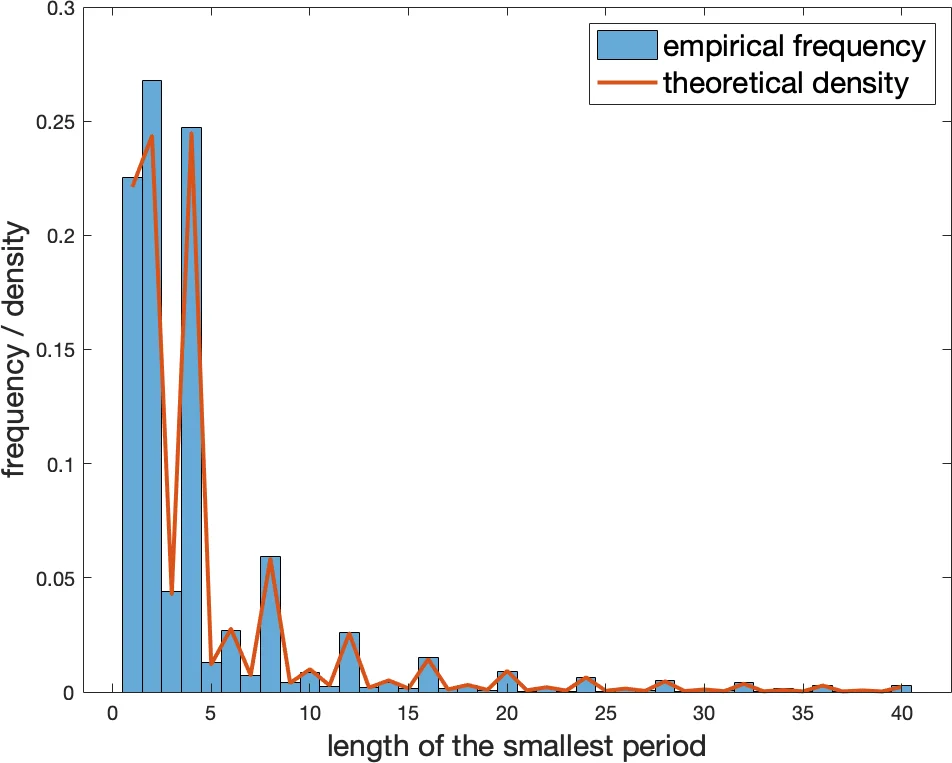
We study cellular automata with randomly selected rules. Our setting are two-neighbor rules with a large number $n$ of states. The main quantity we analyze is the asymptotic probability, as $n \to \infty$, that the random rule has a periodic solution with given spatial and temporal periods. We prove that this limiting probability is non-trivial when the spatial and temporal periods are confined to a finite range. The main tool we use is the Chen-Stein method for Poisson approximation. The limiting probability distribution of the smallest temporal period for a given spatial period is deduced as a corollary and relevant empirical simulations are presented.
💡 Research Summary
This paper investigates the probability that a one‑dimensional cellular automaton (CA) with a large number n of states possesses a periodic solution (PS) when its update rule is chosen uniformly at random from the space of all two‑neighbor rules. A periodic solution is defined as a space‑time configuration that repeats after σ sites in space and τ time steps, with both σ and τ minimal; equivalently, it can be represented by a τ × σ “tile” whose rows and columns obey the CA rule. The authors focus on the asymptotic regime n → ∞ and ask: for fixed integers σ ≥ 1 and τ ≥ 1, what is the limiting probability that a random rule admits at least one PS with those periods?
The rule space Ωₙ consists of n^{n²} possible functions f: ℤₙ² → ℤₙ, each selected with probability 1/|Ωₙ|. The main results are two theorems giving explicit limiting probabilities. Define
\
Comments & Academic Discussion
Loading comments...
Leave a Comment