Voltage regulation in buck--boost coniverters feeding an unknown constant power load: an adaptive passivity-based control
Rapid developments in power distribution systems and renewable energy have widened the applications of dc--dc buck--boost converters in dc voltage regulation. Applications include vehicular power systems, renewable energy sources that generate power …
Authors: Carlos A. Soriano--Rangel, Wei He, Fern
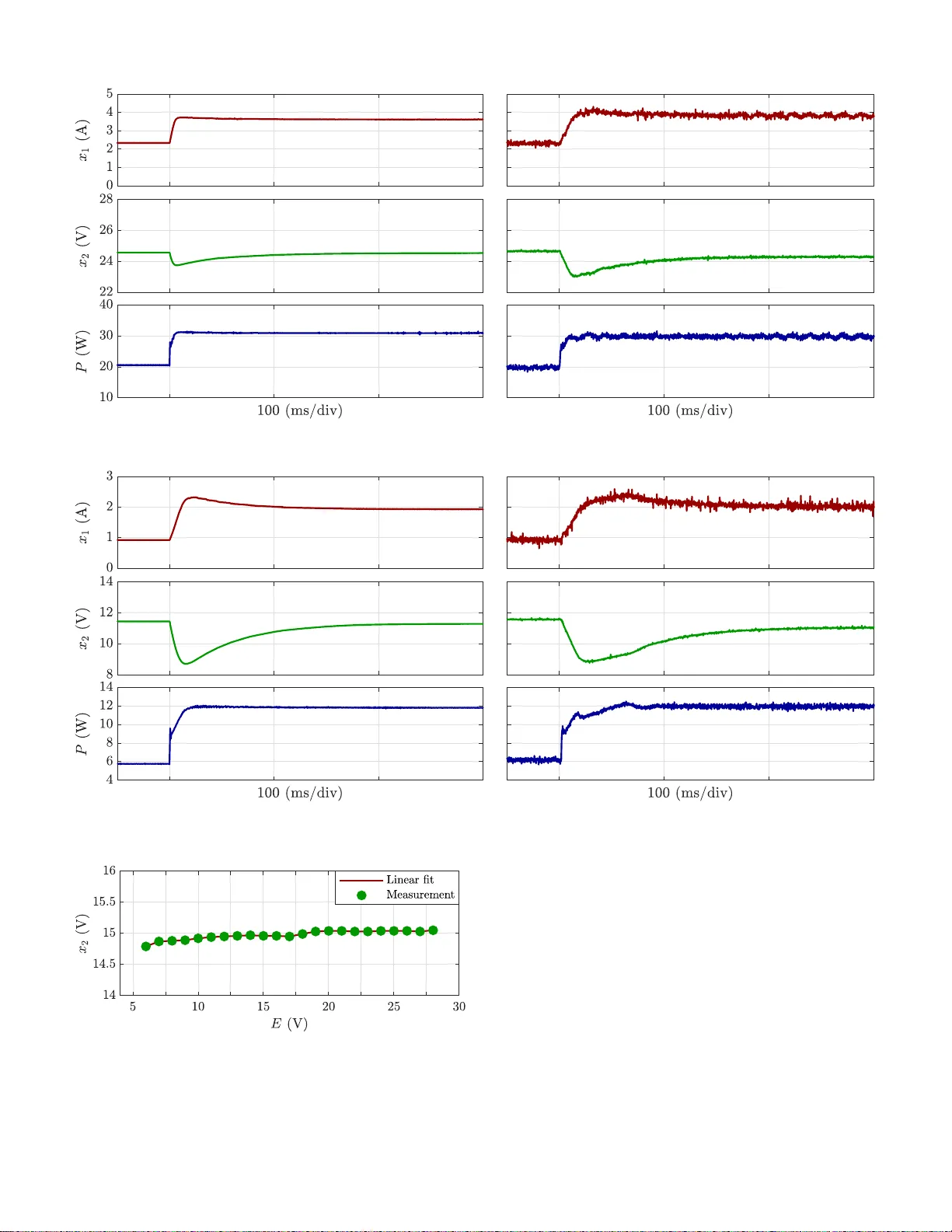
1 V oltage re gulation in b uck–boos t coni v erte rs feeding an unkno wn constant po wer load: an adapti v e pas s i vity–based con trol Carlos A. Soriano–Rangel, W ei He, Fernando Mancilla–Da vid, Member , IEEE , and Romeo Ortega, F ellow , IEEE Abstract —Rapid developments in power distribution systems and renewable ener gy h a ve wid ened the applications of dc– dc buck–boost con verters in d c vo ltage regulation. A pp lications include v ehicular power systems, renewable energy sources that generate power at a low vo ltage, and d c micr ogrids. It is noted that the cascade–connection of con verters in th ese ap p lications may cause in stability due to the fact that con verters acting as loads ha ve a constant power lo ad (CPL) beha vior . In this paper , the output v oltage reg ul ation problem of a buck–boost con verter feeding a CPL is addressed. The construction of th e feedback controller is based on the interc onn ection and damping assignment control techn ique. Additionally , an immersion and in variance parameter estimator is proposed to compute online the extracted load power , whi ch is difficult to measur e in practical applications. It is ensu red through the d esign th at the desired operating point is (locally) asymptotically stable with a guaranteed domain of attraction. T he approach is validated via computer simulation s and experimental prototyping. Index T erms —dc–dc power con version; pulse width modulated power conv erters; adaptive contro l; voltage control I . I N T R O D U C T I O N Now ada ys, th e DC–DC buck–boost converter is being broadly ad o pted in vehicular power systems (e.g. , sea, land, a ir and space vehicles); un conv en tional energy systems (e. g ., pho - tov o ltaic panels, fu e l cells, piezo electric); and dc microg r ids, due to its voltage step–up and step–down capabilities [1]– [4]. For instanc e , the ar c hitecture o f grid–co nnected doub le– stage p hotovoltaic power system may inclu d e the cascade connectio n of a photovoltaic array , a dc – dc converter and an in verter [4]. The con verter acting as a load (the in verter in the previous example) is often controlled to synthesize a certain amount of power an d therefore will exhibit a constant po wer load (CPL) behavior . As compa r ed to a passive load where the voltage– current relation ship is re stricte d to the first a nd third qu a drants, CPLs correspond to hy perbolas in this space [5 ], [ 6]. Because Manuscript submitted Nov ember 29, 2018. Correspondi ng au thor: W ei H e. C. A. Soriano–Range l and F . Mancilla–Da vid are with the Univ er- sity of Colorado Den ver , Campus Box 110, P .O. Box 173364 Denv er , CO 80217–3364, USA, (e–mail: [carlo s. sorianora ngel]fernando.mancilla- davi d@ucden ver .edu). W . He (correspon ding author) is with School of Automatio n, Nanjing Uni versity of Information Science and T echnology , Ningliu road No. 219, 210044, Nanjing, China, (e– mail: hwe i@nuist.edu.cn). R. Orte ga is with LSS/CNRS/ CentraleSup ´ elec , 3, Rue Joli ot–Curie 91192 Gif–Sur– Yvette, France, (e–mail : romeo.orte ga@lss.supelec.fr). R. Orte ga is also with the IT MO Uni versity , Kron verkskiy Prospekt, 49, San kt-Peterbur g, Russia, 197101. of this, the existence of CPLs may affect th e dy namic behavior of the power system and even could induce erratic or un stab le behavior [7], [8]. Although the contr ol of the se conv erte r s in the face of classical loads is we ll und erstood [ 9]–[13], the prolife r ation of CPLs poses a n ew ch allenge to contro l theorists [14]–[17]. It is noteworthy that the p o tentially large variations of the operating point caused by the varying input voltage render linear approxim ations inadequ ate, and in o rder to capture the complete dynamics a nonlinea r m odel is requ ired. Passi vity– based con trollers ( PBCs) have been applied to stabilize this type of systems with switch ing devices [1 8], [19]. Most of the aforeme n tioned a p plications requ ire to regulate th e output voltage at a p redetermin e d level while being fed b y en ergy sources that genera te power within a wide voltage range need to step–u p and step– down the inpu t voltage depend ing on the operating po int. Buck –boost co n verters provide su ch capability . Sev eral app r oaches can be found in recent literatur e fo r voltage regulation of the buck–boost converter with a CPL, such a s passive damping [2 0], feed back linearization [21], [22], acti ve–da m ping [23], sliding–mod e control [24], and the pulse adjustment method [1]. It should be n oted that although the afore m entioned tech niques have addr essed this pr oblem, they do not provide the gu aranteed stability prope rties for the original nonlinear system. The rece nt re search pr e sented in [25] pr oposes an adaptive PBC and pr ovides a comp lete stability analysis for a buck– boost converter feeding a CPL. The ap proach combines inter- connectio n and d amping assignment (I D A) contro l [2 6] a n d the immer sion a nd inv arianc e (I&I ) techniq ue for estimation of unkn own par ameter [27]. Howe ver , the con trol law of [25] is provid ed in terms of a time– scaled m odel and is extremely complicated to b e of practical interest. A second approac h , presented in [28], [29], ad dresses the same control pr o blem, but synthesizes a significantly simp ler co ntrol law . The key modification that leads to simplifying the contro l law is a partial linea r ization tha t tran sforms the model into a cascade form. Nevertheless, the appr oach still relies on the sam e time–scaled model, which is ha r d to d eal with in pr actical applications. The approa ch presented herein overcom es the afo remen- tioned lim itations, pro posing an adaptive PBC simple enough to be implem e nted in pr actice, with no tim e scalin g or any kind of linearization tech niques. The specific contributions of 2 this paper are: • Prop o sition o f an adaptive PBC to stabilize a DC– DC buck–boost converter f e eding a CPL with out using any time scaling or lin e arization m ethods • A complete stability analysis of the closed–loo p system under the p r oposed controller • Exp erimental validation, includin g reference tracking, as well as lin e and load r egulation The remainder of the paper is organized as follows. Section II contains the mod el of the system and problem formulation . Section I II presents the adaptive IDA–PBC. Simulation and experimental results ar e pr ovided in Section IV. Finally , the conclud in g remarks of Section V clo se the p a per . I I . S Y S T E M M O D E L A N D C O N T RO L P RO B L E M F O R M U L A T I O N A. Mo del o f buc k–bo ost converter with a CPL The circuit sch ematic of a buck–boost converter f eeding a CPL is shown in Fig. 1. Under the stand ard assumption tha t it operates in continuo us cond uction mod e , the a verage model is gi ven by L dx 1 dt = − (1 − u ) x 2 + uE , C dx 2 dt = (1 − u ) x 1 − P x 2 , (1) where x 1 ∈ R > 0 is th e indu ctor curren t, x 2 ∈ R > 0 th e output voltage, P ∈ R > 0 th e power extracted by the CPL, E ∈ R > 0 is the inp ut voltage and u ∈ [0 , 1] is the duty ratio of the switch S , wh ich is the con trol signal. + x 2 − x 1 S E L d C P u C P L + − Fig. 1. Circuit schematic of t he b uck–boost con verter feeding a CPL. The assignable equilibrium set o f th e system is given by E := ( x 1 , x 2 ) ∈ R 2 > 0 | x 1 − P 1 x 2 + 1 E = 0 . (2) B. Con tr o l pr o blem fo rmulation The co n trol problem is fo rmulated assuming the f o llowing about the system described b y ( 1): Assumption 1: Th e p ower lo a d ( P ) is unk nown, while the parameters L , C a n d E are known. Assumption 2: The state ( x 1 , x 2 ) is measurable. The contro l problem is to design a state–feedback contr ol law wh ere: • x ⋆ = ( x 1 ⋆ , x 2 ⋆ ) is an asympto tically stable equilibriu m o f the closed–loop with a well–defined domain of attraction • It is possible to define an in variant set of initial co nditions Ω ⊂ R 2 > 0 , wh ere x (0) in Ω implies x ( t ) in R 2 > 0 and x ( t ) to x ⋆ . Giv en that the state to control is x 2 , a reference x 2 ⋆ is fixed and then x 1 ⋆ is calculated using ( 2). I I I . P RO P O S E D C O N T R O L S C H E M E Follo wing a similar approach as that of [28], the contro ller design proceed s in two steps: 1) Apply ing the ID A–PBC metho d to stab ilize the system by assuming P known a n d ensure local stability of th e desired operating p oint 2) Designing an I&I estimato r for the power load such that the a bove scheme is adaptive A. I D A–PB C In this subsection, the con trol law obtained through th e ID A–PBC metho d is presen ted. In ord er to av oid notation cluttering, the voltage across the switch thr ow ( v T = E + x 2 ) and a linea r co m bination of the capacitor an d inductor energies ( W = C x 2 2 + 2 Lx 2 1 ) have been in troduce d , as well as W ⋆ = C x 2 2 ⋆ + 2 Lx 2 1 ⋆ . Pr o position 1: Th e ID A–PBC law given by u = 1 x 2 1 C 2 + v 2 T L 2 x 1 C 2 x 1 − P x 2 + x 2 v T L 2 − 2 x 1 x 2 C 2 v T + x 2 v T L 2 x 1 1 C 2 W 2 √ 2 LC 6 W E P x 1 arctan √ 2 Lx 1 √ W ! − C 3 P W v T + k 1 Lx 1 W 2 ( W + 2 C k 2 ) + 1 2 LC x 2 W 2 2 LE x 2 1 C 3 v 2 T − 2 x 2 LC √ 2 LC 6 W E P x 2 2 arctan √ 2 Lx 1 √ W ! + C 2 W (2 LP x 1 v T − E x 2 W ) + k 1 L ( x 2 W ) 2 ( W + 2 C k 2 ) ! , (3) ensures that: • x ⋆ is an asymptotically stable equilibrium of the closed– loop sy stem with L yapu nov function H d ( x ) = − √ C 2 L √ C E x 2 + √ 2 LP arctan " √ 2 Lx 1 √ C x 2 #! − √ 2 LP E ar ctan h √ 2 Lx 1 √ W i q W C + k 1 4 C ( W + 2 C k 2 ) 2 . (4) • Ther e exists a positiv e constant c such that th e sub lev el sets o f th e function H d ( x ) Ω x := { x ∈ R 2 > 0 | H d ( x ) ≤ c } , (5) 3 are an estimate of the d omain of attraction ensu r ing the state trajectories r ema in in R 2 > 0 . T h at is, for all x (0) ⊂ Ω x , x ( t ) ⊂ Ω x , ∀ t ≥ 0 , and lim t →∞ x ( t ) = x ⋆ . k 1 is a tuning gain that needs to satisfy the following conditio n: k 1 > max { k ′ 1 , k ′′ 1 } . (6) k ′ 1 , k ′′ 1 are define d with more detail in the full version of th e paper . Constant k 2 is then calculated as k 2 := 1 2 C k 1 Lx 1 ⋆ W 2 ⋆ p 2 LC 6 W ⋆ E P x 1 ⋆ arctan √ 2 Lx 1 ⋆ √ W ⋆ ! − W ⋆ C 3 P ( E − x 2 ⋆ ) + C 2 k 1 Lx 1 ⋆ x 4 2 ⋆ + 4 C k 1 L 2 x 3 1 ⋆ x 2 2 ⋆ + 4 k 1 L 3 x 5 1 ⋆ ! . (7) Pr o of: The p roof is shown in Section A o f Appe ndix. B. I &I power estimator In this subsectio n, the fact that P is usually unknown is addressed via an I & I estima to r . Pr o position 2: Con sider th e buck–bo ost converter of (1) sat- isfying Assum ptions 1 and 2 in closed–lo o p with a n adaptive version of the contr o l (3) given by u = ¯ u ( x, ˆ P , k 1 ) (8) where ˆ P ( t ) is an o n–line estimate of P generated with the I & I estimator ˆ P = − 1 2 γ C x 2 2 + P I (9) ˙ P I = γ x 1 x 2 (1 − u ) + 1 2 γ 2 C x 2 2 − γ P I (10) where γ > 0 is a f ree gain. T h ere exists k min 1 such that for all k 1 > k min 1 the overall system has an asymptotically stable equilibriu m at ( x, ˆ P ) = ( x ⋆ , P ) . The proof o f power load estimato r ( 9), (1 0) is given in Section B of Append ix . T o prove asymptotic stability of ( x, ˆ P ) = ( x ⋆ , P ) th e adaptive controller (8) is written as ¯ u ( x, ˆ P , k 1 ) = ¯ u ( x, P , k 1 ) + δ ( x, ˜ P , k 1 ) , where the m apping δ ( x, ˜ P , k 1 ) := ¯ u ( x, ˜ P + P, k 1 ) − ¯ u ( x, P, k 1 ) , has been defined. It is no tew orth y th at δ ( x, 0 , k 1 ) = 0 . In voking the proof of proposition 1 th e closed–loop system is now a cascaded system of th e fo rm ˙ x = F d ( x ) ∇ H d ( x ) + g ( x ) δ ( x, ˜ P , k 1 ) ˙ ˜ P = − γ ˜ P , where g ( x ) is the system in put matrix g ( x ) := C ( x 2 + E ) − Lx 1 . (11) Now , ˜ P ( t ) tends to zer o expon entially fast fo r all in itial condition s, an d f o r su fficiently large k 1 , i.e. , such tha t (6) is satisfied, the system above with ˜ P = 0 is asympto tically stable. In voking well–known resu lts of asymptotic stability of cascaded systems, e.g. , Proposition 4.1 of [3 0], completes the proof of (local) asymptotic stability . I V . C O M P U T E R S I M U L A T I O N S A N D E X P E R I M E N T S This section validates the the oretical r esults o f Section III via computer simu lations a n d exp e rimental proto typing. Computer simu lations are implemented in MA TLAB/Simulink release R2 0 17b. The prototyp ing of the buck–boost converter feeding a CPL is re a lized using commerc ia l off–the– sh elf V ishay Dale conv erter bo ards mod el MPCA751 3 6 and a T exas Instrumen t DSP mod e l TMS320 F28335 . T able I summ arizes simulation an d exper imental set–po ints utilized as case stud ies, along with the phy sical para m eters of the MPCA75136 b oards. It is n oted tha t simulations and experiments are p erform e d using th e same system characterization , an d therefore results are directly comparable. T ABLE I S I M U L ATI O N / E X P E R I M E N TA L S E T P O I N T S A N D P H Y S I C A L PA R A M E T E R S . Parame ter Symbol (unit) V alue Boost Buck Input volt age E ( V ) 15 15 Referen ce output voltag e x 2 ⋆ ( V ) 25 12 Gain x 2 ⋆ /E 1 . 67 0 . 8 Nominal extrac ted po wer P ( W ) 20 , 30 6 , 12 Inducta nce L, L ′ ( µ H ) 216.8 216.8 Capaci tance C, C ′ ( µ F ) 1380 1380 Sev eral tests of the c losed loop system with the propo sed controller are do n e using averaged an d switched simulations, and experimen ts. The average system of the circuit shown in Fig. 1 in clo sed loop with the IDA–PBC of (3) and the po wer estimator of (9)–(10) are simu lated and used to perfor m a gain sensitivity analysis, and to obtain th e p hase plots of the system. Results of simulations u sing different values for k 1 and γ ar e used fo r the gain sensitivity analysis, while the phase plots are ob ta in ed by running the closed loop simulatio n with different initial values for x 1 and x 2 . Besides, a performan ce compariso n of the proposed adaptive PBC aginst a trad itional PI controller is p resented. Then, the contro ller’ s ability to regulate the outp ut voltage when a step is applied to the extracted power is ev alu a ted experimentally and compare d with simulation results fo r a chosen set of gains. T o this end, a switched simulatio n of the closed lo op system is implemented in MA TLAB/Simulink’ s Simscape electrical toolbox . In this simu lation, add itio nal compon ents suc h as sensing r esistors wh ich are installed in the c o n verters ar e taken into co n sideration to match closer th e actual con verter bo ards. Finally , the ability o f th e I D A–PBC to r egu late the outpu t at the desire d voltage wh en th e input voltage ch anges (line regulation) and wh en the lo ad chan ges (load regulatio n) is tested experimentally . 4 A. A veraged simulation s 1) Gain sensitivity ana lysis: An averaged sim u lation of a buck–boost conv erter f eeding a CPL (1) with the p r oposed ID A–PBC (3) while operating in boost mode is c a r ried ou t. The simulatio n p arameters are prsente d in T able I. H e rein, a step ch a nge is applied to P and the tran sient pro files of both states is obser ved fo r dif fer e nt v alues of the con trol gain k 1 , while keeping γ c onstant at 2 0 . Th en, th e estimator’ s transient p erforma n ce is evaluated f o r different values o f γ while keeping k 1 constant at 0 . 1. The results o f this analysis are ta ken then in to co nsideration to select proper gains for the experiments. Fig. 2. Simulated current (top), voltag e (middle) and power (bottom) wa veforms for the adapti ve ID A–PBC with γ = 20 and dif ferent value s of k 1 . Fig. 2 sho ws the profiles of the outpu t voltage and in ductor current fo r the adaptiv e ID A–PBC for different values of the control gain k 1 and ad aptation gain γ = 20 , wh ile app lying a step ch ange in the extracted power P fr om 20 to 30 W . As shown in the figure, a larger c o ntrol g ain k 1 causes the o utput voltage to recover faster when P is ch a nged. Howe ver , for all values of k 1 , th e ou tput voltage always con verges to the desired eq uilibrium. This is due to the fact th at, as predicted by the the ory , the power estimated conver g e s expo nentially fast to th e true value indep endently o f th e contr ol sign al. A step chang e in P with its co rrespond ing estimate ˆ P for different values of γ , is sh own in Fig. 3. As predic ted by the theory , for a larger γ , the speed of convergence of the estimator is faster . No tice, h owe ver , that in the selection of γ , there is a tradeoff between con vergence speed and noise sen siti vity . 2) Phase plo ts: Given that the IDA–PBC liv es in the plan e, it is po ssible to obtain a glo bal picture of the behavior of these controller s by drawing their phase p lot. These p lo ts are Fig. 3. Simulate d transient performanc e of the estimate ˆ P under step change s of the parameter P with k 1 = 0 . 1 and various estimator gains γ . obtained by perfo rming averaged simulations o f the closed loop system with a w id e range of initial co nditions for both states. For these simulations, it is assumed that P is correctly estimated and k 1 is kept constan t at a preselected value. Fig. 4. Phase plots of the system with the ID A–PBC for dif ferent initial conditi ons and k 1 = 0 . 001 . The transient behavior dep icted in the phase p lots depends greatly on the values of p a rameters L and C . Given that the conv er te r will be op erating within a specified ran ge for gain and th rough put power , it ca n be d esigned so that the current and voltage ripples due to the switchin g actio n in x 1 and x 2 , stay w ith in p re–specified limits. For an example design with E = 15 V , P = 30 W and x 2 ⋆ = 25 V , the equilibriu m is defined as x ⋆ = ( x 1 ⋆ , x 2 ⋆ ) = (3 . 2 , 2 5 ) . Considering a switching freq uency of 100 kH z and fo llowing the stan dard approa c h with ripples of 5 % and 1 % fo r x 1 and x 2 respectively , the min imum required values for L and C are f o und to be 5. 859 mH and 4 80 µ F , respectively . Fig. 4 show the phase plots of the I D A–PBC together with some trajectories fo r different initial con ditions and k 1 = 0 . 00 1 . Fig . 5 4 sho ws the phase plots fo r the system with the param eters of T ab le I in the to p and in the b ottom the ph ase plots fo r the example design. The initial conditio ns ch o sen ( ) repr esent equilibriu m p oints with th e same P and different values for x 2 ⋆ . It can be seen that the system conver ges to the desired equilibriu m p oint ( ⋆ ) fo r a wide rang e of initial condition s 5 V ≤ x 2 (0) ≤ 45 V . Howe ver , it is possible to show that the closed–loo p vector field has a n other equ ilibrium in R 2 > 0 that correspo n ds to a sadd le po int. Addition ally , in can b e observed that when x 2 (0) < x 2 ⋆ , x 1 will have an overshoot that will increase as x 2 (0) ap proaches zero. Howe ver, pr oper selection of reactive elemen ts can reduce this overshoot. Finally , it was observed that even if the values of L an d C change but the ratio L /C is kept c o nstant, the trajecto ries fo llowed by th e system are the same. 3) Comparison aga inst a PI contr oller: Herein , a c ompari- son of the system in closed loo p with th e proposed IDA–PBC and a PI controller is presented . The co nverter is o p erated in boost m o de with E = 15 V and x 2 ⋆ = 25 V . A step ch ange is applied to the power demanded by the CPL from 20 to 25 W . The PI controller seeks to drive to zer o the error between the refer ence and measur e d values of the outpu t v oltag e x 2 . The gains f o r the PI controller are c hosen as k p = 0 . 002 and k i = 0 . 00 1 . For the I D A–PBC, the gains are cho sen as γ = 20 and k 1 = 0 . 3 . Fig. 5 illustrates th e dynam ic p erforma n ce of the output voltage with both controllers. Fig. 5. Output voltag e x 2 , contrasting the response of a PI controller against the proposed IDA–PB C. It can be observed immediately that after the occurren ce o f the dyn amic ev en t the PI co ntroller leads to an oscillato r y response, and even after 8 s, it is still una b le to achieve zero steady state er r or . Conversely , the pro posed ID A–PBC takes less than 300 ms to recover fr om the step chan ge in the load an d does it with a much smo other d y namics. It should be n oticed that the clo sed–loop system with tra ditional PI controller will be u nstable under bigg er variations o f power load, which shows the po or robustness perfo r mance against larger disturbance s. Howev er, th is pro blem does no t exist in the p r oposed metho d since it is ba sed on larger signal analysis. B. S witched simulatio n and experiments The realization o f the buck–bo ost con verter feeding a CPL (physical system) an d its associated co ntrol schem e (con tr ol system) is illustrated in th e schema tic of Fig . 6. Dashed arrows are utilized to repr esent th e flow o f sign a ls between the p hysical and control sy stem. Th e em u lation and control of the CLP is boxed u sing red dashed– dotted lines to h ig hlight the fact that, while n eeded f or the implementation, this part of system is not p a rt o f the pro posed IDA–PBC. + x 2 − x 1 S E L d C L 0 C 0 R S 0 d 0 A V T o control system x 1 x 2 V v R F rom control system Emulation of CPL I&I (9) (10) IDA PBC (3) T o physical system PWM F rom physical system ^ P k 2 (7) q ( t ) q 0 ( t ) x 1 x 2 u u F rom physical system v R PI PWM q ( t ) q 0 ( t ) Physical system Control system v R ? + v R − Low{ pass fi lter Low{ pass fi lter x 1f x 2f v Rf u 0 MOSFET driver circuits x 2 ? R 0 V E E f E x 1 ? (2) x 2 ? x 1 ? ^ P x 1f x 2f E f k 2 ^ P i o Control of CPL Fig. 6. Schematic and control struct ure of a buck–boost con verte r feeding a CPL. The CPL is e mulated v ia a tigh tly voltage–con tr olled buck conv erter (also u tilizing a V ishay Dale board ) and a re sistor bank that can be switched in stages [2 3], [3 1], [32]. It is also noted that within th e c ontrol system an f appen ded to the subindex of a variable indicates that it has b een filtered. This is d one to conv ert switche d signals into average ones. Furthermo re, several blo cks in the diagram point the equation number that is requ ired to imp lement the c orrespon ding action. A picture o f th e exper imental setup is shown in Fig. 7. Fig. 7. Experimental setup of th e b uck–boost con verter feed ing a CPL. For the experimental setup, the co ntroller pro posed in (3) with k 1 = 0 . 0 1 , the I & I estimato r with γ = 20 an d the PI regulator for the CPL are imp lemented in a T exas Instru- ment DSP . The optimized floating–poin t math f u nction lib rary for this DSP is used, w h ich allows f o r consid e rably faster execution speeds when p erform ing tasks such as calcula tin g trigono m etric fun ctions. Gi ven that the controller is design ed for th e average model of the co n verter, the DSP samples the measured states at 10 kHz and then ap plies a low pa ss filter 6 with a cutoff frequency o f 1 k Hz befor e they are fed to the controller s. For plotting pur poses, sign als from the experim e n t are acquired with a n oscilloscop e at a fre q uency of 50 kHz. Giv en th at the simulation u ses a variable–step solver , the simulation results are resampled to 50 kHz. Both experime n tal and simula tio n wav efo rms are passed through a low pass filter with f c = 1 k Hz befo re being plotted next to each o ther . The output cur rent i o is also measur ed and filtered , and then used to calculate the p ower shown in the results a s P = x 2 i o . 1) Step chan ges in P : Th e ability of th e con troller to regulate th e ou tput voltage wh ile the lo ad chang es is tested experimentally . The resu lts of these expe riments a r e com- pared again st results of switched simulation s. The switches and passiv e elements in the simulation are realized using compon ents from the Simscape /SimPowerSystems library . For both simulations and experiments, the switchin g frequen cy is chosen at 75 kHz. T o validate the ef fectiveness of the prop osed app roach, tw o cases which represen t different scenarios of interest in practical applications are presented. T he first experiment validates th e propo sed co ntrol when the co n verter is operating in boost mode. Th e input voltage E and d e sired output voltage x 2 ⋆ are set to 15 V , 25 V , respectively , while the load power P is changed from 20 W to 30 W . It can be seen in Fig . 8 that the output voltage an d th e inductor cu r rent settle to their stationary values with a good transient performa nce. One add itional experime n t is ca r ried ou t to exam ine the output voltage regu la tio n when o perating in buck mode . The input voltage E and desire d output voltage x 2 ⋆ are set to 15 V and 12 V , respec tively . The load p ower is initially set to P = 6 W and is increased to 12 W . The resulting outpu t v oltage and inductor current are shown in Fig. 9. Although the outpu t voltage contains steady state errors caused by parasitic elemen ts no t considered in the ideal mod el for both op erating modes, the prop osed con tr oller suc cessfully regulates the voltage at the d e sired value, regar d less of the changes in P . 2) Line an d load r e gu lation: Th e experim e ntal ability of the p roposed IDA–PBC to co n trol the voltage u nder stan- dard lin e/load regulatio n tests is presented herein. For line regulation, x 2 ⋆ = 15 V and P = 1 0 W , while E is being changed f r om 6 to 2 8 V in steps of 1 V . It is noted that for this experim ent the co n verter ope rating mo de transitions from boost ( E < x 2 ⋆ ) to buck ( E > x 2 ⋆ ), and therefore the regulation p lot is a compo site of b oth operating modes. Fig. 10 illustrates the results. For load regulation, the input voltage is set to E = 15 V and x 2 ⋆ = 12 V ( buck mod e), while the load was changed from 5 W to 27 . 5 W in steps of 2 . 5 W . For boost mode, the input voltage is set to E = 15 V and x 2 ⋆ = 25 V . Th e same values f or P were used as those in the b uck mo de experiment. Results are summarized in Fig. 11. It is readily o bserved fro m Fig. 1 0 an d Fig. 1 1 that, d espite small steady sate error s caused b y the parasitic elements n ot considered in th e mathematical mode l, the controller success- fully regulates the outp ut voltage in a hardware environment, and und er relatively large variations in the input voltage and the output power . This in dicates th a t the so p histicated ID A–PBC co ntroller propo sed herein will be suitable to be implemented in a c tual in dustrial applications. V . C O N C L U S I O N S This p aper has proposed a novel ap proach based on PBC to regulate the ou tput v o ltag e o f DC–DC b u c k–boo st conv erter s feeding an un known CPL. The co ntrol scheme assumes first that the CPL ’ s power is known, and sy nthesizes an ID A–PBC that stab ilize s th e ou tput voltage. Sub sequently , an on –line I & I estimator with g lo bal conver g ence has been presented to r ender the overall sch eme adaptiv e, pr eserving asymptotic stability . The theo retical claims have been th oroug hly vali- dated via co mputer simulations an d experimental pro totyping, demonstra tin g the p ractical viability of the ap proach . R E F E R E N C E S [1] A. Khaligh, A. M. Rahimi, and A. Em adi, “Modified pulse–adjustment techni que to control DC/DC con verters dri ving v ariable constant –power loads, ” IEEE T rans. Ind. Ele ctro n. , v ol. 55, no. 3, pp. 1133–1146, Mar . 2008. [2] E . Lefeuvre, D. Audigier , C. Richa rd, and D. Guyomar , “Buck–boost con vert er for sensorless power optimization of piezoelect ric ener gy harve ster , ” IEEE T rans. P ower Electr on. , vol . 22, no. 5, pp. 2018–2025, Sep. 2007. [3] T . Pavlo vic, T . Bjazic, and Z. Ban, “Simplified avera ged models of DC–DC po wer con verters suitable for controller design and microgrid simulatio n, ” IEE E T rans. P ower Electr on. , vol. 28, no. 7, pp. 3266–3275, Jul. 2013. [4] A. D. Martin, J. M. Cano, J. F . A. Silva , and J. R. Vzquez, “Backste pping control of sm art grid–con nected distribute d phot ovolta ic power supplies for telec om equipment , ” IEEE T rans. Ener gy Con vers. , vol. 30, no. 4, pp. 1496–1504, Dec. 20 15. [5] A. Kwasinski and C. N. Onwuchekwa, “Dynamic behavi or and stabiliza - tion of DC microgrids with instantane ous constan t–power loads, ” IEEE T rans. P ower E lect ron. , vol. 26, no. 3, pp. 82 2–834, Mar . 2011. [6] M. K. Zadeh, R. Gava gsaz–Ghoachani , J. P . Martin, S. Pierfederic i, B. Nahid–Moba rakeh, and M. Molina s, “Discrete –time tool for stability analysi s of DC power electronics–b ased cascad ed systems, ” IEEE T rans. P ower Electr on. , vol . 32 , no. 1, pp. 652–667, Jan. 2017. [7] J . A. Solsona , S. G. Jorg e, and C. A. Busada, “Non linear control of a buck con vert er whi ch feeds a constant po wer load, ” IEEE T rans. P ower Electr on. , vol . 30, no. 12, pp. 7193–7201, Dec. 2015. [8] W . J. Du, J. M. Zhang, Y . Zhang, and Z. M. Qiao, “Stabil ity criter ion for cascaded system with constant power load, ” IEEE T rans. P ower Electr on. , vol . 28, no. 4, pp. 1843–1851, Apr . 2013. [9] T . Geyer , G. Papafotiou, and M. Morari, “Hybrid model predicti ve control of the step–do wn DC–DC con verter , ” IE EE T rans. Contr ol Syst. T echn ol. , vo l. 16, no. 6, pp. 1112–1124, Nov . 2008. [10] Y . I. Son and I. H. Kim, “Co mplementary PID controller to Passi vity– Based nonlinear control of boost con verters with inductor resistance , ” IEEE T rans. Contr ol Syst. T echnol. , vol. 20, no. 3, pp. 826–834, May 2012. [11] S. Kim, C. R. Park, J. Kim, and Y . I. Lee, “ A s tabilizing model predic tiv e control ler for voltage regulat ion of a DC/DC boost con verter , ” IEEE T rans. Contr ol Syst. T echnol. , vol. 22, no. 5, pp. 2016–2023, Sep. 2014. [12] L . W ang, Q. H. W u, Y . K. T ao, and W . H. T ang, “Switching control of buck con verter based on ener gy conserv ation principle, ” IEEE T rans. Contr ol Syst. T echnol . , vol. 24, no. 5, pp. 1779–1787, Sep. 2016. [13] J. W ang, C. Z hang, S. Li, J. Y ang, and Q. Li, “Finite–time output feedbac k control for PW M–based DC–DC buck power conv erters of current sensorle ss mode, ” IEEE T rans. Contr ol Syst. T ec hnol. , vol. 25, no. 4, pp. 135 9–1371, Jul . 2017. [14] N. Barabano v , R. Orteg a, R. Gri, and B. Polya k, “On exi stence and stabili ty of equilibria of linear time–in var iant systems with constant po wer l oads, ” IEEE T rans. Circuit s Syst. I, Re g. P apers , vol . 63, no. 1, pp. 114–121, Jan. 2016. [15] D. Marx, P . Magne, B. Nahid–Mobarak eh, S. Pierfederic i, and B. Dav at, “Large signal stabili ty analysi s tools in DC power systems with constant po wer loads and vari able po wer loa ds—A re vie w, ” IEEE T rans. P ower Electr on. , vol . 27, no. 4, pp. 1773–1787, Apr . 2012. 7 Fig. 8. Simulated (left) and e xperimental (ri ght) wa veforms. Boost mode ( E = 15 V , x 2 ⋆ = 25 V) and P stepped from 20 W to 30 W . Fig. 9. Simulated (left) and e xperimental (ri ght) wa veforms. Buck mode ( E = 15 V , x 2 ⋆ = 12 V) and P stepped from 6 W to 12 W . Fig. 10. Line regulat ion plot. Output v oltage against input v oltage. [16] S. Singh, A. R. Gautam, and D. Fulwa ni, “Constant po wer loads and their ef fects in DC distrib uted po wer systems: A revie w, ” Renewabl e and Sustainable Energy Revi ews , vol. 72, pp. 407 –421, May 2017. [17] A. Em adi, A. Khaligh, C. H. Ri vetta, and G. A. Will iamson, “Consta nt po wer loads and negati ve impedance instabilit y in aut omotiv e systems: Definitio n, modeli ng, stabi lity , and contro l of power electronic con vert- ers and m otor dri ves, ” IEEE T rans. V eh. T echno l. , vol . 55, no. 4, pp. 1112–1125, Jul. 2006. [18] G. C. Konstan topoulos and A. T . Ale xandridis, “Genera lized nonlinear stabili zing controlle rs for Hamiltonian– passiv e systems wit h switchin g de vices, ” IEEE T rans. Contr ol Syst. T ec hnol. , vol. 21, no. 4, pp. 1479– 1488, Jul. 2013. [19] R. V . Meshram, M. Bha gwat, S. K hade, S. R. W agh, A. M. Stankovi c, and N. M. Singh, “Port–controll ed phasor Hamiltonia n modeling and ID A–PBC control of solid–state transformer, ” IEEE T rans. Contr ol Syst. T echn ol. , pp. 1–14, 2018. [20] M. Cespedes, L. Xing, and J. Sun, “Constant–po wer load system stabili zation by passiv e damping, ” IEEE T rans. P ower Electr on. , vol. 26, no. 7, pp. 183 2–1836, Jul . 2011. [21] A. M. Rahimi, G. A. W illiamson, and A. E madi, “Loop–c ancellati on techni que: A nove l nonlinear feedbac k to ove rcome the desta bilizing ef fect of constant–po wer loads, ” IEEE T rans. V eh. T echn ol. , vol. 59, no. 2, pp. 650 –661, Feb . 2010. [22] M. Salimi and S. Siami, “Cascad e nonline ar control of DC–DC buck /boost con verter using e xact feedb ack linea rization, ” in 2015 4th 8 Fig. 11. Load regu lation plots for buck (top) and boost (bo ttom) operating modes. Output voltage against load power . Int. Conf. Elect. P ower & Energy Conv ers. Syst. (EPECS) , Nov . 2015. [23] A. M. Rahimi and A. Emadi, “ Acti ve damping in DC/DC powe r elect ronic conv erters: A novel method to overc ome the problems of constant power loads, ” IE EE T rans. Ind. Electr on. , vol. 56, no. 5, pp. 1428–1439, May 2009. [24] S. Singh, N. Rathore, and D. Fulw ani, “Mitigat ion of neg ativ e impedance instabi lities in a DC/DC buck –boost con verter with composite load, ” J ournal of P ower Electr on. , v ol. 16, no. 3, pp. 1046–1055, May 2016. [25] W . He, R. Ortega, J. E. Machado, and S. H. Li, “An adapt ive passi vity– based controlle r of a buck–boost con verter with a constant power load, ” Asian Journal of Contr ol , vol. 21, no. 2, pp. 1–15, Mar . 2018. [26] R. Ortega , A. V . D. Schaft, B. Maschke, , and G. Escobard, “Interconn ec- tion and damping assignment passi vity–based control of port–controlle d Hamiltoni an systems, ” Automatica , vol. 38, no. 4, pp. 585–596, Apr . 2002. [27] A. Astolfi, D. Karagianni s, and R. Ortega, Nonlinear and adaptive contr ol with applicati ons . Berlin: Springer–V erlag, 2008. [28] W . He, C. A. Soriano-Rangel , R. Ortega, A. Astolfi, F . Mancil la-David, and S. Li, “Energy shaping control for buck–boost con verters with unkno wn constant po wer load, ” Contr ol Engineeri ng P ract ice , vol. 74, pp. 33–43, May 2018. [29] W . He, C. Soriano–Rangel , R. Ortega, A. Astolfi, F . Mancilla–Da vid, and S. Li, “DC–DC buck –boost con vert ers with unkno wn CPL: An adapti ve PBC, ” in 2018 Annual A merican Contr ol Confer ence (ACC ) , J un. 2018, pp. 6749–6754. [30] R. Sepulc hre, M. Jankovic , and K. P ., Constructive nonlinear contr ol . London: Springer–V erlag, 1997. [31] A. Kwasinski and P . T . Krein, “Stabi lization of constant power loads in DC–DC co nv erters using passi vity–based cont rol, ” in 2007 29th Int. T elecommu n. Energy Conf. (INTELEC) , Se p. 200 7, pp. 867–874. [32] S. Arora, P . T . Balsara , and D. K. Bhatia , “Digital implementat ion of const ant powe r load (CPL), acti ve resisti ve load, constant current load and combinati ons, ” in 2016 IEEE Dallas Circui ts and Systems Confer ence (DCAS) , Oct . 2016, pp. 1–4. A P P E N D I X A. P r o of o f pr o position 1 It will be shown th at the control (3) can be derived using the ID A–PBC method of [26] with th e selection F d ( x ) := " − x 2 Lx 1 − 2 x 2 C v T 2 x 2 C v T − 2 LE x 1 C 2 v 2 T # , (12) that, for x ∈ R 2 > 0 , satisfies the c ondition F d ( x ) + F d ( x ) T < 0 . The system (1) can b e rewritten in th e form ˙ x = f ( x ) + g ( x ) u where g ( x ) := C ( x 2 + E ) − Lx 1 (13) is the system inp ut m atrix, and f ( x ) := − x 2 L x 1 C − P C x 2 is th e vector field. Noting that the left ann ihilator of g ( x ) is g ⊥ ( x ) := [ Lx 1 C ( x 2 + E )] , the PDE takes the form of (1 4), which is eq uiv alent to − x 2 ∇ x 1 H d ( x ) + 2 Lx 1 C ∇ x 2 H d ( x ) = P − E x 1 + P E x 2 . (15) The solution of (15) is easily obtained using a sym bolic languag e , e.g. , Maple or Mathematica, and is of the form of (16), wher e Φ( · ) is an arb itrary functio n. Selecting this free function as Φ( z ) := k 1 2 ( z + k 2 ) 2 , with k 1 and k 2 arbitrary constants, yields (4). T o comp le te th e design it o nly remains to prove the ex- istence of k 1 and k 2 . T owards th is end, the gr adient is first computed a s (17) Evaluating it a t the equilib r ium and selectin g k 2 as giv en in ( 7) yields ∇ H d | x = x⋆ = " 0 √ C √ C x 2 2 ⋆ ( P − E x 1 ⋆ )+ E √ C P 2 Lx 1 ⋆ x 2 ⋆ # . (18) In voking x 1 ⋆ = P 1 x 2 ⋆ + 1 E one gets ∇ H d | x = x⋆ = 0 . On th e other hand, the Hessian of H d ( x ) is given by ∇ 2 H d = ∇ 2 x 1 H d ∇ 2 x 1 x 2 H d ∇ 2 x 2 x 1 H d ∇ 2 x 2 H d , (19) where the elemen ts ar e given as in (2 0)–(22). Rep la c ing k 2 in (19) a n d ev aluating it at the equilib rium point x = x ⋆ , it follows ∇ 2 H d x = x⋆ = ∇ 2 x 1 H d | x = x⋆ ∇ 2 x 1 x 2 H d | x = x⋆ ∇ 2 x 2 x 1 H d | x = x⋆ ∇ 2 x 2 H d | x = x⋆ , (23) where the elem ents ar e giv en as in (24)–(26). Some lengthy , but straig htforward, calculations prove that ∇ 2 x 1 H d | x = x⋆ > 0 holds if an d only if k 1 > k ′ 1 where k ′ 1 is defined as in (2 7) and k ′′ 1 is defined as in ( 28). Finally , in ord e r to ensure det ∇ 2 H x = x⋆ > 0 , k 1 should be chosen such that k 1 > max { k ′ 1 , k ′′ 1 } . This ensur es ∇ 2 H | x = x⋆ > 0 , wh ich end s the proof that x ⋆ is an asymptotically stable equilibrium o f th e clo sed–loop . The proo f of the existence of an e stimate of the do main of attraction follows imme d iately n oting that it ha s b een shown ab ove th at the fu nction H d ( x ) h a s a po siti ve definite Hessian evaluated at x ⋆ , therefor e it is conve x . Con seq uently , for sufficiently small c , the sublevel set Ω x defined in (5) is bound ed and strictly contained in R 2 > 0 . Th e proof is co mpleted recalling that sublevel sets of strict L yap unov fun ctions ar e inside the domain o f attr action of th e eq uilibrium. 9 Lx 1 C ( x 2 + 1) − x 2 L x 1 C − P C x 2 − " − x 2 Lx 1 − 2 x 2 C v T 2 x 2 C v T − 2 LE x 1 C 2 v 2 T # ∇ H d ( x ) ! = 0 , (14) H d ( x ) = − √ C 2 L √ C E x 2 + √ 2 LP arctan " √ 2 Lx 1 √ C x 2 #! − √ 2 LP E arctan h √ 2 Lx 1 √ W i q W C + Φ Lx 2 1 C + x 2 2 2 . (16) ∇ H d = W ( C 3 P ( E − x 2 )+ C 2 k 1 Lx 1 x 2 2 ( 2 k 2 + x 2 2 ) +4 C k 1 L 2 x 3 1 ( k 2 + x 2 2 ) +4 k 1 L 3 x 5 1 ) − √ 2 LC 6 W E P x 1 arctan √ 2 Lx 1 √ W C 2 W 2 √ W C ( − E C 3 x 3 2 + C 2 L ( 2 k 1 k 2 x 4 2 + k 1 x 6 2 +2 P x 1 x 2 − 2 E x 1 ( P + x 1 x 2 ) ) +4 C k 1 L 2 x 2 1 x 2 2 ( k 2 + x 2 2 ) +4 k 1 L 3 x 4 1 x 2 2 ) − √ 2 LC 5 E P x 2 2 arctan √ 2 Lx 1 √ W 2 L √ C W 3 (17) ∇ 2 x 1 H d = 1 p C 5 x 2 2 W 3 √ 2 LC 4 x 2 E P r W C C x 2 2 − 4 Lx 2 1 arctan √ 2 Lx 1 √ W ! LW 4 √ C 7 P x 1 x 2 2 + q C 7 x 2 2 2 k 1 k 2 x 4 2 + k 1 x 6 2 + 6 E P x 1 + 4 L 2 √ C 3 k 1 x 4 1 x 2 2 2 k 2 + 7 x 2 2 + (2 L √ C 5 k 1 x 2 1 x 3 2 ) 4 k 2 + 5 x 2 2 + 24 L 3 √ C k 1 x 6 1 x 2 2 ! (20) ∇ 2 x 2 x 1 H d = 1 C W 2 x 2 − 2 LC 2 P x 1 x 2 − 3 √ 2 LC 5 E P x 1 x 2 2 arctan √ 2 Lx 1 √ W q W C + C 3 P x 2 + 2 C 3 E P x 2 2 + 2 LC 2 x 1 k 1 x 6 2 − E P x 1 + 8 L 2 C k 1 x 3 1 x 4 2 + 8 L 3 k 1 x 5 1 x 2 2 ! (21) ∇ 2 x 2 H d = 1 2 √ LC 3 x 3 2 W 3 2 √ 2 C 4 E P x 3 2 r W C Lx 2 1 − C x 2 2 arctan √ 2 Lx 1 √ W ! + √ LW − 4 √ C 7 P x 1 x 4 2 + 2 L √ C 5 x 2 1 x 3 2 4 k 1 k 2 x 4 2 + 7 k 1 x 6 2 − 2 E P x 1 + √ C 7 x 2 2 k 1 k 2 x 4 2 + 3 k 1 x 6 2 − 8 E P x 1 + 4 k 1 L 2 √ C 3 x 4 1 x 3 2 2 k 2 + 5 x 2 2 + 8 k 1 L 3 x 6 1 x 2 2 q C x 2 2 ! . (22) B. P r o of o f pr o position 2 Differentiating ˜ P along the trajectories of (1) and u sing (9) one gets ˙ ˜ P = − γ x 2 C ˙ x 2 + ˙ P I = − γ x 1 C x 2 (1 − u ) + γ P + ˙ P I . Substituting (10) in the last equ a tio n yields ˙ ˜ P = γ P + 1 2 γ 2 C x 2 2 − γ P I = − γ ˜ P , which reveals that th e estimation ˆ P will exponentially con- verge to P . 10 ∇ 2 x 1 H d | x = x⋆ = 1 C 2 W 3 ⋆ x 1 ⋆ W ⋆ C 4 P x 2 2 ⋆ ( x 2 ⋆ + E ) + 2 LC 3 P x 2 1 ⋆ (3 x 2 ⋆ + 4 E ) + 4 L 2 C 2 k 1 x 3 1 ⋆ x 4 2 ⋆ + 16 L 3 C k 1 x 5 1 ⋆ x 2 2 ⋆ + 16 L 4 k 1 x 7 1 ⋆ − 6 √ 2 L 3 C 7 E P x 3 1 ⋆ r W ⋆ C arctan √ 2 Lx 1 ⋆ √ W ⋆ ! ! (24) ∇ 2 x 2 x 1 H d | x = x⋆ = 1 √ C W 5 x 2 ⋆ r W C C 3 P x 2 2 ⋆ ( x 2 ⋆ + 2 E ) − 2 LC 2 x 1 ⋆ − k 1 x 6 2 ⋆ + P x 1 ⋆ x 2 ⋆ + E P x 1 ⋆ + 8 L 2 C k 1 x 3 1 ⋆ x 4 2 ⋆ + 8 L 3 k 1 x 5 1 ⋆ x 2 2 ⋆ − 3 √ 2 LC 5 E P x 1 ⋆ x 2 2 ⋆ arctan √ 2 Lx 1 ⋆ √ W ⋆ ! ! (25) ∇ 2 x 2 H d | x = x⋆ = 1 2 √ 3 C W 5 x 2 2 ⋆ 2 √ 2 C 5 E P x 2 2 ⋆ Lx 2 1 ⋆ − C x 2 2 ⋆ arctan √ 2 Lx 1 ⋆ √ W ⋆ ! + r LW ⋆ C C 3 x 2 2 ⋆ 2 k 1 k 2 x 4 2 ⋆ + 3 k 1 x 6 2 ⋆ − 4 P x 1 ⋆ x 2 ⋆ − 8 E P x 1 ⋆ + 2 LC 2 x 2 1 ⋆ 4 k 1 k 2 x 4 2 ⋆ + 7 k 1 x 6 2 ⋆ − 2 E P x 1 ⋆ + 4 L 2 C k 1 x 4 1 ⋆ x 2 2 ⋆ 2 k 2 + 5 x 2 2 ⋆ + 8 k 1 L 3 x 6 1 ⋆ x 2 2 ⋆ ! . (26) k ′ 1 := − C 3 P 2 √ Lx 1 ⋆ (2 x 2 ⋆ + 3 E ) W ⋆ + √ 2 C E q W ⋆ C C x 2 2 ⋆ − 4 Lx 2 1 ⋆ arctan √ 2 Lx 1 ⋆ √ W ⋆ √ LW 3 ⋆ ( C ( 2 k 2 + x 2 2 ⋆ ) + 6 Lx 2 1 ⋆ ) , (27) k ′′ 1 := 1 2 L q W 5 C x 1 ⋆ C x 3 2 ⋆ + E C x 2 2 ⋆ − 2 E Lx 2 1 ⋆ 3 √ 2 LC 5 E P x 1 ⋆ C x 3 2 ⋆ + E C x 2 2 ⋆ − 2 E Lx 2 1 ⋆ arctan √ 2 Lx 1 ⋆ √ W ⋆ ! − √ C 5 W P 2 E x 2 ⋆ C x 2 2 ⋆ − 5 Lx 2 1 ⋆ + E 2 C x 2 2 ⋆ − 10 L x 2 1 ⋆ + C x 4 2 ⋆ − 2 Lx 2 1 ⋆ x 2 2 ⋆ ! . (28)
Original Paper
Loading high-quality paper...
Comments & Academic Discussion
Loading comments...
Leave a Comment