Statistical Modelling of the Clipping Noise in OFDM-based Visible Light Communication System
This paper analyses the statistics of the clipping noise in orthogonal frequency-division-multiplex (OFDM) based visible light Communication systems. The clipped signal is generally modelled as the summation of the scaled original signal and clipping…
Authors: Nima Taherkhani, Kamran Kiasaleh
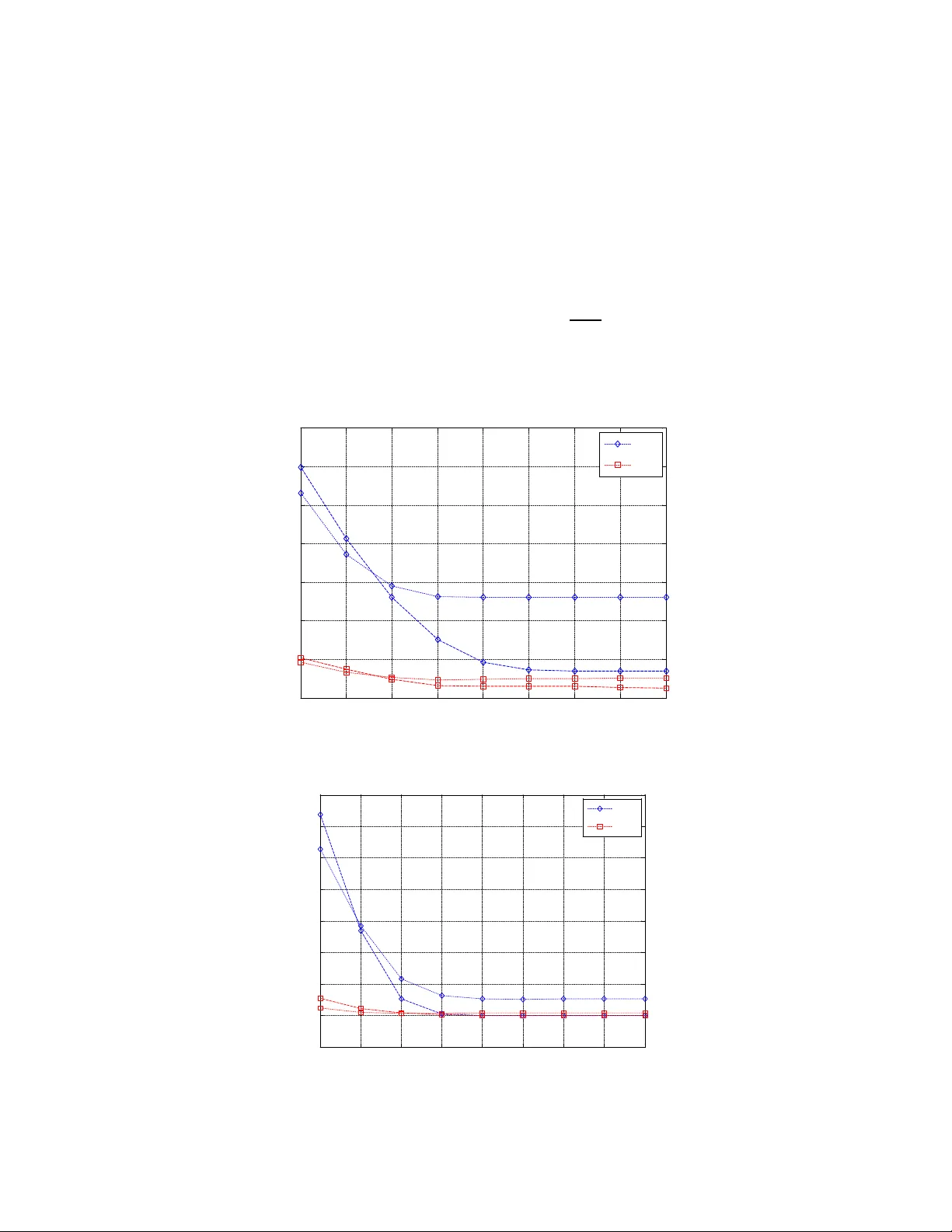
Statistical Modell ing of the Clippi ng No ise in OFDM - based Visible Lig ht Communication Sy stem Abstract This paper analyses the statistics of the clipping noise in orthogonal frequency -division- multiplex (OFD M) based visible ligh t Communication sy stems. The clippe d signal is g enerally mode lled as the summation of the scaled or igina l signal and clipping noise, whic h is treated by th e linear equalizer in the rece iver. Generally , it is assume d that the clipp ed and orig inal sig nal share the same statistics. Alt hough valid in some cases, we show that such assumption is invalid when the tra nsmitter is tightly constra ined. We derive cl osed - form proba bility distribution function (pdf) for the clipping nois e and use the pdf f or statisti cal hypothe sis testing in an optimum receiver . Index Term s — DC Bia sed Op tical O FDM, Gaussi an Proces s, Nonlinear Noise, OFDM, Optical Communication, Statistical Modeling. I. INTRODUCTI ON The emerging 5G networ ks are predicted to offer high data tra nsmission capacity for new streaming applications. Due to the high definition videos and billions of Internet of Thing (IoT) de vices, it is pre dicted that a capacity per unit area of 100 Mbps will be d emanded for future indoor spaces [1] . This g oal is g etting difficult to achieve for conventiona l RF communic ations with lim ited RF sp ectra a nd increasing RF radiation levels in condensed indoor medium. Hence, t he al ternativ e wirel ess tran smi ssio n techno logies ha ve been consid ered . VLC has a l arge free unregulated spectrum, from 428 to 750 THz, which can be exploi ted for Nima Taherkhani and Kamran Kiasaleh are with the Erik Jonsson School of Engineering and Co mputer Science, The University of Texas at Dal las, 800 W. C am pbell Road, Rich ardson, TX, 7508 0 - 3021, U SA . (e - mail: nima .ta herk hani @utd al las.e du , kamran@utdallas.edu ) Nima Tah erkhani , Student Member , IEEE , Kamran Kiasaleh , 1 Senior Member , IEEE connecting the abundant number of IoT devices and for streaming high definition videos [2] . I n VLC, the modulating signal is used to switch LED s at de sired frequencies to convey the information. A m ajor limitation in VL C is the low mod ulation bandw idth of L EDs. To de al with modulation limitation of L ED, OFDM schem e has b een emp loyed to achi eve dat a rate i n the ord er of gigabi ts p er second (Gb ps) [2]. Unlike RF communication, OFDM symbols in VLC n eed t o be r eal and unipol ar. To achiev e a real - valued output signa l, Hermitian sy mmetry is applie d on the par allel data stre ams befor e inverse Fast - F ou rier Tran sform (IFFT) operation. In order to get unipolar t ransmitting signal, e ither spectral ef ficiency or power efficien c y needs to be sa crific ed in OFDM - b ased V LC. In DC biased op tical OFDM (DCO - OFDM), whi ch results in loss of powe r effic iency, a bias c urrent is a dded after mu ltiplexing to ma ke the tra nsmittin g signa l unipolar [3] , while in asy mmetr ically clippe d optical OFDM (A CO - OFDM) [4] , where only odd subcarriers carry data, the tra nsmitting signal is c lipped at zero. I n both of schemes, in o rder t o keep signal transmitta ble, the transmitting signa l is clipped ac cording to the d y namic range of the optica l frontend. This c lipping will c ause nonlinear distortion in the transmitting sig nal. In a double - side constrained transmitte r, where the signal is clipped at the minimum a nd maximum signal level that an L ED can operate, the chance of clipping and its deterio rating impact on transmittin g signal incre ase. This distortio n can be severe enough su ch that it can potent iall y overtake d ata carr ying and dr ast icall y reduces the throughput of the VLC. Simila r to the noise in wireless chann els, th e receiv er requi res an accu rate kn owled ge about the s tatis tical d istri butio n of the clipping noise in order to battle this dis tortion and detect and es timate the origina l data carr ying si gnal. The clipping noise and signa l shaping for OFDM is investigated in the literature, where based on the Bussgang theore m, the time - domain clipped Gaussian signal is modelled as an a ttenuated original signal plus a clipping noise compon ent wh ich i s eith er modell ed as a Gau ssian r andom vari able [ 5] , or as an uncorrelated noise with unknown distribution [6] . This linear modelling has been used then for derivin g the expression for the received symbols in freque nc y - domain, where the nonlinear clipping distortion is tre ated as an extra Gaussian noise added to the channel Gaussian noise [7] . Although valid under particular condition, in this paper we question the accuracy of this modelling due to the fact that, for some nontrivial ranges of parameters, Gaussian pdf fails to model the impac t of clipping noise, and the e xact distribution of this noise in time - domain under practical clipp ing scen ario i s yet to be i nvesti gated. A key assumption of the pr evious approach is th at the clipp ed sign al rem ains Gaus si an. We dem onst rate th at the ef fect o f clipp ing noise imposed by the constrain ts in VLC may re sult in a signa l statisti cs that is no longer Gaussian . The motivation to find an alternate distribution is due to the f act that, although the output of the OF DM multiplex er f ollows a Gaussia n distribution due to centra l limit theorem, the c lipping noise resulted by an as ymme trica l double - sided clipping will follow an as ymmetric distribution. The approximation of the clipping noise, hence , using symmetric distributions, such as Gaussian distribution, will result in a n inaccurate modelling of the distortion. W ith the aid of Kurtosis , we mea sure the normality of the clipped signal at the output of OFD M multiplexer for non - trivial clipping ranges and show that commonl y used linear expression given b y Buss gang theor y will le ad to an accurat e answe r onl y if the ran ge spe cified for trunc a ting the Gaussian random variable is wide enough to leave a better part of the signal intact. We then theoretically find the distribution function of the clipping noise generated by double - sid ed clipping of the tra nsmitting sig nal in the OFDM - based VLC, an d use Hellinger dista nce to validate its accurac y when com pare d wit h the emp iricall y - acquired pdf. We also exploit the Kullback - L eibl er (K - L) divergen ce to m easur e the d ifferen ce in u ncertai nt y that can be c aused b y for ecastin g the cl ippi ng no ise b y a Gaus sian distribution a nd compare it to that of the proposed distribution. The motivation to find an alternate distribution is due to the fact that, althou gh the output of the OFDM multiplexer follows a Ga ussian distribu tion due to centra l limit theor em, the c lipping noise resulted by an asymme trical double - sided clipping w ill follow an a s y mmetric distributio n. The appr oximation of the clipping noise, hence, using s ymmetr ic distributi ons, such as Gaussian dist ribution, will result in an inaccur ate mod ellin g of t he distortion. With the ai d of Kurtosis, we measure the normalit y of the clipped signal at the output of O FDM multiplexer for non - trivial clipping r anges and show that commonly used linear ex press ion given b y Bus sgang th eor y will lead t o an accur ate ans we r only if the range specified for truncat ing th e Gaussian r andom vari able is wide enough t o leav e a bet ter part of the s ignal i ntact. We then theoretically find the distribution function of the clipping noise generated by double - sided clipping of the trans mitting signal in the OFDM - based VLC, and use H elli nger distan ce to v alidat e its accurac y when com pare d wit h the emp iricall y - acquired pdf. We also exploit the Kullback - L eibl er (K - L) divergen ce to m easur e the d ifferen ce in u ncertai nt y that can be c aused b y forecasting the clipping n oise by a Gaussian distribution and compare it to that of the proposed distribution. II. SYST EM MODEL OF A DCO - O FDM TRANSMITTER DCO - OFD M is a form o f OFDM tha t modu late s the inte nsity of an LED, where the clippi ng and Hermitian symmetry are ap plied to arrive at a real - value d, n on - neg ative tra nsm itting s ignal. The b lock diagram of a D CO - OFDM is presen ted in Fig.1 . The data str eam is f irst ma pped o nto an M - QAM mod ulat or where the data sy mbol = [ , , … , ] is generated. To ensure that the o utput of the multi plexer is a real va lue sig nal, the H erm itian symme try is appl ied t o for m the co mple x s y mbol vec tor I give n by = [0, , , … , , 0, , , … , ] Wh er e denote s the comple x conjug ate of . IFF T is the n applie d to in order to ob tain a t ime doma in si gnal. T his r esults in an N - point IF FT output of the OFDM sy mbol. For large FFT, i.e ., N > 64, t he out pu t is conside red to be Gaussian di stribut ed with zero me an and standar d deviat ion , i.e ., ~ (0, ) . Th en, th e biasin g and cli ppin g are p erform ed to tra nsfo rm the FF T output to a unipo la r signal . The bia sin g additi on and cli pping ra nge a re chose n such tha t the trans mitte d s ignal meets the c ons train ts ap plied by optica l power condi tion and LED dy namic ra nge. Fig. 1. DCO - OFDM transmitter For an LE D with t he d ynamic ran ge of [ , ] , the unipolar time domain DCO- OFD M transmitting signa l, , is given by: , = , + (1) where , , = ( ) = , < < , . (2) I n the above, cli p (. ) denote s the c lipping proce ss, is the bia sin g curr ent, = and = are the lower an d uppe r cl ipping b ound. In th is work , we as sume that t he min imum ope rating current of the LED, is zero , whic h wil l y ield = . The u pper and lower c lippi ng r anges are usually set as rela tive to the sta ndard dev iation of the original OFDM sy mbol using pro portiona lly constant and give n by : = { } = { } (3) where E {.} denote s the expec tation of the enclo sed [8] . The pdf o f , can b e calcu late d usin g (2), and is given by : ( , ) = ( ) , + , = , , < , < , ( ) , , = . (4) with ( ) = . III. ESTIMATING THE DISTRIBU TION OF C LIPPING NOISE The cl ipping proces s of OFDM signa l i s genera lly modeled in the litera ture using the Bus sgang theorem , and is give n by [9] : , = + (5) where i s the attenuation factor and is the clipping noise, which is assumed to be a random variable uncorrel ated wi th si gnal . Using this property, this factor is calculated by [9] : = { , } { } (6) In this wor k, we use Kurtosis to analyse the sta tistical characte ristics of (5) and the validity of Gaussian assump tion f or a desired ran ge of par ameters. In the field o f statistics, the Kurtosis func tion is used to measure the pea kedness of a pdf and to test the normality of a r andom variable. The Kurtosis of , can be exploited to mea sure the normality of the clipped signa l as well. In Fig. 2, with the aid simula tion, we depict the Kurtosis function of , , for different values of clipping bounds, given b y : ( , ) = {( , , ) } ( {( , , ) }) (7) A deviation from a Kurtosis of 3 is an indication that the pdf in qu estion is not a Gaussian pdf. As the figure shows, the Kurtosis approaches 3 for onl y large values of and . This is a troublin g result as and may assum e smal l value s. Hen ce, we ex amine t he pdf of t he clip pin g noise for a wi de ran ge of s ystem paramete rs. Using (2 ) and (5 ) , clipping noise can be expressed as a function of for different domains. That is : = ( ) = , ( 1 ) < < , . (8) C onsidering as a function of , the cumulative distribution function (cdf) of , = 1, … , , can be calculated using (8). This is given by: ( ) = Pr ( < ) = Pr ( > ) ( 1 ) Pr ( < < ( ) ) + Pr ( > ) ( 1 ) < < ( 1 ) , Pr > ( 1 ) . (9) Applying Leibniz Integral rule, the probability density function of is calcu lated b y : ( ) = ( 1 ) , ( ) + + ( 1 ) < < ( 1 ) , ( 1 ) . (10) where ( ) is the pdf of . As t he ex pressi on in ab ove i ndi cates, follows a Gaussian distribution for a large ran ge of val ues. However, for a nontrivial domain, the clipping noi se follows a mixture distribution which is determined by the summation of three Gaussian pdfs. Although the domain of the mixture distributing is small, it gove rns the centra l lobe of ( ) , where the distribution valu e is much large r than its tail, hence, has a si gnificant importance in approximating the entropy of the clippin g noise distribution. It s ho uld be also noted that the domain of mix ture distribution is basically determined by the clipping bound paramete rs and . For a transmitt er with small bounds this domain can get large and, subsequentl y , make the penalty of Gaussian assumption even more pronounced. Fig. 2. Kurto sis analysis of doub le - sided clipp ed signal , . IV. ASSES MENT OF PDF ESTI MATION ACCURACY I n a syste m whose transmitter ha s limited dyna mic range, the clip ping bounds can be fairly small , which will result in a fairly large domain for the mixture distribution. In this section, we use two different metrics , Helli nger dis tan ce and Kullback- Leibler (K L) divergence , to quantify the similar ity and accur acy of the approximating pdf when compared with simulated pdf of the clipping noise in DCO - OFDM VLC system. Furthermore, the accurac y of the Gaussian pdf in estimating the b ehaviour of clipping noise is also studied using the aforemen tioned metric s. In statistics, the H ellinge r distance is used to quantify the similarity between two proba bility distrib utions, which is de fined in terms of the Hellinger integr al given by [10] : ( , ) = 1 ( ) ( ) (11) where ( ) is the empir ical pdf obtaine d b y Monte Carlo simulation , which is assu med to estimate the distribution of the clipping noise, and ( ) is the distribution under study. W e con sider t wo scen arios. T ha t is, ( ) = ( ) and ( ) = ( ) , where a nd are t he mean and t he st andard deviation of the Gaussian distribution, which are to be estimated b y the maximum likelihood distribution 0 1 2 3 4 5 1 .5 2 2 .5 3 3 .5 4 4 .5 5 α 1 K u rt( x c,n ) α 2 =1 .5 α 2 =2 α 2 =2 .5 α 2 =3 fitting te chnique of the simulated data. Fig . 3 shows the Hellinge r distanc e between ( ) for = 1,2, and the empirical pdf of the clipping noise. As the graph shows, for small clipping bounds ( ) significantly outperforms ( ) in approximating the underl ying distribution. The KL divergence is also used to stu dy how ( ) and ( ) would diverge f rom ( ) for differe nt clipping rang es in an optic al transmitte r. KL divergence for and , ( || ) , is given by [11] : ( || ) = ( ) log ( ) ( ) . (12) This metric can measure the average inf ormation lost in appr oximating ( ) by a Gaussian pdf, i.e., ( ) . Fig.3: Hellin ger distance a nalysis of ( ) and it s tw o approxima ting pdf s; i.e., ( ) and ( ) , for different lo wer clipping bound, wh en = 3 ( dashed lines), = 2( do tted lines). Fig. 4 . KL Divergence between ( ) and ( ) vs . ( ) , when = 3 ( dashed li nes) , and = 2 ( d otted lines). 1 1 .5 2 2 .5 3 3 .5 4 4 .5 5 0 0. 05 0 .1 0. 15 0 .2 0. 25 0 .3 0. 35 α 1 H(Q ,G i ) g 2 (z) g 1 (z) 1 1 .5 2 2 .5 3 3 .5 4 4 .5 5 - 0.05 0 0. 05 0 .1 0. 15 0 .2 0. 25 0 .3 0. 35 α 1 D kL (Q||G i ) g 2 (z) g 1 (z) Fig. 4 dep icts t he meas ure of i neffi cien cy and in accur acy when utilizi ng a Gaussian distribution as the candidate distribution for the clipping noise . In contrast, the proposed pdf given by (10) yields a fairly small divergence. In a system with a fairly large clipping bound, the G aus sian assumption will y ield a KL diverge nce that is similar to that o f the pdf given by (10). However, in a transmitter with a small maximum allowed current, i.e ., = 2 , the Gaussian pdf diverges considerably from the original distribution for even a larg e lower clipping bound, i.e ., = 5 . Shortening of clipping ra nge basically contributes to the spikiness of ( ) and r educes the interval in which it takes non - negligible values. This will make th e central lobe of the distribution too sharp and “ spikey” and its shoulder too shallow to be modelled b y a Gaussian pdf. In contrast, the proposed pdf allows the flexibility of estimating the pdf of the clipping noise in three distinct intervals such that as the clipping bounds change, the marg ins of these intervals and the clipping attenua tion factor in (10) will also c hange as a function of these bounds, so that even for a s ystem with small bounds the prop osed pdf can achi eve a close fi t .Thi s feature al lows on e to achiev e a high lev el of accu rac y in estimation of the clippi ng noise fo r a wid e ran ge of s ystem p aramet ers . V. CO N CLUSION In this paper, w e anal y sed the statist ics of the c lipping noise generated in DCO - OFDM VLC due to the phy sical limitation o f the optic al front - end. In general, the powe r constrains that are impo sed b y the optical frond - end shapes the time domain si gnal by means of clipping and biasing. This nonl inear modification of transmitting signal leads to a distortion that can be modell ed as a Gaussian noise added to the orig inal signal in a li near sens e under a p arti cular cli pping s cenari o. However, it was showed i n this paper that under stringent clipping conditions, im posed on practical VLC transmitters, this di stortion assumes a statistic that de viates fr om the Gaussian statistics substantia lly . Subsequently, a new probabilit y distribution function was proposed. In particular, we e mployed the Bussgang theory to derive a closed - form probability distribution function for the clipping noise as a function of th e clipping bounds. The proposed dist ribution proves to be closely matching the empirical distribution of the clipping noise acc ording to the Hellin ger dist ance and th e K L divergen ce metrics . W e note that the design of the corresponding detection strategie s for an efficient mitig ation of the impact of clipping noise requires an accurate knowledge of its statistical b ehaviour. The characterization of the clipping noise introduced in this paper will enable system designe rs to dev ise m ore accurat e str ategies in o rder to comp ensate for the im pacts of the clipping noise in practical scena rios. REFERENCES [1] H. Haas, C. Chen, “Visible L ight Communication in 5G,” in Key Tech nologi es for 5G Wireless Systems , Cambridge, Cambridge University Press, 2017, pp. 289-233. [2] D.Tsonev, S. Videv, and H. Haas, “Towards a 100 Gb/s visible light wireless ac cess network,” Opti cs Express, vol. 23, no. 2, pp. 1627-1637, 2015. [3] Joseph M. Kahn, John R. Barry, “Wireless infrared communications,” Proceedings of the IEEE , v ol. 85, no. 2, pp. 265 - 298, 1997. [4] J. Armstrong, A.J. Lowery , “Power efficient optical OFDM,” Electro nics Letter s , vol. 42, no. 6, pp. 370 - 372, 2006 . [5] X. Ling, J. Wang, X. Liang, Z. Ding, C. Zhao and X. Gao,, “Biased Multi - LED Beamform ing fo r Multicarr ier Visible Light Communications,” IEEE Journal on Selected Areas in Communications, vol. 36, no. 1, pp. 106-120, 2018. [6] C. H. a. J. Armstrong, “Clippi ng Noise Mitig ation in Optica l OFDM Systems,” IE EE Communications Letter s, vol. 21, no. 3, pp. 548-551, 2017. [7] S. Dimitrov, S. Sinanovic and H. Haas, “A comparison of OFDM - based modulation schemes for OWC with clipping distortion,” in IEEE GLOBECOM Wor kshops (GC Wkshps) , Houston, TX, 2011. [8] S. Dimitrov, S. Sinanovic and H. Ha as, “Clipping Noise in OFDM - Based Opt ical W ireless Communication Systems,” IEEE Transactions on Communications , vol. 60, no. 4, pp. 1072 - 1081, 2012. [9] D. Dardari, V. Tralli, A. Vac cari, “A theoretical characterization of nonlinear distortion effects in OFDM systems,” IEEE Transactions on Communications, vol. 48, no. 10, pp. 1755 - 1764, 2000 . [10] M. S. Nikulin, “Hellinger distance,” in Encyclopaedia of Mathematics, M. Hazewinkel, Springer, 2001. [11] C. Bishop, Pattern Recognition and Machine Learning, New York: Springer-Verlag New York, 2006.
Original Paper
Loading high-quality paper...
Comments & Academic Discussion
Loading comments...
Leave a Comment