Reconfigurable Multi-UAV Formation Using Angle-Encoded PSO
In this paper, we propose an algorithm for the formation of multiple UAVs used in vision-based inspection of infrastructure. A path planning algorithm is first developed by using a variant of the particle swarm optimisation, named theta-PSO, to gener…
Authors: V.T. Hoang, M.D. Phung, T.H. Dinh
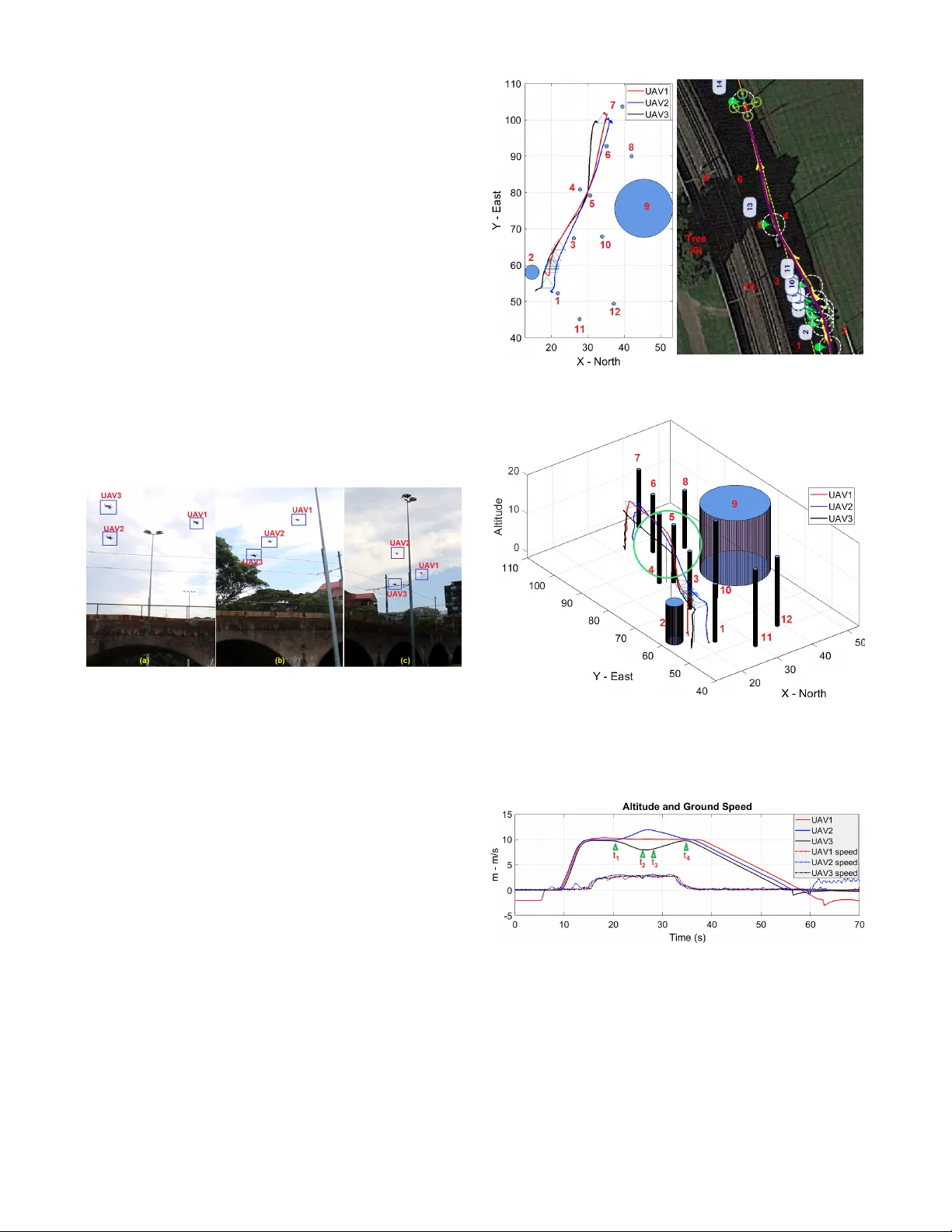
Reconfigurable Multi-U A V F ormation Using Angle-Encoded PSO V .T . Hoang, M.D. Phung, T .H. Dinh, Q. Zhu, Q.P . Ha Abstract — In this paper , we propose an algorithm for the formation of multiple U A Vs used in vision-based inspection of infrastructure. A path planning algorithm is first dev eloped by using a variant of the particle swarm optimisation, named θ -PSO, to generate a feasible path for the overall f ormation configuration taken into account the constraints f or visual inspection. Here, we introduced a cost function that includes various constraints on flight safety and visual inspection. A reconfigurable topology is then added based on the use of inter- mediate waypoints to allow the formation to av oid collision with obstacles during operation. The planned path and formation are then combined to derive the trajectory and velocity pr ofiles for each U A V . Experiments hav e been conducted for the task of inspecting a light rail bridge. The results confirmed the validity and effectiveness of the pr oposed algorithm. Keyw ords: Quadcopter , U A V , Angle-encoded PSO, path plan- ning, reconfigurable formation, infrastructure inspection. I . I N T RO D U C T I O N The use of Unmanned Aerial V ehicles (U A Vs) for civil in- frastructure monitoring and inspection is recei ving increasing interest recently due to its various benefits over traditional inspection methods such as risk and budget reduction, traffic free and flexible operation. In practice, a number of UA V systems ha ve been successfully deployed to periodically monitor the condition of bridges, buildings, wind turbines, gas pipelines, etc. [1]. Howe ver , the need to inspect large structures with high accuracy and small completion time are posing new challenges that transcend the use of a single U A V to a formation-based approach. The approach features multiple UA Vs coordinating in a certain configuration with capabilities to adapt itself to the operating en vironment. In the literature, approaches for formation problems can be categorized into the consensus-based [2]–[4], artificial potential function-based [5]–[7], leader-follo wer (L-F) [8]– [10], observer-based [11], behavior -based and virtual struc- ture [12], [13] methods. Among them, the virtual structure formation is more relev ant for visual inspection as it enables quick reconfiguration which is essential in cases of failure in communication, sensor/actuator , flight path constraints or ev en the loss of one or more agents. The general idea of the reconfigurable problem includes defining a set of new separation distance, position, and other parameters that are suitable for specific mission requirements, and a relev ant process to achiev e that configuration [14], [15]. Optimal algorithms were mostly preferable to solve reconfiguration, The authors are with School of Electrical and Data Engi- neering, Faculty of Engineering and Information T echnology (FEIT), Univ ersity of T echnology Sydney (UTS), 81 Broadway , Ultimo NSW 2007, Australia { VanTruong.Hoang, ManhDuong.Phung, TranHiep.Dinh, Qiuchen.Zhu, Quang.Ha } @uts.edu.au such as semianalytic approach [16], PSO [17], [18] or hybrid PSO [13], [19], nonlinear programming [20] and hierarchical ev olutionary [21] trajectory planning. Other methods also contribute their adv antages to solve the formation reconfig- uration problem, including obstacle and collision avoidance, i.e., potential field [22], [23], distributed controller with a failure detection logic [24] and interior point algorithm [25]. For visual inspection, the reconfigurable problem, howe ver , in volv es new constraints on data collection which require further in vestigation such as the constraints on waypoints for photos taken, the distance between UA Vs and inspecting surfaces, or the overlap among photos for stitching. In this paper , we propose a new algorithm for recon- figurable formations based on the angle-encoded PSO. W e begin with the use of a 3D representation of the surface to be inspected and its neighboring en vironment to determine a set of intermediate waypoints (WPs) necessary for the U A Vs to trav el through in order to collect sufficient data for inspection. A formation shape is then defined at these WPs so that multiple U A Vs are feasible to operate. A set of new constraints is additionally proposed to increase collision av oidance ability and task performance. Based on that, an optimal path for the centroid of the formation is produced by employing the θ -PSO path planning algorithm [26]. Finally , trajectories for individual U A Vs will be achieved by inte- grating the generated path with the selected reconfiguration shapes. Experiments hav e been carried out with the results confirmed the v alidity and effecti veness of the proposed approach. The main contribution of this work is an augmentation of the proposed optimisation algorithm for path planning [26] with additional constraints based on intermediate waypoints to satisfy the requirements for safety and task ef ficiency giv en a number of formation types that can be reconfig- urable during operations. The new formation path planning technique can therefore (i) generate safer flights of the UA V group, and (ii) improv e the formation flexibility as well as its capacity for inspection tasks. The paper is organised as follows. Section II presents the design of the path planning algorithm using θ -PSO. The proposed reconfigurable configurations and implementation of trajectory planning for U A Vs are described in Section III. Experimental results are introduced in Section IV. The paper ends with conclusions and recommendations for further study described in Section V. I I . P A T H P L A N N I N G F O R V I S U A L I N S P E C T I O N Our approach begins with the generation of a flyable path for the triangular centroid of a multiple-UA V formation conducting surface inspection tasks. This path will be further adjusted to include the reconfiguration for the formation as presenting in next sections. As we aim to create an optimal path with quick time conv ergence, the angle-coded PSO ( θ - PSO) is used [26]. In θ -PSO, the location of particles is encoded by the angle of the formation centroid and their mov ements are described as: ∆ θ k +1 ij = w ∆ θ k ij + c 1 r k 1 i ( λ k ij − θ k ij ) + c 2 r k 1 i ( λ k g j − θ k ij ) θ k +1 ij = θ k ij + ∆ θ k +1 ij , ( i = 1 , 2 , ..., N ; j = 1 , 2 , ..., S ) x k ij = 1 2 ( x max − x min ) sin θ k ij + x max + x min , (1) where subscript k represents the iteration index; w , N and S are the inertial weight, total number of particles and the dimension of the search-space, respectiv ely; r 1 and r 2 are pseudo-random scalars; c 1 and c 2 are the gain coef ficients; θ ij ∈ [ − π / 2 , π / 2] represents the phase angle, and ∆ θ ij ∈ [ − π / 2 , π / 2] is the increment of θ ij in the j th dimension of the particle i ; λ g = [ λ g 1 , λ g 2 , . . . , λ g S ] and λ i = [ λ i 1 , λ i 2 , . . . , λ iS ] represent the global and personal best positions, respectiv ely; x ij = f ( θ ij ) is the j th dimension of the i th particle’ s position; x max and x min are the upper and lo wer constraints of the searching space. For the θ -PSO to find the global optimum solution corre- sponding to the shortest flyable path, it is essential to define a proper cost function incorporating a number of constraints relating to the maneuverability of U A Vs, operating space, task performance, and collision a voidance. In this work, the objectiv e function is defined in the following form: J F ( T F i ) = 3 X m =1 β m J m ( T F i ) , (2) where T F i is the i th path for the formation to be judged; β m represents the weighting factor selected for the corresponding cost component; and J m ( T F i ) , m = 1 .. 3 , are respectiv ely the cost components correlated with the length of a path, obstacle a voidance, and operating height. T o determine J m ( T F i ) , the centroid path T F i is divided into L i segments, where L i is chosen to be suf ficiently large so that each segment can be considered to be straight and represented by coordinates of ending nodes P i,l = { x i,l , y i,l , z i,l } , l = 0 ..L i . The path length cost component J 1 is then computed for all se gments as: J 1 ( T F i ) = L i X l =1 P i,l − P i,l − 1 , (3) where k . k denotes the Euclidean norm. T o form J 2 for collision av oidance, let K be the number of all obstacles within the operation space. The overall violation cost scaled across all path segments and K obstacles then can be obtained as: J 2 ( T F i ) = 1 L i K L i X l =1 K X k =1 max (1 − d l,k r S l,k , 0) , (4) x O y O z O in e r t i a l fra m e x F y F z F d 1 d 2 d 3 UAV1 UAV3 UAV2 𝑃 𝐹 Fig. 1: U A V formation frames where d l,k is the actual distance between the k th obstacle and the midpoint of segment l , and r S l,k is a safe radius of the formation w .r .t. the obstacle k . Finally , the cost J 3 relating to the altitude constraints that restrict the U A Vs to travel within a predefined height range, represented by the minimum and maximum values, z min and z max can be expressed as: J 3 ( T F i ) = L i P l =1 δ l δ l = z M l − z max , if z M l > z max 0 , if z min ≤ z M l ≤ z max z min − z M l , if 0 < z M l < z min ∞ , if z M l ≤ 0 . , (5) where z M l represents the height of segment l . I I I . R E C O N F I G U R A B L E F O R M A T I O N In this section, the path planning result is updated with a reconfigurable strategy in order to complete a safe trajectory for an individual U A V during its operation in formation. It begins with a triangle formation model with some potential transforming shapes, follo wed by the fix waypoint selection and ends with the individual trajectory generation for each U A V and the ov erall algorithm. A. Intr oduction of UA V F ormation T opologies Figure 1 illustrates the two frames that represent a trian- gular formation created by three U A Vs, the formation and the inertial frames. The formation frame, { x F , y F , z F } , is determined such that its origin P F is selected to be coincident with the triangle centroid. Denoting P n = { x n , y n , z n } , n = 1 , 2 , 3 , as the position of U A V n and d n as the distance between U A V n and P F . The formation is then represented by the position P F computed as: P F = 1 3 3 X i =1 P n , (6) and the radius is giv en by r F = max ( d n ) , while the rotation matrix, R I F , relating the formation and inertial frames is giv en in [26]. The triangular formation can be used to coordinate the U A Vs for inspection tasks giv en that the formation is man- aged as a rigid body . Under that assumption, the path generated in Section II can be directly used as the ref- erence for the formation centroid. In practice, the rigid- body assumption is not al ways held as the U A Vs may need to change the formation shape to adapt to the operating en vironment. For example, a narro w passage or an unwanted obstacle may require the UA Vs to fly in a row or column instead of the triangular . As explained in Fig. 2 the following reconfigurations are considered in this study: · Alignment: The U A Vs form a line. It is used for the scenarios of appearing narrow passages/obstacles that is only possible for a single U A V to pass. · Rotation: The UA Vs rotates as a rigid body structure to preserve the formation shape. It allo ws the U A Vs to quickly turn back to the pre vious formation configura- tion. · Shrinkage: The UA Vs fly toward the formation centroid while maintaining the formation shape. This configura- tion is used in case of required to maintain the overlap among photos taken. A l i g nm ent Shri nk age R o ta t i o n Fig. 2: Reconfigurable formation B. Reconfiguration with Intermediate W aypoints In order to reconfigure, the U A Vs need to re-route their flying paths through adjacent space and thus require in- termediate waypoints (IWPs). T o identify those waypoints, additional constraints are required as follo ws: 1. The distance between U A Vs must be within the com- munication range but not smaller than two times of the U A V radius: d com ≥ d ( P m , P n ) ≥ 2 r Q , (7) where d com is the communication range, and r Q is the safe radius of a UA V , and d ( P m , P n ) is the distance between U A V m and U A V n . 2. The U A Vs must fly within a certain distance to the inspecting surf ace: d s n ∈ [ d s min , d s max ] , n ∈ { 1 , 2 , 3 } , (8) where d s n is the distance from U A V n to the inspecting surface, d s min and d s max are respecti vely the minimum and maximum distances from a U A V to the surface. Assume that each obstacle in the working environment of U A Vs is modelled as a cylinder with the center’ s coordinate C k , radius r k and height z k . For any different obstacles p and q, ∀ p 6 = q , p, q ∈ { 1 , ..., K } , we have their radii r p , r q , and centre coordinates C p ( x p , y p ) , C q ( x q , y q ) , respectiv ely . Denoting P p and P q as intersection points between the straight line created by C p and C q and the two circles ( C p , r p ) and ( C q , r q ) , we determine location of the j th IWP as the midpoint of P p P q : C j = 1 2 ( P p + P q ) , if r S n ≤ d p,q < r S l,k ∅ otherwise , (9) where C j = ( x j , y j ) is the coordinates of the j th IWP in the horizontal plane, d p,q is the smallest distance between the two adjacent obstacles, and r S n is the safe radius of U A V n . Finally , the cost function (2) need be updated to include the cost caused by the intermediate waypoints as follo ws: J ( T F i ) = J F ( T F i ) + J R ( T F i ) , (10) where J R ( T F i ) represents the distance from intermediate waypoints to path segments: J R ( T F i ) = 1 L i M j L i X l =1 M j X j =1 q ( x l − x j ) 2 + ( y l − y j ) 2 , (11) where M j is the total number of IWPs. At each IWP , the formation is reconfigured by changing positions of the UA Vs to a designated position in the newly selected shape. The UA Vs then come back to their original defined position after passing those IWPs. Hence, the chang- ing shape can be divided into two phases, transformation and reconfiguration, conducting between time intervals [ t 1 , t 2 ] and [ t 3 , t 4 ] respectiv ely as shown in Fig.2. The new shape is maintained between those phases, from t 2 to t 3 , to keep the U A Vs safe while travelling inside the narrow passage. The next step is to find a set of positions, P n for each U A V n such that the planned trajectory of the whole formation, represented by the formation centroid P F , and the formation shape are preserved. C. Reference T rajectory Gener ation Giv en the optimized path, P ∗ F , produced by the θ -PSO for the centroid of the triangular formation in which the inter- mediate waypoints for reconfiguration have been included, specific paths for each UA V can be computed based on the formation model presented in (6). For IWP j , a set of ne w waypoints P j F = [ P F,t 1 , .., P F,t 4 ] for the formation is generated. Depending on the defined position in the reconfiguration shape and P j F , a set of way- points for UA V n , P j n = [ P n,t 1 , .., P n,t 4 ] , is also computed. Let ∆ P n be the set of desired difference in position between U A V n and the formation centroid at time t : ∆ P n = ( P n ∪ P j n ) − ( P F ∪ P j F ) , (12) This dif ference is calculated in the inertial frame as: ∆ P I n = R − 1 I F ( t )∆ P n , (13) where R I F is the rotation matrix. The flying path for each U A V is then gi ven by: P ∗ n = P ∗ F + ∆ P n . (14) Finally , by combining the results of the path planning process and the reconfigurable algorithm, the completed set of trajectory commands for the n th U A V is determined as: T n = [ P ∗ n , V n ] T , (15) where V n is the velocity profile set for U A V n . This command set will be uploaded to the onboard controller of the n th U A V for trajectory tracking. D. Algorithm Implementation The implementation of our reconfigurable formation al- gorithm can be described by the pseudo code in Fig. 3. It starts with the initialisation of the inspection surface, working space, obstacle positions, flight constraints and θ - PSO parameters. The θ -PSO is then executed based on the cost function (10) to generate an optimal path for the formation centroid. At each IWP , the chosen formation shape is the basis to compute the new set of positions for U A V n w .r .t their corresponding positions of the centroid. The distance error, ∆ d n,t 1 → t 2 , is found by comparing between the trav el distances, d n,t 1 → t 2 and d 0 n,t 1 → t 2 , of the nominal and transformation shape, respectiv ely . The ground velocity increment ∆ V n,t 1 → t 2 is found based on ∆ d t 1 → t 2 and the transformation time t t computed from the planned path. A similar process is applied for the period of [ t 3 , t 4 ] . I V . E X P E R I M E N T S W e have conducted a number of experiments to ev aluate the validity and efficienc y of the proposed algorithm. The setup and results are presented belo w . A. Experimental setup The task designated in our experiments is to inspect differ- ent surfaces of a light rail bridge employing three identical U A Vs. The UA Vs used are the 3DR Solo drones retrofitted with inspection cameras and communication boards [26]. The onboard low-le vel controllers for these drones have been addressed in [27]. The operation space is chosen in the rect- angular area with two opposite corners at GST coordinates of {− 33 . 87601 , 151 . 191182 } and {− 33 . 875086 , 151 . 192676 } . Therein, actual obstacles are identified and the mission of U A Vs is to inspect the surface represented by their poles numbered from (1) to (12). These obstacles include a pole / * Preparation: * / 1 Determine the inspection surf ace(s); 2 Identify boundaries of the working space; 3 Identify obstacle set K ; 4 Group all the abo ve data and save in a common file (init file); / * Initialisation: * / 5 Initialise the working environment by loading the init file to global memory; 6 Initialise constraints, i.e., r Q , d com , d s min , d s max ; 7 Determine locations of IWPs using Eqs. (7), (8), and (9); 8 Initialise θ -PSO parameters; 9 Generate a random path to connect the start and target waypoints; 10 Set θ ij ∈ [ − π / 2 , π / 2] and ∆ θ ij ∈ [ − π / 2 , π / 2] ; / * Path Planning: * / 11 for each i < (swarm iteration) do 12 f oreach j < (swarm population) do 13 Compute ne w value of ∆ θ ij ; / * using 1st equation in (1) * / 14 Compute ne w value of θ ij ; / * using 2nd equation in (1) * / 15 Compute ne w position; / * using 3rd equation in (1) * / 16 Check V iolation cost; 17 Evaluate each path based on the Best Costs and V iolation cost; 18 Update each particle personal best and the global best positions; 19 end 20 Update global best and V iolation costs; 21 end 22 Sav e global best and V iolation cost; 23 The optimized path is achiev ed when the maximum number of iterations is reached. 24 Generate the individual path for U A V n . / * Path generation: * / 25 for each U A V n do 26 f oreach j = 1 to M j do 27 Select a relev ant formation shape; 28 Compute the new position set P j n ; 29 Compute the mission time t t and t r ; 30 Determine ∆ d n,t 1 → t 2 and ∆ d n,t 3 → t 4 ; 31 Compute ∆ V n,t 1 → t 2 and ∆ V n,t 3 → t 4 ; 32 P ∗ n ← P ∗ F , ∆ P n / * using (12)-(14) * / ; 33 V n ← ∆ V n,t 1 → t 2 , ∆ V n,t 3 → t 4 ; 34 end 35 T n ← P ∗ n , V n . / * using (15) * / . 36 end Fig. 3: Pseudo code for reconfigurable trajectory generation process. (2), a light pole (4), bridge piers (1, 3, 5, 6), power poles (8, 10), and a tree (9). The initial configuration for inspection was a triangle formation with initial positions of the UA Vs relativ e to the formation centroid to be ∆ T 1 = [0 , 2 , 0] m, ∆ T 2 = [ − 2 , − 1 , 0] m and ∆ T 3 = [2 , − 1 , 0] m. The lower and upper bounds of altitudes between the UA Vs and the ground are z max = 15 m and z min = 7 m, respectiv ely . The U A Vs are required to fly within the relativ e distance to the inspected structure as d n,s ∈ [1 , 5] m. The formation is set to flight at a constant ground velocity of 3 m/s. For θ -PSO, the swarm size, number of waypoints, and number of iterations are respectiv ely selected as 100, 7, and 150. B. Results The ev aluation is conducted in three reconfiguration shapes where the formation needs to change its configuration to keep safe while fulfilling the inspection task. The reference points are chosen to coincide with the centroid of the triangle created by the three UA Vs. In experiments, it is planned that the designed formation shape starts to reconfigure at waypoint 11 and fully transforms into the new shape at about 1 m before waypoint 13. The new shape would be preserved until 1 m after the waypoint 13 and then complete the reconfiguration process at waypoint 14, which is illustrated in the right image of Fig. 5. Figure 4 sho ws pictures that were captured from the field test of the formation transformation from the original horizontal triangle shape (Fig. 4.a) to the alignment (Fig. 4.b) and the vertical triangle (Fig. 4.c) ones. Fig. 4: Transformation of triangular formation (a) to align- ment (b), and rotation (c) configurations In the experiment with the alignment reconfiguration, Fig. 6 shows the capability of the formation in trav ersing the narrow corridor in which space is just enough for a single U A V to pass through. It sho ws clearly in the figure that the reconfiguration is completed to allo w the U A Vs to go through the narrow passage between obstacles 4 and 5 without any contact. In the rotation transformation, the U A V 1 kept following its planned path while the two others changed their flight heights to reach their new positions in the vertical plane as sho wn in Fig. 7. Specifically , changes in the altitude happened at time t 1 = 20 s to reconfigure the UA Vs fully to the new shape at time t 2 = 26 s. The new shape is then preserved until t 3 = 27 s and finally con verted back to its original at t 4 = 35 s. The v elocity profiles of the UA Vs shown in Fig. 8 imply the relatively stable movement of U A Vs during this experiment. Fig. 9 sho ws the result of the shrink reconfiguration. The U A Vs start to change their altitudes when encountering obstacle 3 and shrink the triangular formation to pass through obstacle 9. This result proves the capability of the proposed algorithm in handling situations where the formation shape Tree (9) 8 10 2 4 5 6 3 1 Fig. 5: U A Vs’ trajectories in horizontal plane in the align- ment formation Fig. 6: 3D real-time plot for alignment formation needs to be maintained, but its size need adjusting to avoid collisions. Fig. 7: Altitudes and ground speeds of UA Vs during the experiment with rotating reconfiguration On the other hand, it is also noted that the reconfiguration in experiments was conducted by using offline satellite maps. While this approach is relev ant for most static civil infrastructure, occasionally unexpected dynamic obstacles not included in the calculation may cause safety concerns. The problem can be ov ercome by incorporating real-time data acquired by sensors installed on U A Vs which will be Fig. 8: Ground speed of U A Vs in rotating reconfiguration Fig. 9: T rajectories of UA Vs in the experiment with shrink reconfiguration our ne xt focus. V . C O N C L U S I O N S In this paper , we have proposed a path planning algorithm for multi-U A V formation in which its shape can vary in accordance with the operating environment. The core of our algorithm is the deriv ation of a cost function that takes into account the constraints on collision avoidance, flight altitude, communication range, and visual inspection requirements. Based on it, the θ -PSO has been used to generate the path for the formation which is then used to determine trajectories for indi vidual U A Vs. W e ha ve also proposed the use of intermediate waypoints for reconfiguration which can be accomplished in the alignment, rotation, or shrink fashion. A number of experiments have been completed to ev aluate the performance of the proposed algorithm for inspection tasks. The results obtained not only confirm its validity but also practically suggest a possibility of e xtending the work to ward a generic reconfigurable architecture for robotic formation control in complex en vironments. R E F E R E N C E S [1] S. Rathinam, Z. W . Kim, and R. Sengupta, “V ision-based monitoring of locally linear structures using an unmanned aerial vehicle, ” Journal of Infrastructure Systems, vol. 14, no. 1, pp. 52–63, 2008. [2] M.-d. Y an, X. Zhu, X.-x. Zhang, and Y .-h. Qu, “Consensus- based three-dimensional multi-uav formation control strategy with high precision, ” Frontiers of Information T echnology & Electronic Engineering, vol. 18, no. 7, pp. 968–977, Jul 2017. [3] X. Dong, B. Y u, Z. Shi, and Y . Zhong, “Time-v arying formation control for unmanned aerial vehicles: Theories and applications, ” IEEE T ransactions on Control Systems T echnology, vol. 23, no. 1, pp. 340– 348, 2015. [4] L. He, P . Bai, X. Liang, J. Zhang, and W . W ang, “Feedback formation control of uav swarm with multiple implicit leaders, ” Aerospace Science and T echnology, vol. 72, pp. 327–334, 2018. [5] D. H. Kim, H. W ang, and S. Shin, “Decentralized control of au- tonomous swarm systems using artificial potential functions: Analyt- ical design guidelines, ” Journal of Intelligent and Robotic Systems, vol. 45, no. 4, pp. 369–394, 2006. [6] K. D. Do, “Bounded controllers for formation stabilization of mobile agents with limited sensing ranges, ” IEEE Transactions on Automatic Control, vol. 52, no. 3, pp. 569–576, 2007. [7] F . Liao, R. T eo, J. L. W ang, X. Dong, F . Lin, and K. Peng, “Distributed formation and reconfiguration control of vtol uavs, ” IEEE Transactions on Control Systems T echnology, vol. 25, no. 1, pp. 270–277, Jan 2017. [8] E. Semsar-Kazerooni and K. Khorasani, “Optimal consensus algo- rithms for cooperativ e team of agents subject to partial information, ” Automatica, vol. 44, no. 11, pp. 2766–2777, 2008. [9] D. Panagou and V . Kumar , “Cooperati ve visibility maintenance for leader–follower formations in obstacle en vironments, ” IEEE T ransactions on Robotics, vol. 30, no. 4, pp. 831–844, 2014. [10] X. Y u and L. Liu, “Distributed formation control of nonholonomic ve- hicles subject to velocity constraints, ” IEEE Transactions on Industrial Electronics, vol. 63, no. 2, pp. 1289–1298, 2016. [11] A. D. Nguyen, Q. P . Ha, S. Huang, and H. T rinh, “Observer - based decentralised approach to robotic formation control, ” in Proc. Australian Conf. Robotics and Automation, 2004, pp. 1–8. [12] R. Sharma and D. Ghose, “Collision av oidance between uav clusters using swarm intelligence techniques, ” International Journal of Systems Science, vol. 40, no. 5, pp. 521–538, 2009. [13] J. W ang and M. Xin, “Integrated optimal formation control of multiple unmanned aerial vehicles, ” IEEE Transactions on Control Systems T echnology, vol. 21, no. 5, pp. 1731–1744, 2013. [14] P . W ang and F . Hadaegh, “Optimal formation-reconfiguration for multiple spacecraft, ” in Guidance, Navigation, and Control Conference and Exhibit, 1998, p. 4226. [15] K. W ang, “Minimum-fuel formation reconfiguration of multiple free- flying spacecraft, ” J. of Astronautical Sciences, vol. 47, no. 1, pp. 77–102, 1999. [16] L. Sauter and P . Palmer , “Onboard semianalytic approach to collision- free formation reconfiguration, ” IEEE Transactions on Aerospace and Electronic Systems, vol. 48, no. 3, pp. 2638–2652, 2012. [17] H. Duan and S. Liu, “Non-linear dual-mode receding horizon control for multiple unmanned air vehicles formation flight based on chaotic particle swarm optimisation, ” IET control theory & applications, v ol. 4, no. 11, pp. 2565–2578, 2010. [18] Z. Sui, Z. Pu, and J. Yi, “Optimal uavs formation transformation strategy based on task assignment and particle swarm optimization, ” in 2017 IEEE International Conference on Mechatronics and Automation (ICMA). IEEE, 2017, pp. 1804–1809. [19] H. Duan, Q. Luo, Y . Shi, and G. Ma, “Hybrid particle swarm optimiza- tion and genetic algorithm for multi-ua v formation reconfiguration, ” IEEE Computational intelligence magazine, vol. 8, no. 3, pp. 16–27, 2013. [20] G. Ma, H. Huang, and Y . Zhuang, “Time optimal trajectory planning for reconfiguration of satellite formation with collision avoidance, ” in Control and Automation (ICCA), 2010 8th IEEE International Conference on. IEEE, 2010, pp. 476–479. [21] S. W ang and C. Zheng, “ A hierarchical evolutionary trajectory plan- ner for spacecraft formation reconfiguration, ” IEEE Transactions on Aerospace and Electronic Systems, vol. 48, no. 1, pp. 279–289, 2012. [22] T . Paul, T . R. Krogstad, and J. T . Gravdahl, “Uav formation flight using 3d potential field, ” in Control and Automation, 2008 16th Mediterranean Conference on. IEEE, 2008, pp. 1240–1245. [23] Y . Feng, Y . Wu, H. Cao, and J. Sun, “Uav formation and obsta- cle avoidance based on improved apf, ” in 2018 10th International Conference on Modelling, Identification and Control (ICMIC). IEEE, 2018, pp. 1–6. [24] J. Seo, Y . Kim, S. Kim, and A. Tsourdos, “Consensus-based reconfig- urable controller design for unmanned aerial vehicle formation flight, ” Proceedings of the Institution of Mechanical Engineers, Part G: Journal of Aerospace Engineering, vol. 226, no. 7, pp. 817–829, 2012. [25] W . Jian-hong and R. Javed Masood, “Interior point algorithm for multi-uavs formation autonomous reconfiguration, ” Journal of Control Science and Engineering, vol. 2016, 2016. [26] V . T . Hoang, M. D. Phung, H. D. Tran, and Q. P . Ha, “ Angle-encoded swarm optimization for uav formation path planning, ” in Intelligent Robots and Systems (IROS), 2018 IEEE/RSJ International Conference on. IEEE, 2018, pp. 5239–5244. [27] V . Hoang, M. D. Phung, and Q. Ha, “ Adaptive twisting sliding mode control for quadrotor unmanned aerial vehicles, ” in 2017 11th Asian Control Conference (ASCC). IEEE, 2017, pp. 671–676.
Original Paper
Loading high-quality paper...
Comments & Academic Discussion
Loading comments...
Leave a Comment