Partitioned Exponential Methods for Coupled Multiphysics Systems
Multiphysics problems involving two or more coupled physical phenomena are ubiquitous in science and engineering. This work develops a new partitioned exponential approach for the time integration of multiphysics problems. After a possible semi-discretization in space, the class of problems under consideration is modeled by a system of ordinary differential equations where the right-hand side is a summation of two component functions, each corresponding to a given set of physical processes. The partitioned-exponential methods proposed herein evolve each component of the system via an exponential integrator, and information between partitions is exchanged via coupling terms. The traditional approach to constructing exponential methods, based on the variation-of-constants formula, is not directly applicable to partitioned systems. Rather, our approach to developing new partitioned-exponential families is based on a general-structure additive formulation of the schemes. Two method formulations are considered, one based on a linear-nonlinear splitting of the right hand component functions, and another based on approximate Jacobians. The paper develops classical (non-stiff) order conditions theory for partitioned exponential schemes based on particular families of T-trees and B-series theory. Several practical methods of third order are constructed that extend the Rosenbrock-type and EPIRK families of exponential integrators. Several implementation optimizations specific to the application of these methods to reaction-diffusion systems are also discussed. Numerical experiments reveal that the new partitioned-exponential methods can perform better than traditional unpartitioned exponential methods on some problems.
💡 Research Summary
The paper addresses the challenge of efficiently integrating multiphysics problems—systems in which two or more physical processes interact simultaneously—by introducing a novel class of partitioned exponential time‑integration methods. After spatial semi‑discretization, the governing equations take the form y′ = F(y) = Σ_{m=1}^P f^{(m)}(y). Each component f^{(m)} is further split into a linear stiff part L^{(m)}y and a nonlinear remainder N^{(m)}(y). Traditional exponential integrators based on the variation‑of‑constants formula treat the whole right‑hand side as a single entity, requiring the evaluation of matrix‑function products involving the combined linear operator L = Σ L^{(m)}. This approach forfeits any computational advantage that might arise from the natural partitioning of the problem.
To overcome this limitation, the authors propose two families of partitioned‑exponential schemes. The first family relies on a linear‑nonlinear splitting: each partition is advanced with its own exponential integrator, either a Rosenbrock‑type EXP method (which uses only the ϕ₁ function) or an EPIRK method (which employs higher‑order ϕ‑functions and linear combinations Ψ). The second family adopts the “W‑type” idea, replacing the exact Jacobian Jₙ with an approximate matrix W^{(m)} for each partition, thereby preserving order while allowing cheaper linear solves or preconditioning.
A central theoretical contribution is the development of a generalized order‑condition framework based on TPS‑trees, an extension of the classic T‑tree/B‑series machinery. By representing the action of the partitioned ϕ‑functions and the forward difference operators Δ^{(j)} applied to the nonlinear remainders, the authors derive non‑stiff (classical) order conditions for arbitrary additive partitions. These conditions are then used to construct explicit third‑order methods: PEXPW (partitioned EXP with W‑type Jacobian approximations), PEPIRKW (partitioned EPIRK with W‑type), and several sEPIRK‑based schemes (including an averaging strategy, PSEPIRK).
Implementation details focus on reaction‑diffusion systems, a common multiphysics testbed. The diffusion operator is handled via Krylov subspace approximations of exp(hL)·v, while the nonlinear reaction terms are treated with forward differences, enabling reuse of intermediate quantities and reducing the number of expensive matrix‑vector products. By computing the exponential of each partition’s linear operator separately (e^{hL^{(1)}}, e^{hL^{(2)}}), the methods exploit the additive structure and avoid forming the full combined matrix.
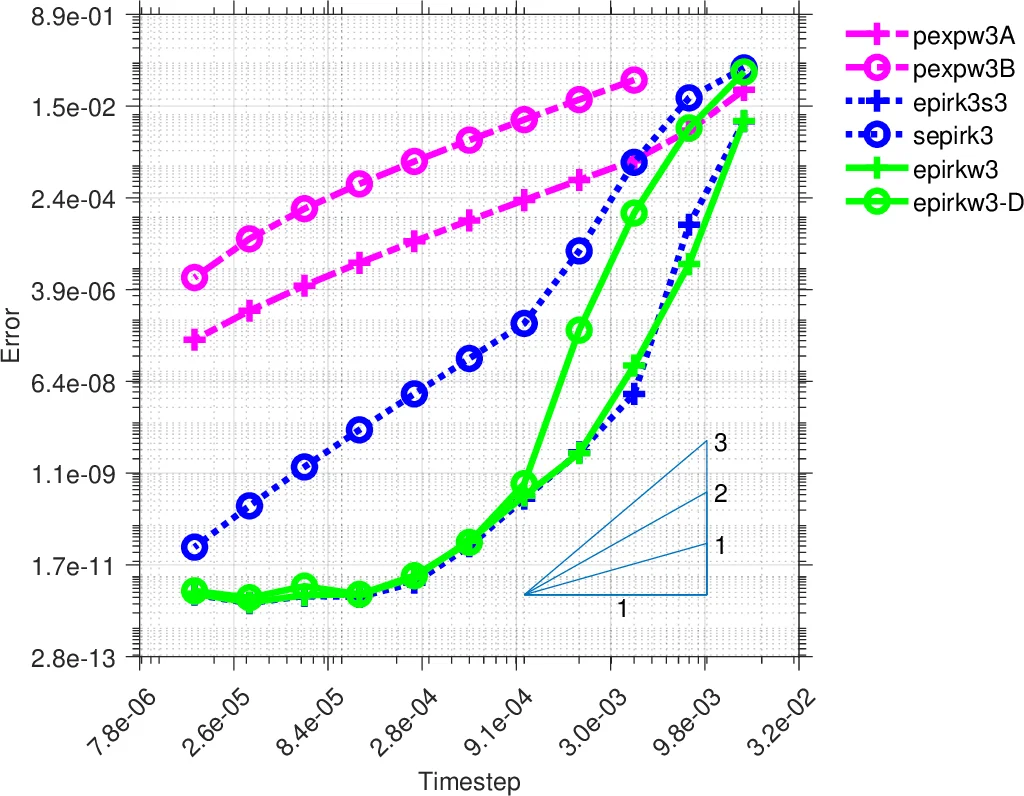
Numerical experiments involve (1) a one‑dimensional stiff diffusion / non‑stiff reaction problem and (2) a more realistic atmospheric chemistry model with multiple species, stiff diffusion, and highly nonlinear reaction kinetics. Fixed‑step tests show that the partitioned methods achieve the same error levels as traditional unpartitioned EXP/EPIRK schemes while allowing time steps 2–3 times larger. Adaptive‑step experiments demonstrate overall CPU‑time reductions of 30–45 % for comparable accuracy. In cases where both partitions are stiff, the new methods outperform IMEX and fully implicit schemes, which either suffer from restrictive stability limits or require costly coupled nonlinear solves.
The paper concludes that partitioned exponential integrators provide a systematic way to leverage the natural additive decomposition of multiphysics systems, delivering higher efficiency without sacrificing stability or accuracy. Future work is suggested in extending the framework to higher orders (fourth and beyond), dynamic repartitioning of components, and large‑scale parallel implementations for industrial‑strength simulations.
Comments & Academic Discussion
Loading comments...
Leave a Comment