Middle-atmosphere dynamics observed with a portable muon detector
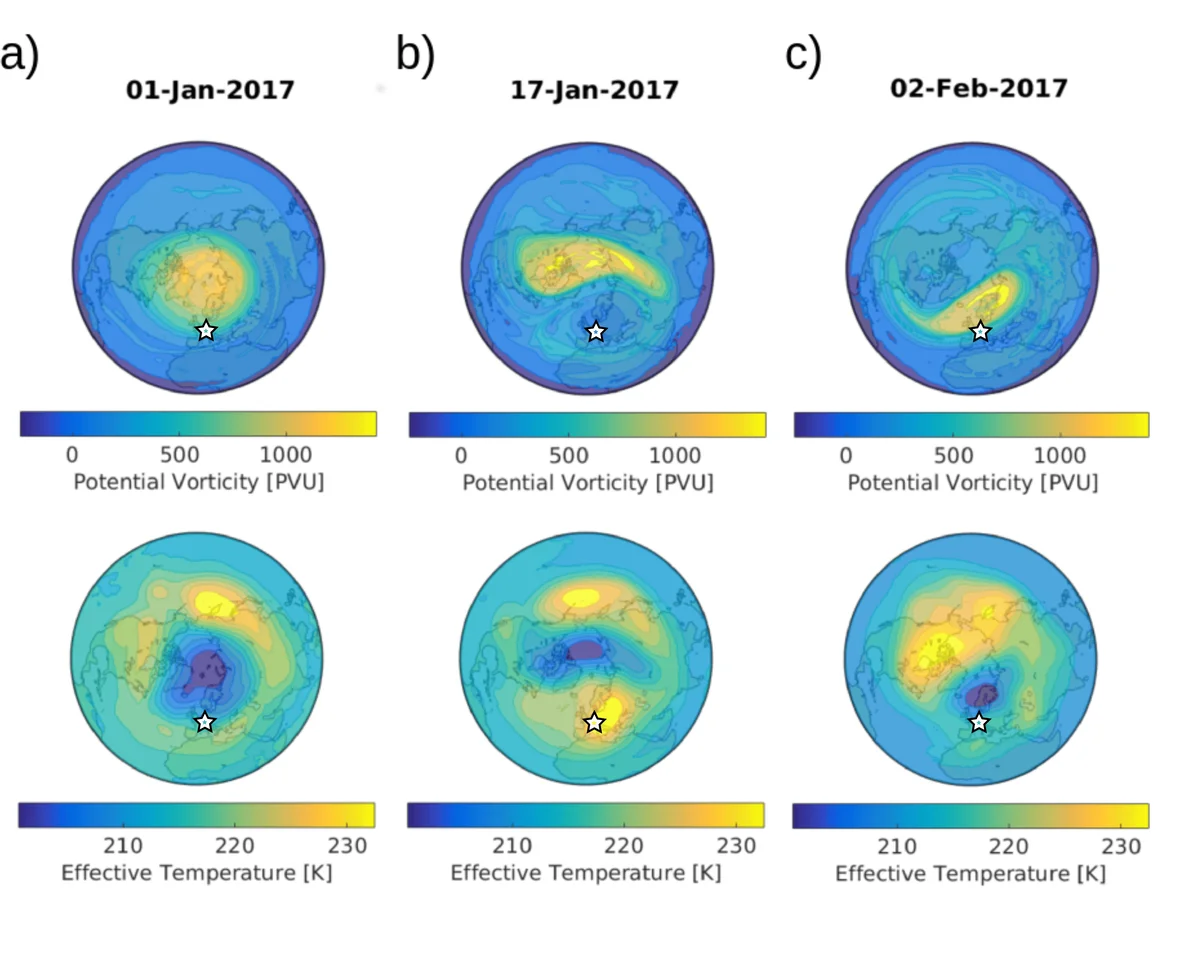
In the past years, large particle-physics experiments have shown that muon rate variations detected in underground laboratories are sensitive to regional, middle-atmosphere temperature variations. Potential applications include tracking short-term atmosphere dynamics, such as Sudden Stratospheric Warmings. We report here that such sensitivity is not only limited to large surface detectors under high-opacity conditions. We use a portable muon detector conceived for muon tomography for geophysical applications and we study muon rate variations observed over one year of measurements at the Mont Terri Underground Rock Laboratory, Switzerland (opacity of ~700 meter water equivalent). We observe a direct correlation between middle-atmosphere seasonal temperature variations and muon rate. Muon rate variations are also sensitive to the abnormal atmosphere heating in January-February 2017, associated to a Sudden Stratospheric Warming. Estimates of the effective temperature coefficient for our particular case agree with theoretical models and with those calculated from large neutrino experiments under comparable conditions. Thus, portable muon detectors may be useful to 1) study seasonal and short-term middle atmosphere dynamics, especially in locations where data is lacking such as mid-latitudes; and 2) improve the calibration of the effective temperature coefficient for different opacity conditions. Furthermore, we highlight the importance of assessing the impact of temperature on muon rate variations when considering geophysical applications. Depending on latitude and opacity conditions, this effect may be large enough to hide subsurface density variations due to changes in groundwater content, and should therefore be removed from the time-series.
💡 Research Summary
The authors present the first systematic study demonstrating that a compact, portable muon detector—originally designed for geophysical tomography—can reliably track middle‑atmosphere temperature variations, including both seasonal cycles and short‑term events such as Sudden Stratospheric Warmings (SSWs). The detector, built by the DI‑APHANE collaboration, consists of three orthogonal plastic‑scintillator planes (16 × 16 pixels of 5 × 5 cm² each) spaced 1 m apart, providing 961 distinct viewing axes. Each muon crossing the three planes generates a time‑coincident triple‑hit with sub‑nanosecond precision, allowing accurate trajectory reconstruction and direction‑dependent opacity estimation.
Measurements were carried out at the Mont Terri Underground Rock Laboratory (Switzerland, 47.4° N) over 382 days between October 2016 and February 2018. The overburden corresponds to an average opacity of ≈700 m water equivalent (m w.e.), with individual lines of sight ranging from 200 to 500 m of rock. The raw muon count rate averaged (800 ± 10) d⁻¹, and a 30‑day Hamming moving average was applied to smooth the time series while preserving the relevant seasonal and short‑term features.
To relate muon flux variations to atmospheric conditions, the authors employed the effective temperature formalism. Using atmospheric temperature profiles T(X) as a function of atmospheric depth X, they computed the weighted effective temperature T_eff via the Grashorn et al. (2010) weighting function W(X), which encodes the contribution of each atmospheric layer to muon production. Because the detector’s acceptance varies with zenith angle, a zenith‑dependent effective temperature T_eff(θ) was calculated for each angular bin, and a flux‑weighted average T_weighted_eff was derived. This procedure was repeated four times per day using ECMWF reanalysis data, and daily means with associated uncertainties were obtained.
A linear regression of the relative muon rate variation ΔR/R against the relative effective temperature variation ΔT_eff/T_eff yielded the effective temperature coefficient α_T. Monte‑Carlo simulations were used to propagate uncertainties in both R and T_eff, and systematic errors arising from the atmospheric model, weighting function parameters, and muon spectrum were added in quadrature. The resulting coefficient α_T = 0.92 ± 0.05 (stat + sys) is in excellent agreement with theoretical expectations (≈0.90) and with values reported by large underground experiments such as IceCube, Borexino, and MINOS (0.85–0.95). The Pearson correlation coefficient between the muon rate and T_eff exceeds 0.9, confirming a strong linear relationship.
Temporal analysis reveals a clear annual modulation: muon rates peak in summer (≈820 d⁻¹) and trough in winter (≈780 d⁻¹), mirroring the seasonal temperature cycle of the middle atmosphere. Importantly, during the major SSW that occurred in January–February 2017—a rapid warming of the 30–50 km stratosphere—the muon rate exhibited a distinct, ≈1.5 % increase, clearly identifiable above statistical noise. This demonstrates that even a modest‑size detector, operating under relatively low opacity, can capture day‑scale atmospheric dynamics that previously required multi‑kiloton neutrino observatories.
Beyond atmospheric science, the study highlights critical implications for geophysical applications of muon tomography. In mid‑latitude settings, variations in groundwater or subsurface density typically induce muon flux changes of only a few tens of permil, whereas temperature‑induced variations can reach several hundred permil. Consequently, any attempt to monitor subsurface processes (e.g., volcanic activity, aquifer depletion) with portable muon detectors must first correct for atmospheric temperature effects; otherwise, genuine geological signals could be masked or misinterpreted.
In summary, the paper establishes that portable muon detectors are viable tools for probing middle‑atmosphere dynamics, offering a low‑cost, high‑temporal‑resolution complement to traditional radiosonde or satellite observations, especially in regions lacking dense atmospheric monitoring networks. Simultaneously, it provides a practical framework for quantifying and removing temperature‑driven muon flux variations, thereby enhancing the reliability of muon‑based geophysical imaging in diverse opacity regimes.
Comments & Academic Discussion
Loading comments...
Leave a Comment