Distributed finite-time termination for consensus algorithm in switching topologies
In this article, we present a finite time stopping criterion for consensus algorithms in networks with dynamic communication topology. Recent results provide asymptotic convergence to the consensus algorithm. However, the asymptotic convergence of th…
Authors: Govind Saraswat, Vivek Khatana, Sourav Patel
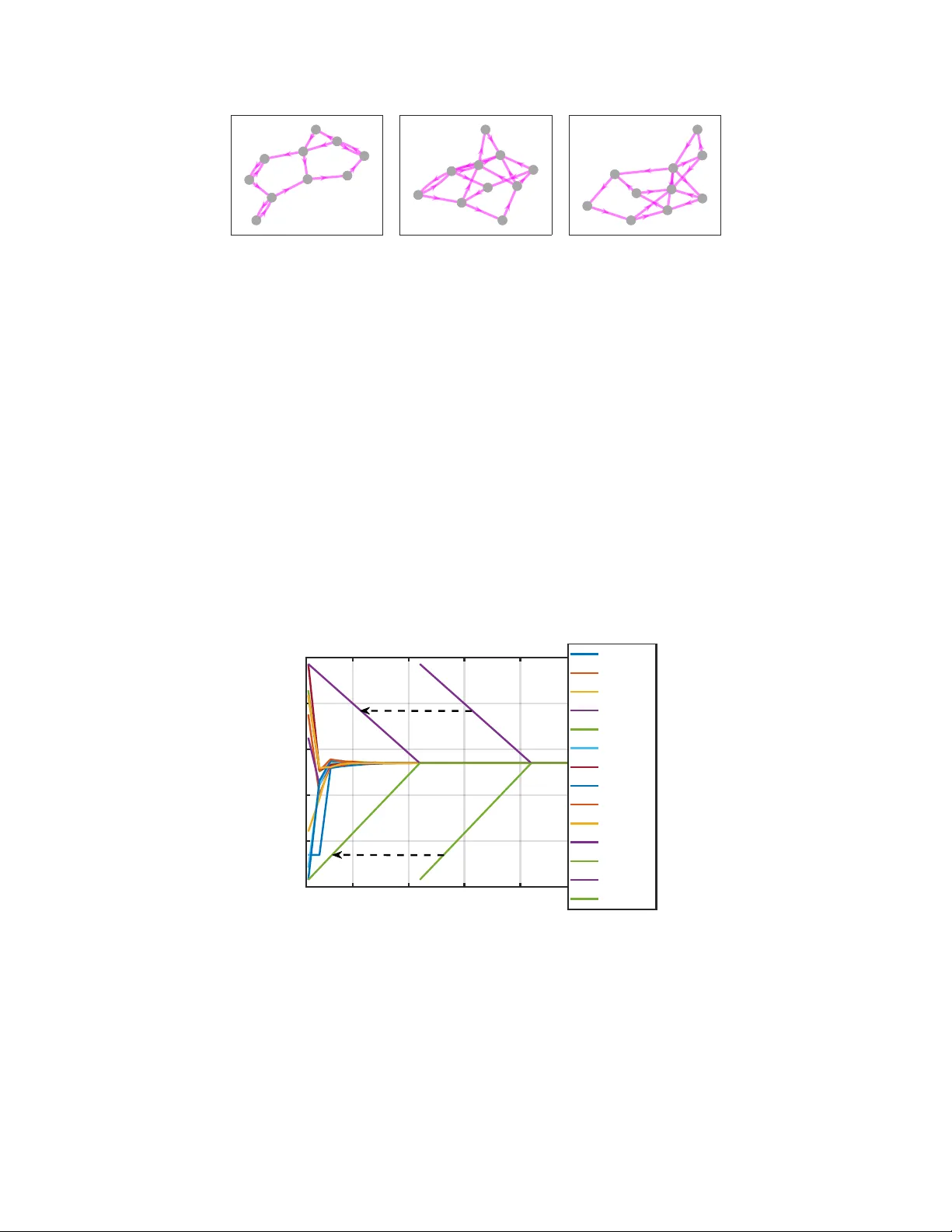
Distrib uted finite-time termination f or consensus algorithm in switching topologies Govind Saraswat, V iv ek Khatana, Sourav P atel, Murti V . Salapaka Department of Electrical and Computer Engineering Univ ersity of Minnesota Minneapolis, USA {saras006,khata010,patel292,murtis}@umn.edu A B S T R AC T In this article, we present a finite time stopping criterion for consensus algorithms in networks with dynamic communication topology . Recent results provide asymptotic con ver gence to the consensus algorithm. Howe ver , the asymptotic conv ergence of these algorithms pose a challenge in the prac- tical settings where the response from agents is required in finite time. T o this end, we propose a Maximum-Minimum protocol which propagates the global maximum and minimum v alues of agent states (while running consensus algorithm) in the network. W e establish that global maximum and minimum v alues are strictly monotonic e ven for a dynamic topology and can be utilized to distrib u- tiv ely ascertain the closeness to con ver gence in finite time. W e show that each node can ha ve access to the global maximum and minimum by running the proposed Maximum-Minimum protocol and use it as a finite time stopping criterion for the otherwise asymptotic consensus algorithm. The prac- tical utility of the algorithm is illustrated through experiments where each agent is instantiated by a NodeJS sock et.io server . K eyw ords Distrib uted Consensus · Switching topology · Multi-agent systems · Netw ork-based computing systems 1 Introduction A vailability of large number of low-cost sensors and development of suitable network protocols has led to the de velop- ment of modern-day multi-agent systems. In many practical domains, these multi-agent systems are often designed to attain coordinated objectiv es such as movement coordination among a group of mobile autonomous v ehicles for traffic optimization [1], task allocation among agents (nodes) such as unmanned aerial vehicles (UA Vs) or autonomous un- derwater vehicles (A UVs) for search and survey operations [2],[3]. Such systems are limited by their size and mobile ( ad hoc ) nature that restrict computational and sensing resources, rendering distributed algorithms well-suited for coor- dination of these multi-agent systems [4]. A number of works in the literature have proposed distributed coordination algorithms for multi-agent systems achie ving consensus on the average of agents' initial state values. The authors in [5] introduced a novel gossip-based decentralized scheme called push-sum protocol to compute the av erage of the initial state values of nodes. The push-sum protocol has been sho wn to con ver ge to the av erage exponentially fast. Authors of [6] have proposed a ratio-consensus protocol in which agents in a fixed topological network conv erge asymptotically to the ratio of the sum of initial value of the two states maintained by each agent. These algorithms hav e a significant advantage; con ver gence to the av erage value can be established where the protocol can be realized in a truly distributed manner without requiring any centralized dissemination of parameters making them suitable for plug-and-play ad hoc networks. [7] extends this approach to the case where netw ork topology is dynamic under the condition that the union of the communication graphs at different time instants remain strongly connected infinitely often. Con ver gence rate is an important performance indicator for consensus protocols [8],[9]. As presented in [10], con v ergence rate depends on the spectral properties of the interaction graph topology . Several researchers hav e endeav ored to design interac- tion graphs amenable to faster con ver gence [11],[8]. A consensus based distributed optimization scheme utilizing the subgradient-push ov er a time-varying graph topology was presented in [12]. The subgradient iterations are shown to con ver ge at a rate of O (ln( t ) / √ t ) . Ho wev er , each node has to continue the subgradient iteration updates as there is no mechanism to distributi v ely detect when the optimal solution is reached. Abov e results do not provide any finite time stopping criterion for the consensus protocol. As multi-agent systems with real-time applications, require the consensus value to be used by each agent for a subsequent task or action, a finite-time distributed stopping criterion is imperativ e. Moreover , if the agents can distributedly detect the con ver gence within a pre-specified tolerance of the consensus value, they will a void running the algorithm longer than necessary and sav e scarce power and computational resources. The authors in [13] ha ve presented a method to achiev e the consensus value in a finite number of iterations. Here, each node can calculate the final consensus value using the minimal polynomial associated with the weight matrix in the state update iterations. Howe ver , to calculate the coefficients of the minimal polynomial each node has to run N (total number of agents) different linear iterations each for at least N + 1 time-steps. Also, ev ery node should ha ve enough storage and computation abilities to handle matrix inv ersions and rank calculations which makes it unsuitable for applications like ad hoc sensor netw orks. T o this end, authors in [14],[15],[16] established that the sequence of global maximum (or minimum) state value of the agents follo wing a consensus algorithm is a monotonic sequence con verging to the consensus when network topology is fixed. A distributed maximum (and minimum) protocol w as proposed to propagate these global maximum (and min- imum) state values to achiev e finite-time consensus within a pre-specified tolerance margin. Having additional states corresponding to the global maximum and minimum values help each node to detect the progress to ward consensus. Each node is able to simultaneously detect the con vergence in finite time thus the consensus protocol is terminated by each node at the same iteration. Moreov er the abov e methodology guarantees that each node will have access to the consensus value at the same time. In this article, we show that the abo ve approach is not directly applicable when the netw ork topology is dynamic. Here, we propose an extension of this approach which can be applied to netw orks with dynamic topology . W e introduce the concept of a "time-path" to incorporate the effect of current state value of an agent on other agents at the following time instants. W e establish the existence of time-paths of finite length for all pairs of agents in the network. Le veraging the existence of time-paths, we propose a new Maximum-Minimum protocol to propagate the global maximum and minimum state values. Now , we briefly describe some of the applications of the proposed protocol. Ad hoc cognitive radio networks. In cognitiv e radio networks, secondary users can sense the spectrum to detect the presence of primary users. In a spectrum-sensing consensus algorithm [17], secondary users mutually transmit and receiv e their states according to the real-time (dynamic) network topology , regardless of whether primary users are present. The topology is created when secondary users establish communication links with their own neighbors to locally exchange information among them. The algorithm iterations are repeatedly done until all the individual states con ver ge to ward the av erage of the initial v alue of states to make a local decision. Contr ol of autonomous agents. It is often necessary to coordinate a collection of autonomous agents (e.g., cars or unmanned aerial vehicles). For example, consider a fleet of self-driving cars where each car can communicate with its neighboring cars. One may wish for the cars to meet a global objectiv e such as maintaining a particular formation where the neighbors of a car can change in real-time. A distributed decision is usually needed in such situations. All the cars can distributi vely agree on a direction or an av erage speed (or both). Such a coordination model was in vestig ated in [2]. Statement of contribution: 1. This article presents an algorithm with a distributed stopping criterion for ratio consensus in the presence of directed switching topologies. W e augment the ratio consensus algorithm with two additional states: global maximum and global minimum of the values held by agents. W e show that these values are monotonic in nature and con ver ge to the consensus v alue e ven when the network is dynamic. The stopping criterion can be set such that if the criterion is met by an agent then it has access to the consensus v alue within an y prespecified tolerance margin. Here, the maximum and minimum consensus based distrib uted stopping approach [14],[15] is extended to the case of time v arying topologies. 2. W e provide an upper bound on the number of iterations required for a node in the network to influence all other nodes. In order to achieve this, we introduce a novel concept of time-path. W e prove the existence of finite-length time-paths for every pair of nodes and present the Maximum-Minimum protocol to propagate the global maximum and minimum state values in the netw ork. 3. The scheme proposed here is shown to be scalable for implementation as it only requires each agent to have access to an upper bound on the number of nodes. The performance of the proposed algorithm is illustrated by e xperimentally realizing a netw ork with dynamic topology created using a NodeJS framew ork. Here each node is implemented as a sock et.io [18] server . This validates the distributed stopping criterion experimentally in the presence of switching topologies, thus providing evidence that our algorithm is indeed applicable for real-time applications. The rest of the paper is organized as follo ws. In Section 2, the basic definitions needed for subsequent de velopment are presented. The setup for distributed av eraging using ratio consensus is presented in Section 3. In Section 4, analytical 2 results for distributed finite-time termination of ratio consensus in switching topology using maximum and minimum consensus algorithms ha ve been discussed. Theoretical findings are v alidated with experiments presented in Section 5 followed by conclusions in Section 6. 2 Definitions In this section we present basic notions of graph theory and linear algebra which are essential for the subsequent de- velopments. Detailed description of graph theory and linear algebra notions are av ailable in [19] and [20] respecti vely . Definition 1. (Car dinality of a set) Let A be a set. The cardinality of a set A denoted by | A | is a measure of the number of elements of the set A . Definition 2. (Dir ected Graph) A dir ected graph (denoted as digraph) G is a pair ( V , E ) wher e V is a set of vertices or nodes and E is a set of edges, which are or der ed subsets of two distinct elements of V . If an edge fr om j ∈ V to i ∈ V exists then it is denoted as ( i, j ) ∈ E . Definition 3. (P ath) In a dir ected graph, a directed path fr om node i to j exists if there is a sequence of distinct dir ected edges of G of the form ( k 1 , i ) , ( k 2 , k 1 ) , ..., ( j, k m ) . Definition 4. (Str ongly Connected Graph) A dir ected graph is strongly connected if it has a directed path between each pair of distinct nodes i and j . Definition 5. (Column Stochastic Matrix) A real n × n matrix A = [ a ij ] is called a column stochastic matrix if 1 ≥ a ij ≥ 0 for 1 ≤ i, j ≤ n and n X i =1 a ij = 1 for 1 ≤ j ≤ n. Definition 6. (Irr educible Matrix) A N × N matrix A is said to be irreducible if for any i, j ∈ { 1 , ..., N } , ther e exist m ∈ N such that ( A m )( i, j ) > 0 , that is, it is possible to reac h any state fr om any other state in a finite number of hops. Definition 7. (Primitive Matrix) A non negative matrix A is primitive if it is irreducible and has only one eigen value of maximum modulus. 3 A verage Consensus in switching topology In this section, the ke y result from [6], which enables reaching a verage consensus in the presence of dynamic topology is summarized. Consider a scenario where the network topology is dynamic but with a fixed set of nodes V ( |V | = n ) i.e. at any giv en instant k , the network is described by a digraph G ( k ) = ( V , E ( k )) . Let P ( k ) = ( p ij ( k )) be the weighted adjacency matrix associated with the digraph G ( k ) . Here G ( k ) ∈ ¯ G = {G 1 , G 2 , . . . , G m } , m ≤ 2 n 2 − n is the set of all possible digraphs for a giv en set of nodes V . Here we assume that a node always has access to its o wn information, i.e. for any node i ∈ V , ( i, i ) ∈ E ( k ) for all k . No w we present a few definitions related to dynamic topology . Definition 8. (Union of digraphs) Given a collection of digraphs {G 1 , G 2 , . . . , G m } (for some m ≥ 1 ) of the form G ( k ) = ( V , E ( k )) , k = 1 , 2 , ..., m , the union of digraphs is defined as G ( k ) 1 , 2 ,...,m = ( V , ∪ m k =1 E ( k )) . Definition 9. (In-Neighborhood at instant k) The set of in-neighbors of node i ∈ V at instant k is denoted by N − ( i, k ) = { j : ( i, j ) ∈ E ( k ) } . Definition 10. (Out-Neighborhood at instant k) The set of out-neighbors of node i ∈ V at instant k is denoted by N + ( i, k ) = { j : ( j, i ) ∈ E ( k ) } . Each node i ∈ V maintains two states at time k , denoted by x i ( k ) (referred as numerator state of node i ) and y i ( k ) (referred as denominator state of node i ). Node i updates its state at the ( k + 1) th iteration according to the follo wing policy: x i ( k + 1) = p ii ( k ) x i ( k ) + X j ∈ N − ( i , k ) \{ i } p ij ( k ) x j ( k ) (1) y i ( k + 1) = p ii ( k ) y i ( k ) + X j ∈ N − ( i , k ) \{ i } p ij ( k ) y j ( k ) , (2) where y i (0) = 1 for all i ∈ V . W e consider the network with dynamic topology to satisfy the follo wing assumptions throughout the rest of the paper . 3 Assumption 1. F or a sequence of digraphs G ( k ) = ( V , E ( k )) , k = 0 , 1 , 2 , . . . , ther e exists an infinite sequence of time instants t 0 , t 1 , . . . , t m , . . . , where t 0 = 0 , 0 < t m +1 − t m ≤ l < ∞ , l ≥ 0 , m ≥ 0 , with the pr operty that for any m the union of digraphs G ( t m ) , G ( t m + 1) , . . . , G ( t m +1 − 1) is str ongly connected. Assumption 2. P ( k ) for all k is a column-stochastic, primitive and irr educible matrix. Theorem 1. Consider a sequence of digraphs of the form G ( k ) = ( V , E ( k )) , k = 0 , 1 , 2 , . . . satisfying Assumption 1 and Assumption 2. W ith the update rule (1) and (2), the ratio x i ( k ) y i ( k ) asymptotically con ver ges to P n i =1 x i (0) n for all i = 1 , ..., n , that is, the ratio of the numer ator and denominator states con verg e to the aver age of the initial conditions of x i variables (r eferr ed to as ratio consensus). Proof . See [6] for proof. 4 Distributed Finite-T ime T ermination In this section, the definitions and con ver gence of maximum and minimum consensus algorithms are established. Subsequently , a finite-time termination criterion for average consensus in the case of switching topology is de veloped based on these algorithms. Let us consider the maximum and minimum v alue of the ratio of consensus protocols gi ven by (1) and (2) ov er all nodes at any time instant k be given by , M ( k ) := max i ∈V x i ( k ) y i ( k ) , y j ( k ) 6 = 0 , j ∈ V , (3) m ( k ) := min i ∈V x i ( k ) y i ( k ) , y j ( k ) 6 = 0 , j ∈ V (4) The following Lemma shows that the ratio of states at each node stays within the maximum and minimum for subse- quent iterations. Lemma 1. Consider the ratio consensus pr otocol of (1) and (2). Let Assumption 1 and Assumption 2 hold. Then for all time instants k 0 ≥ k and for all i ∈ V , m ( k ) ≤ x i ( k 0 ) y i ( k 0 ) ≤ M ( k ) . Proof . W e first pro ve the inequality for M ( k ) using induction. By definition of M ( k ) , for k 0 = k , the proof is trivial. Suppose it is asserted that for k 0 = k + l, l ≥ 1 , x i ( k + l ) y i ( k + l ) ≤ M ( k ) for all i ∈ V . Then we hav e, x i ( k + l + 1) y i ( k + l + 1) = P j ∈ N − ( i,k + l ) p ij ( k + l ) x j ( k + l ) P j ∈ N − ( i,k + l ) p ij ( k + l ) y j ( k + l ) = p ii ( k + l ) x i ( k + l ) y i ( k + l ) + P j ∈ N − ( i,k + l ) \{ i } p ij ( k + l ) x j ( k + l ) y i ( k + l ) p ii ( k + l ) + P j ∈ N − ( i,k + l ) \{ i } p ij ( k + l ) y j ( k + l ) y i ( k + l ) . It follows from the inducti ve assumption that, x i ( k + l + 1) y i ( k + l + 1) ≤ p ii ( k + l ) M ( k ) + P j ∈ N − ( i,k + l ) \{ i } p ij ( k + l ) M ( k ) y j ( k + l ) y i ( k + l ) p ii ( k + l ) + P j ∈ N − ( i,k + l ) \{ i } p ij ( k + l ) y j ( k + l ) y i ( k + l ) = M ( k ) . Therefore, x i ( k + l +1) y i ( k + l +1) ≤ M ( k ) for all i ∈ V . Other inequality is similar and is left to the reader . Next Lemma strengthens the result of Lemma 1 to a strict inequality . Lemma 2. Consider the ratio consensus pr otocol of (1) and (2) where the initial time instant is k . Let Assumption 1 and Assumption 2 hold. Let M ( k ) and m ( k ) be as in (3) and (4). Let i be a node such that x i ( k 0 ) y i ( k 0 ) < M ( k ) and let j be a node such that x j ( k 0 ) y j ( k 0 ) > m ( k ) for some time instant k 0 ≥ k . Then for all time instants k 00 ≥ k 0 , x i ( k 00 ) y i ( k 00 ) < M ( k ) and x j ( k 00 ) y j ( k 00 ) > m ( k ) . 4 Proof . The proof is based on induction and follows similarly to the proof of Lemma 1 and is left to the reader . The follo wing definition and Lemmas introduce the concept of a time-path and deri ve a bound on number of iterations required for one node to access information of any other node in the network. Definition 11. (T ime-path) In the case of switching topology , a time-path of length l at time t fr om node i ∈ V to j ∈ V is a sequence of nodes k 1 , k 2 , . . . , k l − 1 such that ( k 1 , i ) ∈ E ( t ) , ( k 2 , k 1 ) ∈ E ( t + 1) , . . . , ( j, k l − 1 ) ∈ E ( t + l − 1) . In other wor ds, node j has access to node i ’s information after l time steps thr ough the nodes k 1 , k 2 , . . . , k l − 1 starting at time t . Lemma 3. Consider a network wher e Assumption 1 and Assumption 2 hold along with added constraint that digr aphs G ( k ) for all k ∈ N ar e str ongly connected. Then for any node i ∈ V , let R i ( k , t ) := [ m ∈ R i ( k,t − 1) { l : l ∈ N + ( m, k + t − 1) } , with, R i ( k , 0) = { i } , | R i ( k , 0) | = 1 and N + ( m, k ) is the out-neighborhood of node m at instant k . The following hold: 1. R i ( k , t − 1) ⊂ R i ( k , t ) for all t = 1 , 2 . . . . 2. R i ( k , n − 1) = V . Proof . Here, R i ( k , t + 1) is the union of out-neighborhoods of all the elements of R i ( k , t ) at instant t . Clearly , R i ( k , t − 1) ⊆ R i ( k , t ) . Indeed, l ∈ R i ( k , t − 1) implies l ∈ N + ( l, k + t − 1) which in turn implies, l ∈ R i ( k , t ) . Now for t = 1 , R i ( k , 1) = { m 1 : m 1 ∈ N + ( i, k ) } = N + ( i, k ) . If R i ( k , 1) = V , the claim is proven. Suppose R i ( k , 1) ⊂ V . Note that at time instant k + 1 , the graph is strongly connected. Thus, there exists an outgoing edge between the set of nodes R i ( k , 1) and V \ R i ( k , 1) . That is there exists m 2 ∈ V \ R i ( k , 1) such that m 2 ∈ N + ( m 1 , k + 1) for some m 1 ∈ R i ( k , 1) . Thus, m 2 ∈ R i ( k , 2) . It follows that m 2 ∈ R i ( k , 2) \ R i ( k , 1) which implies that | R i ( k , 2) \ R i ( k , 1) | ≥ 1 . Now , as R i ( k , 1) ⊂ R i ( k , 2) we hav e, | R i ( k , 2) | = | R i ( k , 1) | + | R i ( k , 2) \ R i ( k , 1) | which implies | R i ( k , 2) | ≥ | R i ( k , 1) | + 1 . Note here R i ( k , 1) is a proper subset of R i ( k , 2) . Follo wing in the same manner we get, | R i ( k , t ) | ≥ | R i ( k , t − 1) | + 1 ≥ | R i ( k , t − 2) | + 2 ≥ · · · ≥ | R i ( k , 0) | + t, and thus | R i ( k , t ) | ≥ t + 1 . For t = n − 1 , | R i ( k , n − 1) | ≥ n . Howe ver R i ( k , t ) ⊆ V and thus | R i ( k , t ) | ≤ n for all t . Thus, | R i ( k , n − 1) | = n implying R i ( k , n − 1) = V . Therefore, the claim is true. Lemma 4. Consider the assumptions of Lemma 3. Then for any two nodes i, j ∈ V and at any time instant k , there exist a time-path of length s from i to j with s ≤ n − 1 . In other wor ds, j has access to information of i in s number of time steps. Proof . It is to be noted here that R i ( k , t ) is the set of nodes influenced by node i ’ s current state within next t time steps. Now , we show the existence of a time-path. W e have R i ( k , 0) ⊂ R i ( k , 1) ⊂ R i ( k , 2) ⊂ · · · ⊂ R i ( k , s ) = V . Let s be the smallest time step such that j ∈ R i ( k , s ) . From Lemma 3, s ≤ n − 1 . As, j ∈ R i ( k , s ) , there exists m s − 1 ∈ R i ( k , s − 1) such that j ∈ N + ( m s − 1 , k + s − 1) . As m s − 1 ∈ R i ( k , s − 1) it follows that there exists m s − 2 ∈ R i ( k , s − 2) such that m s − 1 ∈ N + ( m s − 2 , k + s − 2) . Choosing m i ’ s in this manner we get m s − 2 ∈ R i ( k , s − 2) , m s − 3 ∈ R i ( k , s − 3) , . . . m 1 ∈ R i ( k , 1) such that m 1 ∈ N + ( i, k ) . Therefore, there exists a time-path ( m 1 , i ) , ( m 2 , m 1 ) , . . . , ( j, m s − 1 ) with s ≤ n − 1 . Using Lemma 3 and Lemma 4, we next provide a sampling of the M ( k ) and m ( k ) such that the resulting sub- sequences are strictly monotonic and con ver ge to the av erage of the initial conditions of x i variables. Lemma 5. Consider the ratio consensus pr otocol of (1) and (2) with the assumptions of Lemma 3. Let M ( k ) and m ( k ) be as in (3) and (4) such that m ( k ) < M ( k ) where initial time instant is k . Then for all k 0 ≥ k + n 0 and for all i ∈ V , m ( k ) < x i ( k 0 ) y i ( k 0 ) < M ( k ) , (5) wher e n 0 is an upper bound on n − 1 . 5 Proof . As m ( k ) < M ( k ) it follo ws that there exists a node i ∈ V such that x i ( k ) y i ( k ) < M ( k ) . Let j ∈ V be an arbitrary node, then from Lemma 4 there exist a time-path of length l from node i to node j at instant k where l ≤ n − 1 ≤ n 0 . Let this path be denoted as ( m 1 , i ) , ( m 2 , m 1 ) , ..., ( j, m l − 1 ) . Then, x m 1 ( k + 1) y m 1 ( k + 1) = p m 1 i ( k ) x i ( k ) + P u ∈ N − ( m 1 ,k ) \{ i } p m 1 u ( k ) x u ( k ) p m 1 i ( k ) y i ( k ) + P u ∈ N − ( m 1 ,k ) \{ i } p m 1 u ( k ) y u ( k ) = p m 1 i ( k ) x i ( k ) y i ( k ) + P u ∈ N − ( m 1 ,k ) \{ i } p m 1 u ( k ) x u ( k ) y i ( k ) p m 1 i ( k ) + P u ∈ N − ( m 1 ,k ) \{ i } p m 1 u ( k ) y u ( k ) y i ( k ) < p m 1 i ( k ) M ( k ) + P u ∈ N − ( m 1 ,k ) \{ i } p m 1 u ( k ) x u ( k ) y i ( k ) p m 1 i ( k ) + P u ∈ N − ( m 1 ,k ) \{ i } p m 1 u ( k ) y u ( k ) y i ( k ) . By definition of M ( k ) , x u ( k ) y u ( k ) ≤ M ( k ) for all u ∈ V , thus x u ( k ) ≤ y u ( k ) M ( k ) . It follows that, x m 1 ( k + 1) y m 1 ( k + 1) < p m 1 i ( k ) M ( k ) + P u ∈ N − ( m 1 ,k ) \{ i } p m 1 u ( k ) M ( k ) y u ( k ) y i ( k ) p m 1 i ( k ) + P u ∈ N − ( m 1 ,k ) \{ i } p m 1 u ( k ) y u ( k ) y i ( k ) = M ( k ) . Thus, x m 1 ( k +1) y m 1 ( k +1) < M ( k ) . Therefore, from Lemma 2 it follo ws that for all k 0 ≥ k + 1 , x m 1 ( k 0 ) y m 1 ( k 0 ) < M ( k ) . Similarly , if k 0 ≥ k + 2 , then x m 2 ( k 0 ) y m 2 ( k 0 ) < M ( k ) and that for all k 0 ≥ k + l, x j ( k 0 ) y j ( k 0 ) < M ( k ) . Note that since n 0 ≥ n − 1 ≥ l , it follows that k + n 0 ≥ k + l. The condition k 0 ≥ k + n 0 is independent of the index j and where the node j was chosen arbitrarily . Thus, it can be concluded that x i ( k 0 ) y i ( k 0 ) < M ( k ) for all k 0 > k + n 0 and for all i ∈ V . This completes the proof for M ( k ) . The other inequality for m ( k ) can be pro ven similarly and is left to the reader . Remark 1.1. Note that fr om Lemma 5, after a finite number of iterations given by n 0 , all ratios of the nodal states under (1) and (2) become strictly less than the maximum value of the ratio in network in the past and strictly greater than the minimum value of the ratio in the network in the past. The follo wing theorem sho ws that after a finite time, the maximum v alue of the ratio in the netw ork decreases and the minimum value of the ratio in the netw ork increases. Theorem 2. Consider the ratio consensus pr otocol of (1) and (2) with the assumptions of Lemma 3 and the initial ratio vector being r ( un 0 ) := h x 1 ( un 0 ) y 1 ( un 0 ) x 2 ( un 0 ) y 2 ( un 0 ) . . . x N ( un 0 ) y N ( un 0 ) i such that min r ( un 0 ) < max r ( un 0 ) , wher e, u = 0 , 1 , 2 , ... . Then, M (( u + 1) n 0 ) < M ( un 0 ) and m (( u + 1) n 0 ) > m ( un 0 ) . Proof . Let k = un 0 , then using Lemma 5, it follows that for k 0 ≥ ( u + 1) n 0 , x i ( k 0 ) y i ( k 0 ) < M ( un 0 ) for all i ∈ V . Hence, M (( u + 1) n 0 ) := max i ∈V x i (( u +1) n 0 ) y i (( u +1) n 0 ) < M ( un 0 ) . This completes the proof of the inequality inv olving M ( un 0 ) . The other inequality in v olving m ( un 0 ) can be prov ed similarly and is left to the reader . Theorem 3. Consider the ratio consensus pr otocol of (1) and (2) with the assumptions of Lemma 3. Then, lim u →∞ M ( un 0 ) = P n j =1 x j (0) n and lim u →∞ m ( un 0 ) = P n j =1 x j (0) n . Proof . This result follows directly from Theorem 1 and Theorem 2 and is left to the reader . 6 Corollary 3.1. Consider the ratio consensus pr otocol of (1) and (2) with the assumptions of Lemma 3. Then, lim u →∞ M ( un 0 ) − m ( un 0 ) = 0 . Proof . The proof follows from Theorem 3 and is left to the reader . W e next present Maximum-Minimum consensus protocol in the case of dynamic topology and use the preceding theorems to design a finite time termination criterion. 4.1 Maximum-Minimum Consensus Protocol The Maximum and Minimum Consensus Protocol denoted by MXP and MNP computes the maximum and minimum of the giv en initial node conditions z (0) = [ z 1 (0) z 2 (0) ... z n (0)] T , w (0) = [ w 1 (0) w 2 (0) ... w n (0)] T in a distrib uted manner respectiv ely . It takes z (0) and w (0) as an input and generates a sequence of node v alues based on the following update rules for node i , z i ( k + 1) = max j ∈ N − ( i,k ) z j ( k ) , (6) w i ( k + 1) = min j ∈ N − ( i,k ) w j ( k ) . (7) Proposition 1. MXP pr otocol given by (6) con ver ges to max j ∈V z j (0) in finite time k ≤ n 0 for any n 0 ≥ n − 1 . Proof . Let m be a node with state value at z m (0) = max j ∈V z j (0) . Then at k = 1 , all nodes connected to m at instant k = 0 will hav e the maximum value z m (0) . Then, from the definition of R m (0 , k ) in Lemma 4, if m 1 ∈ R m (0 , 1) then z m 1 (1) = z m (0) . Similarly , at k = 2 , all the nodes connected to the elements of the set R m (0 , 1) at instant k = 1 will have the maximum value, that is, if m 2 ∈ R m (0 , 2) then z m 2 (2) = z m (0) and so on. At k = n − 1 , if m n − 1 ∈ R m (0 , n − 1) then z m n − 1 ( n − 1) = z m (0) . As R m (0 , n − 1) = V , we have for all j ∈ V , z j ( n − 1) = z m (0) . Thus, at instant k = n − 1 all nodes will hav e the maximum value. As n 0 ≥ n − 1 , z j ( k ) con verges to max j ∈V z j (0) in finite time k ≤ n 0 . Proposition 2. MNP pr otocol given by (7) con ver ges to min j ∈V w j (0) in finite time k ≤ n 0 for any n 0 ≥ n − 1 . Proof . Similar to the proof of Proposition 1 4.2 Distributed Finite-T ime T ermination Algorithm for Ratio Consensus Here, we propose an algorithm using the abov e MXP-MNP protocol which allo ws each node to simultaneously detect the con ver gence of the ratio consensus within a pre-specified threshold ρ . In the proposed algorithm, the initial conditions for the MXP-MNP protocol are set as ratio of the initial values held by the nodes. Definition 12. (Epoch) u th epoch is defined as the state update iter ation at the instant un 0 for any positive inte ger u . The MXP-MNP protocol is re-initialized at ev ery u th epoch that is k = un 0 , where u = 1 , 2 , ... , with z ( un 0 ) = x ( un 0 ) y ( un 0 ) and w ( un 0 ) = x ( un 0 ) y ( un 0 ) respectiv ely . W e define ¯ α i ( un 0 ) := max z ( un 0 ) = M ( un 0 ) , α i ( un 0 ) = min w ( un 0 ) = m ( un 0 ) and β i ( un 0 ) := ¯ α i − α i = M ( un 0 ) − m ( un 0 ) . Each node compares β i with ρ at ev ery epoch and if β i < ρ then it terminates the consensus protocol. Details of this scheme are giv en in Algorithm 1. Theorem 4. Algorithm 1 con ver ges in finite-time simultaneously at each node . Proof . From Corollary 3.1, it follo ws that M ( un 0 ) − m ( un 0 ) → 0 as u → ∞ . Thus, for an y gi v en ρ > 0 , there e xists an integer t ( ρ ) such that for all u ≥ t ( ρ ) , | M ( un 0 ) − m ( un 0 ) | < ρ for all nodes in the network. As each node has access to M ( un 0 ) and m ( un 0 ) , con ver gence is detected simultaneously by each node at the same iteration. Remark 4.1. Notice that using the above pr otocol, the global maximum and minimum values at any instant k ar e available to each node at instant k + n 0 . Further , the only global parameter needed for Algorithm 1 is the knowledge of number of nodes of the network. Howe ver , it should be noted that each node does not need to know the actual number of nodes but some upper bound. In most applications, an upper bound on the number of nodes is r eadily available. 7 Algorithm 1: Finite-time termination of ratio consensus for switching topology (at each node i ∈ V ) Input: x j (0) , y j (0) = 1 , j ∈ N − ( i, 0) , ρ ; // Initial condition Initialize: k := 0 ; z i := x i (0) /y i (0) ; w i := x i (0) /y i (0) ; u := 1 ; Repeat: /* ratio consensus updates of node i given by (1) and (2) */ x i ( k + 1) := P j ∈ N − ( i , k ) p ij ( k ) x j ( k ) ; y i ( k + 1) := P j ∈ N − ( i , k ) p ij ( k ) y j ( k ) ; /* global max-min updates of node i given by (6) and (7) respectively */ z i := max j ∈ N − ( i,k ) z j ; w i := min j ∈ N − ( i,k ) w i ; if k = un 0 then ¯ α i := z i ; α i := w i ; β i := ¯ α i − α i ; if β i < ρ then break ; // stop x i , y i , z i and w i updates else set z i = x i ( un 0 ) /y i ( un 0 ) ; w i = x i ( un 0 ) /y i ( un 0 ) ; u = u + 1 ; end k = k + 1 ; 1 2 3 4 6 5 1 2 3 4 6 5 ( G 1 ) ( G 2 ) Figure 1: Both G 1 and G 2 hav e diameter 3 . This result is a non trivial extension of [14],[15] as these considered only static network where the finite time consensus is based on knowledge of upper bound on graph diameter . There it was deri ved that within D max iterations ev ery node has access to global maximum and minimum where D max is an upper bound on the graph diameter . This is not applicable to a network with dynamic topology . The following counter example highlights the case where an upper bound on maximum diameter ( D max = { max ( D ( G )); G ∈ ¯ G } where D ( G ) is diameter of graph G ) does not provide access to global maximum and minimum to all the nodes of the network. Let us consider a network of 6 nodes where the network topology can be either of undirected graphs G 1 or G 2 (see Figure 1), that is ¯ G = {G 1 , G 2 } , with switching as described in T able 1. Here the diameter of both graphs D = 3 . Range (as defined in Lemma 3) of node 1 starting from any instant k is also shown in T able 1. It can be clearly observed that it takes 5 iterations for range to contain all the nodes which is more than the bound on maximum diameter ( D max = 3 ). In other words, it requires at least 5 (= n − 1) iterations for any node to receiv e information from node 1 which follo ws directly from Lemma 4. Therefore, if n 0 is set as D max in Proposition 1 and Proposition 2, z i and w i for a node i will not Iteration T opology Range of node 1 t = 1 G 1 R 1 ( k , 1) = { 1 , 2 } t = 2 G 1 R 1 ( k , 1) = { 1 , 2 , 3 } t = 3 G 2 R 1 ( k , 1) = { 1 , 2 , 3 , 4 } t = 4 G 2 R 1 ( k , 1) = { 1 , 2 , 3 , 4 , 5 } t = 5 G 2 R 1 ( k , 1) = { 1 , 2 , 3 , 4 , 5 , 6 } T able 1: Network topology and range ( R 1 ( k , t ) ) of node 1 starting at instant k for iterations t = 1 , 2 , 3 , 4 , 5 . 8 1 2 3 4 5 6 7 8 9 10 1 2 3 4 5 6 7 8 9 10 1 2 3 4 5 6 7 8 9 10 (a) (b) (c) Figure 2: T opology at time instants (a) k = 9 , (b) k = 18 and (c) k = 27 . con ver ge to global maximum and minimum respectiv ely and rather con ver ge to local maximum and minimum of the neighborhood defined by R i ( k , D max ) . This will lead to two problems: • Theorem 2 giv es strict monotonicity of global maximum/minimum and does not extend to local maxi- mum/minimum. Thus, the resulting sequences may not be monotonic. • Some nodes in Algorithm 1 can detect local con ver gence (when the maximum and minimum of the neigh- borhood defined by R i ( k , D max ) are within tolerance) and terminate well before actual global con ver gence. Abov e analysis is further bolstered by experimental results in Section 5. 5 Experimental Results Consider a network of 10 agents with switching topology represented by a digraph chosen at random from a set of 100 strongly connected digraphs for every time instant. Three instances of these digraphs are shown in Figure 2. Here, each agent running the consensus Algorithm 1 is implemented using a NodeJS socket.io server . Initial condition of the numerator states are chosen at random from (0 , 1) . With ρ = 0 . 01 and n 0 = 10 , Algorithm 1 results in distributed finite-time termination of computations performed by the agents in 21 iterations as shown in Figure 3. Observe that the 5 10 15 20 25 Iterations 0 0.2 0.4 0.6 0.8 1 node1 node2 node3 node4 node5 node6 node7 node8 node9 node10 MXP MNP MXP' MNP' Shift of n' Figure 3: Finite-time termination of ratio consensus on a 10 node dynamic network in 21 iterations with ρ = 0 . 01 . ratio of the nodal states are close to the av erage of the numerator initial conditions (consensus value). The consensus value for this instance is 0 . 54 . This experiment was repeated multiple times by randomly choosing digraphs for each iteration as well as the initial values of the agents. The proposed MXP-MNP protocol was able to distributiv ely terminate the algorithm each time. As noted in Remark 4.1, the global maximum and minimum state v alues at k are av ailable at n 0 + k . This is shown in Figure 3 where shifting the MXP and MNP plots left by n 0 time instants we get the MXP 0 and MNP 0 plots which coincide with global maximum and minimum. Remark 4.2. It is worth noting that while running MXP-MNP pr otocol, global maximum and minimum ar e available to each agent after every n 0 iterations. It entails that if all the node states wer e within tolerance mar gin at any epoch 9 u , algorithm will terminate at the next epoch resulting in a delay of n 0 iterations in detection of con ver gence . This delay in detection scales linearly with the number of nodes making the algorithm suitable for lar ge networks. 0 5 10 15 Iterations 2 4 6 8 10 State values node1 node2 node3 node4 node5 node6 MXP (node1) MNP (node1) Figure 4: Non monotonicity of MXP when maximum of diameter is used as sampling. W e next present the specific example discussed in Section 4 where it was shown analytically that some of the nodes will not have access to global maximum and minimum within D max iterations. W e consider a 6 node network where the topology is giv en by the sequence {G 2 , G 2 , G 1 , G 2 , G 2 , G 1 , . . . } with G 1 and G 2 as defined in Figure 1. Initial state value of the nodes is chosen as x (0) = [2 , 3 , 2 , 2 , 2 , 10] leading to a consensus value equal to 3 . 5 . As earlier , each node is implemented using a NodeJS socket.io server . W e use n 0 = D max = 3 to reset z i and w i in Algorithm 1 and plot the results in Figure 4. It can be clearly seen that the MXP plot for node 1 is non-monotonic. Moreover , MXP is unable to capture the global maximum v alue of the netw ork (as some of the nodes hav e state v alues greater than MXP between iterations 0 and 3 ). 6 Conclusions In this article, we present a protocol for distributed finite-time termination of consensus algorithms in networks with dynamic topology . W e introduced a novel concept of time-path which helps in analyzing the influence of an agent in the network on all other agents. W e prove the existence of finite-length time-paths and establish the strict monotonic property of the global maximum and minimum of the ratio of the two state values of each node after ev ery n 0 (upper bound on number of nodes) number of iterations. A new Maximum-Minimum protocol for dynamic topology is presented and utilized to design the distributed finite-time termination algorithm. W e discussed that the existing algorithms for finite-time termination based on static topology can fall short in case of dynamic topology for real-time applications such as ad hoc cognitiv e radio networks and control of autonomous agents. The ef fectiv eness of our algorithm in these cases is demonstrated by experimentally realizing a network with dynamic topology created using a NodeJS framew ork. References [1] A. Jadbabaie, J. Lin, et al. , “Coordination of groups of mobile autonomous agents using nearest neighbor rules, ” Automatic Contr ol, IEEE T r ansactions on , vol. 48, no. 6, pp. 988–1001, 2003. [2] J. A. F ax and R. M. Murray , “Information flow and cooperativ e control of vehicle formations, ” IF AC Pr oceedings V olumes , v ol. 35, no. 1, pp. 115–120, 2002. [3] R. Olfati-Saber , J. A. Fax, and R. M. Murray , “Consensus and cooperation in networked multi-agent systems, ” Pr oceedings of the IEEE , v ol. 95, no. 1, pp. 215–233, 2007. [4] M. Mesbahi and M. Egerstedt, Graph theoretic methods in multiagent networks . Princeton University Press, 2010. [5] D. Kempe, A. Dobra, and J. Gehrke, “Gossip-based computation of aggregate information, ” in 44th Annual IEEE Symposium on F oundations of Computer Science, 2003. Pr oceedings. , pp. 482–491, IEEE, 2003. 10 [6] A. D. Dominguez-Garcia and C. N. Hadjicostis, “Coordination and control of distributed energy resources for provision of ancillary services, ” in Smart Grid Communications (SmartGridComm), 2010 F irst IEEE Interna- tional Confer ence on , pp. 537–542, IEEE, 2010. [7] T . Charalambous and C. N. Hadjicostis, “ A verage consensus in the presence of dynamically changing directed topologies and time delays, ” in 53r d IEEE Confer ence on Decision and Contr ol , pp. 709–714, IEEE, 2014. [8] L. Xiao and S. Boyd, “F ast linear iterations for distributed a veraging, ” Systems & Control Letter s , vol. 53, no. 1, pp. 65–78, 2004. [9] A. Olshevsky and J. N. Tsitsiklis, “Con ver gence speed in distributed consensus and av eraging, ” SIAM Journal on Contr ol and Optimization , v ol. 48, no. 1, pp. 33–55, 2009. [10] R. Olfati-Saber and R. M. Murray , “Consensus problems in networks of agents with switching topology and time-delays, ” IEEE T ransactions on automatic contr ol , vol. 49, no. 9, pp. 1520–1533, 2004. [11] Y . Kim and M. Mesbahi, “On maximizing the second smallest eigen v alue of a state-dependent graph laplacian, ” in Pr oceedings of the 2005, American Contr ol Conference , 2005. , pp. 99–103, IEEE, 2005. [12] A. Nedi ´ c and A. Olshe vsky , “Distributed optimization ov er time-v arying directed graphs, ” IEEE T ransactions on Automatic Contr ol , vol. 60, no. 3, pp. 601–615, 2014. [13] S. Sundaram and C. N. Hadjicostis, “Finite-time distributed consensus in graphs with time-inv ariant topologies, ” in 2007 American Contr ol Confer ence , pp. 711–716, IEEE, 2007. [14] M. Prakash, S. T alukdar, S. Attree, S. Patel, and M. V . Salapaka, “Distributed Stopping Criterion for Ratio Consensus, ” in 2018 56th Annual Allerton Confer ence on Communication, Control, and Computing (Allerton) , pp. 131–135, Oct. 2018. [15] V . Y adav and M. V . Salapaka, “Distributed protocol for determining when averaging consensus is reached, ” in 45th Annual Allerton Conf , pp. 715–720, 2007. [16] M. Prakash, S. T alukdar , S. Attree, V . Y adav , and M. V . Salapaka, “Distributed stopping criterion for consensus in the presence of delays, ” IEEE T ransactions on Contr ol of Network Systems , 2019. [17] Z. Li, F . R. Y u, and M. Huang, “ A distrib uted consensus-based cooperati v e spectrum-sensing scheme in cognitiv e radios, ” IEEE T ransactions on V ehicular T echnology , v ol. 59, no. 1, pp. 383–393, 2009. [18] P . Mulder and K. Breseman, Node.js for Embedded Systems: Using W eb T echnologies to Build Connected De- vices . O’Reilly Media, 2016. [19] R. Diestel, Graph Theory . Berlin, Germany: Springer-V erlag, 2006. [20] R. A. Horn and C. R. Johnson, Matrix analysis . Cambridge university press, 2012. 11
Original Paper
Loading high-quality paper...
Comments & Academic Discussion
Loading comments...
Leave a Comment