Aleph: Efficient Atomic Broadcast in Asynchronous Networks with Byzantine Nodes
The spectacular success of Bitcoin and Blockchain Technology in recent years has provided enough evidence that a widespread adoption of a common cryptocurrency system is not merely a distant vision, but a scenario that might come true in the near future. However, the presence of Bitcoin’s obvious shortcomings such as excessive electricity consumption, unsatisfying transaction throughput, and large validation time (latency) makes it clear that a new, more efficient system is needed. We propose a protocol in which a set of nodes maintains and updates a linear ordering of transactions that are being submitted by users. Virtually every cryptocurrency system has such a protocol at its core, and it is the efficiency of this protocol that determines the overall throughput and latency of the system. We develop our protocol on the grounds of the well-established field of Asynchronous Byzantine Fault Tolerant (ABFT) systems. This allows us to formally reason about correctness, efficiency, and security in the strictest possible model, and thus convincingly prove the overall robustness of our solution. Our protocol improves upon the state-of-the-art HoneyBadgerBFT by Miller et al. by reducing the asymptotic latency while matching the optimal communication complexity. Furthermore, in contrast to the above, our protocol does not require a trusted dealer thanks to a novel implementation of a trustless ABFT Randomness Beacon.
💡 Research Summary
The paper presents Aleph, a novel asynchronous Byzantine Fault‑Tolerant (ABFT) protocol that solves the Atomic Broadcast problem with optimal latency and communication complexity while eliminating the need for a trusted dealer. Operating under the standard N = 3f + 1 model (f < N/3 Byzantine nodes) and assuming authenticated point‑to‑point messages, Aleph targets the harsh conditions of real‑world cryptocurrency networks where message delays can be arbitrarily long.
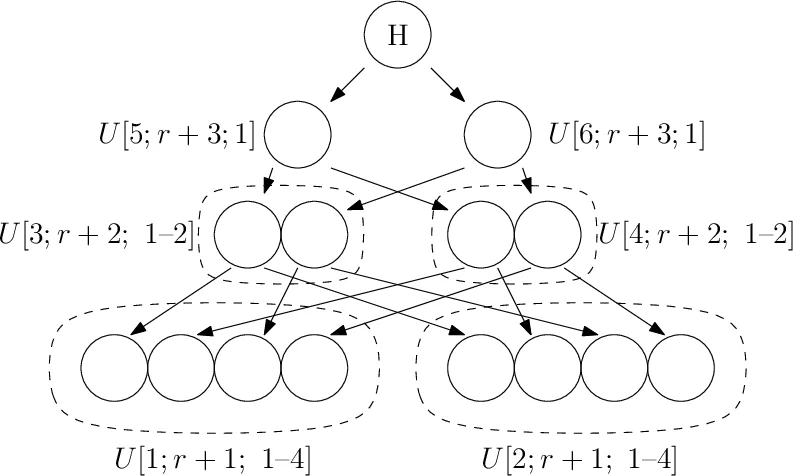
The authors first formalize the Atomic Broadcast requirements—Total Order, Agreement, and Censorship‑Resistance—within an asynchronous round‑based framework. They then introduce a two‑layer architecture: a network layer that maintains a shared Directed Acyclic Graph (DAG) called the Communication History (CH), and a protocol layer that drives consensus through combinatorial properties of this DAG. In each asynchronous round, every honest node broadcasts its current view of the CH, incorporates newly received transactions into the DAG, and checks whether a transaction has been seen by at least k honest nodes. If k ≥ Ω(N), the expected number of rounds until the transaction is output by all honest nodes is O(N/k) = O(1). Consequently, Aleph achieves constant‑time latency regardless of system load, a stark improvement over HoneyBadgerBFT (HBBFT), whose optimistic latency is Ω(log N) and degrades to Ω(β log N) under high contention.
Communication complexity is measured in machine words per node. In each round, every node sends O(N log N) data, leading to a per‑round cost of O(N² log N) and an overall cost of O(T + R·N² log N) over R rounds, where T is the total number of transactions injected during those rounds. This matches HBBFT’s optimal per‑transaction communication while delivering superior latency. Moreover, Aleph satisfies the “Responsiveness” property: progress is proportional to actual network throughput and is not hindered by predetermined timeouts.
A second major contribution is a trustless ABFT Randomness Beacon. Traditional ABFT protocols often rely on a trusted dealer to distribute correlated cryptographic keys. Aleph replaces this with a distributed key‑generation and multi‑signature scheme that yields a common, unpredictable random value without any trusted setup. This beacon can be used for leader election, threshold signatures, or any component that requires shared randomness, making the protocol fully suitable for permissionless blockchain environments.
The paper provides rigorous proofs of safety (no two honest nodes decide different orders) and liveness (every transaction submitted to an honest node eventually appears in the global order). The proofs exploit the DAG’s monotonic growth, the impossibility of forging signatures, and the bounded number of Byzantine nodes. An optional variant of Aleph achieves the 3‑round optimistic latency of partially synchronous protocols such as PBFT, demonstrating that the asynchronous design does not sacrifice best‑case performance.
In the discussion, the authors compare Aleph to prior work: HBBFT (optimal communication but logarithmic latency and trusted dealer), classic PBFT (requires synchrony assumptions and complex mode switching), and newer BFT protocols that either sacrifice latency or depend on setup assumptions. Aleph uniquely combines constant latency, optimal communication, and a dealer‑free randomness beacon.
The paper concludes by highlighting practical advantages: modular separation of network and logic layers simplifies implementation, the protocol’s simplicity reduces the risk of bugs, and the trustless beacon opens avenues for broader blockchain applications. Open challenges include quantifying the memory and CPU overhead of maintaining the DAG in large‑scale deployments, evaluating performance under realistic network conditions, and optimizing the constant factors hidden in the asymptotic bounds.
Comments & Academic Discussion
Loading comments...
Leave a Comment