A Reference Governor for Nonlinear Systems with Disturbance Inputs Based on Logarithmic Norms and Quadratic Programming
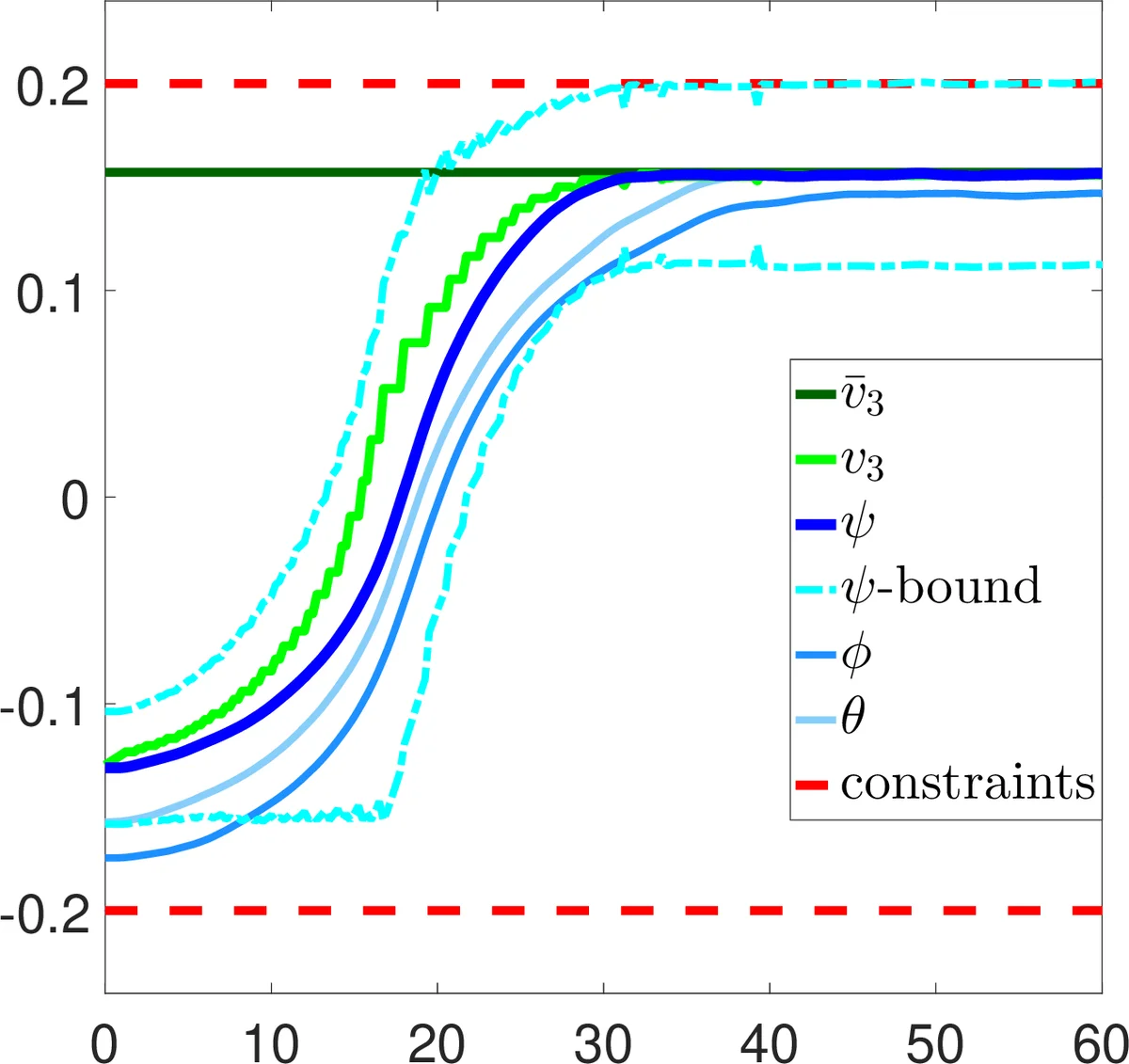
This note describes a reference governor design for a continuous-time nonlinear system with an additive disturbance. The design is based on predicting the response of the nonlinear system by the response of a linear model with a set-bounded prediction error, where a state-and-input dependent bound on the prediction error is explicitly characterized using logarithmic norms. The online optimization is reduced to a convex quadratic program with linear inequality constraints. Two numerical examples are reported.
💡 Research Summary
This paper presents a novel reference governor (RG) design for continuous‑time nonlinear systems subject to additive, unknown disturbances. The authors consider a plant described by (\dot x(t)=f(x(t),v(t))+w(t)), where the state (x\in\mathbb R^{n}), the reference input (v\in\mathbb R^{n_v}), and the disturbance (w) belongs to a known compact set (W) containing the origin. The control objective is to keep the state and input within polyhedral constraint sets (X) and (V) for all time while making the applied reference (v(t)) track a commanded signal (r(t)) as closely as possible.
Problem Setting and Limitations of Existing Approaches
Traditional RG schemes formulate at each sampling instant a constrained optimization problem that directly enforces the nonlinear state‑and‑input constraints over the entire prediction horizon and for all admissible disturbance trajectories. For general nonlinear systems this results in a non‑convex, infinite‑dimensional program that is computationally intractable in real time. Existing remedies—such as discretizing the dynamics, employing input‑to‑state stability (ISS) Lyapunov functions, or using conservative invariant set over‑approximations—either introduce sampling‑induced violations or lead to overly cautious behavior and slow convergence.
Linearization and Error Modelling
The authors linearize the nonlinear dynamics around an arbitrary equilibrium pair ((x_v(v),v)) to obtain a first‑order model
\
Comments & Academic Discussion
Loading comments...
Leave a Comment