Voltage Instability Prediction Using a Deep Recurrent Neural Network
This paper develops a new method for voltage instability prediction using a recurrent neural network with long short-term memory. The method is aimed to be used as a supplementary warning system for system operators, capable of assessing whether the current state will cause voltage instability issues several minutes into the future. The proposed method use a long sequence-based network, where both real-time and historic data are used to enhance the classification accuracy. The network is trained and tested on the Nordic32 test system, wherecombinations of different operating conditions and contingency scenarios are generated using time-domain simulations. The method shows that almost all N-1 contingency test cases were predicted correctly, and N-1-1 contingency test cases were predicted with over 93 % accuracy only seconds after a disturbance. Further, the impact of sequence length is examined, showing that the proposed long sequenced-based method provides significantly better classification accuracy than both a feedforward neural network and a network using a shorter sequence.
💡 Research Summary
**
The paper proposes a novel voltage‑instability‑prediction (VIP) scheme that leverages a deep recurrent neural network with long short‑term memory (LSTM) cells to exploit long‑term temporal information from power‑system measurements. Traditional dynamic security assessment (DSA) relies on time‑domain simulations, which are computationally intensive and unsuitable for real‑time operation. Existing machine‑learning‑based DSA methods usually feed only instantaneous snapshots of the system state into classifiers, implicitly assuming a Markov property that the future depends solely on the current measurement vector. In reality, voltage stability is influenced by hidden dynamic variables such as generator rotor speeds, transformer tap positions, and induction‑motor slips, which cannot be captured by a single static snapshot.
To address this, the authors design a three‑layer LSTM network that processes sequences of measurement vectors sampled at 1 Hz. Each input vector contains all bus voltage magnitudes, voltage angles, active and reactive power flows. No explicit information about the type or location of contingencies is provided; the network is expected to infer such relationships implicitly (e.g., a zero line flow indicating a tripped line). The LSTM’s gating mechanisms (forget, input, and output gates) enable the model to retain salient features over long horizons while discarding irrelevant data, thereby approximating the hidden state of the power system.
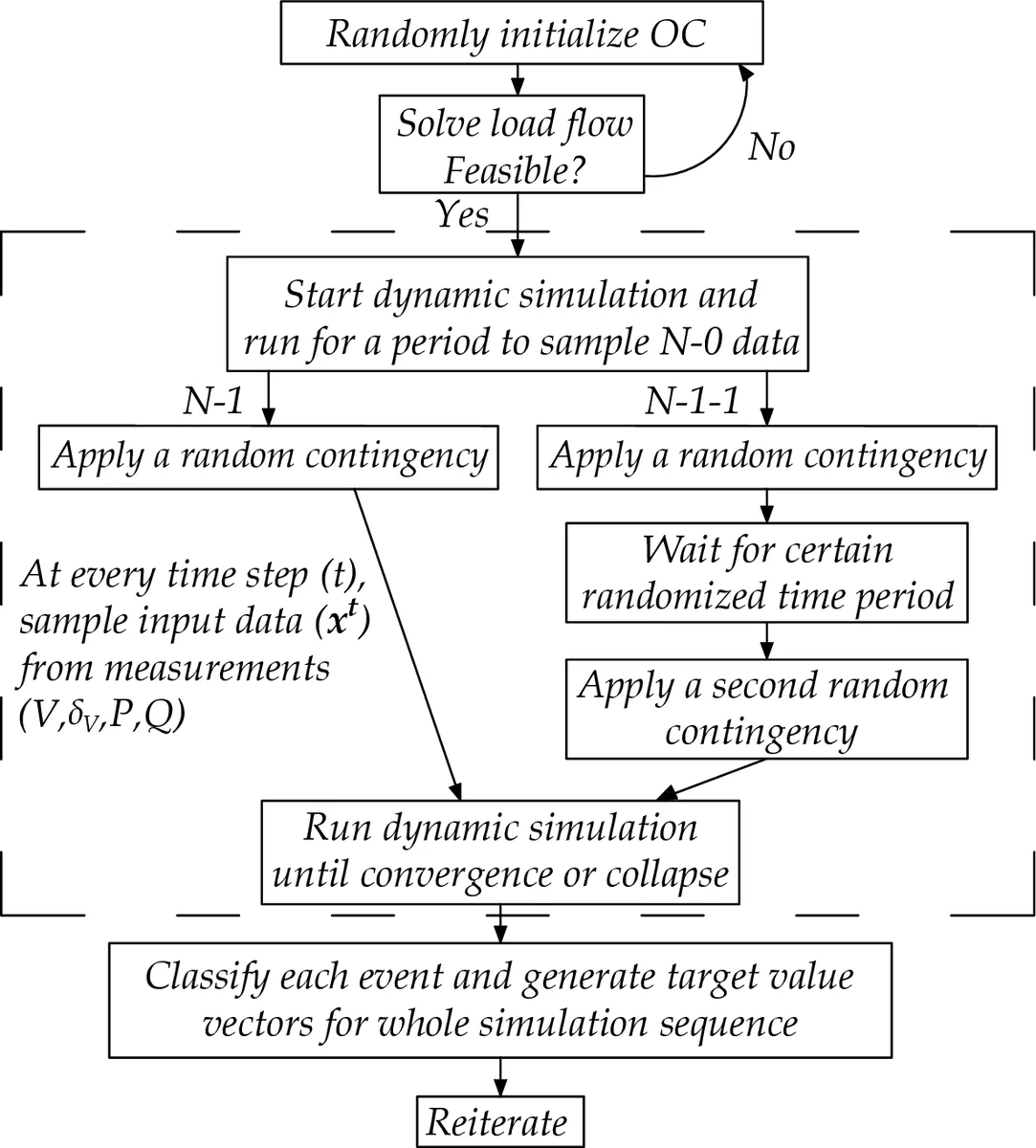
The training data are generated offline using the Nordic‑32 test system. Initial operating conditions (OCs) are randomly sampled around a base load (80 %–120 % of nominal) with uniform load distribution and constant power factor. After a power‑flow convergence check, each OC is subjected to dynamic simulations in PSS®E 34.2.0. Two simulation scenarios are created: (i) a single N‑1 contingency (major line fault or large generator outage) applied after 65 s of normal operation, and (ii) an N‑1‑1 scenario where a second random line outage occurs 10–30 s after the first. Each simulation runs up to 560 s or stops earlier if voltage collapse occurs. Measurements are recorded every second, forming a time‑ordered sequence of length 560 (or truncated earlier for collapsed cases). For each time step a target label is generated based on the final system condition at the end of the simulation: Stable (all bus voltages ≥ 1 pu), Alert (any bus voltage between 0.9 pu and 1 pu), or Emergency (any bus voltage < 0.9 pu). Alert cases are further subdivided into three geographical zones (C1, C2, C3) where the lowest voltage occurs, yielding five one‑hot encoded classes.
The LSTM network processes the 60‑step (60 s) sequence preceding each prediction, passes the final hidden state through a fully‑connected layer, and applies a softmax activation to output class probabilities. Training uses the cross‑entropy loss minimized by the Adam optimizer, with early stopping and a dropout of 0.2 to mitigate over‑fitting. Hyper‑parameters (e.g., 128 hidden units per layer) are chosen empirically.
Results show that the LSTM model achieves near‑perfect classification for N‑1 cases and over 93 % accuracy for N‑1‑1 cases, even though the latter involve two consecutive disturbances that dramatically increase system complexity. When compared with a conventional feed‑forward neural network (FFNN) trained on short (20 s) sequences, the long‑sequence LSTM improves accuracy by roughly 10–15 percentage points, demonstrating the value of temporal context. Moreover, the model operates in an online fashion: as new measurements arrive, the hidden state is updated, and the prediction is refreshed within seconds of a disturbance, providing operators with an early warning window of several minutes before a potential voltage collapse.
The authors acknowledge limitations: the dataset is confined to the Nordic‑32 system, so transferability to larger, more heterogeneous grids remains to be validated. Additionally, the simulations do not incorporate realistic measurement noise, communication delays, or data‑loss scenarios typical of phasor measurement units (PMUs). Future work is suggested to (a) extend the methodology to multiple test systems and real‑world PMU streams, (b) integrate uncertainty quantification, and (c) couple the VIP module with remedial‑action schemes for automated voltage‑support dispatch.
In summary, the paper demonstrates that a deep recurrent architecture exploiting long‑term measurement histories can substantially enhance voltage‑instability prediction, offering a practical, near‑real‑time decision‑support tool for system operators.
Comments & Academic Discussion
Loading comments...
Leave a Comment