Blind Identification of SFBC-OFDM Signals Using Subspace Decompositions and Random Matrix Theory
Blind signal identification has important applications in both civilian and military communications. Previous investigations on blind identification of space-frequency block codes (SFBCs) only considered identifying Alamouti and spatial multiplexing transmission schemes. In this paper, we propose a novel algorithm to identify SFBCs by analyzing discriminating features for different SFBCs, calculated by separating the signal subspace and noise subspace of the received signals at different adjacent OFDM subcarriers. Relying on random matrix theory, this algorithm utilizes a serial hypothesis test to determine the decision boundary according to the maximum eigenvalue in the noise subspace. Then, a decision tree of a special distance metric is employed for decision making. The proposed algorithm does not require prior knowledge of the signal parameters such as the number of transmit antennas, channel coefficients, modulation mode and noise power. Simulation results verify the viability of the proposed algorithm for a reduced observation period with an acceptable computational complexity.
💡 Research Summary
This paper addresses the problem of blind identification of space‑frequency block coded (SFBC) orthogonal frequency‑division multiplexing (OFDM) transmissions, a task that is essential for both civilian cognitive‑radio applications and military electronic‑warfare scenarios. Existing blind identification methods have largely focused on space‑time block codes (STBC) or on the Alamouti scheme and spatial‑multiplexing (SM) configurations, and they rely on time‑domain correlation properties that disappear when redundancy is introduced across frequency rather than time. Consequently, those techniques cannot be directly applied to SFBC‑OFDM, where the coding redundancy is spread over adjacent sub‑carriers within the same OFDM symbol.
The authors propose a novel algorithm that exploits the structure of SFBC‑OFDM by analyzing the signal and noise subspaces of received data on pairs of adjacent sub‑carriers. The key steps are as follows:
-
Signal Model and Sub‑space Formation – For a MIMO‑OFDM system with (N_t) transmit and (N_r) receive antennas, the channel matrix on sub‑carrier (k) is denoted (H_k). Because the channel is frequency‑selective but varies slowly across sub‑carriers, the authors assume (H_{k+1}\approx H_k). By stacking the real and imaginary parts of the received vectors from sub‑carriers (k) and (k+1), and using the Kronecker product, they construct an extended channel matrix (\bar H_k) of size (2N_r\times2N_t). The transmitted block can be expressed as a linear combination of independent symbols (\bar x_k) through code‑specific generator matrices (A_1(k)) and (A_2(k)).
-
Covariance Matrix and Eigenvalue Structure – The covariance of the stacked received vector (\tilde y_k(n)) is (\Sigma_k = \frac12 (I_2\otimes\bar H_k) M_k M_k^T (I_2\otimes\bar H_k^T) + \frac{\sigma_w^2}{2} I_{4N_r}), where (M_k) contains the real/imaginary parts of the generator matrices. The rank of (M_k M_k^T) equals (2m_k), where (m_k) is the number of independent symbols transmitted over the two sub‑carriers. Consequently, the smallest (4N_r-2m_k) eigenvalues of (\Sigma_k) are exactly the noise variance (\sigma_w^2/2). This property provides a direct link between the eigenvalue spectrum and the underlying SFBC code.
-
Random Matrix Theory (RMT) Based Dimension Test – To decide how many eigenvalues belong to the signal subspace, the authors employ a sequential binary hypothesis test. Using results from RMT, specifically the Tracy‑Widom distribution for the largest eigenvalue of a Wishart matrix, they derive an asymptotically accurate threshold (\gamma) that depends only on the number of observations and the matrix dimensions, not on the unknown SNR. If the largest eigenvalue exceeds (\gamma), the test declares an additional signal dimension; otherwise it stops. Repeating this test yields an estimate (\hat d_k = 2\hat m_k) for each sub‑carrier pair.
-
Feature Vector Construction – By sliding a frequency‑domain window across the OFDM band, a sequence of estimated dimensions (\hat d_k) is collected, forming a feature vector (\mathbf{f}). Different SFBC schemes produce distinct patterns in (\mathbf{f}) because each code uses a different number of independent symbols per sub‑carrier pair.
-
Special Distance Metric and Decision Tree – Direct comparison of (\mathbf{f}) with theoretical templates can be misleading in low‑SNR regimes where estimation errors are large. The authors therefore define a custom distance metric that combines the Euclidean distance with confidence weights derived from the hypothesis‑test outcomes (i.e., how far each eigenvalue lies above the threshold). This metric penalizes uncertain dimensions more heavily, improving robustness. A decision tree is then built, where each node corresponds to a binary discrimination (e.g., single‑antenna vs. multi‑antenna, Alamouti vs. other multi‑antenna codes). The tree uses the distance metric to prune candidates, resulting in logarithmic‑scale computational complexity.
-
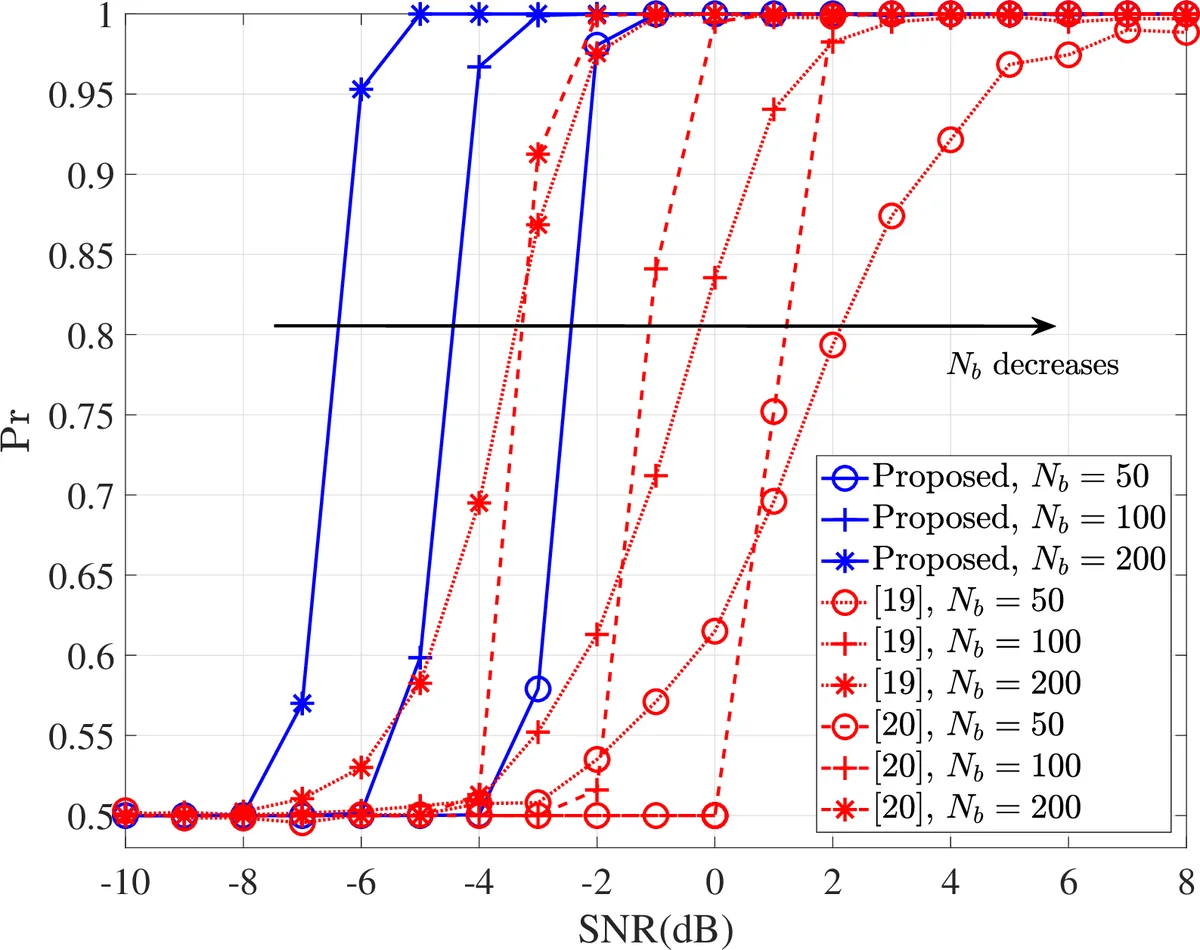
Performance Evaluation – Simulations are conducted with 64‑subcarrier OFDM, various antenna configurations (2–4 transmit, 2–4 receive), QPSK and 16‑QAM constellations, and realistic frequency‑selective fading channels. The observation window contains as few as 5–10 OFDM symbols. Results show that the proposed method achieves identification accuracies above 90 % even at 0 dB SNR, outperforming the authors’ prior work
Comments & Academic Discussion
Loading comments...
Leave a Comment