An investigation of alternative configurations of the read controllers of the Fermi LAT tracker
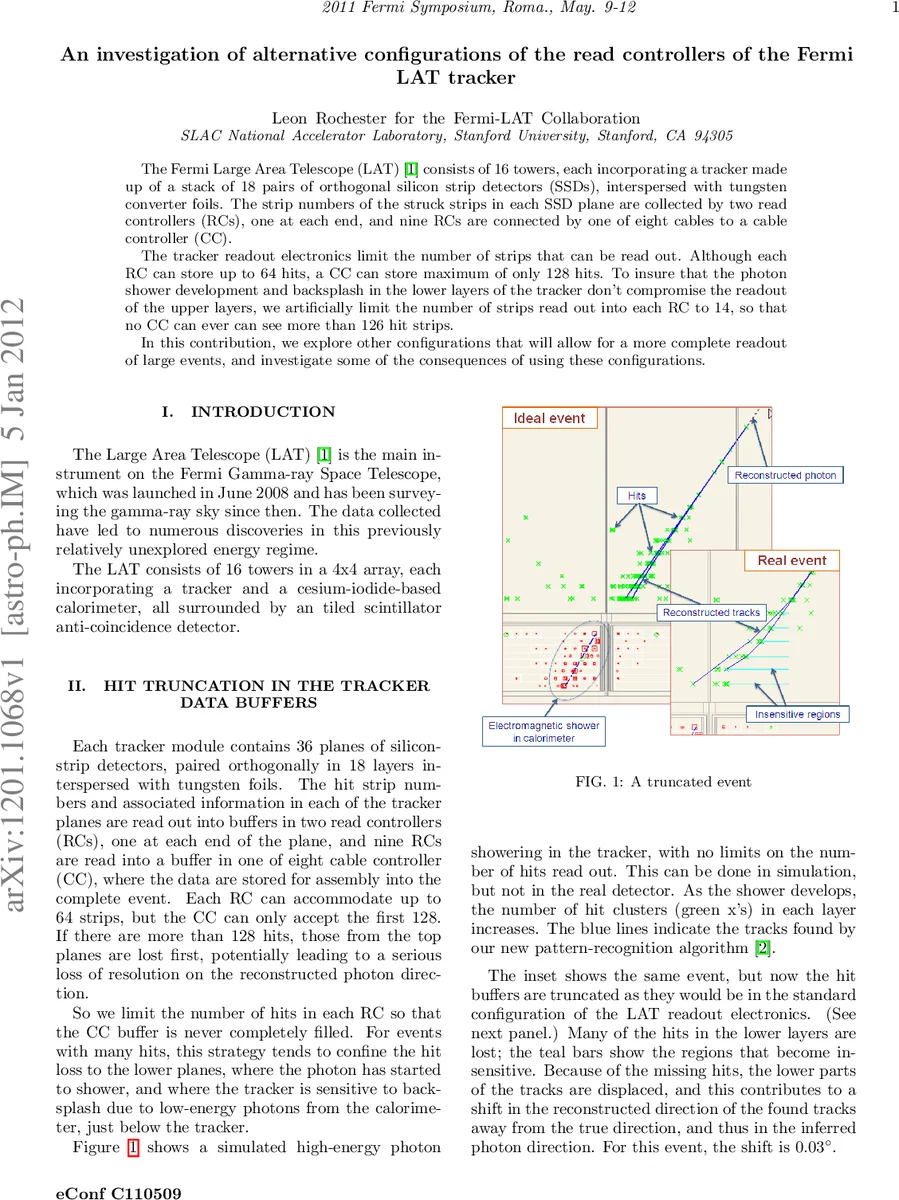
The Fermi Large Area Telescope (LAT) consists of 16 towers, each incorporating a tracker made up of a stack of 18 pairs of orthogonal silicon strip detectors (SSDs), interspersed with tungsten converter foils. The strip numbers of the struck strips in each SSD plane are collected by two read controllers (RCs), one at each end, and nine RCs are connected by one of eight cables to a cable controller (CC). The tracker readout electronics limit the number of strips that can be read out. Although each RC can store up to 64 hits, a CC can store maximum of only 128 hits. To insure that the photon shower development and backsplash in the lower layers of the tracker don’t compromise the readout of the upper layers, we artificially limit the number of strips read out into each RC to 14, so that no CC can ever can see more than 126 hit strips. In this contribution, we explore other configurations that will allow for a more complete readout of large events, and investigate some of the consequences of using these configurations.
💡 Research Summary
The Fermi Large Area Telescope (LAT) employs sixteen towers, each containing a silicon‑strip detector (SSD) tracker interleaved with tungsten converter foils. In each tracker plane the struck strip numbers are read out by two read controllers (RCs) located at opposite ends; nine RCs feed a single cable controller (CC). While an RC can buffer up to 64 hits, a CC can accept only the first 128 hits. To prevent the upper layers from being starved when a high‑energy photon creates a large shower, the current flight configuration artificially limits each RC to 14 hits, guaranteeing that no CC ever receives more than 126 hits. This safety margin, however, discards many useful hits, especially in the lower tracker where backsplash and shower cores generate the bulk of the information needed for precise direction reconstruction.
The authors investigate alternative readout schemes that make more efficient use of the existing hardware. The first proposal abandons the conventional “split‑plane” readout, in which each RC records hits from half of the SSD. Because the lateral spread of a shower is typically much smaller than the half‑width of the plane, most hits fall into one half. By reading the entire plane from a single end and alternating the readout end from plane to plane, the total number of hits presented to each CC remains unchanged, but the lost hits are shifted from the central region (where they most affect track fitting) to the plane edges. In a simulated high‑energy event this “alternating‑end” configuration reduces the number of lost hits from five to two compared with the standard scheme.
The second proposal introduces a “tapered” buffer allocation. The upper tracker layers encounter few conversion events and therefore generate few hits, while the lower layers experience dense hit patterns. By assigning a small buffer limit (e.g., 12 hits) to RCs in the top layers and progressively increasing the limit (up to 49 hits) toward the bottom, the overall CC capacity is never exceeded, yet the lower layers can retain a much larger fraction of their hits. This tapering can be implemented in onboard software without any hardware modifications.
Simulation results compare four configurations: an ideal case with no truncation, the tapered scheme, the alternating‑end scheme, the standard 14‑hit limit, and a “restricted” case where the RC limit is set to eight hits (used to emulate truncation on existing data). The average angular deviation of reconstructed tracks from the true photon direction (the point‑spread function) is 0.071° for the ideal case, 0.074° for the tapered scheme, 0.077° for the alternating‑end scheme, 0.092° for the standard configuration, and 0.144° for the restricted case. Thus, both proposed schemes improve the point‑spread function by roughly 20 % relative to the current flight configuration.
The paper also discusses practical concerns. Changing the distribution of hits between RCs may affect trigger timing, potentially degrading the hardware trigger efficiency for high‑rate events. Reducing the granularity of hit timing could impair the identification of out‑of‑time “ghost” tracks, which rely on precise time stamps from both ends of a plane. Moreover, the reconstruction software would need to accommodate variable buffer limits and alternating readout directions, increasing offline processing complexity and CPU time.
To validate the proposals, the authors recommend a series of next steps: (1) extend the simulation to include photons arriving at all incident angles and realistic background events; (2) apply the restricted‑8‑hit configuration to existing flight data to compare simulated and real truncation effects; (3) conduct on‑orbit tests with the new configurations uploaded via the existing software update mechanism; and (4) evaluate the impact on trigger performance, ghost‑track rejection, and reconstruction latency.
In summary, the study demonstrates that modest software‑level re‑configuration of the LAT tracker readout can substantially reduce hit loss in high‑multiplicity events, leading to a measurable improvement in angular resolution without any hardware changes. If the operational concerns are addressed, adopting either the alternating‑end or tapered‑buffer scheme could enhance the scientific return of the Fermi LAT, especially for the highest‑energy γ‑ray photons where precise direction reconstruction is most critical.
Comments & Academic Discussion
Loading comments...
Leave a Comment