Observation of shadowing of the cosmic electrons and positrons by the Moon with IACT
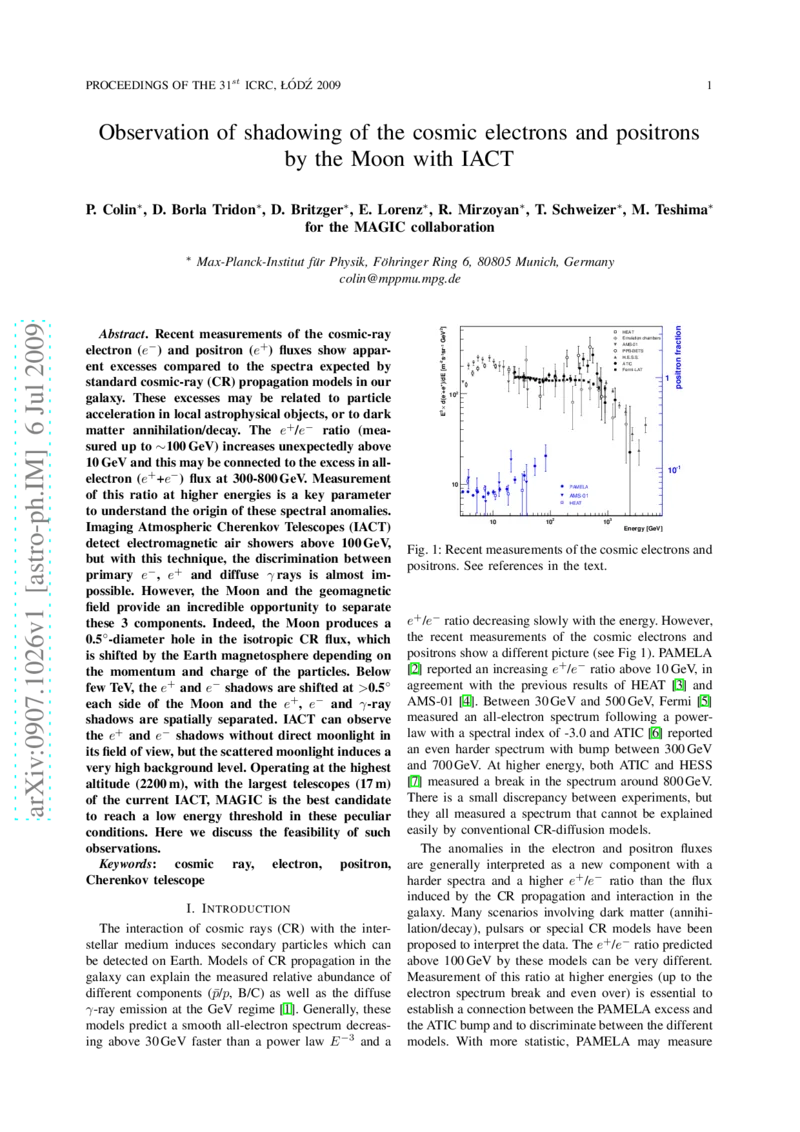
Recent measurements of the cosmic-ray electron (e-) and positron (e+) fluxes show apparent excesses compared to the spectra expected by standard cosmic-ray (CR) propagation models in our galaxy. These excesses may be related to particle acceleration in local astrophysical objects, or to dark matter annihilation/decay. The e+/e- ratio (measured up to ~100 GeV) increases unexpectedly above 10 GeV and this may be connected to the excess measured in all-electron flux at 300-800 GeV. Measurement of this ratio at higher energies is a key parameter to understand the origin of these spectral anomalies. Imaging Atmospheric Cherenkov Telescopes (IACT) detect electromagnetic air showers above 100 GeV, but, with this technique, the discrimination between primary e-, e+ and diffuse gamma-rays is almost impossible. However, the Moon and the geomagnetic field provide an incredible opportunity to separate these 3 components. Indeed, the Moon produces a 0.5deg-diameter hole in the isotropic CR flux, which is shifted by the Earth magnetosphere depending on the momentum and charge of the particles. Below few TeV, the e+ and e- shadows are shifted at >0.5deg each side of the Moon and the e+, e- and gamma-ray shadows are spatially separated. IACT can observe the e+ and e- shadows without direct moonlight in the field of view, but the scattered moonlight induces a very high background level. Operating at the highest altitude (2200m), with the largest telescopes (17m) of the current IACT, MAGIC is the best candidate to reach a low energy threshold in these peculiar conditions. Here we discuss the feasibility of such observations.
💡 Research Summary
Recent measurements by PAMELA, AMS‑01, Fermi‑LAT, ATIC, and H.E.S.S. have revealed an unexpected rise in the cosmic‑ray electron (e⁻) and positron (e⁺) spectra above the energies predicted by conventional Galactic propagation models. While the e⁺/e⁻ ratio is known to increase above ~10 GeV, the all‑electron spectrum shows a pronounced bump between 300 GeV and 800 GeV and a break around 800 GeV. Determining the e⁺/e⁻ ratio at TeV energies is crucial for discriminating among competing explanations such as nearby pulsars, supernova remnants, or dark‑matter annihilation/decay. Satellite and balloon experiments are limited in exposure and sensitivity above a few hundred GeV, motivating the exploration of ground‑based techniques.
Imaging Atmospheric Cherenkov Telescopes (IACTs) such as MAGIC can detect electromagnetic air showers above ~100 GeV with excellent angular (≈ 0.1°) and energy (≈ 15%) resolution, but they cannot directly separate electrons from positrons or diffuse gamma rays. The Moon provides a natural “spectrometer”: it blocks a 0.5°‑diameter cone of isotropic cosmic rays, creating a deficit (the Moon shadow) in the observed flux. The Earth’s geomagnetic field deflects charged particles east‑west by an amount proportional to charge‑to‑energy (Z/E). Consequently, electrons (negative charge) are shifted eastward, positrons (positive charge) westward, while neutral gamma rays remain aligned with the Moon’s true position. For energies between 300 GeV and 1 TeV the expected deflection is > 0.5°, sufficient to spatially separate the e⁻, e⁺, and γ‑ray shadows with the resolution of current IACTs.
The authors model the geomagnetic field using a centered dipole approximation (accurate to ~10 %) and calculate deflection angles as a function of particle energy, observer latitude (MAGIC’s site at La Palma), and Moon elevation. They find that at zenith the deviation is ≈ 1.3° · (Z/E
Comments & Academic Discussion
Loading comments...
Leave a Comment