On the Finsler metrics obtained as limits of chessboard structures
We study the geodesics in a planar chessboard structure with two values 1 and $\beta>1$. The results for a fixed structure allow us to infer the properties of the Finsler metrics obtained, with an homogenization procedure, as limit of oscillating che…
Authors: Micol Amar, Graziano Crasta, Annalisa Malusa
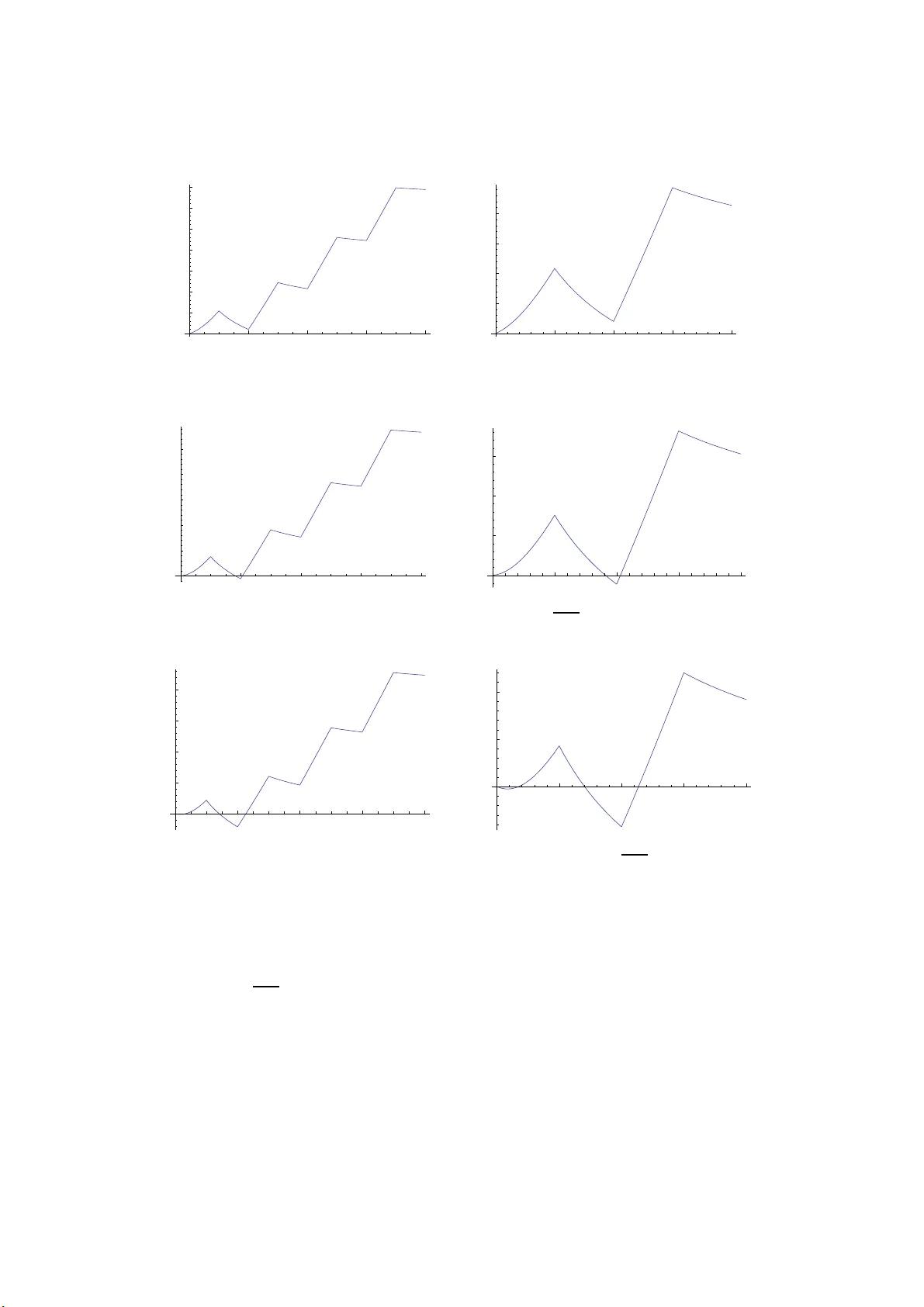
ON THE FINSLER METRICS OBT AINED AS LIMITS OF CHESSBOAR D STR UCTURES MICOL AMAR, GRAZIANO CRAST A, AND ANNALISA MALUSA Abstra ct. W e study the geo desics in a planar chess b oard structure with tw o v alues 1 and β > 1. The results for a fixed structure allow us to infer th e properties of the Finsler metrics obtained, with an homogenization pro cedure, as limit of oscillating chessboard structures. 1. Introduction In this pap er we deal with optical paths in a dioptric material with p arallel geometry and a c h essb oard str u cture on transv ersal p lanes. F urther to a b idimensional redu ction, w e fix the optical features of the comp osite material in terms of its refractiv e index: giv en β > 1, let us define on [0 , 2) × [0 , 2) the function (1) a β ( x, y ) = ( β , if ( x, y ) ∈ [(0 , 1) × (1 , 2)] ∪ [(1 , 2) × (0 , 1)] , 1 , otherwise , and extend it b y p erio dicit y to a function defined on R 2 whic h we still denote by a β . Hence, normalizing to 1 the sp eed of ligh t in the v acuum, light trav els in the dioptric material with a sp eed 1 /a β . Since we are dealing with a system emplo ying only refraction, F ermat’s pr inciple dictates that th e optical paths b et wee n t wo p oin ts minim ize the optical p ath length, whic h coincides with the time sp en t. Th us, in an h omoge neous material, where the sp eed of light is constan t, the optical path is a segmen t. Moreo v er, F ermat’s principle leads to Snell’s la w of refraction, which completely d escrib es the optical p aths in lay ered materials (see [ ? ] for a compr ehensiv e in tro duction on the principles of optics). The explicit descrip tion of the optical p aths in the c hessb oard str u cture b ecomes h arder since, for example, no necessary condition prescrib es their b eha viour at corner s . F rom a geometrical viewp oint, we are inte rested in the description of th e geod esics in the Riemannian structure ( R 2 , a β ), that hereafter w ill b e called standa r d chessb o ar d structur e . W e shall refer to light squar es or to dar k squ ar es , when, resp ectiv ely , a β = 1 or a β = β . In the mathematical mo del, a v ir tual path emanate d fr om the origin is a solution u : [0 , T ] → R 2 to the differenti al inclusion (2) ( u ′ ( t ) ∈ G β ( u ( t )) , 0 ≤ t ≤ T , u (0) = 0 , where th e set–v alued map (with noncon v ex v alues) G β is defined by G β ( x, y ) = 1 a β ( x, y ) ∂ B 1 (0) , ( x, y ) ∈ R 2 Date : April 28, 2008. Key wor ds and phr ases. Minim u m time problems, F ermat’s Principle, Finsler metrics. 1 2 M. AMA R, G. CRAST A, A ND A. MALUSA (see e.g. [ ? ] for an introd uction to differen tial in clusions). F ermat’s Principle states that a ra y of ligh t from O to ξ is a solution of the minimum time p roblem with target ξ (3) T β ( ξ ) = inf { T ≥ 0; ∃ u ( · ) solution of ( 2 ), with u ( T ) = ξ } . In [ ? ] it is pro v ed that the infim u m in ( 3 ) is r eac hed. Moreo ve r, if u ( · ) is a solution of (2) satisfying u ( T ) = ξ , then the optical length of the curve Γ = { u ( t ); 0 ≤ t ≤ T } is L β (Γ) = Z T 0 a β ( u ( t )) | u ′ ( t ) | dt = T . Then optical p aths are geo desic cur v es in the Riemannian structure ( R 2 , a β ). W e un derline again that the global minimization pro cedure consid ers only r efracted ra ys, excludin g all reflected ra ys , b ecause a reflected ra y is never a global geo desics. Hence our results ha v e a reasonable ph ysical meaning either if the num b er of in terfaces tra v ersed in the p erio dic media is n ot very h igh, or f or β n ear to 1, since in b oth cases the reflected ligh t ca n b e neglected. Anyho w the results are in tended as a depiction of curves of minimal length in the Riemannian structure ( R 2 , a β ). A starting p oint is the elementa ry observ ation that, for β > 2, any geo desic joining t wo p oin ts in the light m ateria l (i.e. in the set { a β = 1 } ) is a “ligh t path”, i.e. it n ev er crosses the d ark material. With little more w ork it is n ot d ifficult to prov e the same conclusion if β > √ 2, pro v id ed that the endp oin ts of the geo desic ha v e integ er coord inates. Moreo ve r, the v alue β = √ 2 is an optimal th reshold in this class of geo desics, since the diagonal of a dark square is a geodesic for eve ry β ≤ √ 2. In this p ap er we obtain a p erhaps surpr ising result, f o cusin g our atten tion to geodesics joining t wo p oint s with co ordinates (2 n + j, j ), n , j ∈ Z , that we call light vertic es . F or β ≥ p 3 / 2 w e depict explicitl y the geodesics j oining the origin to a ligh t vertex. As a consequence, w e pro v e th at the threshold v alue for the minimalit y of ligh t paths is giv en b y β c 0 ∈ ( p 3 / 2 , √ 2), whic h is exactly the v alue of β suc h that the op tical path joining O with the light v ertex (3 , 1) has the same length (2 + √ 2) o f the optimal ligh t paths. More precisely , we sho w that f or β > β c 0 the geo desics are optimal ligh t paths, wh ereas f or p 3 / 2 < β < β c 0 the minimal cu rv es are constructed concatenating the maximal n um b er of translations of the optical path joining O with (3 , 1), w ith segmen ts either on the sid es of the squares or on light d iago nals. F or 1 < β < p 3 / 2 the c haracterization of the geo desics seems to b e a h ard p r oblem, for reasons that will b e clarified in S ectio n 5. An yho w , we are able to compute the optical paths joinin g th e origin to a ligh t v ertex in a small cone { 0 ≤ K y ≤ x } , where K = K ( β ) is an o d d p ositive in teger, w h ose v alue div erges to + ∞ as β app r oac hes 1. The kn o wledge of the min imal length of curves j oining the origin to ligh t ve rtices in the c h essb oard stru cture is enough to c haracterize the so-called homogenized mo del. Namely , the results describ ed ab o ve give information a b out the optic al paths in an inhomoge- neous dioptric material wh ose observed refractiv e index, at a mesoscopic lev el, is giv en b y the c hessb oard structure, that is the observe d refractiv e ind ex at a giv en scale ε > 0 is a ε β ( x, y ) = a β ( x/ε, y /ε ) . W e are in terested in the b eha vior of the optical length of geod esics when ε → 0. LIMITS O F CHESSBOARD STRUCTURES 3 W e already know that, at the scale ε , a virtual path emanated from th e origin is a solution u : [0 , T ] → R 2 of the differen tial inclusion (4) u ′ ( t ) ∈ 1 a ε β ( u ( t )) ∂ B 1 (0) , 0 ≤ t ≤ T , u (0) = 0 , and F ermat’s Prin ciple states that a r ay of ligh t f rom O to ξ is a solution of the minimum time p roblem with target ξ (5) T ε β ( ξ ) = inf { T ≥ 0; ∃ u ( · ) solution of (4), with u ( T ) = ξ } . W e are int erested in the c haracterizati on o f the limit, as ε → 0, of the minim um time problems (4)–(5). The minimum time problems can b e rephrased in terms of minimum problems of the Calculus of V ariations. Let u s d en ote by L ε β the le ngth functional in the c hessb oard structure corresp onding to a ε β , that is L ε β ( u ) = Z 1 0 a ε β ( u ( t )) | u ′ ( t ) | dt , u ∈ AC ([0 , 1] , R 2 ) , and by d ε β (0 , ξ ) the distance b et ween O an d ξ in su c h a stru cture, that is (6) d ε β (0 , ξ ) = inf n L ε β ( u ) : u ∈ AC ([0 , 1]; R 2 ) s.t. u (0) = 0 , u (1) = ξ o . If u ( · ) is a solution of (4) satisfying u ( T ) = ξ , then T equals the optical length of the curv e Γ = { u ( t ); 0 ≤ t ≤ T } so that (7) T ε β ( ξ ) = d ε β (0 , ξ ) , ξ ∈ R 2 . The adv anta ge of this form ulation is th at the asymptotic b eha vior of d ε β can b e d iscussed in terms of Γ–conv ergence of the functionals F ε β (see e.g. [ ? ] for an in tro duction to Γ– con vergence) . In [ ? ] it was sh o wn that the sequence ( L ε β ) Γ–conv erges in AC ([0 , 1] , R 2 ) (w.r.t. th e L 1 top ology) to the f unctional L hom β ( u ) = Z 1 0 Φ β ( u ′ ( t )) dt , u ∈ AC ([0 , 1] , R 2 ) , where Φ β : R 2 → [0 , + ∞ ) is a conv ex, p ositiv ely 1-homogeneous function, such that | ξ | ≤ Φ β ( ξ ) ≤ β | ξ | for every ξ ∈ R 2 . As a consequence, Φ β turns out to b e a homogeneous Finsler metric in R 2 (see e.g. [ ? ] for an introd uction to Finsler geometry). In [ ? ] it is sho wn th at Φ β is not a Riemannian metric in R 2 for ev ery β > 1. In this pap er w e shall refine this result pro ving that the optical unit ball { Φ β ≤ 1 } is neither strictly conv ex nor differen tiable (see Theorem 6.4 and Corollary 6.5 b elo w). Since Φ β is charac terized b y Φ β ( ξ ) = lim ε → 0 + d ε β (0 , ξ ) , then th e limit of the minim um time problems (4)–( 5 ) is giv en b y T β ( ξ ) = inf { T ≥ 0; ∃ u ( · ) suc h that Φ β ( u ′ ( t )) = 1 , u (0) = 0 , u ( T ) = ξ } = Φ β ( ξ ) . This is what we hav e calle d homogenized mod el related to the c hessb oard structure. Since Φ β is p ositiv ely 1-homogeneous, it is completely determined by th e geometry of th e optical unit sph ere { Φ β = 1 } , w h ic h is, in some sense, a generalized geometric wa ve fron t with sour ce p oin t lo cated at O . Moreo v er, due to elemen tary symmetry prop erties, it is enough to describ e th e set { Φ β = 1 } ∩ { 0 ≤ y ≤ x } . 4 M. AMA R, G. CRAST A, A ND A. MALUSA Starting from our results on chessb oard structures, we obtain that, if β ≥ β c 0 , then the homogenized metric is (8) Φ β ( x, y ) = ( √ 2 − 1) min {| x | , | y |} + max {| x | , | y |} , ∀ ( x, y ) ∈ R 2 , and th e geo metric w a vefron t { Φ β = 1 } is the r egular octagon inscrib ed in the u n it circle, whose v ertices lie on the coordinate axes and on the diagonals. This resu lt generalizes the tr ivial remark concerning the case β ≥ 2 (see [ ? ]). On th e other, w e ob tain that the o ctag onal geometry o f the w a vefron t breaks for β = β c 0 , and the optical u nit sphere b ecomes an irregular p olygon with s ixteen sides for p 3 / 2 ≤ β < β c 0 (see Figure 11). These are t wo of the main results of our pap er; we refer to Theorem 6.3 b elo w for their precise statemen t. F or 1 < β < p 3 / 2 we will b e able to compute the optical u nit ball in the t w o small cones { K | y | ≤ | x |} and { K | x | ≤ | y |} , where K = K ( β ) is the o dd p ositiv e inte ger introd u ced ab o ve for the c hessb oard structur e. More pr ecisel y , we shall sh o w that in these regions the b oundary { Φ β = 1 } is piecewise fl at with corners at the p oin ts (1 , 0), (0 , 1), ( − 1 , 0), and (0 , − 1) (see Th eorem 6.4). As a consequence, the optical un it ball { Φ β ≤ 1 } is n either strictly conv ex nor differen tiable. W e co nclude this introdu ction with a warning on the physica l inte rpretation of our results concerning the homoge nized mod el. First of all, the ge ometrical optics approxi- mation is v alid if the lengthscale ε is muc h greater than the w av elength of light. If ε is of the same ord er of magnitude of the w a v elength, then w e fall in the domain of photonic crystals optics, for whic h the full sys tem of Maxw ell equations must b e considered. On the other hand, ev en in the range of geometric optics, ou r global min imizati on pro cedure considers only refracted ra ys, excludin g all r eflected rays. Since, at a macroscopic leve l, the n um b er of interfaces tra versed in the p erio dic media can b e v ery high, the refl ecte d ligh t cannot in general b e neglected. In the pap er the follo wing notation will b e used. • [ [ P , Q ] ]: closed segmen t joining P , Q ∈ R 2 • ] ] P , Q ] ] = [ [ P , Q ] ] \ { P } , [ [ P , Q [ [ = [ [ P , Q ] ] \ { Q } • [ [ P 1 , P 2 , . . . , P n ] ]: p olygonal line joining the ordered set of p oin ts P 1 , P 2 , . . . , P n . • ⌊ t ⌋ = max { k ∈ Z : k ≤ t } . • f s = ∂ f ∂ s : p artial deriv ativ e of a function f with resp ect to s • S ( A, B ): S n ell path j oining A to B (defined in S ectio n 2) • L β (Γ) = L 1 β (Γ): length of Γ in the standard chessb oard stru cture (optical length). 2. Snell p a ths Let u s consider the fl at Riemannian structure ( R 2 , a β ), where a β ( x, y ) = ( 1 if ⌊ x ⌋ is eve n , β if ⌊ x ⌋ is o dd , β ∈ R , β > 1 . Note that this stru cture corresp onds to a comp osite medium whose structure is made b y alternate v er tical strip s of light and dark material. It is well kn o wn that for eve ry pair A = ( x A , y A ), B = ( x B , y B ) ther e exists a unique curv e of minimal le ngth (t he geo desic curv e) j oinin g A to B , whic h is an affine path in LIMITS O F CHESSBOARD STRUCTURES 5 dark light p q B A B A θ 2 θ 1 h Figure 1. A Snell path in the lay ered material and the equ iv alen t Sn ell path w ith a single int erface. ev ery v ertical strip {⌊ x ⌋ = k } , k ∈ Z . Moreo v er, at every inte rface b etw een t wo strips, the c h ange of slop e is go v er n ed b y the Snell’s Law of refraction (9) sin θ 1 = β sin θ 2 , where θ 1 and θ 2 are the angles of incidence with the interface from the ligh t strip and the dark s trip, resp ectiv ely (see, e.g., [ ? , § 3.2.2] or [ ? , § 3.4] ). In the sequel, this geo desic cur v e will b e called the Snel l p ath joining A and B and will b e denoted by S ( A, B ). In order to fix th e ideas, we shall alwa ys assu me that x A < x B , and y A ≤ y B . W e shall refer to the p ositiv e quantit y x B − x A as the thickness of the Snell path. Let p , q ≥ 0 b e, resp ectiv ely , the thic kness of the ligh t and of the dark zone crossed b y the path S ( A, B ), so that x B − x A = p + q , and let h b e the v ertical height h = y B − y A . Since h = p tan θ 1 + q tan θ 2 (see Figure 1 ), and (9) holds true, then ˆ σ ( p, q , h ) = sin θ 1 is implicitly d etermined in term of p , q and h b y the constrain t (10) p ˆ σ √ 1 − ˆ σ 2 + q ˆ σ p β 2 − ˆ σ 2 = h . Clearly , ˆ σ ( p, q , h ) is a strictly decreasing fu nction w.r.t. p and q , wh ile it is a strictly increasing function w.r.t. h . Finally , the optical length of the S nell path S ( A, B ), giv en b y p/ cos θ 1 + β q / cos θ 2 , can b e expressed in terms of p , q and h taking again in to accoun t ( 9 ): (11) L ( p, q , h ) := p q 1 − ˆ σ ( p, q , h ) 2 + β 2 q q β 2 − ˆ σ ( p, q , h ) 2 . Lemma 2.1. L et ˆ σ and L b e define d by (10) and (11) r esp e ctively. Then L p ( p, q , h ) = p 1 − ˆ σ 2 , L q ( p, q , h ) = q β 2 − ˆ σ 2 , for every p , q ≥ 0 , and for every h ∈ R . Pr o of. Differen tiating (10) w.r .t. p , w e get ˆ σ √ 1 − ˆ σ 2 + p ˆ σ p (1 − ˆ σ 2 ) 3 / 2 + β 2 q ˆ σ p ( β 2 − ˆ σ 2 ) 3 / 2 = 0 . 6 M. AMA R, G. CRAST A, A ND A. MALUSA q(t) t p(t) A B Figure 2. The solid line corresp ond s to the Snell path S ( A, B ), wh ile the dashed line is a minimal path j oinin g A and B without crossing the dark squares. Hence L p ( p, q , h ) = 1 √ 1 − ˆ σ 2 + p ˆ σ p ˆ σ (1 − ˆ σ 2 ) 3 / 2 + β 2 q ˆ σ p ˆ σ ( β 2 − ˆ σ 2 ) 3 / 2 = 1 √ 1 − ˆ σ 2 − ˆ σ 2 √ 1 − ˆ σ 2 = p 1 − ˆ σ 2 . By an analogous computation one obtai ns the exp ression for L q . R emark 2.2 . By L emm a 2.1, it follo w s that, giv en the thic kness τ = p + q and the heigh t h ∈ R of a Snell p ath w e hav e that d dq L ( τ − q , q , h ) = − p 1 − ˆ σ 2 + q β 2 − ˆ σ 2 > 0 . The geometrical meaning of this formula is clear: f or Sn ell paths with fixed thic kness, the more is th e thickness of the dark material crossed, the more is the optical length of the path. 3. The n ormalized l ength Let u s consider no w R 2 endo w ed with the standard c h essb oard structur e. Definition 3.1 . The n -th light dia gonal , n ∈ Z , is t he straigh t line D n of equation y = x − 2 n . A light vertex is a p oin t ha vin g integer co ordinates and b elonging to a ligh t diagonal. Definition 3 .2. Giv en t w o p oin ts A and B in the same horizon tal strip { y ∈ [ r , r + 1] } , r ∈ Z , the Snell path j oining A to B (in the c h essb oard structure) is th e geo desic S ( A, B ) in the corresp onding p arallel la yer structure a ( x + r, y ). W e are in terested in the pr op erties of the Snell p aths sta rting from a light v ertex A (sa y A = O , without loss of generalit y) and endin g in a p oin t B on the other side of th e horizon tal strip con taining A (sa y B = ( x B , 1), x B > 0) (see Figure 2 ). If 0 < x B ≤ 1, clearly S ( O , B ) = [ [ O , B ] ] is the unique geo desic joining O to B . On the other h and, S ( O , B ) need not to b e a geo desic when x B > 1. Namely , w e al ready kno w that for β large enough the optica l length of S ( O , B ) is strictly greate r than the optical length of the path obtained b y a concatenatio n of horizont al segmen ts on the lines x = 0 or x = 1, with tota l length x B − 1, and a segmen t on a ligh t diagonal, with length √ 2. In this section w e discuss the b eha vior of the difference L β ( S ( O , B )) − x B + 1 − √ 2 LIMITS O F CHESSBOARD STRUCTURES 7 0 5 10 15 20 25 30 t 0.1 0.2 0.3 0.4 0.5 0.6 0.7 Σ H t, Β L Figure 3. Plot of ˆ σ ( t, β ), β = 1 . 15. for x B ≥ 1. T o this ai m, for t ≥ 0 and β ≥ 1, with some abuse of notati on w e define ˆ σ ( t, β ) = ˆ σ ( p ( t ) , q ( t ) , 1), wh ere (12) q ( t ) = ( ⌊ t +1 ⌋ 2 if ⌊ t ⌋ is o dd , t − ⌊ t ⌋ 2 if ⌊ t ⌋ is eve n , and p ( t ) = t + 1 − q ( t ). Recall that ˆ σ ( t, β ) is d etermined by the co nstrain t (13) p ( t ) ˆ σ √ 1 − ˆ σ 2 + q ( t ) ˆ σ p β 2 − ˆ σ 2 − 1 = 0 . As a consequence we hav e (14) ˆ σ t ( t, β ) = − ˆ σ p t √ 1 − ˆ σ 2 − ˆ σ q t p β 2 − ˆ σ 2 p (1 − ˆ σ 2 ) 3 / 2 + β 2 q ( β 2 − ˆ σ 2 ) 3 / 2 < 0 , t > 0 , t 6∈ N , since p t ( t ), q t ( t ) ≥ 0, and p t ( t ) + q t ( t ) = 1 for ev ery t > 0, t 6∈ N . Thus the map t 7→ ˆ σ ( t, β ) is strictly decreasing in [0 , + ∞ ), and satisfies ˆ σ (0 , β ) = 1 / √ 2, lim t → + ∞ ˆ σ ( t, β ) = 0 (see Figure 3). Moreo ve r, as a straigh tforw ard consequence of the Imp licit F unction T h eorem, we hav e that ˆ σ β ( t, β ) > 0 for every t > 0. In particular w e ha ve (15) ˆ σ ( t, β ) > ˆ σ ( t, 1) = 1 p (1 + t ) 2 + 1 , ∀ t > 0 , ∀ β > 1 . Definition 3.3. W e shall call normalize d length the fun ction (16) l ( t, β ) := p ( t ) q 1 − ˆ σ ( t, β ) 2 + β 2 q ( t ) q β 2 − ˆ σ ( t, β ) 2 − t − √ 2 . Notice that l ( t, β ) is the length of the Snell path joining th e origin (0 , 0) w ith the p oin t ( t + 1 , 1) normalized b y subtracting the minimal length of th e paths joining th e same t wo p oin ts without crossing the dark squ ares (see Figure 2 ). In order to simplify the notatio n w e introd uce the sets I L = [ k ∈ N (2 k + 1 , 2 k + 2) , I D = [ k ∈ N (2 k, 2 k + 1) . If t ∈ I L then the last segment of the Snell path is in the interior of a light square, while, if t ∈ I D , it is in the interior of a dark square. 8 M. AMA R, G. CRAST A, A ND A. MALUSA The b asic prop erties of the normalized length are collected in the follo wing lemma. Lemma 3.4. The fol lowing pr op erties hold. (i) l t ( t, β ) = p 1 − ˆ σ 2 ( t, β ) − 1 for e v ery t ∈ I L ; (ii) l t ( t, β ) = p β 2 − ˆ σ 2 ( t, β ) − 1 for e v ery t ∈ I D ; (iii) l ( · , β ) is strictly c onvex in any interval of I L ∪ I D ; (iv) l ( · , β ) is strictly monoto ne de cr e asing in any i nterval of I L ; (v) if β ≥ p 3 / 2 , then l ( · , β ) is strictly mono tone incr e asing in any i nterval of I D ; (vi) if 1 < β < p 3 / 2 , then ther e exists a unique t 0 > 0 , char acterize d by ˆ σ ( t 0 , β ) = p β 2 − 1 , and such that l t ( t, β ) < 0 , ∀ t ∈ [0 , t 0 ) ∩ I D , l t ( t, β ) > 0 , ∀ t ∈ ( t 0 , + ∞ ) ∩ I D . Pr o of. The deriv ativ es in (i) and (ii) follo w fr om Lemma 2.1, up on observin g that p t = 1 and q t = 0 in I L , while p t = 0 and q t = 1 in I D . Clearly (i) imp lies (iv), while (ii) and the fact that 0 ≤ ˆ σ 2 ( t, β ) ≤ 1 / 2 imply (v) and (vi). (iii) follo ws from (i), (ii), and the fact that ˆ σ ( · , β ) is a decreasing fu nction. In conclusion, since l (0 , β ) = 0 for every β ≥ 1, b y Lemma 3. 4 w e ha ve that, for β ≥ p 3 / 2, l ( t, β ) > 0 for t ∈ (0 , 1) and the lo cal m inima of l ( · , β ) are attained at t = 2 k , k ∈ N , corresp onding to the Sn ell p aths ending in the light v ertices (see Figures 5 and 4). On the contrary , if β < p 3 / 2, a n ew lo cal minimum for l ( · , β ) ma y app ear (see Figures 6 and 7). One may w onder if l ( t 0 , β ) is an ab s olute minimum for some β . The follo wing result sho ws that this is nev er the case. (W e w arn the r eader that the pro of is rather long and tec hnical, and can b e skipp ed in a firs t reading.) Theorem 3.5. Given 1 < β < p 3 / 2 , let t 0 > 0 b e as in L emma 3.4(vi). Then l (2 k 0 + 2 , β ) ≤ l ( t 0 , β ) , wher e k 0 = min { k ∈ N : t 0 ≤ 2 k + 2 } . Mor e over, the strict ine q uality holds if t 0 6 = 2 k 0 + 2 . Pr o of. If t 0 ∈ [2 k 0 + 1 , 2 k 0 + 2], then b y Lemma 3.4(iv),(vi), l (2 k 0 + 2 , β ) < l ( t, β ) for eve ry t ∈ [0 , 2 k 0 + 2), and th e result is straigh tforw ard . Let u s now consider the case t 0 ∈ (0 , 1), so that k 0 = 0. Recalling that ˆ σ ( t 0 , β ) = p β 2 − 1, w e obtain that l ( t 0 , β ) = p 2 − β 2 + p β 2 − 1 − √ 2. On the other h an d we h a v e l (2 , β ) = 2 q 1 − σ 2 3 + β 2 q β 2 − σ 2 3 − 2 − √ 2 − σ 3 2 σ 3 q 1 − σ 2 3 + σ 3 q β 2 − σ 2 3 − 1 = 2 q 1 − σ 2 3 + q β 2 − σ 2 3 − 2 − √ 2 − σ 3 , where σ 3 = ˆ σ (2 , β ), and w e h av e used the constrain t (13) satisfied by σ 3 . Hence, den oting b y (17) ϕ ( σ , β ) = 2 p 1 − σ 2 + q β 2 − σ 2 − 2 − σ − q 2 − β 2 − q β 2 − 1 , w e ha v e to sho w that l (2 , β ) − l ( t 0 , β ) = ϕ ( σ 3 , β ) < 0. One can easily chec k th at ϕ ( σ , β ) is strictly monotone decreasing w .r.t. σ in [0 , 1], so that, by (15), we obtain ϕ ( σ 3 , β ) < ϕ (1 / √ 10 , β ) for ev ery β ≥ 1. In addition, ϕ (1 / √ 10 , β ) LIMITS O F CHESSBOARD STRUCTURES 9 is a strictly m on otone increasing function w.r.t. β , so that we get ϕ ( σ 3 , β ) < ϕ (1 / √ 10 , β ) < ϕ (1 / √ 10 , q 3 / 2) = 5 √ 10 − 2 + r 14 10 − √ 2 < 0 , for every β ∈ (1 , p 3 / 2), wh ic h concludes the pro of for t 0 ∈ (0 , 1). Assume n o w that t 0 ∈ (2 k 0 , 2 k 0 + 1) with k 0 ≥ 1. Since w e ha v e l (2 k 0 + 2 , β ) = l ( t 0 , β ) + Z 2 k 0 +1 t 0 l t ( t, β ) dt + Z 2 k 0 +2 2 k 0 +1 l t ( t, β ) dt = Z 2 k 0 +1 t 0 q β 2 − ˆ σ 2 ( t, β ) − 1 dt + Z 2 k 0 +2 2 k 0 +1 q 1 − ˆ σ 2 ( t, β ) − 1 dt , our aim is to pro v e that (18) Z 2 k 0 +1 t 0 q β 2 − ˆ σ 2 ( t, β ) dt + Z 2 k 0 +2 2 k 0 +1 q 1 − ˆ σ 2 ( t, β ) dt < 2 k 0 + 2 − t 0 . W e split the pro of of (18) into three steps. Step 1. Setting f ( k , t , γ ) = 2 k + 1 + ( β 2 − 1) t + β 2 − β q (2 k + 2) 2 + ( t + 1) 2 ( β 2 − 1) − ( k + 1) log 1 + q 1 + ( γ − 1) e − 2 / ( k +1) √ γ + 1 (19) and c = 1 / (1 − ˆ σ (2 k 0 + 1 , β ) 2 ), we sho w that if f ( k 0 , t 0 , c ) ≥ 0 th en (18) holds. Step 2. Setting (20) g ( b ) = 1 + 3 b 2 − 4 b √ c 0 + (1 − e − 1 ) √ c 0 − 1 √ c 0 , c 0 = c 0 ( b ) = 1 + 9 16 ( b 2 − 1) , then f ( k 0 , t 0 , c ) ≥ g ( β ). Step 3. g ( b ) > 0 for every b ∈ (1 , p 3 / 2). Pro of of Step 1. Let u s consider th e fun ctions ψ ( t ) = q β 2 − ˆ σ 2 ( t, β ) , χ ( t ) = q 1 − ˆ σ 2 ( t, β ) . Recalling (14), and taking in to accoun t that p t ( t ) = 0 and q t ( t ) = 1 for t ∈ [ t 0 , 2 k 0 + 1), w e obtain ψ ′ = − ˆ σ t ˆ σ p β 2 − ˆ σ 2 = ˆ σ 2 β 2 − ˆ σ 2 · 1 p (1 − ˆ σ 2 ) 3 / 3 + β 2 q ( β 2 − ˆ σ 2 ) 3 / 3 < ˆ σ 2 p β 2 − ˆ σ 2 β 2 ( t + 1) , where in the last inequalit y w e h a ve u sed the fact that the fun ctio n b 7→ b 2 / ( b 2 − ˆ σ 2 ) 3 / 2 is strictly monotone decreasing, and p + q = t + 1. In conclusion w e obtain that ψ satisfies the differential inequalit y (21) ψ ′ < 1 t + 1 ψ − 1 β 2 ( t + 1) ψ 3 , t ∈ [ t 0 , 2 k 0 + 1) , ψ ( t 0 ) = 1 . 10 M. AMA R, G. CRAST A, A ND A. MALUSA Similarly , recalling that p t ( t ) = 1 and q t ( t ) = 0 for t ∈ (2 k 0 + 1 , 2 k 0 + 2), w e obtain χ ′ = − ˆ σ t ˆ σ √ 1 − ˆ σ 2 = ˆ σ 2 1 − ˆ σ 2 · 1 p (1 − ˆ σ 2 ) 3 / 3 + β 2 q ( β 2 − ˆ σ 2 ) 3 / 3 < ˆ σ 2 p p 1 − ˆ σ 2 , and, sin ce p ≥ k 0 + 1, w e conclude that χ satisfies the differentia l inequalit y (22) χ ′ < χ − χ 3 k 0 + 1 , t ∈ (2 k 0 + 1 , 2 k 0 + 2) , χ (2 k 0 + 1) = p 1 − β 2 + ψ 2 (2 k 0 + 1) . Solving the Cauc h y p r oblems asso ciat ed to th e differenti al inequalities (21), (22), w e get ψ ( t ) ≤ 1 s 1 β 2 + 1 − 1 β 2 ( t 0 + 1) 2 ( t + 1) 2 , t ∈ [ t 0 , 2 k 0 + 1] , (23) χ ( t ) ≤ 1 s 1 + 1 1 − β 2 + ψ 2 1 − 1 e − 2( t − 2 k 0 − 1) / ( k 0 +1) , t ∈ [2 k 0 + 1 , 2 k 0 + 2] . (24) As a consequence of these estimates we obtain Z 2 k 0 +1 t 0 q β 2 − σ 2 ( t, β ) dt ≤ β q (2 k 0 + 2) 2 + ( t 0 + 1) 2 ( β 2 − 1) − β ( t 0 + 1) Z 2 k 0 +2 2 k 0 +1 q 1 − σ 2 ( t, β ) dt ≤ 1 + ( k 0 + 1) log 1 + q 1 + ( c − 1) e − 2 / ( k 0 +1) √ c + 1 , where c = 1 / (1 − β 2 + ψ (2 k 0 + 1) 2 ), w hic h concludes the pro of of the Step 1. Pro of of Step 2. F rom (23) and the fact that t 0 > 2 k 0 , w e ha v e that ψ (2 k 0 + 1) ≤ β (2 k 0 + 2) p (2 k 0 + 2) 2 + ( β 2 − 1)( t 0 + 1) 2 < β (2 k 0 + 2) p (2 k 0 + 2) 2 + ( β 2 − 1)(2 k 0 + 1) 2 , so that c = 1 1 − β 2 + ψ (2 k 0 + 1) 2 ≥ 1 + ( β 2 − 1) 2 k 0 + 1 2 k 0 + 2 2 1 − ( β 2 − 1) 2 2 k 0 + 1 2 k 0 + 2 2 > 1 + ( β 2 − 1) 2 k 0 + 1 2 k 0 + 2 2 ≥ 1 + 9 16 ( β 2 − 1) = c 0 ( β ) . Moreo ve r, it can b e easily c hec k ed that the function γ 7→ log 1 + q 1 + ( γ − 1) e − 2 / ( k 0 +1) √ γ + 1 , γ > 1 is strictly monotone decreasing, while the fu nction t 7→ ( β 2 − 1) t − β q (2 k 0 + 2) 2 + ( t + 1) 2 ( β 2 − 1) , t ∈ (2 k 0 , 2 k 0 + 1) LIMITS O F CHESSBOARD STRUCTURES 11 is strictly monotone increasing. Hence w e ha v e that f ( k 0 , t 0 , c ) > f ( k 0 , 2 k 0 , c 0 ( β )) = 2 k 0 β 2 − β q (2 k 0 + 2) 2 + (2 k 0 + 1) 2 ( β 2 − 1) + 1 + β 2 − ( k 0 + 1) log 1 + q 1 + ( c 0 − 1) e − 2 / ( k 0 +1) √ c 0 + 1 , where c 0 = c 0 ( β ) is defined as in (20). In addition, the functions k 7→ 2 k β 2 − β q (2 k + 2) 2 + (2 k + 1) 2 ( β 2 − 1) , k 7→ ( k + 1) log 1 + q 1 + ( c 0 − 1) e − 2 / ( k +1) √ c 0 + 1 , are strictly monotone increasing for k ≥ 1. Hence we get f ( k 0 , t 0 , c ) > 1 + 3 β 2 − β q 16 + 9( β 2 − 1) − 2 log 1 + p 1 + ( c 0 − 1) e − 1 √ c 0 + 1 ! . Finally log 1 + p 1 + ( c 0 − 1) e − 1 √ c 0 + 1 ! ≤ p 1 + ( c 0 − 1) e − 1 − √ c 0 √ c 0 + 1 = √ c 0 q 1 + (1 − e − 1 ) 1 − c 0 c 0 − 1 √ c 0 + 1 ≤ 1 2 (1 − e − 1 ) 1 − √ c 0 √ c 0 , so that the p ro of of S tep 2 is complete. Pro of of Step 3. W e ha ve that g ′ ( b ) = 6 b − 7 + 18 b 2 √ 7 + 9 b 2 + 36(1 − e − 1 ) b (7 + 9 b 2 ) 3 / 2 , and, f or 1 < b ≤ p 3 / 2, d db 6 b − 7 + 18 b 2 √ 7 + 9 b 2 ! = 6 − 27 b 7 + 6 b 2 (7 + 9 b 2 ) 3 / 2 = 6 − 9 3 b √ 7 + 9 b 2 7 + 6 b 2 7 + 9 b 2 ≥ 6 − 9 3 √ 3 √ 41 13 16 > 0 , and d db b (7 + 9 b 2 ) 3 / 2 = − 16 18 b 2 − 7 (7 + 9 b 2 ) 3 / 2 < 0 , b > 1 . Then we get g ′ ( b ) > 6 − 25 4 + 72 √ 3 41 3 / 2 (1 − e − 1 ) > 0 , ∀ 1 < b ≤ q 3 / 2 . Hence g ( b ) > g (1) = 0 for all 1 < b ≤ p 3 / 2, and Step 3 is pro ved. No w we fo cus our atten tion to th e stud y of the sequence l (2 k , β ), k ∈ N . Giv en k ∈ N , w e set δ ( k , β ) = l (2 k + 2 , β ) − l (2 k , β ), that is (25) δ ( k, β ) = k + 2 √ 1 − τ 2 + β 2 ( k + 1) p β 2 − τ 2 − k + 1 √ 1 − σ 2 − β 2 k p β 2 − σ 2 − 2 , 12 M. AMA R, G. CRAST A, A ND A. MALUSA where τ = τ ( k , β ) := ˆ σ (2 k + 2 , β ) and σ = σ ( k , β ) := ˆ σ (2 k, β ) are implicitly defined by ( k + 2) τ √ 1 − τ 2 + ( k + 1) τ p β 2 − τ 2 = 1 , (26) ( k + 1) σ √ 1 − σ 2 + k σ p β 2 − σ 2 = 1 . (27) By the monotonicit y of the function ˆ σ ( · , β ) (see inequalit y (14)) it follo ws that τ < σ . R emark 3.6 . While the sign of l ( t, β ) give s a co mparison b et w een the optical lengths of the Snell path S ( O , ( t + 1 , 1)) and the “ligh t p ath” [ [ O , (1 , 1) , (1 + t, 1)] ], the s ign of δ ( k , β ) giv es a comparison b etw een the optical lengths of S ( O , (2 k + 3 , 1)) and of S ( O , (2 k + 1 , 1)) ∪ [ [(2 k + 1 , 1) , (2 k + 3 , 1)] ]. R emark 3.7 . Given β > 1, consider the function ˜ l : [0 , + ∞ ) → R , affine on eac h interv al [2 k , 2 k + 2] and such th at ˜ l (2 k ) = l (2 k , β ), k ∈ N . Then the deriv ativ e of ˜ l ( t ), for t ∈ (2 k, 2 k + 2), is giv en by δ ( k , β ) / 2. Since δ ( k , β ) = L β ( S ( O , (2 k + 3 , 1))) − L β ( S ( O , (2 k + 1 , 1)) − 2, and it is clear that L β ( S ( O , (2 k + 3 , 1))) − L β ( S ( O , (2 k + 1 , 1)) ∼ β + 1 for k → + ∞ , one exp ects that δ ( k, β ) ∼ β − 1. A more p recise result is the follo wing. Theorem 3.8 . L e t β > 1 b e fixe d. Then ( δ ( k , β )) k is a st rictly monotone incr e asing se quenc e and (28) δ ( k, β ) = ( β − 1) − β 2( β + 1) 1 k 2 + O 1 k 3 , k → + ∞ . Pr o of. W e can defi n e τ , σ , a nd δ resp ectiv ely through (26), (27) and (25) as smo oth functions of k ∈ R , k ≥ 0. Differen tiating δ w.r.t. k , we get δ k ( k , β ) = 1 √ 1 − τ 2 + ( k + 2) τ k τ (1 − τ 2 ) 3 / 2 + β 2 p β 2 − τ 2 + ( k + 1) β 2 τ k τ ( β 2 − τ 2 ) 3 / 2 − 1 √ 1 − σ 2 − ( k + 1) σ k σ (1 − σ 2 ) 3 / 2 − β 2 p β 2 − σ 2 − k β 2 σ k σ ( β 2 − σ 2 ) 3 / 2 . On the other h an d , differenti ating the constraints (26) and (27) w e obtain the identities ( k + 2) τ k (1 − τ 2 ) 3 / 2 + ( k + 1) β 2 τ k ( β 2 − τ 2 ) 3 / 2 = − τ √ 1 − τ 2 − τ p β 2 − τ 2 , (29) ( k + 1) σ k (1 − σ 2 ) 3 / 2 + k β 2 σ k ( β 2 − σ 2 ) 3 / 2 = − σ √ 1 − σ 2 − σ p β 2 − σ 2 . (30) Hence, b eing τ < σ , w e get δ k ( k , β ) = p 1 − τ 2 − p 1 − σ 2 + q β 2 − τ 2 − q β 2 − σ 2 > 0 . In order to d etermine the b eha vior of δ ( k, β ) for k large, notice that, setting ε = 1 /k and e σ ( ε ) = σ (1 /ε, β ), (27) b ecomes (1 + ε ) e σ √ 1 − e σ 2 + e σ p β 2 − e σ 2 = ε , LIMITS O F CHESSBOARD STRUCTURES 13 that is e σ is implicitly defined by f ( e σ ) − ε = 0 , f ( t ) = t √ 1 − t 2 + t p β 2 − t 2 1 − t √ 1 − t 2 . One h as f (0) = 0, f ′ (0) = β + 1 β , f ′′ (0) = 2 β + 1 β , so that e σ (0) = 0 , e σ ′ (0) = β β + 1 , e σ ′′ (0) = − 2 β 2 ( β + 1) 2 , and hence (31) e σ ( ε ) = β β + 1 ε − β 2 ( β + 1) 2 ε 2 + O ( ε 3 ) ε → 0 + , that is (32) σ ( k , β ) = β β + 1 1 k − β 2 ( β + 1) 2 1 k 2 + O 1 k 3 , and (33) τ ( k , β ) = σ ( k + 1 , β ) = e σ 1 k + 1 = e σ 1 k − 1 k 2 + O 1 k 3 = β β + 1 1 k − β β + 1 + β 2 ( β + 1) 2 ! 1 k 2 + O 1 k 3 . Finally we hav e δ ( k, β ) = ( k + 2) 1 + 1 2 τ 2 + β ( k + 1) 1 + τ 2 2 β 2 ! − ( k + 1) 1 + 1 2 σ 2 − β k 1 + σ 2 2 β 2 ! − 2 + O 1 k 3 = ( β − 1) − β 2( β + 1) 1 k 2 + O 1 k 3 , completing the pro of. Definition 3.9. Giv en β > 1, w e shall d enote by k c ( β ) the in teger n um b er defined b y (34) k c ( β ) = min { k ∈ N : δ ( k , β ) > 0 } . By the v ery definition, we ha v e that l (2 k c ( β ) , β ) ≤ l (2 k, β ) for every k ∈ N (see also Remark 3.7). Moreo v er, by Lemm a 3.4 and Theorem 3.5, the abs olute minimum of l ( · , β ) is attained at a p oin t t = 2 k , k ∈ N . Hence l (2 k c ( β ) , β ) (i.e., the normalized length of the Snell p ath joining the origin with the right -top vertex of the (2 k c + 1)–th square) minimizes the norm alized length l ( · , β ) among all the p aths remaining in a single h orizon tal strip. No w we wan t to study k c ( β ), β > 1. As a preliminary step w e inv estigate the b eha vior of δ ( k , · ) for a give n k . Lemma 3.10. L et k ∈ N b e fixe d. Th en the function β 7→ δ ( k , β ) is strictly incr e asing in [1 , + ∞ ) . Mor e over δ ( k, 1) < 0 and δ ( k, √ 2) > 0 . 14 M. AMA R, G. CRAST A, A ND A. MALUSA Pr o of. Differen tiating δ w.r.t. β , w e get δ β ( k , β ) = ( k + 2) τ τ β (1 − τ 2 ) 3 / 2 + ( k + 1) β β 2 − 2 τ 2 ( β 2 − τ 2 ) 3 / 2 + ( k + 1) β 2 τ τ β ( β 2 − τ 2 ) 3 / 2 − ( k + 1) σ σ β (1 − σ 2 ) 3 / 2 − k β β 2 − 2 σ 2 ( β 2 − σ 2 ) 3 / 2 − k β 2 σ σ β ( β 2 − σ 2 ) 3 / 2 . (35) Differen tiating (26) and (27) w.r.t. β , w e obtain ( k + 2) τ τ β (1 − τ 2 ) 3 / 2 + ( k + 1) β 2 τ τ β ( β 2 − τ 2 ) 3 / 2 = ( k + 1) τ 2 β ( β 2 − τ 2 ) 3 / 2 (36) ( k + 1) σ σ β (1 − σ 2 ) 3 / 2 + k β 2 σ σ β ( β 2 − σ 2 ) 3 / 2 = k τ 2 β ( β 2 − σ 2 ) 3 / 2 . (37) Substituting (36) and (37 ) in to (35), w e conclude that δ β ( k , β ) = ( k + 1) β p β 2 − τ 2 − k β p β 2 − σ 2 . W e ha v e to sho w that (38) ( k + 1) β p β 2 − τ 2 − k β p β 2 − σ 2 > 0 , ∀ k ∈ N . F or ev ery κ ∈ R , let u s denote b y s ( κ ) the uniqu e function implicitly defined b y (39) ( κ + 1) s √ 1 − s 2 + κ s p β 2 − s 2 = 1 so that s ( k ) = σ , s ( k + 1) = τ . Since in equalit y (38 ) clearly holds true for k = 0, it is enough to sho w that d dκ κ q β 2 − s ( κ ) 2 = β 2 − s 2 + κss κ ( β 2 − s 2 ) 3 / 2 > 0 ∀ κ ∈ R , κ ≥ 1 . Differen tiating (39) w.r.t. κ (see also (29)), w e get s κ ( κ ) = − s 1 √ 1 − s 2 + 1 p β 2 − s 2 κ + 1 (1 − s 2 ) 3 / 2 + κβ 2 ( β 2 − s 2 ) 3 / 2 . Moreo ve r, using ag ain (39), we hav e 1 √ 1 − s 2 + 1 p β 2 − s 2 = 1 κs − 1 κ √ 1 − s 2 < 1 κs , so that β 2 − s 2 + κss κ = β 2 − s 2 − κs 2 1 √ 1 − s 2 + 1 p β 2 − s 2 κ + 1 (1 − s 2 ) 3 / 2 + κβ 2 ( β 2 − s 2 ) 3 / 2 > β 2 − s 2 κβ 2 κβ 2 − s q β 2 − s 2 > 0 , LIMITS O F CHESSBOARD STRUCTURES 15 where the last inequalit y can b e easily c hec ke d recalling that 0 < s < 1, while β , κ ≥ 1. Hence we conclude that inequalit y (38) holds tr u e, which implies that the f unction δ ( k , β ) is strictly increasing w .r.t. β . T aking into accoun t that, by (27), σ (0 , √ 2) = √ 2 / 2, w e easily get that δ (0 , √ 2) > 0, so that, by Theorem 3.8, δ ( k , √ 2) > 0. In order to pro ve that δ ( k, 1) < 0, w e note th at, from (26) and (27), we get τ ( k , 1) = 1 p 1 + (2 k + 3) 2 , σ ( k , 1) = 1 p 1 + (2 k + 1) 2 , so that δ ( k, 1) = q 1 + (2 k + 3) 2 − q 1 + (2 k + 1) 2 − 2 < 0 , concluding the pro of. R emark 3.11 . As an easy consequence of Lemma 3.1 0 w e obtain that k c ( β ) is a nonin- creasing fu nction of β . Thanks to Lemma 3.1 0, the follo wing definition mak es sense. Definition 3.12. F or eve ry k ∈ N w e shall denote by β c k the unique num b er in (1 , √ 2) suc h that δ ( k, β c k ) = 0. By Theorem 3.8 w e ha ve th at δ ( j, β c k ) < 0 , ∀ j < k , δ ( j, β c k ) > 0 , ∀ j > k , hence (40) l (2 k , β c k ) = l (2 k + 2 , β c k ) < l (2 j, β c k ) ∀ j ∈ N \ { k , k + 1 } . In particular w e h a ve that (41) l (2 k + 2 , β c k ) = l (2 k, β c k ) ≤ l (0 , β c k ) = 0 , where we ha v e tak en in to accoun t that l (0 , β ) = 0, for every β ≥ 1. Lemma 3.13. The se quenc e ( β c k ) k ∈ N is strictly de cr e asing and lim k → + ∞ β c k = 1 . Pr o of. Giv en k ∈ N , by th e monotonicit y of δ w.r .t. k stated in Theorem 3.8 w e ha v e δ ( k, β c k +1 ) < δ ( k + 1 , β c k +1 ) = 0 , where the last equ ality f ollo ws from th e v ery definition of β c k +1 . Again, the d efinition of β c k and th e monotonicit y of δ w.r.t. β stated in L emm a 3.10 imply that β c k +1 < β c k . In order to pro ve the last p art of th e thesis, giv en k ∈ N , let u s defin e the fu nctions f k ( s, β ) := ( k + 1) √ 1 − s 2 + β 2 k p β 2 − s 2 − 2 k − √ 2 , g k ( s, β ) := ( k + 1) s √ 1 − s 2 + k s p β 2 − s 2 − 1 , h k ( s, β ) := f k ( s, β ) − s g k ( s, β ) = ( k + 1) p 1 − s 2 + k q β 2 − s 2 − 2 k − √ 2 + s , (42) where s ∈ [0 , 1) and β > 1. Since ˆ σ (2 k, β ) is the u nique solution of g k ( s, β ) = 0, we ha v e that h k ( ˆ σ (2 k , β ) , β ) = f k ( ˆ σ (2 k , β ) , β ) = l (2 k , β ). Moreo ver h k s ( s, β ) = − g k ( s, β ) and g k s ( s, β ) > 0, so that h k ( · , β ) is a strictly concav e function in [0,1] w h ic h attains its absolute maxim um at s = ˆ σ (2 k, β ). Hence l (2 k , β ) = h k ( ˆ σ (2 k , β ) , β ) = max s ∈ [0 , 1) h k ( s, β ) > h k (0 , β ) = ( β − 1) k + 1 − √ 2 , ∀ β > 1 . 16 M. AMA R, G. CRAST A, A ND A. MALUSA Then, from (41), we hav e 0 ≥ l (2 k + 2 , β c k ) > ( β c k − 1)( k + 1) + 1 − √ 2 so that (43) 1 < β c k < 1 + √ 2 − 1 k + 1 and the conclusion follo ws. The fi rst v alues ( β c k ) (up to the fifth digit) are listed in the f ollo wing table. k 0 1 2 3 4 5 6 7 β c k 1.2408 4 1.06413 1.02 820 1.0157 7 1.01006 1.00 698 1.005 12 1.00392 By Lemma 3.4(v), f or β ≥ p 3 / 2 the S n ell path S ( O , ( t, 1)), with t ∈ (0 , 1) is nev er a geod esic. Th is pr op er ty will b e crucial for the results in Section 5. The follo w ing result giv es the p osition of p 3 / 2 ≃ 1 . 22474 w.r.t. the critical v alues β c k . Lemma 3.14. β c 1 < p 3 / 2 < β c 0 . Pr o of. F rom (43) we hav e β c 1 < 1 + √ 2 − 1 2 < r 3 2 , β c 0 < √ 2 . In order to pro v e th e inequalit y p 3 / 2 < β c 0 , let f 1 , g 1 , h 1 b e the functions defined in (42) for k = 1, and let σ 1 ∈ (0 , 1) b e the uniqu e solution of g 1 ( s, β c 0 ) = 0. S ince 0 = δ (0 , β c 0 ) = l (2 , β c 0 ) = f 1 ( σ 1 , β c 0 ) , w e ha v e that h 1 ( σ 1 , β c 0 ) = 0. Moreo ve r h 1 β ( s, β ) = β p β 2 − s 2 > 0 . Hence the inequalit y p 3 / 2 < β c 0 can b e obtained showing that (44) h 1 s, r 3 2 ! = 2 p 1 − s 2 + r 3 2 − s 2 − 2 − √ 2 + s < 0 , ∀ s ∈ (0 , 1) . The in equalit y (44) easily follo w s observing that 2 p 1 − s 2 + 2 3 s ≤ 2 3 √ 10 , r 3 2 − s 2 + 1 3 s ≤ r 5 3 , ∀ s ∈ (0 , 1) , so that h 1 s, r 3 2 ! ≤ 2 3 √ 10 + r 5 3 − 2 − √ 2 < 0 , ∀ s ∈ (0 , 1) , whic h completes the p ro of. W e summarize the p r evious analysis in the follo wing result, w h ic h is dep icte d in Fig- ures 4– 7 . Corollary 3.15. F or every β > 1 (45) min s ≥ 0 l ( s , β ) = min k ∈ N l (2 k , β ) < l ( t, β ) ∀ t ∈ [ k ∈ N (2 k, 2 k + 2) . Mor e over the fol lowing hold. LIMITS O F CHESSBOARD STRUCTURES 17 2 4 6 8 t 0.1 0.2 0.3 0.4 0.5 0.6 0.7 l H t, Β L 1 2 3 4 t 0.05 0.10 0.15 0.20 l H t, Β L Figure 4. Plot of l ( t, β ), β = 1 . 26 ( β > β c 0 ) 2 4 6 8 t 0.1 0.2 0.3 0.4 0.5 l H t, Β L 1 2 3 4 t 0.05 0.10 0.15 l H t, Β L Figure 5. Plot of l ( t, β ), β = 1 . 23 ( p 3 / 2 < β < β c 0 ) 2 4 6 8 t 0.1 0.2 0.3 0.4 l H t, Β L 1 2 3 4 t 0.05 0.10 l H t, Β L Figure 6. Plot of l ( t, β ), β = 1 . 2 ( β c 1 < β < p 3 / 2) (i) k c ( β ) = 0 f or every β > β c 0 , and k c ( β ) = k + 1 for eve ry β ∈ ( β c k +1 , β c k ] , k ∈ N ; (ii) if β > β c 0 , then 0 = l (0 , β ) < l ( t, β ) for every t > 0 ; (iii) if β ∈ ( β c k +1 , β c k ) , k ∈ N , then l (2 k + 2 , β ) < l ( t, β ) f or al l t ∈ [0 , + ∞ ) \ { 2 k + 2 } ; (iv) l (2 k , β c k ) = l (2 k + 2 , β c k ) < l ( t, β c k ) for every k ∈ N , and t ∈ [0 , + ∞ ) \ { 2 k , 2 k + 2 } ; (v) if β ≥ p 3 / 2 , then l ( t, β ) > 0 for t ∈ (0 , 1] . (vi) for every β > 1 , l (2 k c ( β ) , β ) < l ( t, β ) for every t > 2 k c ( β ) . Pr o of. F ormula (45) summarizes the results in Lemma 3.4 and Theorem 3.5. Let u s now pro v e (i). By Lemm a 3.10 and Theorem 3.8 w e h a ve δ ( j, β ) ≤ δ ( k, β ) ≤ δ ( k , β c k ) = 0 , ∀ j ∈ N , j ≤ k β ≤ β c k , (46) δ ( j, β ) ≥ δ ( k + 1 , β ) > δ ( k + 1 , β c k +1 ) = 0 , ∀ j ∈ N , j ≥ k + 1 , β > β c k +1 , (47) 18 M. AMA R, G. CRAST A, A ND A. MALUSA 20 40 60 80 100 t - 0.30 - 0.25 - 0.20 - 0.15 - 0.10 - 0.05 l H t, Β L 7 8 9 10 11 12 t - 0.322 - 0.320 - 0.318 - 0.316 l H t, Β L Figure 7. Plot of l ( t, β ), β = 1 . 009 ( β c 5 < β < β c 4 ) and we ha ve the strict in equ alit y in (46) if β 6 = β c k . Hence, r ecall ing the definition of k c ( β ) giv en in (34), we conclude that (i) holds. Moreo ve r, since for every n , m ∈ N , n < m , w e ha v e l (2 m, β ) = l (2 n, β ) + m − 1 X j = n δ ( j, β ) , as a consequence of (46) and (47), for eve ry k ∈ N w e get 0 = l (0 , β ) < l (2 j, β ) , ∀ j ∈ N , j 6 = 0 , β > β c 0 (48) l (2 k + 2 , β ) < l (2 j, β ) , ∀ j ∈ N , j 6 = k + 1 , β ∈ ( β c k +1 , β c k ) (49) l (2 k , β c k ) = l (2 k + 2 , β c k ) < l (2 j, β c k ) , ∀ j ∈ N , j 6 = k , k + 1 , . (50) Hence (ii), (iii), and (iv) follo w from (45). Finally (v) follo w s from Lemma 3.4(v), whereas (vi) is a d irect consequence of (i)–(iv). Up to no w we ha v e describ ed the b eha vior of the normalized le ngth o f Sn ell p aths starting from a light v ertex and remaining in a horizon tal strip. Th e follo wing r esult deals with th e normalized length of an y Snell p ath remaining in a horizon tal strip . Lemma 3.16. Given x ∈ R , τ ≥ 0 , r ∈ Z , let S ( A, B ) b e the Snel l p at h joining A = ( x, r ) to B = ( x + τ , r + 1) . Then (51) L β ( S ( A, B )) − τ + 1 − √ 2 ≥ l (2 k c ( β ) , β ) . Mor e over i) if β 6 = β c k for eve ry k ∈ N , th en the e quality in (51) hol ds if and only if τ = 2 k c ( β ) + 1 , and x = 2 n , n ∈ Z ; ii) if β = β c k for some k ∈ N , then the e quality in (51) holds if and only if τ ∈ { 2 k c ( β ) − 1 , 2 k c ( β ) + 1 } , and x = 2 n , n ∈ Z . Pr o of. By Remark 2.2 w e ha v e that (52) L β ( S ( A, B )) ≥ L β ( S (0 , C )) , C = ( τ , 1) , since S (0 , C ) crosses a quantit y of dark materia l not greater then the one crossed by an y other Sn ell path with thickness τ . On the other hand, if τ ∈ [0 , 1), then L β ( S ( O , C )) = p 1 + τ 2 > τ − 1 + √ 2 , so that, by (52), L β ( S ( A, B )) − τ + 1 − √ 2 > 0 ≥ l (2 k c ( β ) + 2 , β ) . LIMITS O F CHESSBOARD STRUCTURES 19 Moreo ve r, w e stress that th e equalit y in (51) nev er o ccurs when τ ∈ [0 , 1). If τ ≥ 1, then L β ( S (0 , C )) = l ( τ , β ) + τ + √ 2 , so that (53) L β ( S ( A, B )) − τ + 1 − √ 2 ≥ l ( τ , β ) ≥ l (2 k c ( β ) , β ) . It remains to discu ss the o ccurrence of the equalit y in (53) for τ ≥ 1. If β 6 = β c k , k ∈ N , then l ( · , β ) h as its strict absolute minim um p oin t at t = 2 k c ( β ), so that l ( τ − 1 , β ) = l (2 k c ( β ) , β ) if and on ly if τ = 2 k c ( β ) + 1. Moreo ve r, for τ = 2 k c ( β ) + 1, the equalit y L β ( S ( A, B )) = L β ( S (0 , C )) holds if and only if x = 2 n , n ∈ Z . Namely , if p x denotes the thickness of light material crossed b y S ( A, B ), then p x ≤ k c ( β ) + 1 = p (2 k c ( β ) + 1) (sin ce the total thic kness is 2 k c ( β ) + 1), and p x = k c ( β ) + 1 if and only if A is a ligh t vertex (i.e. x = 2 n , n ∈ Z ). If β = β c k for some k ∈ N , then the conclusion in (ii) follo w s from (53) and the fact that the absolute minimum of l ( · , β c k ) is attained b oth for t = 2 k c ( β ) − 1, and t = 2 k c ( β ) + 1. W e conclude this section by stating s ome p r op erties, wh ic h will b e useful in th e second part of Section 4, of the follo wing generalization of the normalized length introdu ced in (16). Let q ( t ), t ≥ 0, b e th e function defined in (12). F or 0 < h ≤ 1, let p ( t, h ) = t + h − q ( t ). Giv en β > 1, let ˜ σ ( t, β , h ) b e the uniqu e solution of the implicit equation (54) p ( t, h ) ˜ σ √ 1 − ˜ σ 2 + q ( t ) ˜ σ p β 2 − ˜ σ 2 − h = 0 , and let us defi n e the function (55) ˜ l ( t, β , h ) = p ( t, h ) q 1 − ˜ σ ( t, β , h ) 2 + β 2 q ( t ) q β 2 − ˜ σ ( t, β , h ) 2 − t − h √ 2 . The function ˜ l is the normalized length of a Snell path starting from the p oin t ( − h, − h ) and ending in ( t, 0). It is straigh tforward that ˜ σ ( t, β , 1) and ˜ l ( t, β , 1) coincide with the functions ˆ σ ( t, β ) and l ( t, β ) defined in (13) and (16) resp ectiv ely . The fu nction t 7→ ˜ l ( t, β , h ) has the same qualitativ e prop erties of ˜ l ( · , β , 1) studied at the b eginning of this Section. More p recisely the deriv ativ e (56) ˜ l t ( t, β , h ) = ( p 1 − ˜ σ 2 ( t, β , h ) − 1 , if t ∈ I L , p β 2 − ˜ σ 2 ( t, β , h ) − 1 , if t ∈ I D , is a monotone in cr easing function b oth in the set I L and in the set I D (see Lemma 2.1). Concerning th e deriv ative ˜ l h w.r.t. h , we ha v e the follo wing result. Lemma 3.17. The function h 7→ ˜ l ( t, β , h ) is strictly c onvex and monotone de cr e asing i n (0 , 1] for e very t > 0 , β > 1 , and (57) ˜ l h ( t, β , h ) = q 1 − ˜ σ 2 ( t, β , h ) + ˜ σ ( t, β , h ) − √ 2 . Pr o of. Since p h ( t, h ) = 1 w e ha v e that (58) ˜ l h ( t, β , h ) = 1 √ 1 − ˜ σ 2 + p ˜ σ ˜ σ h (1 − ˜ σ 2 ) 3 / 2 + q β 2 ˜ σ ˜ σ h ( β 2 − ˜ σ 2 ) 3 / 2 − √ 2 . Differen tiating (54) w.r.t. h , w e get (59) p ˜ σ h (1 − ˜ σ 2 ) 3 / 2 + β 2 q ˜ σ h ( β 2 − ˜ σ 2 ) 3 / 2 = 1 − ˜ σ √ 1 − ˜ σ 2 . 20 M. AMA R, G. CRAST A, A ND A. MALUSA A A Figure 8. Substituting (59) in (58), we obtain (57). It is straigh tforw ard to c heck that the fu nction ˜ σ 7→ √ 1 − ˜ σ 2 + ˜ σ is strictly increasing in (0 , 1 / √ 2). Therefore, since t > 0 implies ˜ σ < 1 / √ 2, it f ollo ws that ˜ l h ( t, β , h ) < 0, for h ∈ (0 , 1). Moreo v er, b y (59) it follo ws that ˜ σ h > 0, so that the function h 7→ ˜ σ ( t, β , h ) is strictly increasing in (0 , 1) for ev ery t > 0 and β > 1. Hence, ˜ l h is strictly increasing for h ∈ (0 , 1), whic h im p lies th at ˜ l ( t, β , h ) is strictly conv ex w.r.t. h . 4. General proper ties of the geode sics in the chessboard structure Up to no w we h a v e inv estigated the prop erties of a geo desic joining tw o p oints on the sides of on e horizon tal strip in the c h essb oard str u cture. In this secti on w e will study th e prop erties of a geo desic starting from the origin O , crossing an arbitrary large num b er of horizon tal strips, and endin g in a light v ertex (2 n + j, j ), n , j ∈ N . If n = 0 or j = 0 , then the unique geod esic from the origin to the p oint (2 n + j, j ) is the segmen t joining the t w o p oin ts. Hence we sh all further assume that j, n ≥ 1. Throughout this section w e shall assume that (60) Γ is a geo desic from th e origin to the p oin t (2 n + j, j ), n, j ∈ N , n, j ≥ 1 . The b asic prop erties of Γ are listed in the follo win g tw o prop ositions. Prop osition 4.1. L et Γ b e as in (60). Then the fol lowing pr op erties hold. (i) L et H b e a close d ha lf plane such that ∂ H is ei ther the line x = k , o r y = k , o r a light diagonal D k , for some k ∈ Z . L et e Γ ⊆ Γ b e a p ath , with endp oints e A , e B , such that e Γ ⊆ H and e A , e B ∈ ∂ H . Then e Γ = [ [ e A, e B ] ] . (ii) L et A = ( x A , y A ) ∈ Γ and let Γ − , Γ + ⊆ Γ b e the two p aths joining O to A and A to (2 n + j, j ) r esp e ctively. Th en the fol lowing b ounds hold: – if A ∈ Z × Z then Γ − ⊆ [0 , x A ] × [0 , y A ] and Γ + ⊆ [ x A , 2 n + j ] × [ y A , j ] ; – if in addition A is a light vertex, then Γ − ⊆ { ( x, y ) ∈ R 2 : 0 ≤ y ≤ y A , y ≤ x ≤ y − y A + x A } , Γ + ⊆ { ( x, y ) ∈ R 2 : y A ≤ y ≤ j, y − y A + x A ≤ x ≤ y + 2 n } (se e Figur e 8 ). (iii) L et Q b e the interior of a light or a dark squar e, and assume that Γ ∩ Q 6 = ∅ . Then Γ ∩ Q is a se gment. As a c onse quenc e, Γ = ∪ N i =1 [ [ P i − 1 , P i ] ] , wh er e P 0 = (0 , 0) , P N = (2 n + j, j ) , P i 6 = P k for i 6 = k , an d P i b elongs to the b oundary of a squar e for every i = 0 , . . . , N . LIMITS O F CHESSBOARD STRUCTURES 21 (iv) L et θ i denote the oriente d angle b etwe en the horizontal axis and [ [ P i − 1 , P i ] ] , i = 1 , . . . , N . Then θ i ∈ [0 , π / 2] . M or e over, if either P i − 1 or P i is a light vertex, then θ i ∈ [0 , π / 4] . Pr o of. Prop erty (i) is a straigh tforward consequence of the local minimalit y of Γ and the fact that a segmen t [ [ e A, e B ] ] con tained in the lines x = k , or y = k , or D k , for some k ∈ Z is the unique geo desic from e A to e B . In order to pro ve (ii), w e fir st observ e that Γ ⊆ W . = { ( x, y ) ∈ R 2 : 0 ≤ y ≤ j, y ≤ x ≤ 2 n + y } . Namely , if th is is not the case, there exists an op en half plane H suc h that H ∩ W = ∅ , H ∩ Γ 6 = ∅ , and ∂ H is one of the lines y = 0, y = j , D 0 , D n , a con tradiction with (i). Then, if A ∈ Γ ⊆ W has th e stated requiremen ts, then the b ounds in (ii) can b e obtained reasoning as ab ov e with half planes with b oundary giv en by a lin e of the t yp e x = x A , or y = y A , or D ( x A − y A ) / 2 . Prop ert y (iii) is a necessary condition for minimalit y , see, e.g., [ ? , Section IV]. In order to pro v e (iv), we notice that, by (ii), θ i ∈ [0 , π / 2] w henev er either P i − 1 or P i is in Z × Z , and θ i ∈ [0 , π / 4] if either P i − 1 or P i is a ligh t v ertex. In particular θ 1 , θ N ∈ [0 , π / 4]. Hence we h av e only to sho w that if θ i − 1 ∈ [0 , π / 2] and P i − 1 6∈ Z × Z , then θ i ∈ [0 , π / 2]. This follo ws fr om the fact that P i − 1 is in the in terior of a side of a square, so that the S nell’s la w ( 9 ) holds. R emark 4.2 . S ince a β = 1 on the b oundary of the s quares, then Prop osition 4.1(ii i) can b e impr ov ed observing that the inte rsection of Γ with the closure of a ligh t square is a segmen t. In what follo ws we will b e int erested in the in tersections Γ ∩ D k , k = 1 , . . . , n . Prop osition 4.3. L et Γ b e a s i n (60), and let P i , i = 0 , . . . , N b e as in Pr o p osition 4.1(iii). Then the fol lowing pr op erties hold. (i) F or every k = 0 , . . . , n ther e e xist 0 ≤ η k ≤ ζ k ≤ j such that Γ ∩ D k = [ [ A k , B k ] ] , A k = (2 k + η k , η k ) , B k = (2 k + ζ k , ζ k ) . Mor e over A 0 = (0 , 0) = P 0 , B n = (2 n + j, j ) = P N , and ζ k ≤ η k +1 for every k = 0 , . . . , n − 1 . (ii) If A k 6 = B k then η k and ζ k ar e inte ge rs (that is A k and B k ar e light vertic es). (iii) Given k = 1 , . . . , n , let i = 1 , . . . N b e such th at A k ∈ ] ] P i − 1 , P i ] ] . Then 0 ≤ θ i < π / 4 . If in addition A k is not a light vertex, then θ i 6 = 0 . The same pr op erties hold if B k ∈ [ [ P i − 1 , P i [ [ . Pr o of. It is clea r that Γ ∩ D k 6 = ∅ for every k = 1 , . . . , n . Moreov er, by Prop ositio n 4.1(i) and Remark 4.2, Γ ∩ D k is either a single p oin t, or a segmen t joining t wo ligh t vertic es. The inequalit y ζ k ≤ η k +1 , k = 0 , . . . , n − 1 an d prop ert y (ii) then follo w from Prop osition 4.1(iv). Let us no w p ro ve that (iii) holds. By Prop osition 4.1(iv), w e know that θ i ∈ [0 , π / 2]. Moreo ve r, if A k is a light ve rtex, then b y Prop osition 4.1(ii) with A = A k w e g et θ i ∈ [0 , π / 4],. Finally , it h as to be θ i 6 = π / 4 ot herwise [ [ P i − 1 , A k ] ] ⊆ Γ ∩ D k , in c on tradiction with th e definition of A k . Assume no w that A k b elongs to the in terior of a light square. T hen, b y (ii), Γ ∩ D k = { A k } , so that θ i < π / 4. Finally θ i 6 = 0, otherwise Γ has to b e an horizon tal segmen t, due to S nell’s La w (9). Definition 4.4. Giv en k = 0 , . . . , n , we say that Γ cuts the ligh t diagonal D k if the p oints A k and B k , defin ed in Pr op ositio n 4.3, coincide and b elong to the interior of a ligh t square. 22 M. AMA R, G. CRAST A, A ND A. MALUSA A A = A B B B B 0 0 1 1 Figure 9. Construction of e Γ, k c ( β ) = 1. F or ev ery r = 1 , . . . , j , w e sh all denote by Γ r the curve (61) Γ r = Γ ∩ { r − 1 < y < r } . By Prop osition 4.1(i) , the in tersection A := Γ r ∩ { y = r − 1 } is a single p oin t, as w ell as for B := Γ r ∩ { y = r } . The curv e Γ r is a Sn ell path j oining the t w o p oints A and B , and lying in a sin gle horizon tal str ip . R emark 4.5 . In w hat f ollo ws we shall assume, without loss of generalit y , that Γ 1 is a Snell path starting from the origin. Namely , if this is n ot the case, Γ 1 = S ( C 0 , C 1 ) where C 0 = ( x 0 , 0) and C 1 = ( x 1 , 1), 0 < x 0 < x 1 . Let us denote b y p 1 , q 1 resp ectiv ely the thic kn ess of the ligh t zone and of the dark zone crossed by Γ 1 , and by p 2 , q 2 the analogous quan tities for the Snell path S ( O , C 2 ), C 2 = ( x 1 − x 2 , 1). W e ha v e p 1 + q 1 = p 2 + q 2 , and p 2 ≤ p 1 , so that, b y Remark 2.2, L β (Γ 1 ) ≥ L β ( S ( O , C 2 )). Hence the curve S ( O , C 2 ) ∪ [ C 2 , C 1 ] ∪ (Γ ∩ { y ≥ 1 } ) is a geod esic. The follo w in g result is another fairly general prop ert y of the geod esics based on the b eha vior of the fun ction l ( t, β ) studied in the previous s ection. Prop osition 4.6. L et β > 1 b e gi ven, and let k c ( β ) b e as in De finition 3.9 (se e also Cor ol lary 3.15(i)). F or every r = 1 , . . . , j the curve Γ r define d in (61) interse cts at most k c ( β ) lig ht diagona ls. Pr o of. Set, as ab ov e, A = Γ r ∩ { y = r − 1 } = ( x A , r − 1) and B = Γ r ∩ { y = r } = ( x B , r ) resp ectiv ely the starting and the endin g p oin t of the S nell path Γ r . Assume by con tradiction that Γ r in tersects more than k c ( β ) light diagonals, so that t 0 := x B − x A − 1 > 2 k c ( β ). Let k ∈ N be the smallest integ er s uc h that 2 k + r − 1 ≥ x A , and let m ∈ N b e the largest in teger suc h that 2 m + r ≤ x B . Set A 0 := (2 n + r − 1 , r − 1), B 0 := (2 m + r, r ). It is clear th at A 0 and B 0 lie r esp ectiv ely on the first and the last ligh t diagonal intersected b y Γ r (see Figure 9), so that, b y assumption, m − n ≥ k c ( β ). Let us denote b y ∆ A = 2 k + r − 1 − x A and ∆ B = x B − 2 m − r . It is not restrictiv e to assume that ∆ A ≤ ∆ B . T he p oint s A 1 = ( α, r − 1) and B 1 = ( α ′ , r ) defined by (T1) A 1 = A 0 , B 1 = (2 m + r + ∆ A + ∆ B , r ), if either 0 < ∆ A ≤ ∆ B ≤ 1, or 0 < ∆ A ≤ 1 , 1 < ∆ B ≤ 2 , ∆ A + ∆ B < 2; (T2) A 1 = (2 k + r − 1 − ∆ A − ∆ B , r − 1) , B 1 = B 0 , if either 1 ≤ ∆ A ≤ ∆ B ≤ 2, or 0 < ∆ A ≤ 1 , 1 < ∆ B ≤ 2 , ∆ A + ∆ B ≥ 2, are suc h that α ′ − α − 1 = t 0 > 2 m − 2 k , and either A 1 or B 1 is a light v ertex. Moreo v er, from a direct insp ection w e can chec k that the thic kness of the dark zone from A 1 to B 1 is not greater that the one from A to B , so that b y Remark 2.2 we conclude that (62) L β ( S ( A 1 , B 1 )) ≤ L β ( S ( A, B )) . Let u s consider the case (T 1), so that A 1 = A 0 , and let B ′ = (2 k + 2 k c ( β ) + r , r ). The assum ption m − k ≥ k c ( β ) implies that B ′ lies on the left of B 0 (p ossibly the t wo LIMITS O F CHESSBOARD STRUCTURES 23 p oin ts coincide). Let us consider the follo wing new p aths: Γ ′ = S ( A 1 , B ′ ) ∪ [ [ B ′ , B 1 ] ], and Γ 1 = S ( A 1 , B 1 ). S ince 2 k c ( β ) < t 0 , from Corollary 3.15 (vi) w e deduce that L β (Γ ′ ) = l (2 k c ( β ) , β ) + t 0 + √ 2 < l ( t 0 , β ) + t 0 + √ 2 = L β (Γ 1 ) . Finally , setting e Γ = [ [ A, A 1 ] ] ∪ S ( A 1 , B ′ ) ∪ [ [ B ′ , B ] ] and noticing th at the segmen ts [ [ A, A 1 ] ] and [ [ B , B 1 ] ] ha ve the same length, w e h av e that L β ( e Γ) = L β (Γ ′ ) < L β (Γ 1 ) ≤ L β (Γ r ) , where th e last in equalit y follo ws from (62). The analysis of th e case (T2) can b e carried out in a similar w a y , with ob vious mo difi- cations. 5. Geodesics of t he ch essboard str ucture ( β ≥ p 3 / 2 ) In this section w e shall restrict our analysis to the case β ≥ p 3 / 2, and we sh all pro vide a complete description of the geo desics joining tw o ligh t v ertices in th e chessb oard stru ctur e. The case β < p 3 / 2 seems to b e h arder to c haracterize, as we shall s ho w b y an example (see Examp le 5.6 b elo w). The next theorem sta tes that, for β > β c 0 , any geo desic Γ joinin g the origin with the p oin t (2 n + j, j ) is a finite un ion of segmen ts, conn ecting ligh t v ertices, and lying on ligh t diagonals or on h orizon tal lines. Theorem 5.1. L et Γ b e a ge o desic as in (60). If β > β c 0 , then the p oints A k , B k ar e light vertic es for ev e ry k = 0 , . . . , n , and [ [ B k − 1 , A k ] ] is an horizontal se gment for every k = 1 , . . . , n . Pr o of. By Corollary 3.15 (i) w e ha ve that k c ( β ) = 0, so that, by Prop osition 4.6, Γ nev er cuts a ligh t diagonal. Hence the p oints A k , B k defined in Prop osition 4.3(i) are v ertices of light squares, for ev ery k = 0 , . . . , n . Giv en r = 1 , . . . , n , let B r − 1 b e the exit point from D r − 1 and A r b e the access p oin t to D r , and let i , i ′ = 1 , . . . N b e su c h that B r − 1 ∈ [ [ P i − 1 , P i [ [, and A r ∈ ] ] P i ′ − 1 , P i ′ ] ]. W e hav e that θ i = θ i ′ = 0, that is b oth [ [ P i − 1 , P i ] ] and [ [ P i ′ − 1 , P i ′ ] ] lie on the horizon tal sides of the squ ares. Indeed, b y P r op osition 4.3(iii), θ i ′ , θ i ∈ [0 , π / 4), and , if either θ i or θ i ′ b elong to (0 , π / 4) , then Γ should conta in a Sn ell path starting fr om a vertex of a light squ are and lying in a horizon tal strip, a contradict ion with C orolla ry (3.15 )(ii) and the lo cal optimali t y of Γ. Then θ i = θ i ′ = 0, and, b y Remark 4.2, there exists t w o p oints A , B su c h that the segmen ts [ [ B r − 1 , B ] ] and [ [ A, A r ] ] are horizonta l, with length greater than or equal to 1, and they are con tained in Γ. I n ord er to complete the pr o of w e ha ve to sho w that [ [ B , A ] ] is a horizon tal segmen t. Assume b y contradictio n that this is not the case, that is B 6 = A ′ , where A ′ is the inte rsection of the line con taining [ [ A, A r ] ] with D r − 1 . In th is case th e length of the p olygonal line [ [ B r − 1 , A ′ , A r ] ] is less than the length of an y curv e joining B r − 1 with A r and co n taining [ [ B r − 1 , B ] ] and [ [ A, A r ] ], in con tradiction with the local minimalit y of Γ. Definition 5.2. An S 3 –path is a Snell path joining the p oin t (2 m + k , k ) to the p oin t (2 m + k + 3 , k + 1) f or some m , k ∈ N . W e shall denote its normalized length b y λ 3 = l (2 , β ) = 2 q 1 − σ 2 3 + β 2 q β 2 − σ 2 3 − 2 − √ 2 , 24 M. AMA R, G. CRAST A, A ND A. MALUSA where σ 3 = ˆ σ (2 , β ) is implicitly d efined by 2 σ 3 q 1 − σ 2 3 + σ 3 q β 2 − σ 2 3 − 1 = 0 . The optical length of an S 3 –path will b e d enoted by Λ 3 = λ 3 + 2 + √ 2. R emark 5.3 . It is str aigh tforwa rd to c hec k that √ 10 < Λ 3 < β √ 10, and, by the v ery definition of β c 0 , Λ 3 = 2 + √ 2 w hen β = β c 0 . Moreo v er, 1 / √ 10 < σ 3 < β / √ 10. The S 3 –paths will play a fund amen tal rˆ ole in the analysis of the geo desics for p 3 / 2 ≤ β < β c 0 (see Theorem 5.4 b elo w). Namely for β in this range the S 3 –paths ha v e th e m inimal normalized length among all the Snell paths starting from a ligh t v ertex (2 m + k , k ) and reac hin g a p oin t on the line y = k + 1 (see C orollary 3.15). Theorem 5.4. L et Γ b e a ge o desic as in (60). If p 3 / 2 ≤ β < β c 0 , then the p oints A k , B k ar e light vertic es for every k = 0 , . . . , n . Mor e over B k − 1 is c onne cte d to A k either by an horizonta l se gment or by an S 3 –p ath for eve ry k = 1 , . . . , n . Pr o of. By Remark 4.5 we can assume, with ou t loss of generalit y , that A 0 = B 0 = (0 , 0). Let u s define (63) i = min { r ∈ { 1 , . . . , n } ; A r is a ligh t v ertex } . Notice that the index i in (63) is well defin ed, since as a consequence of Prop osition 4.3(i) and (ii) at least A n is a ligh t ve rtex. Moreo ve r, if i ≥ 2, then Γ cuts ev ery ligh t diagonal D k , k = 1 , . . . , i − 1, that is, the p oints A k and B k coincide and they are not ligh t ve rtices. Let u s denote by Γ ′ the p ortion of Γ joining A 0 = B 0 = (0 , 0) to A i . W e are going to pro v e that i = 1 , and Γ ′ is either an h orizon tal segmen t or an S 3 –path . (64) Once these prop erties are prov ed, then B 1 is a ligh t v ertex and, rep eating the p r ocedu re n times, w e r eac h the conclusion. Let m ∈ N b e su c h that A i = (2 i + m, m ). If m = 0, then B 0 is connecte d to A i b y an horizon tal segmen t, so that i = 1 and (64) h olds. If m = 1, then b y Corollary 3.15(ii) and the lo cal minimalit y of Γ, w e conclud e that i = 1 and Γ ′ is and S 3 –path. It remains to pro v e that the case m ≥ 2 cannot happ en . F or ev ery k = 0 , . . . , i let r k = 1 , . . . , m b e such that A k = (2 k + η k , η k ) ∈ Γ r k , where Γ r is the Snell path d efined in (61). Let us denote by C k = ( x k , r k − 1) and C ′ k = ( x ′ k , r k ) resp ectiv ely the starting and the end ing p oin t of Γ r k , let δ k = x ′ k − x k b e the th ickness of Γ r k , and define t − k = 2 k + r k − 1 − x k , t + k = x ′ k − 2 k − r k , h k = η k − ⌊ η k ⌋ , so that δ k = t − k + t + k + 1 (see Figure 10). F or k = 0, we hav e that r 0 = 1, C 0 = B 0 = (0 , 0) and C ′ 0 = ( δ 0 , 1). By construction we ha v e δ 0 > 1. W e claim th at 2 < δ 0 < 3. Namely , b y Corollary 3.15(v) and (iii), w e hav e ( L β (Γ 1 ) = l ( δ 0 , β ) + √ 2 + δ 0 − 1 > √ 2 + δ 0 − 1 = L β ([ [ O , (1 , 1) , ( δ 0 , 1)] ] ) , if δ 0 ∈ (1 , 2] , L β (Γ 1 ) > l (2 , β ) + √ 2 + δ 0 − 1 ≥ L β ( S (0 , (3 , 1)) ∪ [ [(3 , 1) , ( δ 0 , 1)] ] ) , if δ 0 > 3 , hence, by th e local m inimalit y of Γ 1 , we cannot ha ve neither 1 < δ 0 ≤ 2 nor δ 0 > 3. F or k = i the same argumen ts sho w that 2 < δ i < 3. Hence, from Prop osition 4.6, we ha ve that 1 = r 0 < r 1 < · · · < r i = m . LIMITS O F CHESSBOARD STRUCTURES 25 C k A C k k t k + k t − Figure 10. Finally , b y Lemma 3.17, ˜ l ( t − k , β , h k ) > ˜ l ( t − k , β , 1) , ˜ l ( t + k , β , 1 − h k ) > ˜ l ( t + k , β , 1) , k = 1 , . . . , i − 1 , ( i ≥ 2) where ˜ l is th e fun ction defined in (55). Moreo v er, b eing Γ a geo desic, w e ha v e ˜ l ( t − k , β , h k ) < 0 and ˜ l ( t + k , β , 1 − h k ) < 0, so th at by Corollary 3.15(v), w e ha v e t − k , t + k > 1. On the other h and, from Corollary 3.15 and Prop osition 4.6, w e cannot ha ve t − k ≥ 2 or t + k ≥ 2, otherwise Γ r k w ould inte rsect more than one ligh t diagonal. In conclusion, w e ha v e that t − k , t + k ∈ (1 , 2), so that δ k ∈ (3 , 5), k = 1 , . . . , i − 1 ( i ≥ 2). Let u s defin e ∆ = i X k =0 δ k . By construction and from the estimates ab ov e w e ha v e ∆ ≤ 2 i + m, m ≥ i + 1 , 3 i + 1 < ∆ < 5 i + 1 . It is straigh tforw ard to sho w that L β Γ ′ \ i [ k =0 Γ r k ! ≥ L β ([ [(∆ , i + 1) , (2 i + m, m )] ]) , so that L β (Γ ′ ) ≥ i X k =0 L β (Γ r k ) + q (2 i + m − ∆) 2 + ( m − i − 1) 2 . L β (Γ r k ) can b e estimated using the function ˜ l . F or k = 0 and k = i w e ha ve that L β (Γ r 0 ) = ˜ l ( δ 0 − 1 , β , 1) + δ 0 − 1 + √ 2 , L β (Γ r i ) = ˜ l ( δ i − 1 , β , 1) + δ i − 1 + √ 2 , (65) while, for k = 1 , . . . , i − 1, ( i ≥ 2) (66) L β (Γ r k ) = ˜ l ( t − k , β , h k ) + ˜ l ( t + k , β , 1 − h k ) + δ k − 1 + √ 2 . F rom Lemma 3.4(iii) and Lemma 3.17 we hav e that ˜ l ( t, β , h ) > ˜ l h ( t, β , 1)( h − 1) + ˜ l t (2 , β , 1)( t − 2) + λ 3 for ev ery ( t, h ) ∈ (1 , 2) × [0 , 1]. (W e recall that λ 3 = ˜ l (2 , β , 1), see Definition 5.2). Moreo ve r, from (56) and (57) w e h a v e that ˜ l t (2 , β , 1) = q 1 − σ 2 3 − 1 , ˜ l h ( t, β , 1) = q 1 − ˜ σ 2 ( t, β , 1) + ˜ σ ( t, β , 1) − √ 2 . where σ 3 = ˜ σ (2 , β , 1), see Definition 5.2. Since t 7→ ˜ σ ( t, β , 1) is a decreasing function for t ≥ 0, and the m ap s 7→ √ 1 − s 2 + s − √ 2 is increasing for 0 ≤ s ≤ 1 / √ 2, we finally obtain (67) ˜ l ( t, β , h ) > λ 3 + q 1 − σ 2 3 − 1 ( t − 2) + q 1 − σ 2 3 + σ 3 − √ 2 ( h − 1) 26 M. AMA R, G. CRAST A, A ND A. MALUSA for every ( t, h ) ∈ (1 , 2) × [0 , 1]. F rom (65), (66) and (67) we obtain L β (Γ r 0 ) > λ 3 + q 1 − σ 2 3 − 1 ( δ 0 − 3) + δ 0 − 1 + √ 2 , L β (Γ r i ) > λ 3 + q 1 − σ 2 3 − 1 ( δ i − 3) + δ i − 1 + √ 2 , L β (Γ r k ) > 2 λ 3 + q 1 − σ 2 3 − 1 ( δ k − 5) − q 1 − σ 2 3 − σ 3 + δ k − 1 + 2 √ 2 , (68) ( k = 1 , . . . , i − 1, i ≥ 2), so that i X k =0 L β (Γ r k ) > ∆ q 1 − σ 2 3 + σ 3 + 2 √ 2 + 4 − 6 q 1 − σ 2 3 − σ 3 + 2 λ 3 i and L β (Γ ′ ) > ∆ q 1 − σ 2 3 + σ 3 + 2 √ 2 + 4 − 6 q 1 − σ 2 3 − σ 3 + 2 λ 3 i + q (2 i + m − ∆) 2 + ( m − i − 1) 2 . (69) Let us no w consid er the path Γ ′′ starting from the origin, obtained by the concatenation of i S 3 -paths and the segmen t connecting the p oin t (3 i, i ) to A i = (2 i + m, m ). Since this segmen t connects t wo p oints on the ligh t diagonal D i , its length is ( m − i ) √ 2, so that L β (Γ ′′ ) = i Λ 3 + ( m − i ) √ 2 = i ( λ 3 + 2 + √ 2) + ( m − i ) √ 2 . W e are going to sho w that L β (Γ ′′ ) < L β (Γ ′ ), in con tradiction with the lo cal minimalit y of Γ ′ . W e hav e that L β (Γ ′ ) − L β (Γ ′′ ) > 2 + √ 2 − 3 q 1 − σ 2 3 − σ 3 + λ 3 i − √ 2 − q 1 − σ 2 3 − σ 3 + q µ 2 1 + µ 2 2 − µ 1 q 1 − σ 2 3 − µ 2 √ 2 − q 1 − σ 2 3 (70) where µ 1 = 2 i + m − ∆ ≥ 0 , µ 2 = m − i − 1 ≥ 0 . Since 3 i + 1 < ∆ and m ≥ i + 1 we ha v e that (71) 0 ≤ µ 1 < µ 2 . Moreo ve r (72) q µ 2 1 + µ 2 2 − µ 1 q 1 − σ 2 3 − µ 2 √ 2 − q 1 − σ 2 3 = µ 2 ϕ µ 1 µ 2 , where ϕ ( s ) = p 1 + s 2 − s q 1 − σ 2 3 − √ 2 − q 1 − σ 2 3 . Since 0 < σ 3 < 1 / √ 2, w e ha ve that 1 / √ 2 < q 1 − σ 2 3 < 1. It can b e easily c h ec k ed that ϕ ′ ( s ) < 0 for every s ∈ [0 , 1], hence (73) 0 = ϕ (1) < ϕ ( s ) , ∀ s ∈ [0 , 1) . F rom (70), (71), (72) an d (73) w e th u s get L β (Γ ′ ) − L β (Γ ′′ ) > 2 + √ 2 − 3 q 1 − σ 2 3 − σ 3 + λ 3 i − √ 2 − q 1 − σ 2 3 − σ 3 . (74) LIMITS O F CHESSBOARD STRUCTURES 27 W e claim that 2 + √ 2 − 3 q 1 − σ 2 3 − σ 3 + λ 3 > √ 2 − q 1 − σ 2 3 − σ 3 > 0 . (75) The second inequalit y in (75) easily follo ws fr om the fact that 0 < σ 3 < 1 / √ 2. Concerning the first one, b y the v ery definition of λ 3 , and since b 7→ b 2 / q b 2 − σ 2 3 is an increasing function in [1 , + ∞ ), w e hav e that 2 + √ 2 − 3 q 1 − σ 2 3 − σ 3 + λ 3 − √ 2 − q 1 − σ 2 3 − σ 3 = − 2 q 1 − σ 2 3 + 2 q 1 − σ 2 3 + β 2 q β 2 − σ 2 3 − √ 2 ≥ − 2 q 1 − σ 2 3 + 2 q 1 − σ 2 3 + 3 / 2 q 3 / 2 − σ 2 3 − √ 2 = : ψ ( σ 3 ) . It can b e c h ec k ed that ψ is strictly increasing in (0 , 1). Sin ce, b y Remark 5.3, σ 3 > 1 / √ 10, w e ha v e that ψ ( σ 3 ) > ψ 1 √ 10 = √ 10 15 + 3 √ 10 2 √ 14 − √ 2 > 0 , and (75) is p ro ved. Since i ≥ 1, it is straigh tforward to c hec k that (7 4) and (75) imply that L β (Γ ′ ) − L β (Γ ′′ ) > 0, in contradict ion with th e lo cal minimality of Γ ′ . Theorem 5.5. L et Γ b e a ge o desic fr om the origin to a light vertex ξ = ( x, y ) , with 0 ≤ y ≤ x . (i) If β ≥ β c 0 , then L β (Γ) = x + ( √ 2 − 1) y . (ii) If p 3 / 2 ≤ β ≤ β c 0 , then L β (Γ) = x + (Λ 3 − 3) y , if 0 ≤ y ≤ x/ 3 , Λ 3 − √ 2 2 x + 3 √ 2 − Λ 3 2 y , if x/ 3 ≤ y ≤ x , wher e Λ 3 = Λ 3 ( β ) is the length of an S 3 –p ath, intr o duc e d in Definition 5.2. Pr o of. (i) F or β > β c 0 it is a s tr aigh tforwa rd consequence of Theorem 5.1. (ii) Let us consider th e case p 3 / 2 ≤ β < β c 0 . F rom Theorem 5.4 w e know that Γ is the concatenati on of S 3 –paths and segment s joining light v ertices, lying on ligh t diagonals or on horizonta l lines. Hence w e hav e that L β (Γ) = t Λ 3 + r + d √ 2 , where t is th e n um b er of S 3 –paths, r is t he n u m b er o f unit horizont al seg men ts, and d is the num b er of diagonals of ligh t squares. It is clear that the three n um b ers t, r, d ∈ N m ust satisfy the constraints 3 t + r + d = x, t + d = y , so that L β (Γ) = (Λ 3 − 2 − √ 2) t + x + ( √ 2 − 1) y . Since Λ 3 < 2 + √ 2, L is minimized b y c ho osing the largest admissible v alue of t , wh ic h is y if y ≤ x/ 3, and ( x − y ) / 2 if y ≥ x/ 3. (W e remark that ( x − y ) / 2 is an in tege r num b er, since the p oin t P = ( x, y ) is a ligh t vertex.) In conclusion, if y ≤ x/ 3 we choose t = y , 28 M. AMA R, G. CRAST A, A ND A. MALUSA d = 0 and r = x − 3 y , w h ereas if y ≥ x/ 3 we c ho ose t = ( x − y ) / 2, d = (3 y − x ) / 2, r = 0, obtaining (ii). Finally , if β = β c 0 , it is straightfo rw ard to c hec k that th e lengths of ge o desics ca n be computed in differen tly as in (i) or in (ii). W e r emark that, in th is case, these t w o form ulas giv e the same result, since Λ 3 = 2 + √ 2. One ma y wonder if the previous c haracteriza tion of the geod esics for p 3 / 2 ≤ β < β c 0 remains v alid for β c 1 < β < β c 0 . T he follo w ing example shows that this is n ot the case. Example 5.6 . Let Γ = [ [(0 , 0) , (1 , 1)] ] ∪ S ((1 , 1) , (4 , 2)). By Theorem 5.5, if p 3 / 2 ≤ β < β c 0 , then Γ is a geo desic joining the origin to the p oin t ξ = (4 , 2). Giv en t ∈ [0 , 1], let us consider the curve Γ( t ) = S ((0 , 0) , (1 + t, 1)) ∪ S ((1 + t, 1) , (4 , 2)) . W e ha ve that L ( t ) := L β (Γ( t )) = l ( t, β ) + l (2 − t, β ) . Moreo ve r, for t = 0 we hav e Γ(0) = Γ, L (0) = Λ 3 + √ 2, and L ′ (0) = lim t → 0 + L ( t ) − L (0) t = l + t (0 , β ) − l − t (2 , β ) = r β 2 − 1 2 − q 1 − σ 2 3 . (76) W e recall that, for a giv en β > 1, σ 3 is the unique zero in (0 , 1) of the function g ( σ ) = 2 σ √ 1 − σ 2 + σ p β 2 − σ 2 − 1 . Moreo ve r, g is a strictly monotone increasing fu nction in (0 , 1), with g (0) = − 1 and g ( s ) → + ∞ as s → 1 − . F or β ≤ p 3 / 2, let us compute ψ ( β ) = g r 3 2 − β 2 ! = 2 s 3 − 2 β 2 2 β 2 − 1 + s 3 − 2 β 2 4 β 2 − 3 − 1 . Since ψ ′ ( β ) = − 2 β p 3 − 2 β 2 3 (4 β 2 − 3) 3 / 2 + 4 (2 β 2 − 1) 3 / 2 < 0 , the map ψ is strictly monotone decreasing in [1 , p 3 / 2], w ith ψ (1) = 1 and ψ p 3 / 2 = − 1. The unique zero of ψ in (1 , p 3 / 2) is ˜ β ≃ 1 . 178 68, and ˜ β > β c 1 ≃ 1 . 06413 . Hence, for 1 < β < ˜ β , w e h a v e that σ 3 < p 3 / 2 − β 2 and, by (76), L ′ (0) < 0. In conclusion, if 1 < β < ˜ β , for t > 0 sm all enough we hav e that L ( t ) < L (0), an d Γ is not a geo desic. 6. The h omogenized me tric As a direct consequence of Theorem 5.5, w e obtain the complete description of the homogenized metric Φ β for β ≥ p 3 / 2. In the general case we discuss th e regularit y of th e homogenized metric. In order to make some usefu ll reductions, we need t wo remarks on the distance d ε β (0 , ξ ) defined in (6). R emark 6.1 . Since | ξ − η | ≤ d ε β ( η , ξ ) ≤ β | ξ − η | , it can b e easily seen that (77) Φ β ( ξ ) = lim ε → 0 + d ε β ( η ε , ξ ε ) , ∀ ξ ∈ R 2 , ∀ ξ ε → ξ , ∀ η ε → 0 . LIMITS O F CHESSBOARD STRUCTURES 29 Figure 11. Th e homogenized unit ball for β ≥ β c 0 (left) and p 3 / 2 ≤ β < β c 0 (righ t) R emark 6.2 . F or ev ery ε > 0 let η ε = ( ε 2 , ε 2 ). F rom (77) w e hav e that Φ β ( ξ ) = lim ε → 0 + d ε β ( η ε , ξ + η ε ) , ∀ ξ ∈ R 2 . Since the m ap ξ 7→ d ε β ( η ε , ξ + η ε ) is symmetric w.r.t. the co ordinated axis and the d iago nals passing thr ough the origin, it is clear that Φ β has the same sym metries. In what follo ws, given ( x, y ) ∈ R 2 w e den ote M = max {| x | , | y |} , m = min {| x | , | y |} . Theorem 6.3. F or eve ry ( x, y ) ∈ R 2 the fol lowing hold . (i) If β ≥ β c 0 , then Φ β ( x, y ) = M + ( √ 2 − 1) m . (ii) If p 3 / 2 ≤ β ≤ β c 0 , then Φ β ( x, y ) = M + (Λ 3 − 3) m, if 3 m ≤ M , Λ 3 − √ 2 2 M + 3 √ 2 − Λ 3 2 m, if 3 m ≥ M , wher e Λ 3 = Λ 3 ( β ) is the length of an S 3 –p ath, intr o duc e d in Definition 5.2. Pr o of. By Remark 6.2 it is enough to consid er the case 0 ≤ y ≤ x , so that M = x and m = y . Let ξ = ( x, y ) and, for ε > 0, let us define j = y ε , n = x − j ε 2 ε , ξ ε = ( x ε , y ε ) = ((2 n + j ) ε, j ε ) . Then | y − y ε | < ε, | x − x ε | < 2 ε, so that | ξ − ξ ε | < ε √ 5. Moreo ver d ε β (0 , ξ ε ) is explicitly compu ted in Theorem 5.5. Since ξ ε → ξ , b y (77), the conclusion follo ws. In the general case we ha v e the follo wing result. Theorem 6.4. L et β > 1 b e gi ven, and let k c ( β ) b e the numb er define d in D efinition 3.9. Then Φ β ( x, y ) = M + ( l (2 k c ( β ) , β ) + √ 2 − 1) m for ev ery ( x, y ) ∈ R 2 b elonging to one of the c ones { (2 k c ( β ) + 1) | y | ≤ | x |} or { (2 k c ( β ) + 1) | x | ≤ | y |} . Pr o of. F rom Remark 6.2 it is enough to consider the case 0 ≤ (2 k c ( β ) + 1) y ≤ x . Moreo v er, w e can assu me that y > 0, the case y = 0 b eing trivial. Since th e homogenized m etric dep ends con tin u ously on β , it is not restrictiv e to assume β 6 = β c k , in such a wa y that l (2 k c ( β ) , β ) < l ( t, β ) , ∀ t ≥ 0 , t 6 = 2 k c ( β ) 30 M. AMA R, G. CRAST A, A ND A. MALUSA (see Corollary 3.1 5(iii)). F or ev ery 0 < ε < y , let ξ ε = ( x ε , y ε ) b e the nearest ligh t v ertex to ξ = ( x, y ) b elo w the line x = (2 k c ( β ) + 1) y . Then ξ ε = ((2 n + j ) ε, j ε ) for some j ≥ 1 and n ≥ k c ( β ) j , and ξ ε → ξ as ε tends to 0. W e claim that (78) d ε β (0 , ξ ε ) = x ε + ( l (2 k c ( β ) , β ) + √ 2 − 1) y ε , ∀ 0 < ε < y , so that the result will follo ws from (77). In order to p ro ve the claim, after a s cali ng, w e ha v e to depict a geodesic Γ joining th e origin to the p oin t (2 n + j, j ) in the standard c h essb oard structure. Let us define the cla ss S of all S nell p aths joining the light v ertices (2 m + r − 1 , r − 1) and (2 m + 2 k c ( β ) + r, r ), m , r ∈ Z . W e are going to show that Γ h as to b e the concatenation of j Snell paths in S and of horizon tal segments. As a consequence, since the length of an y p ath in S equals to l (2 k c ( β ) , β ) + 2 k c ( β ) + √ 2, whereas the total length of the horizon tal segmen ts is 2( n − k c ( β ) j ), w e obtain that (78) holds. Let us defin e th e paths Γ 1 , . . . , Γ j as in (61). F or eve ry r = 1 , . . . , j let us denote by ( x r , r − 1) and ( x ′ r , r ) the endp oin ts of Γ r , and let τ r = x ′ r − x r . T hanks to Lemm a 3.16, w e ha v e that L β (Γ r ) ≥ l (2 k c ( β ) , β ) + τ r − 1 + √ 2 , for every r = 1 , . . . , j . Then we get L β (Γ) = j X r =1 L β (Γ r ) + 2 n + j − j X r =1 τ r ≥ 2 n + j + ( l (2 k c ( β ) , β ) + √ 2 − 1) j and again b y Lemma 3.16 th e equalit y holds if and only if τ r = 2 k c ( β ) and Γ r ∈ S for ev ery r = 1 , . . . , j . Corollary 6.5. F or every β > 1 the unit b al l of th e homo genize d metric is not str ictly c onvex, and its b oundary is not differ entiable. R emark 6.6 . The presence of faces in the optical ball corr esp onds to nonuniqueness of the geod esics. More precisely , if F is a face of p ositiv e length, an d C = { λη ; η ∈ F , λ ≥ 0 } is the corresp onding cone, then for eve ry ξ ∈ C , a fu nction u ∈ AC ([0 , 1] , R 2 ) with u (0) = 0, u (1) = ξ , parameterizes a geo desic if and only if u ′ ( t ) ∈ C for a.e. t ∈ [0 , 1]. Namely , there exists p ∈ R 2 suc h that Φ β ( η ) = h p, η i for eve ry η ∈ C , and Φ β ( η ) > h p, η i for every η ∈ R 2 \ C . Hence, if u ′ ( t ) ∈ C for a.e. t ∈ [0 , 1], then we get L hom β ( u ) = Z 1 0 Φ β ( u ′ ( t )) dt = Z 1 0 h p, u ′ ( t ) i dt = Φ β ( ξ ) , whereas L hom β ( u ) > Φ β ( ξ ) whenev er { t ∈ [0 , 1]; u ′ ( t ) 6∈ C } h as p ositiv e measure. As a fin al remark, let us consider the c hessb oard s tr ucture corresp ondin g to th e upp er semicon tinuous function (79) ˜ a β ( ξ ) = ( β if ξ ∈ ([0 , 1] × [1 , 2]) ∪ ([1 , 2] × [0 , 1]) 1 otherwise whic h differs from the standard c hessb oard stru cture defined in (1) b y the fact that ˜ a = β instead of 1 on the sid es of the squ ares. In this w a y we obtain a new family of length fu n ctionals e L ε β . I n this case the existence of a ge o desic j oining the origin with a p oin t ξ ∈ R 2 is n ot guaran teed. F or example, if ξ = ( ε, 0), we ha v e e L ε β ( u ) > ε for every u ∈ AC ([0 , 1] , R 2 ) such that u (0) = 0 and u (1) = ξ . LIMITS O F CHESSBOARD STRUCTURES 31 On the other hand, w e can construct a minimizing sequen ce ( u n ) n suc h that e L ε β ( u n ) → ε for n → + ∞ , defining u n ( t ) = ( ( εt, 2 t/n ) , if t ∈ [0 , 1 / 2] , ( εt, 2(1 − t ) /n ) , if t ∈ [1 / 2 , 1] . Nev ertheless, the Γ-limit with resp ect to the L 1 -top olog y of the functionals ( e L ε β ) coincides with the Γ-limit L hom β of the functionals ( L ε β ). Namel y , the liminf inequalit y is certainly satisfied since e L ε β ≥ L ε β . On the other hand , given u ∈ AC ([0 , 1] , R 2 ) and a reco vering sequence ( u ε ) f or ( L ε β ), we can construct a reco vering sequence ( ˜ u ε ) for ( e L ε β ) in th e follo w ing w a y: for a giv en ε , we obtain ˜ u ε mo difying u ε in the region where u ε ( t ) b elongs to the set S of the sides o f squares, in suc h a wa y that L ε β ( ˜ u ε ) < L ε β ( u ε ) + ε , a nd the set { t ∈ [0 , 1]; ˜ u ε ∈ S } has v anishin g Leb esgue measur e. Dip ar time nto di Metodi e Modelli Ma tema tici, Univ. di Ro ma I, Via Scarp a, 16 – 00161 Ro ma (It al y) E-mail addr ess , Micol Amar: amar@dmm m.uniroma 1.it Dip ar time nto di Ma tema tica “G. Castelnuov o”, Univ. di Roma I, P.le A. Mor o 2 – 00185 Ro ma (It al y) E-mail addr ess , Graziano Crasta: crasta@ mat.uniro ma1.it E-mail addr ess , Annalisa Malusa: malusa@ mat.uniro ma1.it
Original Paper
Loading high-quality paper...
Comments & Academic Discussion
Loading comments...
Leave a Comment