Realization and Connectivity of the Graphs of Origami Flat Foldings
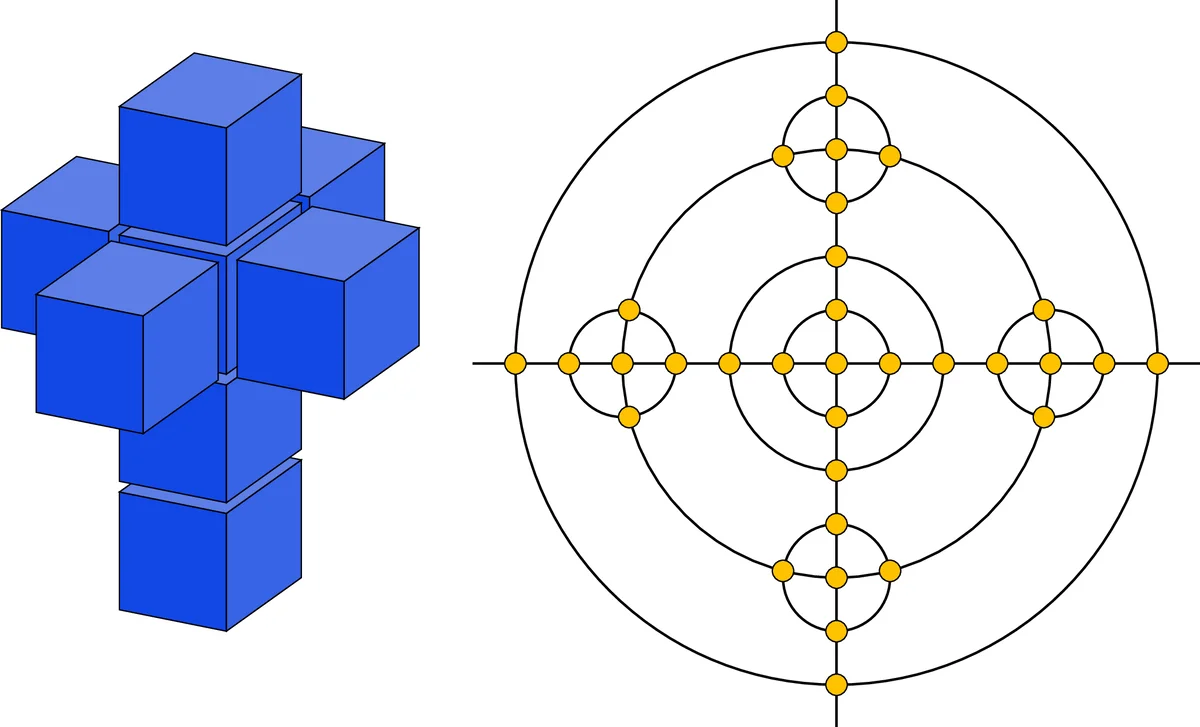
We investigate the graphs formed from the vertices and creases of an origami pattern that can be folded flat along all of its creases. As we show, this is possible for a tree if and only if the internal vertices of the tree all have even degree greater than two. However, we prove that (for unbounded sheets of paper, with a vertex at infinity representing a shared endpoint of all creased rays) the graph of a folding pattern must be 2-vertex-connected and 4-edge-connected.
💡 Research Summary
The paper investigates which planar graphs can be realized as the crease‑vertex structure of an origami pattern that folds flat along every crease. The authors adopt a mathematical model in which the sheet of paper is the entire Euclidean plane, allowing infinite rays to represent creases that extend indefinitely. A special “vertex at infinity” ∞ is introduced to serve as a common endpoint for all such rays, thereby turning any unbounded crease pattern into a finite graph augmented by ∞.
The first major contribution is a complete characterization of trees that can appear as the truncated graph of a flat‑foldable origami pattern. By invoking Maekawa’s theorem (every vertex must be incident to an even number of creases) and Kawasaki’s theorem (the alternating sum of sector angles around a vertex must be zero, which forces each sector angle to be less than π), the authors deduce that any internal vertex of a realizable tree must have even degree greater than two. They then prove sufficiency: using induction on the number of internal nodes, they construct a “wedge” around each leaf ray, ensuring that wedges are pairwise interior‑disjoint and that each wedge can be folded in three dimensions so that its two halves meet without interference from other parts of the paper. This construction yields a global flat folding (a family of ε‑close three‑dimensional embeddings) for any tree whose internal vertices satisfy the even‑degree‑>2 condition. The result shows that the even‑degree requirement is both necessary and sufficient for tree realizability under their infinite‑paper model.
The second major contribution concerns connectivity constraints on arbitrary folding‑pattern graphs (including ∞). The authors prove that such a graph must be 2‑vertex‑connected and 4‑edge‑connected. The proof proceeds by contradiction: if a single vertex (other than ∞) were an articulation point, removing it would isolate some set of rays, leaving ∞ with only one incident edge, which violates Maekawa’s even‑degree condition. Similarly, if fewer than four edges could disconnect the graph without involving ∞, one could isolate a subgraph whose incident angles would sum to a value incompatible with Kawasaki’s angle condition, again contradicting flat‑foldability. Thus any flat‑foldable crease graph, when modeled with the vertex at infinity, possesses a surprisingly strong level of connectivity—far stronger than that required for planar polyhedral graphs (Steinitz’s theorem) or for many other geometric graph representations.
The paper also distinguishes between “local flat folding,” a purely topological notion where each point locally behaves like an isometry (allowing self‑intersections), and “global flat folding,” which requires the existence of a family of three‑dimensional embeddings arbitrarily close to the local map. The tree construction explicitly yields a global flat folding, demonstrating that the additional geometric constraints of global foldability are not vacuous.
In summary, the authors (1) give a precise combinatorial criterion for when a tree can be drawn as a flat‑foldable origami pattern (internal vertices must have even degree > 2), and (2) establish that any flat‑foldable origami graph (with the vertex at infinity) must be 2‑vertex‑connected and 4‑edge‑connected. These results extend classic single‑vertex folding theorems to the multi‑vertex setting and reveal deep connections between origami mathematics and graph connectivity theory.
Comments & Academic Discussion
Loading comments...
Leave a Comment