Post-disaster Repair Scheduling in Partially Automated Electricity Distribution Networks
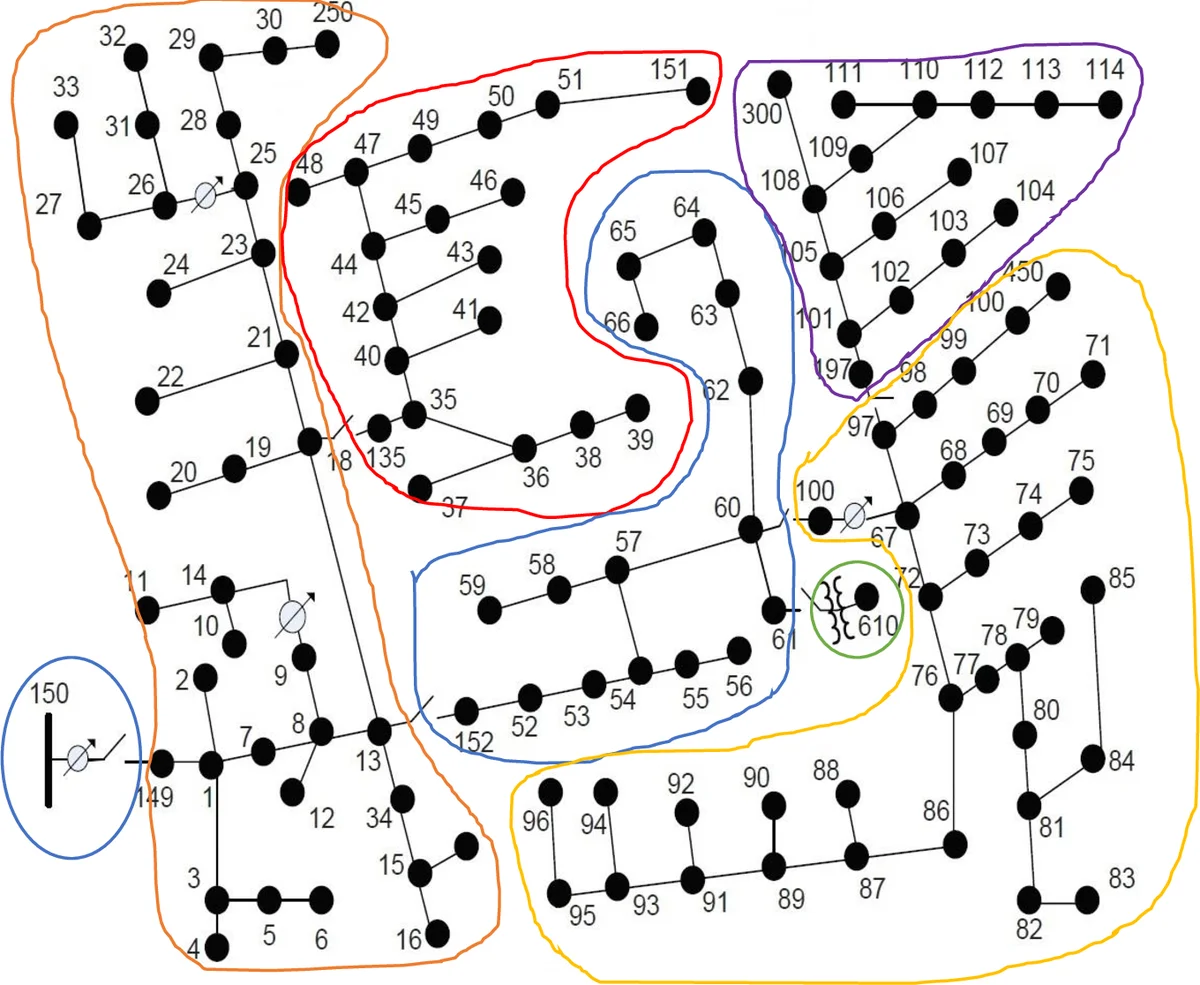
Natural disasters require repairing all damaged components in electricity distribution networks. Optimal scheduling repair crews to minimize the aggregate duration of interruptions reduces the harm. We consider the fact that the number of switches is much smaller than the number of edges. The problem is modeled by a parallel identical machine scheduling with group soft precedence constraints to minimize the total weighted energization time. We propose an LP-based list scheduling algorithm and a conversion algorithm and analyze their theoretical performances.
💡 Research Summary
The paper addresses the post‑disaster repair scheduling problem for electric distribution networks that are only partially automated, i.e., the number of remotely controllable switches is far smaller than the number of feeder lines. In such networks, power cannot be restored to a downstream area until all damaged components in the upstream island have been repaired and the upstream switch is closed. The authors formalize this situation by modeling the distribution system as a rooted tree and partitioning it into “islands” delimited by the limited set of switches. Each island J has a weight ω_J (the sum of the importance weights of its nodes) and an energization time E_J (the moment when the last damaged line in the island is repaired). The objective is to minimize the total weighted energization time H = ∑ ω_J E_J, which directly reflects the aggregate duration of customer outages.
The problem is mapped to a parallel identical‑machine scheduling problem with a novel class of constraints called “group soft precedence constraints.” These constraints capture the fact that an island can be energized only after all upstream islands (according to the tree topology) have been energized. The authors propose two algorithmic approaches with provable approximation guarantees.
1. LP‑based List Scheduling (Algorithm 1).
A linear programming (LP) relaxation is constructed. The decision variables are completion times C_j for each damaged line j and energization times E_J for each island. Constraints enforce: (i) C_j ≥ p_j (the repair duration), (ii) E_J ≥ max_{j∈J} C_j, (iii) the group soft precedence relations E_{J′} ≥ E_J for every upstream‑downstream pair, and (iv) a family of valid inequalities (Theorem 1) that describe the convex hull of feasible completion‑time vectors for parallel machines. Solving the LP yields an optimal fractional completion‑time vector C^LP. For each line a “mid‑point” M_j = C_j^LP − p_j/2 is computed, and the lines are sorted by increasing M_j to form a priority list. The list is then processed by a greedy rule: whenever a crew (machine) becomes idle, the next line on the list is assigned. The authors prove that the start time of any line in the resulting schedule is at most (1/m) ∑_{i≤j} p_i ≤ 2 M_j, which implies that the actual completion time C_j^H ≤ 2 C_j^LP. Consequently, for every island J, the energization time in the schedule satisfies E_J^H ≤ 2 E_J^LP. Since the LP provides a lower bound on the optimal objective, the algorithm is a 2‑approximation (Theorem 2). The exponential number of valid‑inequality constraints can be separated in polynomial time using the ellipsoid method, preserving polynomial‑time solvability.
2. Conversion Algorithm for Multiple Crews.
The authors first analyze the single‑crew case (m = 1). They show that within any island, the optimal schedule never interleaves jobs from different islands; all lines in an island can be treated as a single composite job with processing time p_J = ∑_{j∈J} p_j and weight ω_J. The resulting problem is exactly the classic single‑machine scheduling problem 1 | out‑tree | ∑ ω_J C_J, where the out‑tree encodes the group soft precedence constraints. This problem can be solved optimally in polynomial time (Lemma 1).
Having obtained the optimal ordering of composite jobs for one crew, the conversion algorithm distributes the same order among m crews. The algorithm keeps the relative order of islands but assigns them to crews in a round‑robin fashion, effectively parallelizing the single‑crew schedule. The authors prove that this transformation inflates each island’s energization time by at most a factor 2 − 1/m, yielding a (2 − 1/m)‑approximation (Theorem 4). As m grows, the bound approaches 1, indicating near‑optimal performance for large crew pools.
Theoretical Contributions and Practical Implications.
- Introduction of “group soft precedence constraints” to model limited switch placement in radial distribution networks.
- Derivation of a tight LP relaxation that captures both machine capacity and network‑flow induced precedence.
- A simple yet provably effective list‑scheduling rule based on LP mid‑points, achieving the same 2‑approximation factor previously known for more general models without the switch limitation.
- A polynomial‑time optimal algorithm for the single‑crew case, and a conversion technique that leverages this optimal order to obtain strong guarantees for any number of crews.
- Discussion of polynomial‑time separation for the exponential family of valid inequalities, ensuring that the LP can be solved efficiently in practice.
Although the paper does not present computational experiments, the analytical results suggest that utilities could employ the LP‑based list scheduler for real‑time post‑disaster restoration planning, especially when the number of remotely controllable switches is limited. The conversion algorithm offers a scalable approach for dispatching multiple repair crews while preserving a provable bound on outage duration. Overall, the work bridges the gap between theoretical scheduling literature and the operational realities of modern, partially automated power distribution systems, providing tools that can directly reduce customer outage times and societal impact after extreme weather events.
Comments & Academic Discussion
Loading comments...
Leave a Comment