GCN-LASE: Towards Adequately Incorporating Link Attributes in Graph Convolutional Networks
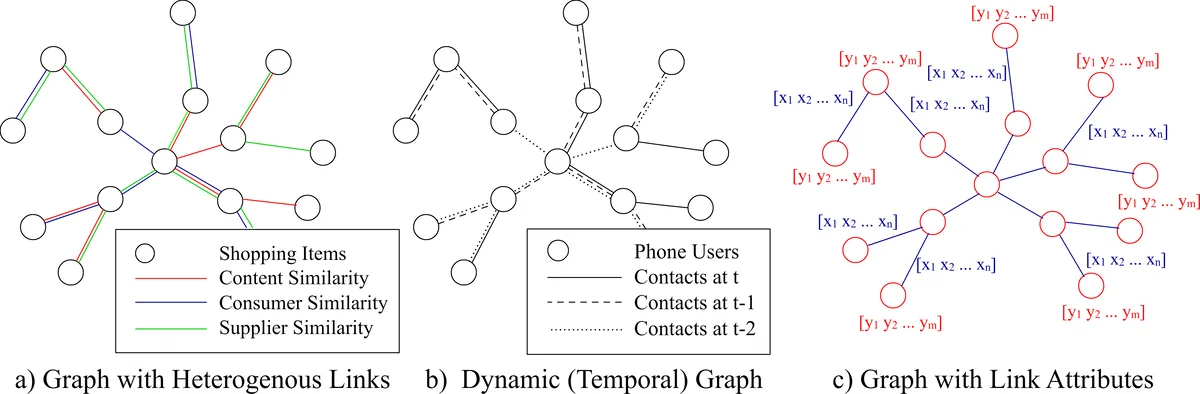
Graph Convolutional Networks (GCNs) have proved to be a most powerful architecture in aggregating local neighborhood information for individual graph nodes. Low-rank proximities and node features are successfully leveraged in existing GCNs, however, attributes that graph links may carry are commonly ignored, as almost all of these models simplify graph links into binary or scalar values describing node connectedness. In our paper instead, links are reverted to hypostatic relationships between entities with descriptional attributes. We propose GCN-LASE (GCN with Link Attributes and Sampling Estimation), a novel GCN model taking both node and link attributes as inputs. To adequately captures the interactions between link and node attributes, their tensor product is used as neighbor features, based on which we define several graph kernels and further develop according architectures for LASE. Besides, to accelerate the training process, the sum of features in entire neighborhoods are estimated through Monte Carlo method, with novel sampling strategies designed for LASE to minimize the estimation variance. Our experiments show that LASE outperforms strong baselines over various graph datasets, and further experiments corroborate the informativeness of link attributes and our model’s ability of adequately leveraging them.
💡 Research Summary
Graph Convolutional Networks (GCNs) have become a cornerstone for learning node representations by aggregating information from local neighborhoods. However, almost all existing GCN variants treat edges merely as binary or scalar indicators of connectivity, completely discarding the rich attributes that many real‑world links carry (e.g., relationship type in social networks, transaction amount and timestamp in commerce graphs). This paper introduces GCN‑LASE (GCN with Link Attributes and Sampling Estimation), a novel framework that explicitly incorporates both node and edge attributes into the convolutional process.
The central technical contribution is the definition of a neighbor feature as the tensor product of a neighbor node’s feature vector (f(v)) and the corresponding edge’s feature vector (f(e_{u,v})):
\
Comments & Academic Discussion
Loading comments...
Leave a Comment