Evaluation of 4D Light Field Compression Methods
Light field data records the amount of light at multiple points in space, captured e.g. by an array of cameras or by a light-field camera that uses microlenses. Since the storage and transmission requirements for such data are tremendous, compression…
Authors: David Barina, Tomas Chlubna, Marek Solony
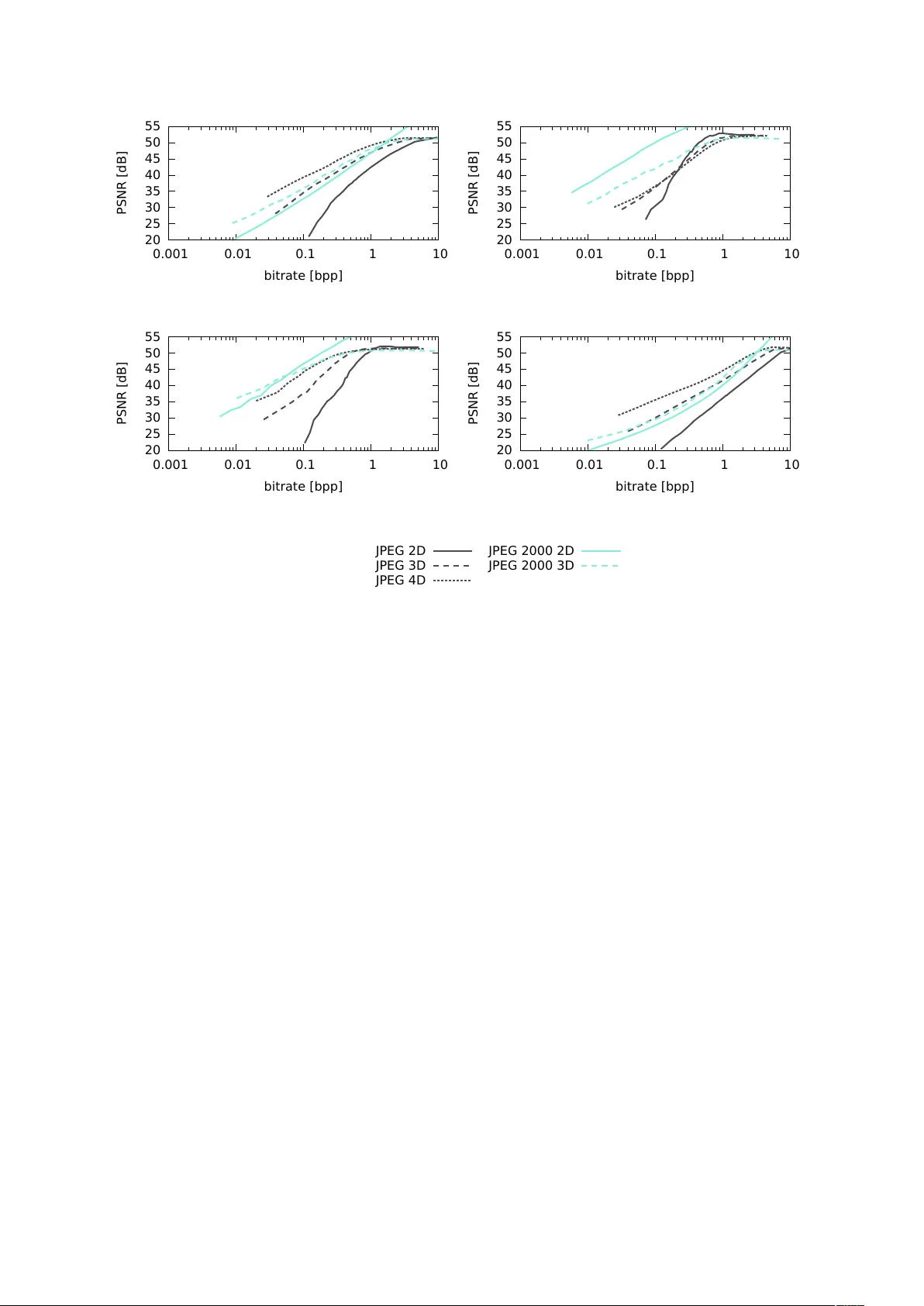
Ev aluation of 4D Light Field Compression Methods David Barina T omas Chlubna Marek Solony Drahomir Dlabaja P a v el Zemcik Centre of Excellence IT4Innov ations F aculty of Inf ormation T echnology Brno University of T echnology Bozetecho va 1/2, Brno Czech Repub lic {ibarina,ichlubna,isolony ,zemcik}@fit.vutbr .cz Abstract Light field data records the amount of light at multiple points in space, captured e.g. by an array of cameras or by a light-field camera that uses microlenses. Since the storage and transmission requirements for such data are tremendous, compression techniques for light fields are gaining momentum in recent years. Although plenty of efficient compression formats do exist for still and moving images, only a little research on the impact of these methods on light field imagery is performed. In this paper , we ev aluate the impact of state-of-the-art image and video compression methods on quality of images rendered from light field data. The methods include recent video compression standards, especially A V1 and XVC finalised in 2018. T o fully exploit the potential of common image compression methods on four-dimensional light field imagery , we have extended these methods into three and four dimensions. In this paper , we sho w that the four -dimensional light field data can be compressed much more than independent still images while maintaining the same visual quality of a percei ved picture. W e gradually compare the compression performance of all image and video compression methods, and eventually answer the question, "What is the best compression method for light field data?". K eywords Light field, Plenoptic imaging, Lossy compression, Image refocusing 1 INTR ODUCTION T o describe a three-dimensional scene from an y possible viewing position at an y viewing angle, one could define a plenoptic function P ( x , y , z , φ , ψ ) , where the ( x , y , z ) is the position and ( φ , ψ ) is a vie wing angle (in spherical coordinates) of a camera. Figure 1 sho ws the situation. The v alue of the P is color . The definition can be further extended with t (time) to describe a dynamic scene. Our interest here is to describe the scene by capturing either via an array of cameras or by a single compact sensor preceded by microlenses. In this case, the aper - ture is modeled by a grid of views (cameras) located on a two-dimensional plane. This situation is sho wn in Figure 2, where the baseline between indi vidual vie ws from the grid is described by the distance d . This rep- resentation is often referred to as 4D light field (LF) since we deal with the light field function, L , sampled in four dimensions, ( k , l , m , n ) , where the ( m , n ) are pixel Permission to make digital or hard copies of all or part of this work for personal or classroom use is granted without fee provided that copies are not made or distrib uted for profit or commercial advantage and that copies bear this notice and the full citation on the first page. T o copy otherwise, or republish, to post on servers or to redistribute to lists, requires prior specific permission and/or a fee. φ ( x , y , z ) Figure 1: Plenoptic capture of a scene from a single viewing position. For simplicity , the range of vie wing angles is indicated for one spherical coordinate. d Figure 2: 4D light field capture via an array of cameras. coordinates, and ( k , l ) are indices of a sub-aperture im- age. Light fields acquired by the single compact sensor hav e limited support for the viewing angle. Light fields based on the array of cameras offer larger vie wing an- gles at the cost of missing information in between the cameras. In practice, the number of vie ws located on Figure 3: Dataset used in this paper . From top left to bottom right: Black Fence, Chessboard, Lego Bulldozer , and Palais du Lux embourg. the two-dimensional plane ranges from a couple of units to se v eral hundred. Considering increasing resolution sensors, it is no surprise that the light field data reach huge sizes. As an example, consider "Lego Bulldozer" light field (Figure 3) taken from the Stanford Light Field Archiv e. The light field is captured using a 17 × 17 grid of cameras ha ving image resolution 1536 × 1152 (rectified and cropped). The uncompressed size easily exceeds a gigabyte. For light field videos, storage and transmission requirements are enormous. Sev eral methods to compress 4D light fields ha ve been recently proposed. Some of them attempt to compress directly the data from sensors preceded by microlenses (lenslet image). Other compresses the resulting 4D light field. In this paper, we focus only on the latter ones. W e compare v arious state-of-the-art compression methods applicable to 4D light field data. These methods include recent video compression standards, especially A V1 (v al- idated in June 2018), and XVC (v ersion released in July 2018). In order to ev aluate the comparison, we refocus the original and decompressed light field. The ev aluation is then carried out using the PSNR as a full-reference quality assessment metric. The remainder of the paper is organized as follows. Sec- tion 2 revie ws related work and compression methods. Section 3 presents our experiments in detail, and dis- cusses the results. Section 4 concludes the paper . 2 RELA TED WORK The individual vie ws from a light field are usually never displayed. Therefore, it is not very meaningful to com- pare the original and decompressed light field directly , ev en though such methodology is usual to asses a sin- gle view compression performance. F or this reason, we adopt the compression performance assessment method- ology for multi-focus rendering from [ 2 ]. This methodol- ogy basically lies in assessing the quality of the rendered views for multiple focal points. The rendered views are obtained by combining pixels from dif ferent 4D light field views for v arious focal planes. The a verage distor - tion is computed as the mean of the PSNR for multiple rendered focal plane views. This situation is shown in Figure 4. Note that the PSNR is computed from the MSE ov er all three color components. The 4D light field comprises a two-dimensional grid of two-dimensional vie ws. The baseline between indi vid- ual vie ws ranges from a fe w millimeters (microlenses) to sev eral centimeters (camera array). It is, therefore, natural to expect a high similarity of views adjacent in any of two grid directions. This similarity opens the door to understanding the 4D light field data as a video sequence navigating between the vie wpoints. Another possible point of vie w is to see the 4D light field as the three- or directly four-dimensional body . The above ap- proaches can also be reflected in light field compression by using either an image, video, volumetric, or four - dimensional coding system. Although other approaches (like 3D video) are also possible, we are not a ware of generally av ailable coding systems for such cases. In recent years, sev eral papers compared and e valuated the compression performance of various approaches on light field imagery . The authors of [ 2 ] ev aluated the performance of the main image coding standards, JPEG, JPEG 2000, H.264/A VC intra profile, and H.265/HEVC intra profile. The "intra" suf fix refers to the fact the individual views were compressed independently (in- tra profile). The video coding approaches were not ev aluated. As could be e xpected, the H.265/HEVC in- tra profile prov ed to be the most efficient compression method. In [ 17 ], the authors compared the compression performance of three strategies using the H.265/HEVC. Their first strate gy performs compression directly on the lenslet image. Another strategy arranges 4D LF vie ws a pseudo-temporal sequence in spiral order and subse- quently compressed it. The last strate gy compresses a subset of lenslet images through the transformation to 4D LF . Their results show that coding 4D LF leads to better performance when compared to coding lenslet images directly . The authors of [ 6 ] compared the per- formance of JPEG, JPEG 2000, and SPIHT directly on lenslet images. The comparison w as performed using the same methodology as in this paper . As could be expected, the JPEG 2000 exhibits the best compression performance. In [ 16 ], the authors proposed to rearrange 4D LF vie ws into tiles of a big rectangular image. This image is then compressed using the JPEG 2000 coder . The proposed scheme was compared against standard image coding algorithms, namely the JPEG 2000 and JPEG XR. It is, howe ver , unclear how these standard coding algorithms were e xactly applied to the 4D light field data. In [ 1 ], the author rearranges the 4D light field into a three-dimensional body . The three-dimensional volume is then encoded using the 3D DCT scheme on 8 × 8 × 8 blocks, similarly as in the JPEG coding system. 4D light field compress decompress render render compare Figure 4: Data flow diagram of the compression performance assessment methodology used in this paper . Besides con v entional coding methods, also an alternativ e approach [ 3 ] exists that uses deep learning to estimate the 2D vie w from the sparse sets of 4D views. Another approach [ 4 ] propose s o wn sparse coding scheme for the entire 4D LF based on sev eral optimized ke y vie ws. The method in [ 9 ] decomposes the 4D light field into homog- raphy parameters and residual matrix. The matrix is then factored as the product of a matrix containing k basis vectors and a smaller matrix of coefficients. The basis vectors are then encoded using the H.265/HEVC intra profile. In [ 11 , 12 ], the authors propose a hierarchical coding structure for 4D light fields. The 4D LF is de- composed into multiple views and then or ganized them into a coding structure according to the spatial coordi- nates. All of the vie ws are encoded hierarchically . The scheme is implemented in the reference H.265/HEVC software. In [ 5 ], the authors propose a coding scheme that splits the 4D light field into se veral central views and remaining adjacent vie ws. The adjacent views are subtracted from the central vie ws, and both groups are then encoded using H.265/HEVC coder . The authors of [ 13 , 14 ] feed the 4D LF into the H.265/HEVC e xploit- ing the inter prediction mode for indi vidual LF views. Finally , tremendous attentions hav e also been focused on con v olutional neural network based compression ap- proaches [7, 8]. From the abov e, it can be seen that the JPEG 2000 and especially the H.265/HEVC coding schemes are quite popular . In this paper , we compare the compression performance of the main state-of-the-art lossy compres- sion methods. These methods can be di vided into four groups according to the way they process the 4D LF data. The first group covers the follo wing image coding methods—the JPEG and JPEG 2000. In the literature [ 10 ], this kind of methods is sometimes referred to as the self-similarity based methods. The second group com- prises video coding methods: H.265/HEVC, A V1, VP9, and XVC. In the literature, these methods are referred to as the pseudo sequence based methods. The third group extends the image coding methods into three dimensions. This group consists of JPEG 3D (our o wn implementa- tion) and JPEG 2000 3D (P art 10, JP3D). Notice that the JPEG 3D refers to a volume image rather than a pair of stereoscopic images. The fourth group extends the image coding methods into four dimensions. Ho we ver , only one method in this group e xists, JPEG 4D (our o wn implementation). T o ev aluate the abov e methods, we use the following list of encoders: OpenJPEG, x265, libaom (A V1 Codec Library), lib vpx (VP8/VP9 Codec SDK), xvc codec, and our o wn implementation of the JPEG method. Since our comparison also deals with the latest video compression standards, we consider it appropriate to present their short description here. The H.265/HEVC (High Ef ficiency V ideo Coding, MPEG-H Part 2) is a video compression standard designed as a successor to the widely used H.264/A VC (MPEG-4 Part 10). The standard was published in June 2013. The A V1 (A OMe- dia V ideo 1) is an open video coding format standardized in June 2018. It succeeds the VP9 video coding format dev eloped by Google. According to [ 18 ], the A V1 out- performs the H.265/HEVC by 17 %, and VP9 by 13 % ov er a wide range of bitrate/resolutions. The XVC is a video coding format with a strong focus on low bitrate streaming applications. The official website claims that the codec outperforms the A V1, H.265/HEVC, and VP9. 3 EV ALU A TION This section presents our dataset, multi-focus rendering method, e xperiments conducted on this dataset using the abov e methodology , and the results we achieved. Our dataset consists of four 4D light fields based on two types of capturing devices. T wo of the light fields were captured using L ytro Illum B01 plenoptic camera and the other two using con ventional cameras. The first con ventional camera light field was captured using a multi-camera array , and the other one using simple mo- torized gantry equipped with Canon Digital Rebel XT i camera. Corresponding resolutions and adjacent image disparity ranges are listed in T able 1. The value in the last column describes the pixel difference in the location of the same 3D object projected to images captured by a camera or computed from a lenslet image in the case of L ytro. The range is narrow (ca. − 1 to + 1 pixel) for the densely-sampled light field (L ytro) and wide (ca. 40 to 90 pixels) for the images captured by camera array . These values correlate to the focal length and camera baseline (distance between camera centers). For con ve- nience, the central vie w for each light field is sho wn in Figure 3. description source resolution disparity Black Fence EPFL Light-field data set 15 × 15 × 625 × 434 − 1 to 1 Chessboard Saarland Univ ersity 8 × 8 × 1920 × 1080 40 to 90 Lego Bulldozer Stanford Computer Graphics Laboratory 17 × 17 × 1536 × 1152 − 1 to 7 Palais du Lux embourg EPFL Light-field data set 15 × 15 × 625 × 434 − 1 to 1 T able 1: Dataset used in this paper . The first and last light field are taken using a plenoptic camera; the Chessboard is captured using a camera array; the Lego Bulldozer is captured using a motorized gantry holding a camera. The adjacent image disparity range (last column) is giv en in pixels. The digital refocus of the images at the virtual focal plane is achie ved using shift-sum algorithm [ 15 ]. This algorithm shifts the sub-aperture images (views) accord- ing to camera baseline with respect to the reference frame and accumulates the corresponding pixel v alues. The refocused image will be an av erage of the trans- formed images. The computation of the pix el value at point ( m , n ) of the refocused image E d is given by the equation E d ( m , n ) = 1 N ∑ k , l L ( k , l , m + α k , n + α l ) , (1) where N is the number of summed images, α is the distance of the synthetic plane from the main lens, k and l are indices of a sub-aperture image of the light field representation, and α k and α l are the shift parameters with respect to the reference frame. W e performed a linear interpolation in the last two 4D dimensions to con vert the sampled light field function into a continuous one. Experiment 0 Before we start, the reader might wonder whether it is really necessary to assess the image quality on views rendered for multiple focal points rather than the origi- nal vie ws (i.e. compare the original and decompressed LF directly). A quick experiment re v eals that a big dif- ference exists between the former and the latter (see Fig- ure 5). This difference is about 10 decibels in the PSNR, depending on the bitrate and compression method. This can be explained by the fact that any pixel in the rendered view is a sum of pix els from the 4D LF so that this sum all together suppresses compression artifacts. In other words, we can afford to compress the 4D light fields much more than independent images, while maintaining the same visual quality of a screened picture. Experiment 1 As seen from the previous section, most current LF com- pression approaches handle either 2D data or their se- quence (video compression). Compression of 4D LF images is still a relatively une xplored area of research. Since 4D LF are sequences of 2D images (views), the 20 25 30 35 40 45 50 55 0.001 0.01 0.1 1 10 PSNR [dB] bitrate [bpp] 20 25 30 35 40 45 50 55 0.001 0.01 0.1 1 10 PSNR [dB] bitrate [bpp] JPEG (r efocusing) JPEG (4D LF) JPEG 2000 (r efocusing) JPEG 2000 (4D LF) A V1 (r efocusing) A V1 (4D LF) Figure 5: Experiment 0. The difference in the quality assessment using the 4D light field directly vs. using images rendered at virtual focal planes. Illustrativ ely shown on the Black Fence light field. 2D compression methods may be used to code the vie ws independently . Ho wev er , such methods fail to exploit pixel correlations in all four dimensions. Similar reason- ing can be used for 3D methods. In our first experiment, we were interested in examining the ef fects of LF com- pression in three and four dimensions. T o ev aluate the compression performance fairly , identical compression method must be used for the 2D, 3D, and 4D case. Thus, we hav e created a custom implementation of the JPEG compression method with the ability to process either the 2D, 3D, or 4D data. Additionally , we are aware of the e xistence of the JPEG 2000 standard, with the ability to compress the 2D and 3D data in the same manner . Unfortunately , the JPEG 2000 does not deal with the 4D images. Since the similarity of adjacent pixels in the third and four dimensions strongly depends on the cam- era baseline, dif ferent results can be expected depending on the baseline distance. The result of this experiment is sho wn in Figure 6. In each panel, the horizontal axis shows the bitrate (bits per pix el), whereas the vertical axis shows the mean of the PSNR for multiple rendered focal plane views. On light fields with a small baseline (Black Fence and Palais du Luxembour g), both 3D compression meth- ods clearly outperform their 2D counterparts over a 20 25 30 35 40 45 50 55 0.001 0.01 0.1 1 10 PSNR [dB] bitrate [bpp] (a) Black Fence 20 25 30 35 40 45 50 55 0.001 0.01 0.1 1 10 PSNR [dB] bitrate [bpp] (b) Chessboard 20 25 30 35 40 45 50 55 0.001 0.01 0.1 1 10 PSNR [dB] bitrate [bpp] (c) Lego Bulldozer 20 25 30 35 40 45 50 55 0.001 0.01 0.1 1 10 PSNR [dB] bitrate [bpp] (d) Palais du Lux embourg 20 25 30 35 40 45 50 55 0.001 0.01 0.1 1 10 PSNR [dB] bitrate [bpp] JPEG 2D JPEG 3D JPEG 4D JPEG 2000 2D JPEG 2000 3D Figure 6: Experiment 1. Comparison of image compression methods against their extensions into three and four dimensions. whole range of bitrates. Similarly , the 4D JPEG method clearly outperforms its 3D counterpart. This is not so surprising because pixels at the same spatial position in adjacent views are strongly correlated. Ho wev er , the situation changes with increasing baseline. W ith increasing baseline (Le go Bulldozer and Chessboard), adjacent vie ws are less and less similar , which results in higher amplitudes of the underlying transform coef- ficients. Consequently , the tide is turning in fav or of the less-dimensional compression methods. Consider- ing the JPEG method, the Le go Bulldozer is a special case because it contains large areas of blackness (black pixels). It turns out that it is more ef ficient to compress these solid areas at once using a single 4D block than using multiple 3D blocks. Similarly , it is more ef ficient to use a single 3D block than multiple 2D blocks. Experiment 2 The second thing to notice in the previous section is the employment of the video compression standards. Upon this, a question arises: whether it be better to compress the 4D light fields as a sequence of 2D frames, or as multi-dimensional body . W e, therefore, measured the performance of all the above-mentioned video compres- sion standards. The results can be seen in Figure 7. This time results only for two light fields are shown for brevity . W e hav e, howe ver , got similar results for the other two. Interestingly , the XVC codec has really shown better compression performance than HEVC and A V1, as claimed by the of ficial website. T o answer the question, "What is the best compression method for LF data?", we ha ve further compared these results with the best-performing methods from Exper - iment 1. The overall comparison is shown in Figure 8. Interestingly , video compression methods perform better than all image compression methods, even better than their 3D and 4D extensions. 20 25 30 35 40 45 50 55 0.001 0.01 0.1 1 10 PSNR [dB] bitrate [bpp] (a) Black Fence 20 25 30 35 40 45 50 55 0.0001 0.001 0.01 0.1 1 10 PSNR [dB] bitrate [bpp] (b) Chessboard 20 25 30 35 40 45 50 55 0.001 0.01 0.1 1 10 PSNR [dB] bitrate [bpp] H .265 VP9 A V1 XVC Figure 7: Experiment 2. Performance of video compression methods. The XVC and A V1 clearly overcome the older standards. 20 25 30 35 40 45 50 55 0.001 0.01 0.1 1 10 PSNR [dB] bitrate [bpp] (a) Black Fence 20 25 30 35 40 45 50 55 0.0001 0.001 0.01 0.1 1 10 PSNR [dB] bitrate [bpp] (b) Chessboard 20 25 30 35 40 45 50 55 0.001 0.01 0.1 1 10 PSNR [dB] bitrate [bpp] JPEG 4D JPEG 2000 2D A V1 XVC Figure 8: Overall performance of the best compression methods. V ideo compression methods perform better than all image compression methods. 4 CONCLUSIONS The purpose of our work was to ev aluate the current methods suitable for lossy compression of 4D light fields. Since the light field is basically a collection of images (views), image compression methods are often the first choice, when it comes to the need for compression. It turns out that the methods handling the 4D light fields directly in four (or three) dimensions are able to achieve better compression results than common image com- pression algorithms. This is, ho wev er , dependent on a baseline between neighboring views. F or lar ge baselines (e.g., camera arrays), the common image compression methods come handy . W e hav e also e v aluated the performance of video com- pression methods. The underrated XVC compression format demonstrated superior performance, closely fol- lowed by the A V1. This confirms that the latest video compression standards offer better performance than their predecessors. Eventually , it turns out that these video compression methods perform better than the im- age compression methods (including their 3D and 4D extensions). Acknowledgements This work has been supported by the T echnology Agency of the Czech Republic (T A CR) Competence Centres project V3C – V isual Computing Competence Cen- ter (no. TE01020415), the Ministry of Education, Y outh and Sports of the Czech Republic from the Na- tional Programme of Sustainability (NPU II) project IT4Innov ations excellence in science (LQ1602), and the European Union’ s Horizon 2020 Research and Innov a- tion Programme under Grant Agreement No 780470. REFERENCES [1] Aggoun, A. A 3D DCT compression algorithm for omnidirectional integral images. In IEEE In- ternational Confer ence on Acoustics, Speech, and Signal Pr ocessing (ICASSP) , volume 2, 2006. doi: 10.1109/ICASSP .2006.1660393. [2] Alves, G., Pereira, F ., and da Silv a, E. A. Light field imaging coding: Performance assessment methodology and standards benchmarking. In IEEE International Conference on Multimedia & Expo W orkshops (ICMEW) , pages 1–6, 2016. doi: 10.1109/ICMEW .2016.7574774. [3] Bakir, N., Hamidouche, W ., Deforges, O., Sam- routh, K., and Khalil, M. Light field image compression based on con volutional neural net- works and linear approximation. In IEEE Inter- national Conference on Image Pr ocessing (ICIP) , pages 1128–1132, 2018. doi: 10.1109/ICIP .2018. 8451597. [4] Chen, J., Hou, J., and Chau, L.-P . Light field compression with disparity-guided sparse coding based on structural key vie ws. IEEE T r ansactions on Image Pr ocessing , 27(1):314–324, 2018. ISSN 1057-7149. doi: 10.1109/TIP .2017.2750413. [5] Han, H., Xin, J., and Dai, Q. Plenoptic image compression via simplified subaperture projection. In Advances in Multimedia Information Pr ocessing (PCM) , pages 274–284, 2018. ISBN 978-3-030- 00767-6. [6] Higa, R. S., Cha vez, R. F . L., Leite, R. B., Arthur , R., and Iano, Y . Plenoptic image compression comparison between JPEG, JPEG2000 and SPIHT. Cyber Journals: Multidisciplinary Journals in Sci- ence and T echnolo gy , Journal of Selected Areas in T elecommunications (JSAT) , 3(6), 2013. [7] Hou, J., Chen, J., and Chau, L.-P . Light field image compression based on bi-lev el view compensation with rate-distortion optimization. IEEE T ransac- tions on Circuits and Systems for V ideo T echnol- ogy , 29(2):517–530, 2019. ISSN 1051-8215. doi: 10.1109/TCSVT .2018.2802943. [8] Jia, C., Zhang, X., W ang, S., W ang, S., Pu, S., and Ma, S. Light field image compression using gen- erativ e adv ersarial network based vie w synthesis. IEEE Journal on Emerging and Selected T opics in Cir cuits and Systems , 2018. ISSN 2156-3357. doi: 10.1109/JETCAS.2018.2886642. [9] Jiang, X., Pendu, M. L., F arrugia, R. A., and Guille- mot, C. Light field compression with homography- based low-rank approximation. IEEE J ournal of Selected T opics in Signal Pr ocessing , 11(7):1132– 1145, 2017. ISSN 1932-4553. doi: 10.1109/JSTSP . 2017.2747078. [10] Li, L. and Li, Z. Light F ield Image Compression , pages 547–570. Springer , 2018. ISBN 978-3-319- 95504-9. doi: 10.1007/978- 3- 319- 95504- 9_24. [11] Li, L., Li, Z., Li, B., Liu, D., and Li, H. Pseudo sequence based 2-D hierarchical coding structure for light-field image compression. In Data Com- pr ession Conference (DCC) , pages 131–140, 2017. doi: 10.1109/DCC.2017.10. [12] Li, L., Li, Z., Li, B., Liu, D., and Li, H. Pseudo- sequence-based 2-D hierarchical coding structure for light-field image compression. IEEE Journal of Selected T opics in Signal Pr ocessing , 11(7):1107– 1119, 2017. ISSN 1932-4553. doi: 10.1109/JSTSP . 2017.2725198. [13] Li, Y ., Sjostrom, M., Olsson, R., and Jennehag, U. Ef ficient intra prediction scheme for light field image compression. In IEEE International Con- fer ence on Acoustics, Speech, and Signal Pr o- cessing (ICASSP) , pages 539–543, 2014. doi: 10.1109/ICASSP .2014.6853654. [14] Li, Y ., Sjostrom, M., Olsson, R., and Jennehag, U. Coding of focused plenoptic contents by dis- placement intra prediction. IEEE T ransactions on Circuits and Systems for V ideo T echnology , 26(7):1308–1319, 2016. ISSN 1051-8215. doi: 10.1109/TCSVT .2015.2450333. [15] Ng, R., Le v oy , M., Bredif, M., Duval, G., Horowitz, M., and Hanrahan, P . Light field pho- tography with a hand-held plenoptic camera. T ech- nical report, 2005. Stanford T ech Report CTSR 2005-02. [16] Perra, C. and Giusto, D. JPEG 2000 compression of unfocused light field images based on lenslet array slicing. In IEEE International Conference on Consumer Electr onics (ICCE) , pages 27–28, 2017. doi: 10.1109/ICCE.2017.7889217. [17] V iola, I., Rerabek, M., and Ebrahimi, T . Com- parison and e valuation of light field image coding approaches. IEEE Journal of Selected T opics in Signal Pr ocessing , 11(7):1092–1106, 2017. ISSN 1932-4553. doi: 10.1109/JSTSP .2017.2740167. [18] Zabrovskiy , A., Feldmann, C., and Timmerer , C. Multi-codec D ASH dataset. In A CM Multimedia Systems Confer ence , MMSys ’18, pages 438–443. A CM, 2018. ISBN 978-1-4503-5192-8. doi: 10. 1145/3204949.3208140.
Original Paper
Loading high-quality paper...
Comments & Academic Discussion
Loading comments...
Leave a Comment