Scalable, Secure and Broad-Spectrum Enforcement of Contracts, Without Blockchains
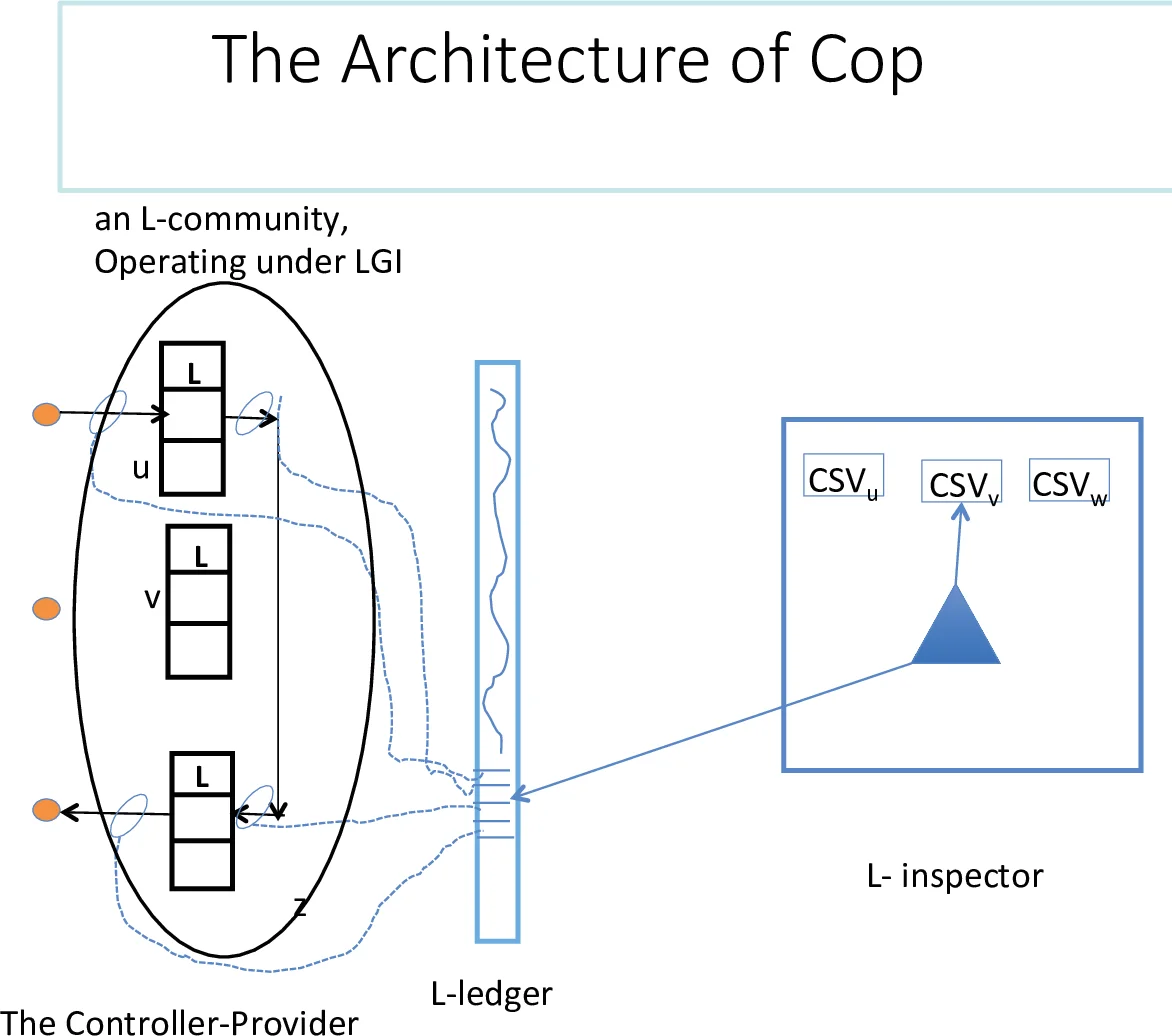
This paper introduces a scalable and secure contract-enforcement mechanism, called Cop, which can be applied to a broad range of multi-agent systems including small and large systems, time-critical systems, and systems-of-systems. Cop enforces contracts (or protocols) via the existing Law- Governed Interaction (LGI) mechanism, coupled with a new protective layer that significantly enhances the dependability and security of such enforcement. Cop is arguably superior to the currently popular blockchain-based smart-contract mechanisms, due to its scalability, interoperability, and the breadth of the spectrum of its domain of applications.
💡 Research Summary
The paper proposes “Cop,” a contract‑enforcement mechanism that builds on the existing Law‑Governed Interaction (LGI) framework and adds a protective layer to address LGI’s security weakness. The authors begin by identifying four essential qualities that any protocol‑enforcement mechanism (PEM) should possess: (1) sufficiently short latency to support time‑critical applications, (2) scalability so that latency remains essentially independent of transaction volume, (3) interoperability that allows multiple communities operating under different protocols to interact safely, and (4) dependability and security against both software faults and malicious attacks.
Two widely used PEMs are examined. First, blockchain‑based smart contracts provide strong immutability and cryptographic security but suffer from high latency (minutes) due to consensus, limited scalability (linear processing of blocks), and poor interoperability, especially when multiple blockchains must cooperate. Second, LGI already satisfies latency, scalability, and a form of controlled interoperability through its dual‑mediation architecture: each actor is paired with a local controller (TL) that enforces a law L on both outgoing and incoming messages. This local, parallel enforcement yields low latency and high throughput. However, LGI’s “Achilles heel” is that a compromised controller or a maliciously crafted law can jeopardize the entire system, because the enforcement relies on the integrity of the controllers themselves.
Cop addresses this weakness by introducing a trusted controller service (CoS) and a set of security extensions. The CoS supplies generic controllers that are hardened using Trusted Platform Modules (TPM) or modern Trusted Execution Environments (TEE). Each controller receives a digital certificate signed by the CoS, and any law loaded onto a controller must be digitally signed and verified, ensuring only authenticated policies are executed. Cop also defines an “obligation‑Due” event mechanism that detects violations or abnormal states and automatically triggers isolation, recovery, or controller replacement procedures. By combining hardware‑based root of trust with cryptographic law authentication, Cop preserves LGI’s low‑latency, scalable, and interoperable characteristics while substantially raising its security posture.
The paper details LGI’s architecture (controller service, formation of L‑agents, dual mediation, law structure) and then explains how Cop augments each component. The protective layer adds (i) hardware‑rooted integrity checks for controllers, (ii) PKI‑based law signing, (iii) automated response to obligation‑Due events, and (iv) optional state synchronization among controllers to avoid single points of failure.
In the comparative analysis, Cop is shown to achieve millisecond‑level transaction latency, maintain throughput regardless of transaction load, support multi‑community interactions through LGI’s dual mediation, and provide stronger defenses against tampering and unauthorized policy changes than blockchain smart contracts. The authors acknowledge potential drawbacks: the CoS introduces a centralized trust anchor that could become a single failure point, the complexity of law design may increase controller processing overhead, and large‑scale deployments will require inter‑organizational agreements on CoS governance.
Future work is suggested in three directions: (a) decentralizing the CoS to reduce central trust, (b) modularizing laws to manage complexity and improve performance, and (c) conducting extensive experimental evaluations in real‑world domains such as industrial IoT, smart grids, and air‑traffic management. Overall, Cop represents a novel attempt to combine the performance and flexibility of LGI with robust, hardware‑anchored security, offering a compelling alternative to blockchain‑based smart contracts for a broad spectrum of multi‑agent systems.
Comments & Academic Discussion
Loading comments...
Leave a Comment