The Digital Architectures of Social Media: Comparing Political Campaigning on Facebook, Twitter, Instagram, and Snapchat in the 2016 U.S. Election
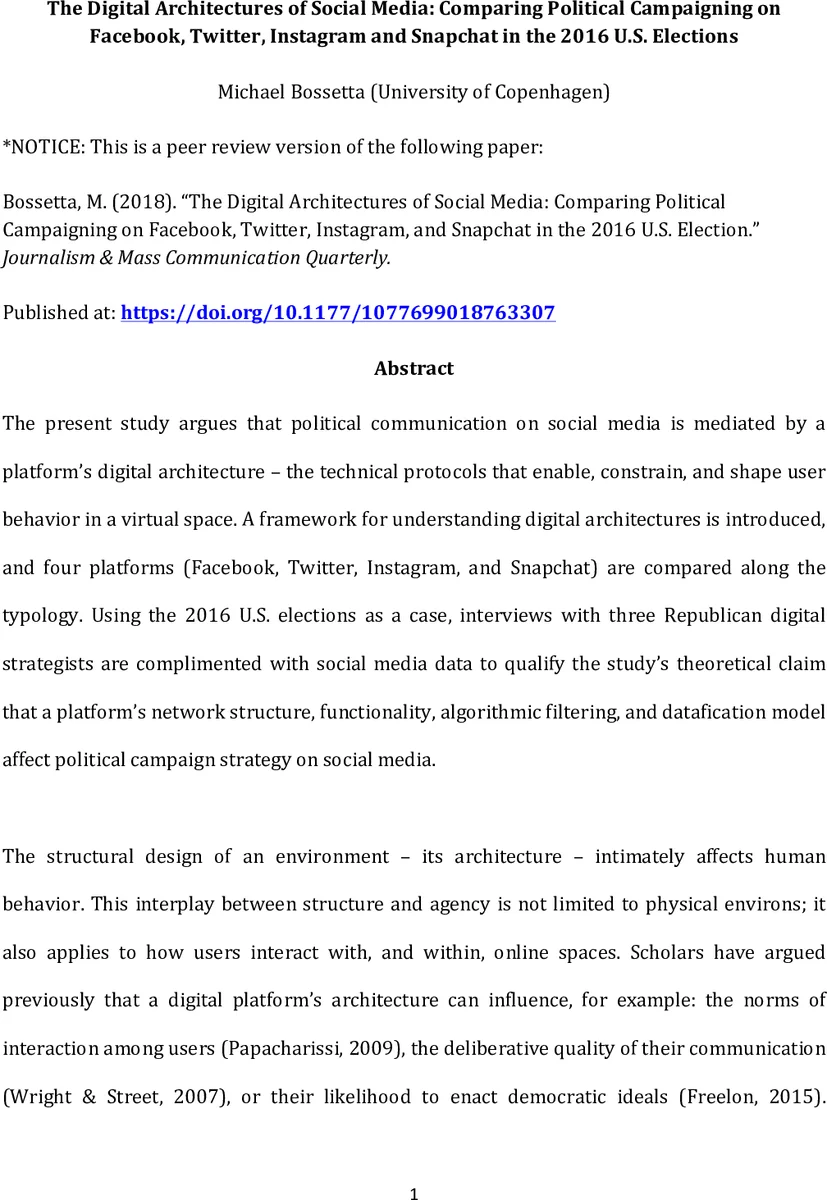
The present study argues that political communication on social media is mediated by a platform’s digital architecture, defined as the technical protocols that enable, constrain, and shape user behavior in a virtual space. A framework for understanding digital architectures is introduced, and four platforms (Facebook, Twitter, Instagram, and Snapchat) are compared along the typology. Using the 2016 US election as a case, interviews with three Republican digital strategists are combined with social media data to qualify the studyies theoretical claim that a platform’s network structure, functionality, algorithmic filtering, and datafication model affect political campaign strategy on social media.
💡 Research Summary
The paper introduces the concept of “digital architecture” – the set of technical protocols that enable, constrain, and shape user behavior on a platform – and proposes a four‑dimensional typology to analyze it: (1) network structure, (2) functionality, (3) algorithmic filtering, and (4) datafication model. Using the 2016 United States presidential election as a case study, the authors compare four major social‑media platforms – Facebook, Twitter, Instagram, and Snapchat – to determine how each platform’s architecture influences political campaign strategy.
Methodologically, the study combines quantitative analysis of platform‑specific political content (posts, retweets, shares, comments, etc.) with qualitative insights from in‑depth interviews with three Republican digital strategists who managed campaign operations in 2016. The quantitative work employs network analysis, text mining, and metric aggregation to capture each platform’s structural and functional properties. The interviews reveal how campaign practitioners interpret and exploit those technical affordances in real‑time decision‑making.
Findings by platform
Facebook possesses a dense, multi‑layered friendship/family/group network and a sophisticated targeting algorithm. Its datafication model is the most extensive, allowing precise micro‑targeted advertising and the creation of organized supporter groups. Strategists report using “custom audience” ads to reach swing‑state voters and leveraging pages and groups for grassroots mobilization.
Twitter is characterized by an open follower/retweet graph and a real‑time hashtag stream. Algorithmic curation is relatively weak, so trends shift rapidly and short (140‑character) messages dominate. The platform excels at rapid issue amplification and direct interaction between politicians, journalists, and the public. Campaign staff emphasize “hashtag challenges” and real‑time response tactics to dominate the news cycle.
Instagram is a visual‑first platform with a story/feed interface. Its algorithm prioritizes visual preferences and interaction frequency, producing a personalized feed. The network is more “closed‑loop” and community‑oriented. The limited data collection pushes strategists toward “visual branding” and influencer collaborations, using images and short videos to convey emotional appeals.
Snapchat offers disappearing snaps and a friend‑centric, closed network, with minimal data harvesting. Its primary audience is 18‑24‑year‑olds, making it suitable for fleeting, informal messaging. Campaigns used “Snap ads” to create a sense of immediacy and intimacy, targeting younger voters with short, eye‑catching content.
Cross‑platform comparison
- Network structure: Facebook and Instagram form tight‑knit clusters; Twitter forms a broadcast‑style diffusion network; Snapchat operates as a closed, ephemeral network.
- Functionality: Facebook/Instagram provide rich multimedia, ad tools, and community management; Twitter offers real‑time text streams; Snapchat supplies disappearing media and AR filters.
- Algorithmic filtering: Facebook/Instagram employ highly personalized recommendation engines; Twitter relies on trend‑based exposure; Snapchat applies minimal filtering, leaving content largely user‑selected.
- Datafication: Facebook and Twitter collect extensive behavioral logs enabling granular targeting; Instagram and Snapchat collect less, leading campaigns to focus on affective, visual tactics rather than large‑scale precision targeting.
Strategic implications
The architecture of each platform dictates distinct campaign tactics. Facebook’s precise targeting facilitated micro‑targeted ads for swing‑state voters; Twitter’s speed allowed campaigns to set the agenda and respond instantly to breaking news; Instagram’s visual emphasis supported emotional storytelling and brand building; Snapchat’s ephemerality created urgency among younger audiences. Understanding these affordances enables political actors to allocate resources efficiently, tailor messages to platform‑specific audiences, and maximize voter engagement.
Conclusion
Digital architecture is a decisive factor shaping how political communication unfolds on social media. By mapping platforms onto the four‑dimensional typology, the study demonstrates that each platform offers unique strategic possibilities and constraints. Campaigns that internalize these technical differences can design platform‑specific strategies that enhance message reach, persuasion, and mobilization. The paper contributes a robust analytical framework for future research on digital elections and offers practical guidance for political practitioners navigating an increasingly fragmented media ecosystem.
Comments & Academic Discussion
Loading comments...
Leave a Comment