Resource Allocation Algorithm for V2X communications based on SCMA
In this paper, we propose a resource allocation algorithm for V2X communications based on Sparse Code Multiple Access(SCMA). By analyzing the interference model in the V2X scenario, we formulate the problem which deals with resource allocation to max…
Authors: Wei Wu, Linglin Kong
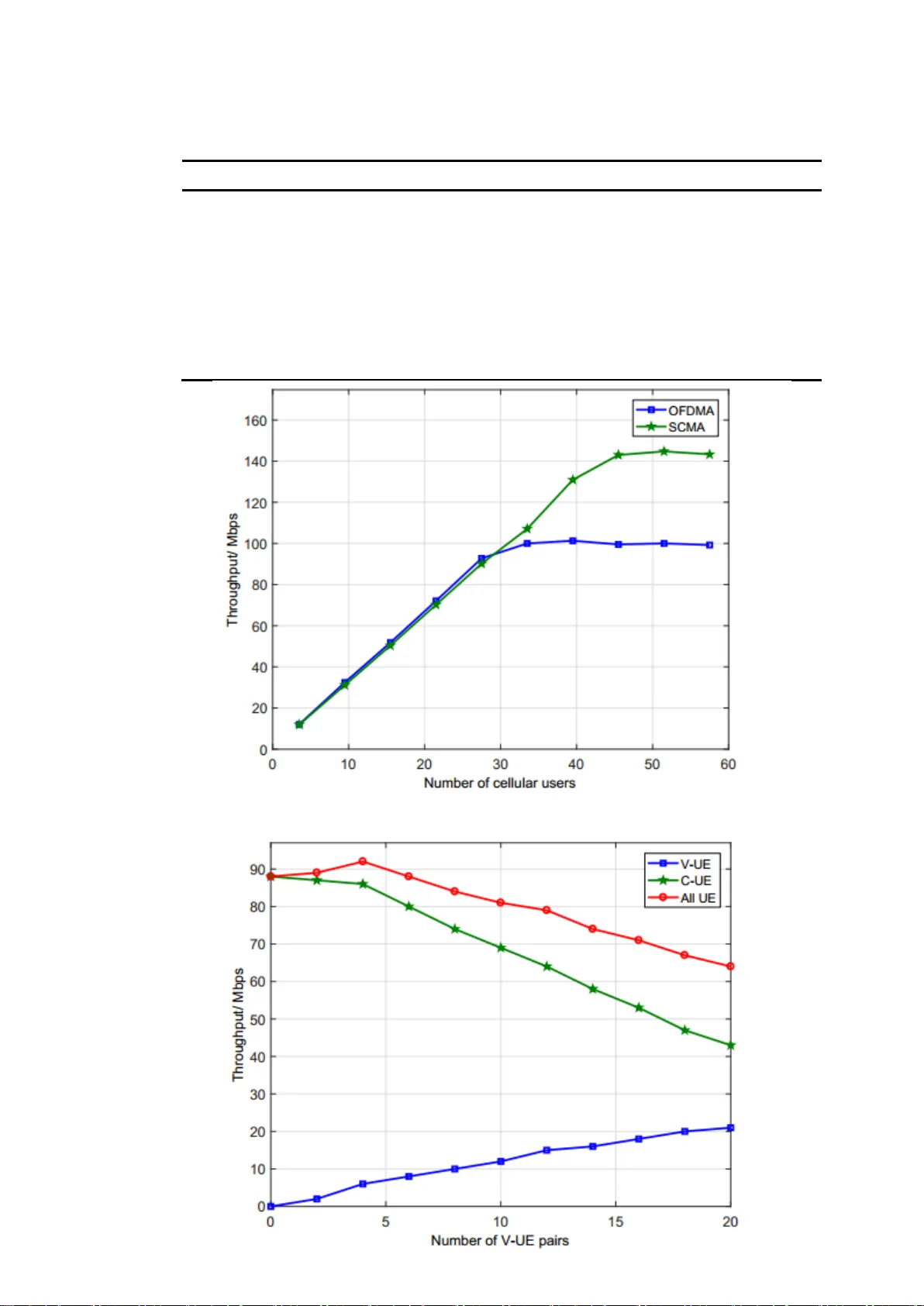
Resource Allocatio n Algorithm for V2 X communications based on SCMA Wei wu, Linglin Kong and Tong Xue Communication Research Center, Harbin Institute of Technology, Harbin, 150080, China Emails:{kevinking , tengerskong}@hit.edu.cn, xtong940213@163.com Abstrac t: In this paper, we propose a resource allocation algo rithm for V2X communications based on Sparse Code Multiple Access(SCMA). By analy zing the interference model in the V2X scenario, we formu late the problem which deals with resource allocation to maximize the syst em through put. A graph color -based user cluster algorithm combined with resource allocation algorithm based o n both result of clustering and SINR is presented to solve the problem. The simulation results indicate that the throughpu t performance of system based on SCMA is superior to which based on OFDMA, and the proposed algorithm can improve the syst em throughput an d t he number of access users. Key wo rds: V2X, SCMA, resource allocation, cluster I. Introduction With the increasing of the number of vehicles and the development of the Internet, the re search of Internet of Vehicles(IOV) becom es a research focus [1]. Low latency and high reliability are critical requirements for the services, especial ly safety app lications, in the IOV [2]. Howe ve r, in the scenario of IOV, the vehicles are densely distributed, fast moving an d the numbe r of users is large. It is difficult for t he base station to obtain full channel state information(CSI). It will lead to a longer r esource scheduling tim e, unreliable channel information. V2X is the general term for Vehicle- to -Vehicle(V2V), Vehicle- to -Infrastructure ( V2 I) and vehicle- to -device(V2D). The current solution for V2X is based on th e IEEE 802.11p standard ad-hoc communications and back-end co mmunications based o n the Lon g- Term-Evolution(LTE). How ev er , both of these solutions cannot guarantee quality of service (QoS) of IOV applications [3]. Device- to -Device (D 2D) communications u nderlay LTE networks can be seen as on e of the wa ys to solve the problem [4]. In D2D communication underlay L TE network s, tw o adjacent users (UEs) can co mmunicate wit hout the f orward of base station(BS). D2D communications can reduce the delay and improve the reliabil ity [5]. In V2X, D2D can be employed to achieve V2V communication. How ev er, the performance improvement is limited when introducing D2D into V2X due to the interference problem resulted fr om the reusing of radio resources D2D users(D-UEs) and cellular users(C-UEs). In [6], [7], th e radio resource management (RRM) pro ble m of the D- UEs reused the resources of C-UEs was analyzed, but only one case that one D-UE reusing the resources of one C-UE is considered. In [8], the authors proposed an RRM algorithm based on cluster-base d D2D and cellular hybrid networks. This algorithm was based on orthogonal multiple access. In [9], the authors indicated that non- orthogonal multiple access technology can increase the number of connections, improve the system throughput and spectral efficiency and reduce the en d- to -end de lay. Therefore, V2X communication based on non-orthogonal multiple access becomes a valuable research topic in IOV. In this paper, we consider a sing le cell hybrid netw ork which includes C -UEs and V-UEs. We utilize S parse Code Multiple Access in cellular c ommunication t o improve the number of cellular users [10]. Th e V-U Es reuse the resources of C-UEs. To reduce the interference between the connected V-UEs, we employ the graph coloring method to cluster the users so that several users in a cluster reuse the same resources with litt le interference. To maximum the sum rate of the cell, we propose a resource allocation algorithm based on SINR selection. The rest of the paper is organized as follows. In Section II, we provide a system model, including the hybrid network and SCMA access scheme. Section III provides the formulation of problem. The graph-colored cluster selected method and resourc e allocation sche me are presented in Section IV. In Sectio n V, we show the performance of our algorithm by simulation. Se ction is the conclusion. II. System Model A. Cell Model The system scenario is a hybrid network consisted of C -UEs and V -UEs. C- UEs communicate with the forward of BS, i.e. V2I mode. V -UEs communicate directly, i.e. V2V mode, as shown in Figure 1. Note that , represents the set of V- UEs, while represents the set of C-UEs. K and N represents the number of V -UEs and C-UEs respectively. Res ource ce ntrally control by BS. There i s interference between C-UEs and V -UEs pairs when they reuse the same resource. In order to simplify the model, this paper assumes that both sides of the V2V communication must be in the same cell. Fig. 1 Channel sharing and interference model of V2X commun ications B. Multiple Access Scheme In order to increase the number of access users and the system throughput, we adopt SCMA as the multiple access scheme of C-UEs in this paper. SCMA maps the log 2 D bits to the M -d imensional co dewords via the enco der. D represented the number of codeword s. The SCMA encoder of user k can be expressed as: (1) Where b is the input binary bit stream, and f k is the mapping function of user k . x k is an M -dimensional sparse codeword vector whose non-zer o dimension M C < M . The maximum number of codebooks is: (2) If L is the number of resource blocks(RBs), the overload factor can be defined as OF = J/L. Figure 2 shows an example of SCMA encoder. The signa ls of 6 UEs are overlaid and spread over 4 RBs. Therefore, the overload factor is 1.5. Fig. 2 An exampl e of SC MA encod er Since the V-UEs which reuse the resources of the C-UEs may interfere C- UEs, the number of the V-UEs which reused the same C- UE resource should be limite d. The V- UEs use orthogonal multiple access to reduce interference. V-UE p Tx V-UE p Rx C-UE n eNB V-UE q Tx V-UE q Rx III. Problem Fo rm ulat ion In this paper , D2 D communication is centrally controlled by BS. BS can ob tains CSI through t he measurement reports from the users. It assumes that K V2V pairs reuse the same resource of N C-UEs i n uplinks. When the UEs adopt SCMA, as the example in Fi g. 2, UE1, UE2 and UE3 use the same RB. Hen ce, there are co -chann el interference with each other. In addition, the uplink signal o f C -UE may interfere the V-UE Rx, the V -UE Tx may interfere the BS , and V2V pairs may interfere each other, when reuse occurs. Therefore, it is very necessary for BS to tak e measures to contr ol the interference. Our problem formulation deals with resource allocation for both V-UEs and C- UEs. The optimization objective is to maximize the sum rate of the cell. According to the interference analyzation and Shannon capa cit y, our problem can be formulated as a sum rate optimization: subject to: Where , , and are the SINR and transmit power of C -UE i and V- UE j , respectively. , and are reuse indicator with binary values. If V-UE j reuses the same RB of C-UE i , then , otherwise 0; if C-UE i and C-UE k reuse the same RB, then , otherwise 0; likely, if V-UE l and V-UE j reuse the same RB, th en otherwise 0. , and are the maximum transmission power and minimum SINR requirement of C -UEs and V- UEs, respectively. Besides, is Gaussian White Noise; represents the number of RBs in the system. Constraints (4) and (5) ensure that the C-U E and the V-UE should meet their own quality of service (QoS) requirements. Constraints (6) and (7) indicate that the transmit power of C -UE and the V-UE should not exceed their respective maximum transmit power. Constraint (8) indicates that the number of active C -UEs accessing the base station can not g reater than the product of the number of RBs in the system and the overload factor. IV. Graph C oloring -base d Clust er Alg orit hm and Resourc e Allocation Algorithm A. Graph Coloring-based Cluster Algorithm We can make multiple V -UE pairs simultaneously reuse a same C-UE resource to improve th e system capacity and spectral efficiency. A graph-based clustering algorithm is adopted to achieve this target. The n odes in the inter ference graph denote a V-UE pair, while different colors representing different clusters. If there are interference between V-UE pair i and j , we can’t assign V -UE pair i and j into th e same cluster, i.e. , node i and node j can’t be the same c olor. S o we should use as few colors as possible in the interference graph to minimize the total number of clusters. T o ac hieve this goal, our algorithm firstly colors the most interfered node, and t hen consider the node w hich is the second more interfered. According the interference relationship amoug the cu rrent node and al ready colored nodes to determine its co lor, and repeat th is loop un til all nodes are colored successfully. B. Resource Allocation Algorithm based on QoS After the clustering is completed, we allocate resources of C- UE with best SINR C-UE to a V-UE cluster, and determine whether the SINR is high enough for Qos after reuse. If the condition is satis fied, the next V-UE cluster can continue to reuse its resource. Otherwise, the cluster chooses the next C- UE to reuse until the process ends. Algorithm 2. Resource Allocation Algorithm 1: Initialization : the set of C-UEs are sorted in descending order of SINR 2: the set of V-UE pairs 3: : the set of V-UE pairs which have been c lustered 4: if or then 5: for do 6: for j = 1 : K’ do 7: Let cluster j’ reuse the RB of C-UE i , calculate new and 8: if and then 9: j’ = j’ + 1 10: else 11: i = i +1 12: end if 13: end for 14: end for 15: end if Algorithm 1. Graph Coloring-based Cluster Algorithm 1 : initializa tion : 2: Cluster : the set of all clusters; create a new blank V-UE cluster , put it into Cluster 3: if V-UE j interferes V-UE i then 4: 5: else 6: 7: end if 8: for do 9: 10: end for 11: Sort InterfSize in descending order of size store in SortedSize 12: for j = 1: K do 13 : index = SortedSize(j).second 14: for k = Cluster .(1) : Cluster.final do 15: if Cluster.(K) ∩ then 16: pu t V-UE index into Cluster.(K) , then break 17: else 18: V-UE index is not assigned to any cluster in Cluster , create Cluster. ( K+ 1) put V-UE index into this cluster and Cluster 19: end if 20: end for 21: end for V. Simulation Results In the simulation, we constructed a single cell. The system is a hybrid communication netwo rk with C-UEs and V - UE pairs. Two k inds of users are rand omly distributed in the cell. In addition, the parameters of SCMA are set that sub- carrier number L = 4, non-zero elements number M c = 2, codebook number J = 6. The other parameters are shown in T ab le 1. Fir stly , we compare the throughput per formance of different multiple access methods when the number of RB s is same. Figure 3 shows that SCMA has a better performance than OFDMA. Since the overload feature of SCMA, it allows more users access the system. It leads to a larger average throughput. In Figure 4, it indicates the total throughput of C-UEs is gradually reduced due to the reusing interference of the V-UE pairs , and the overall throughput of the V- UE pairs increases with the growth of number of V- UE pairs. Meanwhile, V-UE pairs bring more interference, so the total throughput of the two kinds of UEs firstly rise and then decline in the trend. Table 1. Simulation Parameters Parameter s Value Radius of cell Carrier frequency System bandwidth C-UE transmit power V-UE transmit power Noise power spectral density V2V link distance 250m 2GHz 20MHz 20dBm 17dBm -174dBm/Hz 25m Fig. 3 Throughput vs C-UE number with different multiple access scheme Fig. 4. Throughput vs V-UE pairs number VI. Conclusion In this paper, we consider a hybrid network c onsisting of C-UEs and V- UE pairs in a single cell. To increase the number of access users, we adopt S CMA for C- UEs. The simulation results show that there is a better performance than OMA. Then, we propose a V-UEs clustering algorithm based on graph coloring theory to minimize the mutual interference of V-UEs that reuse a same RB in the same cluster. Furt he r, we propose a resource allocation algorithm based on SINR to maximize the sum rate. The simulation results show that our algorithm can incr ease s ystem throughput, as well as the number of access users. References 1. Khelil, A., Soldani, D.: On the suitability of Device- to -Device communications for road traffic sa fet y. Int ernet of Things. 16, pp.224 – 229 (2014) 2. METIS: Scenarios, Requirem ents and KPIs for 5G Mobile and Wireless System, ICT-317669-METIS/D1.1, 2013, METIS deliverable D1.1. https://www. metis2020.com/documents/deliv erables/ 3. Sun, W., Strom, E. G., Brannstrom, F., Sui, Y.: D2D-based V2V communications with latency and reliability constraints. In: IEEE GLOBECOM Workshop s. pp.1414- 1419. IEEE Press, New Yo rk (2015) 4. 3GPP: Study on L TE device to device proximity services, Te ch. Rep. RP-12209 (2012) 5. Fodor, G., Dahlman, E., Mildh, G., Parkvall, S., Reider, N., Mikls, G., et al.: De- sign aspects of network assisted device- to -device communications. IEEE Comm uni cations Magazine, 50(3), pp . 170 – 177(2012) 6. Phunchongharn, P ., Hossain, E., Dong, I. K.: Resource allocation for device- to - device communications und erlaying lte-advanced networks. IEEE Wireless Communications, 20(4), pp.91-100(2013) 7. Asadi, A., Wa ng, Q., Mancuso, V.: A survey on device- to -device communication in cellular networks. IEEE Commun ications S urveys and Tutorials, 16(4), pp.1801- 1819(2013). 8. Sun, W., Yu an , D., Stro m, E., Brannstrom, F.: Cluster-based radio resource management for d2d-supported safety-critical v2x communications. IEEE Transactions on Wireless Communications, 15 (4), pp.2756- 27 69(2016) 9. Yunzheng Long, Shang Zhang .: A survey: several technologies of non-orthogonal transmission for 5G. China Communications, 12(10) , pp.1 – 15(2015). 10. Au, K., Zhang, L., Nikopour, H., Yi, E., Bayesteh, A., Vilaipornsawai, U., et al.: Uplink contention based SCMA for 5 G radio access. In: IEEE GLOBECOM Wo rk shops. pp.900-905. IEEE Press, New York (2014)
Original Paper
Loading high-quality paper...
Comments & Academic Discussion
Loading comments...
Leave a Comment