Real-time Robot-assisted Ergonomics
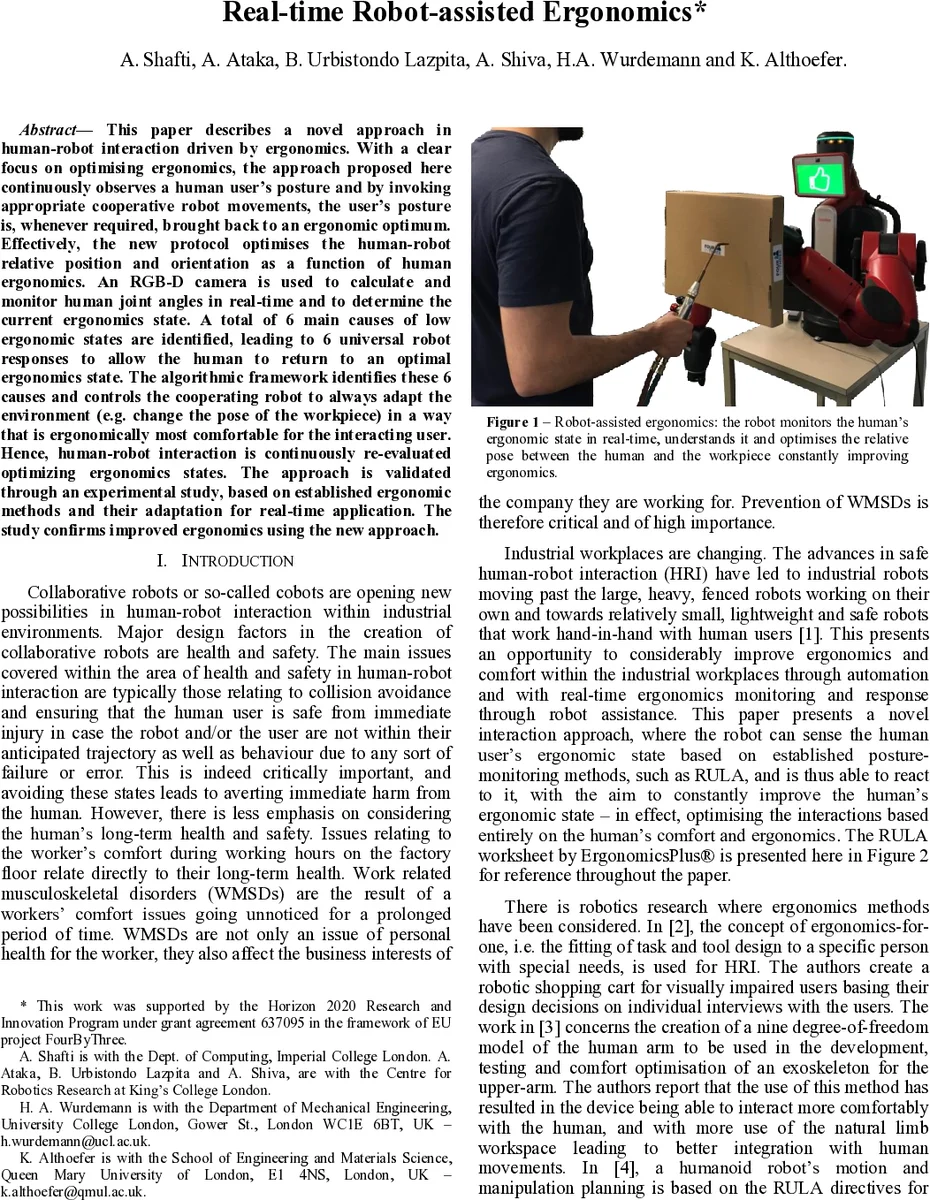
This paper describes a novel approach in human robot interaction driven by ergonomics. With a clear focus on optimising ergonomics, the approach proposed here continuously observes a human user’s posture and by invoking appropriate cooperative robot movements, the user’s posture is, whenever required, brought back to an ergonomic optimum. Effectively, the new protocol optimises the human-robot relative position and orientation as a function of human ergonomics. An RGB-D camera is used to calculate and monitor human joint angles in real-time and to determine the current ergonomics state. A total of 6 main causes of low ergonomic states are identified, leading to 6 universal robot responses to allow the human to return to an optimal ergonomics state. The algorithmic framework identifies these 6 causes and controls the cooperating robot to always adapt the environment (e.g. change the pose of the workpiece) in a way that is ergonomically most comfortable for the interacting user. Hence, human-robot interaction is continuously re-evaluated optimizing ergonomics states. The approach is validated through an experimental study, based on established ergonomic methods and their adaptation for real-time application. The study confirms improved ergonomics using the new approach.
💡 Research Summary
The paper introduces a novel human‑robot interaction (HRI) framework that continuously monitors a worker’s posture and automatically adjusts the robot‑controlled workpiece to keep the worker in an ergonomic optimum. The system relies on a Microsoft Kinect RGB‑D camera to capture 15 skeletal joint positions and on two Bosch BNO055 inertial measurement units (IMUs) mounted on the forearm and the back of the hand to obtain wrist flexion and twist angles. All sensor streams are processed in ROS, where joint vectors are transformed into the anatomical planes (sagittal, coronal, transversal) and fed into the Rapid Upper Limb Assessment (RULA) method. The RULA score, originally comprising 144 possible arm postures, is reduced to six representative ergonomic violations: upper‑arm sagittal deviation, upper‑arm coronal deviation, lower‑arm sagittal deviation, lower‑arm transversal deviation, wrist flexion, and wrist twist.
For each violation the authors pre‑define a robot response that moves the workpiece rather than the human. Upper‑arm deviations are corrected by translating the workpiece up/down or left/right so that the arm returns to a near‑vertical, neutral position. Lower‑arm deviations are handled by moving the workpiece to bring the forearm angle toward the ergonomic target of 90° (range 60°–100°). Wrist violations trigger rotation of the workpiece to reduce required wrist twist. The translation and rotation magnitudes are calculated analytically using the measured arm length (shoulder‑elbow vector magnitude) and the observed deviation angle; a 10° threshold is applied to avoid over‑reacting to small fluctuations. Because the arm length is measured in real time, the system automatically adapts to users of different sizes.
The experimental validation involved ten participants who were instructed to adopt postures that deliberately violated ergonomic norms. The robot (a Baxter research platform) then applied the appropriate response in each case. Quantitative results showed an average reduction of 2.3 points in the RULA score after robot assistance, with statistically significant improvements (p < 0.01). Subjective questionnaires indicated reduced perceived fatigue and higher comfort.
The authors acknowledge several limitations. Kinect’s skeleton tracking can be unreliable under poor lighting or rapid motion, which may affect real‑time stability. The current implementation only adjusts the pose of a single workpiece, limiting applicability to more complex assembly tasks that require multi‑axis manipulation or tool changes. Moreover, only six ergonomic violation categories are addressed; combined or higher‑order postural issues involving the spine, shoulder girdle, or dynamic loads are not covered.
Future work is proposed in three directions: (1) replacing the Kinect with a deep‑learning‑based pose estimator for higher accuracy and robustness; (2) extending the framework to coordinate multiple collaborative robots for more sophisticated task environments; and (3) incorporating user feedback loops and adaptive learning so that the robot can personalize its responses over time.
In summary, this study presents the first integrated, real‑time system that fuses ergonomic assessment with robot‑mediated environment adaptation. By shifting the corrective action from the human to the robot‑controlled workspace, it offers a promising pathway to reduce work‑related musculoskeletal disorders while maintaining or even enhancing productivity in industrial settings.
Comments & Academic Discussion
Loading comments...
Leave a Comment