Importance of Amplifier Physics in Maximizing the Capacity of Submarine Links
The throughput of submarine transport cables is approaching fundamental limits imposed by amplifier noise and Kerr nonlinearity. Energy constraints in ultra-long submarine links exacerbate this problem, as the throughput per fiber is further limited …
Authors: Jose Krause Perin, Joseph M. Kahn, John D. Downie
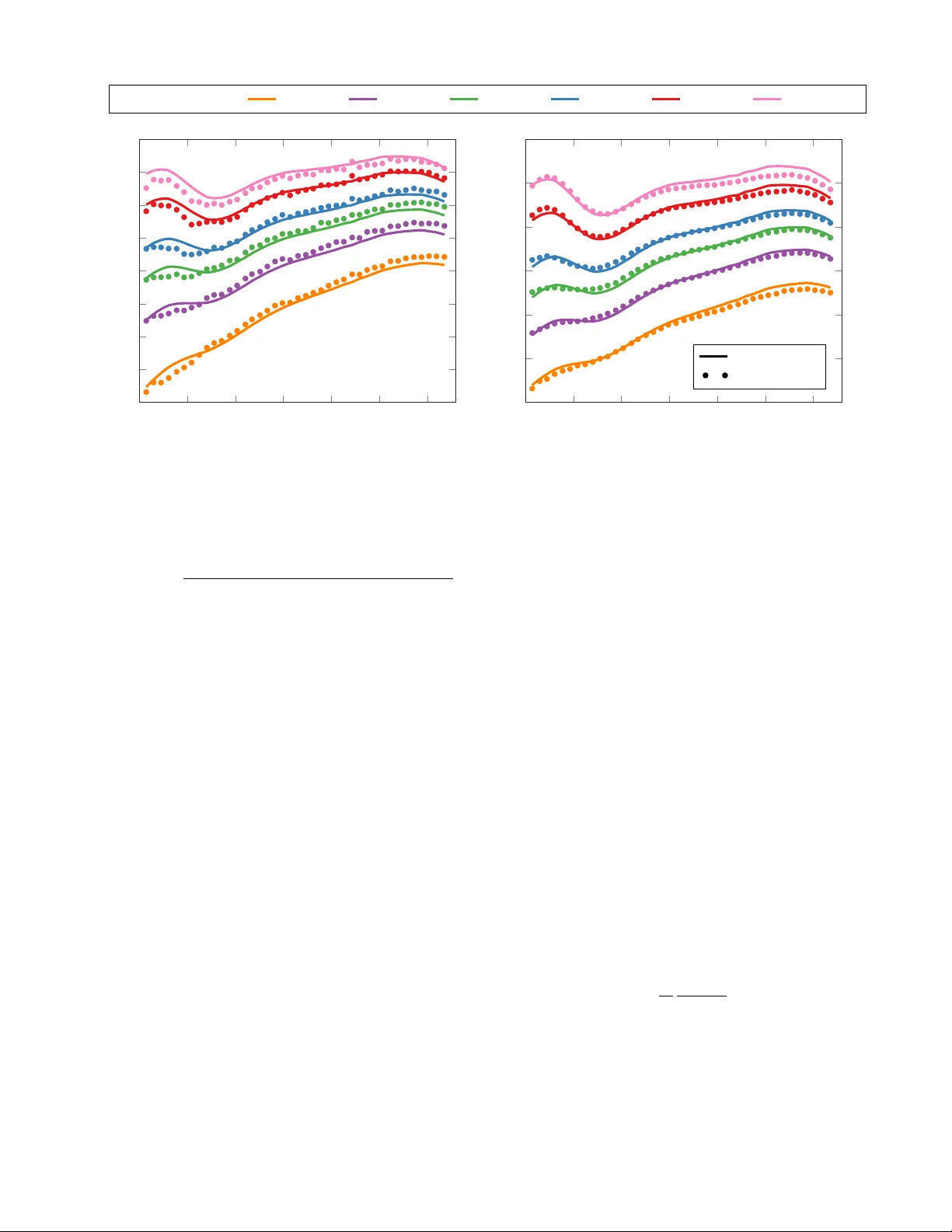
Imp ortance of Amplifier Ph ysics in Maximizing the Capacit y of Submarine Links Jose Krause P erin 1 , Joseph M. Kahn 1 , John D. Do wnie 2 , Jason Hurley 2 , and Kevin Bennett 2 1 E. L. Ginzton Lab oratory , Stanford Univ ersity , Stanford, CA, 94305 USA 2 Corning, Sulliv an P ark, SP-AR-02-1, Corning, NY, 14870 USA F ebruary 20, 2019 Abstract The throughput of submarine transp ort cables is approaching fundamen tal limits imp osed b y am- plifier noise and Kerr nonlinearit y . Energy constrain ts in ultra-long submarine links exacerbate this problem, as the throughput per fib er is further limited b y the electrical pow er av ailable to the un- dersea optical amplifiers. Recen t w orks hav e studied how emplo ying more spatial dimensions can mitigate these limitations. In this pap er, w e address the fundamental question of ho w to optimally use each spatial dimension. Specifically , w e discuss ho w to optimize the channel p o w er allocation in order to maximize the information-theoretic capacit y under an electrical p ow er constrain t. Our form ulation accounts for amplifier ph ysics, Kerr nonlinearit y , and p o wer feed constraints. Whereas recen t w orks assume the optical amplifiers operate in deep saturation, where p o wer-con version effi- ciency (PCE) is high, w e sho w that given a p o wer constraint, op erating in a less saturated regime, where PCE is lo wer, supp orts a wider bandwidth and a larger num b er of spatial dimensions, thereb y maximizing capacity . This design strategy increases the capacit y of submarine links by about 70% compared to the theoretical capacity of a recently prop osed high-capacity system. 1 In tro duction Submarine transport cables interconnect countries and con tinents, forming the backbone of the In ternet. Ov er the past three decades, piv otal tec hnologies such as erbium-dop ed fib er amplifiers (EDF As), w av elength- division multiplexing (WDM), and coherent detection emplo ying digital comp ensation of fib er impairments hav e enabled the throughput p er cable to jump from a few gi- gabits p er second to tens of terabits p er second, fueling the explosive gro wth of the information age. Scaling the throughput of submarine links is a chal- lenging technical problem that has rep eatedly demanded inno v ative and exceptional solutions. This intense tech- nical effort has exploited a recurring strategy: to force ev er-larger amounts of information ov er a small n umber of single-mo de fibers [1]. This strategy is reac hing its limits, ho wev er, as the amoun t of information that can be practi- cally transmitted per fib er approac hes fundamen tal limits imp osed b y amplifier noise and Kerr nonlinearity [2, 3]. In submarine cables longer than ab out 5,000 km, this strat- egy faces another fundamen tal limit imp osed by energy constrain ts, as the electrical pow er a v ailable to the under- sea amplifiers ultimately restricts the optical p o wer and throughput p er fib er. Insigh ts from Shannon’s capacity offers a different strategy . Capacit y scales linearly with the num b er of di- mensions and only logarithmically with the pow er p er di- mension, so a p o wer-limited system should employ more spatial dimensions (fib ers or modes), while transmitting less data in each. This principle was understoo d as early as 1973 (see [4] and references therein) and recently em- braced b y the optical communications communit y [5 – 7]. In fact, numerous recent w orks hav e studied how thi s new strategy improv es the capacity and pow er efficiency of ultra-long submarine links [8 – 11]. But a fundamen tal question remained unanswered: what is the optimal wa y of utilizing each spatial dimension? F ormally , what is the c hannel pow er allo cation that maximizes the information- theoretic capacity p er spatial dimension given a con- strain t in the total electrical p o wer? In this pap er, we form ulate this problem mathematically and demonstrate ho w to solve it. In con trast to the existing literature [8 – 11], we mo del the optical amplifier using amplifier rate equations rather than mo dels assuming a constan t p o w er-conv ersion effi- ciency (PCE). W e argue that mo deling amplifier physics is critical for translating energy constraints in to param- eters that gov ern the system capacity , such as amplifica- tion bandwidth, noise, and optical p o wer. This is partic- ularly critical when the n umber of spatial dimensions is large, and the amplifier must op erate with reduced pump p o w er. Under these unusual op erational conditions, sim- ple constant-PCE models may not b e accurate. 1 Our formulation results in a non-conv ex optimization problem, but its solutions are robust, i.e., they do not seem to dep end on initial conditions. This suggests that the optimization reaches the global minim um or is con- sisten tly trapp ed in an inescapable lo cal minimum. In either case, the solutions are very promising. The opti- mized p o w er allo cation increases the theoretical capacity p er fib er b y 70% compared to recen tly published results that employ spatial-division multiplexing (SDM) and flat p o w er allo cation. Our optimization yields insights into p o wer-limited submarine link design and op eration. In agreement with prior work [11], we find that o verall cable capacity is max- imized by employing tens of spatial dimensions p er di- rection. Prior w ork, how ever, modeled EDF As using a constan t PCE v alue consisten t with operation in a highly saturated regime, whic h maximizes PCE. Our work shows that op eration in a less saturated regime, where PCE is lo wer, increases the useful amplification bandwidth, i.e., the n umber of wa velength c hannels for whic h the gain ex- ceeds the span atten uation, and makes more p o w er a v ail- able for additional spatial dimensions. Thus, our opti- mization increases capacit y b y better utilization of both w av elength and spatial domains. Moreov er, our optimiza- tion, b y including Kerr nonlinearity and not neglecting it a priori , clarifies the conditions under whic h nonlinearit y is imp ortant, and is applicable to systems in which the n umber of spatial dimensions is constrained. The remainder of this pap er is organized as follo ws. In Section I I w e formulate the optimization problem and describ e ho w to solve it. In Section I II w e present sim- ulation results comparing the optimized c hannel p o wer profile with con ven tional flat allo cation designs. W e con- clude the pap er in Section IV. W e pro vide an App endix on modeling EDF A physics and Kerr nonlinearit y , and on the optimization algorithm. 2 Problem form ulation A submarine transp ort cable emplo ys S spatial dimen- sions in eac h direction, which could b e modes in a multi- mo de fib er, cores of a multi-core fib er, or simply multiple single-mo de fib ers. Throughout this paper, w e assume that eac h spatial dimension is a single-mo de fib er, since this is the prev ailing scenario in to da y’s submarine sys- tems. Eac h of those fibers can b e represented by the equiv alent diagram shown in Fig. 1. The link has a total length L , and it is divided into M spans, eac h of length l = L/ M . An optical amplifier with gain G ( λ ) comp ensates for the fiber atten uation A ( λ ) = e α SMF ( λ ) l of eac h span, and a gain-flattening filter (GFF) with transfer function 0 < F ( λ ) < 1 ensures that the amplifier gain matc hes the span attenuation, so that at eac h span w e ha ve G ( λ ) F ( λ ) A − 1 ( λ ) ≈ 1. In practice, this condition has to be satisfied almost perfectly , as a mismatc h of just a tenth of a dB would accumulate to GFF G ( λ ) e − α SMF ( λ ) l F ( λ ) × M = L l P n ≈ P n + P ASE ,n + NL n Figure 1: Equiv alent blo c k diagram of each spatial di- mension of a submarine optical link including amplifier noise and nonlinear noise. tens of dBs after a c hain of hundreds of amplifiers. As a result, in addition to GFF p er span, perio dic pow er rebalancing after ev ery fiv e or six spans corrects for an y residual mismatches. The input signal consists of N p oten tial WDM c hannels spaced in frequency by ∆ f , so that the channel at wa v e- length λ n has p o wer P n . Our goal is to find the pow er allo cation P 1 , . . . , P N that maximizes the information- theoretic capacit y p er spatial dimension. W e do not mak e an y prior assumptions about the amplifier bandwidth, hence the optimization ma y result in some channels not b eing used i.e., P n = 0 for some n . Due to GFFs and p eriodic p o wer rebalancing, the out- put signal p ow er of eac h c hannel remains appro ximately constan t along the link. But the signal at each WDM c hannel is corrupted b y amplifier noise P ASE ,n and non- linear noise NL n . Thus, the SNR n of the n th c hannel is giv en b y SNR n = P n P ASE ,n + NL n , G ( λ n ) > A ( λ n ) 0 , otherwise . (1) Note that only c hannels for which the amplifier gain is greater than the span attenuation can be used to transmit information, i.e., P n 6 = 0 only if G ( λ n ) > A ( λ n ). The optical amplifiers for submarine links generally consist of single-stage EDF As with redundant forw ard- propagating pump lasers op erating near 980 nm. In ultra- long links, the pump po wer is limited b y feed v oltage con- strain ts at the shores. F rom the maximum p o wer transfer theorem, the total electrical pow er a v ailable to all under- sea amplifiers is at most P = V 2 / (4 Lρ ), where V is the feed v oltage, and ρ is the cable resistance. T o translate this constrain t on the total electrical p o wer into a con- strain t on the optical pump p o wer P p p er amplifier, w e use an affine mo del similar to the one used in [8, 10]: P p = η P 2 S M − P o , (2) where η is an efficiency constan t that translates electri- cal p o wer into optical pump pow er, and P o is a pow er o verhead term that accounts for electrical p ow er sp en t in operations not directly related to optical amplification suc h as pump laser lasing threshold, monitoring, and con- trol. The factor of 2 S appears b ecause there are S spatial dimensions in each direction. 2 This constrain t on the pump p o wer limits the EDF A output optical pow er and bandwidth, th us imposing a hard constraint on the fib er throughput. As an exam- ple, increasing P n ma y impro v e the SNR and spectral efficiency of some WDM c hannels, but increasing P n also depletes the EDF and reduces the amplifier ov erall gain. As a result, the gain of some channels may drop below the span attenuation, th us reducing the amplifier bandwidth and the n umber of WDM c hannels that can be transmit- ted. F urther increasing P n ma y reduce the SNR, as the nonlinear noise pow er becomes significant. These consid- erations illustrate ho w forcing more pow er per fib er is an ineffectiv e strategy in improving the capacity p er fiber of p o w er-limited submarine cables. T o compute the amplifier noise P ASE ,n in a bandwidth ∆ f after a c hain of M amplifiers, we use the analytical noise mo del discussed in App endix A: P ASE ,n = M NF n hν n ∆ f , (3) where h is Planck’s constant, ν n is the channel frequency , and NF n is the amplifier noise figure at wa v elength λ n . F or amplifiers pump ed at 980 nm, the noise figure is ap- pro ximately gain-and-w av elength independent, and it can b e computed from theory or measured exp erimen tally . Although w e fo cus on end-pump ed single-mo de EDF As, similar models exist for m ulticore EDF As [12]. Note that the accumulated ASE pow er in (3) does not dep end on the amplifier gain, as in Fig. 1 we defined P n as the in- put p ow er to the amplifier, as opp osed to the launched p o w er. This conv ention con venien tly mak es the accumu- lated ASE indep endent of p o w er gain. T o compute the amplifier gain, w e use the semi- analytical mo del given in App endix A. In this calculation, w e assume that the input p o w er to the amplifier is equal to P n + ( M − 1)NF n hν n ∆ f . That is, the signal pow er plus the accum ulated ASE noise p o wer at the input of the last amplifier in the c hain. As a result, all ampli- fiers are designed to op erate under the same conditions as the last amplifier. This p essimistic assumption is not critical in systems that op erate with high optical signal- to-noise ratio (OSNR), and accoun ts for signal dro op in lo w-OSNR systems, where the accum ulated ASE p ow er ma y be larger than the signal p o wer, and th us reduce the amplifier useful bandwidth. T o account for Kerr nonlinearity , we use the Gaussian noise (GN) model, which establishes that the Kerr nonlin- earit y in dispersion-uncomp ensated fiber systems is well mo deled as an additive zero-mean Gaussian noise whose p o w er at the n th channel is giv en b y [13] NL n = A − 1 ( λ n ) N X n 1 =1 N X n 2 =1 1 X q = − 1 ˜ P n 1 ˜ P n 2 ˜ P n 1 + n 2 − n + q D ( M spans) q ( n 1 , n 2 , n ) , (4) for 1 ≤ n 1 + n 2 − n + q ≤ N . Here, ˜ P n denotes the launched p o w er of the n th c hannel, which is related to the input p o w er to the amplifier by ˜ P n = A ( λ n ) P n . The nonlinear noise p o wer is scaled b y the span atten uation A − 1 ( λ n ) due to the con v ention in Fig. 1 that P n refers to the input p o w er to the amplifier, rather than the launched p o wer. D ( M spans) q ( n 1 , n 2 , n ) is the set of fib er-sp ecific nonlinear co efficien ts that determine the strength of the four-wa ve mixing comp onen t that falls on c hannel n , generated b y c hannels n 1 , n 2 , and n 1 + n 2 − n + q . Here, q = 0 describ es the dominant nonlinear terms, while the co efficien ts q = ± 1 describe corner contributions. These co efficients w ere computed in [13] and are detailed in App endix B. As discussed in Section 3, for systems that op erate with pump p o w er b elo w ab out 100 mW, Kerr nonlinearity is negligible and may b e disregarded from the mo deling. W e do not include stim ulated Raman scattering (SRS) in our mo deling for tw o reasons. First, long-haul sub- marine cables emplo y large-effectiv e-area fib ers, whic h reduces SRS intensit y . Second, the optimized amplifier bandwidth is not larger than 45 nm, while the Raman efficiency p eaks when the wa velength difference is ∼ 100 nm. Using equations (1)–(4), w e can compute Shannon’s ca- pacit y p er fib er by adding the capacities of the individual WDM channels: C = 2∆ f N X n =1 1 {G ( λ n ) ≥ A ( λ n ) } log 2 (1 + ΓSNR n ) , (5) where 0 < Γ < 1 is the co ding gap to capacity and G ( λ n ) , A ( λ n ) denote, resp ectiv ely , the amplifier gain and span atten uation in dB units. The indicator function 1 {·} is one when the condition in its argumen t is true, and zero otherwise. As we do not know a priori which channels con tribute to c apacit y ( P n 6 = 0), w e sum ov er all chan- nels and let the indicator function indicate which channels ha ve gain ab o ve the span attenuation. Since the indicator function is non-differen tiable, it is con venien t to approximate it b y a differentiable sigmoid function such as 1 { x ≥ 0 } ≈ 0 . 5(tanh( D x ) + 1) , (6) where D > 0 controls the sharpness of the sigmoid ap- pro ximation. Although making D large b etter approxi- mates the indicator function, it results in v anishing gra- dien ts, whic h retards the optimization pro cess. Hence, the optimization problem of maximizing the ca- pacit y p er fib er giv en an energy constrain t that limits the amplifier pump p ow er P p can b e stated as maximize L EDF , P 1 ,..., P N C giv en P p (7) In addition to the p ow er allocation P 1 , . . . , P N in dBm units, w e optimize ov er the EDF length L EDF , resulting in a ( N + 1)-dimensional non-conv ex optimization prob- lem. L EDF ma y be remo ved from the optimization if its 3 T able 1: Simulation parameters. Parameter V alue Units Link length ( L ) 14,350 km Span length ( l ) 50 km Number of amplifiers p er fib er ( M ) 287 First c hannel ( λ 1 ) 1522 nm Last c hannel ( λ N ) 1582 nm Channel spacing (∆ f ) 50 GHz Max. num ber of WDM channels ( N ) 150 Fiber attenuation co efficient ( α SMF ( λ )) 0.165 dB km − 1 Fiber disp ersion co efficien t ( D ( λ )) 20 ps nm − 1 km − 1 Fiber nonlinear co efficien t ( γ ) 0.8 W − 1 km − 1 Fiber additional loss (margin) 1.5 dB Overall span attenuation ( A ( λ )) 8 . 25 + 1 . 5 = 9 . 75 dB Nonlinear noise p ow er scaling ( ) 0.07 Coding gap (Γ) − 1 dB Sigmoid sharpness ( D ) 2 Excess noise factor ( n sp ) 1.4 Excess loss ( l k ) 0 dB/m v alue is predefined. It is conv enien t to optimize ov er the signal p o wer in dBm units, as the logarithmic scale en- hances the range of signal pow er that can b e cov ered b y taking small adaptation steps. Ev en if w e assumed bi- nary p ow er allo cation, i.e., P n ∈ { 0 , ¯ P } , it is not easy to determine the v alue of ¯ P that will maximize the ampli- fication bandwidth for whic h the gain is larger than the span attenuation. Note that if we did not ha ve the pump pow er constraint and the amplifier gain did not change with the p o w er allo- cation P 1 , . . . , P N , the optimization problem in (7) w ould reduce to the con vex problem solv ed in [13]. Therefore, w e can argue that to within a small ∆ P n that does not c hange the conditions in the argumen t of the indicator function, the ob jectiv e (5) is lo cally concav e. Nev ertheless the optimization problem in (7) is not con vex, and therefore w e must employ global optimiza- tion tec hniques. In this paper, we use the particle sw arm optimization (PSO) algorithm [14]. The PSO randomly initializes R particles X = [ L EDF , P 1 , . . . , P N ] T . As the optimization progresses, the direction and velocity of eac h particle is influenced by its best known position and also b y the best known p osition found b y other particles in the swarm. The PSO algorithm was shown to outper- form other global optimization algorithms suc h as the ge- netic algorithm in a broad class of problems [15]. F urther details of the PSO are giv en in App endix C. When nonlinear noise is negligible, the solutions found through PSO are robust. That is, they do not dep end on the initial conditions. When nonlinear noise is significant, differen t particle initializations lead to the same ov erall solution, but these solutions differ by small random v aria- tions. T o o vercome this problem, once the PSO algorithm stops, we contin ue the optimization using the saddle-free Newton’s (SFN) metho d [16]. This v ariant of Newton’s metho d is suited to non-conv ex problems, as it is not at- tracted to saddle p oints. It requires kno wledge of the Hessian matrix, which can b e computed analytically or through finite differences of the gradient. F urther details of the SFN metho d are given in App endix C. 3 Results and Discussion W e now apply our prop osed optimization pro cedure to the reference system with parameters listed in T able 1. These parameters are consisten t with recen tly published exp erimen tal demonstration of high-capacit y systems em- plo ying SDM [9]. W e consider M = 287 spans of l = 50 km of lo w-loss large-effectiv e area single-mo de fib er, re- sulting in a total link length of L = 14 , 350 km. The span atten uation is A ( λ ) = 9 . 75 dB, where 8.25 dB is due to fib er loss, and the additional 1.5 dB is added as margin. F or the capacity calculations w e assume a coding gap of Γ = 0 . 79 ( − 1 dB). 3.1 Optimized channel p o w er W e first study how the optimized p o wer allo cation and the resulting sp ectral efficiency is affected b y the ampli- fier pump pow er. W e also inv estigate how Kerr nonlin- earit y affects the optimized p o wer allo cation and when it can b e neglected. This discussion does not assume any particular electrical pow er budget or n um b er of spatial dimensions. In Section 3.5, we consider ho w emplo ying m ultiple spatial dimensions can lead to higher o verall ca- ble capacity . F or a giv en pump pow er P p , w e solve the optimiza- tion problem in (7) for the system parameters listed in T able 1. The resulting pow er allo cation P n is plotted in Fig. 2 when Kerr nonlinearity is (a) disregarded and (b) included. The corresp onding achiev able sp ectral effi- ciency of each WDM channel is shown in Fig. 2cd. F or small pump p o wers, the optimized p o wer profile is limited b y amplifier properties, and thus there is only a v ery small difference b etw een the t wo scenarios sho wn in Fig. 2. As the pump p o wer increases and the amplifier deliv ers more output p o wer, Kerr nonlinearity b ecomes a factor limiting the channel p o wer. In terestingly , the op- timized pow er allocation in the nonlinear regime exhibits large v ariations at the extremities b ecause the nonlinear noise is smaller at those c hannels. Although the opti- mization is p erformed for 150 possible WDM channels from 1522 nm to 1582 nm, Fig. 2a and (b) show that not all of these WDM channels can b e utilized. The useful bandwidth is restricted betw een roughly 1528 nm and 1565 nm. Note that, as exp ected, the useful band- width does not increase significan tly ev en when the pump p o w er P p is tripled from 60 mW to 180 mW, since the amplification bandwidth is fundamentally limited by the EDF’s gain and absorption co efficien ts. Ho wev er, for v ery small pump p ow ers the useful amplification bandwidth decreases, as the gain for some channels b ecomes insuf- ficien t to comp ensate for the span atten uation. F or in- stance, note that for P p = 30 mW, part of the amplifier bandwidth cannot be used, as the resulting amplifier gain is b elo w atten uation. The optimized EDF length do es not v ary significantly , and it is generally in the range of 6 to 8 m. 4 1 , 520 1 , 530 1 , 540 1 , 550 1 , 560 1 , 570 − 20 − 18 − 16 − 14 − 12 − 10 W av elength (nm) Power allocation P n (dBm) 1 , 520 1 , 530 1 , 540 1 , 550 1 , 560 1 , 570 − 20 − 18 − 16 − 14 − 12 − 10 W av elength (nm) Power allocation P n (dBm) Pump power ( P p ) 180 mW 120 mW 60 mW 30 mW 1 , 520 1 , 530 1 , 540 1 , 550 1 , 560 1 , 570 2 4 6 8 W av elength (nm) Spectral efficiency (bit/s/Hz) 1 , 520 1 , 530 1 , 540 1 , 550 1 , 560 1 , 570 2 4 6 8 W av elength (nm) Spectral efficiency (bit/s/Hz) Exact Approximated Ignoring Kerr nonlinearity Including Kerr nonlinearity (a) (b) (c) (d) Figure 2: Optimized pow er allo cation P n for several v alues of pump p o wer P p . Kerr nonlinearity is disregarded in (a) and included in (b). Their corresponding achiev able sp ectral efficiency is sho wn in (c) and (d). Note that P n corresp onds to the input p ow er to the amplifier. The launc hed pow er is ˜ P n = G ( λ n ) F ( λ n ) P n = A ( λ n ) P n . Thus, the launc h p o w er is 9.75 dB ab o ve the v alues sho wn in these graphs. The solid lines in Fig. 2c and (d) are obtained from (5) by using exact mo dels (8) for the amplifier gain and noise, while the dashed lines are computed b y making appro ximations to allo w (semi-)analytical calculation of amplifier gain (10) and noise (3) (see App endix A), and sp eed up the optimization pro cess. Although the approx- imations lead to fairly small errors in estimating the sp ec- tral efficiency , we emphasize that after the optimizations conclude, the exact models are used to definitively quan- tify the spectral efficiency and o verall system capacit y obtained. 3.2 Signal and ASE evolution F or the optimized p o w er profile for P p = 60 mW sho wn in Fig. 2b, w e compute the ev olution of amplifier gain, accu- m ulated ASE, and the required GFF gain along the 287 spans, as sho wn in Fig. 3. The amplifier gain and ASE p o w er are computed using the exact amplifier mo del given in (8). The accum ulated ASE p o wer (Fig. 3c) increases after every span, causing the amplifier gain (Fig. 3a) and consequen tly the ideal GFF gain (Fig. 3b) to c hange sligh tly . Note that the ideal GFF profiles ha ve ripples of less than 3 dB. The v ariations in amplifier gain along the 287 spans are also small, resulting in GFF shap e difference of less than 2 dB betw een the first and last GFFs. In practice, the ideal GFF shap e can be ac hieved by fixed GFF after eac h amplifier and perio dic pow er rebalancing at in terv als of fiv e or so spans. As a test of how critically imp ortan t ideal per-span gain flattening is, we considered a scenario in whic h all GFFs are iden tical to the last GFF (lab eled 287 in Fig. 3b), and ideal p o w er rebalancing is realized only after ev ery 10 spans. The difference in ca- pacit y in this scenario is less than 3% with respect to the ideal case. A t the last span of the signal and ASE ev olution sim- ulation, w e compute the spectral efficiency per c hannel and compare it to the approximated results obtained us- ing (1)–(5). As in the discussion of Fig. 2(c) and (d), although the approximations lead to fairly small errors in estimating the sp ectral efficiency , w e use the exact cal- culations to definitively quantify spectral efficiency and o verall capacit y . 5 1 , 520 1 , 530 1 , 540 1 , 550 1 , 560 1 , 570 9 10 11 12 13 1 100 200 287 span attenuation W av elength (nm) Amplifier gain (dB) 1 , 520 1 , 530 1 , 540 1 , 550 1 , 560 1 , 570 − 3 − 2 − 1 0 1 100 200 287 W av elength (nm) Ideal GFF gain (dB) 1 , 520 1 , 530 1 , 540 1 , 550 1 , 560 1 , 570 − 50 − 40 − 30 − 20 1 100 200 287 W av elength (nm) Acc. ASE power (dBm) 1 , 520 1 , 530 1 , 540 1 , 550 1 , 560 1 , 570 3 4 5 6 W av elength (nm) Spectral efficiency (bit/s/Hz) Approx. using Eqs. 1–5 Signal & ASE evolution simulation (a) (b) (c) (d) Figure 3: Theoretical (a) amplifier gain, (b) ideal GFF gain, and (c) accumulated ASE p o w er in 50 GHz after 1, 100, 200, and 287 spans of 50 km. The pump p o wer of eac h amplifier is 60 mW, resulting in the optimized p o w er profile shown in Fig. 2b for P p = 60 mW and EDF length of 6.27 m. 3.3 Capacit y per spatial dimension Fig. 4a shows the total capacit y p er fib er as a function of the pump p ow er. Once again, for eac h v alue of pump p o w er P p , we solve the optimization problem in (7) for the system parameters listed in T able 1. The capacity p er spatial dimension plotted in Fig. 4a is computed by summing the capacities of the individual WDM c hannels. Belo w ab out 100 mW of pump pow er, the system op erates in the linear regime. A t higher pump p o wers, the ampli- fier can deliv er higher optical p o wer, but Kerr nonlinear- it y b ecomes significan t and limits the capacity . Fig. 4b details the ratio betw een ASE p o wer and nonlinear noise p o w er. A t high pump pow ers, ASE is only ab out 4 dB higher than nonlinear noise. This illustrates the dimin- ishing returns of forcing more p o wer o ver a single spatial dimension. Fig. 4c sho ws the total launched optical p ow er and amplifier pow er con version efficiency (PCE) defined as PCE ≡ total output optical p o wer − total input optical pow er optical pump p o wer [17]. F rom energy conserv ation argumen ts, it can be sho wn that PCE is upp er b ounded by the ratio betw een pump and signal wa velengths, whic h for 980 nm pump results in PCE < 63% [17]. Fig. 4c also shows the diminishing returns of forcing more pow er ov er a single spatial di- mension, since the amplifier efficiency does not increase linearly with pump pow er. In fact, doubling the pump p o w er from 50 mW to 100 mW increases PCE b y only 7 . 43%. Clearly , this additional pump pow er could be b etter emplo yed in doubling the n umber of spatial di- mensions, whic h would nearly double the ov erall cable capacit y . W e ha ve also computed the capacity for different span lengths assuming a total pump p o wer p er fib er of P p,total = 287 × 50 = 14350 mW. In agreement to prior w ork [18], the optimal span length is ac hieved for 40–50 km, resulting in an optimal span attenuation of 8.1–9.75 dB. 3.4 Comparison to exp erimen tal system T o gauge the b enefits of our proposed optimization pro- cedure, we compare the results of our approac h to those of a recen tly published w ork [9], whic h experimentally demonstrated high-capacit y SDM systems. In their ex- p erimen tal setup, Sinkin et al used 82 c hannels spaced b y 33 GHz from 1539 nm to 1561 nm. Eac h of the 12 cores of the m ulticore fib er w as amplified individually b y an end-pump ed EDF A with forw ard-propagating pump. Eac h amplifier was pumped near 980 nm with 60 mW re- sulting in an output pow er of 12 dBm [9], thus − 7 . 1 dBm p er c hannel. The span attenuation was 9.7 dB, leading 6 50 100 150 200 250 300 10 20 30 40 50 [9] × 1 . 7 Pump power (mW) Capacity per spatial dimension (Tb/s) ASE only ASE + Kerr nonlinearity 50 100 150 200 250 300 0 2 4 6 8 10 Pump power (mW) ASE/NL noise (dB) 50 100 150 200 250 300 30 40 50 60 Pump power (mW) PCE (%) 10 12 14 16 18 20 T otal launched power (dBm) (a) (b) (c) Figure 4: (a) T otal capacit y per single-mode fiber as a function of pump p o wer. The pow er allo cation and EDF length are optimized for eac h point. The red dot corresp onds to the capacit y according to (5) for a system with parameters consisten t with [9]. (b) Corresp onding ratio b et ween ASE and nonlinear noise p o wer, and (c) corresp onding p o w er con version efficiency and total launched optical p o w er. to the input p o w er to the first amplifier of P n = − 16 . 7 dBm p er channel. W e compute the capacit y of this sys- tem according to (5) using the same methods and models for amplifier and Kerr nonlinearit y discussed in Section 2. Fib er parameters and amplifier noise figure are giv en in T able 1. The EDF length is assumed 7 m, whic h is the v alue resulting from our optimization for EDF As pumped with 60 mW. The resulting achiev able sp ectral efficiency p er channel is, on a verage, 4.8 bit/s/Hz, yielding a maxi- m um rate of ab out 13 Tb/s p er core. This is indicated b y the red dot in Fig. 4. Naturally , this calculation is ov er- simplified, but it is consistent with the rate ac hieved in [9]. Their exp erimen tal sp ectral efficiency is 3.2 bit/s/Hz in 32.6 Gbaud, leading to 106.8 Gb/s p er channel, 8.2 Tb s − 1 p er core, and 105 Tb s − 1 o ver the 12 cores. The ca- pacit y using the optimized p o w er profile is ab out 22 Tb s − 1 p er core for the same pump p o wer and o verall system (ASE + Kerr nonlinearit y curve in Fig. 4), th us offering 70% higher capacity when compared to the theoretical estimate for a system consistent with [9]. The optimized p o w er profile for P p = 60 mW is plotted in Fig. 2b. The main b enefit of the channel p o w er optimization is to allo w the system to op erate o ver a wider amplifica- tion bandwidth with more spatial dimensions. Capacity scales linearly with the num b er of dimensions (frequency or spatial) and only logarithmically with p ow er. The opti- mization tends to fa vor lo wer signal p o wers, inducing less gain saturation and allo wing higher gain for a given pump p o w er. This increases the usable bandwidth, o ver whic h the gain exceeds the span atten uation, and frees pump p o w er for additional spatial dimensions. The optimiza- tion do es not necessarily optimize the amplifiers for high PCE. Highly saturated optical amplifiers ac hieve higher PCE, but that does not necessarily translate to higher p o w er-limited information capacity . 3.5 Optimal n um b er of spatial dimen- sions The optimal strategy is therefore to emplo y more spa- tial dimensions while transmitting less pow er in eac h one. The optimal num b er of spatial dimensions dep ends on the av ailable electrical pow er budget. As an example, Fig. 5 sho ws the capacity of a cable employing S spatial dimensions in each direction. W e consider the feed v olt- age V = 12 kV, cable resistivit y ρ = 1 Ω km − 1 , and the reference link of T able 1. Thus, the total electrical p o wer a v ailable for all amplifiers is 2.5 kW. F rom this and as- suming efficiency η = 0 . 4 and ov erhead pow er P o , w e can compute the pump p o wer pe r amplifier P p according to (2), and obtain the capacity p er fiber from Fig. 4a. The optimal num ber of spatial dimensions in each direction S decreases as the o verhead p o wer increases, reac hing 20, 12, and 8 for the pow er ov erhead P o = 0 . 1 , 0 . 2, and 0.3 W, respectively . This corresponds to amplifiers with pump p o wers of 43.7, 47.4, and 65.7 mW, resp ectiv ely . Hence, at the optimal n umber of spatial dimensions the system op erates in the linear regime, as can b e seen by insp ecting Fig. 4. F or small v alues of P o → 0, the optimal n umber of spatial dimensions is v ery large, illustrating the benefits of massive SDM, as rep orted in [11]. Fig. 5 also illustrates the diminishing returns of oper- ating at a v ery large num b er of spatial dimensions. Con- sider, for instance, the curve for pow er ov erhead P o = 0 . 1 W. The optimal num b er of spatial dimensions is S = 20, 7 5 10 15 20 25 30 0 200 400 600 Number of spatial dimensions S Overall cable capacity (Tb/s) P o = 0 W 0 . 1 W 0 . 2 W 0 . 3 W Figure 5: Capacity as a function of the n umber of spatial dimensions for the system of T able 1 assuming a p o wer budget of P = 2 . 5 kW for all amplifiers. − 3 − 2 − 1 0 1 2 3 4 5 6 − 6 − 4 − 2 0 2 1527.6 nm 1567.3 nm Span index Power difference (dB) Figure 6: Difference in signal p ow er with resp ect to cor- rect p o w er allo cation in the ev ent of a single pump failure at the span indexed b y zero. After ab out tw o spans the p o w er lev els are restored to their correct v alues. resulting in a total capacit y p er cable of ab out 383 Tb s − 1 . How ever, with half of this n umber of spatial dimen- sions S = 10 (and P p = 135 mW), we can achiev e ab out 80% of that capacit y . Thus, systems sub ject to practi- cal constraints such as cost and size ma y op erate with a n umber of spatial dimensions that is not very large. 3.6 Reco v ery from pump failure An imp ortan t practical consideration for submarine sys- tems is their ability to recov er when the input p o w er drops significan tly due to faulty comp onen ts or pump laser fail- ure. Thus, submarine amplifiers are designed to op erate in high gain compression, so that the p o wer lev el can re- co ver from these even ts after a few spans. W e show that the optimized input pow er profile and amplifier operation can still recov er from such even ts. Fig 6 illustrates the p o w er v ariation with resp ect to the optimized pow er pro- file when one of the tw o pump lasers in an amplification mo dule fails. The failure occurs at the span indexed b y zero. The amplifier operates with redundant pumps re- sulting in P p = 50 mW, and in the ev ent of a single-pump failure the pow er drops to P p = 25 mW. The signal pow er in the channels at the extremities of the sp ectrum are re- stored with just t wo spans. Capacit y is not significantly affected b y a single-pump failure, since the amplifier noise increases by less than 0.5 dB in all c hannels. Although the p o wer lev els could still b e restored in the even t that the tw o pump lasers in the mo dule fail, the total ampli- fier noise p o w er w ould be ab out 10 dB higher in some c hannels. 4 Conclusion W e ha v e demonstrated how to maximize the information- theoretic capacit y of ultra-long submarine systems by op- timizing the channel p o wer allo cation in eac h spatial di- mension. Our mo dels accoun t for EDF A physics, Kerr nonlinearit y , and p o wer feed limitations. Mo deling EDF A ph ysics is paramoun t to understanding the effects of en- ergy limitations on amplification bandwidth, noise, and optical p ow er, whic h in timately go vern the system ca- pacit y . W e sho w that this optimization results in 70% higher capacity when compared to the theoretical capac- it y of a recently proposed high-capacity system. Our op- timization also provides insights on the optimal n um b er of spatial dimensions, optimal amplifier op eration, and the impact of Kerr nonlinearit y . Our prop osed tec hnique could be used in optimizing existing systems, and also to design future systems leveraging SDM. A Amplifier ph ysics The steady-state pump and signal p o wer ev olution along an EDF of length L E DF is w ell mo deled b y the standard confined-doping (SCD) model [19], which for a tw o-lev el system is describ ed by a set of coupled first-order nonlin- ear differential equations: d dz P k ( z ) = u k ( α k + g ∗ k ) ¯ n 2 ¯ n t P k ( z ) − u k ( α k + l k ) P k ( z ) + 2 u k g ∗ k ¯ n 2 ¯ n t hν k ∆ f (8) ¯ n 2 ¯ n t = P k P k ( z ) α k hν k ζ 1 + P k P k ( z )( α k + g ∗ k ) hν k ζ (9) where the subindex k indexes b oth signal and pump i.e., k ∈ { p, 1 , . . . , N } , z is the p osition along the EDF, l k is the excess loss, and u k = 1 for beams that mov e in the forw ard direction i.e., increasing z , and u k = − 1 oth- erwise. α k is the absorption co efficien t, g ∗ k is the gain co efficien t, and ¯ n 2 / ¯ n t denotes the p opulation of the sec- ond metastable level normalized b y the Er ion density ¯ n t . 8 1 , 480 1 , 500 1 , 520 1 , 540 1 , 560 0 0 . 5 1 1 . 5 2 W avelength (nm) Coef ficient (m − 1 ) Absorption α k Gain g ∗ k Figure 7: Absorption and gain co efficien ts for the EDF used in this pap er. C band is highlighted. F or the pump at 980 nm, α p = 0 . 96 m − 1 , and g ∗ p = 0 m − 1 . Other relev ant parameters are NA = 0 . 28, r E r = 0 . 73 µ m, and ¯ n t = 9 . 96 × 10 18 cm 3 . ζ = π r 2 E r ¯ n t /τ is the saturation parameter, where r E r is the Er-doping radius, and τ ≈ 10 ms is the metastable lifetime. According to this mo del, the amplifier c harac- teristics are fully describ ed b y three macroscopic param- eters, namely α k , g ∗ k , and ζ . Fig 7 shows α k and g ∗ k for the EDF used in our simulations for this pap er. The first term of (8) corresponds to the medium gain, the second term accounts for absorption, and the third term accounts for amplified sp ontaneous emission (ASE) noise. T o compute the amplifier gain and noise using (8), we m ust solve the b oundary v alue problem (BVP) of N + 1 + 2 N coupled equations, where w e hav e N equations for the signals, one for the pump, and the noise at the signals’ wa velengths is brok en in to 2 N equations: N for the forward ASE, and N for the backw ard ASE. Although (8) is very accurate, the optimizations require ev aluation of the ob jective function h undreds of thou- sands of times, which would require solving the BVP in (8) that many times. Hence, appro ximations for the gain and noise are necessary . By assuming that the amplifier is not saturated by ASE, equation (8) reduces to a single-v ariable implicit equation [20], whic h can b e easily solv ed n umerically . Ac- cording to this mo del, the amplifier gain is given b y G k = exp α k + g ∗ k ζ ( Q in − Q out ) − α k L EDF (10) where Q in k = P k hν k is the photon flux in the k th channel, and Q in = P k Q in k is the total input photon flux. The output photon flux Q out is giv en b y the implicit equation: Q out = X k Q in k exp α k + g ∗ k ζ ( Q in − Q out ) − α k L EDF (11) Therefore, to compute the amplifier gain using the semi-analytical mo del, we m ust first solve (11) n umer- ically for Q out , and then compute the gain using (10). This pro cedure is muc h faster than solving (8). The semi-analytical mo del is useful to compute the gain, but it do es not giv e us any information ab out the noise p o w er. Th us, we must use a further simplification. By assuming that the amplifier is inv erted uniformly , equation (8) can be solved analytically resulting in the w ell-known expression for ASE p o w er in a bandwidth ∆ f for a single amplifier: P ASE ,n = 2 n sp,n ( G n − 1) hν n ∆ f (12) where n sp is the excess noise factor [19, equation (32)]. The excess noise factor is related to the noise figure N F n = 2 n sp,n G n − 1 G n , where the commonly used high-gain appro ximation G ( λ n ) − 1 G ( λ n ) ≈ 1 may b e replaced by the more accurate approximation G ( λ n ) − 1 G ( λ n ) ≈ 1 − e − α S M F l , since in submarine systems the amplifier gain is appro ximately equal to the span atten uation, whic h is on the order of 10 dB. This appro ximation conv enien tly makes the amplifier noise figure indep endent of the amplifier gain. Fig. 8 compares the gain and ASE pow er predicted us- ing the theoretical model in (8) with exp erimen tal mea- suremen ts for several v alues of pump pow er P p . The am- plifier consists of a single 8-m-long EDF pumped by a forw ard-propagating laser near 980 nm with p o wer P p . The incoming signal to the amplifier consists of 40 un- mo dulated signals from 1531 to 1562. The p o w er of each signal is − 13 dBm, resulting in a total of 3 dBm. The theoretical results use (8) with exp erimen tally measured v alues of the absorption and gain co efficien ts α and g ∗ . The nominal exp erimen tally measured v alues ha ve been scaled up by 8% to ac hieve the best fit b et w een theory and experiment. The experimental error in these v alues w as estimated indep enden tly to b e ab out 5%. B Discrete Gaussian noise mo del The nonlinear co efficien ts D (1span) q ( n 1 , n 2 , n ) for one span of single-mo de fiber of length l , nonlinear co efficien t γ , p o w er atten uation α SMF , and propagation constan t β 2 are given b y the triple integral D (1 span) q ( n 1 , n 2 , n ) = 16 27 γ 2 Z Z Z 1 / 2 − 1 / 2 ρ (( x + n 1 )∆ f , ( y + n 2 )∆ f , ( z + n )∆ f ) · rect( x + y − z + q ) ∂ x∂ y ∂ z , (13) 9 1 , 530 1 , 535 1 , 540 1 , 545 1 , 550 1 , 555 1 , 560 0 2 4 6 8 10 12 14 16 W av elength (nm) Gain (dB) Pump p o w er ( P p ) 18.1 mW 31.9 mW 45.8 mW 59.6 mW 87.2 mW 114.9 mW 1 , 530 1 , 535 1 , 540 1 , 545 1 , 550 1 , 555 1 , 560 − 50 − 48 − 46 − 44 − 42 − 40 − 38 Theory Exp erimen t W av elength (nm) ASE p o w er in 0.1 nm (dBm) (a) (b) Figure 8: Comparison b et w een exp erimen t and theory for (a) gain and (b) ASE p ow er in 0.1 nm for different v alues of pump p ow er. Theoretical gain and ASE curves are computed using (8). ρ ( f 1 , f 2 , f ) = 1 − exp( − α l + j 4 π 2 β 2 l ( f 1 − f )( f 2 − f )) α − j 4 π 2 β 2 ( f 1 − f )( f 2 − f ) 2 , (14) where rect( ω ) = 1, for | ω | ≤ 1 / 2, and rect( ω ) = 0 oth- erwise. Equation (13) assumes that all c hannels ha ve a rectangular sp ectral shap e. Computing D (1 span) q ( n 1 , n 2 , n ) is computationally less in tensive than D ( M spans) q ( n 1 , n 2 , n ), since the highly os- cillatory term χ ( f 1 , f 2 , f ) in D ( M spans) q ( n 1 , n 2 , n ) [13] is constan t and equal to one in D (1 span) q ( n 1 , n 2 , n ). The nonlinear co efficien ts for M spans can b e computed b y follo wing the nonlinear p ow er scaling given in [21]: D ( M spans) q ( n 1 , n 2 , n ) = M 1+ D (1 span) q ( n 1 , n 2 , n ) , (15) where the parameter controls the nonlinear noise scaling o ver m ultiple spans, and for bandwidth of ∼ 40 nm (e.g., 100 channels spaced b y 50 GHz), it is approximately equal to 0.06 [21]. The parameter may also b e computed from the approximation [21, eq. (23)]. C Optimization algorithms The particle swarm algorithm (PSO) randomly initializes R particles X = [ L EDF , P 1 , . . . , P N ] T . As the optimiza- tion progresses, the direction and velocity of the i th par- ticle is influenced b y its b est known position and also by the b est kno wn p osition found by other particles in the sw arm: v i ← w v i + µ 1 a i ( p i,best − X i ) + µ 2 b i ( s best − X i ) (v elo cit y ) X i ← X i + v i (lo cation) where w is an inertial constant chosen uniformly at ran- dom in the interv al [0 . 1 , 1 . 1], µ 1 = µ 2 = 1 . 49 are the adap- tation constan ts, a i , b i ∼ U [0 , 1] are uniformly distributed random v ariables, p i,best is the b est p osition visited by the i th particle, and s best is the b est p osition visited b y the sw arm. T o sp eed up conv ergence and av oid lo cal minima, it is critical to initialize the particles X = [ L EDF , P 1 , . . . , P N ] to within close range of the optimal solution. F rom the nature of the problem, w e can limit the particles to a v ery narro w range. The EDF length is limited from 0 to 20 m. Since the amplifier gain will b e relativ ely close to the span attenuation A ( λ ) = e α S M F l , we can compute the maxim um input pow er to the amplifier that will allo w this gain for a giv en pump p o wer P p . This follo ws from conserv ation of energy [17, eq. 5.3]: P n < 1 ¯ N λ p P p λ n A ( λ ) , (16) where λ p is the pump wa velength, λ n is the signal wa ve- length, and ¯ N is the expected num b er of WDM channels that will be transmitted. The minim um pow er is assumed to b e 10 dB b elo w this maximum v alue. When nonlinear noise p o wer is small, the solution found b y the PSO does not change for differen t particle ini- tializations. How ev er, the solutions found b y PSO when 10 nonlinear noise is not negligible exhibit some small and undesired v ariabilit y . T o ov ercome this problem, after the PSO con verges, w e contin ue the optimization using the saddle-free Newton’s metho d [16]. According to this algorithm, the adaptation step X ← X + ∆ X is giv en by ∆ X = − µ | H | − 1 ∇ C, (17) where µ is the adaptation constan t, ∇ C is the gradient of the capacity in (5) with resp ect to X , and H is the Hessian matrix, i.e., the matrix of second deriv ativ es of C with resp ect to X . The absolute v alue notation in (17) means that | H | is obtained by replacing the eigenv alues of H with their absolute v alues. Both the gradient and the Hessian can b e derived ana- lytically b y using the semi-analytical mo del given in equa- tions (10) and (11). How ever, w e compute the gradien t analytically and compute the Hessian numerically using finite differences of the gradient. Ac kno wledgmen ts The authors are grateful for the v aluable discussions with Marcio F reitas and Ian Rob erts. References [1] J. M. Kahn and D. A. B. Miller, “Comm unications expands its space,” Natur e Photonics , v ol. 11, no. 1, pp. 5–8, 2017. [2] P . P . Mitra and J. B. Stark, “Nonlinear limits to the information capacity of optical fibre communica- tions,” Natur e , vol. 411, no. 6841, p. 1027, 2001. [3] R.-J. Essiambre, G. Kramer, P . J. Winzer, G. J. F os- c hini, and B. Goeb el, “Capacit y limits of optical fiber net works,” Journal of Lightwave T e chnolo gy , vol. 28, no. 4, pp. 662–701, 2010. [4] C. M. Ca v es and P . D. Drummond, “Quan tum limits on b osonic communication rates,” R ev. Mo d. Phys. , v ol. 66, pp. 481–537, Apr 1994. [5] P . J. Winzer, “Energy-efficient optical transp ort ca- pacit y scaling through spatial m ultiplexing,” IEEE Photonics T e chnolo gy L etters , v ol. 23, pp. 851–853, July 2011. [6] R. J. Essiam bre and R. W. Tk ach, “Capacity trends and limits of optical comm unication netw orks,” Pr o- c e e dings of the IEEE , vol. 100, pp. 1035–1055, May 2012. [7] G. Li, N. Bai, N. Zhao, and C. Xia, “Space-division m ultiplexing: the next fron tier in optical comm uni- cation,” A dvanc es in Optics and Photonics , v ol. 6, no. 4, pp. 413–487, 2014. [8] S. Desbruslais, “Maximizing the capacity of ultra- long haul submarine systems,” in 2015 20th Eur o- p e an Confer enc e on Networks and Optic al Commu- nic ations - (NOC) , pp. 1–6, June 2015. [9] O. V. Sinkin et al. , “Sdm for pow er-efficient undersea transmission,” J. Lightw. T e ch. , v ol. 36, pp. 361–371, Jan 2018. [10] O. D. Domingues, D. A. A. Mello, R. da Silv a, S. O. Arık, and J. M. Kahn, “Ac hiev able rates of space- division multiplexed submarine links sub ject to non- linearities and p o w er feed constraints,” Journal of Lightwave T e chnolo gy , v ol. 35, pp. 4004–4010, Sept 2017. [11] R. Dar, P . J. Winzer, A. R. Chraplyvy , S. Zsig- mond, K. . Huang, H. F evrier, and S. Grubb, “Cost-optimized submarine cables using massive spatial parallelism,” Journal of Lightwave T e chnol- o gy , vol. 36, pp. 3855–3865, Sept 2018. [12] K. S. Ab edin, J. M. Fini, T. F. Thierry , V. R. Supradeepa, B. Zhu, M. F. Y an, L. Bansal, E. M. Mon b erg, and D. J. Digio v anni, “Multicore Erbium Dop ed Fib er Amplifiers for Space Division Multi- plexing Systems,” Journal of Lightwave T e chnolo gy , v ol. 32, no. 16, pp. 2800–2808, 2014. [13] I. Rob erts, J. M. Kahn, and D. Bo ertjes, “Con- v ex Channel Po wer Optimization in Nonlinear WDM Systems Using Gaussian Noise Mo del,” Journal of Lightwave T e chnolo gy , v ol. 34, no. 13, pp. 3212–3222, 2016. [14] J. Kennedy and R. Eberhart, “P article swarm opti- mization,” in Neur al Networks, 1995. Pr o c e e dings., IEEE International Confer enc e on , v ol. 4, pp. 1942– 1948 vol.4, No v 1995. [15] R. Hassan, B. Cohanim, O. De W ec k, and G. V en ter, “A comparison of particle swarm op- timization and the genetic algorithm,” in 46th AIAA/ASME/ASCE/AHS/ASC structur es, struc- tur al dynamics and materials c onfer enc e , p. 1897. [16] Y. N. Dauphin, R. P ascanu, C. Gulcehre, K. Cho, S. Ganguli, and Y. Bengio, “Identifying and attack- ing the saddle p oin t problem in high-dimensional non-con vex optimization,” in A dvanc es in neur al in- formation pr o c essing systems , pp. 2933–2941, 2014. [17] E. Desurvire and M. N. Zerv as, “Erbium-dop ed fiber amplifiers: principles and applications,” Physics T o- day , vol. 48, p. 56, 1995. [18] J. D. Downie, “Maxim um Submarine Cable Capac- it y Analysis with C-band, C+L-band, and Multicore Fib er C-band,” no. 2, pp. 5–7, 2018. 11 [19] C. Giles and E. Desurvire, “Mo deling erbium-dop ed fib er amplifiers,” Journal of Lightwave T e chnolo gy , v ol. 9, no. 2, pp. 271–283, 1991. [20] A. A. M. Saleh, R. M. Jopson, J. D. Ev ank ow, and J. Aspell, “Modeling of gain in erbium-dop ed fib er amplifiers,” IEEE Photonics T e chnolo gy L et- ters , vol. 2, pp. 714–717, Oct 1990. [21] P . Poggiolini, “The GN Mo del of Non-Linear Prop- agation in Uncomp ensated Coherent Optical Sys- tems,” Journal of Lightwave T e chnolo gy , v ol. 30, no. 24, pp. 3857–3879, 2012. 12
Original Paper
Loading high-quality paper...
Comments & Academic Discussion
Loading comments...
Leave a Comment