Multitask learning for frame-level instrument recognition
For many music analysis problems, we need to know the presence of instruments for each time frame in a multi-instrument musical piece. However, such a frame-level instrument recognition task remains difficult, mainly due to the lack of labeled datase…
Authors: Yun-Ning Hung, Yi-An Chen, Yi-Hsuan Yang
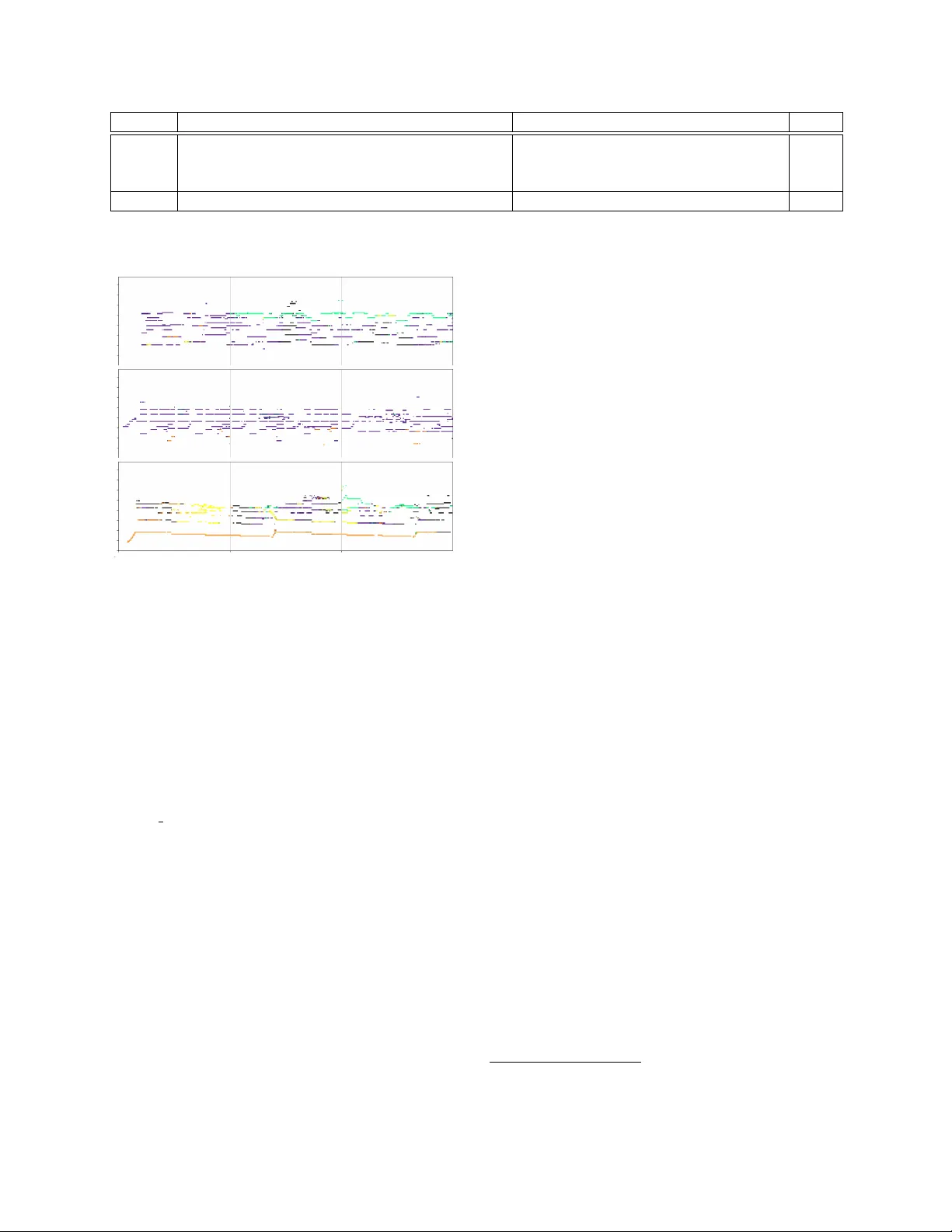
MUL TIT ASK LEARNING FOR FRAME-LEVEL INSTR UMENT RECOGNITION Y un-Ning Hung 1 , Y i-An Chen 2 and Y i-Hsuan Y ang 1 1 Research Center for IT Innov ation, Academia Sinica, T aiwan 2 KKBO X Inc., T aiwan { biboamy,yang } @citi.sinica.edu.tw, annchen@kkbox.com ABSTRA CT For many music analysis problems, we need to know the pres- ence of instruments for each time frame in a multi-instrument musical piece. Howe ver , such a frame-le vel instrument recog- nition task remains dif ficult, mainly due to the lack of labeled datasets. T o address this issue, we present in this paper a large-scale dataset that contains synthetic polyphonic music with frame-lev el pitch and instrument labels. Moreov er , we propose a simple yet novel network architecture to jointly pre- dict the pitch and instrument for each frame. W ith this multi- task learning method, the pitch information can be le veraged to predict the instruments, and also the other way around. And, by using the so-called pianoroll representation of music as the main target output of the model, our model also pre- dicts the instruments that play each individual note e vent. W e validate the effecti veness of the proposed method for frame- lev el instrument recognition by comparing it with its single- task ablated versions and three state-of-the-art methods. W e also demonstrate the result of the proposed method for multi- pitch streaming with real-world music. For reproducibility , we will share the code to crawl the data and to implement the proposed model at: https://github .com/biboamy/instrument- streaming/. Index T erms — Instrument recognition, pitch streaming 1. INTR ODUCTION Pitch and timbre are two fundamental properties of musical sounds. While the pitch decides the notes sequence of a mu- sical piece, the timbre decides the instruments used to play each note. Since music is an art of time, for detailed analy- sis and modeling of the information of a musical piece, we need to build a computational model that predicts the pitch and instrument labels for each time frame. W ith the release of sev eral datasets [1, 2] and the dev elopment of deep learn- ing techniques, recent years hav e witnessed great progress in frame-lev el pitch recognition, a.k.a., multi-pitch estimation (MPE) [3, 4]. Howe ver , this is not the case for the instrument part, presumably due to the following tw o reasons. First, manually annotating the presence of instruments for each time frame in a multi-instrument musical piece is a time- Pitch labels CQT Model time frequency L r o l l Instrument wise sum up instrument L p L i Instrument labels Pitch wise sum up Fig. 1 . Architecture of the proposed model, which employs three loss functions for predicting the (multitrack) pianoroll, the pitch roll, and the instrument roll. The pitch and instru- ment predictions are computed directly from the predicted pi- anoroll, which is a tensor of { frequency , time, instrument } . consuming and labor-intensiv e process. As a result, most datasets available to the public only pro vide instrument la- bels on the clip level , namely , labeling which instruments are present ov er an entire audio clip of possibly multi-second long [5 – 8]. Such clip-le vel labels do not specify the presence of in- struments for each short-time frame (e.g., multiple millisec- onds, or for each second). Datasets with frame-lev el instru- ment labels emer ge only over the recent few years [1, 2, 9, 10]. Howe ver , as listed in T able 1 (and will be discussed at length in Section 2), these datasets contain at most a few hundred songs and some of them contain only classical musical pieces. The musical diversity found in these datasets might therefore not be sufficient to train a deep learning model that performs well for different musical pieces. Second, we note that most recent work that explores deep learning techniques for frame-level instrument recognition fo- cuses only on the instrument recognition task itself and adopts the single-task learning paradigm [13, 14, 16]. This has the drawback of neglecting the strong relations between pitch and instruments. For example, different instruments have their own pitch ranges and tend to play different parts in a poly- phonic musical composition. Proper modeling of the onset and of fset of musical notes may also make it easier to de- tect the presence of instruments [14]. From a methodological point of view , we see a potential gain to do better than these prior arts by using a multitask learning paradigm that models timbre and pitch jointly . This requires a dataset that contains Pitch labels Instrument labels Real or Synth Genre Number of Songs MedleyDB [1] 4 [3, 11] √ [12, 13] Real V ariety 122 MusicNet [2] √ [4] √ [14] Real Classical 330 Bach10 [9] √ [9] √ [15] Real Classical 10 Mixing Secret [10] √ [13] Real V ariety 258 MuseScore (this paper) √ √ Synthetic V ariety 344,166 T able 1 . This table provides information re garding some datasets that provide frame-le vel labels for either pitch or instrument: whether the audio is real or synthetic, the genre and the number of songs. W e also cite some papers (after the symbols √ or 4 ) that employed these datasets for training either pitch or instrument recognition models. And, we use 4 to denote ‘part of it. ’ both frame-lev el pitch and instrument labels. In this paper , we introduce a new lar ge-scale dataset called MuseScor e to address these needs. The dataset contains the audio and MIDI pairs for 344,166 musical pieces downloaded from the of ficial website ( https://musescore.org/ ) of MuseScore, an open source and free music notation soft- ware licensed under GPL v2.0. The audio is synthesized from the corresponding MIDI file, usually using the sound font of the MuseScore synthesizer . Therefore, it is not difficult to temporally align the audio and MIDI files to get the frame- lev el pitch and instrument labels for the audio. Although the dataset only contains synthesized audio, it includes a variety of performing styles in different musical genres. Moreov er , we propose to transform each MIDI file to the multitrac k pianoroll representation of music (see Fig. 1 for an illustration) [17], which is a binary tensor representing the presence of notes ov er dif ferent time steps for each instru- ment. Then, we propose a multitask learning method that learns to predict from the audio of a musical piece its (mul- titrack) pianoroll, frame-lev el pitch labels (a.k.a., the pitch r oll ), and the instrument labels (a.k.a., the instrument r oll ). While the latter two can be obtained by directly summing up the pianoroll along dif ferent dimensions, the three in volv ed loss functions would work together to force the model learn the interactions between pitch and timbre. Our experiments show that the proposed model can not only perform better than its task-specific counterparts, but also existing methods for frame-lev el instrument recognition [13, 14, 16]. 2. BA CKGROUND T o our knowledge, there are four public-domain datasets that provide frame-le vel instrument labels, as listed in T able 1. Among them, MedleyDB [1], MusicNet [2] and Bach10 [9] are collected originally for MPE research, while Mixing Secret [10] is meant for instrument recognition. When it comes to building “clip-level” instrument recognizers, there are other more well-known datasets such as the P arisT ech [5] and IRMAS [6] datasets. Still, there are previous work that uses these datasets for building either clip-le vel [12, 15] or frame-lev el [13, 14] instrument recognizers. There are three recent works on frame-level instrument recognition. The model proposed by Hung and Y ang [14] is trained and ev aluated on dif ferent subsets of MusicNet [2], which consists of only classical music. This model considers the pitch labels estimated by a pre-trained model (i.e. [3]) as an additional input to predict instrument, but the pre-trained model is fixed and not further updated. The model presented by Gururani et al. [13] is trained and ev aluated on the combi- nation of MedleyDB [1] and Mixing Secrets [10]. Both [14] and [13] use frame-level instrument labels for training. In contrast, the model presented by Liu et al. [16] uses only clip-lev el instrument labels associated with Y ouTube videos for training, using a weakly-supervised approach. Both [16] and [13] do not consider pitch information. As the existing datasets are limited in genre coverage or data size, prediction models trained on these datasets may not generalize well, as shown in [3] for pitch recognition. Unlike these prior arts, we explore the possiblity to train a model on large-scale synthesized audio dataset, using a multitask learn- ing method that considers both pitch and timbre. OpenMIC-2018 [7] is a new large-scale dataset for train- ing clip-lev el instrument recognizers. It contains 20,000 10- second clilps of Creativ e Commons-licensed music of various genres. But, there is no frame-lev el labels. Multi-pitch str eaming has been referred to as the task that assigns instrument labels to note ev ents [18]. Therefore, it goes one step closer to full transcription of musical audio than MPE. Howe ver , as the task in volv es both frame-lev el pitch and instrument recognition, it is only attempted sporadically in the literature (e.g., [18, 19]). By predicting the pianorolls, the proposed model actally performs multi-pitch streaming. 3. PROPOSED DA T ASET The MuseScore dataset is collected from the online forum of the MuseScore community . Any user can upload the MIDI and the corresponding audio for the music pieces they create using the software. The audio is therefore usually synthesized by the MuseScore synthesizer , b ut the user has the freedom to use other synthesizers. The audio clips have diverse musical genres and are about two mins long on average. More statis- tics of the dataset can be found from our GitHub repo. While the collected audio and MIDI pairs are usually well Fig. 2 . The network architecture of the proposed model. It has a simple U-net structure [23] with four residual conv olution layers and four residual up-con volution layers. aligned, to ensure the data quality we further run the dynamic time warping (DTW)-based alignment algorithm proposed by Raffel [20] o ver all the data pairs. W e then compute from each MIDI file the groundtruth pianoroll, pitch roll and instrument roll using Pypianoroll [17]. The dataset contains 128 different instrument categories as defined in the MIDI spec. A main limitation is that there is no singing voice. This can be made up by datasets with labels of vocal acti vity [21], such as the Jamendo dataset [22]. Due to copyright issues, we cannot share the dataset itself but the code to collect and process the data. 4. PROPOSED MODEL As Fig. 1 shows, the proposed model learns a mapping f ( · ) (i.e., the ‘Model’ block in the figure) between an audio rep- resentation X , such as the constant-Q transform (CQT) [24], and the pianoroll Y rol l ∈ { 0 , 1 } F × T × M , where F , T and M denote the number of pitches, time frames and instruments, respectiv ely . Namely , the model can be vie wed as a multi- pitch streaming model. The model has two by-products, the pitch roll Y p ∈ { 0 , 1 } F × T and the instrument roll Y i ∈ { 0 , 1 } M × T . As Fig. 1 shows, from an input audio, our model computes b Y p and b Y i directly from the pianoroll b Y rol l pre- dicted by the model. Therefore, f ( · ) contains all the learnable parameters of the model. W e train the model f ( · ) with a multitask learning method by using three cost functions, L rol l , L p and L i , as shown in Fig. 1. For each of them, we use the binary cross entropy (BCE) between the groundtruth and the predicted matrices (tensors). The BCE is defined as: L ∗ = − P [ Y ∗ · ln σ ( c Y ∗ ) + (1 − Y ∗ ) · ln(1 − σ ( c Y ∗ ))] , (1) where σ is the sigmoid function that scales its input to [0 , 1] . W e weigh the three cost terms so that they have the same range, and use their weighted sum to update f ( · ) . In sum, pitch and timbre are modeled jointly with a shared network by our model. This learning method is designed for music and, to our knowledge, has not been used else where. Method Instrument Pitch Pianoroll L rol l only (ablated) — — 0.623 L i only (ablated) 0.896 — — L p only (ablated) — 0.799 — all (proposed) 0.947 0.803 0.647 T able 2 . Performance comparison of the proposed multitask learning method (‘all’) and 3 single-task ablated versions, for frame-lev el instrument recognition (in F1-score), frame-lev el pitch recognition (Acc), and pianoroll prediction (Acc) using the triaining and test subsets of MuseScore, for 9 instruments. 4.1. Network Structure The network architecture of our model is shown in Fig. 2. It is a simple con volutional encoder/decoder network with sym- metric skip connections between the encoding and decoding layers. Such a “U-net” structure has been found useful for im- age segmentation [23], where the task is to learn a mapping function between a dense, numeric matrix (i.e., an image) and a sparse, binary matrix (i.e., the se gment boundaries). W e presume that the U-net structure can work well for predict- ing the pianorolls, since it also inv olves learning such a map- ping function. In our implementation, the encoder and de- coder are composed of four residual blocks for conv olution and up-con volution. Each residual block has three con volu- tion, two batchNorm and two leakyReLU layers. The model is trained with stochastic gradient descent with 0.005 learning rate. More details can be found from our GitHub repo. 4.2. Model Input W e use CQT [24] to represent the input audio, since it adopts a log frequenc y scale that better aligns with our perception of pitch. CQT also provides better frequency resolution in the low-frequenc y part, which helps detect the fundamental fre- quencies. F or the conv enience of training with mini-batches, each audio clip in the training set is divided into 10-second segments. W e compute CQT by librosa [25], with 16 kHz sampling rate, 512-sample hop size, and 88 frequency bins. 5. EXPERIMENT 5.1. Ablation Study W e report two sets of experiments for frame-lev el instrument recognition. In the first e xperiment, we compare the proposed multitask learning method with its single-task versions, using two non-ov erlapping subsets of MuseScore as the training and test sets. Specifically , we consider only the 9 most popular in- struments 1 and run a script to pick for each instrument 5,500 clips as the training set and 200 clips as the test set. W e con- sider three ablated v ersions here: using the U-net architecutre 1 Piano, acoustic guitar , electric guitar, trumpet, sax, violin, cello & flute. Method T raining set Piano Guitar V iolin Cello Flute A vg [16] Y ouT ube-8M [26] 0.766 0.780 0.787 0.755 0.708 0.759 [13] T raining split of ‘MedleyDB+Mixing Secrets’ [13] 0.733 0.783 0.857 0.860 0.851 0.817 [14] MuseScore training subset 0.690 0.660 0.697 0.774 0.860 0.736 Ours MuseScore training subset 0.718 0.819 0.682 0.812 0.961 0.798 T able 3 . A UC scores of per -second instrument recognition on the test split of ‘MedleyDB+Mixing Secrets’, for 5 instruments. 80 70 60 50 40 30 20 10 0 80 70 60 50 40 30 20 10 0 80 70 60 50 40 30 20 10 0 0 sec 10 sec 20 sec 30 sec Notes Notes Notes Fig. 3 . The predicted pianoroll (best viewed in color) for the first 30 seconds of three real-world music. W e paint dif- ferent instruments with different colors: Black —piano, Pur- ple —guitar , Gr een —violin, Orange —cello, Y ello —flute. shown in Fig. 1 to predict the pianoroll with only L rol l , to predict directly the instrument roll (i.e. only considering L i ), and to preidct directly the pitch roll (i.e. only L p ). Result shown in T able 2 clearly demonstrates the superior- ity of the proposed multitask learning method over the single- task counterparts, especially for instrument prediction. Here, we use mir eval [27] to calculate the ‘pitch’ and ‘pianoroll’ accuracies. For ‘instrument’, we report the F1-score. 5.2. Comparison with Existing Methods In the second e xperiment, we compare our method with three existing methods [13, 14, 16]. Follo wing [13], we take 15 songs from MedleyDB and 54 songs from Mixing Secret as the test set, and consider only 5 instruments (see T able 3). The test clips contain instruments (e.g., singing voice) that are beyond these five. W e ev aluate the result for per-second in- strument recognition in terms of area under the curve (A UC). As sho wn in T able 3, these methods use different training sets. Specifically , we retrain model [14] using the same train- ing subset of MuseScore as the proposed model. The model [16] is trained on the Y ouTube-8M dataset [26]. The model [13] is trained on a training split of ‘MedleyDB+Mixing Se- cret’, with 100 songs from each of the two datasets. The model [13] therefore has some advantages since the training set is close to the test set. The result of [16] and [13] are from the authors of the respectiv e papers. T able 3 shows that our model outperforms the two prior arts [14, 16] and is behind model [13]. W e consider our model compares fav orably with [13], as our training set is quite dif- ferent from the test set. Interestingly , our model is better at the flute, while [13] is better at the violin. This might be related to the difference between the real and synthesized sounds for these instruments, but future w ork is needed to clarify . 5.3. Multi-pitch Streaming Finally , Fig. 3 demonstrates the predicted pianorolls for the first 30 seconds of three randomly-selected real-world songs. 2 In general, the proposed model can predict the notes and in- struments pretty nicely , especially for the second clip, which contains only a guitar solo. This is promising, since the model is trained with synthetic audio only . Y et, we also see two lim- itations of our model. First, it cannot deal with sounds that are not included in the training data—e.g., for the 5th–10th seconds of the third clip, our model mistakes the piano for the flute, possibly because the singer hums in the meanwhile. Second, it cannot predict the onset times accurately—e.g., the violin melody of the first clip actually plays the same note for sev eral times, but the model mistak es them for long notes. 6. CONCLUSION In this paper, we hav e presented a new synthetic dataset and a multitask learning method that models pitch and timbre jointly . It allo ws the model to predict instrument, pitch and pianorolls representation for each time frame. Experiments show that our model generalizes well to real music. In the future, we plan to improve the instrument recogni- tion by re-synthesizing the MIDI files from Musescore dataset to produce more realistic instrument sound. Moreo ver , we also plan to mix the singing voice clips from [1] with our training data (for data augmentation) to deal with singing voices. 2 The three songs are, from top to bottom: All of Me violin & guitar cover (https://www .youtube.com/watch?v=YpYQh7eQULc), Ocean by Pur- dull (https://www .youtube.com/watch?v=5Lb9GvEO-sA) and Beautiful by Christina Aguilera (https://www .youtube.com/watch?v=eAfyFTzZDMM). 7. REFERENCES [1] Rachel M. Bittner et al., “MedleyDB: A multitrack dataset for annotation-intensive MIR research, ” in Pr oc. ISMIR , 2014, [Online] http://medleydb .weebly .com/. [2] John Thickstun, Zaid Harchaoui, and Sham M. Kakade, “Learning features of music from scratch, ” in Pr oc. Int. Conf. Learning Representations , 2017, [Online] https://homes.cs.washington.edu/ ∼ thickstn/musicnet.html. [3] Rachel M. Bittner et al., “Deep salience representations for f 0 estimation in polyphonic music, ” in Pr oc. ISMIR , 2017. [4] John Thickstun et al., “Inv ariances and data augmenta- tion for supervised music transcription, ” Pr oc. ICASSP , pp. 2241–2245, 2018. [5] Cyril Joder , Slim Essid, and Ga ¨ el Richard, “T empo- ral integration for audio classification with application to musical instrument classification, ” IEEE T rans. Au- dio, Speech and Language Pr ocessing , vol. 17, no. 1, pp. 174–186, 2009. [6] Juan J. Bosch et al., “ A comparison of sound segrega- tion techniques for predominant instrument recognition in musical audio signals, ” in Pr oc. ISMIR , 2012. [7] Eric J. Humphrey , Simon Durand, and Brian McFee, “OpenMIC-2018: An open dataset for multiple instru- ment recognition, ” in Pr oc. ISMIR , 2018, [Online] https://github .com/cosmir/openmic-2018. [8] Jort F . Gemmeke et al., “ Audio Set: An ontology and human-labeled dataset for audio ev ents, ” in Pr oc. ICASSP , 2017, pp. 776–780. [9] Zhiyao Duan, Bryan Pardo, and Changshui Zhang, “Multiple fundamental frequency estimation by model- ing spectral peaks and non-peak regions, ” IEEE T rans. Audio, Speech, and Language Pr ocessing , vol. 18, pp. 2121–2133, 2010. [10] Siddharth Gururani and Alexander Lerch, “Mixing se- crets: a multi-track dataset for instrument recognition in polyphonic music, ” in Pr oc. ISMIR-LBD , 2017. [11] Jong W ook Kim et al., “Crepe: A con volutional repre- sentation for pitch estimation, ” in Pr oc. ICASSP , 2018. [12] Peter Li et al., “ Automatic instrument recognition in polyphonic music using conv olutional neural networks, ” CoRR , vol. abs/1511.05520, 2015. [13] Siddharth Gururani, Cameron Summers, and Alexander Lerch, “Instrument activity detection in polyphonic mu- sic using deep neural networks, ” in Pr oc. ISMIR , 2018. [14] Y un-Ning Hung and Y i-Hsuan Y ang, “Frame-lev el in- strument recognition by timbre and pitch, ” in Pr oc. IS- MIR , 2018, pp. 135–142. [15] Dimitrios Giannoulis, Emmanouil Benetos, Anssi Kla- puri, and Mark D. Plumbley , “Impro ving instrument recognition in polyphonic music through system inte- gration, ” Pr oc. ICASSP , pp. 5222–5226, 2014. [16] Jen-Y u Liu, Y i-Hsuan Y ang, and Shyh-Kang Jeng, “W eakly-supervised visual instrument-playing action detection in videos, ” IEEE T rans. Multimedia , in press. [17] Hao-W en Dong, W en-Y i Hsiao, and Y i-Hsuan Y ang, “Pypianoroll: Open source Python package for handling multitrack pianoroll, ” in Pr oc. ISMIR-LBD , 2018, [On- line] https://github .com/salu133445/pypianoroll. [18] Zhiyao Duan, Jinyu Han, and Bryan Pardo, “Multi-pitch streaming of harmonic sound mixtures, ” IEEE/A CM T rans. Audio, Speech, and Language Pr ocessing , v ol. 22, no. 1, pp. 138–150, 2014. [19] V ipul Arora and Laxmidhar Behera, “Multiple f0 esti- mation and source clustering of polyphonic music audio using PLCA and HMRFs, ” IEEE/ACM T rans. Audio, Speech and Language Pr ocessing , vol. 23, no. 2, pp. 278–287, 2015. [20] Colin Raffel, Learning-Based Methods for Comparing Sequences, with Applications to Audio-to-MIDI Align- ment and Matching , Ph.D. thesis, Columbia U., 2016, [Online] https://github .com/craffel/alignment-search. [21] Kyungyun Lee, Keunwoo Choi, and Juhan Nam, “Re- visiting singing voice detection: A quantitati ve revie w and the future outlook, ” in Pr oc. ISMIR , 2018. [22] Mathieu Ramona, G. Richard, and B. Da vid, “V ocal detection in music with support vector machines, ” in Pr oc. ICASSP , 2008, pp. 1885–1888. [23] Olaf Ronneberger , Philipp Fischer , and Thomas Brox, “U-net: Con volutional networks for biomedical image segmentation, ” in Pr oc. MICCAI , 2015. [24] Christian Sch ¨ orkhuber and Anssi Klapuri, “Constant-Q transform toolbox for music processing, ” in Proc. Sound and Music Computing Conf. , 2010. [25] Brian McFee et al., “librosa: Audio and music signal analysis in Python, ” in Pr oc. Python in Science Conf. , 2015, [Online] https://librosa.github .io/librosa/. [26] “Y ouT ube-8M, ” https://research.google.com/youtube8m/. [27] Colin Raffel et al., “mir ev al: A transparent implemen- tation of common MIR metrics, ” in Pr oc. ISMIR , 2014, [Online] https://craffel.github .io/mir ev al/.
Original Paper
Loading high-quality paper...
Comments & Academic Discussion
Loading comments...
Leave a Comment