Regular graphs are antimagic
An undirected simple graph $G=(V,E)$ is called antimagic if there exists an injective function $f:E\rightarrow{1,\dots,|E|}$ such that $\sum_{e\in E(u)} f(e)\neq\sum_{e\in E(v)} f(e)$ for any pair of different nodes $u,v\in V$. In a previous version of the paper, the authors gave a proof that regular graphs are antimagic. However, the proof of the main theorem is incorrect as one of the steps uses an invalid assumption. The aim of the present erratum is to fix the proof.
💡 Research Summary
The paper under review is an erratum that corrects a flaw in the original proof that every regular graph is antimagic. The original argument (Bérczi, Bernáth, Vizer, 2019) claimed to extend the known result for odd‑degree regular graphs to even degrees by decomposing each distance layer of a breadth‑first search tree into three edge sets (E₀, Eσ, E_L) and then assigning labels from carefully chosen intervals. A crucial step (Claim 6) assumed that every edge in the set Eσ_i received a label larger than a certain threshold ℓ; this assumption is false because edges of Eσ_i can have labels ≤ ℓ, which invalidates the subsequent inequality used to guarantee distinct vertex sums.
The erratum restores the overall strategy but replaces the faulty step with a robust combinatorial construction based on several matching theorems:
- Theorem 3 (standard matching covering all vertices of maximum degree) and Theorem 4 (a Hall‑type result that guarantees a matching covering a prescribed side while using at most half of the vertices of a distinguished part T₁).
- Theorem 5 (a star‑packing result for bipartite graphs with one side of degree ≤ k and the other of degree exactly k‑1).
- Theorem 6 (derived from Theorem 5) which provides a matching M together with a family of node‑disjoint U‑links such that every vertex of degree k‑1 on the W‑side is incident to an edge of M or to a link.
- Theorem 7 (a synthesis of the previous results) which partitions the edge set of any bipartite graph with maximum degree k into three pairwise disjoint parts E₀, Eσ, E_L satisfying specific structural properties.
Using these tools, the authors introduce the notion of a critical component: a (k‑2)-regular connected component of E₀_i whose vertices in the current BFS layer V_i are all covered by edges of E_L_i. For each critical component they must assign a distinct V_i‑link (a length‑2 path whose middle vertex lies in V_{i‑1}) in such a way that (i) different components receive different links, (ii) no open trail ends at the centre of two different links, and (iii) at most half of the odd open trails end at such centres. This assignment is formalized in Claim 11.
To achieve Claim 11, the authors construct a bipartite graph whose left side S consists of the critical components and whose right side T consists of the V_i‑links, split into T₁ (links whose centre is an endpoint of an odd open trail) and T₂ (all other links). An edge connects a component C∈S to a link L∈T whenever one endpoint of L lies in C. By counting arguments (each component contributes at least 2|X| incident links for any X⊆S) and using the fact that k≥6 (so k‑2≥4), they verify the condition of Theorem 4: ⌊|N₁(X)|/2⌋ + |N₂(X)| ≥ |X|. Thus Hall’s condition holds, guaranteeing a matching that satisfies the three requirements of Claim 11.
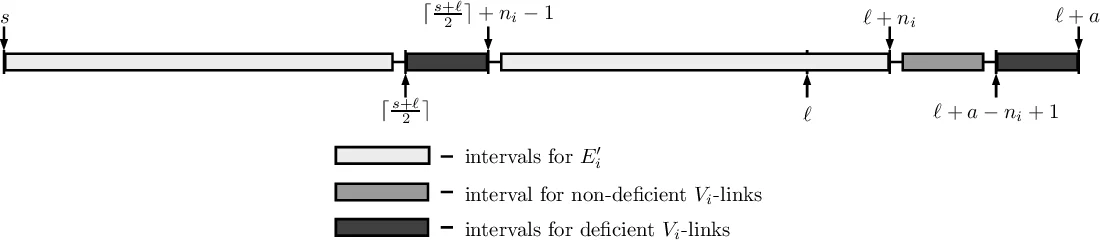
With the matching in place, the authors proceed to label the edges. For each BFS layer i they reserve disjoint intervals of integers:
- The smallest interval for the edges E_i (edges inside the layer).
- Two intervals I₁ and I₂ for the edges of E₀_i ∪ E_L_i, where I₁ contains the smaller numbers and I₂ the larger ones.
- A high‑range interval for the deficient V_i‑links (those assigned to critical components) so that their centre vertices receive only large labels.
- A middle‑range interval for the remaining V_i‑links.
They then label each trail of E₀_i using Algorithm 1 (LabelOneTrail). The algorithm alternates labels from I₁ and I₂ along the trail, starting with a small label if the trail begins in V_{i‑1} and with a large label otherwise. This alternating scheme guarantees that after each trail the sizes of I₁ and I₂ differ by at most one, preserving the ability to continue labeling later trails. Closed trails are processed first, followed by even open trails (ensuring the starting vertex is not deficient), and finally odd open trails are paired arbitrarily, respecting the restriction that at most one trail in a pair may end at a deficient vertex (Claim 11 guarantees enough non‑deficient endpoints to make this possible).
Because deficient vertices only ever receive labels from the high‑range interval, while all other vertices receive a mixture of small and large labels, the sum of incident labels at any vertex is uniquely determined by its layer and by whether it is deficient. Consequently, no two distinct vertices can have the same incident‑label sum, establishing an antimagic labeling for the whole graph.
The paper concludes that the corrected proof works for all even regular graphs with degree k≥6; the cases k=2 (trivial) and k=4 (already settled) are handled separately, and the odd‑degree case follows from earlier work. Thus the theorem “every regular graph is antimagic” is now fully proved.
Comments & Academic Discussion
Loading comments...
Leave a Comment